Feeds:
Posts
Comments

Archive for February, 2010

Stonehenge visitor centre approved – January 2010

Posted: 2010-01-28 03:28:20 UTC-08:00
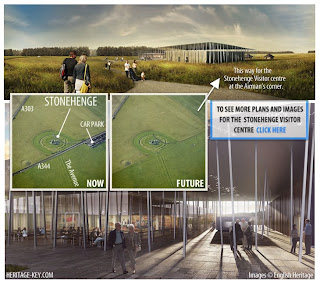
PLANS for the new £27.5million visitor centre and facilities at Stonehenge have been given the go ahead by Wiltshire Council.

Despite concerns raised about increased congestion, the size of the new car park and transportation from the centre to the ancient monument, 12 out of 13 councillors on the council’s strategic planning committee voted to approve the scheme.

The project involves building a new centre with a car park at Airman’s Corner, with a land train to take visitors to the stone circle.

The existing visitor centre and parking will be removed and the A344 from Stonehenge to the A303 will be closed off and grassed over.

Cars will be diverted to Longbarrow Roundabout and along the A360 to Airman’s Corner, where a new roundabout will be constructed.

“There is no question that something is needed,” said Amesbury councillor Fred Westmoreland. “To me, this site makes sense.

“Most of the objections which are being made are looking for a solution we are never going to get. This is the third planning application, or the fourth, and you will never get everyone to agree on everything.

“If in five years or five months time we find the road system does not work, no problem, we can change the system. If we find the buildings themselves are not working particularly well, we can amend them.

Cllr Christine Crisp said: “There is public money on the table to make this one happen. If it is delayed a year or two years, we will have no idea whether there is any public money on the table to make that development happen.”

Loraine Knowles, Stonehenge project director for English Heritage, said: “This is an important step in returning Stonehenge to a more dignified setting and creating facilities more fitting for a world-renowned tourist attraction.

“We can now begin to look forward to providing a much improved, high quality experience for visitors at an environmentally sensitive development.”

* Councillors also approved an application to move the Airman’s Cross monument from its current position at the staggered junction into the visitor centre grounds, where it will be placed next to the path from the car park to the centre.

English Heritage welcomes Stonehenge Vistor Centre decision

English Heritage has welcomed yesterday’s decision by Wiltshire Council’s planning committee to approve plans for a new visitor centre for Stonehenge.

Loraine Knowles, Stonehenge project director for English Heritage, said: “This is an important step in returning Stonehenge to a more dignified setting and creating facilities more fitting for a world-renowned tourist attraction.

“We can now begin to look forward to providing a much improved, high quality experience for visitors at an environmentally sensitive development.”

With planning permission in place for the visitor centre, plans for the closure of the A344 adjacent to the Stones (from the A303 to Byway 12) will now be put forward for approval. At the same time, Wiltshire Council will be consulting on proposals to restrict motorised vehicles on the remaining part of the A344 and on nearby Byways.

Following a lengthy consultation and extensive technical assessments, the Prime Minister announced on 13 May last year that Airman’s Corner would be the location for new Stonehenge visitor facilities. Together with proposals for the closure of the A344, the scheme will enhance the monument’s setting by removing the existing visitor facilities (including car parking) and improving the visitor experience with new exhibition and education facilities. A fully accessible transit system will run from the new visitor centre to a drop-off near the Stones.

Airman’s Corner is about 1.5 miles (2.5km) west from Stonehenge, on the junction of the A344 and A360. It is at the edge of the World Heritage Site and is easily accessible by road. The land is currently used for farming, with very few residents living close to the site.

Nicholas – Tour Guide
Histouries UK – Stonehenge Tours
Read Full Post »

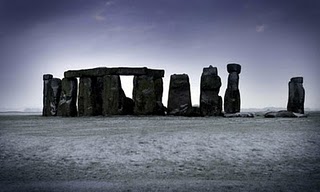
Stonehenge may have been used as a site where knowledge was communicated ritually, according to a new theory.

Stonehenge theory

Stonehenge Tours

Lynne Kelly, La Trobe University doctoral researcher and science writer, has been working on technologies oral cultures used to present and pass on scientific knowledge.

Kelly demonstrated the constant changes in the archaeology at Stonehenge are consistent with the mnemonic (conveying through chants and rituals) needs of the knowledge elite as they settle, while delivering the inaugural Marshall McLuhan Lecture in Chicago.

‘Instead of moving between sacred places to perform the cycle of ceremonies which encode all formal knowledge of their culture, Neolithic Britons replicated that landscape in the monuments they built over 1,500 years in transition from a mobile hunter-gathering to settled agriculture,’ says Kelly.

The Neolithic Britons who built Stonehenge, like other cultures starting to settle, lacked a written language with which to preserve their knowledge.

Kelly says the most reliable recording system they had were mnemonic methods, whereby knowledge ranging from animal behaviour to astronomy could be communicated.

To facilitate this, she argues that Stonehenge itself acted as a knowledge centre, a function that it had in common with many other sites around the world, says a university release.

Kelly’s research draws parallels with oral cultures such as Native American, African and Aboriginal Australian, and finds clues in the physical remains of Stonehenge

Nicholas – Tour Guide
Histouries UK – Stonehenge Tours
Read Full Post »

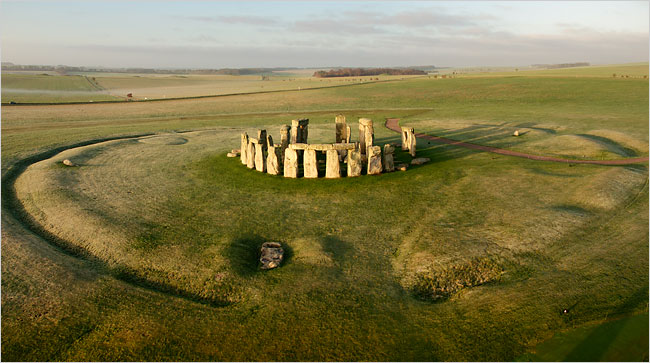
A new research project that promises to significantly improve our understanding of Stonehenge is going ahead after receiving an £800,000 grant. Stonehenge aerial

Dr Oliver Craig, from the University of York’s Department of Archaeology, is part of the team behind Feeding Stonehenge, a follow-up to the earlier Stonehenge Riverside project which saw a wealth of material excavated from nearby Durrington Walls.

The latest stage of the research involves the analysis of that material, including pottery, stone tools and animal bones, to shed new light on the people who built and visited Stonehenge.

“Earlier investigations have made huge inroads into our understanding of what is one of the world’s most important prehistoric monuments but many questions remain unanswered”

Feeding Stonehenge is being supported by a grant from the Arts and Humanities Research Council.

Dr Craig said: “This research will allow us to gauge Stonehenge’s significance in the 3rd Millennium BC and the extent of its sphere of influence.

“Earlier investigations have made huge inroads into our understanding of what is one of the world’s most important prehistoric monuments but many questions remain unanswered.

“The next stage will focus on how the people who built Stonehenge lived, what they ate, when the monument was visited and where the visitors came from.”

Initial chemical analysis of cattle teeth found in the area suggests the animals were raised hundreds of miles away before being walked to Durrington Walls for slaughter and consumption.

One aim of Feeding Stonehenge that will be covered by the York team will be to try and understand what the pottery was used for by conducting chemical analysis of any organic residues present.

Pottery was used for domestic as well as ceremonial activities but it is not known what types of foods were prepared for these different activities.

The Feeding Stonehenge research is led by Professor Mike Parker Pearson of the University of Sheffield working alongside Dr Craig, Dr Umberto Albarella, from the University of Sheffield and Dr Jane Evans, from the NERC British Geological Survey.

Read Full Post »

A classic! Originally broadcast on 12 January 1969 this pre-Monty Python series was written by and starred Michael Palin and Terry Jones. This clip is part 1 of the first episode (unfortunately some of  is missing)

Peter – Tour Guide
Histouries UK – Stonehenge Tours

Read Full Post »


Survey of landscape suggests prehistoric monument was surrounded by two circular hedges.
The Monty Python knights who craved a shrubbery were not so far off the historical mark: archaeologists have uncovered startling evidence of The Great Stonehenge Hedge.

Inevitably dubbed Stonehedge, the evidence from a new survey of the Stonehenge landscape suggests that 4,000 years ago the world’s most famous prehistoric monument was surrounded by two circular hedges, planted on low concentric

banks. The best guess of the archaeologists from English Heritage, who carried out the first detailed survey of the landscape of the monument since the Ordnance Survey maps of 1919, is that the hedges could have served as screens keeping even more secret from the crowd the ceremonies carried out by the elite allowed inside the stone circle.

Their findings are revealed tomorrow in British Archaeology magazine, whose editor, Mike Pitts, an archaeologist and expert on Stonehenge himself, said: “It is utterly surprising that this is the first survey for such a long time, but the results are fascinating. Stonehenge never fails to reveal more surprises.”

“The time these two concentric hedges around the monument were planted is a matter of speculation, but it may well have been during the Bronze Age. The reason for planting them is enigmatic.”

Pitts wonders if the hedges might have been to shelter the watchers from the power of the stones, as much as to ward off their impious gaze.

If the early Bronze Age date is correct, when the hedges were planted the Stonehenge monument already had the formation now familiar to millions of tourists, after centuries when the small bluestones from west Wales and the gigantic sarsens from the Stonehenge plain were continually rearranged.

The survey also found puzzling evidence that there may once have been a shallow mound among the stones, inside the circle. It was flattened long ago, but is shown in some 18th century watercolours though it was written off as artistic licence by artists trying to make the site look even more picturesque. The archaeologists wonder if the circle originally incorporated a mound which could have been a natural geological feature, or an even earlier monument.

Read Full Post »

HisTOURies UK. Private guided tours departing from Salisbury, Bath and London
We operate ‘bepoke’ private guided tours of Britain. You can choose to depart from the UK Cities of London, Salisbury or Bath. We have a number of great itineraries to suggest or we’ll help construct the perfect day according to you. Our tour planning department are always pleased to help plan your itinerary to give you the best possible experience, creating the perfect itinerary to suit you is easy.
Special interests, foreign languages and themed tours (Stonehenge special access / Crop Circles / Myths and Legends) easily catered for. Half day, full day tours and extended tours. Competitive rates for cars, luxury MPV’s, mini- coaches and coaches (with driver/guide or driver and guide) to suit your requirements. Stonehenge Thatched Cotswolds Cottage Private tour itineraries can include:
Stonehenge and Stonehenge Inner Circle Tours | Salisbury Cathedral | Old Sarum Hillfort | Abebury Stone Circle | King Arthurs Avalon | Glastonbury Tor and Abbey | Challice Well Gardens |Silbury Hill | Chalk Hill Figures | Roman City of Bath | Lacock Village | Castle Combe | Cotswolds Villages | Crop Circles |

Our personalised door-to-door service gives you the ultimate freedom and flexibility. No one does it better


If you plan to visit Stonehenge and other English Heritage sites buying a Heritage Pass will save time and money –

Combine great value and great sightseeing with the Great British Heritage Pass. Giving you free entry to nearly 600 attractions in England, Scotland, Wales and Northern Ireland, the multi-day heritage pass takes you on an amazing journey through Britain’s rich cultural heritage.

Britain has a vibrant history, and scores of brilliantly preserved stately homes, palaces, castles, gardens and famous monuments to visit. Plan your visit using the Great British Heritage Pass and the free 40-page guidebook you’ll receive  and save money along the way.

With the Great British Heritage Pass you’ll have FREE ENTRY to nearly 600 attractions, including:

•Stonehenge
•Edinburgh Castle
•Palace of Holyroodhouse
•Roman Baths
•Shakespeare’s Birthplace
•Leeds Castle
•St. Paul’s Cathedral
•Royal Albert Hall
•Anne Hathaway’s Cottage
•Stirling Castle
•Cardiff Castle
•Caernarfon Castle
•Tintern Abbey

Additional information

The Great British Heritage Pass

Inclusions:
•FREE 40 page Guidebook
•FREE Map of Great Britain
•The Great British Heritage Pass
•FREE entry to over 600 attractions

If you wish to purchase a pass the cheapest place to buy one is at this link – click here

Hope this helps save you money – You can use this on opur tours and save some extral money
Nicholas

Read Full Post »

« Newer Posts