Feeds:
Posts
Comments

Archive for the ‘Archaeologists’ Category

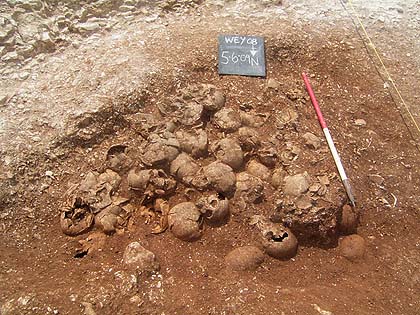
A 2,000-year-old mass grave full of dismembered bodies and skulls has been discovered at an ancient burial site being dug up to create a road for the 2012 Olympics.

Archaeologists excavating the Weymouth Relief Road, on Ridgeway Hill near Weymouth, believe the pit of corpses comprises Iron Age war casualties massacred by the Roman Army.

The road is being dug as part of transport links for the Olympics. Picture courtesy Oxford Archaeology

“We have counted 45 skulls so far in one section of the pit, and several torsos and leg bones in separate sections,” said David Score, Project Manager for Oxford Archaeology.

“It’s very early days but so far, after a visit to the site by our head of burial services, the skulls appear to be predominately those of young men.

Torsos and bones feature. Picture courtesy Oxford Archaeology

“At the moment we don’t fully understand how or why the remains have come to be deposited in the pit, but it seems highly likely that some kind of catastrophic event such as war, disease or execution has occurred.”

Score’s gory finds on the £87 million transport route to the proposed “Olympic Village” are an unprecedented follow-up to the discovery of 12 skeletons at the site in January, when he predicted the team “could find anything” while stripping the soil back.

Archaeologists have been working at the site for months. Picture courtesy Oxford Archaeology

“It is rare to find a burial site like this one,” he added. “There are lots of different types of burial where skeletons may be aligned along a compass axis or in a crouched position, but to find something like this is just incredible.”

Dorset County Council said the development was “extraordinary”, and Head of Highways Andy Ackerman warned the public to stay away from the six-metre pit, which has been fenced off.

Visiting Weymouth during the UK 2012 Olympics ?  We operate private guided sightseeing tours of Dorset, Wiltshire and the West Country

Mysical Landscape, Magical Tours………
HisTOURies UK – The Best Tours in British History

Read Full Post »

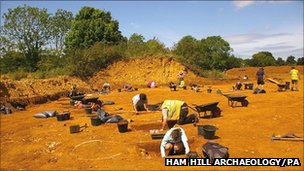
A major excavation is under way to explore the unclear history of Britain’s largest Iron Age hill fort.

The Ham Hill Iron Age hill fort site spreads over 80 hectares making it the largest in Britain

The Ham Hill Iron Age hill fort site spreads over 80 hectares making it the largest in Britain

The purpose of the Ham Hill site in Somerset is not known but researchers are now hoping to gain a deeper insight into life 2,000 years ago.

A joint team from the universities of Cambridge and Cardiff have begun a dig at the 88-hectare site to learn more.

Work is due to continue until September 2013 by which time the team hope to have a clearer map of its interior.

Niall Sharples, from Cardiff University, said: “It’s a bit of an enigma. Ham Hill is so big that no archaeologist has ever really been able to get a handle on it.

“People think of these places as defensive structures, but it is inconceivable that such a place could have been defended.

“Thousands of people would have been required; militarily, it would have been a nightmare.

“Clearly, it was a special place for people in the Iron Age, but when did it become special, why, and how long did it stay that way?”

Researchers believe the site may have been a monument and was somehow meant to create a sense of community, collective identity, or prestige.

‘Communal identity’

Christopher Evans, from the Cambridge archaeological unit, said it was a rare opportunity to tackle the site’s big issues on the scale they deserve.

“We don’t know if the site’s development was prompted by trade, defence or communal identity needs,” he said.

“Equally, should we be thinking of it as a great, centralised settlement place – almost proto-urban in its layout and community size?”

One of the key aims of the current excavation will be to pin down the rough date of the hill fort’s construction.

Smaller scale digs at the site have produced a number of finds, including human remains, the skeleton of a dog, pottery, iron sickles and the remains of a house.

‘There is also a wonderful pearched right on the top of Ham Hill tat serves a mean ‘Ploughmans’ and a great pint’ – Somerset tour guide

The Best Tours in British History
HisTOURies UK – Private Guided Tours of th West Country

Read Full Post »

A chance discovery of coins has led to the bigger find of a Roman town, further west than it was previously thought Romans had settled in England.

The town was found under fields a number of miles west of Exeter, Devon.

Roman coins found by two local men led to the discovery of a town

Roman coins found by two local men led to the discovery of a town

Nearly 100 Roman coins were initially uncovered there by two amateur archaeological enthusiasts.

It had been thought that fierce resistance from local tribes to Roman culture stopped the Romans from moving so far into the county.

Sam Moorhead, national finds adviser for Iron Age and Roman coins for the PAS at the British Museum, said it was one of the most significant Roman discoveries in the country for many decades.

“It is the beginning of a process that promises to transform our understanding of the Roman invasion and occupation of Devon,” he explained.

After the coins were unearthed by the local men out using metal detectors, Danielle Wootton, the University of Exeter’s liaison officer for the Portable Antiquities Scheme (PAS), which looks after antiquities found by the public, was tasked with investigating further.

After carrying out a geophysical survey last summer, she said she was astonished to find evidence of a huge landscape, including at least 13 round-houses, quarry pits and track-ways covering at least 13 fields, the first of its kind for the county.

“You just don’t find Roman stuff on this scale in Devon,” said Ms Wootton.

She carried out a trial excavation on the site, and has already uncovered evidence of extensive trade with Europe, a road possibly linking to the major settlement at Exeter, and some intriguing structures, as well as many more coins.

“This was a really exciting discovery,” said Ms Wootton. But she said most exciting of all was that her team had stumbled across two burial plots that seem to be located alongside the settlement’s main road.

“It is early days, but this could be the first signs of a Roman cemetery and the first glimpse of the people that lived in this community,” she explained.

Romans in Devon

Not enough excavation has been done yet to date the main occupation phase of the site, but the coins that were found range from slightly before the start of the Roman invasion up until the last in 378AD.

The Romans reached Exeter during the invasion of Britain in AD 50-55, and a legion commanded by Vespasian built a fortress on a spur overlooking the River Exe. This legion stayed for the next 20 years before moving to Wales.

A few years after the army left, Exeter was converted into a bustling Romano-British civilian settlement known as Isca Dumnoniorum with all the usual Roman public buildings, baths and forum.

It was also the principal town for the Dumnonii tribe, a native British tribe who inhabited Devon and Cornwall. It was thought that their resistance to Roman rule and influence, and any form of ‘Romanisation’ stopped the Roman’s settling far into the south west.

For a very long time, it was thought that Exeter was the limit of Roman settlement in Britain in the south west, with the rest being inhabited by local unfriendly tribes.

Some evidence of Roman military occupation has been found in Cornwall and Dartmoor, thought to be protecting supply routes for resources such as tin.

However on this site, more than just the coins are Roman. Pottery and amphora fragments recovered suggest the town embraced trading opportunities in Europe that came with Roman rule, and a fragment of a Roman roof tile has also been found.

Danielle Wootton received some funding from the British Museum, the Roman Research Trust and Devon County Council in June to carry out the trial excavation but said more money was needed as they still had not reached its outer limits.

“We are just at the beginning really, there’s so much to do and so much that we still don’t know about this site.

“I’m hoping that we can turn this into a community excavation for everyone to be involved in, including the metal detectorists,” she explained.

Sam Moorhead said he believed more Roman settlements may be found in the area in the next few years.

The excavation of this unique site will feature in the forthcoming BBC Two series Digging For Britain.

The Best Tours in British History
HisTOURies UK

Read Full Post »

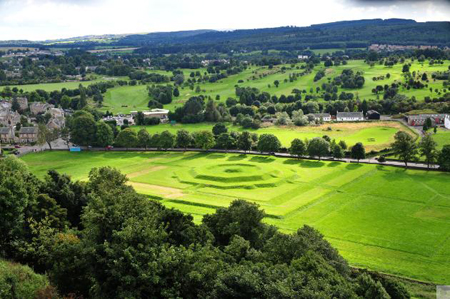
Archaeologists searching for King Arthur’s round table have found a “circular feature” beneath the historic King’s Knot in Stirling.

The King's Knot in the grounds of Stirling Castle

The King's Knot in the grounds of Stirling Castle

The King’s Knot, a geometrical earthwork in the former royal gardens below Stirling Castle, has been shrouded in mystery for hundreds of years.

Though the Knot as it appears today dates from the 1620s, its flat-topped central mound is thought to be much older.

Writers going back more than six centuries have linked the landmark to the legend of King Arthur.

Archaeologists from Glasgow University, working with the Stirling Local History Society and Stirling Field and Archaeological Society, conducted the first ever non-invasive survey of the site in May and June in a bid to uncover some of its secrets.

Their findings were show there was indeed a round feature on the site that pre-dates the visible earthworks.

Historian John Harrison, chair of the SLHS, who initiated the project, said: “Archaeologists using remote-sensing geophysics, have located remains of a circular ditch and other earth works beneath the King’s Knot.

“The finds show that the present mound was created on an older site and throws new light on a tradition that King Arthur’s Round Table was located in this vicinity.”

Stories have been told about the curious geometrical mound for hundreds of years — including that it was the Round Table where King Arthur gathered his knights.

Around 1375 the Scots poet John Barbour said that “the round table” was south of Stirling Castle, and in 1478 William of Worcester told how “King Arthur kept the Round Table at Stirling Castle”.

Sir David Lindsay, the 16th century Scottish writer, added to the legend in 1529 when he said that Stirling Castle was home of the “Chapell-royall, park, and Tabyll Round”.

It has also been suggested the site is partly Iron Age or medieval, or was used as a Roman fort.

Extensive work on the royal gardens was carried out in the early 17th century for Charles I, when the mound is thought to have taken its current form.

The first known record of the site being called the King’s Knot is from 1767, by which time it was being leased for pasture.

Locals refer to the grassy earthworks as the “cup and saucer”, but aerial photographs taken in 1980 showed three concentric ditches beneath and around the King’s Knot mound, suggesting an earthwork monument had preceded it.

The new survey — funded by Historic Scotland and Stirling City Heritage Trust — used the latest scientific techniques to showing lost structures and features up to a metre below the ground.

It also revealed a series of ditches south of the main mound, as well as remains of buildings, and more recent structures, including modern drains which appear at the northern end of the gardens.

Mr Harrison, who has studied the King’s Knot for 20 years, said: “It is a mystery which the documents cannot solve, but geophysics has given us new insights.

“Of course, we cannot say that King Arthur was there, but the feature which surrounds the core of the Knot could explain the stories and beliefs that people held.”

Archaeologist Stephen Digney, who coordinated the project, said: “The area around Stirling Castle holds some of the finest medieval landscapes in Europe.

“This investigation is an exciting first step in a serious effort to explore, explain and interpret them. The results so far suggest that Scotland’s monarchs integrated an ancient feature into their garden, something we know happened in other countries too.

“We are looking forward to the next stage in September when we hope to refine some of the details.”

Dr. Kirsty Owen, Cultural Heritage Adviser at Historic Scotland, added: “The project has the potential to add to our knowledge of the landscape context of the medieval and early modern occupation of Stirling Castle.

“The ditches identified may intriguingly be part of historically documented earlier garden features, or if prehistoric in origin could add to our scant knowledge of prehistoric activity at Stirling Castle.

“We look forward to seeing the results of the next phase of investigations.”Futher work including a ground-penetrating radar survey, is now planned to take place next month to find out more.

A small display of the interim results can be seen close to the site at the Smith Museum.

Wessex Tour Guide – Mystical Landscape, Magical Tours
HisTOURies UK – Private Guided Tours

Read Full Post »

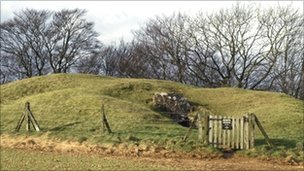
An ancient burial site which dates back thousands of years has been reopened to the public after two years of repairs.

The Long Barrow, known as Hetty Pegler's Tump, could date back as far as 3200BC

The Long Barrow, known as Hetty Pegler's Tump, could date back as far as 3200BC

Uley Long Barrow in Gloucestershire, known as Hetty Pegler’s Tump, was closed while urgent structural work was carried out at the Neolithic site.

Structural damage to the interior dry stone walls of the burial chamber had left it in an unsafe condition.

English Heritage has overseen the work to restore the 120ft (37m) long monument which dates back to 3200BC.

Mark Badger, from English Heritage, said: “We are delighted that this very significant Long Barrow is once again open to visitors.

“The archaeological investigations carried out during the urgent works by the Cotswold Archaeology team have also confirmed the original plan of the burial chambers which were excavated in both 1821 and in 1854.”

Samples of original Neolithic mound material will now be taken away for analysis in a bid to establish a more accurate date.

The scheduled monument is managed by Gloucestershire County Council on behalf of English Heritage and is named after Hester Pegler, the 17th century owner of the field in which it sits.

It is one of a series of ancient stone structures known as the Cotswold-Severn barrow group, sited near Dursley and overlooking the Severn Valley.

Very little is known about who was buried there other than that they were from some of the first settled farming communities

Link: http://www.english-heritage.org.uk/daysout/properties/uley-long-barrow-hetty-peglers-tump/

Wessex Tour Guide
HisTOURies UK – The Best Tours in Ancient History
Mystical Landscape, magical tours………….

Read Full Post »

The Festival for British Archaeology is a fortnight long extravaganza of heritage events, celebrating archaeology for all, and encouraging people to get involved in archaeology. It is made up of hundreds of events across the UK. The Festival of British Archaeology grew out of National Archaeology Week in 2009 to reflect the huge growth of the event in recent years, when it moved from a week-long to a fortnight-long event.

Find out what took place at events around the UK as part of the Festival 2010.

Taking Part

The Festival for British Archaeology is your unique chance to discover and explore the archaeological heritage of the United Kingdom. During this 16 day event, which will run from 16th – 31st July in 2011, you can take part in excavation open days, hands-on activities, family fun days, guided tours, exhibitions, lectures, ancient art and craft workshops and much, much more. Find out what events are happening near you! Put the date in your diary!

Aim of the Festival

The aim of this annual event is to encourage everyone, and especially young people and their families to visit sites of archaeological/historical interest or museums, heritage and resource centres, to see archaeology in action and to take part in activities on-site.

The Festival for British Archaeology is coordinated by the Council for British Archaeology, an educational charity working throughout the UK to involve people in archaeology and to promote the appreciation and care of the historic environment for the benefit of present and future generations. The CBA brings together those for whom archaeology is an interest, an active pastime or a career.

Festival Background

The Festival for British Archaeology originated as National Archaeology Day, first held in 1990 with a total of ten events. Initially it was linked in with European Heritage Days in September of each year, but feedback from participants led to a move to July to make the most of the fieldwork opportunities and to gain maximum publicity. Popularity increased and in 2003 it became a weekend event with 195 events around the country.

A further increase to 232 events in 2004 led to the first nine-day National Archaeology Week being held in July 2005. The number of organisations taking part in National Archaeology Week and public awareness of the event continued to expand rapidly over the next 3 years, and in 2008, over 470 events were held around the UK, with an estimated 160,000 people taking part.

Due to the ongoing success of National Archaeology Week and as a response to positive feedback from both event organisers and members of the public, the event was expanded still further in 2009, to a fortnight long event, and with the new fortnight came the introduction of the new name Festival of British Archaeology. By expanding the number of days the event is held over, event organisers have a greater choice of when to hold events and members of the public have the opportunity to attend a greater number of events. The expanded, newly named Festival is a great success, with 650 events held during the fortnight in 2009, 760 events in 2010, and over 160,000 participants attending events annually.

Link: http://www.britarch.ac.uk

Get involved!

Wessex Tour Guide
HisTOURies UK – The Best Tours in British History

Read Full Post »

Scour the floor near most offices and there’ll be plenty of signs of the modern worker’s addiction to tobacco.

But archaeologists investigating a site in Bath have found evidence of the grip on life of smoking two centuries ago.

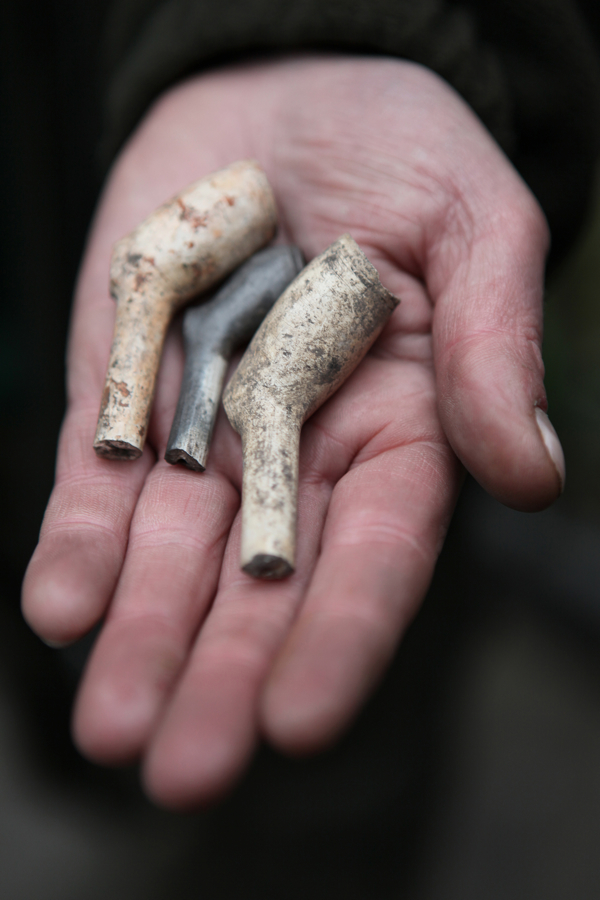
A dig at a city centre car park has unearthed clay smoking pipes.

The pipes were discovered by specialists exploring the area under the Sawclose car park.

They date back to the 19th century, when there was a factory at the site.

Senior project officer for Cotswold Archaeology Chiz Harward said: “We found quite a few clay pipes while digging. Pipes were the principal way of smoking tobacco until the late 19th century when cigarettes came in.

“Some of the bowls are still intact, which is good as clay pipes are very fragile.”

The dig is being carried out ahead of possible redevelopment in the area and the private car park behind the public spaces has been closed while the work takes place.

Meanwhile, an open day was held at the scene of a dig carried out by the Bath and Camerton Archaeological Society at Laverton near Norton St Philip.

The group is excavating a medieval building at Upper Row Farm as part of the Homefield Project, which aims to answer specific questions about settlement in the area.

The event was part of the National Festival of Archaeology, which will also see two free events at the Museum of Bath at Work this Saturday.

There will be a walking tour of the working heritage of Bathampton, presented by director of the museum Stuart Burroughs, starting at 11am from the car park of the Bathampton Mill restaurant. It will feature the Kennet and Avon Canal, and the site of the village’s Plasticine factory.

The second event is a discussion called Industrial Heritage at Risk: Bath and Beyond, led by Keith Falconer from English Heritage.

It starts at 2pm at the Julian Road museum, with a light lunch available from 1pm.
Join us on a private guided tour of Bath soon and discover more……….

The Best Tours of Stonehenge and Bath
HisTOURies UK – Mystical Landscape, Magical Tours

Read Full Post »

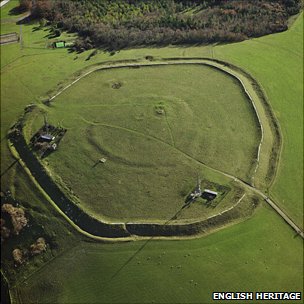
The Trundle near Chichester, Sussex, is one of the first large monuments built in Britain

The Trundle near Chichester, Sussex, is one of the first large monuments built in Britain

Researchers have developed a new dating technique that has given the first detailed picture of the emergence of an agricultural way of life in Britain more than 5,000 years ago.


A new analysis of artefacts recovered from the first monuments built in Britain shows that the Neolithic period had a slow start followed by a rapid growth in trade and technology.

Scientists say the new approach can be used to unravel the detailed sequence of events of many more important moments in human prehistory.

It relies in part on radio-carbon dating – counting the amount of a radioactive type of carbon atom in decaying matter. But the methodology also incorporates many other dating sources, together with some powerful statistical analysis, to produce far more discrete timings for happenings in the past.

The Neolithic period in Britain occurred between 4000 and 2000BC.

It was when people took up agriculture as a way of life and stopped being nomadic hunter-gatherers.

It also saw the emergence of trade across the British Isles and the development of new technologies. But until now, we have had only a rather coarse picture of the chronology of events during this eventful period in our history.

The new analysis by Dr Alex Bayliss, an English Heritage dating expert, has brought the occurrences of that time into sharper focus.

“We can start to tell a bigger story and write a history for the prehistory of Neolithic Britain,” she told BBC News.

“What we thought before was very imprecise. We simply knew that all sorts of different sites and all sorts of new kinds of practices started to happen sometime in the 500 or 600 years of the early Neolithic in Britain.

“We’ve actually now been able to give a timetable, or story of what happened when, to disentangle these things so that we can start to see why certain things may have followed others.”

According to Dr Bayliss’s analysis, Neolithic farming practices began in south-east England probably a few decades before 4,000BC. But then they spread very, very slowly, taking about two centuries to reach western parts of England. And then, she says, there was a sudden increase in activity.

“Monuments, cattle, sheep, the whole farming way of life, bursts across Britain and suddenly – having taken 200 years from getting from Kent to Gloucestershire – it then takes 50 years to get from Cheltenham to Aberdeen.”

The new dating also indicates that by 3700-3800BC, early Britons had developed pottery with regional styles of decorations. Long-distance trading networks were also being established in stone axes and certain other types of pottery

Windmill Hill, a large Neolithic causewayed enclosure in Avebury, was previously thought to have been built around 3700-3100 BC. The new dating shows it was built in 3700-3640 BC

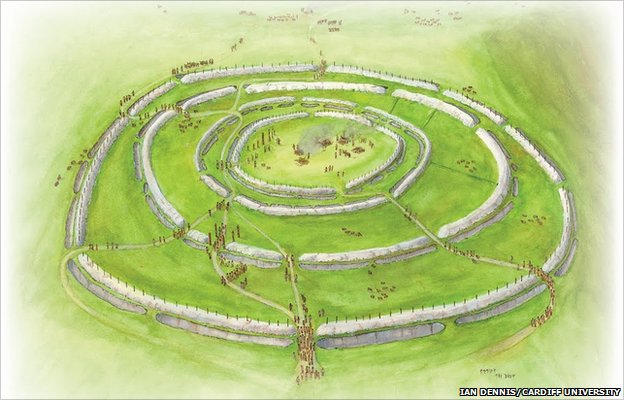
Of particular interest are the first monuments that were built in Britain, called causewayed enclosures. These were made up of concentric rings of ditches and banks – the largest of which can span 300m (1,000ft).

It had been thought that they spread slowly across the country over five centuries. But the new dating approach suggests they spread rapidly within 75 years.

This revelation has been described by archaeologists working on the project as Britain’s first “building boom”.

Professor Alistair Whittle of Cardiff University said: “With more accurate dating, the Neolithic period is no longer the sleepy, hazy swathe of time where it is the default position to lump everything together.

“This research fundamentally challenges the notion that little happened among our Stone Age farmers. We can now think about the Neolithic period in terms of more rapid changes, constant movement of people and fast diffusion of ideas.”

Collective violence

One interpretation of these events is that once the initial “pioneer” phase of the Neolithic period was over, independent groups of people came over from the continent and set up villages across Britain and social structures began to form.

These social structures led to the construction of the enclosures for people to gather and possibly for chieftains to emerge and amass power.

The new dating suggests that there was more collective violence once the enclosures were built. Several of them, particularly in western Britain, were attacked by large numbers of people with showers of arrows, and enclosures’ ramparts were burned down.

This indicates that the enclosures created a hierarchy that was being contested in some way.

The new dating technique involves comparing carbon dates with other markers in the archaeological record. On its own carbon dating is imprecise, but when it is cross-reference with documented events it allows researchers to more accurately date artefacts.

Researchers say this new methodology could in principle be used shed further light on any significant event in our prehistory, such as the emergence of farming in China and the collapse of the Mayan civilisation in the Americas.


A reconstruction of the Whitehawk causewayed enclosure in the South Downs, Sussex

Why not visit Windmill Hill and nearby Avebury and learn more about Neolithic Britain?

Stonehenge and Avebury stone Circle Tour Guide
HisTOURies UK – The Best Tours of Ancient Wiltshire


Read Full Post »

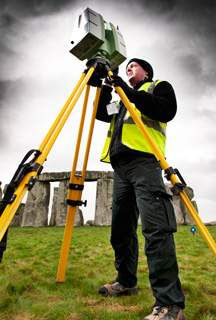
STATE of the art technology is being used to create the most accurate digital model ever of Stonehenge English Heritage is using a combination of modern 3D laser scanning and digital imaging technology to survey every inch of every stone that makes up the prehistoric monument.

The survey includes all the visible faces of the standing and fallen stones of Stonehenge, including Station, Heel and Slaughter stones, as well as the top of the horizontal lintels which have never before been surveyed at this level of detail.

Despite the vast amount of archaeological activity and academic study into Stonehenge and its landscape over the centuries, relatively little is known about the lichen-covered surfaces of the sarsens and bluestones that make up the stone circle.

The availability of high resolution laser scanners that can produce highly accurate surface models means that it is now possible to record details and irregularities on the stone surfaces down to a resolution of 0.5mm. It is also hoped that secrets hidden underneath the thick cover of lichens may be revealed in the analysis using sophisticated software.

The study serves a number of purposes. It will provide precise base-line data to monitor the physical condition of the monument which is subjected to daily weathering.

Digital data of this unprecedented level of detail will also be a valuable resource to anyone who is tasked with producing reconstruction models, drawings and computer generated images of the monument for public understanding and interpretation, including the English Heritage interpretation team who is working on the new displays of the proposed visitor centre.

Understanding of the known Neolithic “dagger” and Bronze Age carvings as well as modern graffiti carvings might also be enhanced, and new ones might be discovered.

Dave Batchelor, English Heritage’s Stonehenge archaeologist, said: “The surfaces of the stones of Stonehenge hold fascinating clues to the past. They are like manuscripts, a whole palimpsest of the ideas, efforts and idiosyncrasies that marked the lives of people over millennia. I look forward very much to seeing what we are about to find.”

http://www.english-heritage.org.uk/about/news/stonehenge-in-high-definition/

Stonehenge Tour Guide
HisTOURies UK – The Best Tours in British History

Read Full Post »

Start: Avebury |Finish: Old Sarum
Distance: Approximately 42 miles

Wiltshire is a county of history and mystery set in a dramatic landscape. The combination of heritage and scenery provides a truly memorable day out. So come with us on a journey through the countryside and across the ages as we go back to the time of our prehistoric ancestors. Hundreds of thousands of years may have passed but all over the county there’s evidence of human activity from the end of the Ice Age through the Stone, Bronze and Iron Ages right up to the invasion of the Romans in AD43.

Click here for audio / visual tour

This driving tour will take you through the heart of Wiltshire. En route you’ll discover more about how our enigmatic and mysterious ancestors lived, worked, fought and died.

This tour can be undertaken in a variety of ways; as a day-long journey, in short sections or you can use the information as a guide to individual visits.

You might also consider embarking on the tour using public transport but keeping up to date with bus service and timetable changes will require plenty of preparation.

Before you set off make sure that you’re properly equipped. Nothing beats a really good Ordnance Survey map, marked with contours and ancient monuments. A compass and a torch would also be useful. Some of these historical gems are in fields and away from roads or footpaths, so good walking boots are a must. Some sites have few or no facilities and it’s also worth noting that mobile phone coverage can’t be guaranteed in parts of rural Wiltshire. For news of road works or route closures, check BBC Local Radio and bbc.co.uk/travelnews

This guide has been produced with the generous assistance of Phil Harding, Wessex Archaeology, English Heritage, Wiltshire Council Archaeology Service, Bob Clarke, Martin Kellett, David Dawson and the Wiltshire Heritage Museum in Devizes.

Stonehenge and Avebury Tour Guide
HisTOURies UK – The Best Tours in Wiltshire

Read Full Post »

« Newer Posts - Older Posts »