Feeds:
Posts
Comments

Archive for the ‘archaeology’ Category

The people who built Stonehenge 5000 years ago probably had the same pallid complexion of many modern inhabitants of the UK. Now it seems that the humans occupying Britain and mainland Europe only lost the darker skins of their African ancestors perhaps just 6000 years earlier, long after Neanderthals had died out. The finding confirms that modern Europeans didn’t gain their pale skin from Neanderthals – adding to evidence suggesting that European Homo sapiens and Neanderthals generally kept their relationships strictly platonic.

There is a clear correlation between latitude and skin pigmentation: peoples that have spent an extended period of time at higher latitudes have adapted to those conditions by losing the skin pigmentation that is common at lower latitudes, says Sandra Beleza at the University of Porto in Portugal. Lighter skin can generate more vitamin D from sunlight than darker skin, making the adaptation an important one for humans who wandered away from equatorial regions.

Those wanderings took modern humans into Europe around 45,000 years ago – but exactly when the European skin adapted to local conditions had been unclear.

Three genes

Beleza and her colleagues studied three genes associated with lighter skin pigmentation. Although the genes are found in all human populations, they are far more common in Europe than in Africa, and explain a significant portion of the skin-colour differences between European and west African populations.

By analysing the genomes of 50 people with European ancestry and 70 people with sub-Saharan African ancestry, Beleza’s team could estimate when the three genes – and pale skin – first became widespread in European populations. The result suggested that the three genes associated with paler skin swept through the European population only 11,000 to 19,000 years ago.

“The selective sweeps for favoured European [versions of the three genes] started well after the first migrations of modern humans into Europe,” says Beleza.

The finding agrees with earlier studies suggesting that modern humans did not lose their dark skins immediately on reaching Europe, says Katerina Harvati at the University of Tübingen in Germany. “[The new study] is interesting because it suggests a very late differentiation of skin pigmentation among modern humans,” she says.

An earlier analysis of ancient DNA in 40,000 and 50,000-year-old Neanderthal bones, respectively from Spain and Italy, suggested that our extinct cousins had light-coloured skin and reddish hair in their European heartland. But the Neanderthals went extinct around 28,000 years ago – long before modern humans in Europe gained a pale skin. Evidently Neanderthals did not pass these useful local adaptations on to modern humans, despite genetic evidence that the two species interbred.

Middle Eastern contact

That might seem unusual given that the two species lived cheek-by-jowl in Europe for several thousand years. But it makes sense if the interbreeding evident in the genes occurred in the Middle East, where modern humans and Neanderthals first met, says Chris Stringer at the Natural History Museum, London.

In that region, Neanderthals may have had darker skins, explaining why our species did not gain a pale skin after interbreeding with them. Indeed, a study earlier this year of ancient DNA suggested that Neanderthals living in what is now Croatia had dark skin and brown hair.

“Neanderthal skin colour was probably variable, as might be expected for a large population spread out over a large territorial expanse,” says Harvati.

Journal reference: Molecular Biology and Evolution, doi.org/h9h
Source: http://www.newscientist.com

HisTOURies UK
Mystical Landscape, magical Tours
Read Full Post »

Tour: Fri 31st Aug – Sun 2nd Sept 2012
Henges, burial mounds of all shapes and sizes, causewayed camps, early field systems and ‘cursus’ monuments are scattered everywhere in Wessex, forming a landscape which hints at its past, but whose story is unintelligible to the untrained eye.

Our experts have been introducing people to this, one of the richest prehistoric landscapes in the world, which lies on our very doorstep, since Andante’s inception.

Day One
Meet in the evening for an introductory lecture and dinner together in a local restaurant. Overnight in Sarum College in the beautiful Cathedral Close.

Day Two
By coach to Avebury for a full exploration of the huge Neolithic henge, so large that part of the village lies within it. It is one of the largest and best preserved of 1300 stone circles known in the British Isles. Morning walk around the henge and along the ceremonial Avenue.  We approach the stones of Avebury just as one would have done in prehistoric times.

Afternoon circular walk (2 hours) past Silbury Hill, the largest man-made mound in Europe.  The most famous of its excavators crawled into an earlier excavation chamber and recorded later:
“the sides of the open chamber provided one of the most astonishing sights that I have ever seen…it was clear that this innermost mound had been covered by a series of conical shells or cappings…the effect was of finding oneself in an enormously complicated and highly coloured layer cake of gigantic size..”
The walk continues to the Long Barrow at West Kennet and a chance to explore the chambered tomb within.  This kind of monument is the earliest known to have been built in Britain – in commemoration of the dead. Continue to the ‘Sanctuary’, a small, complex timber and stone circle on the top of Overton hill. Walking in our ancestors’ footsteps helps us try to understand their motives and methods.

Day Three
Stonehenge for an early (7.30am) visit inside the stone circle before the public arrives. This will be followed by a walk (2 hours) through the wider religious landscape – the cursus, King Barrows and Stonehenge Avenue.
A short drive takes us to Woodhenge, where the remains of wooden post settings have been found – now marked by concrete. From here there is a good view over the huge henge at Durrington Walls, site of exciting recent excavations which revealed the settlement which may have housed the builders of Stonehenge.

Return to Salisbury Museum for a visit to the Stonehenge and Prehistory Galleries. We have arranged a private demonstration of flint-knapping in the gardens here, which is not only much enjoyed, but adds considerably to your understanding of the way in which our prehistoric forebears were able to fashion all manner of implements and tools from our good local flint supplies.  In a world without metal technology this was a critical and highly sophisticated art.
Disperse about 5pm.

Should you choose to arrive earlier or stay later, you might like to visit Old Sarum, the hillfort to the north of Salisbury which was later chosen as the site of our first cathedral, or, of course,  our beautiful Gothic cathedral – straight in front of the College.

NB Most of every day will be spent walking, and you must be prepared for this, with suitable footwear and weatherproof clothing. You will also have to carry your own water, and negotiate a variety of stiles.

  • The original Andante Tour – accept no imitations!
  • We have been introducing guests to these monumental prehistoric landscapes for 26 years
  • Accommodation spectacularly situated within Salisbury cathedral close
  • Bring your hiking boots!
  • Several good cross-country walks

Read Full Post »

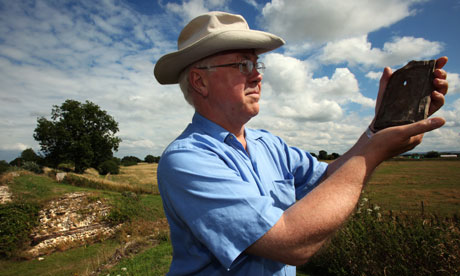
Archaeologists have unearthed a charred stone that suggests the Mediterranean diet came to these islands during the Iron Age

Professor Mike Fulford at the dig in Silchester. The latest find is an olive stone that dates back to Iron Age Britain. Photograph: Graham Turner for the Guardian

Professor Mike Fulford at the dig in Silchester. The latest find is an olive stone that dates back to Iron Age Britain. Photograph: Graham Turner for the Guardian

Iron Age Britons were importing olives from the Mediterranean a century before the Romans arrived with their exotic tastes in food, say archaeologists who have discovered a single olive stone from an excavation of an Iron Age well at at Silchester in Hampshire.

The stone came from a layer securely dated to the first century BC, making it the earliest ever found in Britain – but since nobody ever went to the trouble of importing one olive, there must be more, rotted beyond recognition or still buried.

The stone, combined with earlier finds of seasoning herbs such as coriander, dill and celery, all previously believed to have arrived with the Romans, suggests a diet at Silchester that would be familiar in any high street pizza restaurant.

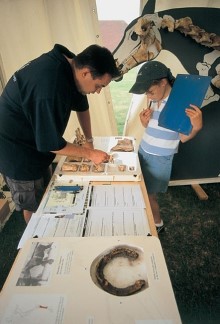
The excavators, led by Professor Mike Fulford of Reading University, also found another more poignant luxury import: the skeleton of a tiny dog, no bigger than a modern toy poodle, carefully buried, curled up as if in sleep. However it may not have met a peaceful end.

“It was fully grown, two or three years old, and thankfully showed no signs of butchery, so it wasn’t a luxury food or killed for its fur,” Fulford said. “But it was found in the foundations of a very big house we are still uncovering – 50 metres long at least – so we believe it may turn out to be the biggest Iron Age building in Britain, which must have belonged to a chief or a sub chief, a very big cheese in the town. And whether this little dog conveniently died just at the right time to be popped into the foundations, or whether it was killed as a high status offering, we cannot tell.

“The survival of the olive stone, which was partly charred, was a freak of preservation. But there must be more; we need to dig a lot more wells.”

Fulford has been leading the annual summer excavations at Silchester, which bring together hundreds of student, volunteer and professional archaeologists, for half a lifetime, and the site continues to throw up surprises. It was an important Roman town, but deliberately abandoned in the 7th century, its wells blocked up and its buildings tumbled, and never reoccupied. Apart from a few Victorian farm buildings, it is still open farmland, surrounded by the jagged remains of massive Roman walls.

Fulford now believes that the town was at its height a century before the Roman invasion in 43AD, with regularly planned, paved streets, drainage, shops, houses and workshops, trading across the continent for luxury imports of food, household goods and jewellery, enjoying a lifestyle in Britain that, previously, was believed to have arrived with the Romans.

This sodden summer have driven the archaeologists to despair, with the site a swamp of deep mud and water bubbling up in every hole and trench.

“Conditions are the worst I can ever remember. Ironically, the wells are the easiest to work in because we have the pumps running there,” Fulford said.

The tiny dog is one of dozens that the team has excavated here over the years, including one that was buried standing up as if on guard for 2,000 years. A unique knife with a startlingly realistic carving of two dogs mating was another of the spectacular finds from one of the most enigmatic sites in the country.

Visitors can observe the archaeologists’ trench warfare this weekend, when the site opens to the public as part of the national festival of archaeology, one of thousands of events across the country.

Article by: Maev Kennedy guardian.co.uk,
Full Story: http://www.guardian.co.uk/uk/2012/jul/19/olive-stone-pre-roman-britain

HisTOURise UK – www.Histouries.co.uk
The Best Tours in British History –

Read Full Post »

ARCHAEOLOGY WEEKEND

It’s the Festival of British Archaeology – this is your chance to meet a real archaeologist and to uncover artefacts from Old Sarum’s history. Enjoy a weekend for all the family with plenty of hands-on activities and crafts to keep everyone busy! Take part in a mini-dig and have a go at identifying objects lost over time.

About Old Sarum

Discover the story of the original Salisbury and take the family for a day out to Old Sarum, 2 miles north of where the city stands now. The mighty Iron Age hill fort was where the first cathedral once stood and the Romans, Normans and Saxons have all left their mark.

Today, 5,000 years of history are told through graphic interpretation panels on site. Families, heritage lovers and walkers can enjoy a great value day out at Old Sarum- you could even bring a picnic and enjoy the fantastic views across the Wiltshire countryside. The gift shop has a delicious range of ice-creams and exclusive English Heritage gifts and produce. Wooden bows and arrows are also on sale to help the kids imagine what life was like all those years ago!
DON’T MISS
The spectacular view from the ramparts at Old Sarum to the ‘new’ cathedral in the centre of Salisbury
Our interesting interpretation panels bringing 5,000 years of history to life
Old Sarum’s literary connections- you can buy some of the famous books written about the site in our shop

English Heritage: http://www.english-heritage.org.uk/daysout/properties/old-sarum/

HisTOURies UK – www.Histouries.co.uk
Mystical Landscape, Magical Tours

Read Full Post »

After hunting for buried treasure for three decades – and not finding a great deal – even the most diligent of us might have given up.

But not Reg Mead and Richard Miles. The two amateur metal detectors kept up their search of the same area throughout the decades and have finally struck gold – or rather silver.

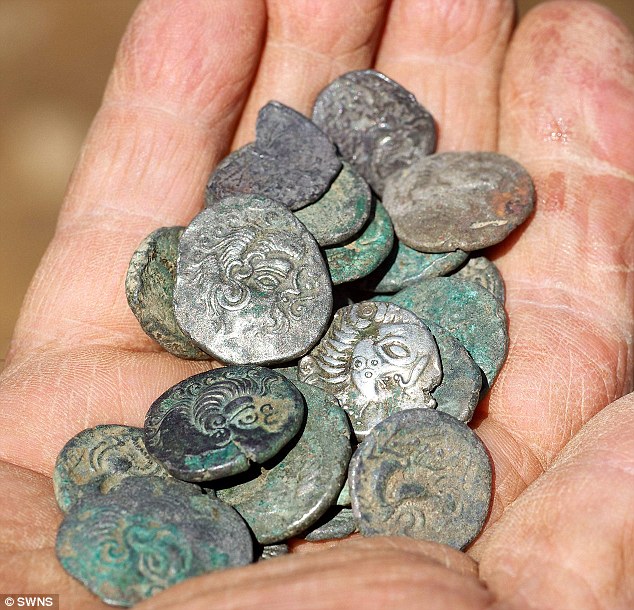
A coin in the hand: Archaeologists believe the hoard, found by two metal detectors, is worth about £10million

A coin in the hand: Archaeologists believe the hoard, found by two metal detectors, is worth about £10million


They have unearthed the largest hoard of Celtic coins ever found. Each one of the 30,000–50,000 coins is estimated to be worth around £200 each, putting the value of the haul at up to £10milion

  • Coins were buried to protect them from Julius Caesar
  • Three-quarter ton hoard estimated to be worth £10m
  • Two enthusiasts searched for three decades in field in Jersey

They are thought to be from the first century BC and were found buried 3ft deep under a hedge in a farmer’s field on Jersey.

Two thousand years ago the Channel Island – which remains a popular spot to stash large sums of money –  was a refuge for tribes fleeing what is now northern France from the invading Roman armies.

As the legions of Julius Ceasar drew closer, the treasure is thought to have been buried by a Celtic tribe called the Coriosolitae, in the hope it could be dug up once the danger had passed.

And there the coins – packed in clay and weighing a ton – have remained undisturbed until last week.

The men who discovered them, Mr Mead, 70, and Mr Miles, a customs officer in his 40s, suspected treasure was in the area three decades ago, when they heard rumours a farmer had found some silver pieces on his land. After a series of largely unsuccessful forays in the area, they unearthed a stash of 120 coins in February.

Mr Mead, a grandfather who lives with wife Ruth in St Clement, Jersey, said: ‘Richard found the first one and it was amazing – when you see him raising his hand above his head (saying) “got one”.’

The pair used a powerful metal detector known as a deepseeker to search for more treasure in the field and struck lucky last week

‘The machine picked up a really strong signal – so we immediately got in touch with professional archaeologists,’ Mr Mead said. ‘They started digging and we could not believe how many coins there were.

‘All of them were stuck together. I have been searching for things like this since 1959 and never found anything on this scale before.

‘We had been searching that land for 30 years.’

After four days of careful digging the hoard was hauled to the surface by crane. It will now be subject of an inquest to determine ownership rights

Mr Mead added: ‘I am absolutely numb at the moment. To find one haul of coins in a lifetime is rare, but to find two is just unheard of.’

The location of the find is being kept secret.

Neil Mahrer of Jersey Heritage Museum, who helped to excavate the money, said: ‘This is the biggest Celtic coin hoard ever found which is tremendously exciting.’

The previous record find was in 1935 at La Marquanderie in Jersey when more than 11,000 were discovered.

Mr Mahrer added that the coins, which are called staters and quarter staters, weigh as much as a 50p piece.

‘All the coins are silver and a common theme is a picture of a man or god’s head on one side of the coin and a horse on the other,’ he said. ‘They are covered in green corrosion because the silver is mixed with copper and copper corrodes. But they should come up again in a good condition.’

Dr Philip de Jersey, a former Celtic coin expert at Oxford University, said: ‘The find is very significant. It will add a huge amount of new information, not just about the coins themselves, but the people who were using them.’

Article by By COLIN FERNANDEZ – Daily Mail

HisTOURise UK
The Best Tours in British History

Read Full Post »

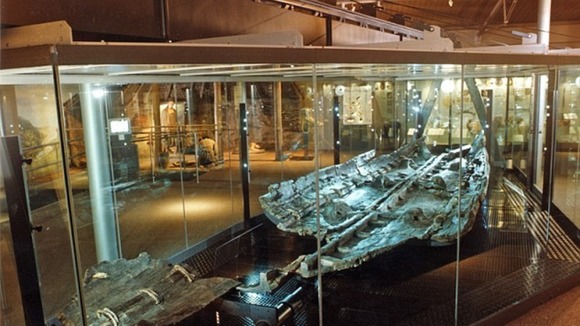
he Dover Boat is one of Britain’s great under-appreciated ancient artefacts.

Older than the Roman Empire. Older than Moses. It would have been in the water at the same time Stonehenge was in use. That’s about 1500 BC – 3,500 years ago.

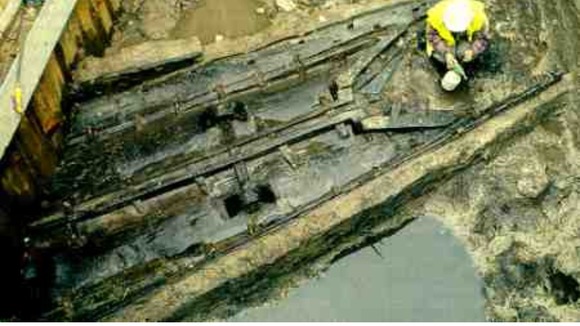
The Dover Boat after it was discovered in 1992 Photo: Dover Museum

The Dover Boat after it was discovered in 1992 Photo: Dover Museum

There would have been countless others like it of course but they have not survived. Built from planks of oak, stiched together with pieces of yew. Certainly not meant to last thousands of years, which is why the vast majority have disappeared.

So to have found one – or at least seventy per cent of one – and to have preserved and displayed it is nothing short of miraculous. There are boats or fragments of boats which may well be older; the Abydos fleet of Egypt for example or the pine canoes of China’s Zhejiang province. And wood found off the Hampshire coast at Hayling Island in the late 1990s has been carbon dated to 7,000 years ago.

What makes Dover’s boat special though is that so much of it can still be seen and appreciated thanks to a huge rescue and conservation effort.

When it was first discovered during roadworks in Dover town centre it stunned archaeologists. But every hour the timbers were exposed it was effectively rotting away. And so teams of historians and archaeologists swung into action by the roadside. The boat was cut into sections, measured, recorded and cleaned. The bits were taken to a shed in Dover Harbour where they were kept wet in large and hastily-constructed water tanks. Later the ancient wood was strengthened using liquid wax, freeze-dried at the Mary Rose Trust in Portsmouth and finally put back together using an adjustable crane.

The preserved Bronze Age Boat in Dover Museum Credit: Dover Museum

The preserved Bronze Age Boat in Dover Museum Credit: Dover Museum

The Dover Boat is one of Britain’s great under-appreciated ancient artefacts.

Older than the Roman Empire. Older than Moses. It would have been in the water at the same time Stonehenge was in use. That’s about 1500 BC – 3,500 years ago.

There would have been countless others like it of course but they have not survived. Built from planks of oak, stiched together with pieces of yew. Certainly not meant to last thousands of years, which is why the vast majority have disappeared.

So to have found one – or at least seventy per cent of one – and to have preserved and displayed it is nothing short of miraculous. There are boats or fragments of boats which may well be older; the Abydos fleet of Egypt for example or the pine canoes of China’s Zhejiang province. And wood found off the Hampshire coast at Hayling Island in the late 1990s has been carbon dated to 7,000 years ago.

What makes Dover’s boat special though is that so much of it can still be seen and appreciated thanks to a huge rescue and conservation effort.

When it was first discovered during roadworks in Dover town centre it stunned archaeologists. But every hour the timbers were exposed it was effectively rotting away. And so teams of historians and archaeologists swung into action by the roadside. The boat was cut into sections, measured, recorded and cleaned. The bits were taken to a shed in Dover Harbour where they were kept wet in large and hastily-constructed water tanks. Later the ancient wood was strengthened using liquid wax, freeze-dried at the Mary Rose Trust in Portsmouth and finally put back together using an adjustable crane.

Then came another battle – to keep the Dover Boat where it belonged. A world-famous museum was said to have bid for it but had the idea of keeping it in pieces. In the end there was a massive fund-raising initiative and a great gallery was built in Dover Museum with a sealed glass chamber that now keeps the precious object safe in perpetuity.

And all the time historians have been looking at it, examining it, working out how it was built.

Seeing how it would have been hewn from the timbers of mighty trees that would have grown all the way down to the shoreline back then.

Seeing how it would not have had a sail, perhaps not even a rudder. Difficult to tell because the back of the boat is missing.

Seeing how it would have been rowed by about a dozen men using huge oars.

Maybe they wave-tested it off the Kent coast. Maybe it pootled upriver. Debate has raged over whether the Dover Boat was robust enough to have taken to the seas and therefore establish a claim to be one of the world’s oldest surviving seagoing vessels.

It or something like it would surely have rowed along the coast of Southern Britain, hugging the coastline in case it shipped too much water. How can we say that? What evidence do we have to back this up?

Well there are artefacts found in Dover from this time period from as far away as Dorset. Logical to think of them having been brought by sea rather than carried overland in what would have been a cumbersome and time-consuming journey.

And so above and beyond all the theories about why and how our boat was built emerges a tantalising possibility.

That it was put together by people who did not just have skills passed down over a few generations, but boat-building knowledge accrued in their communities over hundreds if not thousands of years.

That something very similar to our rickety-looking, oak-planked, yew-stitched craft was crossing the English Channel and also the oceans way back in Stone Age times.

Imagine what light that would cast on our knowledge of the spread and dispersment of peoples, societies, cultures, even entire civilisations, in that yawning chasm of time before recorded history.

The Dover Boat is that significant. A rare treasure.

Article from ITV News: http://www.itv.com/news/meridian/2012-05-12/dover-boat-personal-view/

The Best Guided Tours in British History
HisTOURies UK 

Read Full Post »

Go rambling around England with your little ones, on these 10 buggy friendly walks, selected by Richard Happer from his new book Beautiful Buggy Walks: England

Avebury, Wiltshire

Avebury

Avebury

Strolling through an ancient stone circle is just the start of this adventure. Avebury’s fine historical monument also forms the hub of a cracking day’s countryside wandering. Avebury is the world’s biggest stone circle – so large it has a whole village in its centre – but it doesn’t attract the huge numbers that Stonehenge does. This walk introduces you to the circle via West Kennet Avenue, a ceremonial approach that originally had 100 pairs of stones. It’s half a mile long and still impressive. People can wander freely among the ancient monoliths, unlike Stonehenge. Tourists touch them, kids lean on them and wild-bearded men in rainbow trousers do yoga beneath them. Our tour concludes with a relaxing stretch through the surrounding fields.

OS map: Explorer 157
How far: about 3 miles
Route: Enter the field to the west of the parking area.

• Walk between the stones up West Kennet Avenue.

• When the road to your right joins the main road, cross the smaller road and walk past the trees to the embankment that runs around the ditch.

• Follow the path on top to your right. When you reach a small road, cross it and continue around the circle.

• At the main road follow the path in, towards the centre of the circle, cross the road and take the path out and around the next sector of the circle.

• Detour to your right to visit the café and visitor centre.

• Join the minor road in the village and walk west to east, right through the circle, passing the pub and the point at which you crossed the road earlier.

• You are now walking away from the circle, down a country lane; continue for 1/2 mile, passing Manor Farm, then turn right, down a byway.

• After 1/2 mile, turn right along the edge of a fi eld. Another 1/2 mile will take you back to the start.

Rest and refresh: The Red Lion pub has outdoor space (01672 539266, red-lion-pub-avebury.co.uk). The National Trust visitor centre has a spacious cafe with outside benches. Visitor centre: 01672 539250,nationaltrust.org.uk/avebury

Article Source and more walks:http://www.guardian.co.uk/travel/2012/may/06/buggy-walks-family-holidays-england 

 HisTOURies UK –www.Histouries.co.uk
Mystical Landscape, Magical tours

Read Full Post »

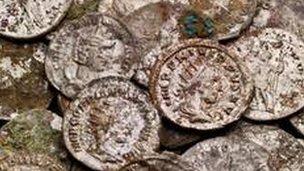
More than 30,000 Roman coins were found by archaeologists working in Bath in 2007, it has been revealed.

The silver coins are believed to date from 270AD and have been described as the fifth largest UK hoard ever found.

The coins were found close to the Roman Baths

The coins were found close to the Roman Baths

The coins are fused together and were sent to the British Museum. Conservators are expected to take at least a year to work through them.

A campaign has now been started at the Roman Baths to try to raise £150,000 to acquire and display them.

The size of the find is not as large as the Frome Hoard in April 2010 when more than 53,500 coins were discovered by metal detectorist Dave Crisp near Frome in Somerset.

The coins found in this hoard date from a similar time and are thought to be the largest ever discovered in a Roman town in the UK.

Roman Baths spokesman Stephen Clews said: “We’ve put in a request for a formal valuation and then hope to buy the coins to display them at the baths.

“At the time there was a lot of unrest in the Roman Empire so there may be some explanation for why the coins were hidden away.

“The find is also unusual as it was discovered by professional archaeologists as opposed to an amateur using a metal detector,” he added.

Source: http://www.bbc.co.uk/news/uk-england-somerset-17480016

HisTOURies UK 

Read Full Post »

The world’s oldest sea-going boat, the Dover Bronze Age Boat is to sail again 3500 years after it crossed the English Channel.

A new project, ‘Boat 1550 BC’ aims to rebuild the boat, which had lain hidden under the centre of Dover for 3,500 years until it was rediscovered in 1992 during the construction of an underpass.

The oak-built boat sailed across the Channel at a time when Stonehenge was still in use, and before Tutankhamun became ruler of Egypt.

The team will use Bronze Age tools and ship-building techniques to reconstruct the Dover Bronze Age Boat, a vessel thought to have crossed the Channel in 1500BCThe team will use Bronze Age tools and ship-building techniques to reconstruct the Dover Bronze Age Boat, a vessel thought to have crossed the Channel in 1500BC

The half-size replica will take two years to construct The half-size replica will take two years to construct

The world's oldest sea-going boat: it will take two and a half years to reconstruct in a half-size replicaThe world’s oldest sea-going boat: it will take two and a half years to reconstruct in a half-size replica

The project aims to understand how people were able to cross the Channel in 1550 BC, using ancient boatbuilding techniques and Bronze Age tools to construct a half-size replica boat.

The boat will launch in the sea when it’s completed in two and a half years time, and will be part of a touring exhibition which visit France, Belgium and the UK to mark the 20th anniversary of the boat’s discovery.

The boat was located during the construction of an underpass and sparked several frantic days of rescue excavations to save it from destruction.

It was removed from the site in sections and rebuilt in the museum.

Canterbury Archaeological Trust Deputy Director, Peter Clark, said: ‘I have been working towards this moment for more than ten years. It’s very exciting. As the days and weeks go by we will learn so much about how our ancestors were able to build such a remarkable vessel.’

The Dover Bronze Age boat on display in a museum. Researchers aim to find out how people crossed the channel in 1550BC The Dover Bronze Age boat on display in a museum. Researchers aim to find out how people crossed the channel in 1550BC

The boat was located during the construction of an underpass and sparked several frantic days of rescue excavations to save it from destructionThe boat was located during the construction of an underpass and sparked several frantic days of rescue excavations to save it from destruction

The researchers will reconstruct the boat using ancient techniques and Bronze Age tools to understand how people crossed the channel in the time of Stonehenge The researchers will reconstruct the boat using ancient techniques and Bronze Age tools to understand how people crossed the channel in the time of Stonehenge
‘We can only speculate about how often people crossed the channel and how close were the ties, but one thing is certain, this project will bring the modern communities in Northern France, Belgium and England just that little bit closer together.’

Link Source:  http://www.mailonsunday.co.uk/sciencetech/article-2110578/Worlds-oldest-sea-going-boat-sail-scientists-rebuild-Dover-Bronze-Age-Boat-ancient-tools-understand-people-crossed-channel-1500BC.html

HisTOURies UK –  Bringing History alive


Read Full Post »

Around 8,000 years ago, prehistoric hunters killed an aurochs and their grilling techniques were frozen in time.

THE GIST

Remains of a butchered and cooked female aurochs (a prehistoric cow) have been identified from a Stone Age Netherlands site.
The hunters appear to have cooked the meat over an open fire, eating the bone marrow first and then the ribs.
Aurochs hunting was common at the site for many years, but humans drove the large horned animals to extinction

aurochs bones AmesburyStone Age barbecue consumers first went for the bone marrow and then for the ribs, suggest the leftovers of an outdoor 7,700-year-old meaty feast described in the July issue of the Journal of Archaeological Science.

The remains, found in the valley of the River Tjonger, Netherlands, provide direct evidence for a prehistoric hunting, butchering, cooking and feasting event. The meal occurred more than 1,000 years before the first farmers with domestic cattle arrived in the region.

Although basic BBQ technology hasn’t changed much over the millennia, this prehistoric meal centered around the flesh of an aurochs, a wild Eurasian ox that was larger than today’s cows. It sported distinctive curved horns.

Another big difference is how meat was obtained then.

NEWS: Mammoths Roasted in Prehistoric Kitchen Pit

“The animal was either caught in a pitfall trap and then clubbed on the head, or shot with a bow and arrow with flint point,” co-author Wietske Prummel, an associate professor of archaeozoology at the University of Groningen, told Discovery News.

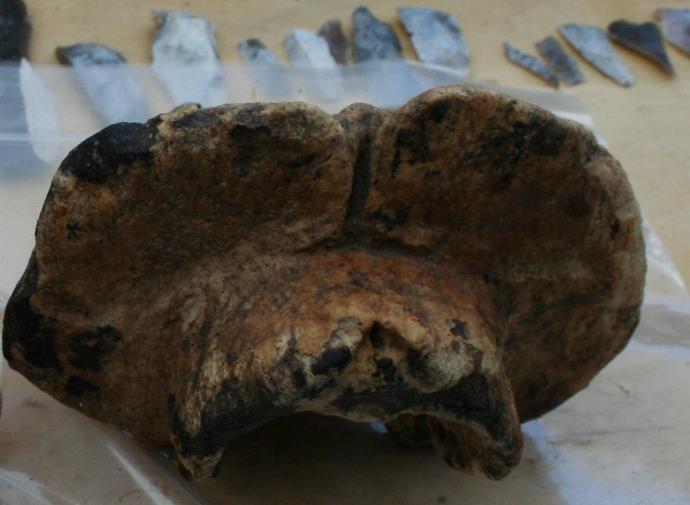
Prummel and colleague Marcel Niekus pieced together what happened by studying an unearthed flint blade found near aurochs bones. These show that after the female aurochs was killed, hunters cut its legs off and sucked out the marrow.

According to the study, the individuals skinned the animal and butchered it, reserving the skin and large hunks of meat for carrying back to a nearby settlement. Chop marks left behind by the flint blade show how the meat was meticulously separated from the bones and removed.

Burn marks reveal that the hunters cooked the meaty ribs, and probably other smaller parts, over an open fire. They ate them right at the site, “their reward for the successful kill,” Prummel said.

The blade, perhaps worn down from so much cutting, was left behind and wound up slightly scorched in the cooking fire.

Niekus told Discovery News, “The people who killed the animal lived during the Late Mesolithic (the latter part of the middle Stone Age). They were hunter-gatherers and hunting game was an important part of their subsistence activities.”

The researchers suspect these people lived in large settlements and frequented the Tjonger location for aurochs hunting. After the Iron Age, the area was only sparsely inhabited — probably due to the region becoming temporarily waterlogged — until the Late Medieval period.

NEWS: Pre-Stonehenge Megaliths Linked to Death Rituals

Aurochs must have been good eats for Stone Age human meat lovers, since other prehistoric evidence also points to hunting, butchering and feasting on these animals. A few German sites have yielded aurochs bones next to flint tool artifacts.

Aurochs bones have also been excavated at early dwellings throughout Europe. Bones for red deer, roe deer, wild boar and elk were even more common, perhaps because the aurochs was such a large, imposing animal and the hunters weren’t always successful at killing it.

At a Mesolithic site in Onnarp, Sweden, for example, scientists found the remains of aurochs that had been shot with arrows. The wounded animals escaped their pursuers before later dying in a swamp.

The aurochs couldn’t escape extinction, though.

“It became extinct due to the destruction of the habitat of the aurochs since the arrival of the first farmers in Europe about 7500 years ago,” Prummel said. “These farmers used the area inhabited by aurochs for their dwellings, arable fields and meadows. The aurochs gradually lost suitable habitat.”

The last aurochs died in 1627 at a zoo in Poland.

Source: http://news.discovery.com/history/ancient-barbeque-aurochs-110627.html

HisTOURies – The Best of Wiltshire History 

Read Full Post »

« Newer Posts - Older Posts »