Feeds:
Posts
Comments

Archive for the ‘archaeology’ Category

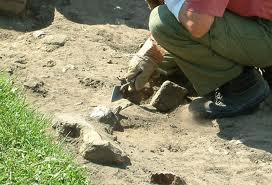
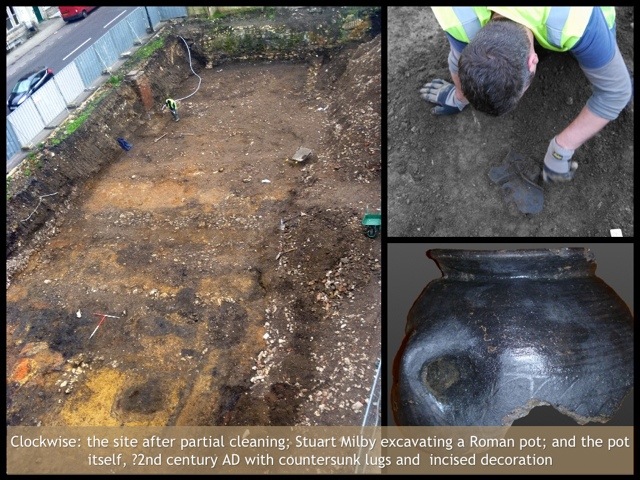
An archaeological excavation currently being undertaken by Context One, on behalf of Ashford Homes, on the corner of Bathwick Street and Henrietta Road, Bathwick, have uncovered the remains of several Roman structures with associated features, as well as a Roman road surface.

Based on some of the finds recovered so far, it appears to be an early Roman site. A preliminary look at the structures suggests we’ve discovered at least one dwelling, divided into both domestic and industrial areas, the latter comprise various external surfaces and boundary walls.

We have also revealed a Roman road crossing the site. This is constructed from a number of layers that have built up over some time, suggesting the road was in continued use. Several exterior (possible yard) surfaces have also been uncovered adjacent to the road.

A large number of smaller features (including various pits) have been revealed during the initial cleaning of the site. Whilst some of these almost certainly post-date the structures and road surface, others may prove to be contemporary.

We are in the initial stages of our investigation and are likely to be on site for at least the next month. Updates on our progress will be forwarded to the local press but for more immediate information we will be posting here on their website. http://www.contextone.co.uk

HisTOURies UK

Read Full Post »

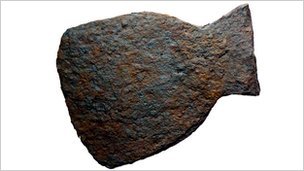
A Viking axe head found in a Gloucestershire village could be evidence of a battle more than 1,100 years ago, according to archaeologists.

The wrought iron object, found in Slimbridge in 2008, has now been identified as being of Viking origin.

Archaeologists think the axe head could be evidence of a battle in 894 AD

Archaeologists think the axe head could be evidence of a battle in 894 AD

Historians say a band of Vikings sailed up the River Severn and fought against the Anglo-Saxons in 894 AD.

Archaeologists say where the axe head was found is where they could have tied up their ships.

It was discovered by Ian Hunter Darling under a hedge in his garden.

Bloody battle

“I couldn’t believe what I saw. I thought it could have been an agricultural implement of some description,” he said.

He said an archaeological visit to the the farm where he lives had got the experts “quite excited”.

“They said I should take it to a museum to have it looked at.”

According to historians King Alfred the Great fought the Vikings in a bloody battle at Minchinhampton, about 10 miles from Slimbridge, in 894 AD.

Three Viking princes were killed in the battle, and fighting could have ranged over a wide area of the Berkeley Vale.

For over a century archaeologists have speculated where the Vikings could have moored their ships.

“They realised my driveway would have been creek in those days before there was a sea wall on the River Severn,” said Mr Hunter Darling.

“The boats could have tied up at the bottom of my garden.”

‘Viking sword’

Members of Slimbridge local history society now want to gather further evidence of Viking activity in the village.

Peter Ballard, from the society, said: “A member of a local family claimed he found a Viking sword in a ditch by the River Cam many years ago, but that has now been lost.”

They are asking for residents who may have found other Viking objects to come forward.

A meeting to highlight the importance of the discovery will be held in Slimbridge Village Hall on 21 February.

The axe head is to go on display at Stroud Museum in the Park.

Link: http://www.bbc.co.uk/news/uk-england-gloucestershire-16829808

HisTOURies UK

Read Full Post »

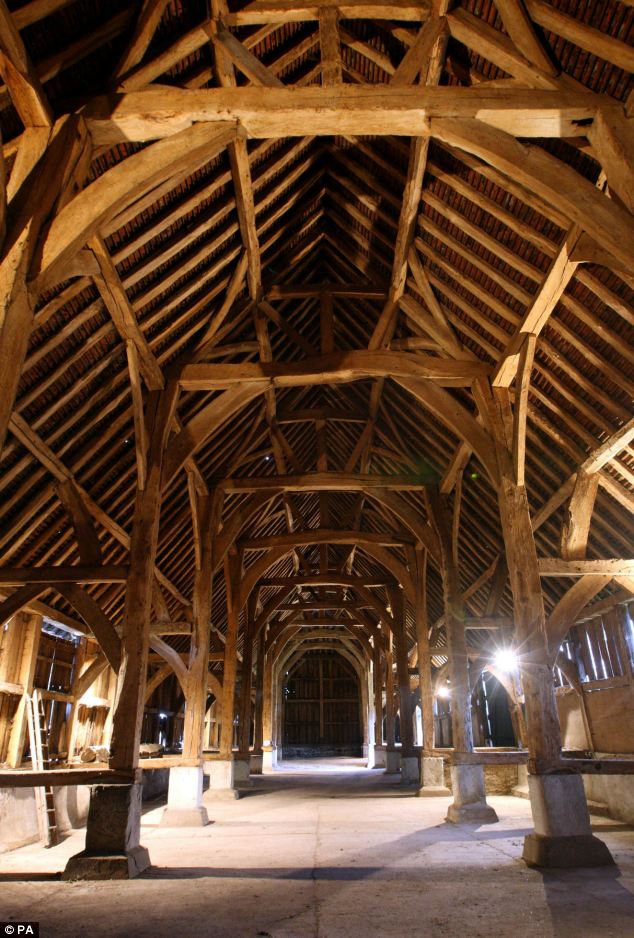
A medieval barn described by the poet John Betjeman as the ‘cathedral of Middlesex’ has been rescued from decay and neglect for the nation, English Heritage said today.

Grade I-listed Harmondsworth Barn in west London joins the likes of Stonehenge, Osborne House and parts of Hadrian’s Wall in the national collection of historic sites and monuments under the guardianship of English Heritage.

Historic: The exquisite oak structure was created by skilled carpenters, whose signature marks can still be seen, in the 15th Century

Historic: The exquisite oak structure was created by skilled carpenters, whose signature marks can still be seen, in the 15th Century

Built by Winchester College in 1426, the barn would have been used to store grain from the surrounding manor, owned by the Bishop of Winchester, with profits from the produce used to pay for the school

The structure resembles the nave of a large church, standing at nearly 60 metres (200ft) long, 12 metres (40ft) wide, and 11 metres (36ft) high, with 13 huge oak trusses resting on stone blocks holding up the roof.

While it has had some repairs over the years, most recently by English Heritage to make it weather-proof and keep out pigeons, the structure is largely as it was built, with the timber and stones still bearing original carpenter and mason marks.

The oak-framed barn, which the heritage agency said ranks alongside the Houses of Parliament and Buckingham Palace for its historic value, was used up until the 1970s but fell into disrepair in the ownership of an offshore company which had bought it in 2006

It is thought the purchase by a Gibraltar-based company for £1 was a speculative one, as the barn stands just metres from where Heathrow’s third runway – had it gone ahead – would have been built.

In 2009, English Heritage became concerned about the barn’s deteriorating condition and issued an urgent works notice for emergency repairs to keep it water and wind-tight.

The barn became known as “Cathedral of Middlesex”

A dispute over payment for the emergency works led to English Heritage buying the barn, which lies between the M25 and M4 motorways, for £20,000.

The barn’s precarious state was publicised in 2009 when building-preservation journal Cornerstone published an article on the gaping holes and disrepair.

Michael Dunn, historic buildings inspector for English Heritage, said the building was the best preserved and largest surviving medieval timber barn in England, probably in Europe.

It is the ninth largest in Europe he said, adding that ‘for its size , and its state of preservation, it is unique.’

‘This is high status, this is the finest timber, and a very confident carpenter. This is as good as it gets,’ he said.

Simon Thurley, chief executive of English Heritage, said: ‘Harmondsworth Barn is one of the greatest medieval buildings in Britain, built by the same skilled carpenters who worked on our magnificent medieval cathedrals.

‘Its rescue is at the heart of what English Heritage does – protecting this nation’s architectural treasures and helping people discover our national story through them.

‘We will complete the repair of this masterpiece and, working with local people, will open it to the public to enjoy.’

A local group, the Friends of the Great Barn at Harmondsworth, formed around six years ago and have been dedicated to preserving the building, researching its history and keeping up the interest in its future, opening it each year to around 400-500 visitors during the Open House weekend.

The barn will now be open for free two Sundays a month between April and October, staffed by volunteers, with plans to open it every Sunday from next year.

Phil Rumsey, chairman of the group, said: ‘After working to save the barn over the last six years, it is wonderful that English Heritage have rescued this much-loved building. It will provide a great lift to the community.’

Archaeologist Justine Bayley told The Guardian: ‘If we had a pound for everyone who walks in here and says “wow!” we could have re-roofed the building twice over. It’s really the only appropriate response.’

Source: http://www.dailymail.co.uk/news/article-2093598/Medieval-barn-described-cathedral-Middlesex-joins-Stonehenge-national-collection-historical-sites.html#ixzz1kxEY35Ci

HisTOURies UK

Read Full Post »

THE discovery of a Stone Age temple on Orkney looks set to rewrite the archeological records of ancient Britain with evidence emerging it was built centuries before Stonehenge.

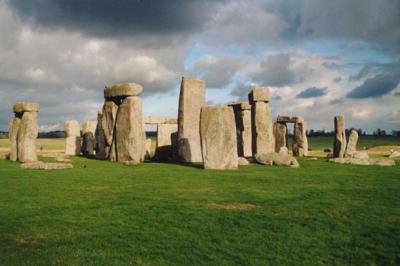
Stonehenge Wiltshire

Stonehenge

 Archeologists have so far found undisturbed artefacts including wall decorations, pigments and paint pots, which are already increasing their understanding of the Neolithic people.

Experts believe the huge outer wall suggests the site was not domestic, while the layout of the buildings has reinforced the view it might have been a major religious site. Archaeologists think the temple was built 500 years before Stonehenge, regarded as the centre of Stone Age Britain.

However, only 10% of the site at Ness of Brodgar has been excavated and it could be years before the scale and age of the discovery is fully understood.

It sits close to the existing Ring of Brodgar stone circles and the standing stones of Stenness, near to the town of Stromness.

The uncovered wall around the edges of the site was built with 10,000 tonnes of quarried rock and may have been up to 10 ft high.

Thermal technology also indicates the site could cover the same area as five football pitches, with some parts potentially older than Stonehenge, in south-west England, by as much as 800 years.

Charcoal samples from beneath the wall indicate it was built around 3200 BC. A 30mm high figurine with a head, body and two eyes, and called the “Brodgar Boy”, was also unearthed in the rubble of one of the structures.

About 18 months ago, a remarkable rock coloured red, orange and yellow was unearthed. This is the first discovery in Britain of evidence that Neolithic peoples used paint to decorate their buildings.

Project manager Nick Card said the discoveries are unparalleled in British prehistory and that the complexity of finds is changing the “whole vision of what the landscape was 5000 years ago.” He said it was of “a scale that almost relates to the classical period in the Mediterranean with walled enclosure and precincts”.

Mr Card added: “It’s a huge discovery; in terms of scale and complexity there really is nothing else quite like it.

“At first we thought it was a settlement but the scale and complexity within the buildings makes you think along the lines of a temple precinct. It’s something you would associate with the classical world.”

Archeologist Julian Richards, who has written several books on Stonehenge, added: “The indication is that building was taking place when Stonehenge was still, relatively speaking, insignificant. We have tended to think we know how things were in the Neolithic period, then something like this turns that on its head.”

Full story: http://www.heraldscotland.com/news/home-news/orcadian-temple-predates-stonehenge-by-500-years.16330802

Stonehenge Tourist Guide
HisTOURies UK – Mystical Landscape, Magical Tours

Read Full Post »

An exciting new Bronze Age hoard discovered in west Wiltshire (near Stonehenge)  has just gone on display at Salisbury Museum. It was found a month ago in a field near Tisbury by a metal detectorist. He reported the first object, a spearhead, to the Wiltshire Finds Liaison Officer. A team of archaeologists then excavated the remaining objects and recorded how they lay in the ground.

The hoard of over 100 copper alloy objects is over 2,700 years old and dates to the late Bronze Age and early Iron Age. It consists of tools – axe heads, chisels, sickles, gouges, and weapons – spearheads, daggers, knives, swords and scabbard fittings. It is the most important hoard to have been found in Wiltshire since the discovery of the Salisbury Hoard in the 1980s.

It is very unusual for a hoard of this significance to be on display in a regional museum before it has been assessed by the experts at the British Museum. The hoard will only be on display until Saturday 26 November – it will then go to the British Museum for assessment and the local coroner will need to hold an inquest to determine whether it is Treasure Trove.

See the Salisbury Journal for an article about the hoard.

 The hoard will only be on display until Saturday 26 November

Salisbury Museum – http://www.salisburymuseum.org.uk/

Wessex Guided Tours
HisTOURies UK – Mystical Landscape, Magical Tours

Read Full Post »

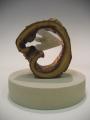
Out of Earth Exhibition

Out of Earth Exhibition

Renowned potter Chris Carter and archaeologist Martin Green share their fascination with the prehistoric past of Cranborne Chase.  Through art and artefact, they reveal a story of the humans that occupied the landscape before history was written.

Out of the Earth explores a dialogue between artist and archaeologist as they respond to the objects excavated from flint-rich soils of Cranborne Chase.  Artefacts from Martin’s own museum, which displays the finds he has discovered over the years, will be on display alongside Chris’s artwork and objects from Salisbury Museum and Wiltshire Heritage Museum.  Together, the objects describe and uncover the imprints left by farming, community and ritual activities in the past.

Chris and Martin describe themselves as ‘sons of the soil’, both having been raised on farms in the countrysides of Warwickshire and Dorset.  They met following a BBC4 radio show ‘Open Country’ which featured Down Farm on Cranborne Chase.  Martin had been excavating there since he inherited it in 1979 and Chris’s interest in the Chase landscape soon developed into a passion for exploring it through his art.

The exhibition shows new developments in Chris’s work and is itself a testimony to the continuing influence of prehistoric people on us today as their artistry, communities and ritual activities are re-discovered through archaeology.  Chris describes the way he searches for his pots in the clay as akin to the archaeologist’s search for an object in the earth.  Cranborne Chase has encouraged his art to take new routes which have seen him sculpting from flint and creating 2D collage works.  A deep-seated influence of the landscape and farming is apparent in his work; his pots suggest the sinuous twist of the plough and the symmetry of the stone axe, whilst the surface textures reflect the processes of people and nature on the landscape.

Both pot and artefact have a power and contemplative quality that makes Out of the Earth an exhibition not to be missed.  Here, the passion for the Cranborne landscape and for the people who lived on and moulded it, is deep-seated, inherent and heartfelt.  The stories revealed are told by two people who know the landscape intimately, both inside and out, and can tell those stories with an authority and understanding that cannot be disputed. 

Link: http://www.salisburymuseum.org.uk/exhibitions/exhibitions/174-out-of-the-earth.html
Sponsors: The Stonehenge Tour Company – www.StonehengeTours.com

Well worth a visit!

HisTOURies UK – Mystical Landscape, Magical Tours
The Best Tours in British History

Read Full Post »

A metal detector enthusiast located more than 100 bronze items, thought to be about 2,700 years old, on a farmland site which is being kept secret.

Having first found a spearhead, he decided not to disturb the ground and notified archaeologists, who were able to conduct a meticulous excavation.

The finds, from the late Bronze Age and early Iron Age, include tools such as chisels, axe heads and gouges, and weapons including fragments of a sword and scabbard and more spearheads.

Experts are hugely excited about the hoard, which is still being catalogued. They are not prepared to guess at its value yet but say it is the biggest in the area since the Salisbury Hoard – now in the British Museum – was discovered in the 1990s.

Salisbury & South Wilts Museum director Adrian Green said: “It’s a very rare and important find, and it’s still fresh out of the ground. This was not previously a known archaeological site. The guy was just metal detecting as a hobby.

“What was significant about it was that he very responsibly told the finds liaison officer for the county, Katie Hinds, who is paid by the British Museum to record finds made by chance like this, rather than just digging it up himself and potentially losing valuable archaeological information.

“This was brilliant, and exactly what we want detectorists to do. She was able to arrange a specialist team to go and dig it up. That’s very important from an academic point of view.

“You could count on two hands the number of Bronze Age hoards which have been recorded professionally by archaeologists in this way.”

The hoard will go to the British Museum to be assessed and there will be an inquest to determine whether it is treasure trove.

If so, Salisbury Museum will have a chance to raise funds to buy it.

Neither the finder nor the landowner wish to be identified
Link : http://www.salisburyjournal.co.uk/news/9336972.Ancient_artefacts_unearthed_in_Tisbury/

The Best Tours in Wessex
HisTOURies UK.  Mystical Landscape, Magical Tours

Read Full Post »

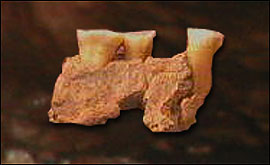
The jawbone which has caused so much excitement

The jawbone which has caused so much excitement

Could a piece of jawbone found at Torquay’s famous Kents Cavern caves be the oldest part of modern human to be unearthed in Europe?

A piece of jawbone excavated from a prehistoric cave in England is the earliest evidence for modern humans in Europe, according to an international team of scientists. The bone first was believed to be about 35,000 years old, but the new research study shows it to be significantly older — between 41,000 and 44,000 years old, according to the findings that will be published in the journal Nature. The new dating of the bone is expected to help scientists pin down how quickly the modern humans spread across Europe during the last Ice Age. It also helps confirm the much-debated theory that early humans coexisted with Neanderthals. Beth Shapiro, the Shaffer Associate Professor of Biology at Penn State University and a member of the research team, explained that the fragment of maxilla — the upper jaw — containing three teeth was unearthed in 1927 in a prehistoric limestone cave called Kent’s Cavern in southwestern England. Records from the original excavations, undertaken by the Torquay Natural History Society located in Devon, England, indicate that the jawbone was discovered 10 feet 6 inches beneath the surface and was sealed by stalagmite deposits. “In 1989, scientists at Oxford University dated the bone as being about 35,000 years old. However, doubts were later raised about the reliability of the date because traces of modern glue, which was used to conserve the bone after discovery, were found on the surface,” Shapiro said. “We knew we were going to have to do additional testing to re-date the bone.” Because the remaining uncontaminated area of bone was deemed too small to re-date, the research team searched through the excavation archives and collections in the Torquay Museum to obtain samples of other animal bones from recorded depths both above and below the spot where the maxilla was found.

Members of the research team then obtained radiocarbon dates for the bones of wolf, deer, cave bear, and woolly rhinoceros, all of which were found close to the maxilla, and all of which could be dated at between 50,000 and 26,000 years old. Using a Bayesian statistical-modelling method, the scientists then were able to calculate an age for the maxilla. The new date indicates that the bone is between 41,000 and 44,000 years old.

Tom Higham, Deputy Director of Oxford University’s Radiocarbon Accelerator Unit and a member of the research team, said “Radiocarbon dating of ancient bones is very difficult to do. Because the initial date from this fragment of jawbone was affected by traces of modern glue, the initial measurement made in 1989 was too young. The new dating evidence we have obtained allows us, for the first time, to pinpoint the real age of this key specimen. We believe this piece of jawbone is the earliest direct evidence we have of modern humans in northwestern Europe.”

Shapiro explained that the new and more-accurate date is especially important because it provides clearer evidence about the coexistence of Neanderthals and anatomically modern humans. “If the jawbone is, in fact, 41,000 to 44,000 years old, that means it was from a time when Neanderthals were still present in Europe, so we first had to confirm that the bone was from an anatomically modern human, and not a Neanderthal,” Shapiro said. Shapiro and her team first tried to extract mitochondrial DNA from one of the teeth, but there were insufficient amounts for valid DNA sequencing. Eventually, team members were able to use a virtual three-dimensional model based on a CT scan of the jawbone to carry out a detailed analysis of the fossil. They compared the external and internal shapes of the teeth with those of modern human and Neanderthal fossils from a number of different sites. They found early modern human characteristics in all but three of the 16 dental characteristics.

Studies of the maxilla have been under way for the last decade, but it was only with the application of the latest investigative and dating techniques that the research team was able to make this breakthrough in identifying the jawbone as the earliest modern human so far known from Europe.

“Comparative data were lacking for some of the traits our team was studying,” Shapiro said. “So, thankfully, our team member Tim Compton of the Natural History Museum in England helped by building a completely new database to help discriminate modern features from Neanderthal features. While the dominant characteristics are certainly modern, there are some that are ambiguous, or that fall into the Neanderthal range.” The research team believe that these ambiguous features may reflect inadequate sampling of modern human variation, shared primitive features between early modern humans and Neanderthals, or even interbreeding between the two species. “We’ll have to delve a little deeper and do more work to resolve these questions,” Shapiro said.

Another exciting feature of the new study is that it could help solve the apparent discrepancy about the known dates of the Aurignacian period — a time of cultural development in Europe and southwest Asia that lasted from around 45,000 to 35,000 years ago. Previous researchers have discovered artefacts and tools from this period that are thought to have been produced by the earliest modern humans in Europe. However, strangely, these artifacts have been found to be much older than the rare skeletal remains found in the same vicinity. While Aurignacian tools and ornaments have been dated at as old as 44,000 years, tests to pinpoint the age of relevant human remains have resulted in dates that reach no further than between 41,000 and 39,000 years ago, indicating a significant gap.

“The new date and identification of this bone from Kent’s Cavern is very important, as we now have direct evidence that modern humans were in northwest Europe about 42,500 years ago,” Higham said. “It confirms the presence of modern humans at the time of the earliest Aurignacian culture, and tells us a great deal about the dispersal speed of our species across Europe during the last Ice Age. It also means that early humans coexisted with Neanderthals in this part of the world, something that a number of researchers have doubted.”

In addition to Shapiro, Higham, and Compton, other members of the research team include Chris Stringer, Roger Jacobi, and Chris Collins of the Natural History Museum in the United Kingdom; Erik Trinkaus of Washington University in the United States; Barry Chandler of the Torquay Museum in the United Kingdom; Flora Gröning, Paul O’Higgins, and Michael Fagan of the University of Hull in the United Kingdom; Simon Hillson of University College London in the United Kingdom; and Charles FitzGerald of McMaster University in Canada.

The research was funded by two organizations in the United Kingdom: the Leverhulme Trust, established at the wish of William Hesketh Lever, the first Viscount Leverhulme, and the Natural Environment Research Council.
Link: http://esciencenews.com

The Best Tours in Ancient History
HisTOURies UK – Guided Tours of Britain

Read Full Post »
Archaeologists have found the first intact Viking boat burial site in the UK. The 5m-long grave contained the remains of a high-status Viking who was buried with an axe, sword, spear and bronze ring-pin.

”]Excavations at the Ardnamurchan Peninsula [Credit: Ardnamurchan Transitions Project]
The 1,000-year-old find, on the remote Ardnamurchan Peninsula, in the Highlands, was made by Ardnamurchan Transitions Project, a team led by experts from the universities of Manchester and Leicester, CFA Archaeology Ltd and Archaeology Scotland. 

Other finds included a knife, a sharpening stone from Norway, a ring pin from Ireland and Viking pottery. 

Dr Oliver Harris, project co-director from the University of Leicester’s School of Archaeology and Ancient History, said: “This project examines social change on the Ardnamurchan Peninsula from the first farmers 6,000 years ago to the Highland clearances of the 18th and 19th century. 

“It has also yielded evidence for what will be one of the best-dated Neolithic chambered cairns in Scotland when post-excavation work is complete.” 

Source: This is Leicestershire [October 18, 2011]

The Best Tours in British History
HisTOURies UK

Read Full Post »

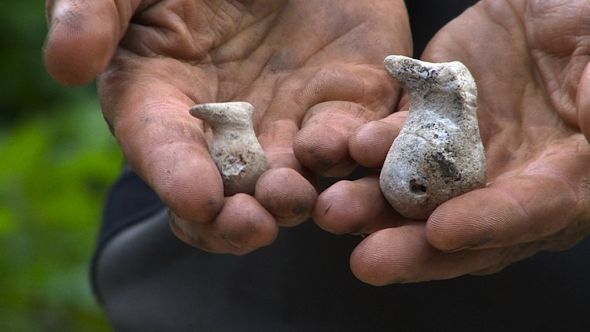
A pair of carved stone ducks unearthed at Vespasian’s Camp near Stonehenge are believed to be the oldest known figurines found in the UK, and are amongst other findings that suggest the sacred site was in use several thousand years before the megalith itself was constructed.

Two stone carvings, in the shape of ducks, dated to around 700 BC. (Luke Beaman/The Open University)

Two stone carvings, in the shape of ducks, dated to around 700 BC. (Luke Beaman/The Open University)

Led by archeologist David Jacques at The Open University, several students uncovered a hoard of artifacts from the mid-Stone Age, including a ceremonial dagger, the remains of an aurochs feast, and more than 5,000 flints and tools.

“We thought it was probably a mixed cache of early prehistoric tools, and assumed some were contemporary with Stonehenge,” Jacques said in a press release.

“When we took them back to Cambridge and a number of experts suggested they were all Mesolithic, we started to get very excited.”

The team found evidence of a fire with over 200 cooked animal bones from at least one aurochs, which were radiocarbon dated back to about 6,250 BC, more than 3,000 years before the giant stone circle was erected.

“Mesolithic people were nomadic hunter-gatherers who would have had temporary settlements,” Jacques explained.

“Salisbury Plain would have been something like the Serengeti with herds of animals roaming across it, and people could have used the hills that sort of create a basin around it as vantage points from which to see the movement of animals.”

Now extinct, aurochs were a type of large cattle that once roamed Eurasia and North Africa, reaching almost two meters in height.

“An aurochs was something like a large minivan in size,” Jacques said. “To catch an animal this big would have been a major feat.”

“It would have fed a lot of people. It’s likely there was a large gathering, possibly as many as 100 people, who cooked and feasted on the aurochs.”

Meanwhile, the ducks were dated back to 700 BC, and the dagger to around 1,400 BC. The figurines are believed to be part of a Bronze Age tradition based on casting sacrificial offerings into water.

Only a few other Mesolithic artifacts have previously been found in the area. Field archeologist Tom Lyons at Oxford Archaeology East said in the release that the discovery is highly significant.

“It’s really exciting to get such a cache of material,” he said. “This certainly makes this find nationally important, if not internationally important”

Link: http://www.theepochtimes.com/n2/science/mesolithic-discovery-could-alter-our-understanding-of-stonehenge-62434.html

Private Guided Tours of Stonehenge and Anciet Britain
HisTOURies UK – Mystical Landscape, Magical Tours..

Read Full Post »

« Newer Posts - Older Posts »