Feeds:
Posts
Comments

Archive for the ‘archaeology’ Category

Round Barrows – That’s where Bronze Age people buried their dead init! Nuff said”. Factually correct, if a tad simplistic, but of course the potential for learning more about society from studying these monuments it could be argued is still in its infancy. The landscape of Cranborne Chase has been at the forefront of British prehistory and archaeology since the middle of the 19th century, it having one of the densest concentrations of prehistoric monuments in north-west Europe.

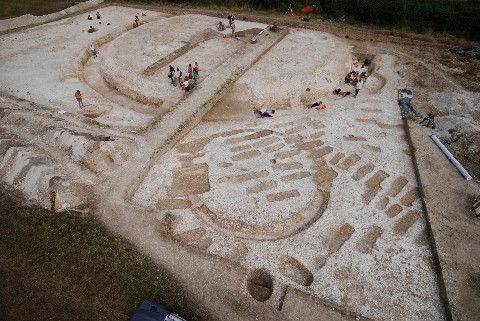
image credit: High Lea Farm excavation © Bournemouth University

image credit: High Lea Farm excavation © Bournemouth University

In 2003 John Gale embarked upon a seasonal campaign of excavations at the little known and apparently flattened barrow group at High Lea Farm near Hinton Martell north of Wimborne. The fieldwork was completed in 2009 and the analysis currently under way is discovering information which suggests that we still have a lot to learn about these ‘familiar’ monuments of the Wessex landscape.  

John will also be incorporating some early results of his recent survey work at the Clandon Barrow in west Dorset which has a bearing on the lecture title.

 A lecture in the Salisbury Museum Archaeology Lectures (SMAL) series. SMAL lectures are held on the second Tuesday of each month from September to April (2011)

A talk by John Gale, Senior Lecturer in Archaeology, Bournemouth University.

Link: http://www.salisburymuseum.org.uk/what-s-on/lectures/188-the-knowlton-prehistoric-landscape-project-–-we-know-a-lot-about-round-barrows-dont-we.html

Mystical Landscape, Magical Tours
HisTOURies UK – The Best Tours in British History

Read Full Post »

No comprehensive guide to our islands’ buildings should exclude Hadrian’s Wall or Stonehenge
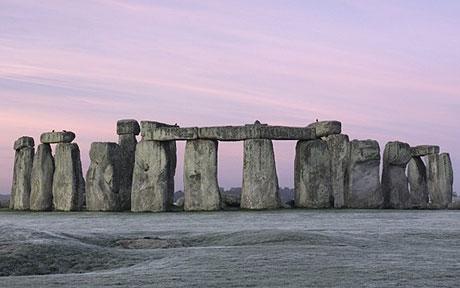
Stonehenge

Jonathan Glancey’s introduction to the Guardian’s Guide to British Architecture encourages a reading of architecture and an immersion in its language (Architecture: an autobiography, 10 September). The buildings “tell tales of people who have lived, loved and worked inside them”. The stories of buildings’ birth, life and death, their design and fabrication, use and abuse, rebirths and ruin, are indeed the narrative that describes a society and its architecture.

Yet the guide as a whole surely misses the deep and longer story of British architecture. Joseph Rykwert’s seminal work The Idea of the Town views the myths and rituals of many previous civilisations; Glancey only allows a brief view of “eight millennia” of architecture with a mention of “the cities and ziggurats (towers) of ancient Sumeria, now hidden from the world in the deserts of southern Iraq”.

Surely Britain is allowed its ancients: does the history of architecture only start with the arrival of Christianity, the dominant force in architecture? Surely it should include places deep in our psyche and defining the last six millennia. Where are the precise fabrications of Stonehenge, and the domestic and environmental connectivity exhibited at Skara Brae? Where are the Romans’ technical marvels, Hadrian’s Wall, and their integrated plumbing and heating?

Are we witnessing an editing moment similar to the TV series Civilisation; or perhaps these Unesco world heritage sites are seen as just buildings, like Nikolaus Pevsner’s bicycle shed – and therefore written out of the story? They were important enough for John Wood, the designer of the Circus in Bath, to survey Stonehenge; and earlier Christopher Wren, a great baroque master, allegedly visited and marked the stones. Peter Ackroyd, in his Hawksmoor novel, develops a narrative that connects Wren at Stonehenge to the death of Wren’s son at the Pyramids of Giza.

Glancey compares the reading of literary greats to the reading of buildings, yet he misses the sensory duet between body and buildings, exemplified by Georges Perec, who combined mathematical and literary puzzles across the life of a Parisian apartment block in Life: a Users Manual. My own favourite from Dickens is a body landscape duet from Great Expectations as Magwitch turns Pip in Cooling churchyard, creating a large-scale metaphoric Thames rotation, moving London west to east.

For me as an architect and tutor, the longer view of British architecture, with civilisations waxing and waning in the face of creative and destructive environmental change, wields salutary lessons.

We can take fictional futures that use the deep and modern past such as those of China Miéville, JG Ballard and Italo Calvino. Digging beyond Calvino’s Invisible Cities, one arrives at the architecture of Cosmicomics, and a fascination in new and rare materials, scientific concepts that become mythical in the Italian’s hand – they are hinted at in your guide’s article on new materials.

Guided tours of Stonehenge
HisTOURies UK – Mystical Landscape, Magical Tours

Read Full Post »

Two children have found “rare” specimens of a fossilised sea creature at the Cotswold Water Park.

Another Rieneckia ammonite was found in the park several years ago

Another Rieneckia ammonite was found in the park several years ago

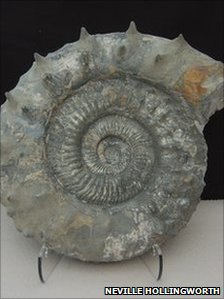
Emily Baldry, five, from Chippenham, discovered the Rieneckia ammonite during a fossil hunt organised by the Cotswold Water Park Society on Sunday.

Hugo Ashley, from Poulton, and his grandfather also found an ammonite cadoceras, and another Rieneckia ammonite.

A society spokeswoman said Rieneckia ammonites were “extremely rare”.

Ammonites were free-swimming molluscs of the ancient oceans, living around the same time as dinosaurs.

‘Quite phenomenal’

Society spokeswoman Jill Bewley said: “The chances of finding something like this [Rieneckia ammonites] are really, really slim.

“It’s the proverbial needle in a haystack so to hit upon something like this is quite phenomenal.”

After Emily hit upon the fossil with a spade, her father and palaeontologist Dr Neville Hollingworth helped her dig out the block of mudstone the 162.8 million-year-old object, which had spikes to ward off predators, was encased in.

A range of other fossils, including many ammonites, were also found during the hunt, in a sand and gravel quarry within the water park.

Ms Bewley said that once work to expose the Rieneckia ammonite, which measures about 40cm (16in) in diameter is complete, it will go on display at the Gateway Information Centre along with a range of other fossils.

She said Dr Hollingworth found another Rieneckia ammonite in a similar quarry in the park several years ago.

The 42 sq mile site of the Cotswold Water Park, which has 150 lakes, is on the Gloucestershire-Wiltshire border.

During the Jurassic period, 165 million years ago, the area was a warm shallow sea.

The Best Tours in British History
HisTOURies UK – Private Guided Tours of Britain

Read Full Post »

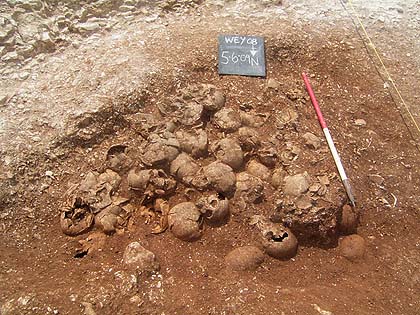
A 2,000-year-old mass grave full of dismembered bodies and skulls has been discovered at an ancient burial site being dug up to create a road for the 2012 Olympics.

Archaeologists excavating the Weymouth Relief Road, on Ridgeway Hill near Weymouth, believe the pit of corpses comprises Iron Age war casualties massacred by the Roman Army.

The road is being dug as part of transport links for the Olympics. Picture courtesy Oxford Archaeology

“We have counted 45 skulls so far in one section of the pit, and several torsos and leg bones in separate sections,” said David Score, Project Manager for Oxford Archaeology.

“It’s very early days but so far, after a visit to the site by our head of burial services, the skulls appear to be predominately those of young men.

Torsos and bones feature. Picture courtesy Oxford Archaeology

“At the moment we don’t fully understand how or why the remains have come to be deposited in the pit, but it seems highly likely that some kind of catastrophic event such as war, disease or execution has occurred.”

Score’s gory finds on the £87 million transport route to the proposed “Olympic Village” are an unprecedented follow-up to the discovery of 12 skeletons at the site in January, when he predicted the team “could find anything” while stripping the soil back.

Archaeologists have been working at the site for months. Picture courtesy Oxford Archaeology

“It is rare to find a burial site like this one,” he added. “There are lots of different types of burial where skeletons may be aligned along a compass axis or in a crouched position, but to find something like this is just incredible.”

Dorset County Council said the development was “extraordinary”, and Head of Highways Andy Ackerman warned the public to stay away from the six-metre pit, which has been fenced off.

Visiting Weymouth during the UK 2012 Olympics ?  We operate private guided sightseeing tours of Dorset, Wiltshire and the West Country

Mysical Landscape, Magical Tours………
HisTOURies UK – The Best Tours in British History

Read Full Post »

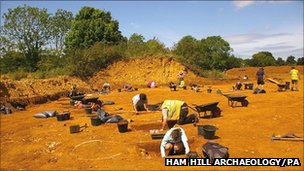
A major excavation is under way to explore the unclear history of Britain’s largest Iron Age hill fort.

The Ham Hill Iron Age hill fort site spreads over 80 hectares making it the largest in Britain

The Ham Hill Iron Age hill fort site spreads over 80 hectares making it the largest in Britain

The purpose of the Ham Hill site in Somerset is not known but researchers are now hoping to gain a deeper insight into life 2,000 years ago.

A joint team from the universities of Cambridge and Cardiff have begun a dig at the 88-hectare site to learn more.

Work is due to continue until September 2013 by which time the team hope to have a clearer map of its interior.

Niall Sharples, from Cardiff University, said: “It’s a bit of an enigma. Ham Hill is so big that no archaeologist has ever really been able to get a handle on it.

“People think of these places as defensive structures, but it is inconceivable that such a place could have been defended.

“Thousands of people would have been required; militarily, it would have been a nightmare.

“Clearly, it was a special place for people in the Iron Age, but when did it become special, why, and how long did it stay that way?”

Researchers believe the site may have been a monument and was somehow meant to create a sense of community, collective identity, or prestige.

‘Communal identity’

Christopher Evans, from the Cambridge archaeological unit, said it was a rare opportunity to tackle the site’s big issues on the scale they deserve.

“We don’t know if the site’s development was prompted by trade, defence or communal identity needs,” he said.

“Equally, should we be thinking of it as a great, centralised settlement place – almost proto-urban in its layout and community size?”

One of the key aims of the current excavation will be to pin down the rough date of the hill fort’s construction.

Smaller scale digs at the site have produced a number of finds, including human remains, the skeleton of a dog, pottery, iron sickles and the remains of a house.

‘There is also a wonderful pearched right on the top of Ham Hill tat serves a mean ‘Ploughmans’ and a great pint’ – Somerset tour guide

The Best Tours in British History
HisTOURies UK – Private Guided Tours of th West Country

Read Full Post »

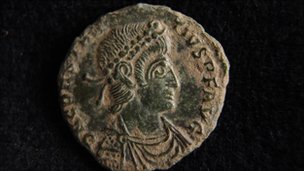
A chance discovery of coins has led to the bigger find of a Roman town, further west than it was previously thought Romans had settled in England.

The town was found under fields a number of miles west of Exeter, Devon.
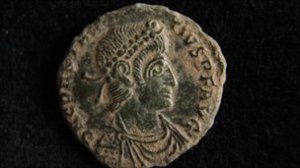
Roman coins found by two local men led to the discovery of a town

Roman coins found by two local men led to the discovery of a town

Nearly 100 Roman coins were initially uncovered there by two amateur archaeological enthusiasts.

It had been thought that fierce resistance from local tribes to Roman culture stopped the Romans from moving so far into the county.

Sam Moorhead, national finds adviser for Iron Age and Roman coins for the PAS at the British Museum, said it was one of the most significant Roman discoveries in the country for many decades.

“It is the beginning of a process that promises to transform our understanding of the Roman invasion and occupation of Devon,” he explained.

After the coins were unearthed by the local men out using metal detectors, Danielle Wootton, the University of Exeter’s liaison officer for the Portable Antiquities Scheme (PAS), which looks after antiquities found by the public, was tasked with investigating further.

After carrying out a geophysical survey last summer, she said she was astonished to find evidence of a huge landscape, including at least 13 round-houses, quarry pits and track-ways covering at least 13 fields, the first of its kind for the county.

“You just don’t find Roman stuff on this scale in Devon,” said Ms Wootton.

She carried out a trial excavation on the site, and has already uncovered evidence of extensive trade with Europe, a road possibly linking to the major settlement at Exeter, and some intriguing structures, as well as many more coins.

“This was a really exciting discovery,” said Ms Wootton. But she said most exciting of all was that her team had stumbled across two burial plots that seem to be located alongside the settlement’s main road.

“It is early days, but this could be the first signs of a Roman cemetery and the first glimpse of the people that lived in this community,” she explained.

Romans in Devon

Not enough excavation has been done yet to date the main occupation phase of the site, but the coins that were found range from slightly before the start of the Roman invasion up until the last in 378AD.

The Romans reached Exeter during the invasion of Britain in AD 50-55, and a legion commanded by Vespasian built a fortress on a spur overlooking the River Exe. This legion stayed for the next 20 years before moving to Wales.

A few years after the army left, Exeter was converted into a bustling Romano-British civilian settlement known as Isca Dumnoniorum with all the usual Roman public buildings, baths and forum.

It was also the principal town for the Dumnonii tribe, a native British tribe who inhabited Devon and Cornwall. It was thought that their resistance to Roman rule and influence, and any form of ‘Romanisation’ stopped the Roman’s settling far into the south west.

For a very long time, it was thought that Exeter was the limit of Roman settlement in Britain in the south west, with the rest being inhabited by local unfriendly tribes.

Some evidence of Roman military occupation has been found in Cornwall and Dartmoor, thought to be protecting supply routes for resources such as tin.

However on this site, more than just the coins are Roman. Pottery and amphora fragments recovered suggest the town embraced trading opportunities in Europe that came with Roman rule, and a fragment of a Roman roof tile has also been found.

Danielle Wootton received some funding from the British Museum, the Roman Research Trust and Devon County Council in June to carry out the trial excavation but said more money was needed as they still had not reached its outer limits.

“We are just at the beginning really, there’s so much to do and so much that we still don’t know about this site.

“I’m hoping that we can turn this into a community excavation for everyone to be involved in, including the metal detectorists,” she explained.

Sam Moorhead said he believed more Roman settlements may be found in the area in the next few years.

The excavation of this unique site will feature in the forthcoming BBC Two series Digging For Britain.

The Best Tours in British History
HisTOURies UK

Read Full Post »

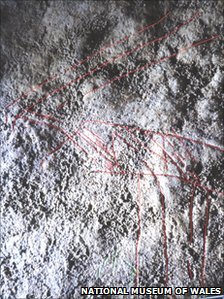
An archaeologist believes a wall carving in a south Wales cave could be Britain’s oldest example of rock art.

The location of the wall carving is being kept secret for the time being

The location of the wall carving is being kept secret for the time being

The faint scratchings of a speared reindeer are believed to have been carved by a hunter-gatherer in the Ice Age more than 14,000 years ago.

The archaeologist who found the carving on the Gower peninsula, Dr George Nash, called it “very, very exciting.”

Experts are working to verify the discovery, although its exact location is being kept secret for now.

Dr Nash, a part-time academic for Bristol University, made the discovery while at the caves in September 2010.

He told BBC Wales: “It was a strange moment of being in the right place at the right time with the right kit.

“For 20-odd years I have been taking students to this cave and talking about what was going on there.

“They went back to their cars and the bus and I decided to have a little snoop around in the cave as I’ve never had the chance to do it before.

“Within a couple of minutes I was scrubbing at the back of a very strange and awkward recess and there a very faint image bounced in front of me – I couldn’t believe my eyes.”

He said that although the characteristics of the reindeer drawing match many found in northern Europe around 4,000-5,000 years later, the discovery of flint tools in the cave in the 1950s could hold the key to the carving’s true date.

Continue reading the main story

“Start Quote

This drawing was done with the right hand and the niche is very, very tight”

End Quote Dr George Nash

“In the 1950s, Cambridge University undertook an excavation there and found 300-400 pieces of flint and dated it to between 12,000-14,000 BC.

“This drawing was done with the right hand and the niche is very, very tight and the engraving has been done by somebody using a piece of flint who has drawn a classic reindeer design.

“My colleagues in England have been doing some work in Nottinghamshire at Creswell Crags and got very nice dates for a red deer and one or two other images of around 12,000-14,000 BC.

“I think this [newly found carving] may be roughly the same period or may be even earlier.”

Glacial geology

The limestone cliffs along the Gower coast are known for their archaeological importance.

The Red Lady of Paviland, actually the remains of a young male, is the earliest formal human burial to have been found in western Europe. It is thought to be roughly around 29,000 years old.

It was discovered at Goat’s Hole Cave at Paviland on Gower in 1823 by William Buckland, then a geology professor at Oxford University.

Dr Nash added: “We know from the glacial geology of the area this was an open area just before the ice limit came down from the glaciers 15,000-20,000 years ago and it stops just about 2km short of the cave site.

“We know hunter fisher gatherers were roaming around this landscape, albeit seasonally, and they were burying their dead 30,000 years ago and making their mark through artistic endeavour between 30,000 and 40,000 years ago.”

The find is now being officially dated and verified by experts at the National Museum of Wales and Cadw.

Its location will be revealed to the public in the future.

The Best Tours in British History
HisTOURies UK

Read Full Post »

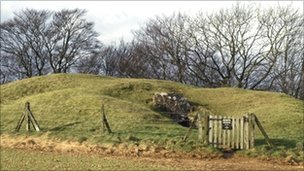
An ancient burial site which dates back thousands of years has been reopened to the public after two years of repairs.

The Long Barrow, known as Hetty Pegler's Tump, could date back as far as 3200BC

The Long Barrow, known as Hetty Pegler's Tump, could date back as far as 3200BC

Uley Long Barrow in Gloucestershire, known as Hetty Pegler’s Tump, was closed while urgent structural work was carried out at the Neolithic site.

Structural damage to the interior dry stone walls of the burial chamber had left it in an unsafe condition.

English Heritage has overseen the work to restore the 120ft (37m) long monument which dates back to 3200BC.

Mark Badger, from English Heritage, said: “We are delighted that this very significant Long Barrow is once again open to visitors.

“The archaeological investigations carried out during the urgent works by the Cotswold Archaeology team have also confirmed the original plan of the burial chambers which were excavated in both 1821 and in 1854.”

Samples of original Neolithic mound material will now be taken away for analysis in a bid to establish a more accurate date.

The scheduled monument is managed by Gloucestershire County Council on behalf of English Heritage and is named after Hester Pegler, the 17th century owner of the field in which it sits.

It is one of a series of ancient stone structures known as the Cotswold-Severn barrow group, sited near Dursley and overlooking the Severn Valley.

Very little is known about who was buried there other than that they were from some of the first settled farming communities

Link: http://www.english-heritage.org.uk/daysout/properties/uley-long-barrow-hetty-peglers-tump/

Wessex Tour Guide
HisTOURies UK – The Best Tours in Ancient History
Mystical Landscape, magical tours………….

Read Full Post »

The ancient standing stones at Avebury, lie between Swindon and Devizes on the A4361. Avebury rings are a World Heritage site and attracts thousands of visitors annually, who are no doubt intrigued by the mystery that surrounds their construction.
Avebury Stone Circle
The henge is believed to date back to around 2600BC; just what motivated our ancestors to construct such an elaborate site and their ultimate purpose in doing so remains largely a mystery. It has been suggested (one of many theories) it may have been used as a place of worship and sacrifice. Some favour an astral observatory, difficult to prove I shouldn’t wonder, in view of the fact that many of the stones are missing and any alignment with the stars must be considered near impossible. Others believe it had a connection with Silbury Hill (see sidebar for more info)and was used to gauge the seasons for agriculture. Whatever the reasons for its construction, its true purpose still eludes archaeologists and scholars to this day.

It is unfortunate that not all of Avebury’s 154 sarsen stones (most likely quarried and transported on wooden rollers from the Marlborough hills) have survived. Of the three rings and the Avenue that make up the henge, only 36 stones are still standing. Many were destroyed or buried (some still are) in massive pits during the 14th century by devout local Christians because a) they believed them to be the harbingers of ill luck and b) to eradicate pagan worship from the monument.

It was during the 18th century that the stones came under attack once more, not from zealous Christians this time but from local construction workers who decided it would be a jolly good idea to utilizes the stones to construct several of the cottages in the village; the grand 15th century Tudor manor and the modernization of 12th century church of St. James. Some of these magnificent stones even went to cobble the streets of Devizes seven miles to the south.

It wasn’t until the intervention and purchase of the site by Marmalade tycoon and archaeologist – Alexander Keiller in the 1930’s, that the destruction ceased. Keiller was responsible for much of the conservation and re-erection of the stones. His work was interrupted during the outbreak of the WWII and remains unfinished to this day, unfinished because there are still stones which lay buried.

Keiller purchased Avebury Manor in 1937 and utilized and modernized the stable block to house a museum of his work and findings. Although small, it is well worth a visit.

Folklore

Folklore has evolved over a millennia regarding the alleged power of Avebury’s standing stones. A fascination has grown for these enigmatic sarsens, which appear to cast their spell on many who see them. The stones are often referred to as ‘grey wethers’ on account of their resemblance to grazing sheep when seen from a distance. Some believe the sarsens have healing properties and by a ‘hugging’ one, it will release its magical properties and cure most ills. Others have claimed whilst hugging a stone, to have felt vibrations emanating from within its very core. ‘Stone hugging’ is a common sight at Avebury. Often when I have been driving past, I can pretty much guarantee that someone will be flat against a stone, adopting a pose reminiscent of the crucifixion and gazing heavenward in eager anticipation of “the vibe‘. I think “the vibe,” can more than likely be attributed to the rumble and subsequent vibration of traffic passing close by on the A4361. There’s nout queerer than folk and Avebury attracts them in swarms – bless ‘em. As mentioned earlier, the locals used to believe the stones were harbingers of ill luck, so hugging one is probably not such a good idea.

Dowsers, crystal pendulum swingers, new age folk, druids, pagans and an assortment of other folk all looking for that something, descend on the village annually, and why not, everyone to their own I say.

With all the magic, mystery and ancient rituals which have grown up around the stones, you would have thought the circle would be a paranormal hotspot. If truth be known, the opposite is very much the case, especially when compared to the generous helping of ghostly history from the likes of The Red Lion pub, which stands within the circle; the resplendent Tudor Manor and the 12th century church of St. James. All these buildings positively exude tales to chill you to the marrow. The few hauntings and folklore that have been reported from the henge are as follows:

Back in the Sixties, a woman driving through the village late at night, reported seeing ghostly figures dressed in period costumes dancing amongst the stones. I would question, that what she actually saw, was probably nothing more than one of the many rituals and parties which take place regularly at Avebury.

There are claims of dwarf like creatures seen darting amongst the stones in the dead of night and of a spectrum of tiny twinkling lights believed by some to be fairy folk. These lights have been seen countless times dancing above the stones, especially the mysterious Diamond Stone, which is located at the north-west quadrant, a stone incidentally, said to uproot itself and crosses the A4361 at the stroke of midnight, no mean feat at around 40 tonnes.

The henge is thought to have several ley lines (hypothetical veins of invisible energy beneath the earth, said to connect ancient megalithic sites, monuments and even buildings, particularly churches) which dowsers especially believe crisscross beneath the henge and are most likely responsible for generating subterranean “earth energy.”

Avebury is a fascinating place and well worth a visit, if only to marvel at its construction and debate its mystery. That said, the claims surrounding the stones abilities will, I’m sure, stretch even the most vivid of imaginations.

Links:
http://hauntedwiltshire.blogspot.com
http://www.nationaltrust.org.uk/main/w-avebury
http://www.StonehengeTours.com

Guided tours of Stonehenge and Avebury Stone Circle
HisTOURies UK – The Best Tours in Ancient History
Mystical Landscape, magical tours………….

Read Full Post »

The Festival for British Archaeology is a fortnight long extravaganza of heritage events, celebrating archaeology for all, and encouraging people to get involved in archaeology. It is made up of hundreds of events across the UK. The Festival of British Archaeology grew out of National Archaeology Week in 2009 to reflect the huge growth of the event in recent years, when it moved from a week-long to a fortnight-long event.

Find out what took place at events around the UK as part of the Festival 2010.

Taking Part

The Festival for British Archaeology is your unique chance to discover and explore the archaeological heritage of the United Kingdom. During this 16 day event, which will run from 16th – 31st July in 2011, you can take part in excavation open days, hands-on activities, family fun days, guided tours, exhibitions, lectures, ancient art and craft workshops and much, much more. Find out what events are happening near you! Put the date in your diary!

Aim of the Festival

The aim of this annual event is to encourage everyone, and especially young people and their families to visit sites of archaeological/historical interest or museums, heritage and resource centres, to see archaeology in action and to take part in activities on-site.

The Festival for British Archaeology is coordinated by the Council for British Archaeology, an educational charity working throughout the UK to involve people in archaeology and to promote the appreciation and care of the historic environment for the benefit of present and future generations. The CBA brings together those for whom archaeology is an interest, an active pastime or a career.

Festival Background

The Festival for British Archaeology originated as National Archaeology Day, first held in 1990 with a total of ten events. Initially it was linked in with European Heritage Days in September of each year, but feedback from participants led to a move to July to make the most of the fieldwork opportunities and to gain maximum publicity. Popularity increased and in 2003 it became a weekend event with 195 events around the country.

A further increase to 232 events in 2004 led to the first nine-day National Archaeology Week being held in July 2005. The number of organisations taking part in National Archaeology Week and public awareness of the event continued to expand rapidly over the next 3 years, and in 2008, over 470 events were held around the UK, with an estimated 160,000 people taking part.

Due to the ongoing success of National Archaeology Week and as a response to positive feedback from both event organisers and members of the public, the event was expanded still further in 2009, to a fortnight long event, and with the new fortnight came the introduction of the new name Festival of British Archaeology. By expanding the number of days the event is held over, event organisers have a greater choice of when to hold events and members of the public have the opportunity to attend a greater number of events. The expanded, newly named Festival is a great success, with 650 events held during the fortnight in 2009, 760 events in 2010, and over 160,000 participants attending events annually.

Link: http://www.britarch.ac.uk

Get involved!

Wessex Tour Guide
HisTOURies UK – The Best Tours in British History

Read Full Post »

« Newer Posts - Older Posts »