Feeds:
Posts
Comments

Archive for the ‘archaeology’ Category

Scour the floor near most offices and there’ll be plenty of signs of the modern worker’s addiction to tobacco.

But archaeologists investigating a site in Bath have found evidence of the grip on life of smoking two centuries ago.
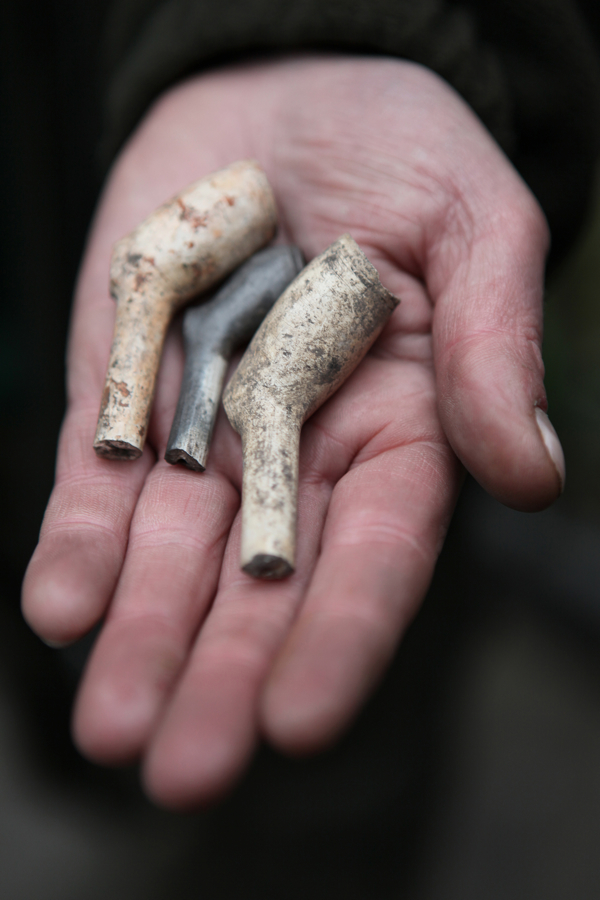
A dig at a city centre car park has unearthed clay smoking pipes.

The pipes were discovered by specialists exploring the area under the Sawclose car park.

They date back to the 19th century, when there was a factory at the site.

Senior project officer for Cotswold Archaeology Chiz Harward said: “We found quite a few clay pipes while digging. Pipes were the principal way of smoking tobacco until the late 19th century when cigarettes came in.

“Some of the bowls are still intact, which is good as clay pipes are very fragile.”

The dig is being carried out ahead of possible redevelopment in the area and the private car park behind the public spaces has been closed while the work takes place.

Meanwhile, an open day was held at the scene of a dig carried out by the Bath and Camerton Archaeological Society at Laverton near Norton St Philip.

The group is excavating a medieval building at Upper Row Farm as part of the Homefield Project, which aims to answer specific questions about settlement in the area.

The event was part of the National Festival of Archaeology, which will also see two free events at the Museum of Bath at Work this Saturday.

There will be a walking tour of the working heritage of Bathampton, presented by director of the museum Stuart Burroughs, starting at 11am from the car park of the Bathampton Mill restaurant. It will feature the Kennet and Avon Canal, and the site of the village’s Plasticine factory.

The second event is a discussion called Industrial Heritage at Risk: Bath and Beyond, led by Keith Falconer from English Heritage.

It starts at 2pm at the Julian Road museum, with a light lunch available from 1pm.
Join us on a private guided tour of Bath soon and discover more……….

The Best Tours of Stonehenge and Bath
HisTOURies UK – Mystical Landscape, Magical Tours
Read Full Post »

Archaeological investigation dates Marlborough Mound at around 2400 BC 

The Wiltshire landscape around Avebury and Silbury Hill is the heart of prehistoric Britain, and has World Heritage designation. Now another monument can be added to its archaeological treasures: the Marlborough Mound.

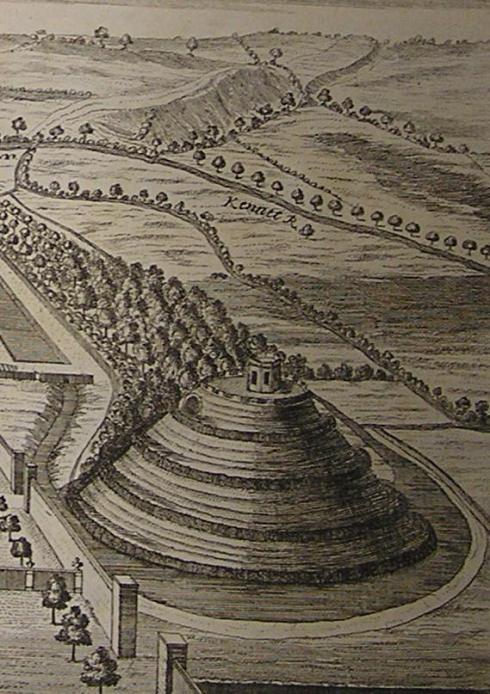
William Stukeley’s 1723 image of Marlborough “Mount”

William Stukeley’s 1723 image of Marlborough “Mount”

The Mound, in the grounds of Marlborough College, was already recognised as a feature of considerable historical significance. It was the motte on which the keep of Marlborough Castle was built fifty years after the Norman Conquest and it subsequently became the centrepiece of a major seventeenth century garden. The latest research has extended its history back by three millennia.

Recent coring of the mound at Marlborough College produced four samples of charcoal, allowing radiocarbon dating for the first time. The samples, which came from different levels in the mound, were taken from two bore holes through the height of the 19m monument, showing that it was built in the years around 2400 BC. This is the first firm evidence proving the theory that the castle motte is largely a re-used prehistoric structure of the highest national standing.

Jim Leary, who led the recent archaeological investigations for English Heritage at the nearby Silbury Hill, and is co-author of the recently published ‘The Story of Silbury Hill’ coordinated EH’s contribution, which also included radiocarbon dating. He says, “This is an astonishing discovery. The Marlborough Mound has been one of the biggest mysteries in the Wessex landscape. For centuries people have wondered whether it is Silbury’s little sister; and now we have an answer. This is a very exciting time for British prehistory”

After the prehistoric mound was re-used as a castle motte – the only known example of its kind – it became an important royal castle for the Norman and Plantagenet kings. It was occasionally the scene of major political events, such as the general oath of allegiance to King John in 1209, as well as being a favourite royal hunting lodge. In the fourteenth century the castle passed to the queens of England, and gradually became neglected.

In the seventeenth century it came into the possession of the Seymour family, and its next avatar was as a feature in a historically significant early romantic garden: a spiral ramp was cut in its side, with a hawthorn hedge enclosing the path which wound to the summit, where there was a water feature.

The Master of Marlborough College, Mr Nicholas Sampson, said: ‘We are thrilled at this discovery, which confirms the long and dramatic history of this beautiful site and offers opportunity for tremendous educational enrichment.’

The work is part of a major conservation programme being undertaken by the Marlborough Mound Trust, specially formed at the invitation of the College and under the coordination of Donald Insall Associates. The Chairman of the Trust, Mr Michael Macfadyen says, ‘The inspiration for this was our founder Eric Elstob, a former pupil at the College, whose generous legacy has provided the means for this work. He would have been totally delighted by this news.’

Links: https://www.marlboroughcollege.org

“This is an astonishing discovery. The Marlborough Mound has been one of the biggest mysteries in the Wessex landscape. For centuries people have wondered whether it is Silbury’s little sister; and now we have an answer. This is a very exciting time for British prehistory”

Wiltshire Tour Guide
HisTOURies UK - The Best Tours in Wiltshire

Read Full Post »

Durrington Walls Excavations“Excavations at the site of the former MOD Headquarters at Durrington have revealed deposits dating to the Late Upper Palaeolithic (Late Glacial) c. 12,000BC and evidence of human activity from the late Neolithic (2550-2200 BC) through to the modern period, with the main focus of activity dating from the Late Iron Age c.100BC to Romano-British period (AD43-410). The site is located within an archaeologically rich landscape just 1km north of the Neolithic Durrington Walls henge and between the Romano-British settlements at Figheldean and at the Packway enclosure to the north and south respectively.

Two monumental Neolithic posthole alignments, which appeared to follow the contours of high ground, contained Grooved Ware pottery. Potentially contemporary with these alignments was a natural swallow hole or sink hole 25m across which had been consolidated with a flint pebble surface which created a metalled platform covered with flint knapping debris and a broken late Neolithic flint axehead or chisel. In the Iron Age, the site comprised a number of paddocks and small fields, formed by shallow gullies and ditches.”

Full story here: http://www.themodernantiquarian.com/post/95719/news/mod_durrington.html

Reklative links: http://en.wikipedia.org/wiki/Stonehenge_Riverside_Project
http://www.sheffield.ac.uk/archaeology/research/stonehenge

Stonehenge Tour Guide
HisTOURies UK – The Best Tours of Wessex

Read Full Post »

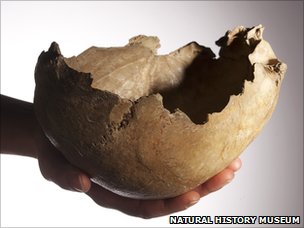
Ancient Britons were not averse to using human skulls as drinking cups, skeletal remains unearthed in southwest England suggest.

The level of modification suggests the ancient Britons were "manufacturing" something of use

The braincases from three individuals were fashioned in such a meticulous way that their use as bowls to hold liquid seems the only reasonable explanation.

The 14,700-year-old objects were discovered in Gough’s Cave, Somerset.

Scientists from London’s Natural History Museum say the skull-cups were probably used in some kind of ritual.

“If you look around the world there are examples of skull-cups in more recent times – in Tibetan culture, in Fiji in Oceania, and in India,” said Dr Silvia Bello, a palaeontologist and lead author of a scientific paper on the subject in the journal PLoS One.

“So, skulls have been used as drinking bowls, and because of the similarity of the Gough’s Cave skulls to these other examples, we imagine that that’s what these ancient people were using them for also,” she told BBC News.

Gough’s Cave is situated in the Cheddar Gorge, a deep limestone canyon on the southern edge of the Mendip Hills.

Palaeo-investigations started there a hundred years ago, with many of the finds now held at the Natural History Museum (NHM).

The site is particularly noteworthy for the discovery in 1903 of “Cheddar Man”, the complete skeleton of a male individual dating to about 10,000 years ago.

But the users – and owners – of the skulls discussed in the PLoS One article are actually from an earlier period in the history of the British Isles.

This was during a brief warm spike in a series of ice ages that allowed humans living in southern Europe to venture north into what was otherwise an utterly inhospitable landscape.

These Cro-Magnons, as we now call them, were hunter-gatherers living on their wits and, it seems, eating human flesh when the need and opportunity arose.

Gough’s Cave famously held the remains of human bones that had been butchered to extract marrow in exactly the same way as animal bones on the site had been processed.

Our modern sensibilities find the thought of cannibalism repulsive, but these people lived in a different age, Dr Bello said:

“They were a one man band; they were going out, hunting, butchering and then eating their kill. And they were extremely skilled at what they did, but then that’s how they survived.

“I think the production of the skull-cups is ritualistic. If the purpose was simply to break the skulls to extract the brain to eat it, there are much easier ways to do that.

“If food was the objective, the skull would be highly fragmented. But here you can really see they tried to preserve most of the skull bone; the cut marks tell us they tried to clean the skull, taking off every piece of soft tissue so that they could then modify it very precisely. They were manufacturing something.”

NHM colleague Professor Chris Stringer helped excavate one of the skull-cups in 1987 and is a co-author on the paper.

“This research shows how extensive the processing of these human remains was,” he said.

“It’s impossible to know how the skull-cups were used back then, but in recent examples they may hold blood, wine or food during rituals.”

At about 14,700 years old, the Gough’s Cave skull-cups would represent the oldest, recognised examples in the world.

The museum plans to put a detailed model of one of the skull-cups on display this March so that visitors can get a deeper insight the practices of these ancient Britons.

Stonehenge Tour Guide
HisTOURies UK – Private tours of the West Country

Read Full Post »

  • The 15ft-high road ran from London to Exeter viaOld Sarum

    It was a route once trod by legionnaires as they marched across a conquered land.

    But, eventually, the Romans left Britain and the magnificent highway they created was reclaimed by nature and seemingly lost for ever.

    Now, some 2,000 years after it was built, it has been uncovered in the depths of a forest in Dorset.
    And, remarkably, it shows no sign of the potholes that blight our modern roads.

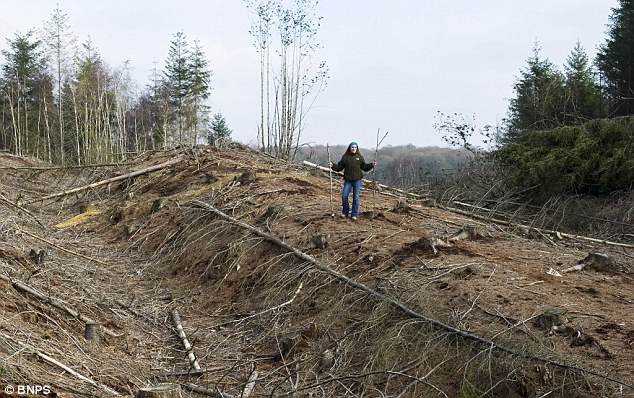
    Half-mile long: Laurence Degoul from the Forestry Commission stands on a 15ft-high section of Roman road uncovered in Puddletown Forest in Dorset

    Half-mile long: Laurence Degoul from the Forestry Commission stands on a 15ft-high section of Roman road uncovered in Puddletown Forest in Dorset

    Constructed by the Roman invaders as part of a route from London (Londinium) to Exeter (Isca), the 85ft wide earthwork stands more than 15ft high and consists of a sweeping road with deep ditches at the side.

    It was so densely covered by trees, however, that although its existence was known about, it simply could not be found until now.

    One of the country’s first roads, it was uncovered when the Forestry Commission, acting on advice from English Heritage expert Peter Addison, cleared the Norway spruce fir trees in Puddletown Forest.

    Mr Addison said it was the biggest Roman road he had come across and that it was probably designed to make a statement. It is thought that it might have been built shortly after the Roman conquest in the first century and its scale would have been chosen to intimidate people living nearby.

    The sight of a Roman legion marching along it would surely have had the desired effect.
    It is thought the road would have been made from layers of gravel and the fact it still exists is testimony to the skills of the builders.

    There is a central cobbled ‘street’, which would have been used for rapid troop movements, and outer ‘droving’ roads for livestock, as well as ditches for water drainage.

    Mr Addison said: ‘It’s extraordinary. It has been known about but when the Forestry Commission wanted to find it, they struggled.

    ‘The trees were planted so tightly it was difficult to move through them. But they called me in and I managed to find it.

    ‘It is part of the road that goes from Badbury Rings to the fort at Dorchester and was part of the network of roads from Old Sarum (now Salisbury) to Exeter.

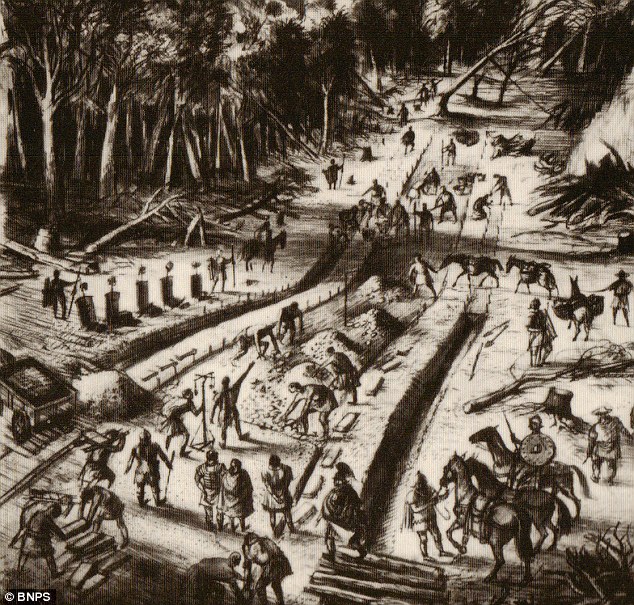
    Artist's impression: The Roman road being built in the Dorset forest 1,900 years ago

    Artist's impression: The Roman road being built in the Dorset forest 1,900 years ago

  • It is absolutely huge and unlike anything I have ever seen. Here you have a large road with huge ditches either side. It is raised very high which is unusual. It is only speculation, but the height might have been to make a statement.

    ‘It is thought this was a road made early in the occupation and not used for long. If so, then it would have been incredibly impressive to the local people.

    ‘In other parts of the forest we know the road was made using gravel and they probably used layers to build up the agger (embankment). They built ditches on either side to act as soakaways to prolong the life of the road.

    ‘But more work needs to be done to find out these details.’

    It is hoped that archaeologists will be able to examine the road.

    A Forestry Commission spokesman said it would not be planting any more trees on it.

    The road will probably be grassed over in the future, he added.

    ‘We have painstakingly uncovered one of the UK’s most remarkable sections of ancient Roman road,’ the spokesman said.

    Wessex Tour Guide
    HisTOURies UK – The Best Tours in History

    Read Full Post »

    Neil Oliver tells the epic story of how Britain and its people came to be over thousands of years of ancient history – the beginnings of our world forged in ice, stone, and bronze.

    About the Programme

    A History Of Ancient Britain will turn the spotlight onto the very beginning of Britain’s story. From the last retreat of the glaciers 12,000 years ago, until the departure of the Roman Empire in the Fifth Century AD this epic series will reveal how and why these islands and nations of ours developed as they did and why we have become the people we are today. The first series transmits in early 2011 and there will be a following series in 2012.

    As well as being a presenter, Neil is also an archaeologist, historian and author. He began his television career in 2002 with the BBC2 series ‘Two Men in a Trench’. This battlefield archaeology series explored iconic British battle sites, focusing on human stories, tragedies and drama.

    Neil became a familiar face on television thanks to the hugely popular, award winning programme, ‘Coast’, in which the landscapes, history, geography and people of the British Isles are given centre stage in a continuing voyage of discovery, remembrance and reminiscence.

    Neil also presented ‘A History of Scotland’ on BBC 1 and BBC2. In this series he revealed how the story of his native Scotland is instrumental to the history of, not only Britain, but also Europe and much of the wider world.
    Neil Oliver takes us on an epic journey expoloring how Britain and its people came to be.
    Watch the trail here
    Neil Oliver’s official website

    Stonehenge and Ancient Britain Tour Guide
    HisTOURies UK – The Best Tours in History

    Read Full Post »

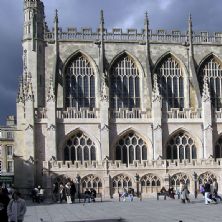
    Bath Abbey Tours

    Bath Abbey Tours

    As part of an on-going project, led by architects Feilden Clegg Bradley, looking at possible future improvements to the Abbey, this month sees the start of a series of archaeological digs in and around the building, which dates back to 1499, (it’s the third church on the site, the original Anglo-Saxon Abbey Church was founded in 757).  There will be seven digs in total, six in the Abbey: choir vestry, shop, near the Montague Tomb, Alphege Chapel, South Transept, and one near the font; the seventh will be outside, between Kingston Buildings and the Abbey.

    The digs, which will be carried out by two local firms, Emerys, who will be responsible for the building work and reinstatement, and Cotswold Archaeology, who will carry out the archaeological observation and recording.  The purpose of the digs is to discover what may or may not be possible in terms of ensuring the Abbey is fit for the 21st century.  One possibility to be explored is the installation of an underfloor heating system, drawing on the springs that feed the nearby Roman Baths.
    The Abbey will remain open during the work, and whilst visitors may find a few views to be limited and some of the Victorian pews missing, it is also hoped that they will be able to observe some of the archaeological work, perhaps via closed circuit television.

    There is an air of excitement at the Abbey as everyone looks forward to seeing ledger stones that have been invisible for 150 years and underground views that were hidden from their predecessors, as well as looking forward to new possibilities.

    The work has been made possible due to a generous donation from the Friends of Bath Abbey, who are very interested in the Abbey Development Project.   If you are interested in becoming a Friend, or making a donation, visit http://www.bathabbey.org/friends.htm

     For further information about the Abbey, including the times of services, its history and information about visiting, please visit www.bathabbey.org

    BBC – Historic Bath Abbey hosts big archaeological dig

    Tower ToursBath Abbey

    A Tower Tour gives visitors to the Abbey a chance to look at the building from a very different perspective. There are 212 steps to the top of the Tower

    Neeldess to say we offer guided tours of the Roman Baths and Bath Abbey.  Visit our website for more details.
    Bath Tourist Guide
    HisTOURies UK – The Best Tours in History

    Read Full Post »

    Archaeologists hail oldest wooden structure ever found on river, despite security services’ armed response to researchers
    The headquarters of MI6 on the banks of the Thames in London. Photograph: Bertrand Langlois/AFP/Getty Images
    The headquarters of MI6 on the banks of the Thames in London. Photograph: Bertrand Langlois/AFP/Getty Images

    When MI6 set up home on the banks of the Thames one secret escaped its watchful eyes. The oldest wooden structure ever found on the river, timbers almost 7,000 years old, have been discovered buried in the silt below the windows of the security services’ ziggurat headquarters at Vauxhall, south London.

    The archaeologists who uncovered the six hefty timber piles had to explain to the security services what they were up to when armed police turned up after they were spotted pottering about on a foggy day in the mud, armed only with tripods, cameras and measuring equipment – not, as one spectator had apparently reported, shoulder-mounted rocket launchers.

    “They accepted there wasn’t much damage we could do with a tripod,” said Gustave Milne, the archaeologist who leads the Thames Discovery programme that has been surveying the entire prehistoric foreshore, uncovering centuries of ancient wharves, fish traps, jetties and ship timbers.

    The timbers, partly scoured bare by erosion of the river bed, the largest up to a third of a metre in diameter, were discovered in work during exceptionally low tides last February, but carbon dating work – revealed in the new edition of London Archaeologist journal – has only recently been completed, proving that the trees were felled between 4790 BC and 4490 BC.

    Although the site is now exposed only at the lowest tides, the ancient Thames was narrower and deeper, and Milne believes that 7,000 years ago the timbers may have been built on dry land, possibly at the highest point of a small island.

    “The find is very interesting, because in the mesolithic period the people were nomadic hunter-gatherers, living in temporary camps – not at all given to building substantial structures like this,” Milne said.

    “At the moment we don’t have enough timbers to give any kind of alignment, they’re not in a straight or a circle – but they could have supported a substantial platform with some form of domestic structure or dwelling.”

    The site is just where a smaller river, the Effra, enters the Thames, and it was clearly important to the prehistoric Londoners. The archaeologists, working with experts from the Museum of London and English Heritage, also found worked flint from the same date as the timbers, older pottery, and just upstream, on the far side of the modern Vauxhall bridge, a much later Bronze Age structure.

    “There may have been a ford, it may have had some religious significance, or it may just have been very rich hunting grounds – but it was clearly what my colleague at the Museum of London calls ‘a memorable place’,” Milne said.

    “We’re just sorting out which are the lowest new year spring tides to go back for another look – if Mr Bond will let us.”

    External link: http://www.guardian.co.uk/science/2011/jan/06/ancient-timbers-mi6-headquarters
    Thames Tours: http://www.bestvaluetours.co.uk/

    British Tour Guide
    HisTOURies UK – The Best Tours in History

    Read Full Post »

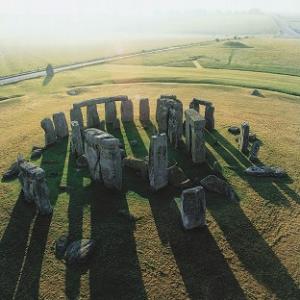
    New Stonehenge theory:
    Neolithic engineers may have used ball bearings in the construction of Stonehenge, it was claimed today.

    Stonehenge

    Stonehenge Mystery

    The same technique that allows vehicles and machinery to run smoothly today could have been used to transport the monument’s massive standing stones more than 4,000 years ago, according to a new theory.

    Scientists showed how balls placed in grooved wooden tracks would have allowed the easy movement of stones weighing many tons.

    No-one has yet successfully explained how the heavy slabs used to build Stonehenge were shifted from their quarries to Salisbury Plain.

    Some, the bluestones, weighed four tons each and were brought a distance of 150 miles from Pembrokeshire, Wales.

    Attempts to re-enact transporting the blocks on wooden rollers or floating them on the sea have not proved convincing.

    The hard surfaces and trenches needed when using rollers would also have left their mark on the landscape, but are missing.

    Experts hit on the new idea after examining mysterious stone balls found near Stonehenge-like monuments in Aberdeenshire, Scotland.

    About the size of a cricket ball, they are precisely fashioned to be within a millimetre of the same size.

    This suggests they were meant to be used together in some way rather than individually.

    The Scottish stone circles are similar in form to Stonehenge, but contain some much larger stones.

    To test the theory, researchers from the University of Exeter constructed a model in which wooden balls were inserted into grooves dug out of timber planks.

    When heavy concrete slabs were placed on a platform above the balls, held in position by more grooved tracks, they could be moved with ease.

    Archaeologist Andrew Young described the experiment in which he sat on top of the slabs to provide extra weight.

    He said: “The true test was when a colleague used his index finger to move me forward – a mere push and the slabs and I shot forward.

    “This proved the balls could move large heavy objects and could be a viable explanation of how giant stones were moved.”

    The team went on to carry out a life-size test funded by an American TV documentary maker.

    To reduce costs, the scientists used relatively soft green wood rather than the hard oak that would have been plentiful in Neolithic times, when Britain was covered in forest.

    This time, the researchers used hand-shaped granite spheres as well as wooden balls.

    The results proved the technique would have made it possible to move very heavy weights long distances.

    Professor Bruce Bradley, director of experimental archaeology at the University of Exeter, said: “The demonstration indicated that big stones could have been moved using this ball bearing system with roughly 10 oxen and may have been able to transport stones up to 10 miles per day.

    “This method also has no lasting impact on the landscape, as the tracks with the ball bearings are moved along leap-frogging each other as the tracks get moved up the line.”

    Neolithic people were known to cut long timber planks, which they used as walkways across bogs, Prof Bradley pointed out.

    Although the tests do not prove for certain that the ball bearing method was used, they show “the concept works”, he said.

    He added: “This is a radical new departure, because previous ideas were not particularly effective in transporting large stones and left unanswered questions about the archaeological record they would have left behind.”

    The next stage in the project is to provide mathematical evidence of how much force would be needed to keep a stone moving.

    Ultimately, the scientists hope to conduct a full-scale experiment in Aberdeenshire using more authentic materials, stone balls and a team of oxen.

    Stonehenge Tour Guide
    HisTOURies UK – The Best Tours in Wiltshire

    Read Full Post »

    Stone Age humans had to evolve a higher level of intelligence before they were able to develop real tools like axes, scientists have proved.

    It took early man almost two million years to move form simply using sharp stones to more complex tools like a stone axe.

    Scientists used computer modelling and tiny sensors embedded in gloves to assess the complex hand skills that early humans needed in order to make two types of tools during the Lower Palaeolithic period, which began around 2.5 million years ago

    Stone Age man took two million years to move from simple stone tools to more complex ones like handheld axes

    Stone Age man took two million years to move from simple stone tools to more complex ones like handheld axes

    Researchers from Imperial College London employed a craftsman called a flintnapper to faithfully replicate ancient tool-making techniques.

    The flintnapper created two types of axes wearing he data glove fabric to record hand and arm movements during the production of sharpened flints or more complex handheld stone axes.

    This enabled the scientists to rule out motor skills as the principal factor for holding up stone tool development as both types were equally complex to produce.

    Until now some scientists believed that it took Stone Age man so long to develop real tools because early humans may have had underdeveloped motor skills or abilities.

    Bbut this study confirms that the evolution of the early human brain was behind the development of the axe.

    The team say that comparing the manufacturing techniques used for both Stone Age tools provides evidence of how the human brain and human behaviour evolved during period.

    Neuroscientist Dr Aldo Faisal said ‘The advance from crude stone tools to elegant hand-held axes was a massive technological leap for our early human ancestors. Hand-held axes were a more useful tool for defence, hunting and routine work.

    ‘Interestingly, our study reinforces the idea that tool making and language evolved together as both required more complex thought, making the end of the Lower Palaeolithic a pivotal time in our history.
    ‘After this period, early humans left Africa and began to colonise other parts of the world.’

    They also believe that the development of hand-held axes may have also coincided with the development of language, as these functions overlap in the same regions of the modern and early human brains.

    The results showed that the axe required a high level of brain processing in overlapping areas of the brain that are responsible for a range of different functions including vocal cords and complex hand gestures.

    In the future, the team plan to use their technology to compare tools made by Neanderthals, an extinct ancestor of humans, to glean insights into their brain development.

    Explore more:

    Places:
    Africa
    Stonehenge
    Organisations:
    Imperial College

    Read more: http://www.dailymail.co.uk/sciencetech/article-1326880/Why-Stone-Age-man-needed-evolve-brain-power-make-axes.html?ITO=socialnet-twitter-dmailscitech#ixzz14sKuiH4U

    Stonehenge Tour Guide
    HisTOURies UK – The Best Tours in ancient History

    Read Full Post »

    « Newer Posts - Older Posts »