Feeds:
Posts
Comments

Archive for the ‘archaeology’ Category

When one thinks of Wiltshire the images which spring most readily to mind are the spacious rolling downland of Salisbury Plain and associations with pre-history which are at their most stunning at Avebury and Stonehenge. Whilst Wiltshire is more complex than this a journey northwards to the Marlborough Downs will reinforce this picture of sweeping chalk downland and ancient times. Here, there is also the handiwork of more recent history, in the famous Wiltshire White Horses. There are now eight of them and they have their own newly opened long distance path, ‘The White Horse Trail’.

The Vale of Pewsey and Savenake Forest, part of the Kennet District, offer a complimentary landscape which also has many enjoyable walking opportunities; and the Kennet and Avon canal, joining the two rivers, provides delightful waterside rambling through peaceful rural countryside.

South of Salisbury Plain the Wylye and Nadder river valleys offer lovely walks, once again through a quiet rural landscape a million miles away from the hustle of industrial Swindon in the north of the county.

Guide Books:

  Guide Books: [For further information]
100 Walks in Wiltshire by: Various contributors. An omnibus of local walks covering the whole of Wiltshire. The book is ideal for family outings and as a valuable reference book for residents and visitors to the region. There is a wide choice of routes with perhaps two thirds spread over the northern part of the county. Salisbury Plain is not well represented, but this is largely due to Ministry of Defense activities, which do not co-exist well with peaceful country walking. However all the best parts of Wiltshire are covered. The walks vary in length from 2 to 12 miles, the majority being in the 4/6 mile range. Sketch maps and route descriptions are on facing pages.
Walks in Mysterious Wiltshire by: Laurence Main. Discover Wiltshire’s secret places. Wiltshire has long been associated with both historic and prehistoric sites, most notably Avebury and Stonehenge. See and experience these for yourself and contemplate their significance as temples, secular monuments or ancient observatories. Many more mysteries await walkers in this historic area; white horses carved on Wiltshire’s hillsides, sites of ancient battles, neolithic burial sites and a network of ley lines, those ancient trackways often associated with spirit pathways. There are stories of Wiltshire’s witches, folklore traditions, Arthurian legends and even UFO’s! These are just some of the prospects offered in 27 well planned routes of interest to all the family.
Waterside walks in Wiltshire by: Nick Channer. The 20 circular routes in this book are all between 2 and 9 miles in length. Each walk instruction also includes details on how to get to the start by car, where to park, and what food and drink are available locally. For greater clarity, the route descriptions are divided into numbered paragraphs, which correspond with the numbers on the accompanying sketch maps. There are also seperate sections about places of interest to visit nearby. From walks near Heytesbury, once the home of war poet Siegfried Sassoon, the Vale of Pewsey and the National Trust village of Laycock to Salisbury’s watermeadows and Devizes’ flight of 29 canal locks, this book provides the walker with many interesting and exhilarating hours in the open air.
50 Walks in Wiltshire by: David Hancock. 50 themed walks of between 2 and 10 miles, each with fascinating background reading, clear, easy-to-follow route descriptions and detailed sketch maps. Locations include: Chute Standen; Great Bedwyn; Savernake’s Royal Forest; Wootton Rivers; Ramsbury; Clarendon; Amesbury; Avon Valley from Downton; Pepperbox Hill; Vale of Pewsey and Oare Hill; Salisbury; Lydiard Park; Great Wishford; Till and Wylye Valleys; Fyfield Down; Old Sarum; Avebury; Barbury Castle; Cricklade; Dinton and the Nadder Valley; Ansty; Wardour Castle; Ebble Valley; Bowood Park; Bremhill; Heytesbury; Devizes; East Knoyle; Fonthill; Tollard Royal; Roundway Hill; Holt; Castle Combe; Lacock; Bowden Park; Malmsbury; Sherston; Box Hill; Stourhead; White Sheet Hill; Westbury White Horse; Corsham; Longleat Estate; Bradford-on-Avon; Frome Valley; Bath.
Ten Walks in West Wiltshire by: RA West Wilts Group. All are circular and they vary in length from 4 to 11 miles. Locations are as follows: Bradford on Avon – Little Ashley (6km); South Wraxall – Stonar School – Little Chalfield (8km); Warminster – Arn Hill – Upton Scudamore (9km); Holt – Staverton – Whaddon – Broughton Gifford – Great Chalford (10km); Brown’s Folly – Farleigh Wick – Monkton Farleigh (10km); Westbury – Upton Scudamore – Old Dilton (11km); Steeple Ashton – West Ashton – Yarnbrook (13km); Bradford on Avon – Westwood – Freshford – Farleigh Hungerford – Avoncliff (13km); Bratton – Bratton Castle – Edington (14km); Nockatt Coppice – Bidcombe Wood – Cold Kitchen Hill – Brimsdown Hill ( 18km).
Walking in West Wiltshire Book 2 by: RA West Wilts Group. The ten walks in this booklet have been devised and written by ten members of the group. Accordingly the descriptive narratives show a variety of different styles. For ease of use a detailed sketch map is shown opposite each walk description with the route clearly highlighted. Paragraph numbers in the description are shown on the maps at relevant points. This guide allows you to share in the discoveries of experienced ramblers with good local knowledge. The walk starting locations are as follows: North Bradley (8.5km); Semington (8km); Trowbridge (9km); Bradford on Avon (9km); Steeple Ashton (6.5km); Thoulstone (9km); Kingston Deverill (11.5km); Shearwater (10km); Melksham (10.5km); Heytesbury (7km).
Walking in West Wiltshire Book 3 by: RA West Wilts Group. In this book members of the RA West Wilts Group have devised a further ten interesting and enjoyable walks using their local knowledge and experience. For ease of use a detailed sketch map is shown opposite each walk description. Also highlighted are paths providing links with adjacent walks described in the book. The walk starting locations are: Edington (8.5km); Heytesbury (11km); Melksham (10.5km); Horningsham (10.5km); Bradford on Avon (11.5km); Codford (15km); Warminster (12km); Westbury (8km); Broughton Gifford (9.5km); Sutton Veny (15.5km).
Somerset, Wiltshire and the Mendips Walks by: Brian Conduit. 28 routes colour coded for difficulty, varying from extended strolls to exhilarating hikes.The guide introduces you to the area and highlights the most scenic walks. OS Explorer mapping is included. Locations include: Nunney Combe; Nettlebridge and Harridge Wood; Devizes and Caen Hill Locks; Ilminster and Herne Hill; Langport and Muchelney Abbey; Salisbury and Old Sarum; Lacock and Bowden Park; Fovant Down; Old and New Wardour Castles; Avebury; West Kennett and Silbury Hill; Glastonbury; Lambourne Downs; Uffington Monuments and Vale of the White Horse; Ham Hill, Montacute and Norton Sub Hamdon; Cadbury Castle and the Corton Ridge; Hinton Charterhouse and Wellow; Bradford-on-Avon, Pewsey Downs; Stonehenge; Barbury Castle and Ogbourne St Andrew; Wells, Ebbor Gorge and Wookey Hole; Savernake Forest.
Literary Strolls in Wiltshire ans Somerset by: Gordon Ottewell. 40 attractive strolls throughout Wiltshire and Somerset, each with a strong literary association. In Wiltshire, you follow in the footsteps of such remarkable people as multi-talented William Morris, architectural commentator Nikolaus Pevsner, war poet Siegfried Sassoon and Celia Fiennes, the pioneer travel writer. The walk locations include: Swindon and South Cotswold Area – Inglesham; Marston Meysey; Oaksey; Broad Town; Hodson; Barbury Castle; Bishopstone. Chippenham and Devizes Area – Kington St Michael; Kington Langley; Bremhill; Bromham; Broughton Gifford; Poulshot; Bishops Cannings. Salisbury and Warminster Area – Heytesbury; Steeple Langford; Hindon; Tisbury; Mere; Newton Tony; Pitton.
Ten Walks Around Devizes by: Graham Hillier and Ron Wiltshire. 10 circular walks created with the intention of starting and finishing at the focal point of Devizes Town – The Market Place. There is much of interest to see on these walks including a visit to the site of the Civil War battle of Roundway Down; a stroll along Quakers Walk, once an elm lined avenue from Roundway Park to Devizes; the remains of Devizes Castle and a medieval deer park enclosure; several stretches along the Devizes canal and the sites of several macabre events desribed in the text. Other locations visited on the walks are Gypsy Patch, Roundway Hill, Hartmoor, Potterne Village, Potterne Woods, Drew’s Pond, Hillworth Park, Sleight and Stert, Consciences Lane, Rowde, Lower Foxhanger’s, and Rangebourne Mill.
11 Half Day Walks in North East Wiltshire by: North East Wiltshire Group – Ramblers’ Association. All the walks are around five miles in length so that only a morning or afternoon is needed to complete them. The walks are well described and sketch maps are included. The walks have been chosen to show the variety of countryside in the area. The walk locations are: Avebury and the Sanctuary; Berwick Bassett Common and Windmill Hill; Love’s Copse and Love’s Lane; Poulton Downs and the Railway Path; Wexcombe and Grafton Downs; Castle Hill and Stanton Fitzwarren; Hare, Aughton and Inham Downs; Hippenscombe Bottom; The Kennet Valley; The Ridgeway and Hinton Downs; Rivers Key, Ray and Thames.
20 Walks Around Swindon by: North East Wilts Group – Ramblers’ Association. This booklet describes 20 circular routes from 2 to 7 miles. Locations are: Cotswold Water Park; Highworth, Red Down and Hannington; Cricklade and Cotswold Water Park; Blunsdon, Stanton Fitzwarren and Kingsdown; Lechlade, Buscot and Kelmscot; Bishopstone, The Ridgeway and Ashbury; Liddington Hill and Downs; Chiseldon and The Ridgeway; Upper Upham; Chilton Foliat and Hungerford; Downs and Og Valley; Barbury Castle, Smeathes Ridge and Burderop Down; Manton and Fyfield Downs; Wootton Bassett, Little Park Farm and Wilts and Berks Canal; Clouts Wood and Elcombe; Peatmoor, Shaw and River Ray Parkway; Lydiard Park and Purton; Coate, Day House Lane and Greenhill; Coate Water and Broome Manor; Old Town Railway and West Leaze.
12 Walks Around Marlborough by: Bert Toomer. The walks in this booklet were devised to take you to the best vantage points in the area and to bring you back to your starting point. Locations are: Circular from Ramsbury; Aldbourne, Ewin’s Hill and Ramsbury; Baydon, Hodd’s Hill and Membury; Great Bedwyn, Wilton and Kennet and Avon Canal; East Croft Coppice; Ramsbury and Littlecote; Piggledene, Stony Valley and Devil’s Den; Marlborough and Mildenhall; Martinsell Hill, Draycot and Gopher Wood; Martinsell Hill, Kennet and Avon Canal and Wootton Rivers; West Woods, Gopher Wood, Knap Hill and Wansdyke; Milk Hill, Wansdyke, Tan Hill and Kennet and Avon Canal; Milk Hill, Wansdyke, Stanton St Bernard and Kennet and Avon Canal.
Nine Downland Walks by: BertToomer. The collection of walks in this booklet will help you make the most of the fine countryside that lies between Swindon and Marlborough. Clear route instructions and sketch maps are provided. The walk locations are: Barbury Castle, The Ridgeway and Burderop Down; Upper Upham and Snap; Smeathe’s Ridge, the Ogbournes and Four Mile Clump; Chiseldon and Hodson; Rockley, Totterdown and Fyfield Down; Ridgeway Path, Shipley Bottom and Sugar Hill; Burderop Down and Smeathe’s Ridge; Hackpen Hill, Rockley, Totterdown and the Ridgeway; Ogbourne St. George, Whiteshard Bottom and Chase Woods.
8 Easy Walks Around Salisbury by: South Wilts Ramblers’ Association. This is a set of eight walk cards contained in a plastic wallet. Each card has a brief description of the walk, the starting point and a sketch map on the front and the route directions on the reverse. The walks are between 2 and 5 miles long. The walk locations are: Charlton All Saints and the River Avon; Godshill Enclosure and Millersford Circular; Breamore House and The Mizmaze; Bowerchalke and over Marleycombe Hill; Fovant Badges and Chiselbury Camp; Old and New Wardour Castles; Great Wishford, Grovely Wood and River Wylye; Battlesbury, Middle and Scratchbury Hills.
10 Short Walks Around Salisbury by: South Wilts Ramblers’ Association This is a set of ten walk cards contained in a plastic wallet. Each card has a brief description of the walk, the starting point and a sketch map on the front and the route directions on the reverse. The walks are between 4 and six miles long. The walk locations are: Salisbury to Old Sarum; Figsbury Ring and Winterbourne; East Grimstead, Bentley Wood, Blackmoor Copse, Farley; Pepperbox Hill and Barford Down; Charlton, Downton and Trafalgar House; Breamore and Whitsbury; Nunton and Odstock; Broad Chalke and The Ox Drove; Dinton, Compton Chamberlayne and Fovant; Great Wishford and Grovely Wood.
10 Longer Walks Around Salisbury by: South Wilts Ramblers’ Association. This is a set of ten walk cards contained in a plastic wallet. Each card has a brief description of the walk, the starting point and a sketch map on the front and the route directions on the reverse. The walks are between 8 and 13 miles long. The walk locations are: Old Sarum to Stonehenge and Amesbury; Around Downton; Woodfalls; Martin Down, Pentridge and Vernditch Chase; Downlands and Valleys; Swallowcliffe, Ansty and Alvediston; The Inner Chase; Old Wardour, Tisbury and Castle Ditches; Sherrington, Great Ridge Wood and Knook; Salisbury Plain and the Till Valley.

 Needless to say we feel its better to join a local guide to explore the area but if you are visiting the area then the books I have listed above may be of great use, enjoy!

Stonehenge Tour Guide
HisTOURies UK – The Best Tours in Wiltshire
Read Full Post »

HISTORIANS in Penmaenmawr believe their ancient landscapes can rival some of the UK’s top tourist attractions.

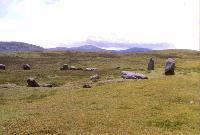
Druids Circle

Druids Circle

Dennis Roberts and David Bathers of the Stori Pen Historical Society hope to have historical sites such as the Graiglwyd axe factory and the Druid’s Circle in the Snowdonia National Park into a UNESCO World Heritage site.

“To have a World Heritage Site would be immense for Penmaenmawr and the whole of Conwy,” said David.

The Graiglwyd axe factory is a Neolithic site where it is thought funerary tools were forged for use at the nearby Druid’s Circle, a collection of 30 stones 80ft in diameter.

// <![CDATA[
if (typeof dartOrd == 'undefined') dartOrd=Math.random()*10000000000000000000;
if (typeof tm.zones == 'undefined') {tm.zones = "";}

(function (x) { if (tm.defer) {tm.defer.defer(x); } else { document.write(x);}})('’);
// ]]>

Excavations at this site have unearthed various relics, including the cremated remains of a child.

“There’s an Iron Age hill fort and there are also Bronze Age sites up there, where people came and settled,” said David.

“There’s a lot of stone areas where Neolithic man used to work.

“The area used to be immensely popular in the 19th century.

“With the right conditions put forward I’m confident it would be recognised.”

David added that it would be years until the site could be put forward for the UNESCO award.

Dennis Roberts is chairman of Penmaenmawr Historical Society.

“We are trying to make people aware of what is available in Penmaenmawr,” he said.

“There’s so much behind Penmaenmawr and Llanfairfechan, the area behind the mountains is extremely rich in prehistory. It would rival some of the Bronze Age sites in Britain.”

The historians plan to organise a trail in the mountains that will highlight the sites, before proposals are put to the United Nations Educational, Scientific and Cultural Organisation. They also plan to put a leaflet together.

Lesley Griffiths of the Penmaenmawr Tourist Association welcomed the proposals: “It’s brilliant news, if it comes to fruition.

“It would be extremely beneficial in that it would bring tourists to the sites. It would put Penmaenmawr back on the map.”

Cllr Ken Stevens added: “Areas of Penmaenmawr have some of the oldest industrial sites in Wales. Not a lot of people know what Penmaenmawr has. I wish them all the luck with it, I think we deserve it.”

Other British UNESCO World Heritage Sites include Stonehenge, the Giant’s Causeway, the Tower of London and Canterbury Cathedral

Stonehenge Tour Guide
HisTOURies UK – The Best Tours in Ancient History

Read Full Post »

David Crisp said the valuation was "fair"

David Crisp said the valuation was "fair"

A hoard of more than 52,500 Roman coins found in a field in Somerset has been valued at £320,250.

The coins were discovered in April by Dave Crisp, from Wiltshire, who will share the sum with the landowner.

Mr Crisp said: “I’m very, very happy with that. I think it’s a fair valuation.”

Somerset County Council hopes to buy the hoard, one of the largest finds of Roman coins in Britain, for display at the Museum of Somerset.

The Treasury Valuation Committee was responsible for determining a value for the find.

The council’s heritage service has received £40,250 from the Art Fund towards the appeal.

‘Important’ discovery

The charity will also match every pound donated by the public up to the value of £10,000.

Steve Minnitt, head of museums for Somerset County Council, said the Frome hoard was one of the most important discoveries made in Somerset in recent years.

He said: “As such, we feel that it’s a find that really needs saving for the people of Somerset, so we’re launching the campaign now.”

The Somerset Archaeological and Natural History Society has also donated £10,000 to the fund.

Under the Treasure Act, the local authority has four months to raise the money, although this deadline can be extended if necessary.

Mr Crisp, a hospital chef, intends to buy a new car with part of his reward money but intends to continue working until his retirement in August 2011.

Stonehenge Guide
HisTOURies UK – The Best Tours in History

Read Full Post »

HE HAS become a byword for an unfeeling brute, but it now seems that Neanderthal Man could simply be deeply ­misunderstood.

Neanderthal Man had a sensitive and caring side, according to new research

Neanderthal Man had a sensitive and caring side, according to new research

Evidence unveiled yesterday suggests that behind that ­low-brow, sloping forehead and crudely ­jutting jaw, lurked a rather ­sensitive and compassionate soul.

Researchers said the sub-­species of modern humans, who lived in Europe and Asia between 230,000 and 29,000 years ago, were actually caring, sharing types who looked after the sick and vulnerable.

The evidence included the remains of a child with a ­congenital brain abnormality who, far from being abandoned, lived to be five or six years old because of ­nurturing.

The researchers, who used new techniques such as neuro-imaging, also cited a ­partially blind caveman with a deformed arm and feet who may have been looked after for 20 years.

Further proof that Neanderthals were committed to the welfare of others was said to lie in their long adolescence – which they could have reached only if older relatives had looked after them.

Dr Penny Spikins, who led the study byYork University’s Archaeology Department, said in the journal Time and Mind: “Compassion is perhaps the most fundamental human ­emotion. It binds us together. The archaeological record has an important story to tell about the prehistory of compassion.”

Stonehenge and Ancient Britain Tour Guide
HisTOURies UK – The Best Tours in History

Read Full Post »

Stonehenge was attracting sightseers thousands of years ago, archeologists say, after discovering the remains of a Bronze Age boy from the Mediterranean.

The teen is believed to have been part of a wealthy group that travelled 2,500 kilometres from southern Europe to Britain. He died, probably from illness, and was buried about a kilometre away while still wearing an expensive amber necklace.

The discovery of The Boy with the Amber Necklace suggests the stone circle would have been a place of pilgrimage or sightseeing as long as 4,000 years ago.

“They may have come to trade, but visited Stonehenge along the way. It would have been an awesome sight,” said Andrew Fitzpatrick, part of the Wessex Archeology team that made the find.

Stonehenge may have been a top international tourist attraction in prehistoric times – just as it is today.

Stonehenge Tour Guide
HisTOURies UK – The Best Tours in ancient History

Read Full Post »

A million visitors from around the world flock to Stonehenge every year. But the monument’s status as an international attraction is nothing new.

Yesterday scientists said the stones were attracting overseas tourists thousands of years ago – after discovering that a Bronze Age teenage boy buried there around 1550BC grew up in the Mediterranean.

The boy – aged 14 or 15 – had travelled to Britain from Spain, Italy, Greece or France, crossing the English Channel in a primitive wooden boat, they said.

He was placed in a simple grave alongside an amber necklace just a mile from the stone circle.

Known as the Boy in the Amber Necklace, his is the third burial site of a foreigner discovered at the World Heritage site in the past few years.

The finds raise the intriguing possibility that Stonehenge was attracting tourists and pilgrims from across the globe thousands of years ago.

Archaeologists have previously shown that the Amesbury Archer – a man buried with a treasure trove of copper and gold and discovered in 2002 – was born in the Alps.

They also believe that the Boscombe Bowmen – a group of seven men, women and children found the following year – originated from Wales, the Lake District or Brittany.

Professor Jane Evans, who traces the birthplace of Bronze Age skeletons using a chemical analysis of teeth, believes the visitors were travelling to Britain specifically to see Stonehenge.

‘If you went to Westminster Abbey today and looked at the people buried there, how many are Londoners?

‘I don’t think many because the great, the good and famous are buried at Westminster Abbey,’ said Prof Evans of the British Geological Survey.

The boy's skeleton was discovered in 2002.The boy’s skeleton was discovered in 2002 at Stonehenge. Today scientists revealed that he must have been born and brought up in the Mediterranean

‘Stonehenge in a similar way is obviously a very important place and people from all sorts of origins came to Stonehenge and were buried there.’

The boy’s virtually intact skeleton was discovered at Boscombe Down, a mile from Stonehenge, by Wessex Archaeology during a housing development.

The remains were radiocarbon dated to around 1550BC – a time when the monument was already more than 1,500 years old.

Prof Evans said: ‘He’s about 14 to 15 years old and he’s buried with this beautiful necklace. From the position of his burial, his age, and this necklace, it suggests he’s a person of significant status and importance.’

She used a slither of tooth enamel the size of a nail clipping to trace his origins.

BeadsThe amber beads that were found buried by his side more than 3,500 years ago

By analysing the ratio of two different forms – or isotopes – of oxygen, the professor found that the boy came from a warmer climate.

And an isotopic comparison of the mineral strontium, which is absorbed by the body from plants, revealed that he was born and grew up in the Mediterranean.

The boy's grave was alongside dozens of other graves at the site but it was the only one that was not from BritainThe boy’s grave was alongside dozens of other graves at the site but it was the only one that was not from Britain

In contrast, the Amesbury Archer, who was buried 1,000 years earlier, was most likely to have been raised in the Alpine foothills of Germany, Prof Evans said.

Mike Pitts, editor of British Archaeology, said: ‘Archaeologists for a long time have been fighting the idea that there was any migration going on at this time.

‘But, clearly, there were individuals moving across huge distances.’

The Boy with the Amber Necklace was found alongside dozens of other graves.

However, all other skeletons studied so far at the site were raised in Britain. Dr Andrew Fitzpatrick, of Wessex Archaeology, said: ‘We don’t know why these people made these long journeys.

‘It’s possible they were coming to visit Stonehenge but we know people had been travelling great distances for thousands of years for trade and exploration.’

Stonehenge was built by early Bronze Age farmers – who lived in homes made of wooden stakes, twigs, chalk and clay – in stages between 3000BC and 2400BC.

It was actively used for at least another 1,000 years.

Stonehenge Tour Guide
HisTOURies UK – The Best Tours in Ancient History

Read Full Post »

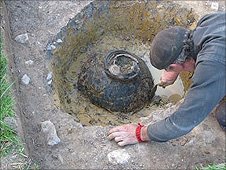
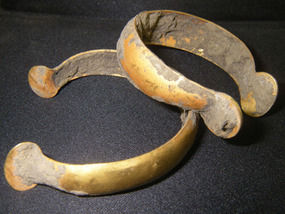
THESE beautiful Bronze Age gold bracelets are the highlights of finds at the site of a new road.

The bracelets, nearly 3,000 years old, were spotted lying on top of a pile of earth dug up from a trench.

Archaeologists are digging on the site of the planned road near Ramsgate, Kent, before builders move in

The bracelets are among 10,000 finds unearthed so far.

The dig on the East Kent Access Road on the Isle of Thanet between Ramsgate and Sandwich is the biggest archaeological excavation in the country this year, involving 150 archaeologists supported by 91 volunteers. It has revealed a huge amount about how people were living on the Isle of Thanet from earliest times.

The remains of prehistoric burial monuments, Iron Age enclosures and a village which would have seen the Roman invasion are among the remarkable discoveries made by the dig, now almost complete.

Simon Mason, Kent County Council’s principal archaeological officer, found the bracelets, dating back to around 700BC.

He said: “It was incredible – a really exciting find. I couldn’t believe it when I saw them. It’s the first time I have found gold in 20 or 30 years as an archaeologist. “They looked too good to be real. When we washed them and cleaned them we realised they were something special.”

It is thought they were child­ren’s bracelets that may have been buried as a worship offering. They were found together, one pushed inside the other.

There is evidence of a Bronze Age settlement on the find site, and five hoards of bronze objects of a similar age have been found in the same area. Mr Mason added: “Their real value to me as an archaeologist is how they contribute to the story we are putting together from our excavations on the road.

“With all the thousands of everyday objects we have dug up they are really helping to shed new light on the lives of prehistoric, Roman and Saxon people in Thanet.”

Dr Andrew Fitzpatrick from Oxford Wessex Archaeology said: “The gold bracelets are stunning.”

The Portable Antiquities Scheme

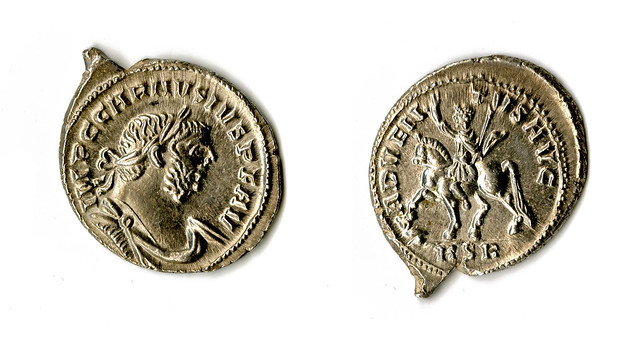
Frome Silver denarius of Carausius 286-93 Adventus (13 3) Composite image

The Portable Antiquities Scheme is a voluntary scheme to record archaeological objects found by members of the public in England and Wales. Every year many thousands of objects are discovered, many of these by metal-detector users, but also by people whilst out walking, gardening or going about their daily work. Such discoveries offer an important source for understanding our past.

This website provides background information on the Portable Antiquities Scheme, news articles, events listings and access to our database of objects and images.

The Treasure Act

All finders of gold and silver objects, and groups of coins from the same findspot, which are over 300 years old, have a legal obligation to report such items under the Treasure Act 1996. Now prehistoric base-metal assemblages found after 1st January 2003 also qualify as Treasure. This website provides further information for finders of potential Treasure

Bespoke Guided Tours of Ancient Britain
HisTOURies UK – The Best Tours in Wiltshire

Read Full Post »

They were crammed together and buried side by side, stripped of all clothing and personal possessions.

Force of circumstance determined this most impersonal and undignified resting place.

For the men buried in mass graves at a ruined York church were the soldiers of Oliver Cromwell’s Parliamentary army.

Roundhead soldiersSkeleton army: The remains found in York, one of 10 mass graves containing Roundhead soldiers

The Roundheads were not killed in combat but probably by infectious disease during the gruelling English Civil War siege of the city.

Oliver CromwellLeader: Oliver Cromwell led the Roundhead cavalry

Their comrades went on to defeat King Charles I’s Cavaliers at the Battle of Marston Moor in 1644 and turn the tide of the war.

But history forgot the more than 100 souls who probably never made it to the battleground.

Now, more than 350 years later, archaeologists have unearthed the graves and their skeletons to reveal the story of Cromwell’s forgotten soldiers.

Routine excavations in 2007 at the site of a medieval church, south of York’s historic city walls, led to the uncovering of ten mass graves.

Archaeologists knew from previous discoveries that the ‘lost’ 11th century church of All Saints in Fishergate had once been there. However, these newlydiscovered graves took archaeologists forward 600 years to a time when the country was split in two by a bloody civil war.

The position of the graves showed they were dug at a time when only the shell of the abandoned church remained. They varied in size, with the smallest containing four skeletons and the largest 18.

RoundheadsDelicate work: An archaeologist examines one of the 350-year-old bodies


RoundheadsNo ceremony: The bodies were evidently buried with some haste

The skeletons were arranged neatly in parallel rows, mostly laid on their side or face down in the dirt, and were packed together like sardines in a can. Larger graves had a second row where the heads of one row overlapped the feet of another.

PSALMS BEFORE BATTLE

Roundheads

Cromwell’s Parliamentary army in 1644 was a loose collection of regional fighting groups, unified the following year as the New Model Army.

The intention was to enforce strict discipline in return for regular pay of eight pence per day for the infantry and two shillings for the cavalry.

It was the first British army to wear the famous red coat uniform. The infantry had muskets or pikes, the troopers carried a sword and two pistols.

Derided by Royalists as the ‘new noddle’ army, it became an effective force under the command of Sir Thomas Fairfax, with Cromwell initially in charge of the cavalry

Officers were appointed on merit rather than status. One colonel was a shoemaker.

Cromwell preferred soldiers who were devoted Puritans like himself and sang psalms before battle. Their close-cropped hair led to the term Roundheads.

No buckles, buttons or jewellery were found, indicating they were probably buried naked. In total there were 113 skeletons.

It was not possible to establish the sex of them all, but 87 were male, most between the ages of 35 and 49.

Details of the find are revealed in Current Archaeology magazine in a report by experts Lauren McIntyre and Graham Bruce.

Analysis of the skeletal remains indicated they were not wounded and did not die in battle. But most had conditions, such as spinal joint disease, caused by excessive physical labour.

‘The skeletons are likely to represent a military group who all died within a short period,’ said the authors.

‘Given the probable 17th century date, it is likely that they relate to the Civil War.’

York was a Royalist stronghold and was besieged by a Parliamentary force of 30,000 between April and July 1644.

The siege ended soon after both armies clashed in fields outside York at Marston Moor  –  the largest single battle of the Civil War.

Evidence suggests that the 113 bodies could well have been Cromwell’s soldiers who died from disease while laying siege to the city.

Although the Royalist army was well-provided for behind the city walls, the besieging Parliamentary forces suffered severe deprivation, making them susceptible to illness and diseases such as dysentery and typhoid.

The skeletons are being kept for further study at the University of Sheffield’s archaeology department.

British Tour Guide.  Bespoke Guided Sightseeing Tours
HisTOURies – The Best Tours in History

Read Full Post »

Dry weather makes 2010 ‘vintage year for archaeology’ says English Heritage Britain’s dry early summer has made 2010 a “vintage year for archaeology” with crop marks revealing several hundred new sites, according to English Heritage.

The hot, dry conditions in May and June allowed aerial researchers to identify ancient sites visible through the appearance of crop marks in one of the busiest years for such finds since the long, hot summer of 1976. A Roman camp near Bradford Abbas, Dorset, was revealed in June after three sides became visible in rain-parched fields of barley. The lightly built defensive enclosure would have provided basic protection for Roman soldiers while on manoeuvres in the first century AD and is one of only four discovered in the south west of England.

  Crop marks are produced when barley or wheat growing over buried features develop at a different rate from those growing next to them because differences in the depth of soil and the availability of nutrients. English Heritage said ”full advantage” was taken of the conditions, which allowed hundreds of crop mark sites to be photographed from the air. The conditions also allowed existing sites to be photographed in greater detail. Newton Kyme, near Tadcaster, North Yorkshire, was shown to not only be home to a Roman fort dating back 2,000 years but also a larger, stronger defence built in 290AD. Stone walls up to three metres thick and a ditch 15 metres wide were revealed by an image taken from a Cessna light aircraft. Dave MacLeod, an English Heritage senior investigator based in York, said: ”It’s hard to remember a better year. ”Cropmarks are always at their best in dry weather, but the last few summers have been a disappointment. ”This year we have taken full advantage of the conditions. We try to concentrate on areas that in an average year don’t produce much archaeology. ”Sorties to the West Midlands and Cumbria, together with more local areas such as the Yorkshire Wolds and Vale of York, have all been very rewarding.” Flights over the Holderness area of the East Riding proved particularly productive with around 60 new sites, mainly prehistoric, found in just one day including livestock and settlement enclosures. English Heritage said some sites which have not been visible since the drought of 1976 reappeared this summer. Damian Grady, a Swindon-based English Heritage senior investigator, said: ”Promising signs started to emerge in late May when the dry conditions had started to reveal cropmarks on well drained soils, especially river gravels and chalk in the east and south east of England. ”By June it became clear that the continuing dry conditions would produce good results across most of the country. ”We then targeted areas that do not always produce cropmarks, such as clay soils, or have seen little reconnaissance in recent years due to recent wet summers or busy airspace. ”Unfortunately July saw deterioration in the weather which reduced the amount of flying we could do and the cropmarks started to disappear just before the harvest got under way.” Mr Grady added: ”It will take some time to take stock of all the sites we have photographed, but we expect to discover several hundred new sites across England.” Crop marks are produced when crops growing over buried features develop at a different rate to those growing immediately adjacent. For example, over a soil filled ditch the deeper soil may provide better moisture retention and more nutrients allowing the crop to grow faster and taller. Over a buried wall, for example, the shallower soil may produce a stunted crop and one more liable to parching under dry conditions.
The first record of aerial surveys dates back to 1906 when Stonehenge was photographed from above from a hot air balloon.
Wiltshire Tour Guide
HisTOURies – The Best Tours in British History

Read Full Post »

Later Silbury – Archaeological evaluation of the fields south of Silbury Hill, Wiltshire.

This project aims to evaluate the Roman settlement in the fields south of Silbury Hill, to improve our understanding of a poorly-understood phase of activity around the monument and to provide information to help with its future care within the Stonehenge, Avebury and Associated Sites World Heritage Site.

English Heritage’s Silbury Hill Conservation Project started in 2001, following a series of collapses within the Hill. In 2007, and research and rescue excavation stabilised the Hill and consolidated it for the future.

As part of the Conservation Project, English Heritage’s Geophysical Survey team carried out extensive surveys of the fields around the monument. You can read a summary of their results in Research News (Issue 10: Winter 2008-09, pages 10-13).

In the large field south of the A4 – a Roman road – extensive evidence for archaeological features shows clearly in the magnetometer survey, and ground-penetrating radar has added the details of several large stone buildings to the picture.  We think that this is a Roman roadside settlement or small town. Roman activity around Silbury has been known since the 19thcentury, when wells and middens were excavated. In the 1990s, air photographs and excavation provided new evidence for stone buildings set along a trackway on the slopes of Waden Hill, east of Silbury.

Being able to see the layout of an extensive settlement was a new and exciting discovery. It has raised many questions about the area around Silbury Hill and how it was used in the Roman period – and many of these can only be answered by excavation.

So this summer, as part of the new Later Silbury project, archaeologists and archaeological scientists from our Research Department based at Fort Cumberland are excavating some evaluation trenches in the fields south of the Hill.

We aim to: 

  • Understand more about the settlement itself – what activities can we find evidence for? When was it occupied? Is there any evidence for its ritual or religious role?
  • Investigate its relationship to Silbury Hill and surroundings – how did it fit in with the ritual landscape of Silbury Hill and Avebury, more than 2000 years after they were built?
  • Find out more about the past environment and use of the landscape around the hill and in the Winterbourne and Kennet valleys.
  • See how well the archaeological remains survive, and how deeply they are buried – this will help plan the management of the site and its safe preservation.
Silbury Hill

Silbury Hill

Silbury Hill is huge; it is likely to have involved roughly 4 million man-hours of work and 500,000 tonnes of material.

The largest man-made mound in Europe, mysterious Silbury Hill compares in height and volume to the roughly contemporary Egyptian pyramids. Probably completed in around 2400 BC, it apparently contains no burial. Though clearly important in itself, its purpose and significance remain unknown. There is no access to the hill itself.

It is part of the Avebury World Heritage Site.

Stonehenge and Avebury Stone Circle Tour Guide
HisTOURies UK Tours – Bringing History alive

Read Full Post »

« Newer Posts - Older Posts »