|
HisTOURies UK – Bringing History Alive |
Archive for the ‘archaeology’ Category
Living History Events in the UK – 2010
Posted in archaeology, british history, England facts, History, sightseeing tours, UK Tourism updates, wessex, Wiltshire on August 16, 2010| Leave a Comment »


Home Sweet Stone-age Home: Britain’s first house at 10,500 years old is uncovered by archaeologists
Posted in archaeology, british history, England facts, History, sightseeing tours, Stonehenge on August 12, 2010| Leave a Comment »
It is cramped, draughty and unlikely to win any design awards. But, according to archaeologists, this wooden hut is one of the most important buildings ever created in Britain.
The newly discovered circular structure – as shown in our artist’s impression – is the country’s oldest known home.
Built more than 6,000 years before Stonehenge, it provided shelter from the icy winds and storms that battered the nomadic hunters roaming Britain at the end of the last ice age.
 Ancient find: Manchester University student Ruth Whyte on the archaelogical dig in Flixton near Scarborough which has unearthed an 11,000 year old tree and remains
 Pictures from the dig where archaeologists believe that one of the first houses in Britain may have been buried
The remains of the 11ft-wide building, discovered near Scarborough, North Yorkshire, have been dated to at least 8,500BC. It stood next to an ancient lake and close to the remains of a wooden quayside.
Dr Chantal Conneller, from the University of Manchester, said it was between 500 and 1,000 years older than the previous record holder, a building found at Howick, Northumberland.
‘This changes our ideas of the lives of the first settlers to move back into Britain after the end of the last ice age,’ she said. ‘We used to think they moved around a lot and left little evidence.
‘Now we know they built large structures and were very attached to particular places in the landscape.’
None of the wood used to make the building has survived. Instead, archaeologists found the tell-tale signs of 18 timber posts, arranged in a circle. The centre of the structure had been hollowed out and filled with organic material.
 STONEAGE HOUSE
The researchers believe the floor was once carpeted with a layer of reeds, moss or grasses and that there may have been a fireplace.
Dr Conneller said the hut was used for at least 200 to 500 years – and may have been abandoned for long stretches.
‘We don’t know much about it and we don’t know what it was used for,’ she said. ‘It might have been a domestic structure, although you could only fit three or four people in it. It could have been a form of ritual structure because there is evidence of ritual activity on the site.’
Previous archaeological digs have unearthed head-dresses made from deer skulls close to the hut, along with remains of flints, the paddle of a boat, antler tools, fish hooks and beads.
 Archaeologists have been excavating at the Mesolithic site Star Carr since 2003
The researchers also found a large wooden platform alongside the ancient – and long vanished – lake at Star Carr. It was made from timbers which were split and hewn.
The platform, which may have been a quay, is the earliest evidence of carpentry in Europe. At the time, Britain was connected to the rest of Europe. The occupiers of the hut were nomads who migrated from an area now under the North Sea to hunt deer, wild boar, elk and wild cattle.
Dr Nicky Milner, from the University of York, said: ‘This is a sensational discovery and tells us so much about the people who lived at this time.
‘From this excavation, we gain a vivid picture of how these people lived. For example, it looks like the house may have been rebuilt at various stages.
 The ancient Star Carr site is located not far from the Yorkshire town of Scarborough
‘It is also likely there was more than one house and lots of people lived here. And the artefacts of antler, particularly the antler headdresses, are intriguing, as they suggest ritual activities.’
Although Britain had been visited by hunter-gatherers for hundreds of thousands of years, it was only at the end of the last ice age, when the glaciers finally retreated from Scotland, that the country became permanently occupied.
Thousands of miles away, in the ‘Fertile Crescent’ of Mesopotamia, the earliest farmers were learning how to sow seeds and domesticate animals in a discovery that would transform the world – and herald the age of villages, writing and civilisation.
But in northern Europe, the hunter-gatherer way of life that had served prehistoric man for millennia remained unchallenged.
 A depiction of a stone-age house in Ireland. The original building at Star Carr would have looked very similar to this, with thatched roof and circular shape
Salisbury and Stonehenge Tour Guide
HisTOURies UK – The Best Tours in British History
Found after 4,000 years: the lost wooden ‘sister’ of Stonehenge
Posted in archaeology, stone circle, Stonehenge, Stonehenge private tours, Stonehenge Visitor Centre, wessex on July 27, 2010| 1 Comment »

Stonehenge – a wooden neighbour has been discovered
Stonehenge had a previously unknown wooden “twin” just 900m to its north-west, according to remarkable new archaeological investigations.
Using the ground-penetrating equivalent of an X-ray, scientists have discovered what appears to have been a circle of massive timber obelisks, constructed more than 4,200 years ago.
The newly discovered “henge” would have been visible from Stonehenge itself – and seems to have been part of a wider prehistoric ritual and religious landscape. Roughly 25m in diameter, it was almost the same size as the central part (the circle of standing stones) at Stonehenge itself.
The newly discovered monument – almost certainly some sort of Neolithic temple – is thought to have consisted of 24 wooden obelisks, each around 75cm in diameter and therefore potentially up to 8m high. The circle of obelisks was enclosed by an inner ditch and probable outer bank.
Of potential significance is the fact that the newly found henge “mirrors” a similar monument (this time long known to archaeologists) on the other side of Stonehenge – 1,300m south-east of the famous monument. Like the newly discovered site, it is in direct line of sight of Stonehenge and had two entrances. All three monuments would have been roughly aligned.
The discovery of the site north-west of the stone circle suggests that the Stonehenge landscape was even more complex than people have thought – and archaeologists are now keen to find further unknown elements of it.
The archaeologists – from Birmingham, Bradford, St Andrews and Vienna Universities – are trying to map the unknown aspects of the Stonehenge landscape without digging a single hole.
Instead of conventional excavations, they are using X-ray-style systems which look beneath the ground surface. The techniques – including magnetometry, ground-penetrating radar, electrical imaging and resistivity – are likely to yield huge amounts of previously unknown information about what the Stonehenge landscape looked like 40 to 50 centuries ago.
Over the next four years the survey, led by Professor Vince Gaffney of Birmingham University’s Institute of Archaeology and Antiquity, is likely to produce hundreds of millions of pieces of information from 14 sq km of countryside which will then be collated and analysed to produce a detailed map. “Some 90 per cent of the Stonehenge landscape is still terra incognita. Our survey will hopefully begin to remedy our current lack of knowledge,” explained Professor Gaffney. “The discovery will significantly change the way we think about the landscape around Stonehenge.”
The newly discovered prehistoric temple was found using the subsurface archaeological detection system known as magnetometry, which measures the differences in interaction with the Earth’s magnetic field produced by different layers or deposits of earth or rock.
Detecting variations in the strength of the magnetic field revealed the existence of the enclosure ditches and the pits believed to have held the timber obelisks at the newly discovered henge.
Stonehenge Tourist Guide
HisTOURies UK – Stonehenge Guided Sightseeing Trips
Salisbury and Wiltshire Museum
Posted in archaeology, british history, History, Salisbury Cathedral, sightseeing tours, Stonehenge, UK Tourism updates, wessex, Wiltshire on July 27, 2010| Leave a Comment »
Salisbury Museum is based in the King’s House, a grade I listed building located opposite Salisbury Cathedral. We have a small but friendly staff, supported by over 100 volunteers. We offer a variety of services, including the opportunity to hire this unique location for corporate events and activities.
About the Museum
|
||
 The Museum is located in the King’s House, situated in the glorious setting of the Cathedral Close. The King’s House is a Grade I listed building, the history of which stretches back to the 13th Century. It formerly housed a teacher training college and was the inspiration for an episode in Thomas Hardy’s novel Jude the Obscure.
Coroner decides Somerset Roman coin hoard is treasure
Posted in archaeology, british history, History, sightseeing tours, wessex on July 26, 2010| Leave a Comment »
About 53,000 coins were found buried in a field in Somerset
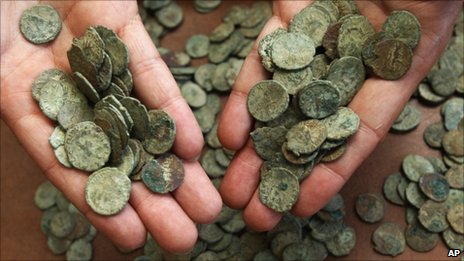
A hoard of more than 52,500 Roman coins discovered in a Somerset field has been declared treasure.
Dave Crisp, from Wiltshire, found the coins – dating from the 3rd Century AD – in April buried near Frome.
“I’ve been metal detecting since 1988 and it’s the most exciting and important find I’ve made,” he said.
A British Museum spokesman said the 160kg find was the largest single coin haul found in one pot and was probably intended as a religious offering.
Most of the coins, which are made from debased silver or bronze, are currently at the British Museum in London and includes examples from AD286 to 293 during the reign of Carausius who was the first Roman emperor to strike coins in Britain.
A small selection has gone on display at Frome Library.
Mr Crisp had earlier found a hoard of 60 silver coins in the same field before he discovered the larger pot of coins.
The coins date from the 3rd Century AD
That find was also declared treasure earlier.
Somerset County Council Heritage Service can buy the treasure for the Museum of Somerset, which is due to reopen in 2011, under the Treasure Act.
Following the ruling by East Somerset coroner Tony Williams, Mr Crisp, who works as a chef in the NHS, said: “It was a foregone conclusion that treasure would be declared today.”
He said he did not know what reward he was going to get, but would split whatever he did get equally with the farmer who owned the land according to their agreement and the law.
It has been suggested the reward could be up to £1m.
When asked how a share of the money would change his life, Mr Crisp said he did not know but added: “I’m coming up for retirement… I’ll work until I’m 65 then I’ll see.”
He added it was not the money that mattered.
“This is what matters, I’m the finder of the largest single hoard of Roman coins ever.
“I’ll always be the finder, unless someone beats me of course. There are a lot more pots out there.”
The landowner, whose surname is not being released to deter further treasure hunters, said: “I have always loved history but I never expected anything as important, exciting or old as this to be found on my land.”
WHAT IS TREASURE TROVE?
- Where the owner of a find cannot be traced, it normally belongs to the landowner but anything declared “treasure” belongs to the Crown
- Anyone making find that could be treasure must report it to a coroner
- An inquest will then determine its status
- Treasure must be at least 300 years old
- Once something is declared treasure, the finder may be able to keep it, or an institution, such as the British Museum, may buy it
- Objects are not treasure if their owners can be traced or if they are found on the shore but do not come from a shipwreck
A British Museum spokesman said the Treasure Valuation Committee would recommend a value for the hoard in October, which would be paid out when the finder, landowner and museum agreed with the valuation.
Anna Booth, from the Portable Antiquities Scheme (PAS), said of the reward: “It will be fairly substantial but how substantial, we don’t know.
“If they find lots of rare coins, the price could go up. It won’t be millions, but beyond that it is hard to speculate.
“Once it has been evaluated, the British Museum will be given a chance to acquire it. If not, the local museum will have it.
“The British Museum has already said it hopes the find will be acquired by the Museum of Somerset.
“We are now going to be on a fundraising drive to get the money.”
- The story of the excavation will be told in a new BBC Two archaeology series, Digging for Britain, presented by Dr Alice Roberts and made by 360production, to be broadcast in August.
British Tour Guide
HisTOURies UK – The Best Tours in Histoy
Archaeologists unearth Neolithic henge at Stonehenge
Posted in archaeology, british history, England facts, stone circle, Stonehenge, Stonehenge Visitor Centre on July 22, 2010| 1 Comment »

Archaeologists say the find is “exceptional”
Archaeologists have discovered a second henge at Stonehenge, described as the most exciting find there in 50 years.
The circular ditch surrounding a smaller circle of deep pits about a metre (3ft) wide has been unearthed at the world-famous site in Wiltshire.
Archaeologists conducting a multi-million pound study believe timber posts were in the pits.
Project leader Professor Vince Gaffney, from the University of Birmingham, said the discovery was “exceptional”.
The new “henge” – which means a circular monument dating to Neolithic and Bronze Ages – is situated about 900m (2,950ft) from the giant stones on Salisbury Plain.
It’s a timber equivalent to Stonehenge”
End Quote Professor Vince Gaffney University of Birmingham
Images show it has two entrances on the north-east and south-west sides and inside the circle is a burial mound on top which appeared much later, Professor Gaffney said.
“You seem to have a large-ditched feature, but it seems to be made of individual scoops rather than just a straight trench,” he said.
“When we looked a bit more closely, we then realised there was a ring of pits about a metre wide going all the way around the edge.
“When you see that as an archaeologist, you just looked at it and thought, ‘that’s a henge monument’ – it’s a timber equivalent to Stonehenge.
“From the general shape, we would guess it dates backs to about the time when Stonehenge was emerging at its most complex.
“This is probably the first major ceremonial monument that has been found in the past 50 years or so.
‘Terra incognita’
“This is really quite interesting and exceptional, it starts to give us a different perspective of the landscape.”
Data from the site is being collected as part of a virtual excavation to see what the area looked like when Stonehenge was built.
Speculation as to why the 4,500-year-old landmark was built will continue for years to come, but various experts believe it was a cemetery for 500 years, from the point of its inception.
In 2008, the first excavation in nearly half a century was carried out at the iconic site on Salisbury Plain.
This latest project is being funded by the Ludwig Boltzmann Institute for Archaeological Prospection and Virtual Archaeology, in Vienna, and the University of Birmingham, and is assisted by the National Trust and English Heritage.
Professor Gaffney said he was “certain” they would make further discoveries as 90% of the landscape around the giant stones was “terra incognita” – an unexplored region.
“The presumption was this was just an empty field – now you’ve got a major ceremonial monument looking at Stonehenge,” he said.
Stonehenge Tour Guide
HisTOURies UK – The Best Tours in British History
Marden Henge dig uncovers 4,500-year-old dwelling
Posted in archaeology, british history, History, stone circle, Stonehenge, Stonehenge Visitor Centre, wessex, Wiltshire on July 21, 2010| Leave a Comment »
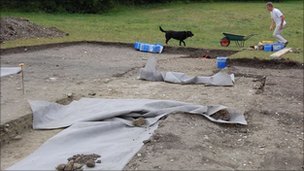
A dwelling, thought to be 4,500 years old, has been discovered by archaeologists in Wiltshire.
 S
S
“It looks as if we have a Neolithic building. We’re talking about four and a half thousand years old – so about 2400 or 2500BC.
Excavation work at the prehistoric site of Marden Henge, near Devizes, started three weeks ago and experts say the find has “exceeded expectations”.
Marden Henge no longer has any standing stones and is said to be one of Britain’s least understood ancient sites.
The work is scheduled to last for three more weeks.
Archaeologist Jim Leary, from English Heritage, said: “It’s absolutely fabulous. It’s exceeded all of our expectations.
I don’t think we’re looking at a normal house. I think we’re looking at something equivalent to a priest’s quarters.””We have some wonderful finds coming up and some very fresh looking flint flakes and some pieces of pottery, but far and away the most exciting find so far is over in trench C. – English Heritage
“Up until a few years ago it would have been unique but a couple of years ago archaeologists were digging at Durrington Walls and they found a number of these buildings.
“I don’t think we’re looking at a normal house. I think we’re looking at something equivalent to a priest’s quarters.
“We do seem to have a hearth and it seems that whoever lived there was a very clean person and regularly cleaned out the hearth.
“Just outside the front door we can see this long spread of charcoal and general rubbish material.
“It contains really good fresh flint flakes, pottery, bone pins – things that don’t normally survive on archaeological sites. We’re getting a really good insight into life in that building.”
Stonehenge Tour Guide
HisTOURies UK – The Best Tours Wiltshire
Blog Archive
-
HisTOURies U.K Tours
- There’s more to this English county than just Stonehenge. Visit Wiltshire.
- Private Driver Guided Stonehenge Tours Departing from Salisbury.
- Private Driver-Guided Stonehenge Sightseeing Tours Departing from Bath.
- Stonehenge special access guided inner circle trips from London, Bath or Salisbury. Experience Stonehenge at dawn or dusk with a private VIP tour!
- Visiting Stonehenge? Our expert tour guides can turn the amazing experience of seeing the stones for the first time, into an enlightening one.
-
HISTOURIES PAGES
HISTOURICAL BLOGS
- January 2025 (1)
- December 2024 (1)
- October 2023 (1)
- February 2022 (1)
- March 2021 (1)
- December 2019 (1)
- January 2019 (2)
- June 2018 (2)
- December 2017 (3)
- June 2017 (1)
- May 2017 (5)
- February 2017 (5)
- January 2017 (9)
- December 2016 (5)
- November 2016 (5)
- October 2016 (3)
- July 2016 (1)
- April 2016 (1)
- March 2016 (1)
- February 2016 (5)
- January 2016 (1)
- October 2015 (2)
- September 2015 (2)
- May 2015 (3)
- March 2015 (1)
- February 2015 (2)
- January 2015 (7)
- December 2014 (3)
- October 2014 (5)
- September 2014 (4)
- March 2014 (2)
- February 2014 (1)
- January 2014 (4)
- November 2013 (4)
- October 2013 (8)
- September 2013 (6)
- August 2013 (7)
- July 2013 (3)
- June 2013 (5)
- May 2013 (10)
- April 2013 (8)
- March 2013 (6)
- February 2013 (2)
- January 2013 (3)
- December 2012 (3)
- November 2012 (7)
- October 2012 (7)
- September 2012 (5)
- August 2012 (2)
- July 2012 (6)
- June 2012 (3)
- May 2012 (5)
- April 2012 (3)
- March 2012 (4)
- February 2012 (7)
- January 2012 (5)
- December 2011 (3)
- November 2011 (7)
- October 2011 (8)
- September 2011 (9)
- August 2011 (7)
- July 2011 (7)
- June 2011 (4)
- May 2011 (5)
- April 2011 (4)
- March 2011 (10)
- February 2011 (7)
- January 2011 (11)
- December 2010 (12)
- November 2010 (12)
- October 2010 (17)
- September 2010 (13)
- August 2010 (9)
- July 2010 (12)
- June 2010 (6)
- May 2010 (6)
- April 2010 (13)
- March 2010 (22)
- February 2010 (26)
HISTOURIES UK

STONEHENGE TOURS
March 2026 M T W T F S S 1 2 3 4 5 6 7 8 9 10 11 12 13 14 15 16 17 18 19 20 21 22 23 24 25 26 27 28 29 30 31  Visit London
- An error has occurred; the feed is probably down. Try again later.
 Wessex Guided Tours