Feeds:
Posts
Comments

Archive for the ‘Avebury’ Category

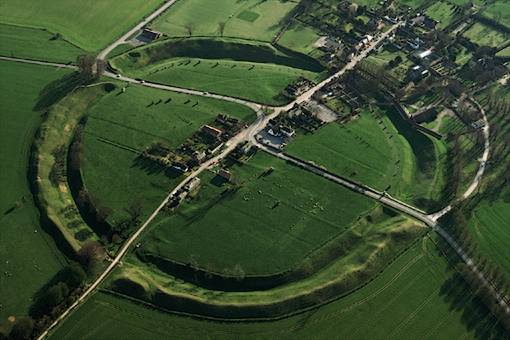
The ancient standing stones at Avebury, lie between Swindon and Devizes on the A4361. Avebury rings are a World Heritage site and attracts thousands of visitors annually, who are no doubt intrigued by the mystery that surrounds their construction.
Avebury Stone Circle
The henge is believed to date back to around 2600BC; just what motivated our ancestors to construct such an elaborate site and their ultimate purpose in doing so remains largely a mystery. It has been suggested (one of many theories) it may have been used as a place of worship and sacrifice. Some favour an astral observatory, difficult to prove I shouldn’t wonder, in view of the fact that many of the stones are missing and any alignment with the stars must be considered near impossible. Others believe it had a connection with Silbury Hill (see sidebar for more info)and was used to gauge the seasons for agriculture. Whatever the reasons for its construction, its true purpose still eludes archaeologists and scholars to this day.

It is unfortunate that not all of Avebury’s 154 sarsen stones (most likely quarried and transported on wooden rollers from the Marlborough hills) have survived. Of the three rings and the Avenue that make up the henge, only 36 stones are still standing. Many were destroyed or buried (some still are) in massive pits during the 14th century by devout local Christians because a) they believed them to be the harbingers of ill luck and b) to eradicate pagan worship from the monument.

It was during the 18th century that the stones came under attack once more, not from zealous Christians this time but from local construction workers who decided it would be a jolly good idea to utilizes the stones to construct several of the cottages in the village; the grand 15th century Tudor manor and the modernization of 12th century church of St. James. Some of these magnificent stones even went to cobble the streets of Devizes seven miles to the south.

It wasn’t until the intervention and purchase of the site by Marmalade tycoon and archaeologist – Alexander Keiller in the 1930’s, that the destruction ceased. Keiller was responsible for much of the conservation and re-erection of the stones. His work was interrupted during the outbreak of the WWII and remains unfinished to this day, unfinished because there are still stones which lay buried.

Keiller purchased Avebury Manor in 1937 and utilized and modernized the stable block to house a museum of his work and findings. Although small, it is well worth a visit.

Folklore

Folklore has evolved over a millennia regarding the alleged power of Avebury’s standing stones. A fascination has grown for these enigmatic sarsens, which appear to cast their spell on many who see them. The stones are often referred to as ‘grey wethers’ on account of their resemblance to grazing sheep when seen from a distance. Some believe the sarsens have healing properties and by a ‘hugging’ one, it will release its magical properties and cure most ills. Others have claimed whilst hugging a stone, to have felt vibrations emanating from within its very core. ‘Stone hugging’ is a common sight at Avebury. Often when I have been driving past, I can pretty much guarantee that someone will be flat against a stone, adopting a pose reminiscent of the crucifixion and gazing heavenward in eager anticipation of “the vibe‘. I think “the vibe,” can more than likely be attributed to the rumble and subsequent vibration of traffic passing close by on the A4361. There’s nout queerer than folk and Avebury attracts them in swarms – bless ‘em. As mentioned earlier, the locals used to believe the stones were harbingers of ill luck, so hugging one is probably not such a good idea.

Dowsers, crystal pendulum swingers, new age folk, druids, pagans and an assortment of other folk all looking for that something, descend on the village annually, and why not, everyone to their own I say.

With all the magic, mystery and ancient rituals which have grown up around the stones, you would have thought the circle would be a paranormal hotspot. If truth be known, the opposite is very much the case, especially when compared to the generous helping of ghostly history from the likes of The Red Lion pub, which stands within the circle; the resplendent Tudor Manor and the 12th century church of St. James. All these buildings positively exude tales to chill you to the marrow. The few hauntings and folklore that have been reported from the henge are as follows:

Back in the Sixties, a woman driving through the village late at night, reported seeing ghostly figures dressed in period costumes dancing amongst the stones. I would question, that what she actually saw, was probably nothing more than one of the many rituals and parties which take place regularly at Avebury.

There are claims of dwarf like creatures seen darting amongst the stones in the dead of night and of a spectrum of tiny twinkling lights believed by some to be fairy folk. These lights have been seen countless times dancing above the stones, especially the mysterious Diamond Stone, which is located at the north-west quadrant, a stone incidentally, said to uproot itself and crosses the A4361 at the stroke of midnight, no mean feat at around 40 tonnes.

The henge is thought to have several ley lines (hypothetical veins of invisible energy beneath the earth, said to connect ancient megalithic sites, monuments and even buildings, particularly churches) which dowsers especially believe crisscross beneath the henge and are most likely responsible for generating subterranean “earth energy.”

Avebury is a fascinating place and well worth a visit, if only to marvel at its construction and debate its mystery. That said, the claims surrounding the stones abilities will, I’m sure, stretch even the most vivid of imaginations.

Links:
http://hauntedwiltshire.blogspot.com
http://www.nationaltrust.org.uk/main/w-avebury
http://www.StonehengeTours.com

Guided tours of Stonehenge and Avebury Stone Circle
HisTOURies UK – The Best Tours in Ancient History
Mystical Landscape, magical tours………….
Read Full Post »

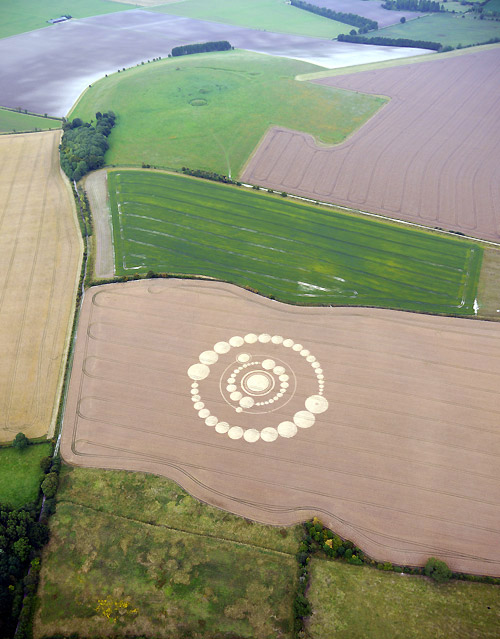
Another circle ‘crops up’ in Wiltshire -Windmill Hill (2), nr Avebury Stone Circle , Wiltshire. Reported 26th July.

Another amazing cropcircle has appeared in Wiltshire.  If you are not visiting with a local tour guide please respect the ‘crop circle etiquette’-see below.


CROP CIRCLE ETIQUETTE: Guidelines for visiting formations
FOR VISITING THE CROP CIRCLES.

In our attempt to become more responsible for giving out information on the locations for the Circles, we have published a Code of Conduct which was drawn up by the National Farmers Union in collaboration with the Centre for Crop Circle Studies. The Connector does not want to deny our readers the chance to visit a Crop Circle. It merely reminds you to ask for their permission to enter their fields.
 

Do not go onto private land unless you have permission from the farmer or landowner. If you can’t find the farmer or landowner to ask permission-you have no right to enter private property.

IF you can not find the farmer DO NOT enter the field.

IF you wander into a formation without permission and a farmer catches you, DO NOT argue with him if he wishes you to leave his land.

Better still – go with a local tour guide who knows exactly where they are, how to get there and has permission from the farmer.

Wilthire Crop Circle Tour Guide
HisTOURies UK – Mystical landscape, magical tours……..

Read Full Post »

Legends of Glastonbury

There are so many myths associated with Glastonbury that it is difficult

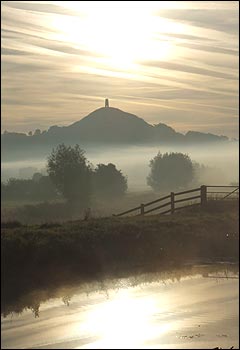
Glastonbury Tor

Glastonbury Tor

to know where to begin to talk about them. There are two main streams of legend that surround Glastonbury, though they twine around each other to some degree. The two streams revolve around the romantic figures of Joseph of Arimathea and King Arthur. Let’s take them one at a time.

Joseph of Arimathea
Joseph was the Biblical figure who took Jesus’ body after the crucifixion. According to some legends he was actually Jesus’ uncle, and had visited Britain years before with Jesus in the pursuit of his interests in the tin trade. It appears that there actually was a strong Jewish presence in the west of England at that time, and many of the tin miners may have been Jewish settlers.

At any rate, when Jesus died, Joseph thought it prudent to flee Palestine, and after many travails he came to Britain with a company of followers. He brought with him the Holy Grail, the cup used by Jesus at the Last Supper. Some versions of the legend have it that the Grail contained two drops of blood captured from Jesus’ side when he was wounded on the cross.

When Joseph came to Britain he was granted land at Glastonbury by the local king. When he arrived at Glastonbury, Joseph stuck his thorn staff in the earth, whereupon it rooted and burst into bloom. A cutting from that first tree was planted in the grounds of the later Glastonbury Abbey, where it continued to bloom every year therafter at Christmas time. There is still a thorn tree in the Abbey grounds, of a variety native to the Holy Lands, and it does indeed bloom around Christmas time.

Joseph was said to have established the first church in England at Glastonbury, and archaeological records show that there may well have been an extremely early Christian church here. What happened to the Holy Grail is another matter. Some legends have it that Joseph buried the Grail at the foot of Glastonbury Tor, whereupon a spring of blood gushed forth from the ground.

There is a well at the base of the Tor, Chalice Well, and the water that issues from it does indeed have a reddish tinge to it, from the iron content of the water.

Other legends have it that the Holy Grail was interred with Joseph when he died, in a secret grave. The search for the mysterious Grail emerges again and again in the tales of Glastonbury.

Further legends tell that the church founded by Joseph continued for many years. Eventually it became a monastery, and one of the first abbots was the future St Patrick, who was born in the west country.

King Arthur and Glastonbury

Glastonbury Abbey, where King Arthur is said to lie buriedLegends of King Arthur swirl about Glastonbury like a tantalizing fog from the nearby Somerset marshes. The nearby hill fort at South Cadbury has long been suggested as the location for Camelot. Indeed, excavations of South Cadbury suggest that it was in use during the early 6th century, which is the likeliest era for the real Arthur to have lived.

The association of Arthur and Glastonbury goes back at least to the early Middle Ages. In the late 12th century the monks of Glastonbury Abbey announced that they had found the grave of Arthur and Guinivere, his queen. According to the monks, an excavation found a stone inscribed “Here lies Arthur, king.” Below the stone they found the bones of a large man, and the smaller skeleton of a woman. The monks reburied the bones in the grounds of the abbey, where they were a very handy draw for pilgrims. The site of the grave can be seen today in the abbey grounds.

Glastonbury Tor, the enigmatic conical hill that rises above Glastonbury, has been linked with the Isle of Avalon, where King Arthur was buried after his death. This isn’t so farfetched as it may sound, for a millennium ago the water level was much higher, and the tor would indeed have been an island. Avalon was also called “the isle of glass” which does suggest similarities to the name “Glastonbury”.

The Holy Grail, the object of Arthur’s questing, is said to be buried beneath Glastonbury Tor, and has also been linked to Chalice Well at the base of the Tor.

One final myth of Arthur at Glastonbury: the landscape around Glastonbury is said to have been moulded and shaped so that the features (such as roads, churches, and burial mounds) create a zodiac calendar replete with Arthurian symbology. Like so many of the Arthurian myths, so much is open to interpretation and your own predisposition to believe or disbelieve.

Glastonbury Abbey
Is there a place more steeped in legend and myth than Glastonbury? Glastonbury AbbeyProbably not. Legend holds that the earliest church here was founded by St. Joseph of Arimathea in about 60AD, and that when he planted his staff in the earth a thorn tree burst forth.

In the grounds of the ruined Benedictine monastery there is a thorn tree of a variety common to the Middle East which is given to bloom around Christmas time.

By the late Middle Ages Glastonbury had become the richest abbey in England, due to the heavy pilgrimage trade. It was rich enough to build an inn for well-to-do pilgrims (the George Inn, on nearby High Street, which still welcomes guests 500 years later). The best preserved building in the abbey grounds is the old Abbot’s Kitchen (see photo), a curious square building which appears round due to its octagonal roof. In the abbey grounds are the reputed graves of King Arthur and Queen Guinevere, which were conveniently discovered by the Glastonbury monks in the 12th century, when the abbey needed a financial boost. Outside the grounds are the abbey tithe barn, which now serves as the Somerset Rural Life Museum (well worth a visit), and 4 miles away at Mere is the abbey’s Fish House, were fish was salted and cured.

The abbey is entered through the Abbey Gatehouse  an imposing arched gateway located on off Magdalene Street. Visitors pass through a fascinating museum depicting life at Glastonbury during the Middle Ages, and then enter the Abbey grounds proper. The first building you see on entering the grounds is St Mary’s Chapel, a roofless structure that boasts wonderful architectural details, from the recessed arches of the door to the repetitive arcading that rings the interior. Look up, where the curious small towers at each corner of the chapel seem almost Georgian in style.

If you continue past the chapel you will soon reach the Abbot’s Kitchen, probably the most recognizable symbol of the Abbey, and subject of numerous postcards! This is a peculiar building, with a high octagonnal tower over a square base bedecked with gargoyles. The interior is notable for the very large ovens and the high dome supported on reed-thin vaulting ribs.

Return from the Abbot’s Kitchen towards St Mary’s Chapel and you will pass a small sign on the green lawn. This marks the old burial ground, where, in the 12th century, monks conveniently found bones beneath an engraved stone indicating the burial place of legendary King Arthur. The bones and those presumed to belong to Arthur’s queen, Guinivere, were reburied within the Abbey Church, where a small memorial can be seen.

The grounds of Glastonbury Abbey emanate a sense of calm and peace; it is truly a magical place, and taken as a whole with the other attractions of this ancient town, make Glastonbury well worth an extended visit.

Visitor Information
Glastonbury Abbey
The Abbey Gatehouse
Magdalene Street
Glastonbury
Somerset
UK
BA6 9EL
Web: http://www.glastonburyabbey.com
Email: nfo@glastonburyabbey.com
 
Join us on a private guided tour of the West Country.   Visit Glastonbury, Stonehenge and Avebury Stone Circle.

Mystical Landscape, Magical Tours……………….
HisTOURies UK – The Best Tours in History

Read Full Post »

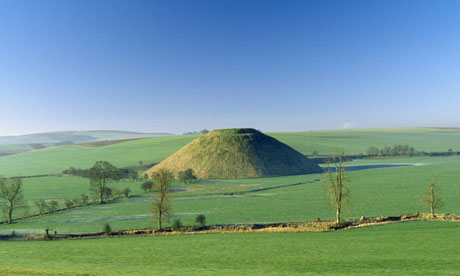
Silbury HillIN A modest house in Swindon, an 86-year-old man formulates exquisitely-detailed theories that turn conventional Wiltshire arch- aeology on its head.

If retired builder Eric Crook is right – and his belief that he’s right is unshakeable – the remains of a neolithic princess have lain deep beneath Silbury Hill for more than 4,000 years.

Even more startling is his insistence that the stones of Avebury once formed a carved amphitheatre of countless thousands of human and animal faces. These carvings would have appeared to move in flickering firelight; an illusion to thrill audiences of people who were centuries dead before Christ was born or the invading legions of Rome set foot on English soil.

These stone faces, Mr Crook says, can still be found in fragments hacked from the stones down the centuries, whether for buildings or perhaps because the powers that be disapproved of such images.

The reaction from the archaeological mainstream has so far been distinctly underwhelming, but Mr Crook, having spent well over 50 years researching and documenting his subject, is undaunted.

“Archaeologists are trained by other archaeologists,” he said. “But they are not trained in a natural learning process going through building technology.

“They learn only through what they can see. I heard of a professor who was asked the question, ‘when do you think you’ll get the answers to Silbury Hill and Avebury?’ “She said it would be another generation, but I thought to myself, ‘The answers are already there and you’re the generation behind.’”

Wiltshire, A Journeyman’s Tale, is £9.99 and can be ordered from Amazon and bookshops, ISBN978-0-7223-3900-8

Well worth touring Avebury and Silbury Hill at the moment.  There are several amazing crop circles in the area

Stonehenge and Avebury Tour Guide
HisTOURies UK – The Best Tours in Wiltshire

Read Full Post »

 The weather may not be anything to write a postcard home about – but the West’s tourism industry enjoyed a twin boost yesterday.

Key visitor attractions featured prominently in the first global TV adverts for a decade and new research showed up to 17 million Brits will holiday at home this year.

VisitBritain, the national tourism agency, yesterday unveiled its international TV campaign to attract overseas visitors to the country.

The adverts will be screened around the world, and include Stonehenge, Glastonbury and the Cotswolds.

Stonehenge is already in the spotlight because of the summer solstice, and VisitBritain say the UNESCO World Heritage Site is one of the most important prehistoric monuments on the planet.

As well as the 5,000-year-old site, there are money Neolithic and Bronze Age monuments in the surrounding landscape, and Avebury, the largest stone circle in Europe, is nearby.

Glastonbury is synonymous with the annual music festival taking place at the weekend, with international superstars such as U2, Coldplay and Beyonce, as well as theatre and circus performers and much more.but VisitBritain also point to the ruins of Glastonbury Abbey, and the iconic Tor, along with myths and legends about the Isle of Avalon, King Arthur, Joseph of Arimathea and the Holy Grail.

The agency adds: “For many visitors, the Cotswolds represent everything that is quintessentially ‘English’, with villages and churches of honey-coloured limestone set among gentle hillsides, cottage gardens, beech woods and drystone walls.”

Historic sites include Sudeley Castle and Chedworth Roman Villa, while VisitBritain urges tourists to sample local produce such as Gloucester Old Spot pork, Tewkesbury mustard and the famous Cotswold cheeses.

Other locations in the TV adverts include London landmarks such as the Houses of Parliament and St Paul’s Cathedral, the Lake District, Snowdon in Wales, Edinburgh Castle and the Highlands.

Celebrities such as actress Dame Judi Dench, fashion icon Twiggy and chef Jamie Oliver – who has restaurants in Bath and Bristol with another opening in Cheltenham this summer – star in them.

The campaign kicks off a major marketing push that seeks to build on the global impact of the Royal Wedding, with the Olympics next year also guaranteeing the international spotlight.

It will concentrate on the current most important tourism markets, such as the US and Western Europe, and the big growth areas for the future, including China and India.

VisitBritain chief executive Sandie Dawe said: “This is our first global TV campaign for 10 years and marks the start of an ambitious marketing programme. With the eyes of the world on us, we have an opportunity to showcase Britain and then to close the sale with great travel deals and offers from our partners.

“This campaign aims to inspire visitors to come and explore for themselves. Over four years, we aim to attract four million extra overseas visitors, who will spend £2 billion across Britain.”

Meanwhile a new survey has found nearly 40 per cent of Britons will stay at home this summer as families strive to balance household finances.

Many of them will instead enjoy ‘staycations’, with the West sure to cash in.

The poll was carried out for savings bank ING Direct, and chief executive Richard Doe said: “It’s not surprising that the summer holiday is often being sacrificed.”

Visiting Britain ? Visit the West Country!

Wessex Tour Guide
HisTOURies UK – the Best Tours in Wiltshire

Read Full Post »

The Trundle near Chichester, Sussex, is one of the first large monuments built in Britain

The Trundle near Chichester, Sussex, is one of the first large monuments built in Britain

Researchers have developed a new dating technique that has given the first detailed picture of the emergence of an agricultural way of life in Britain more than 5,000 years ago.


A new analysis of artefacts recovered from the first monuments built in Britain shows that the Neolithic period had a slow start followed by a rapid growth in trade and technology.

Scientists say the new approach can be used to unravel the detailed sequence of events of many more important moments in human prehistory.

It relies in part on radio-carbon dating – counting the amount of a radioactive type of carbon atom in decaying matter. But the methodology also incorporates many other dating sources, together with some powerful statistical analysis, to produce far more discrete timings for happenings in the past.

The Neolithic period in Britain occurred between 4000 and 2000BC.

It was when people took up agriculture as a way of life and stopped being nomadic hunter-gatherers.

It also saw the emergence of trade across the British Isles and the development of new technologies. But until now, we have had only a rather coarse picture of the chronology of events during this eventful period in our history.

The new analysis by Dr Alex Bayliss, an English Heritage dating expert, has brought the occurrences of that time into sharper focus.

“We can start to tell a bigger story and write a history for the prehistory of Neolithic Britain,” she told BBC News.

“What we thought before was very imprecise. We simply knew that all sorts of different sites and all sorts of new kinds of practices started to happen sometime in the 500 or 600 years of the early Neolithic in Britain.

“We’ve actually now been able to give a timetable, or story of what happened when, to disentangle these things so that we can start to see why certain things may have followed others.”

According to Dr Bayliss’s analysis, Neolithic farming practices began in south-east England probably a few decades before 4,000BC. But then they spread very, very slowly, taking about two centuries to reach western parts of England. And then, she says, there was a sudden increase in activity.

“Monuments, cattle, sheep, the whole farming way of life, bursts across Britain and suddenly – having taken 200 years from getting from Kent to Gloucestershire – it then takes 50 years to get from Cheltenham to Aberdeen.”

The new dating also indicates that by 3700-3800BC, early Britons had developed pottery with regional styles of decorations. Long-distance trading networks were also being established in stone axes and certain other types of pottery

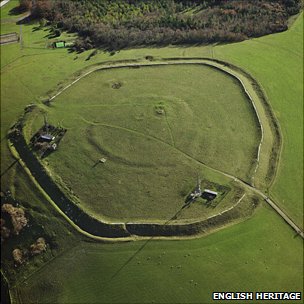
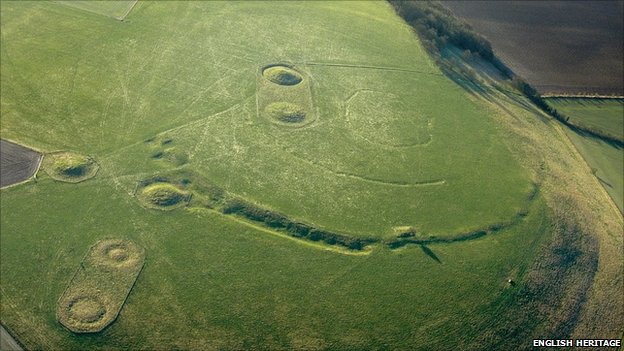
Windmill Hill, a large Neolithic causewayed enclosure in Avebury, was previously thought to have been built around 3700-3100 BC. The new dating shows it was built in 3700-3640 BC

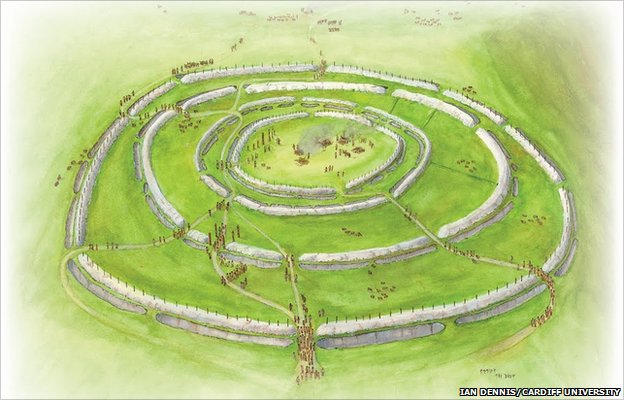
Of particular interest are the first monuments that were built in Britain, called causewayed enclosures. These were made up of concentric rings of ditches and banks – the largest of which can span 300m (1,000ft).

It had been thought that they spread slowly across the country over five centuries. But the new dating approach suggests they spread rapidly within 75 years.

This revelation has been described by archaeologists working on the project as Britain’s first “building boom”.

Professor Alistair Whittle of Cardiff University said: “With more accurate dating, the Neolithic period is no longer the sleepy, hazy swathe of time where it is the default position to lump everything together.

“This research fundamentally challenges the notion that little happened among our Stone Age farmers. We can now think about the Neolithic period in terms of more rapid changes, constant movement of people and fast diffusion of ideas.”

Collective violence

One interpretation of these events is that once the initial “pioneer” phase of the Neolithic period was over, independent groups of people came over from the continent and set up villages across Britain and social structures began to form.

These social structures led to the construction of the enclosures for people to gather and possibly for chieftains to emerge and amass power.

The new dating suggests that there was more collective violence once the enclosures were built. Several of them, particularly in western Britain, were attacked by large numbers of people with showers of arrows, and enclosures’ ramparts were burned down.

This indicates that the enclosures created a hierarchy that was being contested in some way.

The new dating technique involves comparing carbon dates with other markers in the archaeological record. On its own carbon dating is imprecise, but when it is cross-reference with documented events it allows researchers to more accurately date artefacts.

Researchers say this new methodology could in principle be used shed further light on any significant event in our prehistory, such as the emergence of farming in China and the collapse of the Mayan civilisation in the Americas.


A reconstruction of the Whitehawk causewayed enclosure in the South Downs, Sussex

Why not visit Windmill Hill and nearby Avebury and learn more about Neolithic Britain?

Stonehenge and Avebury stone Circle Tour Guide
HisTOURies UK – The Best Tours of Ancient Wiltshire


Read Full Post »

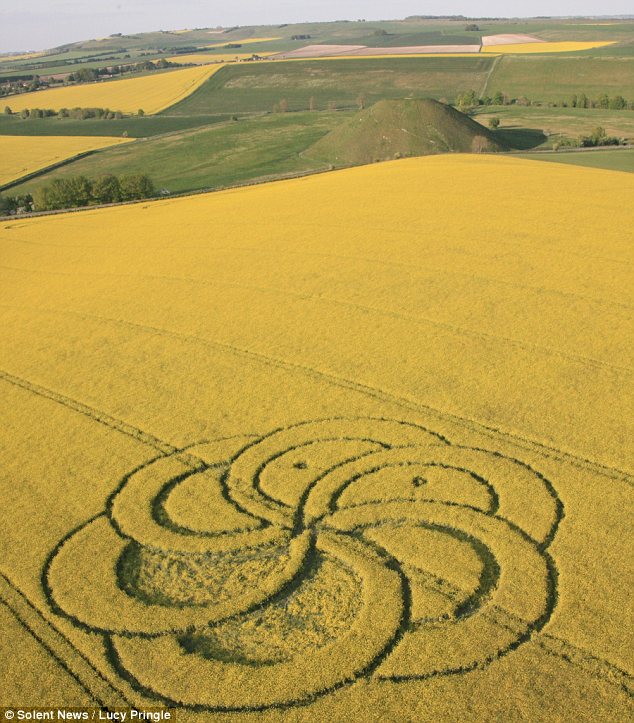
The unseasonably warm spring weather has not only brought forward many summer flowers – it has sparked the usual round of crop circles.

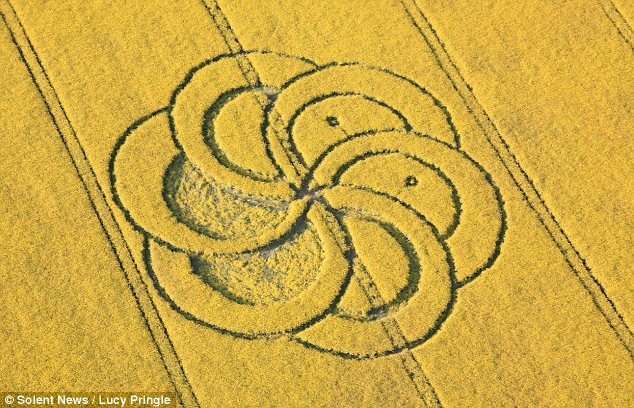
An elaborate 100ft circle which appeared overnight has caused a stir after it was found in a field of oil seed rape near Silbury Hill, Wiltshire.

The extraordinary floral creation is comprised of six interlocking ‘petal’ like crescents.

The ancient site, the tallest prehistoric man-made mound in Europe, is considered a hot spot for the bizarre phenomena and this new design proves the crop circle season is now under way.

Expert Lucy Pringle, widely known as an international authority on crop circles, believes this is the first ‘proper’ design of the year.

She added: ‘The start of the season is always exciting, I never know what’s going to happen for the rest of the year.

‘The latest circle is a floral pattern, I’ve never seen this before. There’s never been one identical to another.’

crop-circle-avebury

Miss Pringle, from Petersfield, Hants, is a founder member of the Centre for Crop Circle Studies.

She has conducted years of research in to the physiological and psychological effects reported by people after visiting the formations.

She says her findings suggest there are measured changes in human hormones and brain activity following contact with the circles.

The new ‘floral’ design is the latest in a long line of patterns to be spotted in the UK over the years.

Previous formations have included stars, triangles, birds, complicated three dimensional geometric shapes and even intricate patterns with hidden mathematical codes.

One, discovered in 2008 near Wroughton in Wiltshire, was thought to represent the first ten digits of pi, the ratio of the circumference of a circle to its diameter.
Link: http://www.dailymail.co.uk/news/article-1383035/First-crop-circle-season-appears-historic-Wiltshire-field.html

Crop Circle Tours 2011:  We operate guided tours of Wiltshire including all the best crp circles.  We know where they are, when thay happen and get you inside – a unique experience.  THere are already more formations in Wiltshire that we are visiting

http://www.histouries.co.uk/crop-circle-tours.htm

Crop Circle Tour Guide
HisTOURis UK – Private guided tours of Wessex

Read Full Post »

Start: Avebury |Finish: Old Sarum
Distance: Approximately 42 miles

Wiltshire is a county of history and mystery set in a dramatic landscape. The combination of heritage and scenery provides a truly memorable day out. So come with us on a journey through the countryside and across the ages as we go back to the time of our prehistoric ancestors. Hundreds of thousands of years may have passed but all over the county there’s evidence of human activity from the end of the Ice Age through the Stone, Bronze and Iron Ages right up to the invasion of the Romans in AD43.

Click here for audio / visual tour

This driving tour will take you through the heart of Wiltshire. En route you’ll discover more about how our enigmatic and mysterious ancestors lived, worked, fought and died.

This tour can be undertaken in a variety of ways; as a day-long journey, in short sections or you can use the information as a guide to individual visits.

You might also consider embarking on the tour using public transport but keeping up to date with bus service and timetable changes will require plenty of preparation.

Before you set off make sure that you’re properly equipped. Nothing beats a really good Ordnance Survey map, marked with contours and ancient monuments. A compass and a torch would also be useful. Some of these historical gems are in fields and away from roads or footpaths, so good walking boots are a must. Some sites have few or no facilities and it’s also worth noting that mobile phone coverage can’t be guaranteed in parts of rural Wiltshire. For news of road works or route closures, check BBC Local Radio and bbc.co.uk/travelnews

This guide has been produced with the generous assistance of Phil Harding, Wessex Archaeology, English Heritage, Wiltshire Council Archaeology Service, Bob Clarke, Martin Kellett, David Dawson and the Wiltshire Heritage Museum in Devizes.

Stonehenge and Avebury Tour Guide
HisTOURies UK – The Best Tours in Wiltshire

Read Full Post »

The Hero Walk – In support of our wounded – 26th June 2011
The Hero Walk is a very tough challenge over the high chalk downs and ridge ways of Wiltshire and Salisbury Plain. At 26 miles it forms a marathon for runners and a great challenge for walkers. This challenge is a diverse trek over marathon distance, going back through 6,000 years of British history; the magnificent prehistoric stone circles of Avebury and Stonehenge need little introduction. The challenge will start in Avebury, where we will be able to get up close to the ancient stones before heading off via the mysterious ancient landmark of Silbury Hill. Silbury is the tallest man-made mound in Europe, however its purpose is still unknown.

Stonehenge - Avebury walk 2011

Stonehenge - Avebury walk 2011

We will then cross the spectacular chalk downs dotted with ancient earth-works, burial mounds and get up close to the enigmatic white horses carved into the chalk. In clear weather we will be able to see more here, as views of other valleys open up to us. The route takes in the highest point in Wiltshire (295m) and travels through the most active crop circle area in the world – keep your eyes open!

Crossing into MOD land you will either walk (or run!) through stunning areas little used by the general public, that have become a haven for wildlife and plants. Our route continues to undulate but the main hills are behind us and we start to anticipate the finish line at the World Heritage Site of Stonehenge. A short section of quiet road is a sign that we are nearing civilisation, and before long the world-renowned ancient circle of stones looms on the horizon before us. There is then time to celebrate with fellow walkers and runners before returning home. We look forward to seeing you there!

Avebury to Stonehenge Hero Walk 2011 Itinerary . . .

The 26-mile walk will take approximately 8-9 hours for fit and strong walkers. Our day starts at Avebury, which lies at the centre of one of the greatest surviving concentrations of Neolithic and Bronze Age monuments in Western Europe. We’ll enjoy Avebury’s magic in the quiet of the early morning before heading via the Silbury Hill.

Help for Heroes 
Help for Heroes

Dropping down into the village of Alton Barnes, we follow the Kennet and Avon canal east. From there we head south and join the White Horse trail to the Pewsey White Horse from where we have fabulous views of the surrounding chalk landscape. We descend the hill and continue along the trail to the Kennet and Avon Canal; this is a fabulous example of industrial revolution engineering. Crossing into MOD land we will either walk (or run!) through stunning areas little used by the general public and a haven for wildlife and plants. After this long day of great views and leg-stretching hills we will reach the final destination: Stonehenge, the most famous stone circle in the world.

DONATE NOW – CLICK HERE
REGISTER ONLINE
http://www.helpforheroes.org.uk/challenges-2011-avebury-stonehenge.html

Proud Sponsors
HisTOURies UK – The Best Tours of Wiltshire

Read Full Post »

Today, we must celebrate John Aubrey’s dramatic rediscovery of Avebury – the world’s largest prehistoric stone circle. 

Avebury Stone Circle today: with its ditches excavated, unsightly cottages demolished, and unnecessary enclosures removed, it’s difficult to imagine the snarl of 17th-century domestic chaos that greeted John Aubrey’s visionary gaze that January morn.

Avebury Stone Circle today: with its ditches excavated, unsightly cottages demolished, and unnecessary enclosures removed, it’s difficult to imagine the snarl of 17th-century domestic chaos that greeted John Aubrey’s visionary gaze that January morn.

Whilst out hunting with fellow royalists during the English Civil War, exactly three hundred and sixty-two years ago. For Aubrey’s heroic retrieval of this vast but (by then) long forgotten Stone Age temple confronted the then-accepted notion that only the coming of the Romans had forced a degree of culture upon the barbaric Ancient British, and also confounded the then-popular 17th-century belief – propounded by the highly influential Scandinavian antiquaries Olaus Magnus and Ole Worm – that all such megalithic culture had its archaic origins in Europe’s far north. Indeed, so rich were the cultural implications of John Aubrey’s re-discovery that – come the fall of Oliver Cromwell’s 11-year-long Commonwealth and the subsequent Restoration of the Monarchy – even the returned King Charles II would himself insist on taking one of Aubrey’s celebrated tours of the Avebury area. But how could the world’s largest stone circle have suffered such a total cultural extinction in the first place? Why, the Avebury standing stones themselves must average at least ten feet in height apiece, while the temple’s enormously bulky northern and southern entrance stones rivalled even nearby Stonehenge’s celebrated trilithons. And how could Avebury’s vast 400-metre-diameter earthen embankment and the equally deep ditch that encircled these huge monoliths have for several centuries become invisible even to local historians? Ironically perhaps, the initial blame for this pagan temple’s centuries in cultural oblivion goes not to scheming Christians but to the 5th century arrival from Germany of another group of pagans – the invading Saxons – who, recognising Avebury’s possible use as a defended settlement, broke with the traditions of the previous Roman and Romano-British occupiers by setting up their homes and farmsteads directly within the mighty earth banks of the temple itself. Blasphemers! Thereafter, many centuries of harsh day-to-day living within the Avebury henge conspired to obscure then finally obliterate all physical traces of this vast Earthen Temple. Saxon ploughing within the henge tumbled soil into the deep ditches, which silted up considerably and became repositories of household refuse. Residents fearful of disturbing the ‘Devil’s work’ incorporated the Avebury megaliths into the hedges of their allotments, gardens, fields, and even saved energy by employing those monoliths most vertically aligned as supporting walls for their stone cottages. And when villagers lost their fears of the stones, deep pits were dug into whose depths several of the most intrusive monoliths were unceremoniously tumbled. Thereafter, the magnificent geometric shape of this robust 4,500 year-old landscape temple became lost in the chaos of domesticity; until that fateful day three hundred and sixty-two years ago, that is, when John Aubrey and his friend Dr. Walter Charleton joined their hunting party and galloped westwards across Fyfield Down along the chalky London-Bath ‘rode’. Aubrey himself recounts in his posthumously published two-volume tome Monumenta Britannica:

“The chase led us at length through the village of Avebury, into the closes there: where I was wonderfully surprised at the sight of those vast stones: of which I had never heard before… I observed in the enclosures some segments of rude circles, made with these stones; whence I concluded, they had been in the old time complete.”

It’s been my experience that no story about Avebury ever concludes without some vicious act of destruction by some pious know-it-all or other; this On This Deity entry is no different. For, despite King Charles II’s fascination with the Avebury stone circle, it was his return to the English throne that prompted the temple’s most vivid and desperate period of destruction. For in their determination to stamp out the Non-Conformism of Cromwell’s time, Charles II’s paranoid Restoration Government in 1665 passed the Five Mile Act (or Non-Conformist Act 1665), which specifically forbade all itinerant Non-Conformist preachers from speaking within five miles of their old parishes. Avebury stone circle is nine miles south of Swindon, eight miles north-east of Devizes, five miles west of Marlborough and six miles east of Calne. Non-conformist preachers throughout northern Wiltshire looked to the ancient pagan temple and regarded the Five Mile Act as a divine sign: let us make our new home here, and every pagan stone we break we’ll make righteous by incorporating it into our Non-Conformist church. And so to Avebury they did come and such destruction so they did: the church remains at the circle’s centre even to this day, self-effacing and easily overlooked but engorged nevertheless with as many splendid sarsen stones of that former 4,500 year-old monument as those Non-Conformist preachers could muster. Our hero John Aubrey would, for his pains, die unpublished and in penury. Today, however, his legend burns with an unquenchable fame due to that pioneering archaeological tome Monumenta Britannica, that gossipy biography of his many contemporaries Brief Lives, and – most of all – for that splendid vision of Avebury exactly three hundred and sixty-two years ago today. To John Aubrey – Culture Hero and how!
http://www.onthisdeity.com

Stonehenge and Avebury Tour Guide
HisTOURies UK – The Best Tours of Ancient Britain

Read Full Post »

« Newer Posts - Older Posts »