Feeds:
Posts
Comments

Archive for the ‘british history’ Category

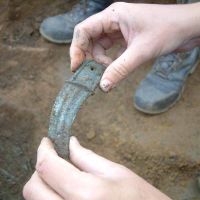
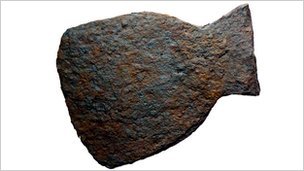
A Viking axe head found in a Gloucestershire village could be evidence of a battle more than 1,100 years ago, according to archaeologists.

The wrought iron object, found in Slimbridge in 2008, has now been identified as being of Viking origin.

Archaeologists think the axe head could be evidence of a battle in 894 AD

Archaeologists think the axe head could be evidence of a battle in 894 AD

Historians say a band of Vikings sailed up the River Severn and fought against the Anglo-Saxons in 894 AD.

Archaeologists say where the axe head was found is where they could have tied up their ships.

It was discovered by Ian Hunter Darling under a hedge in his garden.

Bloody battle

“I couldn’t believe what I saw. I thought it could have been an agricultural implement of some description,” he said.

He said an archaeological visit to the the farm where he lives had got the experts “quite excited”.

“They said I should take it to a museum to have it looked at.”

According to historians King Alfred the Great fought the Vikings in a bloody battle at Minchinhampton, about 10 miles from Slimbridge, in 894 AD.

Three Viking princes were killed in the battle, and fighting could have ranged over a wide area of the Berkeley Vale.

For over a century archaeologists have speculated where the Vikings could have moored their ships.

“They realised my driveway would have been creek in those days before there was a sea wall on the River Severn,” said Mr Hunter Darling.

“The boats could have tied up at the bottom of my garden.”

‘Viking sword’

Members of Slimbridge local history society now want to gather further evidence of Viking activity in the village.

Peter Ballard, from the society, said: “A member of a local family claimed he found a Viking sword in a ditch by the River Cam many years ago, but that has now been lost.”

They are asking for residents who may have found other Viking objects to come forward.

A meeting to highlight the importance of the discovery will be held in Slimbridge Village Hall on 21 February.

The axe head is to go on display at Stroud Museum in the Park.

Link: http://www.bbc.co.uk/news/uk-england-gloucestershire-16829808

HisTOURies UK

Read Full Post »

For 24 hours, on the last Tuesday of January, the town of Lerwick goes more than a little mad.

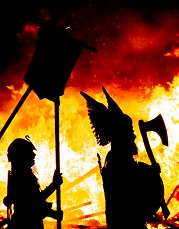
uphellyaa-shetland-festival“There will be no postponement for weather”. That’s a defiant boast by Shetland’s biggest fire festival, considering it’s held in mid-winter on the same latitude as southern Greenland. But it’s true: gales, sleet and snow have never yet stopped the Up Helly Aa guizers of Lerwick from burning their Viking galley – and then dancing the dawn away.

Amazing Blaze

Up Helly Aa is a lot more than a sub-arctic bonfire and booze-up. It’s a superb spectacle, a celebration of Shetland history, and a triumphant demonstration of the islanders’ skills and spirit. This northern Mardi Gras lasts just one day (and night). But it takes several thousand people 364 days to organise. Much of the preparation is in strictest secrecy. The biggest secret of all is what the head of the festival, the ‘Guizer Jarl’, will wear and which character from the Norse Sagas he’ll represent.

The Guy’s A Jarl!

The Jarl will have been planning (and saving up for) the longest day of his life for 12 years or more, before he dons his raven-winged helmet, grabs axe and shield, and embarks on a 24-hour sleepless marathon.

On the evening of Up Helly Aa Day, over 800 heavily-disguised men (no women, thank you, we’re vikings!) form ranks in the darkened streets. They shoulder stout fencing posts, topped with paraffin-soaked sacking.

On the stroke of 7.30pm, a signal rocket bursts over the Town Hall. The torches are lit, the band strikes up and the amazing, blazing procession begins, snaking half a mile astern of the Guizer Jarl, standing proudly at the helm of his doomed replica longship, or ‘galley’.

It takes half an hour for the Jarl’s squad of burly Vikings to drag him to the burning site, through a crowd of four or five thousand spectators.

Amazing Blazing

The guizers circle the dragon ship in a slow-motion Catherine Wheel of fire. Another rocket explodes overhead. The Jarl leaves his ship, to a crescendo of cheers. A bugle call sounds, and then the torches are hurled into the galley.

As the inferno destroys four months of painstaking work by the galley builders, the crowd sings ‘The Norseman’s Home’ – a stirring requiem that can brings tear to the eyes of the hardiest Viking.

The Procession

Tears of mirth are more likely as the night rolls on and more than 40 squads of guizers visit a dozen halls in rotation. They’re all invited guests at what are still private parties – apart from a couple of halls where tickets are on sale to the general public.

At every hall each squad performs its ‘act’, perhaps a skit on local events, a dance display in spectacular costume, or a topical send-up of a popular TV show or pop group.

 Every guizer has a duty (as the ‘Up Helly Aa Song’ says) to dance with at least one of the ladies in the hall, before taking yet another dram, soaked up with vast quantities of mutton soup and bannocks.

The All-Nighter to End All-Nighters

It’s a fast and furious night – and a lucky guizer who arrives home with a completely clear head before 8.30am the next morning which, not surprisingly, is a public holiday. Lerwick’s a ghost town but by evening the hardier merrymakers are out dancing again, this time at the ‘Guizer’s Hop’.

The Burning Galley

That’s not the end of it, for throughout the rest of the winter each gang of guizers will hold their own ‘squad dances’ for family and friends. By early autumn, there’ll be the first meetings to arrange the next year’s performance, while at the Galley Shed in St Sunniva Street the shipwrights, carpenters and their helpers will be starting work on the new galley, not forgetting ‘the boys who made the torches’.

‘From grand old Viking centuries, Up Helly Aa has come…’ That’s what the guizers sing but in fact the festival is only just over 100 years old in its present, highly organised form. In the 19th century Up Helly Aa was often riotous. Special constables were called in to curb trigger-happy drunks firing guns in the air – and dragging a blazing tar barrel through the streets, sometimes leaving it on the doorstep of the year’s least popular worthy burgher. Today’s festival is much better behaved.

Fire, Feasting and Fancy Dress

The ingredients in the Up Helly Aa recipe go back 12 centuries and more – fire, feasting, fancy dress and, above all, fun. The torchlit procession and galley burning echo pagan Norse rituals at the cremation of great chieftains, and religious ceremonies to mark the Sun’s return after the winter solstice.

Elaborate disguise was part of prehistoric fertility rites. Mediaeval Shetland guizers were called ‘skeklers’ and wore costumes of straw. The feasting and dancing continue saga traditions from the winter drinking halls of Viking warriors, while the satirical ‘Bill’ or proclamation, lampooning local worthies and fixed to the Lerwick Market Cross on Up Helly Aa morning, has precedents in the sharp wit of the Norse skalds.

If you should miss the Lerwick Up Helly Aa (or if it gives you the taste for more of the same), don’t despair – there are another eight fire festivals in various districts of Shetland during the late winter.

And the country Up Hellies A’ do NOT ban women from being torch-bearers and guizers. Don’t mention that in Lerwick, though – where the men-only rule is a ticklish topic in these politically correct days.

The Up Helly Aa Exhibition in the Galley Shed, St Sunniva Street, Lerwick, welcomes visitors. Shetland Museum also has extensive photographic archives of the festival.

For more information please visit the dedicated Up Helly Aa website.

Rural Up Helly Aa Celebrations:

Scalloway – 13th January 2012
Nesting – 3rd February 2012
Uyeasound, Unst – 10th February 2012
Northmavine – 17th February 2012
Bressay – 24th February 2012
Cullivoe, Yell – 24th February 2012
Norwick, Unst – 25th February 2012
South Mainland – 9th March 2012
Brae – 16th March 2012

Histouries UK

Read Full Post »

The lights are up, Noddy Holder’s voice is ringing in your ears and you’ve already eaten all your advent chocolate in a gluttonous frenzy. Yes it’s Christmas; that time of year reserved for frantic last-minute shopping, burnt turkeys and half-drunk carols in the front room. It’s also the Christian celebration of Jesus’ birth, of course: and even that bears more than a passing similarity to the ancient god Mithra.
So where did some of the Christmas traditions we take for granted actually come from? The truth stretches back a lot longer than you might think. Here are ten yuletide customs born in the ancient world.

1. Christmas Trees

Our Christmas Tree We might curse the fact that we’re still picking pine needles out of our toes come spring, but the idea of decorating your house with greenery at winter goes back thousands of years. King Tut may never have seen the multicoloured mess we put up with nowadays, but he would have had date palm leaves scattered around his royal abodes on the winter solstice.Evergreens were celebrated in Egypt as a reminder that, though the winter was harsh and yielded little, spring would come just as inevitably. The palm also spawned a shoot each month, meaning that by December (as it would become known) Egyptians weilded the leaves to show that the year was over. They’d have decorated with entire forests if they ever saw a European winter.

Soon Egypt’s tree-hugging tradition spread north to Italy, during the height of the Roman Empire. Palms were substituted for firs and other native species, on which tapers would be lit and burned in honour of Saturn, god of agriculture and justice, during the notoriously raucous Saturnalia festival. The custom migrated north to Germany and Scandinavia during the Middle Ages, resulting in today’s obsession.

2. Christmas Carols


Carol Singing Whether you enjoy strangers caterwauling on your doorstep or not, you can thank ancient pagans and their joyous celebrations of the stars. Song and dance were commonplace at the earliest stone circles of Europe: some think even Stonehenge was built with acoustics in mind.

As with the trees, special songs would be created for the winter solstice. In fact songs would be sung for each of the seasons, but the Christmas tradition stuck with the newly-created Christian faith, eager to commemorate Jesus Christ.

The first ‘proper’ Christmas carol can be dated back to ancient Rome in 129 AD, when a Roman bishop decreed that a song called ‘Angel’s Hymn’ should be sung during the Christmas service at Rome. Fast forward a few hundred years, and a Greek Orthodox Priest named Cosmas of Jerusalem (or Maiuma) wrote another famous hymn. Soon, the whole of Europe was singing at Christmas. Incidentally the tradition of singing to people whether they want to or not was invented some time around the 17th century. If someone had shown Cosmas he might not have bothered.

3. Santa 

 Santa ClausMillions of people still think Santa owes his current scarlet clobber to canny ad men at Coca-Cola. But it’s a belief that should have been consigned to the ‘urban myth’ bin many moons ago. The western world’s enduring image of a red-and-white-robed Santa owes more to his ancient ecclesiastical roots then a syrupy soft drink. Saint Nicholas was the Bishop of Myra, an Ancient Greek town of Lycia, modern Turkey, during the 4th century AD. Popular throughout the Christian world, he’s also known as ‘Nicholas the Wonderworker’ thanks to the large number of miracles attributed to him.

Nicholas’ association with the reindeer-propelled giver of gifts we all know today stems from his propensity for leaving coins in the shoes of those who gave to him (see stockings story below). This grew into a European Catholic tradition, whereby the poor would leave their shoes in church overnight. Coins would then be donated by rich patrons in a homage to Saint Nick’s generosity. Present-hungry kids also can thank Nicholas’ status as the patron saint of children when they’re maniacally tearing open a box of badly-rendered plastic rubbish.

 The name ‘Santa Claus’, incidentally, didn’t come until the 19th century, as an evolution of the Dutch colloquialism Sinterklass. His name may have changed, but Santa still kept the ceremonial red robes of his ancient forebear. However many think the clothing may be an amalgam of Saint Nicholas’ and those of the Norman god of misrule, a red-robed character who would go about causing havoc during the winter solstice period. Santa didn’t always use reindeer to power him from house to house, either: many believe they are an evolution of the eight-legged grey horse of the Norse god Odin called Sleipnir, who could leap huge distances. Middle Ages children would leave out food for Sleipnir, a custom which continues to this day.

 4. Yule Log

  Yule LogLike most things associated with Yule, a pagan festival largely attributed to the Germanic peoples of the medieval period, the yule loge can trace its roots back through some of the world’s most successful ancient civilisations. Today the burning of the yule log has become a marginalised affair, and can be carried out pretty much any time leading up to Christmas Day. Yet the log began its life as a yuletide tradition thousands of years back, in the earliest cities of Sumer and Egypt.

Egyptians believed that the winter solstice period marked the death and rebirth of their national god Horus, the god of the sky and the sun. Thus light was shed to celebrate him, and since Egypt was about 5,000 years from electricity a log would be burned for 12 days. This tradition carried into the cities of Sumer and Mesopotamia via the winter festival of Zagmuk, and would later become one of the features of the Roman celebration of Saturnalia, when a yule-style log was burned for ten days to usher in the strength of Mithra.

Saxons and Visigoths would latch onto the log as a symbol of good, or light prevailing over darkness, or evil. Ashes were prized for their supposed magical powers. Christians, most likely taking their lines from the Romans, would later adopt the log as a symbol for the light of Christ bringing the world from darkness.

5. Christmas Cards


Christmas cardsChristmas cards may only have come into European vogue during the 15th century (thanks to the Germans, again). But their origins go back thousands of years before, to the greetings given in Ancient Egypt via ornately decorated papyrus. Related or not, the ancient Chinese are thought to be some of the greetings card’s earliest fans, exchanging simple messages to celebrate the New Year.

The invention of printing, and the west’s popularising of card-giving, wouldn’t arrive for another 1,500 years or so. You might expect the Chinese, with their longstanding obsession with fireworks (and blowing things up in general) to have invented the Christmas cracker too. Not so: desperate London sweet-seller Tom Smith invented it as an explosive panacea to his ailing bonbon trade, in 1847.

6. Mistletoe

  When Tara from IT starts waving mistletoe at you from across the office fix023with one suggestive eye on the stationery cupboard, you can thank ancient pagans for the group email the next day. Druids, to be precise: the ancient mystics saw the herb as having magical powers thanks to its evergreenness. Amongst its miraculous characteristics – curing illness, countering poison etc – mistletoe was thought to enhance virility.

Kissing under the mistletoe may date all the way back to the ancient Greeks; no strangers to free lovin’. Traditionally, kissing beneath the magical mistletoe would ensure a couple stayed happy. It was even used as a sort of natural proposal, and hung at marital ceremonies. Saxons then took on the mantle, associating the plant with Freya, goddess of love, beauty and fertility. Men could kiss any woman who found herself beneath a sprig of mistletoe, plucking a berry with each kiss. When the berries had all gone, the kissing was over. One suspects mistletoe was never in short supply at Saxon parties.

7. Presents

  For retailers at least, Christmas is the biggest gift of all: whether we want Oxford Street Xmasto or not (boo to those in the latter category) we’ll all be trapsing the high street in search of something we can pass off as thoughtful, with more than half an eye on our wallets. Yet as much as the world hasn’t always been obsessed with Furbies, novelty ties and shaving kits, we’ve been giving and receiving gifts since the beginnings of society. Archaeologists have found evidence of personal decoration as far back as 70,000 years ago – and French anthropologist Marcel Israel Mauss establishes social bonds which establish respect and interdependence – key to social cohesion.

Fast forward a few thousand years, and gift-giving was a key part of Saturnalia, when masters would ceremoniously be ruled over by their slaves. Gifts were also seen as an important way to keep up good spirits during the long, cold winter. Of course Christians point to the Gold, Frankincense and Myrrh given to baby Jesus by the three wise men, though it’s worlds away from the capitalist scrums of today. The idea of presents being stuffed down the chimney pot may also have derived from ancient times. Germanic tribes would throw gifts onto fires as sacrifices for the gods. Thankfully my slippers stayed flame-free last year.

8. Feasting

 It wouldn’t be Christmas without unholy doses of Turkey (or Goose, or Christmas Dinnernuts), bread sauce, potatoes and, of course, the only batch of Brussels sprouts you’ll eat all year. But, like most Christmas customs, feasting to see in the day has its roots in the earliest civilisations on the planet. The Mesopotamian festival of Zagmuk would traditionally involve great feasting, as the height of the winter ended, days became longer and farming could continue once more. Food was one way to usher in the sun, as was the case in Egypt with Horus – and later became part of the Saturnalia festival, a Roman middle-finger to the harsh European winter.

Goose had been used since ancient Egyptian times as the meat of choice for Winter Solsticers, a tradition which continued in Britain until the 16th century. Some credit Henry VIII with having introduced turkeys to our Christmas platters. The Spanish allegedly took on the turkey mantle from their conquered Aztec subjects, who had long domesticated the far juicier bird.

The Romans frequently ate Christmas ham, a custom still followed in many countries today, to celebrate the life of Adonis, god of rebirth and vegetation, who was killed by the tusks of a wild boar sent either by Artemis or Ares. A boar’s head is still roasted ceremonially each year at Oxford University. Though fruits, berries and spices had been used to make cakes in ancient times, the Christmas Pud we all know and love (and hate in equal measure) didn’t enter the annals of history until the 15th century.

9. Stockings

 There are no steadfast stories as to the origin of the Christmas stocking, Stockings for Allbut one apocryphal tale has stood the test of time, true or not. And unsurprisingly it comes courtesy of Saint Nicholas’ legendary generosity. A poor man in Myra lost his wife, and was left to bring up his three young daughters alone. He became poor, and worried that he would not have enough money to pay any of his daughters’ dowries, as was the custom back then.

Enter Saint Nick, who, knowing the father would be too proud to accept money for his daughters, surreptitiously threw coins into his house, beside the hearth over a few nights. The family were drying their clothes by the fire at the time, so each day each daughter would wake up to receive a coin in their shoe or stockings. Some stories even say Nicholas chucked coins down the chimney; another reason why we have Santa throwing presents down the chimney nowadays.

10. The Nativity

 Pushing the boundaries of ‘ancient’ somewhat, you can thank Saint Francis of Assisi for that heart-in-mouth moment you forgot your one and only line, ‘Sorry no room’, in front of over a hundred parents armed with cameras and pitiful expressions (or was that just me?). The famous Catholic deacon set up a living tableau in memory of Christ’s birth, using the accounts in the Gospels of Luke and John, in Greccio, near Rome, in 1223.

The tradition spread fast, leading to the annual humiliation of children that occurs in nearly every school in the western world, if not more. Catholics in Spain and Latin America also celebrate Las Posadas, a ritual re-enactment of the tribulations Mary and Joseph enduring before giving birth to Jesus. This can take place on any day from the 16th to the 24th of December.

Link: http://heritage-key.com

 Happy Christmas everyone………

The Best Tours during the Festive Period
HisTOURies UK – Magical Landscape, Mystical Tours

Read Full Post »
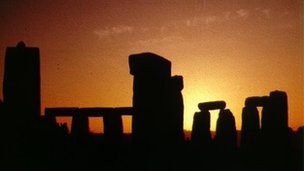
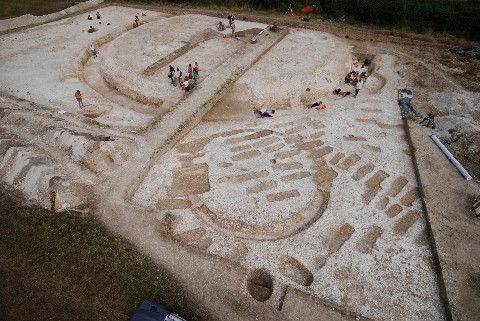
Two previously undiscovered pits have been found at Stonehenge which point to it once being used as a place of sun worship before the stones were erected.

The pits are positioned on celestial alignment at the site and may have contained stones

The pits are positioned on celestial alignment at the site and may have contained stones

The pits are positioned on celestial alignment at the site and may have contained stones, posts or fires to mark the rising and setting of the sun.

An international archaeological survey team found the pits as part of the Stonehenge Hidden Landscapes Project.

The team is using geophysical imaging techniques to investigate the site.

The archaeologists from the University of Birmingham and the Ludwig Boltzmann Institute for Archaeological Prospection in Vienna have been surveying the subsurface at the landmark since summer 2010.

Procession route

It is thought the pits, positioned within the Neolithic Cursus pathway, could have formed a procession route for ancient rituals celebrating the sun moving across the sky at the midsummer solstice.

A Cursus comprises two parallel linear ditches with banks either side closed off at the end.

Also discovered was a gap in the northern side of the Cursus, which may have been an entrance and exit point for processions taking place within the pathway.

These discoveries hint that the site was already being used as an ancient centre of ritual prior to the stones being erected more than 5,000 years ago, the team said.

Archaeologist and project leader at Birmingham University, Professor Vince Gaffney, said: “This is the first time we have seen anything quite like this at Stonehenge and it provides a more sophisticated insight into how rituals may have taken place within the Cursus and the wider landscape.”

More on this story: http://www.bbc.co.uk/news/uk-england-wiltshire-15917921

Stonehenge Special Acess Tours  – beyond the fences: http://www.histouries.co.uk/stonehenge/private-access-tour.htm

Tours of Stonehenge and Wessex
HisTOURies UK – Mystical Landscape, Magical Tours

Read Full Post »

An exciting new Bronze Age hoard discovered in west Wiltshire (near Stonehenge)  has just gone on display at Salisbury Museum. It was found a month ago in a field near Tisbury by a metal detectorist. He reported the first object, a spearhead, to the Wiltshire Finds Liaison Officer. A team of archaeologists then excavated the remaining objects and recorded how they lay in the ground.

The hoard of over 100 copper alloy objects is over 2,700 years old and dates to the late Bronze Age and early Iron Age. It consists of tools – axe heads, chisels, sickles, gouges, and weapons – spearheads, daggers, knives, swords and scabbard fittings. It is the most important hoard to have been found in Wiltshire since the discovery of the Salisbury Hoard in the 1980s.

It is very unusual for a hoard of this significance to be on display in a regional museum before it has been assessed by the experts at the British Museum. The hoard will only be on display until Saturday 26 November – it will then go to the British Museum for assessment and the local coroner will need to hold an inquest to determine whether it is Treasure Trove.

See the Salisbury Journal for an article about the hoard.

 The hoard will only be on display until Saturday 26 November

Salisbury Museum – http://www.salisburymuseum.org.uk/

Wessex Guided Tours
HisTOURies UK – Mystical Landscape, Magical Tours

Read Full Post »

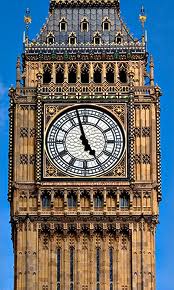
Big BenBritish Summer Time ends: clocks go back – Why?


The clocks will go back by one hour at 2.00 am on Sunday 30 October. At 2.00 am, the clocks will return to 1.00 am as British Summer Time ends for another year.

British Summer Time

British Summer Time (BST) starts each year on the last Sunday in March and ends on the last Sunday in October. On Sunday 27 March the clocks will go forward, meaning we lose an hour. British Summer Time is due to end this year on 30 October.

BST is operational on the following dates:

  2011 2012 2013
Start of BST (clocks go forward) 27 March 25 March 31 March
End of BST (clocks go back) 30 October 28 October 27 October

Summer time changes on standard dates throughout the EU. Britain and Ireland constantly remain an hour behind most of Central Europe.

The history of daylight saving time

In 1907 an Englishman, William Willett, campaigned to advance clocks by 80 minutes. He proposed four moves of 20 minutes at the beginning of the spring and summer months, and to return to Greenwich Mean Time in a similar manner in the autumn. The following year, the House of Commons rejected a Bill to advance the clocks by one hour during the spring and summer months.

Summer time was first defined in an Act of Parliament in 1916. The clocks were moved one hour ahead of GMT from the spring to the autumn.

During the Second World War, double summer time (two hours in advance of GMT) was introduced, lasting until July 1945.

Since the 1980s, all parts of western and central Europe have co-ordinated the date and the time of their clock changes.

Why Change the Clocks?

Twice a year the clocks change, forward in the Spring and then back again in the Autumn. But why?

It happens twice a year. We all change our clocks and watches by one hour. In the spring, we add an hour, and go onto what is called British Summer Time, while in the autumn, we do the reverse, and adhere to Greenwich Mean Time.

Why bother?It’s all to do with saving the hours of daylight, and was started by a chap called William Willett, a London builder, who lived in Petts Wood in Kent.

Basically, he reckoned that you could improve the population’s health and happiness by putting forward the clocks by twenty minutes every Sunday in April and do the opposite in September.

EconomiesHis idea was not taken up, even though a ‘Daylight Saving Bill’ was introduced some five years before the outbreak of World War One. But once the war started, it was considered prudent to economise, to promote greater efficiency in using daylight hours, and in the use of artificial lighting. And so in 1916, ‘Daylight Saving Time’ was introduced.

Even though most countries abandoned this after that war, some eventually decided that it was a good idea, and most of these nations began to keep it throughout the year.

ExperimentSince 1972, Britain has decided to go with Greenwich Mean Time in winter, and British Summer Time in Summer. But back in 1968, Britain tried a four-year experiment by advancing time one hour ahead of GMT throughout the year.

But those living further north, particularly in Scotland, found it most unsatisfactory, with dark mornings for much of the year, and the experiment was dropped.

But the arguments rage on….and on.

The Best Tours in Time Travel
HisTOURies UK

Read Full Post »

If you find yourself gasping, “Wow, that tree’s fatter than anything else like it around here!” the chances are you’ve probably found an ancient tree

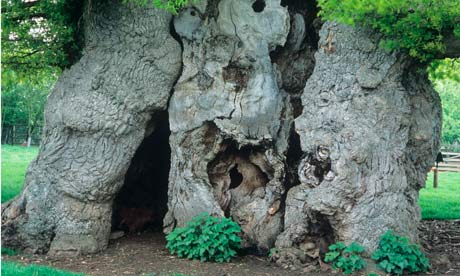
The mighty Bowthorpe Oak, near Bourne in Lincolnshire is Europe's greatest girth English Oak at a massive 42 feet Photograph: Alamy

The mighty Bowthorpe Oak, near Bourne in Lincolnshire is Europe's greatest girth English Oak at a massive 42 feet Photograph: Alamy

What is an ancient tree?  The definition varies from species to species, so a silver birch may be ancient at 150 years old, while an oak of the same age is still a baby. But if you find yourself gasping, “Wow, that tree’s fatter than anything else like it around here!” you’ve probably found one. If you’re tempted to hug it, don’t hold back – ancient trees are essential to biodiversity, providing homes to thousands of species. Hugging is also the easiest way to measure a tree’s girth, to get some clue to its age. The “British standard hug”, as defined by the Woodland Trust, is 1.5 metres (5ft) from fingertip to fingertip.

Here are a few notable specimens; you can find 80,000 more, or log your own discoveries, at ancienttreehunt.org.ukAncient Tree Hunt.

Fortingall yew, Perthshire

Estimated to be at least 3,000 years old and possibly 5,000, this is the oldest yew in Britain. In 1769 its girth was recorded as about 17 metres (55ft). Today you can see only remnants of the old plus new growth amounting to no more than two hugs – a shadow of its former glory but still remarkable. 

Bowthorpe oak, Lincolnshire

This 1,000-year-old tree stands in a field at Manthorpe, near Bourne. Its hollow trunk has been used for parties; at one point, it is claimed, three dozen people managed to stand within it.

Llangernyw yew, Conwy

Possibly more than 4,000 years old, the tree in the grounds of St Dygain’s church in Llangernyw is one of the oldest living things in Wales.

Belvoir oak, County Down

This fine oak is thought to be somewhere between 500 and 700 years old, making it probably the oldest tree in Northern Ireland. It is one of many ancient trees in Belvoir Park Forest.

Tolpuddle Martyrs’ tree, Dorset

Under this sycamore in the village of Tolpuddle in 1834, six poverty-stricken agricultural labourers formed the first trade union in Britain.

Spanish chestnuts, Croft Castle, Herefordshire

Among more than 300 veteran trees in the grounds of this castle near Leominster is an avenue of magnificent sweet chestnuts. Some of them are rumoured to have come from nuts from the wrecks of the Spanish Armada in 1592.

Link: http://www.guardian.co.uk/travel/2011/apr/09/ancient-trees

British Countryside Tour Guide
HisTOURies UK – The Best Tours in History

Read Full Post »

Archaeologists have found the first intact Viking boat burial site in the UK. The 5m-long grave contained the remains of a high-status Viking who was buried with an axe, sword, spear and bronze ring-pin.

”]Excavations at the Ardnamurchan Peninsula [Credit: Ardnamurchan Transitions Project]
The 1,000-year-old find, on the remote Ardnamurchan Peninsula, in the Highlands, was made by Ardnamurchan Transitions Project, a team led by experts from the universities of Manchester and Leicester, CFA Archaeology Ltd and Archaeology Scotland. 

Other finds included a knife, a sharpening stone from Norway, a ring pin from Ireland and Viking pottery. 

Dr Oliver Harris, project co-director from the University of Leicester’s School of Archaeology and Ancient History, said: “This project examines social change on the Ardnamurchan Peninsula from the first farmers 6,000 years ago to the Highland clearances of the 18th and 19th century. 

“It has also yielded evidence for what will be one of the best-dated Neolithic chambered cairns in Scotland when post-excavation work is complete.” 

Source: This is Leicestershire [October 18, 2011]

The Best Tours in British History
HisTOURies UK

Read Full Post »

Round Barrows – That’s where Bronze Age people buried their dead init! Nuff said”. Factually correct, if a tad simplistic, but of course the potential for learning more about society from studying these monuments it could be argued is still in its infancy. The landscape of Cranborne Chase has been at the forefront of British prehistory and archaeology since the middle of the 19th century, it having one of the densest concentrations of prehistoric monuments in north-west Europe.

image credit: High Lea Farm excavation © Bournemouth University

image credit: High Lea Farm excavation © Bournemouth University

In 2003 John Gale embarked upon a seasonal campaign of excavations at the little known and apparently flattened barrow group at High Lea Farm near Hinton Martell north of Wimborne. The fieldwork was completed in 2009 and the analysis currently under way is discovering information which suggests that we still have a lot to learn about these ‘familiar’ monuments of the Wessex landscape.  

John will also be incorporating some early results of his recent survey work at the Clandon Barrow in west Dorset which has a bearing on the lecture title.

 A lecture in the Salisbury Museum Archaeology Lectures (SMAL) series. SMAL lectures are held on the second Tuesday of each month from September to April (2011)

A talk by John Gale, Senior Lecturer in Archaeology, Bournemouth University.

Link: http://www.salisburymuseum.org.uk/what-s-on/lectures/188-the-knowlton-prehistoric-landscape-project-–-we-know-a-lot-about-round-barrows-dont-we.html

Mystical Landscape, Magical Tours
HisTOURies UK – The Best Tours in British History

Read Full Post »

Three very different national histories are marred by their refusal to admit neighbours into the narrative, writes David Cannadine from the Financial Times.

“There are,” John Julius Norwich notes with pardonable exaggeration in his lively and engaging volume on the subject, “a thousand histories of England, ranging from the scholarly to the popular, the impartial to the tendentious, the consistently riveting to the utterly unreadable.”

The Venerable Bede was the first in the field with his Ecclesiastical History of the English People, completed in AD731. Almost 1,200 years and much more history later, another Northumbrian, G.M. Trevelyan, produced the defining account of the national past, not only for his generation but for the next as well. Yet few histories of England have ever attained the canonical status of Bede or Trevelyan, and the best put-down to what has all too often been a formulaic, parochial and self-satisfied genre remains 1066 and All That by W.C. Sellar and R.J. Yeatman. In a bravura display of historical comedy, they unrelentingly sent up the conventional national narratives built around dates and dynasties, which categorised all people and events as either “good” or “bad”, which chronicled England’s pre-destined rise to being “top nation”, and which lamented that history came to a “full stop” when that pre-eminence was given up at the close of the first world war.

Sellar and Yeatman published their incisive masterpiece of historical hilarity in 1930 but it would be another 50 years before the no-longer-deniable decline of Britain as a great power, and the growing demands for devolution in Wales and Scotland, combined with the “Troubles” in Northern Ireland, encouraged a fundamental rethink of the traditional English national narrative – a reappraisal beginning in 1984 with the Oxford Illustrated History of Britain, developed by Hugh Kearney in his “four nations” history of the British Isles, and brought to broader public attention either side of the millennium by Norman Davies in The Isles: A History and by Simon Schama in his television series History of Britain.

As they saw it, the history of England was no longer the right way to define, approach or understand the national past: instead, they urged a more complex and nuanced treatment, exploring the relations between England, Ireland, Scotland and Wales, recognising the constructed and contingent nature of “Britishness” and paying appropriate attention to the constant interactions between the British and continental Europe and the wider world beyond. Thus understood, the English past was merely one specific component of a much bigger history and multilayered narrative.

“We are told that Hampshire is ‘older’ than France – but what exactly does that mean, and do the French know or care?”

But if the three books under review here are any indication, English history has carried on regardless: for their authors are wholly unengaged with or unimpressed by the scholarly rethinking and upscaling of what constitutes our national past that has by now been going on for three decades and more. John Julius Norwich would shed no tears if Scotland became independent and he focuses exclusively on England because writing its history in one hundred places was just about possible, whereas dealing with Britain as a whole with the same number was not.

For Simon Jenkins, too, England is the subject of his concern. Wales, Scotland and Ireland are separate countries with separate histories, which have only occasionally connected with England: Wales was “a thorn in the side of Norman monarchs”; Scotland had an unrivalled “capacity for causing trouble” for the English; while after the Act of Union, Ireland was “a curse on British political leaders”. And although he had thought of including the histories of Wales, Scotland and Ireland, Peter Ackroyd also concentrates on England, on the grounds that a broader approach would run the risk of “their seeming to become merely extensions of England” – which is exactly how he treats them anyway.

So here, once again, are three little England histories: 1066 and All That, but without the jokes. In A Short History of England, Simon Jenkins provides a brisk and confident narrative from the Saxon dawn beginning in 410 to David Cameron exactly 1,600 years later. He focuses on high politics: kings and queens, war and peace, with (as might be expected of a National Trust chairman) occasional allusions to landscape, churches and country houses. There is nothing here that is new and his account is devoid of context, analysis or explanation, falling back on such banalities as “England had a genius for opportunistic social change” and “new forces were now coming into play”. The Black Death, the “rising middle classes” of Tudor and Stuart times, and the Industrial Revolution are dismissed in little more than a few lines. The marriage of the Prince of Wales and Lady Diana Spencer is thought of more importance than the publication of Darwin’s On the Origin of Species or the Indian Mutiny. If the book has a theme, it is the growth of parliament, but this is insufficiently developed. In the conclusion, we are told on one page that no extra-parliamentary movement has ever acquired political traction but, soon after, we learn that progress in England has always been the result of social, economic and political change welling up from below. It is impossible to make sense of such contradictory signals.

Peter Ackroyd’s Foundation is not only on a larger scale than Jenkins’ brief canter across the centuries, it is also the first of a projected six-volume history of England, which will test the stamina not only of the author but also of his readers. In this opening instalment, he takes us from pre-Stonehenge times to the death of Henry VII in 1509. As with Jenkins, the narrative is built around the reigns of kings and queens, and their interminable quarrels, and even Ackroyd’s talents as a storyteller are taxed when he takes us through the Wars of the Roses, where everyone seems to have been called Henry or Edward or, alternatively, Norfolk or Suffolk, or Gloucester or Salisbury. These chapters stress chance, contingency and unintended consequences, and he interleaves them with accounts of the ordinary lives of ordinary people: religion, family, education, crime, medicine and so on. According to Ackroyd, it is in the deep continuity of ordinary people’s lives and circumstances, rather than in the chaos and confusion of royal politics and dynastic quarrels, that the essence of English history and national identity is to be found. But he offers no convincing explanation as to how or why this has been true or could be true; and he seems unaware of the fact that the job of the historian is at least as much to investigate and question identities as to support and create them.

Like Jenkins, Ackroyd adopts a traditional style of exposition, and tells us little that is new, whereas John Julius Norwich adopts a wholly novel approach, whose obvious indebtedness to Neil MacGregor’s recent History of the World in 100 Objects in no sense diminishes his own book’s interest. In A History of England in 100 Places, he takes us from Stonehenge to the Gherkin, via Offa’s Dyke, Bodiam Castle, Blenheim Palace, Ironbridge, the Albert Memorial and the National Theatre; but he also includes such unexpected places as Brick Lane Mosque in London, Old Sarum in Wiltshire, the Liverpool houses in which John Lennon and Paul McCartney grew up, and Greenham Common. In these short histories, Norwich succeeds in conveying the complex texture and endless fascination of English history in ways that elude both Jenkins and Ackroyd. He has wise things to say about, for example, the general ghastliness of medieval life and medieval monarchs, the splendours of the King James Bible (“the only world-class masterpiece ever created by a committee”), the limitations of the English educational system, and the inexcusable destruction of Dresden by the allies during the second world war (though he does harbour a particular – and unexplained – animus against Queen Anne).

Despite their differences of scale and approach, dates and names and kings and queens loom very large in all three of these books. Ackroyd takes us through English history from the Saxons to the Yorkists reign by reign; Norwich prints a list of monarchs from Offa to Elizabeth II; and Jenkins not only has his own table of English sovereigns but also adds the names of all prime ministers from Sir Robert Walpole to David Cameron, along with his choice of 100 key dates, which he regards as “the finger-posts of history”, and as “the most important turning points in the national story”.

No one would deny that names and dates, narrative and chronology, are important in our past or in that of any other nation. But as these lists serve eloquently (and inadvertently) to show, without context and explanation, so-called “finger posts” and “turning points” can be as meaningless as the names and numbers in a telephone directory. When some politicians call for a “return” to history taught around kings and queens, they need to be reminded that such calls have repeatedly been made for the best part of a century, and that all too often, the cult of names and dates can be a substitute for teaching or learning history, rather than opening up the real thing itself.

In addition to their excessive stress on kings and queens, all three authors go too far in asserting the singular importance and identity of England. Ackroyd tells us that Hampshire is “older” than France (but what exactly does that mean, and do the French know or care?). Jenkins insists that England’s history is “the most consistently eventful of any nation on earth” (he does not seem to have heard of China or Iran). And while writing his book, Norwich was constantly struck by “how unlike the English are to any of their neighbours” (though most of their neighbours would probably say the same thing about themselves).

But while these claims to exceptionalism seem overstated and, indeed, inappropriate to the middle-ranking European power that Britain has for several decades been, all three authors are to be congratulated for offering relatively even-handed accounts of the national past, and for avoiding the sort of cheerleading propaganda that some politicians are also again urging. Each of these books describes extraordinary achievements and (on occasions) admirable and exemplary lives. But they also describe poverty and suffering, cruelty and destruction, duplicity and aggression on a scale that calls to mind what is happening in the most impoverished and war-ravaged parts of the world today.

By focusing as they do so specifically on the history of England, all three authors are in ignorant or deliberate denial of a generation’s scholarship that has done so much to make us aware of the many and more complex interactions between England, Wales, Scotland and Ireland, between Britain and France, Scandinavia and Germany, and between Britain and the wider world beyond. A national narrative that gives no more than walk-on parts to the rest of the British Isles, to continental Europe, to the British Empire, and to those places that were never coloured red, is in too many ways a contradiction in terms.

Little England has always been part of a bigger world and, for good or ill, English history has taken place in many parts of the globe beyond its boundaries and its shores. It was Rudyard Kipling (among other things the author of a distinctly tendentious national history) who once inquired: “What do they know of England who only England know?” As these three books inadvertently make plain, there are two very different answers to that question. The first is “a considerable amount”. But the second is “not nearly enough”.

Sir David Cannadine is Dodge professor of history at Princeton University. His ‘The Right Kind of History’, co-authored with Jenny Keating and Nicola Sheldon, is published in November by Palgrave Macmillan

Foundation: The History of England, Volume 1, by Peter Ackroyd, Macmillan, RRP£25, 352 pages

A Short History of England, by Simon Jenkins, Profile, RRP£25, 384 pages

A History of England in 100 Places: From Stonehenge to the Gherkin, by John Julius Norwich, John Murray, RRP£25, 512 pages

The Best Tours in British History
HisTOURies UK – Priveat guided sightseeing tours of Britain

Read Full Post »

« Newer Posts - Older Posts »