Feeds:
Posts
Comments

Archive for the ‘english culture’ Category

Stories of yokels getting the better of townies pepper British folklore – perhaps the best known being one reading of the Nottinghamshire legend The Wise Men of Gotham .
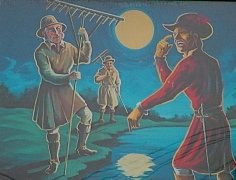
Wiltshire MoonrakerRivalling that tale is the Wiltshire story of The Moonrakers, so dear to the heart of the county that to this day anyone born in Wiltshire is known as a Moonraker.
The story goes that a couple of lads from a village near Devizes were involved in the spirits trade, and were not troubling the Excise with paperwork or duties. Depending on the source they were either distilling ‘brandy’ themselves, or obtaining it through illicit channels. These two entrepreneurs were warned of a raid by the Revenue, so for want of time and better cover they hid their contraband, including a couple of barrels of the good stuff, in a pond.

When the customs officials arrived it was unfortunately a clear night, with a full moon and not a breath of wind to stir the water’s surface. The Wiltshire lads could see the barrels clearly, so they quickly came up with a ruse: grabbing rakes they waded into the pond and used the implements to disturb surface and silt, masking the tuns. When the Revenue men spotted them and asked what they were doing, the yokels replied they were raking the moon in the pond in order to gather cheese from it. The clever Revenue men shook their heads at the peasants’ stupidity and searched the rest of the village, then finding nothing moved on.

Wiltshire Tour Guide
HisTOURies UK – The Best Tours in British History

Read Full Post »

Legends of Glastonbury

There are so many myths associated with Glastonbury that it is difficult

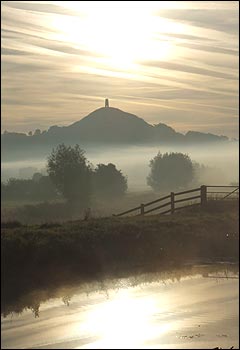
Glastonbury Tor

Glastonbury Tor

to know where to begin to talk about them. There are two main streams of legend that surround Glastonbury, though they twine around each other to some degree. The two streams revolve around the romantic figures of Joseph of Arimathea and King Arthur. Let’s take them one at a time.

Joseph of Arimathea
Joseph was the Biblical figure who took Jesus’ body after the crucifixion. According to some legends he was actually Jesus’ uncle, and had visited Britain years before with Jesus in the pursuit of his interests in the tin trade. It appears that there actually was a strong Jewish presence in the west of England at that time, and many of the tin miners may have been Jewish settlers.

At any rate, when Jesus died, Joseph thought it prudent to flee Palestine, and after many travails he came to Britain with a company of followers. He brought with him the Holy Grail, the cup used by Jesus at the Last Supper. Some versions of the legend have it that the Grail contained two drops of blood captured from Jesus’ side when he was wounded on the cross.

When Joseph came to Britain he was granted land at Glastonbury by the local king. When he arrived at Glastonbury, Joseph stuck his thorn staff in the earth, whereupon it rooted and burst into bloom. A cutting from that first tree was planted in the grounds of the later Glastonbury Abbey, where it continued to bloom every year therafter at Christmas time. There is still a thorn tree in the Abbey grounds, of a variety native to the Holy Lands, and it does indeed bloom around Christmas time.

Joseph was said to have established the first church in England at Glastonbury, and archaeological records show that there may well have been an extremely early Christian church here. What happened to the Holy Grail is another matter. Some legends have it that Joseph buried the Grail at the foot of Glastonbury Tor, whereupon a spring of blood gushed forth from the ground.

There is a well at the base of the Tor, Chalice Well, and the water that issues from it does indeed have a reddish tinge to it, from the iron content of the water.

Other legends have it that the Holy Grail was interred with Joseph when he died, in a secret grave. The search for the mysterious Grail emerges again and again in the tales of Glastonbury.

Further legends tell that the church founded by Joseph continued for many years. Eventually it became a monastery, and one of the first abbots was the future St Patrick, who was born in the west country.

King Arthur and Glastonbury

Glastonbury Abbey, where King Arthur is said to lie buriedLegends of King Arthur swirl about Glastonbury like a tantalizing fog from the nearby Somerset marshes. The nearby hill fort at South Cadbury has long been suggested as the location for Camelot. Indeed, excavations of South Cadbury suggest that it was in use during the early 6th century, which is the likeliest era for the real Arthur to have lived.

The association of Arthur and Glastonbury goes back at least to the early Middle Ages. In the late 12th century the monks of Glastonbury Abbey announced that they had found the grave of Arthur and Guinivere, his queen. According to the monks, an excavation found a stone inscribed “Here lies Arthur, king.” Below the stone they found the bones of a large man, and the smaller skeleton of a woman. The monks reburied the bones in the grounds of the abbey, where they were a very handy draw for pilgrims. The site of the grave can be seen today in the abbey grounds.

Glastonbury Tor, the enigmatic conical hill that rises above Glastonbury, has been linked with the Isle of Avalon, where King Arthur was buried after his death. This isn’t so farfetched as it may sound, for a millennium ago the water level was much higher, and the tor would indeed have been an island. Avalon was also called “the isle of glass” which does suggest similarities to the name “Glastonbury”.

The Holy Grail, the object of Arthur’s questing, is said to be buried beneath Glastonbury Tor, and has also been linked to Chalice Well at the base of the Tor.

One final myth of Arthur at Glastonbury: the landscape around Glastonbury is said to have been moulded and shaped so that the features (such as roads, churches, and burial mounds) create a zodiac calendar replete with Arthurian symbology. Like so many of the Arthurian myths, so much is open to interpretation and your own predisposition to believe or disbelieve.

Glastonbury Abbey
Is there a place more steeped in legend and myth than Glastonbury? Glastonbury AbbeyProbably not. Legend holds that the earliest church here was founded by St. Joseph of Arimathea in about 60AD, and that when he planted his staff in the earth a thorn tree burst forth.

In the grounds of the ruined Benedictine monastery there is a thorn tree of a variety common to the Middle East which is given to bloom around Christmas time.

By the late Middle Ages Glastonbury had become the richest abbey in England, due to the heavy pilgrimage trade. It was rich enough to build an inn for well-to-do pilgrims (the George Inn, on nearby High Street, which still welcomes guests 500 years later). The best preserved building in the abbey grounds is the old Abbot’s Kitchen (see photo), a curious square building which appears round due to its octagonal roof. In the abbey grounds are the reputed graves of King Arthur and Queen Guinevere, which were conveniently discovered by the Glastonbury monks in the 12th century, when the abbey needed a financial boost. Outside the grounds are the abbey tithe barn, which now serves as the Somerset Rural Life Museum (well worth a visit), and 4 miles away at Mere is the abbey’s Fish House, were fish was salted and cured.

The abbey is entered through the Abbey Gatehouse  an imposing arched gateway located on off Magdalene Street. Visitors pass through a fascinating museum depicting life at Glastonbury during the Middle Ages, and then enter the Abbey grounds proper. The first building you see on entering the grounds is St Mary’s Chapel, a roofless structure that boasts wonderful architectural details, from the recessed arches of the door to the repetitive arcading that rings the interior. Look up, where the curious small towers at each corner of the chapel seem almost Georgian in style.

If you continue past the chapel you will soon reach the Abbot’s Kitchen, probably the most recognizable symbol of the Abbey, and subject of numerous postcards! This is a peculiar building, with a high octagonnal tower over a square base bedecked with gargoyles. The interior is notable for the very large ovens and the high dome supported on reed-thin vaulting ribs.

Return from the Abbot’s Kitchen towards St Mary’s Chapel and you will pass a small sign on the green lawn. This marks the old burial ground, where, in the 12th century, monks conveniently found bones beneath an engraved stone indicating the burial place of legendary King Arthur. The bones and those presumed to belong to Arthur’s queen, Guinivere, were reburied within the Abbey Church, where a small memorial can be seen.

The grounds of Glastonbury Abbey emanate a sense of calm and peace; it is truly a magical place, and taken as a whole with the other attractions of this ancient town, make Glastonbury well worth an extended visit.

Visitor Information
Glastonbury Abbey
The Abbey Gatehouse
Magdalene Street
Glastonbury
Somerset
UK
BA6 9EL
Web: http://www.glastonburyabbey.com
Email: nfo@glastonburyabbey.com
 
Join us on a private guided tour of the West Country.   Visit Glastonbury, Stonehenge and Avebury Stone Circle.

Mystical Landscape, Magical Tours……………….
HisTOURies UK – The Best Tours in History

Read Full Post »

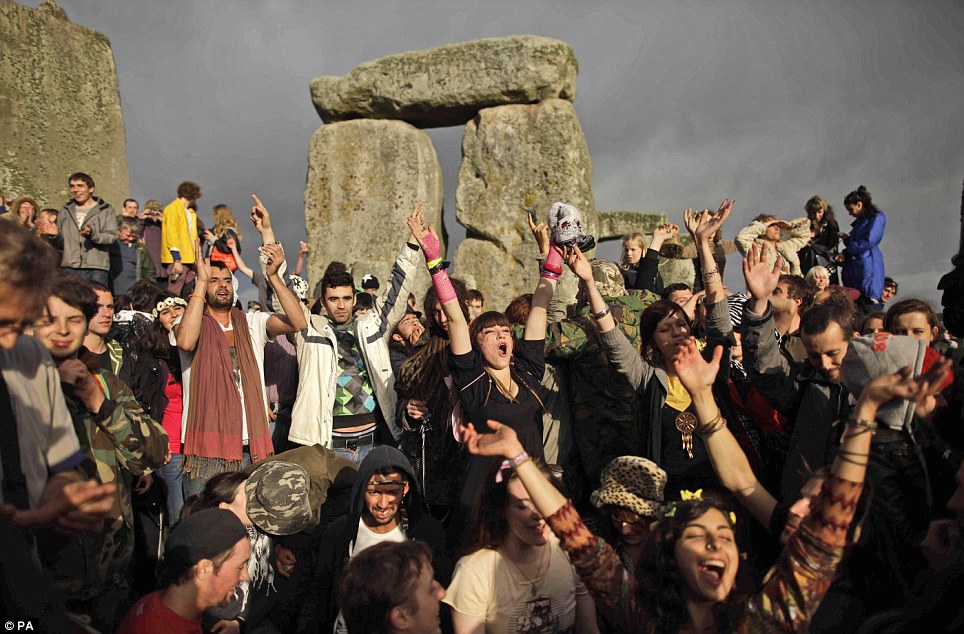
THE rain failed to dampen spirits as thousands of Druids, Pagans and tourists gathered at Stonehenge to celebrate the Summer Solstice on Tuesday morning.

About 18,000 revellers from across the country and abroad braved the weather to welcome the longest day at the ancient stone circle.

Although the sun did not make an appearance as dawn broke in an overcast sky, people enjoyed the festival atmosphere with Morris dancers, musicians and people in traditional robes.

The rain stopped before the sun rose at about 4.51am and crowds cheered as the sky started to brighten.

Denny Bartley, who travels from Essex with friends every year for the Solstice, said: “It’s been good – the Solstice is a great opportunity to catch up with old friends and I enjoy being with the other druids.”

Pagan rituals were led by senior druid King Arthur Pendragon at the Heel Stone, which included two pagan marriage ceremonies.

Mr Pendragon said: “It has been a good night. There are a lot of youngsters and a lot of people here asking all the right questions – they’re here for the right reasons.

“A lot of people came here to celebrate the birth of the sun for the longest day.”

Fewer people attended than last year, something which head of Stonehenge Peter Carson put down to the weather and the fact that the Solstice fell mid-week.

“It’s gone extremely well considering how poor the weather was. Everyone has come along and had a fantastic time yet again and they are leaving with big smiles on their faces,” said Mr Carson.

By Hannah White http://www.salisburyjournal.co.uk/

Stonehenge Tour Guide
HisTOURies UK – Private Guided Tours

Read Full Post »

The first day of the month of May is known as May Day. It is the time of year when warmer weather begins and flowers and trees start to blossom. It is said to be a time of love and romance. It is when people celebrate the coming of summer with lots of different customs that are expressions of joy and hope after a long winter.

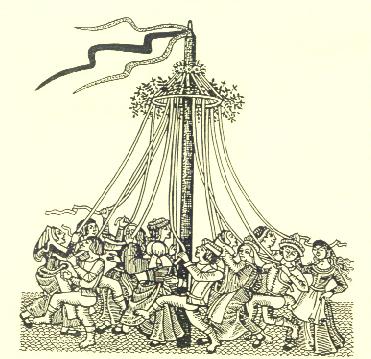
Traditional English May Day celebrations include Morris dancing, crowning a May Queen and dancing around a Maypole.

The beginning of Summer

Although summer does not officially begin until June, May Day marks its beginning. May Day celebrations have been carried out in England for over 2000 years.

The Romans celebrated the festival of Flora, goddess of fruit and flowers, which marked the beginning of summer. It was held annually from April 28th to May 3rd.

How was May Day Celebrated in the past?

It was custom for every one to go a-Maying early on May Day. Herrick, a 17th century English poet wrote:

There’s not a budding boy, or girl, this day,
But is got up, and gone to bring in May.

Decorating Houses

May Day began early in the morning. People would go out before sunrise in order to gather flowers and greenery to decorate their houses and villages with in the belief that the vegetation spirits would bring good fortune.

Washing in the early morning dew

Girls would make a special point of washing their faces in the dew of the early morning. They believed this made them very beautiful for the following year. copyright of protectbritain.com

May Queen

May Queen
The rest of the day was given over to various festivities. There was dancing on the village green, archery contest and exhibitions of strength. The highlight of the day was the crowning of the May Queen, the human replica of Flora. By tradition she took no part in the games or dancing, but sat like a queen in a flower-decked chair to watch her ‘subjects’.

May Day Garlands

Young girls would make May Garlands. They covered two hoops, one at right angles inside the other, with leaves and flowers, and sometimes they put a doll inside to represent the goddess of Spring.

In some parts of Britain, May 1st is called Garland Day.

The first of May is Garland Day
So please remember the garland.
We don’t come here but once a year,
So please remember the garland.

May Day Lifting

There was once a tradition in England of ‘lifting’ where a gang of young men would lift a pretty girl in a flower bedecked chair on May day. Then the girl would choose a boy on May 2nd.

May Day Tricks

In the North of England, the first of May was a kind of late ‘April Fooling’ when all sorts of pranks would take place and ‘May Gosling’ was the shout if you managed to trick someone. The response would be:

‘May Goslings past and gone. You’re the fool for making me one!’

Recommended Events in Wiltshire this May Day: 
http://www.english-heritage.org.uk/daysout/events/robin-hood-ow-1-Jan/
http://www.english-heritage.org.uk/daysout/events/time-travellers-go-medieval-os-30-Jan/
http://www.wherecanwego.com/whatsonengland/Wiltshire/events.aspx

Enjoy Wiltshire!
Stonehenge Tour Guide
HisTOURies UK – The Best Tours in Wesex

Read Full Post »

Prince William
This profile of HRH Prince William appeared in the September 1999 issue of The Royal Report.

As the Royal party partook of a Mediterranean cruise around the Greek islands on the yacht Alexander this summer, the Prince of Wales had good reason to be proud of his elder son. Showing not only his emotional sensitivity, but a mature understanding of his father’s needs, Prince William suggested that Charles’s long-term companion Camilla Parker Bowles be invited join the party. Otherwise, the Prince noted, his father would be forced to spend a month apart from Mrs Parker Bowles: during the luxury 10-day cruise, and afterwards for the traditional two-week break at Balmoral, the Queen’s Scottish residence. The cruise, one commentator noted, appeared to mark the end for the 17-year-old Prince of a two-year period of grief and upheaval.
In the early hours of August 31, 1997, while holidaying at Balmoral, William awoke to the news that his mother and her lover had been fatally wounded in a car accident in Paris. In the two years that have followed, William has shown courage and maturity beyond his years, and has transformed from a shy teenager, with his loyalties torn between love for his mother and duty towards his father, into an independent, strong-willed young man with the destiny of the Monarchy on his shoulders.

The elder son and heir of the Prince and the late Princess of Wales was born on June 21, 1982 in the Lindo Wing of St Mary’s Hospital, Paddington, London, weighing in at at 7lb 10oz after a lengthy labour. The boy was christened William Arthur Philip Louis Windsor, with water from the River Jordan, in the music room of Buckingham Palace on August 4, 1982, coinciding with the 82nd birthday of the Queen Mother.

Both parents wanted William, and later Harry, to have as normal a childhood as possible. Unlike previous heirs to the throne, who were educated at home by private tutors at the same age, William’s formal education began at the age of three at Mrs Mynor’s Nursery School in Notting Hill Gate, West London. It continued at Wetherby, a nearby preparatory day school, where emphasis was placed on music and manners.

At first, Princess Diana was against sending William to boarding school. Prince Charles, remembering the misery of his own schooldays, equally did not want his son to suffer as he had at Gordonstoun. But for reasons of security, a compromise was reached. Aged eight, William was sent to Ludgrove Preparatory School in Wokingham, Berkshire, where he boarded on weekdays only. His school reports revealed his talent on the sports field, where he impressed as a rugby and hockey team captain, a crack shot, an excellent football and basketball player, and a school representative at cross-country running and swimming.

Diana described him as “the man in my life”, and the most photographed woman in the world relied upon her elder son for comfort and advice. Their relationship was close: Wills even announced that he wanted to be a policeman when he grew up, so that he could protect his mother. (“You can’t,” Harry observed, “you’ve got to be King.”) On one occasion, when Diana locked herself in the bathroom after an argument with Charles, it was William who pushed tissues under the door with a note saying: “I hate to see you sad.” By the age of nine, he had already learned to book a table at San Lorenzo, her favourite restaurant, to cheer up his mother. It was William who later advised her to accelerate her divorce proceedings by agreeing to be stripped of the title HRH, reassuring her: “You’ll still be Mummy.”

In turn, “Mummy” took William on a number of visits to meet the homeless and the dying, to make him aware of others’ suffering. “I want William and Harry to experience what most people already know,” Diana told an interviewer. “That they are growing up in a multi-racial society in which everyone is not rich, or has four holidays a year, or speaks standard English and drives a Range Rover.”

At 13, William was sent to Eton College, close to Windsor, a choice well-suited to a boy with a public future, not least because his new classmates would be as well-connected and as well-heeled as he: the Prince would not even be the only boy with a private detective. It became a regular arrangement that, on Sunday afternoons at 4pm, he would take tea with the Queen at the castle on the hill, where they continue to discuss William’s Royal duties – which at this stage include scheduling official photo calls and the occasional walkabout. William is not likely to begin taking on his own major Royal duties until he has completed his education. Unlike his father, there will be no formal title awaiting Prince William when he comes of age.

William developed an early sensitivity to the needs of others. Aged 14, he took the bold step of asking his parents not to attend the most important day in the school calendar, Eton’s Fourth of June celebrations, as he believed the presence of the press and bodyguards would spoil this Parents’ Day for his peers. Charles and Diana were both taken aback when he instead invited Tiggy Legge-Bourke to attend. Engaged by Prince Charles as unofficial nanny to the boys, Ms Legge-Bourke, whose mother was appointed Lady-in-Waiting to the Princess Royal, is a close companion with whom William feels naturally at ease. With a sense of fun that delights both William and Harry, Ms Legge-Bourke has noted: “I give the Princes what they need – fresh air, a rifle and a horse.”

William continues to flourish at Eton. His housemaster Dr Andrew Gailey, a respected constitutional historian and music lover from Northern Ireland, has taken William under his wing educationally and emotionally, and has been an important influence as William has sought to rebuild his life. Having proven to be the fastest junior swimmer at Eton in 10 years, from this term William will captain the swimming team, holding the title of Joint Keeper of Swimming. His duties include team selection, greeting visiting teams, keeping records, training new boys, and recommending swimmers for their colours. William has also been appointed secretary of the renowned Agricultural Club, and recently received Eton’s Sword of Honour, the school’s highest award for a first-year army cadet. In addition, senior pupils have elected him to the élite Eton Society, one of the highest honours bestowed on boys at the top of the school. The exclusive club, known as “Pop”, is a selection of the 11 most popular and respected boys going into the upper sixth. William will ensure that younger boys attend a daily chapel service, serve as an usher at school plays, and gain the authority to fine pupils who break the school rules.

“My boy’s got a good brain,” Diana would note proudly, “considering how hopeless both his parents were.” And close to the first anniversary of his mother’s death, William, who had gained three GCSE passes the previous year, received a further nine GCSEs with top A* and A grades in English, history and languages, and Bs for other subjects including maths and science. He returned for his final year at Eton on September 8 to take geography, English and history of art at A level.

It was long presumed that the Prince would follow in his father’s footsteps by attending Trinity College, Cambridge. This decision had been made for Charles by a committee of advisers, but William will be given more freedom. “God help anyone who tells William what to do,” observed one courtier. “He listens, but he won’t be pushed around by the system.” Indeed, William has told friends that he wishes to attend Cambridge only if his grades merit a place, and that rather than gain favouritism he would rather attend one of his four other choices. These are Edinburgh, St Andrews, Bristol and Durham universities, all of which the Prince has recently visited. History of art is likely to be his chosen subject. An army career will probably follow. “In the medium term, William wants to go into the armed services in some form,” says his uncle, Earl Spencer. “It is a traditional part of the Royal upbringing, but he would actually like to do it of his own volition.”

William values his privacy as well as his independence. At St James’s Palace, where he and Prince Harry share an apartment with their father, William has his own suite of rooms to which only he holds the key. He recently asked his father if he could convert the cellars of Highgrove House, the Gloucestershire home of the Prince of Wales, into his own flat. So far Papa is undecided. Like any other teenager, the second-in-line to the throne listens to techno music, selects all his own clothes, and enjoys playing computer games. For his seventeenth birthday, William was given a VW Golf car by Charles, and soon afterwards passed his driving test at the first attempt. He had been driving on the private roads of the Royal estates from the age of 13, but received just 20 hours of tuition from Police Sergeant Chris Gilbert, an expert in anti-hijack and counter-surveillance techniques, before passing his test in a silver Ford Focus on loan to the Royal Estate. The Prince was praised by his instructor for his “natural flair for driving”, and will continue lessons to make him more confident at night and motorway driving.

Recently, William has taken up his father’s beloved sport of polo, despite being a left-handed player in a game which favours the right-handed. Although he is not always comfortable in the public gaze, all eyes were on William when he made a low-key appearance in the company of the new young polo set at the Cartier International Polo Day at Smith’s Lawns, Windsor, this season. At six-foot one-and-a-half-inches tall, with self-assured elegance and those coy, head-lowered glances inherited from his mother, William has become the focus of much female attention – which embarrasses him terribly. He has chosen to socialise only with girls from families known to him. Informal dates are out of the question, and any future girlfriends will be thoroughly vetted to exclude the unsuitable and welcome the socially preferred. He only has to mention his interest in a young lady for an approach to be made to her parents by St James’s Palace. Mother and daughter will then be invited to tea or a party. Similarly, if William appears to be getting on well with a classmate’s sister or friend, networking will go on behind the scenes and introductions made. His circle includes Lady Iona Douglas Home, Holly Branson, Emilia D’Erlanger and Zara Simmonds, among many other attractive young women.

“William has so much sheer personal confidence for his age, but it has absolutely nothing to do with his position,” observes one Royal insider. “At the same age, his father was a mess of uncertainties. William always seems to know where he’s going and he always gets what he wants.” As he reaches adulthood, Prince William has already demonstrated that he possesses the maturity, sensitivity and strength he will need to rise to his destiny as the future of the Monarchy.

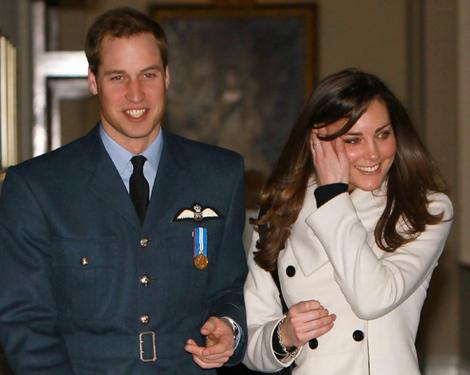
Good luck today Prince William and Kate Middleton!
The Best Tours in British History
HisTOURies UK TOURS

Read Full Post »
According to the Venerable Bede who lived in the 8th century the name Easter derived from the name of a pagan goddess, Eostre. She was goddess of Spring and fertility and her festival was celebrated at the Spring Equinox. Jesus was crucified in April and when the Saxons became Christians they began to celebrate his death and resurrection early in the Spring but they kept the old name Easter. Alternatively it has been suggested that Easter comes from the Saxon word for dawn.

In the early years of Christianity there was a dispute over the date of Easter. In 325 the Nicean Council decided it should be on the first Sunday after the full moon after the Spring Equinox. That is why the date of Easter changes each year.


Friday is the day of the week when the crucifixion took place. It is called Good Friday because good meant holy. On that day we eat hot cross buns. (Good meant holy). The origins of hot cross buns are obscure but in pagan times people baked buns and offered them to the gods. Cross buns with the cross representing the cross of Jesus were first mentioned in the 18th century. In the early 19th century people sold hot cross buns in the street from stalls and so they became known as ‘hot’ cross buns.


The Easter bunny was originally a hare because hares were fertility symbols in the pagan religion and they continued to be associated with Easter after people were converted to Christianity. Because people in the USA were unfamiliar with hares the Easter hare became a rabbit.


In the Middle Ages Christians were forbidden to eat eggs during Lent (the forty days before Easter). Not surprisingly people were keen to eat eggs when Easter arrived!


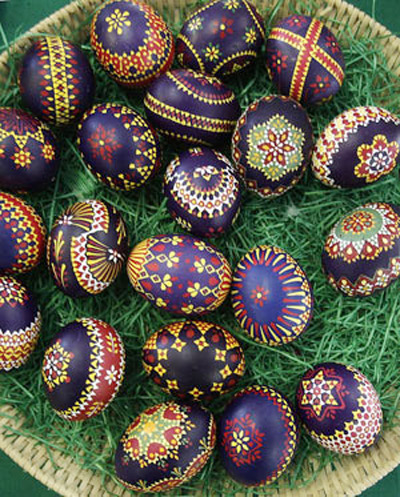
Some people also said that the egg represented the tomb of Jesus, or it represented the stone that was placed over the entrance of his tomb and was rolled away when he rose from the dead. (Long before Christianity eggs were a pagan symbol of fertility).


In the Middle Ages people painted Easter eggs red but by the 18th century people bought artificial eggs made of various materials to give as gifts at Easter. (Sometimes the artificial eggs contained gifts). Chocolate Easter eggs were first made in the 19th century.

http://www.visitwiltshire.co.uk
http://www.dayoutwiththekids.co.uk/search.php?county=wiltshire

Wiltshire Tour Guide
HisTOURies UK – The Best Guided Tours in Wessex

Read Full Post »

Modern tourist attractions such as the London Eye and Cornwall’s £86 million Eden Project rank alongside historic sites including Stonehenge among the “Seven Wonders of Britain”, according to a survey published today.

The British equivalent to the original Seven Wonders of the World span a 4,000-year period from prehistoric Stonehenge in Wiltshire to the 450ft wheel which was erected on the South Bank of the River Thames to mark the millennium.

The remaining four attractions on the list were Big Ben and the Houses of Parliament, York Minster, Windsor Castle and Hadrian’s Wall.

More than 2,500 adults from across Britain took part in the survey, which was commissioned by the Yellow Pages telephone directory.

A parallel survey of teenagers aged between 13 and 17 also recognised traditional attractions but listed Staffordshire theme park Alton Towers as one of their favourites.

Both adults and teenagers agreed on their choice for the Eighth Wonder of Britain – defined as a culturally significant site that is not currently regarded as a tourist attraction – by selecting the Angel of the North, Antony Gormley’s giant sculpture on the outskirts of Gateshead.

Alan Britten, English Tourism Council chairman, said: “It’s the mixture of old and new attractions that is a source of fascination for overseas tourists and a source of pride among the people who live here.

“The Yellow Pages survey reflects our own experience of the endless allure of these ‘must-see’ sites. They are the crown jewels of our tourist attractions.”

John Condron, chief executive of Yell, publisher of Yellow Pages, said: “We hope this timely survey encourages people to get out and explore or rediscover the ‘Wonders’ in their own regions.”

 
The ‘seven wonders of Britain’


The London Eye and Eden Project rank alongside historic sites such as Stonehenge among the ‘seven wonders of Britain’, according to a survey commissioned by Yellow Pages. Here, in no particular order, are the seven winners.
 
Big Ben Big Ben, London
Photo: Peter Jordan, PA
 
Hadrian's Wall Hadrian’s Wall, Northumberland
Photo: John Giles, PA
More arts news
 
Eden Project Eden Project, Cornwall
Photo: Barry Batchelor, PA
 
London Eye London Eye
Photo: Martin Argles, Guardian
 
Windsor Castle Windsor Castle, Berkshire
Photo: Tim Ockenden, PA
 
Stonehenge Stonehenge, Wiltshire
Photo: Sean Smith, Guardian
 
York Minster York Minster, Yorkshire
Photo: John Giles, PA
 
The ‘eighth wonder of Britain’


Angel of the North Angel of the North
Antony Gormley’s giant sculpture on the outskirts of Gateshead, the winner among ‘culturally significant sites not currently regarded as tourist attractions’.
Photo: Owen Humphreys, PA


Good choice!
The Best Tours in British History
HisTOURies UK – Private Guided Tours

Read Full Post »

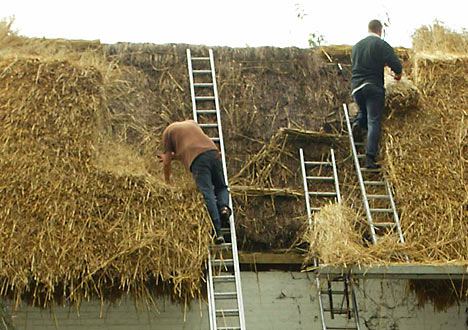
Loosely speaking, thatching is the use of straw or grasses as a building material. Using thatch for roofing goes back as far as the Bronze Age in Britain. At Shearplace Hall in Dorset there are remains of a round hut that shows signs of thatching.

Thatching a roof is an age-old tradition. Not only is it environmentally friendly but also very much back in vogue

Thatching a roof is an age-old tradition. Not only is it environmentally friendly but also very much back in vogue

Thatched cottages and farm buildings were the norm in rural Britain for a millennium or more. Why the attraction to thatch? First of all, the building practices of bygone Britain ran to lightweight, irregular materials, such as wattle and daub walls, and cruck beams. These walls were simply not made to take much weight, and thatch was by far the lightest weight material available.

The study of materials used in thatch buildings can get pretty obscure, but basically, people used whatever was available locally.

This meant materials as diverse as broom, sedge, sallow, flax, grass, and straw. Most common is wheat straw in the south of England, and reeds in East Anglia. Norfolk reed is especially prized by thatchers, although in northern England and Scotland heather was frequently used.

Although thatch was primarily used by the poor, occasionally great houses used this most common of materials. In 1300 the great Norman castle at Pevensey (Sussex) bought up 6 acres of rushes to roof the hall and chambers. Much later, in the late 18th century thatched cottages became an extremely popular theme with the “picturesque” painters, who tried to portray an idealized (Romantic/sanitized) version of nature.

Churches also used thatch frequently. In one humorous episode the parish church at Reyden, near Southwold, was roofed in 1880 with thatch on the side of the church hidden from the road, and with tiles on the side facing the road. Presumably the tiles looked more elegant than the more commonplace thatch.

What caused the decline of thatching? Primarily better transportation. The growing railway network in the Victorian era meant that cheap slate from Wales became easily available all over Britain. Agricultural machinery, particularly the combine harvester, had the unfortunate effect of making wheat straw unusable for thatching. This made Norfolk reed all the more prized, and now the latter material is grown specifically for use in thatching.

So how does one thatch a cottage? First the thatch is tied in bundles, then laid in an underlayer on the roof beams and pegged in place with rods made of hazel or withy.

Then an upper layer is laid over the first, and a final reinforcing layer added along the ridgeline. It is at the ridgeline that the individual thatcher leaves his personal “signature”, a decorative feature of some kind that marks the job as his alone. One lovely cottage I saw on a bicycle tour near Glastonbury (Somerset) has a row of thatch birds marching proudly along the ridge of the roofline!

Although thatching, like many rural crafts, has suffered from the encroachment of “civilisation”, many property owners today recognize the value of keeping their cottages thatched, if for no other reason than that thatched cottages fetch a prime price on the real estate market!

Well thank goodness, for those of us who love traditional British architecture! Sure, it is “corny” but to this anglophile North American at least, nothing says “Great Britain” so much as the sight of a beautiful whitewashed cottage, a blooming rose bush climbing a trellis beneath a roof of weathered thatch. Long live the thatcher!

The phrase “Its raining cats and dogs”
You’ve heard of thatch roofs, well that’s all they were. Thick straw, piled high, with no wood underneath. They were the only place for the little animals to get warm. So all the pets; dogs, cats and other small animals, mice, rats, bugs, all lived in the roof. When it rained it became slippery so sometimes the animals would slip and fall off the roof. Thus the saying, “it’s raining cats and dogs.”

There are more thatch work in Wiltshire than any other county in Britain.  Join us on a private tour of Wessx and learm more about the history of this tradional craft.

Links: 

THE NATIONAL COUNCIL OF MASTER THATCHERS ASSOCIATIONS

Wiltshire Tour Guide
HisTOURies UK – The Best Tours in British History

Read Full Post »

Celtic Britain
(The Iron Age) c. 600 BC – 50 AD

Who were they? The Iron Age is the age of the “Celt” in Britain. Over the 500 or so years leading up to the first Roman invasion a Celtic culture established itself throughout the British Isles. Who were these Celts?

For a start, the concept of a “Celtic” people is a modern and somewhat

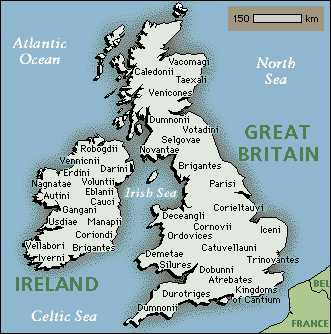
Celtic Britain was dominated by a number of tribes, each with their own well-defined territory. It is thanks to Roman chroniclers, such as Strabo, Julius Caesar, and Diodorus, that the names of individual tribes are known to us today, albeit in Romanized form.

Celtic Britain was dominated by a number of tribes, each with their own well-defined territory. It is thanks to Roman chroniclers, such as Strabo, Julius Caesar, and Diodorus, that the names of individual tribes are known to us today, albeit in Romanized form.

romantic reinterpretation of history. The “Celts” were warring tribes who certainly wouldn’t have seen themselves as one people at the time.

The “Celts” as we traditionaly regard them exist largely in the magnificence of their art and the words of the Romans who fought them. The trouble with the reports of the Romans is that they were a mix of reportage and political propaganda. It was politically expedient for the Celtic peoples to be coloured as barbarians and the Romans as a great civilizing force. And history written by the winners is always suspect.

Where did they come from? What we do know is that the people we call Celts gradually infiltrated Britain over the course of the centuries between about 500 and 100 B.C. There was probably never an organized Celtic invasion; for one thing the Celts were so fragmented and given to fighting among themselves that the idea of a concerted invasion would have been ludicrous.

The Celts were a group of peoples loosely tied by similar language, religion, and cultural expression. They were not centrally governed, and quite as happy to fight each other as any non-Celt. They were warriors, living for the glories of battle and plunder. They were also the people who brought iron working to the British Isles.

The advent of iron. The use of iron had amazing repercussions. First, it changed trade and fostered local independence. Trade was essential during the Bronze Age, for not every area was naturally endowed with the necessary ores to make bronze. Iron, on the other hand, was relatively cheap and available almost everywhere.

Hill forts. The time of the “Celtic conversion” of Britain saw a huge growth in the number of hill forts throughout the region. These were often small ditch and bank combinations encircling defensible hilltops. Some are small enough that they were of no practical use for more than an individual family, though over time many larger forts were built. The curious thing is that we don’t know if the hill forts were built by the native Britons to defend themselves from the encroaching Celts, or by the Celts as they moved their way into hostile territory.

Usually these forts contained no source of water, so their use as long term settlements is doubtful, though they may have been useful indeed for withstanding a short term siege. Many of the hill forts were built on top of earlier causewayed camps.

Celtic family life.
The basic unit of Celtic life was the clan, a sort of extended family. The term “family” is a bit misleading, for by all accounts the Celts practiced a peculiar form of child rearing; they didn’t rear them, they farmed them out. Children were actually raised by foster parents. The foster father was often the brother of the birth-mother. Got it?

Clans were bound together very loosely with other clans into tribes, each of which had its own social structure and customs, and possibly its own local gods.

Housing. The Celts lived in huts of arched timber with walls of wicker and roofs of thatch. The huts were generally gathered in loose hamlets. In several places each tribe had its own coinage system.

Farming. The Celts were farmers when they weren’t fighting. One of the interesting innovations that they brought to Britain was the iron plough. Earlier ploughs had been awkward affairs, basically a stick with a pointed end harnessed behind two oxen. They were suitable only for ploughing the light upland soils. The heavier iron ploughs constituted an agricultural revolution all by themselves, for they made it possible for the first time to cultivate the rich valley and lowland soils. They came with a price, though. It generally required a team of eight oxen to pull the plough, so to avoid the difficulty of turning that large a team, Celtic fields tended to be long and narrow, a pattern that can still be seen in some parts of the country today.

The lot of women. Celtic lands were owned communally, and wealth seems to have been based largely on the size of cattle herd owned. The lot of women was a good deal better than in most societies of that time. They were technically equal to men, owned property, and could choose their own husbands. They could also be war leaders, as Boudicca (Boadicea) later proved.

Language. There was a written Celtic language, but it developed well into Christian times, so for much of Celtic history they relied on oral transmission of culture, primarily through the efforts of bards and poets. These arts were tremendously important to the Celts, and much of what we know of their traditions comes to us today through the old tales and poems that were handed down for generations before eventually being written down.

Druids. Another area where oral traditions were important was in the training of Druids. There has been a lot of nonsense written about Druids, but they were a curious lot; a sort of super-class of priests, political advisors, teachers, healers, and arbitrators. They had their own universities, where traditional knowledge was passed on by rote. They had the right to speak ahead of the king in council, and may have held more authority than the king. They acted as ambassadors in time of war, they composed verse and upheld the law. They were a sort of glue holding together Celtic culture.

Religion. From what we know of the Celts from Roman commentators, who are, remember, witnesses with an axe to grind, they held many of their religious ceremonies in woodland groves and near sacred water, such as wells and springs. The Romans speak of human sacrifice as being a part of Celtic religion. One thing we do know, the Celts revered human heads.

Celtic warriors would cut off the heads of their enemies in battle and display them as trophies. They mounted heads in doorposts and hung them from their belts. This might seem barbaric to us, but to the Celt the seat of spiritual power was the head, so by taking the head of a vanquished foe they were appropriating that power for themselves. It was a kind of bloody religious observance.

The Iron Age is when we first find cemeteries of ordinary people’s burials (in hole-in-the-ground graves) as opposed to the elaborate barrows of the elite few that provide our main records of burials in earlier periods.

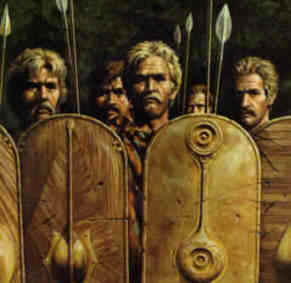
The Celts at War. The Celts loved war. If one wasn’t happening they’d be sure to start one. They were scrappers from the word go. They arrayed themselves as fiercely as possible, sometimes charging into battle fully naked, dyed blue from head to toe, and screaming like banshees to terrify their enemies.

They took tremendous pride in their appearance in battle, if we can judge by the elaborately embellished weapons and paraphernalia they used. Golden shields and breastplates shared pride of place with ornamented helmets and trumpets.

The Celts were great users of light chariots in warfare. From this chariot, drawn by two horses, they would throw spears at an enemy before dismounting to have a go with heavy slashing swords. They also had a habit of dragging families and baggage along to their battles, forming a great milling mass of encumbrances, which sometimes cost them a victory, as Queen Boudicca would later discover to her dismay.

As mentioned, they beheaded their opponents in battle and it was considered a sign of prowess and social standing to have a goodly number of heads to display.

The main problem with the Celts was that they couldn’t stop fighting among themselves long enough to put up a unified front. Each tribe was out for itself, and in the long run this cost them control of Britain.

(Note: The terms “England”, “Scotland”, and “Wales” are used purely to indicate geographic location relative to modern boundaries – at this time period, these individual countries did not exist).

Join us on a guided tour of Britain and learn more about the Celts
HisTOURies UK – The Best Tours in British History

Read Full Post »

« Newer Posts