Feeds:
Posts
Comments

Archive for the ‘history tours’ Category

Prepare for the ultimate historical adventure as over 2,000 costumed performers bring the story of England to life over one action-packed weekend14th – 15th July 2012

HIGHLIGHTS FOR 2012
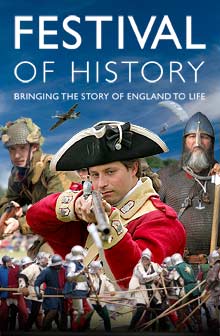
Bringing over 2,000 years of history to life, Festival of History 2012 is packed full of spectacular battle re-enactments, awesome combat displays and celebrations of daily life through the ages.

MAIN ARENA

  • The 1066 Battle of Hastings (NEW!) – Sat & Sun, 12.30pm
    For the first time at Festival of History, re-live the atmosphere and tension of one of England’s most famous conflicts, and witness the making of the most famous date in our history.
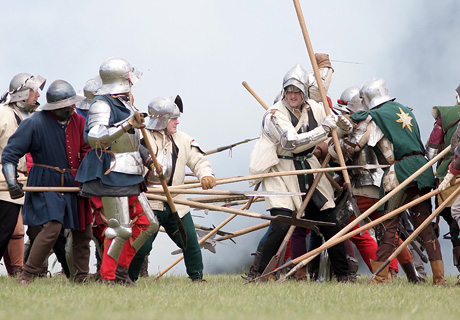
  • The Battle of Stoke Field – Sat & Sun, 11am
    See the last bloody battle of the Wars of the Roses brought to life, as the Tudor age begins and Henry VII takes the English crown.
  • Drop Zone D-Day – Sat & Sun, 4pm
    We’ve a surprise in the skies to help our heroes on the ground in a World War Two battle re-enactment.
  • Prince Malik’s Lancers – Sat & Sun, 1pm
    A favourite with all the family, enjoy this truly spectacular show of unparalleled horsemanship and skill.

PARADE GROUND

  • The Roman Imperial Army – Sat & Sun, 12.15pm & 3pm
    Witness the might and power of the Roman Empire, with a trip back to the 1st century AD.
  • Medieval Joust Tournament – Sat & Sun, 2pm
    A firm favourite returning for 2012, cheer on your champion in the 15th century full-contact joust.
  • The War of 1812 (NEW!) – Sat & Sun, 11.30am
    In the year of the Bicentenary we remember the epic conflict, fought on land and sea between the new United States of America and the British Empire.
  • Victorian Gymkhana – Sat & Sun, 11am
    Watch in wonder as our elegant Ladies and Gentlemen dazzle you with displays of skill and bravery in this Victorian equestrian show
LIVING HISTORY

  • Gladiators! – Are you ready? With awesome hand-to-hand combat displays, our Gladiators keep the ferocious ancient sport alive. And there isn’t a ‘travelator’ in sight!
  • Edwardian Falconry – Marvel at the breathtaking speed and grace of falcons in flight, learn about the history of these magnificent birds of prey and their use throughout the Edwardian era.
  • First World War Music Hall (NEW!)- If the action in the main arena gets too much, escape for a good old sing song in the First World War Music Hall. (Please note that this will replace the Victorian Music Hall previously advertised.)
  • Second World War Vintage Fashion & Beauty (NEW!) – Fancy a new look? Pick up some wartime tricks and tips at these new demonstrations of fashion from the ’40s.

AND MUCH MORE!

  • First World War Trench Experience – Extended for 2012, experience what life would have been like in the Great War in the recreated First World War trench.
  • Festival of Historical Writing – Back by popular demand!
  • Family Zone – From creating giant historical street scenes in the Family Activity Tent to sandcastle building on the Victorian Beach, there’s plenty for all the family to enjoy together.

Link: http://www.english-heritage.org.uk/daysout/events/foh-2012/

HisTOURies UK
The best Tours in British History
Read Full Post »

he Dover Boat is one of Britain’s great under-appreciated ancient artefacts.

Older than the Roman Empire. Older than Moses. It would have been in the water at the same time Stonehenge was in use. That’s about 1500 BC – 3,500 years ago.

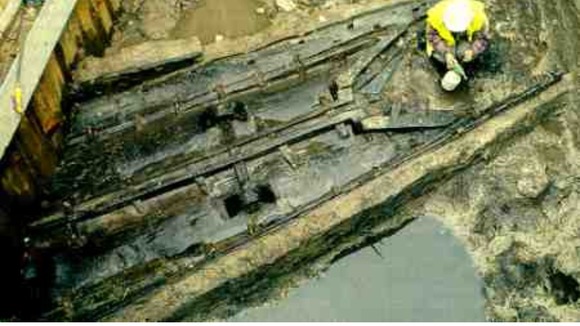
The Dover Boat after it was discovered in 1992 Photo: Dover Museum

The Dover Boat after it was discovered in 1992 Photo: Dover Museum

There would have been countless others like it of course but they have not survived. Built from planks of oak, stiched together with pieces of yew. Certainly not meant to last thousands of years, which is why the vast majority have disappeared.

So to have found one – or at least seventy per cent of one – and to have preserved and displayed it is nothing short of miraculous. There are boats or fragments of boats which may well be older; the Abydos fleet of Egypt for example or the pine canoes of China’s Zhejiang province. And wood found off the Hampshire coast at Hayling Island in the late 1990s has been carbon dated to 7,000 years ago.

What makes Dover’s boat special though is that so much of it can still be seen and appreciated thanks to a huge rescue and conservation effort.

When it was first discovered during roadworks in Dover town centre it stunned archaeologists. But every hour the timbers were exposed it was effectively rotting away. And so teams of historians and archaeologists swung into action by the roadside. The boat was cut into sections, measured, recorded and cleaned. The bits were taken to a shed in Dover Harbour where they were kept wet in large and hastily-constructed water tanks. Later the ancient wood was strengthened using liquid wax, freeze-dried at the Mary Rose Trust in Portsmouth and finally put back together using an adjustable crane.

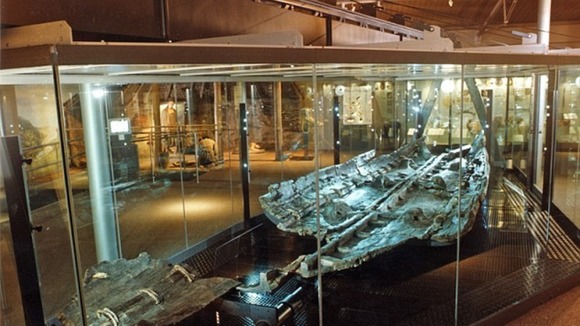
The preserved Bronze Age Boat in Dover Museum Credit: Dover Museum

The preserved Bronze Age Boat in Dover Museum Credit: Dover Museum

The Dover Boat is one of Britain’s great under-appreciated ancient artefacts.

Older than the Roman Empire. Older than Moses. It would have been in the water at the same time Stonehenge was in use. That’s about 1500 BC – 3,500 years ago.

There would have been countless others like it of course but they have not survived. Built from planks of oak, stiched together with pieces of yew. Certainly not meant to last thousands of years, which is why the vast majority have disappeared.

So to have found one – or at least seventy per cent of one – and to have preserved and displayed it is nothing short of miraculous. There are boats or fragments of boats which may well be older; the Abydos fleet of Egypt for example or the pine canoes of China’s Zhejiang province. And wood found off the Hampshire coast at Hayling Island in the late 1990s has been carbon dated to 7,000 years ago.

What makes Dover’s boat special though is that so much of it can still be seen and appreciated thanks to a huge rescue and conservation effort.

When it was first discovered during roadworks in Dover town centre it stunned archaeologists. But every hour the timbers were exposed it was effectively rotting away. And so teams of historians and archaeologists swung into action by the roadside. The boat was cut into sections, measured, recorded and cleaned. The bits were taken to a shed in Dover Harbour where they were kept wet in large and hastily-constructed water tanks. Later the ancient wood was strengthened using liquid wax, freeze-dried at the Mary Rose Trust in Portsmouth and finally put back together using an adjustable crane.

Then came another battle – to keep the Dover Boat where it belonged. A world-famous museum was said to have bid for it but had the idea of keeping it in pieces. In the end there was a massive fund-raising initiative and a great gallery was built in Dover Museum with a sealed glass chamber that now keeps the precious object safe in perpetuity.

And all the time historians have been looking at it, examining it, working out how it was built.

Seeing how it would have been hewn from the timbers of mighty trees that would have grown all the way down to the shoreline back then.

Seeing how it would not have had a sail, perhaps not even a rudder. Difficult to tell because the back of the boat is missing.

Seeing how it would have been rowed by about a dozen men using huge oars.

Maybe they wave-tested it off the Kent coast. Maybe it pootled upriver. Debate has raged over whether the Dover Boat was robust enough to have taken to the seas and therefore establish a claim to be one of the world’s oldest surviving seagoing vessels.

It or something like it would surely have rowed along the coast of Southern Britain, hugging the coastline in case it shipped too much water. How can we say that? What evidence do we have to back this up?

Well there are artefacts found in Dover from this time period from as far away as Dorset. Logical to think of them having been brought by sea rather than carried overland in what would have been a cumbersome and time-consuming journey.

And so above and beyond all the theories about why and how our boat was built emerges a tantalising possibility.

That it was put together by people who did not just have skills passed down over a few generations, but boat-building knowledge accrued in their communities over hundreds if not thousands of years.

That something very similar to our rickety-looking, oak-planked, yew-stitched craft was crossing the English Channel and also the oceans way back in Stone Age times.

Imagine what light that would cast on our knowledge of the spread and dispersment of peoples, societies, cultures, even entire civilisations, in that yawning chasm of time before recorded history.

The Dover Boat is that significant. A rare treasure.

Article from ITV News: http://www.itv.com/news/meridian/2012-05-12/dover-boat-personal-view/

The Best Guided Tours in British History
HisTOURies UK 

Read Full Post »

The Chalke Valley History Festival is planning to launch a series of History Tours in 2012, some in conjunction with the Natural High travel company.

We want to capitalise on our relationship with this country’s most compelling and authoritative historians by offering some as guides for historic tours and holidays.

Both dates and itineraries are yet to be confirmed, as are costs.  However, we are very interested to know whether there is demand for the idea from those who have enjoyed our Festival.

These Chalke Valley History Tours will vary between a few days and a week’s duration, and will be of general rather than specialist interest.

Below are some of the initial tours we are hoping to organise in our first programme of History Tours.  If you would like to learn more about them, please do let us know on info@cvhf.org.uk

THE INDIAN MUTINY
led by Professor Saul David
It began as a mutiny of East India Company sepoys in Meerut in May 1857 and was only contained after the fall of Gwalior a year later.  It rocked the British Empire to its foundations and led to the downfall of the Company.  This tour, by the world’s leading authority on the subject, will tell the story of the Indian Mutiny by visiting its main sites amidst the drama of central India.

Saul David is Professor of War Studies at the University of Buckingham and a specialist in the wars of the Victorian period.  He is particularly well placed to lead this tour; not only is he well-known and popular television historian, the Indian Mutiny was the subject matter of his PhD, and his subsequent book is considered the definitive history of this dark episode from the Raj.

ANCIENT ROME
led by Tom Holland
Was it the greatest empire the world has ever seen?  Certainly, it lasted almost a thousand years and incorporated, at its zenith, most of the known world.  This tour will focus on the city of Rome and those towns to the south, Pompeii and Herculaneum, recapturing the spirit and glory of Ancient Rome.

Tom Holland is an award-winning and highly acclaimed historian of antiquity.  Rubicon, his book on the rise and fall of the Roman Republic, was an international best-seller and was short-listed for the Samuel Johnson Prize.  He is currently working on a new book about the first Emperors.  A brilliant raconteur, Tom Holland is working exclusively for Chalke Valley History Holidays.

THE ZULU WARS
led by Dr Peter Caddick-Adams
The Battle of Isandlwana and the defence of Rorke’s Drift are two of the most dramatic events in the British Imperial story.  For the victors of each, both were triumphs over incredible odds; at Isandlwana, it was the Zulus who won the day, while at Rorke’s Drift, it was the British, in one of the most astonishing last stands in British history.  At both, many men on both sides showed incredible courage.  This tour to some of the most unspoiled battlefields in the world, will tell the story and characters of a war that resonates still to this day, and against the captivating landscape of South Africa.

Peter Caddick-Adams is the doyen of battlefield guides.  Learning his craft from the legendary Richard Holmes, he also chose Battlefield Tourism as the subject matter for his PhD.  Since then, he has worked with British and American armed forces on numerous staff rides, as well as guided politicians and leading public figures around some of the best-known battlefields in Europe and further afield.  Quite simply, Peter Caddick-Adams is one of the very best Battlefield Guides we have.

D-DAY & THE BATTLE FOR NORMANDY 1944
led by James Holland
The Battle for Normandy was one of the fiercest battles ever fought, with higher daily casualty rates than were suffered at the Somme, Passchendaele or Verdun.  From the landings themselves to the bitter fighting as the Allies inched inland, this is a tour that will include little-known sites and bunkers as well as some of the more iconic beaches and D-Day locations.  Told with a mass of anecdotes and new, searing, analysis, this will be a comprehensive guide to the D-Day battlefields, and set to the backdrop of the glorious Normandy countryside, with its wonderful food, wine and calvados.

James Holland is one of the country’s leading authorities on the Second World War, and has written and broadcast on the Battle of Britain and Dams Raid amongst other subjects. With an encyclopaedic knowledge and understanding of the war, he has also conducted Staff Rides for the military and a number of historic tours around many of the Second World War battlefields.

The excellent Chalke Valley History Festival 26th June – 1st July 2012 – http://www.cvhf.org.uk/

HisTOURies UK
Mystical Landscape, Magical Tours

Read Full Post »

« Newer Posts