Feeds:
Posts
Comments

Archive for the ‘History’ Category


War Horse
is a film that Steven Spielberg announced plans for production. War Horse is intended for release in 2011. It will be the film version of the play of the same name, which is a stage adaptation of the book War Horse, a children’s fiction novel by Michael Morpurgo first published in Great Britain in 1982.

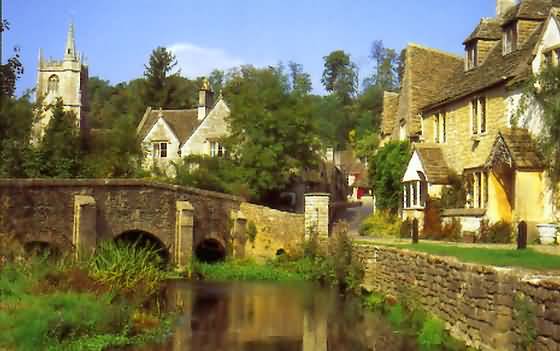
OSCAR-winning actor Sir Anthony Hopkins is set to shoot scenes for his latest film in Castle Combe and Lacock this Autumn.

Hollywood film crews have approached both village parish councils after finding perfect locations for the remake of the 1941 horror flick The Wolfman.

The news comes just months after the penultimate Harry Potter movie was filmed in Lacock.

Chairman of the Lacock Tenants Association Leo Stevens attended a meeting with 50 residents last Tuesday.

He said: “The general reaction was positive and people seemed interested in getting involved with the project.

“As long as the filmmakers take our needs into consideration I think everything will go smoothly.

“I am involved with the project and am tracking down a blacksmiths for them to use in the movie.

“Filming in Lacock has just become an ordinary event these days and people don’t really batter an eyelid when a famous actor crosses the path in front of them.

“We are just waiting for more details from the production company and then we can move forward.”

The production company, part of Universal Pictures, is keen to use the Tithe Barn as the main location and possibly some shots of the High Street.

They want to fill the inside of the barn with blocks of ice, to resemble an ice house, used in the nineteenth century to store dead bodies.

The period film follows the life of Laurence Talbot, a successful actor, who returns to his hometown after his brother goes missing amid rumours of werewolves.

Film crews were also keen to shoot some scenes in Castle Combe, which is still reeling from its Hollywood debut in Stardust last year.

Jean Sheard, who owns the Lacock bakery on Church Street said: “I am really excited about seeing Sir Anthony Hopkins – he is such a huge star.

Lets hope we dont have a repeat of previous holywood films ?
Castle Combe never recovered from its engineered fame. In 1966 it was occupied for three months by a film company making Dr Dolittle with Rex Harrison, Samantha Eggar and Anthony Newley. Men with loud voices and earth-moving equipment built a harbour below Castle Combe’s bridge and made everyone take down their television aerials and link their sets to a communal cable attached to a hidden mast during the filming

Filming starts in September and we will continue to take small group tours to Castle Combe and Lacock – a great phot opportunity.

Cotswolds Tour Guide
HisTOURies UK – The Best Tours in History

Read Full Post »

For the ‘Monty Python’ fans……………………
This scene still bring tears to my eyes.
Life of Brian
(1979) (aka Monty Python’s Life of Brian) is a satirical film by the Monty Python comedy troupe about a man who is born at the same time as (and next door to) Jesus, and whose life parallels his.

 Reg: What Jesus blatantly fails to appreciate is that it’s the meek who are the problem.

Reg: But apart from the sanitation, the medicine, education, wine, public order, irrigation, roads, the fresh-water system, and public health, what have the Romans ever done for us?


Hope you enjoyed as much as I did.

British Tour Guide
HisTOURies UK – The Best Tours in Roman History

Read Full Post »

Salisbury Museum is based in the King’s House, a grade I listed building located opposite Salisbury Cathedral. We have a small but friendly staff, supported by over 100 volunteers. We offer a variety of services, including the opportunity to hire this unique location for corporate events and activities.

About the Museum

About SAlisbury MuseumThe Museum is located in the King’s House, situated in the glorious setting of the Cathedral Close. The King’s House is a Grade I listed building, the history of which stretches back to the 13th Century. It formerly housed a teacher training college and was the inspiration for an episode in Thomas Hardy’s novel Jude the Obscure.
The main strength of the Museum rests in its archaeological collections: these include prehistoric material from South Wiltshire, including Stonehenge; the Pitt Rivers’ Wessex collection; and a fine medieval collection including finds from Old Sarum, Clarendon Palace and the city itself. In addition we have fascinating displays of costume and ceramics, and regular temporary exhibitions.

The Museum is a limited liability company (no. 1826436) and a registered charity (no. 289850). It is Accredited by the Museums, Libraries and Archives Council (no. 878). Its archaeological collections in particular are of national significance and they received Department for Culture, Media and Sport Designated status in 1998.

Salisbury Museum receives some funding from Wiltshire Council, but most of our income derives from a variety of other sources including admission charges, membership, donations and legacies.

The Museum’s mission is to provide a creative and responsive museum, which collects, preserves and presents objects and information of significance relating to the past of Salisbury and south Wiltshire.

Its purpose is to encourage learning, research, publication and enjoyment of its collections, seeking to do this in a professional, friendly and stimulating way. It aims to provide a lively service for the benefit of the whole community within Salisbury and south Wiltshire, as well as for students, scholars, and visitors from this country and around the world.

Whats on2010:

07 Aug 2010 – 14 Aug 2010 Medieval Hats, Masks and Shields Lecture Hall For Families
10 Aug 2010 Art Day – Gorgeous Georgians Lecture Hall For Families
17 Aug 2010 Science Day – Build a Sun Dial Lecture Hall For Families
20 Aug 2010 Make a Mosaic Meetings Room For Families
22 Aug 2010 Romeo and Juliet: Illyria Theatre Company Back Garden Plays
24 Aug 2010 Art Day – Scrap Animals Lecture Hall For Families
31 Aug 2010 Science Day – Design a Wind Sock Lecture Hall For Families
14 Sep 2010 Surveying Historic Buildings: the changing techniques and use of 3d imagery in building recording Lecture Hall Lectures
02 Oct 2010 – 03 Oct 2010 Conference: 150 Years of Salisbury Museum Lecture Hall Events
06 Oct 2010 – 24 Nov 2010 Medieval Life: a series of lectures by Nick Griffiths Lecture Hall Courses
07 Oct 2010 ‘A History of his Affections’: The importance of Salisbury in the wider context of Constable’s art Lecture Hall Lectures
12 Oct 2010 A Day in the Life: a Master Gunner on the Mary Rose Lecture Hall Lectures
20 Oct 2010 – 15 Jan 2011 Walls of Sound Major Exhibition Galleries Exhibitions
20 Oct 2010 Organised Chaos, a series of cock-ups in Royal and Military events Lecture Hall Lectures
03 Nov 2010 SARUM, the Inspiration of Salisbury Lecture Hall Lectures
09 Nov 2010 Collingbourne Ducis – Update Lecture Hall Lectures
17 Nov 2010 Clarendon Lecture Hall Lectures
14 Dec 2010 Bodies from the Bog: what science has told us about the bog people Lecture Hall Lectures

Whilst visiting Salisbury please take the time to visit the Salisbury Museum.

Stonehenge and Salisbury Tour Guide
HisTOURies UK – The Best Tours in Wiltshire

Read Full Post »

About 53,000 coins were found buried in a field in Somerset

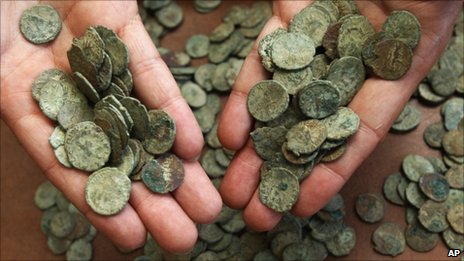
A hoard of more than 52,500 Roman coins discovered in a Somerset field has been declared treasure.

Dave Crisp, from Wiltshire, found the coins – dating from the 3rd Century AD – in April buried near Frome.

“I’ve been metal detecting since 1988 and it’s the most exciting and important find I’ve made,” he said.

A British Museum spokesman said the 160kg find was the largest single coin haul found in one pot and was probably intended as a religious offering.

Most of the coins, which are made from debased silver or bronze, are currently at the British Museum in London and includes examples from AD286 to 293 during the reign of Carausius who was the first Roman emperor to strike coins in Britain.

A small selection has gone on display at Frome Library.

Mr Crisp had earlier found a hoard of 60 silver coins in the same field before he discovered the larger pot of coins.
The coins date from the 3rd Century AD

That find was also declared treasure earlier.

Somerset County Council Heritage Service can buy the treasure for the Museum of Somerset, which is due to reopen in 2011, under the Treasure Act.

Following the ruling by East Somerset coroner Tony Williams, Mr Crisp, who works as a chef in the NHS, said: “It was a foregone conclusion that treasure would be declared today.”

He said he did not know what reward he was going to get, but would split whatever he did get equally with the farmer who owned the land according to their agreement and the law.

It has been suggested the reward could be up to £1m.

When asked how a share of the money would change his life, Mr Crisp said he did not know but added: “I’m coming up for retirement… I’ll work until I’m 65 then I’ll see.”

He added it was not the money that mattered.

“This is what matters, I’m the finder of the largest single hoard of Roman coins ever.

“I’ll always be the finder, unless someone beats me of course. There are a lot more pots out there.”

The landowner, whose surname is not being released to deter further treasure hunters, said: “I have always loved history but I never expected anything as important, exciting or old as this to be found on my land.”

WHAT IS TREASURE TROVE?

  • Where the owner of a find cannot be traced, it normally belongs to the landowner but anything declared “treasure” belongs to the Crown
  • Anyone making find that could be treasure must report it to a coroner
  • An inquest will then determine its status
  • Treasure must be at least 300 years old
  • Once something is declared treasure, the finder may be able to keep it, or an institution, such as the British Museum, may buy it
  • Objects are not treasure if their owners can be traced or if they are found on the shore but do not come from a shipwreck

  • In pictures: Roman coin hoard
  • A British Museum spokesman said the Treasure Valuation Committee would recommend a value for the hoard in October, which would be paid out when the finder, landowner and museum agreed with the valuation.

    Anna Booth, from the Portable Antiquities Scheme (PAS), said of the reward: “It will be fairly substantial but how substantial, we don’t know.

    “If they find lots of rare coins, the price could go up. It won’t be millions, but beyond that it is hard to speculate.

    “Once it has been evaluated, the British Museum will be given a chance to acquire it. If not, the local museum will have it.

    “The British Museum has already said it hopes the find will be acquired by the Museum of Somerset.

    “We are now going to be on a fundraising drive to get the money.”

    • The story of the excavation will be told in a new BBC Two archaeology series, Digging for Britain, presented by Dr Alice Roberts and made by 360production, to be broadcast in August.

      British Tour Guide
      HisTOURies UK – The Best Tours in Histoy

    Read Full Post »

    SALISBURY will be the talk of the art world next year when a John Constable exhibition is staged at the city’s museum.

    The summertime show is being organised to mark the 200th anniversary of the artist’s arrival in Salisbury. His visits to his friend John Fisher, the then Bishop of Salisbury, are widely accepted as inspiring some of his greatest paintings.

    The Constable & Salisbury exhibition will see a multi-million pound collection brought together from both private owners and major art museums.

    A final list of Constable’s paintings is still to be confirmed, but the show starting in May next year will include some of the artist’s most important work including several depicting the cathedral and the Harnham Water Meadows.

    Richard Morgan, who has led a committee of art enthusiasts in developing the project, announced the three-month exhibition this week.

    “This will be a 50-piece collection never seen before. It is work that will be gathered from the leading British galleries and others including the Fitzwilliam in the USA, National Gallery Washington and the Louvre in Paris.”

    He was guest speaker at a garden party held by Salisbury law firm Wilsons in the grounds of the museum.

    Mr Morgan added: “Museums can change places, just as we have seen in Liverpool and St Ives, and we are planning great changes in this museum.”

    He said thanks in part to funding from the English Heritage Lottery Fund they hoped to radically change Salisbury Museum and the Constable exhibition was part of this.

    Stephen Oxley, senior partner at Wilsons, said his firm had a tradition of supporting the arts in the city and they were delighted to be a sponsor of this project. “We have worked with the museum and its people for many years and when they approached us in 2008 with an idea from Lord Congleton to put on an exhibition, the likes of which had never been done before, we jumped at the chance to be involved.”

    Adrian Green, director of Salisbury Museum, said: “It is almost impossible to view Salisbury Cathedral without thinking of Constable, therefore it is surprising that there has never been a major exhibition of his work in the city.

    “As an archaeologist I particularly find Constable’s lesser known views of Old Sarum and Stonehenge evocative. One of Constable’s final exhibits at the Royal Academy was a magnificent watercolour of Stonehenge, shown there in 1836, which will be a major highlight of the exhibition for me.”

    Salisbury Tour Guide
    HisTOURies UK – The best tours of Salsibury, Stonehenge and Wessex

    Read Full Post »

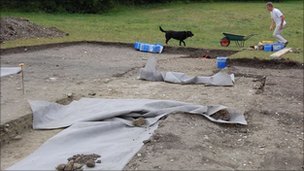
    A dwelling, thought to be 4,500 years old, has been discovered by archaeologists in Wiltshire.

    S
     “It looks as if we have a Neolithic building. We’re talking about four and a half thousand years old – so about 2400 or 2500BC.

    Excavation work at the prehistoric site of Marden Henge, near Devizes, started three weeks ago and experts say the find has “exceeded expectations”.

     Marden Henge no longer has any standing stones and is said to be one of Britain’s least understood ancient sites.

     The work is scheduled to last for three more weeks.

     Archaeologist Jim Leary, from English Heritage, said: “It’s absolutely fabulous. It’s exceeded all of our expectations.

    I don’t think we’re looking at a normal house. I think we’re looking at something equivalent to a priest’s quarters.””We have some wonderful finds coming up and some very fresh looking flint flakes and some pieces of pottery, but far and away the most exciting find so far is over in trench C.  – English Heritage

     “Up until a few years ago it would have been unique but a couple of years ago archaeologists were digging at Durrington Walls and they found a number of these buildings.

     “I don’t think we’re looking at a normal house. I think we’re looking at something equivalent to a priest’s quarters.

     “We do seem to have a hearth and it seems that whoever lived there was a very clean person and regularly cleaned out the hearth.

     “Just outside the front door we can see this long spread of charcoal and general rubbish material.

    “It contains really good fresh flint flakes, pottery, bone pins – things that don’t normally survive on archaeological sites. We’re getting a really good insight into life in that building.”

     Stonehenge Tour Guide
    HisTOURies UK – The Best Tours Wiltshire

    Read Full Post »

    Archaeologists virtually excavate Stonehenge Archaeologists will map an area of 14km around Stonehenge Archaeologists are carrying out a virtual excavation of Stonehenge to discover what the area looked like when the monument was built. The multi-million pound Euro study will map the terrain and its buried archaeological remains with pinpoint accuracy, organisers claim. The millions of measurements will then be analysed and incorporated into gaming technology to produce 2D and 3D images. The research will take three years. Equipment will be spread over an area spanning 4km this year and a total of 14km over the next three years. Project leader Professor Vince Gaffney, from the University on Birmingham, said: “We aim to unlock the mysteries of Stonehenge and show people exactly what the local area looked like during the time the monument was created. “The results of this work will be a digital chart of the ‘invisible’ Stonehenge landscape, a seamless map linking one of the world’s most famous monuments with the buried archaeology that surrounds it.” Dr Christopher Gaffney, from the University of Bradford, said: “Rather than looking at typically small discrete areas we intend to cover the whole of the World Heritage Site. “We will do this using emerging technology that allows us to pull large banks of sensors behind a quad bike and using real time GPS to locate the measurements.” The study is funded by the Ludwig Boltzmann Institute for Archaeological Prospection and Virtual Archaeology, in Vienna, and the University of Birmingham, and is assisted by the National Trust and English Heritage.

    Stonehenge Tour Guide
    HisTOURies UK – The Best Tours in History

    Read Full Post »

    It’s the Festival of British Archaeology – this is your chance to meet a real archaeologist and to uncover artefacts from Old Sarum’s history. Kids will love getting involved with archaeological activities, including: a sand-pit excavation, to learn how archaeologists uncover, recover and record evidence, and a finds washing, to learn how archaeologists process the evidence! Plus, there are lots of fun and games to take part in like our Beat the Archaeologist Challenge or Guess the Mystery Object from Old Sarum’s past.

    Old Sarum Hillfort

    Discover the story of the original Salisbury and take the family for a day out to Old Sarum, 2 miles north of where the city stands now. The mighty Iron Age hill fort was where the first cathedral once stood and the Romans, Normans and Saxons have all left their mark.

    Today, 5,000 years of history are told through graphic interpretation panels on site. Families, heritage lovers and walkers can enjoy a great value day out at Old Sarum- you could even bring a picnic and enjoy the fantastic views across the Wiltshire countryside. The gift shop has a delicious range of ice-creams and exclusive English Heritage gifts and produce. Wooden bows and arrows are also on sale to help the kids imagine what life was like all those years ago!

    Don’t Miss…

    • The spectacular view from the ramparts at Old Sarum to the ‘new’ cathedral in the centre of Salisbury
    • Our interesting interpretation panels bringing 5,000 years of history to life
    • Old Sarum’s literary connections- you can buy some of the famous books written about the site in our shop

      Wiltshire Tour Guide
      HisTOURies UK – The Best Tours in British History

    Read Full Post »

    Archaeologists have begun a major dig to unearth the hidden mysteries of a buried ancient stone circle site that is ten times bigger than Stonehenge.

    The enormous 4,000 year old Marden Henge, in Wiltshire, is Britain’s largest prehistoric structure stretching for 10.5 hectares, the equivalent of 10 football pitches.

    English Heritage is carrying out a six-week dig hoping to reveal the secrets behind the giant henge which has baffled historians for centuries.

    Most of the Neolithic henge has been destroyed over the years due to farming and erosion but minor excavations in 41 years ago estimate the site to between 2,000 and 2,400BC.

    Archaeologists are due to begin digging at the 4,000 year old Marden Henge, in WiltshireArchaeologists are due to begin digging at the 4,000 year old Marden Henge, in Wiltshire

    Marden Henge was once a 45ft high mound surrounded by a water filled ditch which was used for sacrificial offerings.  

    Although the henge no longer has its vast stone circle it has a large puzzling sunken circular feature which is almost unheard of at Neolithic sites.

    A team of 15 archaeologists and historians believe the dig could show the ancient site is even more significant than both Stonehenge and Avebury stone circles.

    Archaeologist Jim Leary, 34, said: ‘Virtually nothing is known about this vast circle. We are starting from point zero.

    ‘Marden Henge deserves to be understood more partly because of its size, but also due to its proximity to the more famous stone circles at Avebury and Stonehenge.

    ‘The relationship between the latter two sites – chronology of their construction, whether it is built by the same people, how they were used, is of immense interest.

    ‘How Marden relates to them is another layer of interest which we want to study.

    ‘We are potentially looking at a much more intricate system of Neolithic ritual sites in this part of the world than we previously thought.

    ‘The study of Prehistory is entering a very exciting phase with lots of fascinating research and dating techniques emerging.

    ‘The stunning discovery of Neolithic houses at Durrington Walls near Stonehenge a few years’ ago, for example, has really turned things on its head.

    ‘We certainly hope that this excavation will bring more pieces of the puzzle to light.’ 

    Stonehenge on Salisbury Plain, Wiltshire.Stonehenge on Salisbury Plain, Wiltshire. Marden Henge has lost its stone circle but scientists are confident they will find some remnant of the ancient circle beneath the surface

    The dig is the culmination of a two year English Heritage project including aerial, topographic and geophysical surveys.

    It has not been touched since an investigation in 1969 by Professor Geoffrey Wainwright which dated the henge from fragments of deer antler found in the area.

    Marden Henge is situated near to the source of the River Avon, in Marden, north of Devizes, between Avebury and Stonehenge and close to ancient Silbury Hill.

    The henge comprises a well-preserved bank covering 10.5 hectares and an internal ditch.

    Unlike Stonehenge and Avebury or Castlerigg, in Cumbria, Marden Henge no longer has any surviving stone monuments.

    All that has remained is the evidence of a huge mound similar to a smaller at the centre of the henge, which collapsed in 1806 and was completely levelled by 1817.

    Most experts now believe that significant ceremonial or ritual activity occurred within the ditches.

    Archaeologists aim to find remnants of the Neolithic age within the remains of the mound.

    The entire site is around 15 hectares and set within surrounding fields covering 40 hectares.

    The dig began on Monday this week and will continue until August.

    Stonehenge Tour Guide
    HisTOURies UK – The Best Tours in History

    Read Full Post »

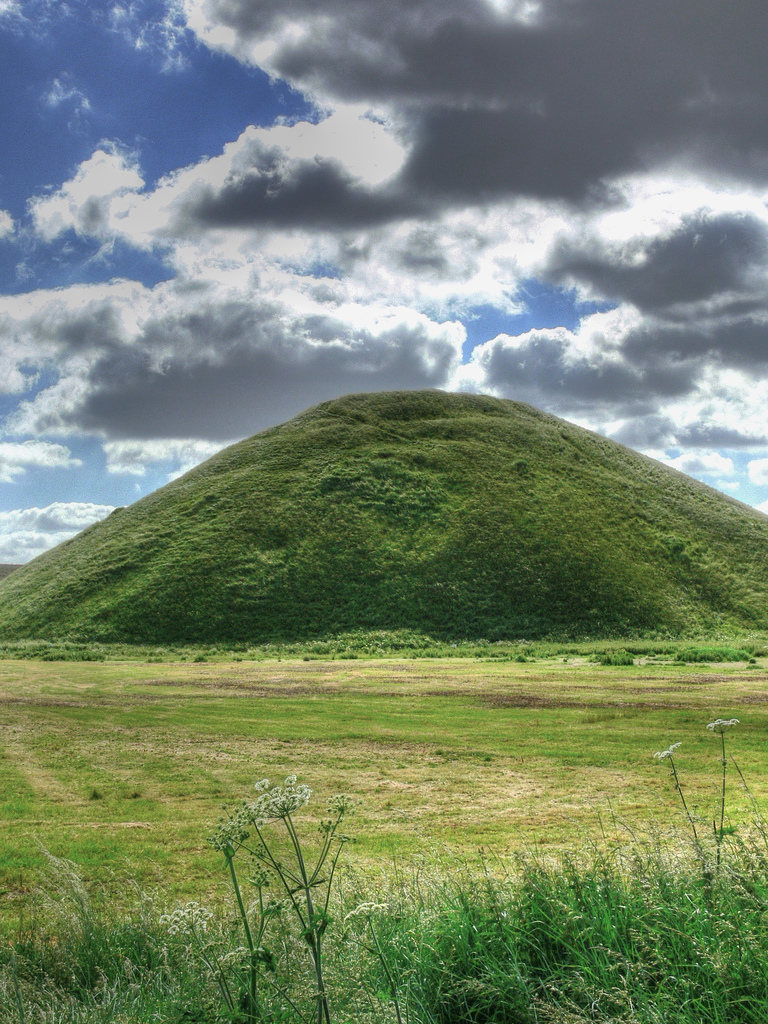
    Letters that lay undiscovered in national archives for more than 230 years suggest that Silbury Hill, the enigmatic man-made mound that stands between Marlborough and Beckhampton, may have originally be constructed around some sort of totem pole.

    Historians have uncovered in the British Library in London letters written in 1776 that describe a 40ft-high pole which once stood at the centre of Silbury Hill. Europe’s largest man-made mound.

    The letters detail an 18th century excavation into the centre of the man-made mound, where archaeologists discovered a long, thin cavity six inches wide and about 40ft deep.

    A separate excavation found fragments of oak timber within the cavity leading historians to believe that the mound was built around the pole dating from around 2,400 BC.

    David Dawson, director of the Wiltshire Heritage Museum in Devizes, said: “This is important, lost information dug out of the library, rather than through field work.

    “It tells us that in one of its earliest phases some kind of totem pole was erected on the mound, then subsequent additions to build the hill up were piled up around that timber.”

    The 18th century letters, written from Edward Drax to Lord Rivers, described excavations Drax had supervised at Silbury Hill.

    He oversaw the digging of a vertical shaft from top to bottom that is sometimes claimed to be the work of the Duke of Northumberland.

    Drax, a wealthy landowner who lived in Bath, had hired a team of miners to dig a shaft from the top of Silbury Hill, to the centre of the hill, 125 feet below.

    To begin with the miners found little but chalk and pieces of deer antler, but 95 feet down – some 30 feet above where they expected the base of the mound to be – they stumbled upon a deep, narrow cavity.

    The hole was six inches across but Drax noted: “We have already followed it already about 20 feet, we can plumb it about eleven feet more.”

    In his letter he wrote that “something now perished must have remained in this hole to keep it open”.

    Together with a later, independent account of fragments of oak timber found at the centre of the mound, the evidence adds weight to the totem pole theory.

    Last year English Heritage completed a £2 million restoration programme on the mound to prevent it from collapsing after previous excavations, including the one by Drax, had left the structure weakened and prey to erosion.

    Drax’s letters have been published for the first time in the new volume of the Wiltshire Archaeological and Natural History Magazine.

    I highy recommend a visit to Silbury Hill if you are visiting the Stonehenge and Avebury area – the best view of Silbury Hill is if you walk up to West Kennet Long Barrow.

    Nicholas – Avebury Tour Guide
    HisTOURies – The Best Tours in History

    Read Full Post »

    « Newer Posts - Older Posts »