Feeds:
Posts
Comments

Archive for the ‘prehistory’ Category

Legends of Glastonbury

There are so many myths associated with Glastonbury that it is difficult
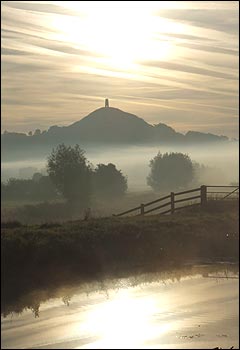
Glastonbury Tor

Glastonbury Tor

to know where to begin to talk about them. There are two main streams of legend that surround Glastonbury, though they twine around each other to some degree. The two streams revolve around the romantic figures of Joseph of Arimathea and King Arthur. Let’s take them one at a time.

Joseph of Arimathea
Joseph was the Biblical figure who took Jesus’ body after the crucifixion. According to some legends he was actually Jesus’ uncle, and had visited Britain years before with Jesus in the pursuit of his interests in the tin trade. It appears that there actually was a strong Jewish presence in the west of England at that time, and many of the tin miners may have been Jewish settlers.

At any rate, when Jesus died, Joseph thought it prudent to flee Palestine, and after many travails he came to Britain with a company of followers. He brought with him the Holy Grail, the cup used by Jesus at the Last Supper. Some versions of the legend have it that the Grail contained two drops of blood captured from Jesus’ side when he was wounded on the cross.

When Joseph came to Britain he was granted land at Glastonbury by the local king. When he arrived at Glastonbury, Joseph stuck his thorn staff in the earth, whereupon it rooted and burst into bloom. A cutting from that first tree was planted in the grounds of the later Glastonbury Abbey, where it continued to bloom every year therafter at Christmas time. There is still a thorn tree in the Abbey grounds, of a variety native to the Holy Lands, and it does indeed bloom around Christmas time.

Joseph was said to have established the first church in England at Glastonbury, and archaeological records show that there may well have been an extremely early Christian church here. What happened to the Holy Grail is another matter. Some legends have it that Joseph buried the Grail at the foot of Glastonbury Tor, whereupon a spring of blood gushed forth from the ground.

There is a well at the base of the Tor, Chalice Well, and the water that issues from it does indeed have a reddish tinge to it, from the iron content of the water.

Other legends have it that the Holy Grail was interred with Joseph when he died, in a secret grave. The search for the mysterious Grail emerges again and again in the tales of Glastonbury.

Further legends tell that the church founded by Joseph continued for many years. Eventually it became a monastery, and one of the first abbots was the future St Patrick, who was born in the west country.

King Arthur and Glastonbury

Glastonbury Abbey, where King Arthur is said to lie buriedLegends of King Arthur swirl about Glastonbury like a tantalizing fog from the nearby Somerset marshes. The nearby hill fort at South Cadbury has long been suggested as the location for Camelot. Indeed, excavations of South Cadbury suggest that it was in use during the early 6th century, which is the likeliest era for the real Arthur to have lived.

The association of Arthur and Glastonbury goes back at least to the early Middle Ages. In the late 12th century the monks of Glastonbury Abbey announced that they had found the grave of Arthur and Guinivere, his queen. According to the monks, an excavation found a stone inscribed “Here lies Arthur, king.” Below the stone they found the bones of a large man, and the smaller skeleton of a woman. The monks reburied the bones in the grounds of the abbey, where they were a very handy draw for pilgrims. The site of the grave can be seen today in the abbey grounds.

Glastonbury Tor, the enigmatic conical hill that rises above Glastonbury, has been linked with the Isle of Avalon, where King Arthur was buried after his death. This isn’t so farfetched as it may sound, for a millennium ago the water level was much higher, and the tor would indeed have been an island. Avalon was also called “the isle of glass” which does suggest similarities to the name “Glastonbury”.

The Holy Grail, the object of Arthur’s questing, is said to be buried beneath Glastonbury Tor, and has also been linked to Chalice Well at the base of the Tor.

One final myth of Arthur at Glastonbury: the landscape around Glastonbury is said to have been moulded and shaped so that the features (such as roads, churches, and burial mounds) create a zodiac calendar replete with Arthurian symbology. Like so many of the Arthurian myths, so much is open to interpretation and your own predisposition to believe or disbelieve.

Glastonbury Abbey
Is there a place more steeped in legend and myth than Glastonbury? Glastonbury AbbeyProbably not. Legend holds that the earliest church here was founded by St. Joseph of Arimathea in about 60AD, and that when he planted his staff in the earth a thorn tree burst forth.

In the grounds of the ruined Benedictine monastery there is a thorn tree of a variety common to the Middle East which is given to bloom around Christmas time.

By the late Middle Ages Glastonbury had become the richest abbey in England, due to the heavy pilgrimage trade. It was rich enough to build an inn for well-to-do pilgrims (the George Inn, on nearby High Street, which still welcomes guests 500 years later). The best preserved building in the abbey grounds is the old Abbot’s Kitchen (see photo), a curious square building which appears round due to its octagonal roof. In the abbey grounds are the reputed graves of King Arthur and Queen Guinevere, which were conveniently discovered by the Glastonbury monks in the 12th century, when the abbey needed a financial boost. Outside the grounds are the abbey tithe barn, which now serves as the Somerset Rural Life Museum (well worth a visit), and 4 miles away at Mere is the abbey’s Fish House, were fish was salted and cured.

The abbey is entered through the Abbey Gatehouse  an imposing arched gateway located on off Magdalene Street. Visitors pass through a fascinating museum depicting life at Glastonbury during the Middle Ages, and then enter the Abbey grounds proper. The first building you see on entering the grounds is St Mary’s Chapel, a roofless structure that boasts wonderful architectural details, from the recessed arches of the door to the repetitive arcading that rings the interior. Look up, where the curious small towers at each corner of the chapel seem almost Georgian in style.

If you continue past the chapel you will soon reach the Abbot’s Kitchen, probably the most recognizable symbol of the Abbey, and subject of numerous postcards! This is a peculiar building, with a high octagonnal tower over a square base bedecked with gargoyles. The interior is notable for the very large ovens and the high dome supported on reed-thin vaulting ribs.

Return from the Abbot’s Kitchen towards St Mary’s Chapel and you will pass a small sign on the green lawn. This marks the old burial ground, where, in the 12th century, monks conveniently found bones beneath an engraved stone indicating the burial place of legendary King Arthur. The bones and those presumed to belong to Arthur’s queen, Guinivere, were reburied within the Abbey Church, where a small memorial can be seen.

The grounds of Glastonbury Abbey emanate a sense of calm and peace; it is truly a magical place, and taken as a whole with the other attractions of this ancient town, make Glastonbury well worth an extended visit.

Visitor Information
Glastonbury Abbey
The Abbey Gatehouse
Magdalene Street
Glastonbury
Somerset
UK
BA6 9EL
Web: http://www.glastonburyabbey.com
Email: nfo@glastonburyabbey.com
 
Join us on a private guided tour of the West Country.   Visit Glastonbury, Stonehenge and Avebury Stone Circle.

Mystical Landscape, Magical Tours……………….
HisTOURies UK – The Best Tours in History
Read Full Post »

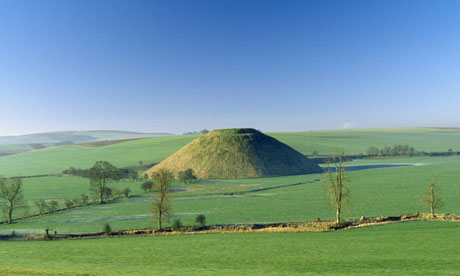
Silbury HillIN A modest house in Swindon, an 86-year-old man formulates exquisitely-detailed theories that turn conventional Wiltshire arch- aeology on its head.

If retired builder Eric Crook is right – and his belief that he’s right is unshakeable – the remains of a neolithic princess have lain deep beneath Silbury Hill for more than 4,000 years.

Even more startling is his insistence that the stones of Avebury once formed a carved amphitheatre of countless thousands of human and animal faces. These carvings would have appeared to move in flickering firelight; an illusion to thrill audiences of people who were centuries dead before Christ was born or the invading legions of Rome set foot on English soil.

These stone faces, Mr Crook says, can still be found in fragments hacked from the stones down the centuries, whether for buildings or perhaps because the powers that be disapproved of such images.

The reaction from the archaeological mainstream has so far been distinctly underwhelming, but Mr Crook, having spent well over 50 years researching and documenting his subject, is undaunted.

“Archaeologists are trained by other archaeologists,” he said. “But they are not trained in a natural learning process going through building technology.

“They learn only through what they can see. I heard of a professor who was asked the question, ‘when do you think you’ll get the answers to Silbury Hill and Avebury?’ “She said it would be another generation, but I thought to myself, ‘The answers are already there and you’re the generation behind.’”

Wiltshire, A Journeyman’s Tale, is £9.99 and can be ordered from Amazon and bookshops, ISBN978-0-7223-3900-8

Well worth touring Avebury and Silbury Hill at the moment.  There are several amazing crop circles in the area

Stonehenge and Avebury Tour Guide
HisTOURies UK – The Best Tours in Wiltshire

Read Full Post »

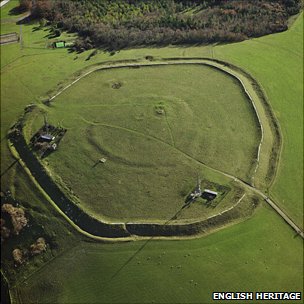
The Trundle near Chichester, Sussex, is one of the first large monuments built in Britain

The Trundle near Chichester, Sussex, is one of the first large monuments built in Britain

Researchers have developed a new dating technique that has given the first detailed picture of the emergence of an agricultural way of life in Britain more than 5,000 years ago.


A new analysis of artefacts recovered from the first monuments built in Britain shows that the Neolithic period had a slow start followed by a rapid growth in trade and technology.

Scientists say the new approach can be used to unravel the detailed sequence of events of many more important moments in human prehistory.

It relies in part on radio-carbon dating – counting the amount of a radioactive type of carbon atom in decaying matter. But the methodology also incorporates many other dating sources, together with some powerful statistical analysis, to produce far more discrete timings for happenings in the past.

The Neolithic period in Britain occurred between 4000 and 2000BC.

It was when people took up agriculture as a way of life and stopped being nomadic hunter-gatherers.

It also saw the emergence of trade across the British Isles and the development of new technologies. But until now, we have had only a rather coarse picture of the chronology of events during this eventful period in our history.

The new analysis by Dr Alex Bayliss, an English Heritage dating expert, has brought the occurrences of that time into sharper focus.

“We can start to tell a bigger story and write a history for the prehistory of Neolithic Britain,” she told BBC News.

“What we thought before was very imprecise. We simply knew that all sorts of different sites and all sorts of new kinds of practices started to happen sometime in the 500 or 600 years of the early Neolithic in Britain.

“We’ve actually now been able to give a timetable, or story of what happened when, to disentangle these things so that we can start to see why certain things may have followed others.”

According to Dr Bayliss’s analysis, Neolithic farming practices began in south-east England probably a few decades before 4,000BC. But then they spread very, very slowly, taking about two centuries to reach western parts of England. And then, she says, there was a sudden increase in activity.

“Monuments, cattle, sheep, the whole farming way of life, bursts across Britain and suddenly – having taken 200 years from getting from Kent to Gloucestershire – it then takes 50 years to get from Cheltenham to Aberdeen.”

The new dating also indicates that by 3700-3800BC, early Britons had developed pottery with regional styles of decorations. Long-distance trading networks were also being established in stone axes and certain other types of pottery

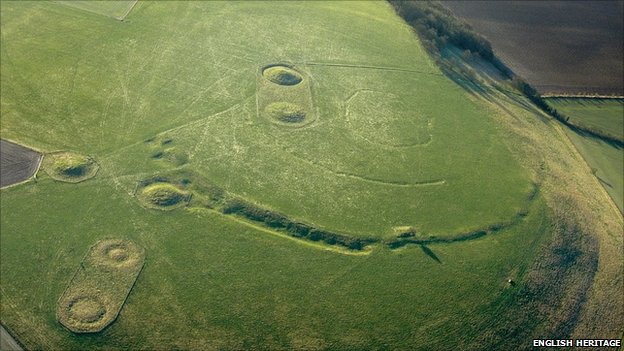
Windmill Hill, a large Neolithic causewayed enclosure in Avebury, was previously thought to have been built around 3700-3100 BC. The new dating shows it was built in 3700-3640 BC

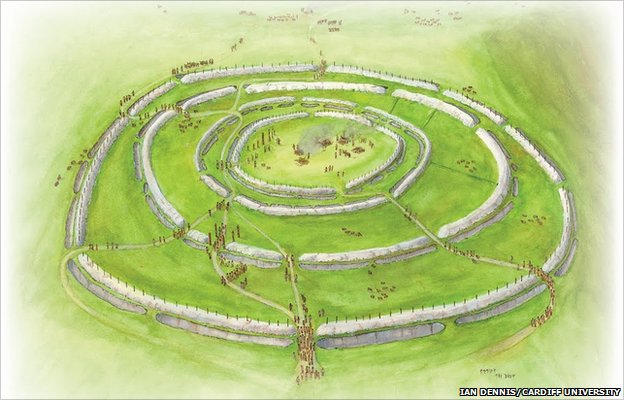
Of particular interest are the first monuments that were built in Britain, called causewayed enclosures. These were made up of concentric rings of ditches and banks – the largest of which can span 300m (1,000ft).

It had been thought that they spread slowly across the country over five centuries. But the new dating approach suggests they spread rapidly within 75 years.

This revelation has been described by archaeologists working on the project as Britain’s first “building boom”.

Professor Alistair Whittle of Cardiff University said: “With more accurate dating, the Neolithic period is no longer the sleepy, hazy swathe of time where it is the default position to lump everything together.

“This research fundamentally challenges the notion that little happened among our Stone Age farmers. We can now think about the Neolithic period in terms of more rapid changes, constant movement of people and fast diffusion of ideas.”

Collective violence

One interpretation of these events is that once the initial “pioneer” phase of the Neolithic period was over, independent groups of people came over from the continent and set up villages across Britain and social structures began to form.

These social structures led to the construction of the enclosures for people to gather and possibly for chieftains to emerge and amass power.

The new dating suggests that there was more collective violence once the enclosures were built. Several of them, particularly in western Britain, were attacked by large numbers of people with showers of arrows, and enclosures’ ramparts were burned down.

This indicates that the enclosures created a hierarchy that was being contested in some way.

The new dating technique involves comparing carbon dates with other markers in the archaeological record. On its own carbon dating is imprecise, but when it is cross-reference with documented events it allows researchers to more accurately date artefacts.

Researchers say this new methodology could in principle be used shed further light on any significant event in our prehistory, such as the emergence of farming in China and the collapse of the Mayan civilisation in the Americas.


A reconstruction of the Whitehawk causewayed enclosure in the South Downs, Sussex

Why not visit Windmill Hill and nearby Avebury and learn more about Neolithic Britain?

Stonehenge and Avebury stone Circle Tour Guide
HisTOURies UK – The Best Tours of Ancient Wiltshire


Read Full Post »

Archaeological investigation dates Marlborough Mound at around 2400 BC 

The Wiltshire landscape around Avebury and Silbury Hill is the heart of prehistoric Britain, and has World Heritage designation. Now another monument can be added to its archaeological treasures: the Marlborough Mound.

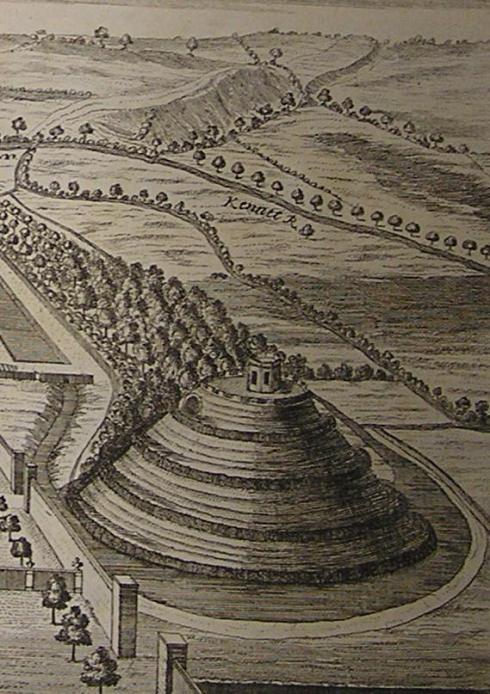
William Stukeley’s 1723 image of Marlborough “Mount”

William Stukeley’s 1723 image of Marlborough “Mount”

The Mound, in the grounds of Marlborough College, was already recognised as a feature of considerable historical significance. It was the motte on which the keep of Marlborough Castle was built fifty years after the Norman Conquest and it subsequently became the centrepiece of a major seventeenth century garden. The latest research has extended its history back by three millennia.

Recent coring of the mound at Marlborough College produced four samples of charcoal, allowing radiocarbon dating for the first time. The samples, which came from different levels in the mound, were taken from two bore holes through the height of the 19m monument, showing that it was built in the years around 2400 BC. This is the first firm evidence proving the theory that the castle motte is largely a re-used prehistoric structure of the highest national standing.

Jim Leary, who led the recent archaeological investigations for English Heritage at the nearby Silbury Hill, and is co-author of the recently published ‘The Story of Silbury Hill’ coordinated EH’s contribution, which also included radiocarbon dating. He says, “This is an astonishing discovery. The Marlborough Mound has been one of the biggest mysteries in the Wessex landscape. For centuries people have wondered whether it is Silbury’s little sister; and now we have an answer. This is a very exciting time for British prehistory”

After the prehistoric mound was re-used as a castle motte – the only known example of its kind – it became an important royal castle for the Norman and Plantagenet kings. It was occasionally the scene of major political events, such as the general oath of allegiance to King John in 1209, as well as being a favourite royal hunting lodge. In the fourteenth century the castle passed to the queens of England, and gradually became neglected.

In the seventeenth century it came into the possession of the Seymour family, and its next avatar was as a feature in a historically significant early romantic garden: a spiral ramp was cut in its side, with a hawthorn hedge enclosing the path which wound to the summit, where there was a water feature.

The Master of Marlborough College, Mr Nicholas Sampson, said: ‘We are thrilled at this discovery, which confirms the long and dramatic history of this beautiful site and offers opportunity for tremendous educational enrichment.’

The work is part of a major conservation programme being undertaken by the Marlborough Mound Trust, specially formed at the invitation of the College and under the coordination of Donald Insall Associates. The Chairman of the Trust, Mr Michael Macfadyen says, ‘The inspiration for this was our founder Eric Elstob, a former pupil at the College, whose generous legacy has provided the means for this work. He would have been totally delighted by this news.’

Links: https://www.marlboroughcollege.org

“This is an astonishing discovery. The Marlborough Mound has been one of the biggest mysteries in the Wessex landscape. For centuries people have wondered whether it is Silbury’s little sister; and now we have an answer. This is a very exciting time for British prehistory”

Wiltshire Tour Guide
HisTOURies UK - The Best Tours in Wiltshire

Read Full Post »

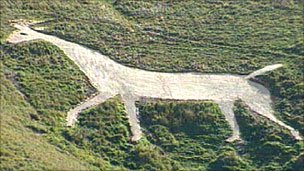
Chalk from Hampshire is used to re-chalk the ancient Wiltshire hill figure

Chalk from Hampshire is used to re-chalk the ancient Wiltshire hill figure

A restoration group is appealing for volunteers to help re-chalk one of Wiltshire’s oldest hill figures.

The Cherhill White horse, cut into the Marlborough Downs, is owned and maintained by the village of Cherhill.

The 232-year-old hill figure underwent a major facelift in 2002 after losing both its whiteness and its horse shape.

Since then the 18th Century landmark, the second oldest in the county, has required a “re-chalking” every two years.

“It had been continuously scraped to reveal fresh chalk but that left a three foot cliff at the top of the horse,” said the restoration group’s chairman, Rob Pickford.

“Now we top it up with extra chalk to level it with the surrounding ground.”

Yellow horse

The horse, one of nine such monuments in the county, requires up to 10 tonnes of chalk to restore it to its former splendour.

The chalk, funded by donations from visitors to the Downs, is being “brought in” after the last chalk quarry in the county at Mere closed down.

“The first top dressing we did we got the chalk from Somerset,” said Mr Pickford. “It was very yellow with bits of grey flint in it so we ended up with a yellow horse with grey spots. This year we’re getting it from a quarry in Hampshire.”

Natural erosion from the weather is normally responsible for the discolouring of the ancient monument.

However, this year’s unusually dry and sunny conditions have “bleached the chalk”.

“It’s looking quite white at the moment but in February it was looking particularly grey,” said Mr Pickford.

“And some of the boards used to hold the chalk in place have become exposed, so it does need top dressing.”

The re-chalking is due to take place on Saturday 14 May and is expected to take up to six hours.

Volunteers are being asked to meet at the Black Horse car park at 9:30 am “armed with spades.”  I am taking the kids and a picnic – see you there ?

Wiltshire’s White Horses

The Wiltshire Countryside is famous for its white horse chalk hill figures. It is thought that there have been 13 white horses in existence in Wiltshire, but only 8 are still visible today.

The oldest, largest and perhaps the most well known white horse is carved into the chalk hillside across the border in Oxfordshire. Little is known of the history of the Uffington White Horse, but it is believed to have influenced the cutting of the subsequent Wiltshire horses.

The first of the Wiltshire white horses to appear was at Westbury in 878AD, although this figure is no longer visible as a new horse was cut on top in 1778. The most recent horse was cut on the hill above Devizes to celebrate the Millennium.
Links:
http://www.bbc.co.uk/news/uk-england-wiltshire-13294489

http://www.wiltshirewhitehorses.org.uk/
http://www.StonehengeTours.com
http://www.visitwiltshire.co.uk/site/things-to-do/attractions/history-and-heritage/white-horses
We continue to offer private guided tours of Wiltshire that include ‘Chalk Hill Figures’

Wiltshite Tour Guide
HisTOURies UK – The Best Tours of Ancient Wiltshire

Read Full Post »

According to the Venerable Bede who lived in the 8th century the name Easter derived from the name of a pagan goddess, Eostre. She was goddess of Spring and fertility and her festival was celebrated at the Spring Equinox. Jesus was crucified in April and when the Saxons became Christians they began to celebrate his death and resurrection early in the Spring but they kept the old name Easter. Alternatively it has been suggested that Easter comes from the Saxon word for dawn.

In the early years of Christianity there was a dispute over the date of Easter. In 325 the Nicean Council decided it should be on the first Sunday after the full moon after the Spring Equinox. That is why the date of Easter changes each year.


Friday is the day of the week when the crucifixion took place. It is called Good Friday because good meant holy. On that day we eat hot cross buns. (Good meant holy). The origins of hot cross buns are obscure but in pagan times people baked buns and offered them to the gods. Cross buns with the cross representing the cross of Jesus were first mentioned in the 18th century. In the early 19th century people sold hot cross buns in the street from stalls and so they became known as ‘hot’ cross buns.


The Easter bunny was originally a hare because hares were fertility symbols in the pagan religion and they continued to be associated with Easter after people were converted to Christianity. Because people in the USA were unfamiliar with hares the Easter hare became a rabbit.


In the Middle Ages Christians were forbidden to eat eggs during Lent (the forty days before Easter). Not surprisingly people were keen to eat eggs when Easter arrived!


Some people also said that the egg represented the tomb of Jesus, or it represented the stone that was placed over the entrance of his tomb and was rolled away when he rose from the dead. (Long before Christianity eggs were a pagan symbol of fertility).


In the Middle Ages people painted Easter eggs red but by the 18th century people bought artificial eggs made of various materials to give as gifts at Easter. (Sometimes the artificial eggs contained gifts). Chocolate Easter eggs were first made in the 19th century.

http://www.visitwiltshire.co.uk
http://www.dayoutwiththekids.co.uk/search.php?county=wiltshire

Wiltshire Tour Guide
HisTOURies UK – The Best Guided Tours in Wessex

Read Full Post »

As a Christian symbol, it seems appropriate that its resurrection took place in time for Easter.  Glastonbury’s Holy Thorn tree began to show new buds this week, three months after it was savagely cut down by vandals.
According to legend, Joseph of Arimathea – who some say was Jesus’s great-uncle – travelled to Wearyall Hill after the Crucifixion and stuck a wooden staff belonging to Jesus into the ground before he went to sleep.

When he awoke, the tale goes, the staff had sprouted into a thorn tree, which became a shrine for Christians across Europe.

Every year, the sacred tree flowered once at Christmas and once at Easter, until just before Christmas last year when it was vandalised, leaving the community of the small Somerset town fearing it was dead.

But that was before the council enlisted the help of Peter Frearson, a self-titled pagan wizard who happens to run his own horticultural business.

Mr Frearson said: ‘Well-meaning but uninformed people were putting things like marmalade on the wounds. ‘Mead, an alcoholic drink made from honey, was also popular, as well as various ales and Guinness on one occasion.

‘There’s also been a few ribbons tied round it, as well as lots of people holding hands around it, and circles of people projecting positive energy.’

Sacred: Well-wishers visit the tree in Glastonbury, SomersetSacred: Well-wishers visit the tree in Glastonbury, Somerset

But Mr Frearson, nicknamed the Garden Wizard, had other ideas to ensure the tree’s revival.

He said: ‘We applied a dressing of pine resin and beeswax to stop further moisture and rain getting in, keep out bacteria and fungus, and applied nutrients.

‘We covered it in horticultural fleece, then bubble wrap, then more fleece.
‘Soon after we replaced the bubble wrap with hessian.

‘We mulched around the base of the tree with well-rotted wood chips to keep the moisture off the ground, and we’ve also driven spikes into the ground and filled the holes with compost and bonemeal, and we’ll do it again soon.’

Glastonbury’s mayor John Coles said the display of new buds on the tree was ‘wonderful news for the town’.

Read more: http://www.dailymail.co.uk/news/article-1370056/Resurrection-Holy-Thorn-Tree-Glastonburys-vandalised-shrine-comes-life.html#ixzz1Hh02v1NE

Visit the ;Holy Thorn’ on a Glastonbury (King Arthure Country) guided sightseeing tour.

Glastonbury Tour Guide
HisTOURies UK – The Best Tours on Ancient Britain

Read Full Post »

Start: Avebury |Finish: Old Sarum
Distance: Approximately 42 miles

Wiltshire is a county of history and mystery set in a dramatic landscape. The combination of heritage and scenery provides a truly memorable day out. So come with us on a journey through the countryside and across the ages as we go back to the time of our prehistoric ancestors. Hundreds of thousands of years may have passed but all over the county there’s evidence of human activity from the end of the Ice Age through the Stone, Bronze and Iron Ages right up to the invasion of the Romans in AD43.

Click here for audio / visual tour

This driving tour will take you through the heart of Wiltshire. En route you’ll discover more about how our enigmatic and mysterious ancestors lived, worked, fought and died.

This tour can be undertaken in a variety of ways; as a day-long journey, in short sections or you can use the information as a guide to individual visits.

You might also consider embarking on the tour using public transport but keeping up to date with bus service and timetable changes will require plenty of preparation.

Before you set off make sure that you’re properly equipped. Nothing beats a really good Ordnance Survey map, marked with contours and ancient monuments. A compass and a torch would also be useful. Some of these historical gems are in fields and away from roads or footpaths, so good walking boots are a must. Some sites have few or no facilities and it’s also worth noting that mobile phone coverage can’t be guaranteed in parts of rural Wiltshire. For news of road works or route closures, check BBC Local Radio and bbc.co.uk/travelnews

This guide has been produced with the generous assistance of Phil Harding, Wessex Archaeology, English Heritage, Wiltshire Council Archaeology Service, Bob Clarke, Martin Kellett, David Dawson and the Wiltshire Heritage Museum in Devizes.

Stonehenge and Avebury Tour Guide
HisTOURies UK – The Best Tours in Wiltshire

Read Full Post »

Celtic Britain
(The Iron Age) c. 600 BC – 50 AD

Who were they? The Iron Age is the age of the “Celt” in Britain. Over the 500 or so years leading up to the first Roman invasion a Celtic culture established itself throughout the British Isles. Who were these Celts?

For a start, the concept of a “Celtic” people is a modern and somewhat

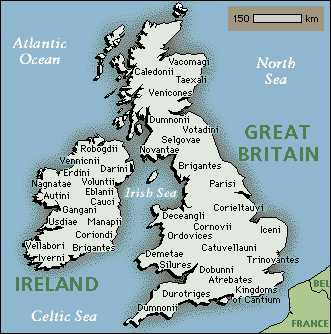
Celtic Britain was dominated by a number of tribes, each with their own well-defined territory. It is thanks to Roman chroniclers, such as Strabo, Julius Caesar, and Diodorus, that the names of individual tribes are known to us today, albeit in Romanized form.

Celtic Britain was dominated by a number of tribes, each with their own well-defined territory. It is thanks to Roman chroniclers, such as Strabo, Julius Caesar, and Diodorus, that the names of individual tribes are known to us today, albeit in Romanized form.

romantic reinterpretation of history. The “Celts” were warring tribes who certainly wouldn’t have seen themselves as one people at the time.

The “Celts” as we traditionaly regard them exist largely in the magnificence of their art and the words of the Romans who fought them. The trouble with the reports of the Romans is that they were a mix of reportage and political propaganda. It was politically expedient for the Celtic peoples to be coloured as barbarians and the Romans as a great civilizing force. And history written by the winners is always suspect.

Where did they come from? What we do know is that the people we call Celts gradually infiltrated Britain over the course of the centuries between about 500 and 100 B.C. There was probably never an organized Celtic invasion; for one thing the Celts were so fragmented and given to fighting among themselves that the idea of a concerted invasion would have been ludicrous.

The Celts were a group of peoples loosely tied by similar language, religion, and cultural expression. They were not centrally governed, and quite as happy to fight each other as any non-Celt. They were warriors, living for the glories of battle and plunder. They were also the people who brought iron working to the British Isles.

The advent of iron. The use of iron had amazing repercussions. First, it changed trade and fostered local independence. Trade was essential during the Bronze Age, for not every area was naturally endowed with the necessary ores to make bronze. Iron, on the other hand, was relatively cheap and available almost everywhere.

Hill forts. The time of the “Celtic conversion” of Britain saw a huge growth in the number of hill forts throughout the region. These were often small ditch and bank combinations encircling defensible hilltops. Some are small enough that they were of no practical use for more than an individual family, though over time many larger forts were built. The curious thing is that we don’t know if the hill forts were built by the native Britons to defend themselves from the encroaching Celts, or by the Celts as they moved their way into hostile territory.

Usually these forts contained no source of water, so their use as long term settlements is doubtful, though they may have been useful indeed for withstanding a short term siege. Many of the hill forts were built on top of earlier causewayed camps.

Celtic family life.
The basic unit of Celtic life was the clan, a sort of extended family. The term “family” is a bit misleading, for by all accounts the Celts practiced a peculiar form of child rearing; they didn’t rear them, they farmed them out. Children were actually raised by foster parents. The foster father was often the brother of the birth-mother. Got it?

Clans were bound together very loosely with other clans into tribes, each of which had its own social structure and customs, and possibly its own local gods.

Housing. The Celts lived in huts of arched timber with walls of wicker and roofs of thatch. The huts were generally gathered in loose hamlets. In several places each tribe had its own coinage system.

Farming. The Celts were farmers when they weren’t fighting. One of the interesting innovations that they brought to Britain was the iron plough. Earlier ploughs had been awkward affairs, basically a stick with a pointed end harnessed behind two oxen. They were suitable only for ploughing the light upland soils. The heavier iron ploughs constituted an agricultural revolution all by themselves, for they made it possible for the first time to cultivate the rich valley and lowland soils. They came with a price, though. It generally required a team of eight oxen to pull the plough, so to avoid the difficulty of turning that large a team, Celtic fields tended to be long and narrow, a pattern that can still be seen in some parts of the country today.

The lot of women. Celtic lands were owned communally, and wealth seems to have been based largely on the size of cattle herd owned. The lot of women was a good deal better than in most societies of that time. They were technically equal to men, owned property, and could choose their own husbands. They could also be war leaders, as Boudicca (Boadicea) later proved.

Language. There was a written Celtic language, but it developed well into Christian times, so for much of Celtic history they relied on oral transmission of culture, primarily through the efforts of bards and poets. These arts were tremendously important to the Celts, and much of what we know of their traditions comes to us today through the old tales and poems that were handed down for generations before eventually being written down.

Druids. Another area where oral traditions were important was in the training of Druids. There has been a lot of nonsense written about Druids, but they were a curious lot; a sort of super-class of priests, political advisors, teachers, healers, and arbitrators. They had their own universities, where traditional knowledge was passed on by rote. They had the right to speak ahead of the king in council, and may have held more authority than the king. They acted as ambassadors in time of war, they composed verse and upheld the law. They were a sort of glue holding together Celtic culture.

Religion. From what we know of the Celts from Roman commentators, who are, remember, witnesses with an axe to grind, they held many of their religious ceremonies in woodland groves and near sacred water, such as wells and springs. The Romans speak of human sacrifice as being a part of Celtic religion. One thing we do know, the Celts revered human heads.

Celtic warriors would cut off the heads of their enemies in battle and display them as trophies. They mounted heads in doorposts and hung them from their belts. This might seem barbaric to us, but to the Celt the seat of spiritual power was the head, so by taking the head of a vanquished foe they were appropriating that power for themselves. It was a kind of bloody religious observance.

The Iron Age is when we first find cemeteries of ordinary people’s burials (in hole-in-the-ground graves) as opposed to the elaborate barrows of the elite few that provide our main records of burials in earlier periods.

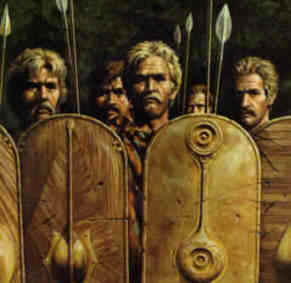
The Celts at War. The Celts loved war. If one wasn’t happening they’d be sure to start one. They were scrappers from the word go. They arrayed themselves as fiercely as possible, sometimes charging into battle fully naked, dyed blue from head to toe, and screaming like banshees to terrify their enemies.

They took tremendous pride in their appearance in battle, if we can judge by the elaborately embellished weapons and paraphernalia they used. Golden shields and breastplates shared pride of place with ornamented helmets and trumpets.

The Celts were great users of light chariots in warfare. From this chariot, drawn by two horses, they would throw spears at an enemy before dismounting to have a go with heavy slashing swords. They also had a habit of dragging families and baggage along to their battles, forming a great milling mass of encumbrances, which sometimes cost them a victory, as Queen Boudicca would later discover to her dismay.

As mentioned, they beheaded their opponents in battle and it was considered a sign of prowess and social standing to have a goodly number of heads to display.

The main problem with the Celts was that they couldn’t stop fighting among themselves long enough to put up a unified front. Each tribe was out for itself, and in the long run this cost them control of Britain.

(Note: The terms “England”, “Scotland”, and “Wales” are used purely to indicate geographic location relative to modern boundaries – at this time period, these individual countries did not exist).

Join us on a guided tour of Britain and learn more about the Celts
HisTOURies UK – The Best Tours in British History

Read Full Post »

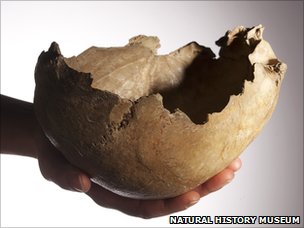
Ancient Britons were not averse to using human skulls as drinking cups, skeletal remains unearthed in southwest England suggest.

The level of modification suggests the ancient Britons were "manufacturing" something of use

The braincases from three individuals were fashioned in such a meticulous way that their use as bowls to hold liquid seems the only reasonable explanation.

The 14,700-year-old objects were discovered in Gough’s Cave, Somerset.

Scientists from London’s Natural History Museum say the skull-cups were probably used in some kind of ritual.

“If you look around the world there are examples of skull-cups in more recent times – in Tibetan culture, in Fiji in Oceania, and in India,” said Dr Silvia Bello, a palaeontologist and lead author of a scientific paper on the subject in the journal PLoS One.

“So, skulls have been used as drinking bowls, and because of the similarity of the Gough’s Cave skulls to these other examples, we imagine that that’s what these ancient people were using them for also,” she told BBC News.

Gough’s Cave is situated in the Cheddar Gorge, a deep limestone canyon on the southern edge of the Mendip Hills.

Palaeo-investigations started there a hundred years ago, with many of the finds now held at the Natural History Museum (NHM).

The site is particularly noteworthy for the discovery in 1903 of “Cheddar Man”, the complete skeleton of a male individual dating to about 10,000 years ago.

But the users – and owners – of the skulls discussed in the PLoS One article are actually from an earlier period in the history of the British Isles.

This was during a brief warm spike in a series of ice ages that allowed humans living in southern Europe to venture north into what was otherwise an utterly inhospitable landscape.

These Cro-Magnons, as we now call them, were hunter-gatherers living on their wits and, it seems, eating human flesh when the need and opportunity arose.

Gough’s Cave famously held the remains of human bones that had been butchered to extract marrow in exactly the same way as animal bones on the site had been processed.

Our modern sensibilities find the thought of cannibalism repulsive, but these people lived in a different age, Dr Bello said:

“They were a one man band; they were going out, hunting, butchering and then eating their kill. And they were extremely skilled at what they did, but then that’s how they survived.

“I think the production of the skull-cups is ritualistic. If the purpose was simply to break the skulls to extract the brain to eat it, there are much easier ways to do that.

“If food was the objective, the skull would be highly fragmented. But here you can really see they tried to preserve most of the skull bone; the cut marks tell us they tried to clean the skull, taking off every piece of soft tissue so that they could then modify it very precisely. They were manufacturing something.”

NHM colleague Professor Chris Stringer helped excavate one of the skull-cups in 1987 and is a co-author on the paper.

“This research shows how extensive the processing of these human remains was,” he said.

“It’s impossible to know how the skull-cups were used back then, but in recent examples they may hold blood, wine or food during rituals.”

At about 14,700 years old, the Gough’s Cave skull-cups would represent the oldest, recognised examples in the world.

The museum plans to put a detailed model of one of the skull-cups on display this March so that visitors can get a deeper insight the practices of these ancient Britons.

Stonehenge Tour Guide
HisTOURies UK – Private tours of the West Country

Read Full Post »

« Newer Posts - Older Posts »