Feeds:
Posts
Comments

Archive for the ‘Salisbury Cathedral’ Category

SALISBURY will be the talk of the art world next year when a John Constable exhibition is staged at the city’s museum.

The summertime show is being organised to mark the 200th anniversary of the artist’s arrival in Salisbury. His visits to his friend John Fisher, the then Bishop of Salisbury, are widely accepted as inspiring some of his greatest paintings.

The Constable & Salisbury exhibition will see a multi-million pound collection brought together from both private owners and major art museums.

A final list of Constable’s paintings is still to be confirmed, but the show starting in May next year will include some of the artist’s most important work including several depicting the cathedral and the Harnham Water Meadows.

Richard Morgan, who has led a committee of art enthusiasts in developing the project, announced the three-month exhibition this week.

“This will be a 50-piece collection never seen before. It is work that will be gathered from the leading British galleries and others including the Fitzwilliam in the USA, National Gallery Washington and the Louvre in Paris.”

He was guest speaker at a garden party held by Salisbury law firm Wilsons in the grounds of the museum.

Mr Morgan added: “Museums can change places, just as we have seen in Liverpool and St Ives, and we are planning great changes in this museum.”

He said thanks in part to funding from the English Heritage Lottery Fund they hoped to radically change Salisbury Museum and the Constable exhibition was part of this.

Stephen Oxley, senior partner at Wilsons, said his firm had a tradition of supporting the arts in the city and they were delighted to be a sponsor of this project. “We have worked with the museum and its people for many years and when they approached us in 2008 with an idea from Lord Congleton to put on an exhibition, the likes of which had never been done before, we jumped at the chance to be involved.”

Adrian Green, director of Salisbury Museum, said: “It is almost impossible to view Salisbury Cathedral without thinking of Constable, therefore it is surprising that there has never been a major exhibition of his work in the city.

“As an archaeologist I particularly find Constable’s lesser known views of Old Sarum and Stonehenge evocative. One of Constable’s final exhibits at the Royal Academy was a magnificent watercolour of Stonehenge, shown there in 1836, which will be a major highlight of the exhibition for me.”

Salisbury Tour Guide
HisTOURies UK – The best tours of Salsibury, Stonehenge and Wessex

Read Full Post »

It’s the Festival of British Archaeology – this is your chance to meet a real archaeologist and to uncover artefacts from Old Sarum’s history. Kids will love getting involved with archaeological activities, including: a sand-pit excavation, to learn how archaeologists uncover, recover and record evidence, and a finds washing, to learn how archaeologists process the evidence! Plus, there are lots of fun and games to take part in like our Beat the Archaeologist Challenge or Guess the Mystery Object from Old Sarum’s past.

Old Sarum Hillfort

Discover the story of the original Salisbury and take the family for a day out to Old Sarum, 2 miles north of where the city stands now. The mighty Iron Age hill fort was where the first cathedral once stood and the Romans, Normans and Saxons have all left their mark.

Today, 5,000 years of history are told through graphic interpretation panels on site. Families, heritage lovers and walkers can enjoy a great value day out at Old Sarum- you could even bring a picnic and enjoy the fantastic views across the Wiltshire countryside. The gift shop has a delicious range of ice-creams and exclusive English Heritage gifts and produce. Wooden bows and arrows are also on sale to help the kids imagine what life was like all those years ago!

Don’t Miss…

  • The spectacular view from the ramparts at Old Sarum to the ‘new’ cathedral in the centre of Salisbury
  • Our interesting interpretation panels bringing 5,000 years of history to life
  • Old Sarum’s literary connections- you can buy some of the famous books written about the site in our shop

    Wiltshire Tour Guide
    HisTOURies UK – The Best Tours in British History

Read Full Post »

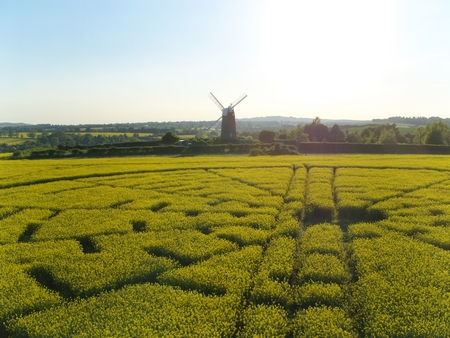
This fantastic formation lies in a beautiful location adjacent to Wilton Windmill. An extremely picturesque and quiet part of the Wiltshire countryside, the calm and tranquil atmosphere was accentuated on the still summers evening when we visited. With only the odd car driving past the field and a couple of late evening explorers, this really was the peaceful and magical experience visiting crop circles should be, rather than the rush to keep up!

The wide outer ring of laid crop here is striking. As can be seen from some of the aerial shots, the crop is laid in a ‘herring bone’ pattern around the entire ring. The effect this creates on the ground is stunning. Throughout the central section of the outer ring, the crop is laid in so many layers it is raised a foot or more off the ground

 Of course when walking around this area, the crunching underfoot gives the impression that this crop circle was not crushed to the ground with excessive force initially, rather that the stems were gently laid to continue growing, as they have.

There are many areas in which the layers of overlapping stems are visible and show little or no sign of damage.

While there are lots of stems which have been broken at or near the base of the plant, this does seem consistent with visitors. This is particularly evident in the central laid circle which looks totally trampled, as is often the case as people flock towards the centre of many formations. There are also ‘walked’ pathways in some parts of the outer ring, consistent with people following a common path towards the centre.

The abundance of bent stems, reassuringly, counteracts the variable damage throughout. Untouched stems are visible throughout every area of the formation (except the centre as discussed) including the herringbone pathway in the outer ring. Stems are bent to varying degrees and more often than not, at the very point the stems emerge from the ground.

This would be impressive enough but is taken to another level by the way at certain points in the design, two of these pathways flow towards one another and then stop short of meeting, but only by a few inches of standing crop in between. The image below does not really do this justice but to see it is so impressive!

Another great addition to the early stages of the 2010 season!

Needless to say, anyone joining a private tour in the Wiltshire area will get a chance to see this amazing formation.

Wessex Tour Guide
HisTOURies UK – The Best Tours in History

Read Full Post »

The cuckoo traditionally marks the beginning of spring and right on cue to mark the first day of summer a crop circle has been spotted.

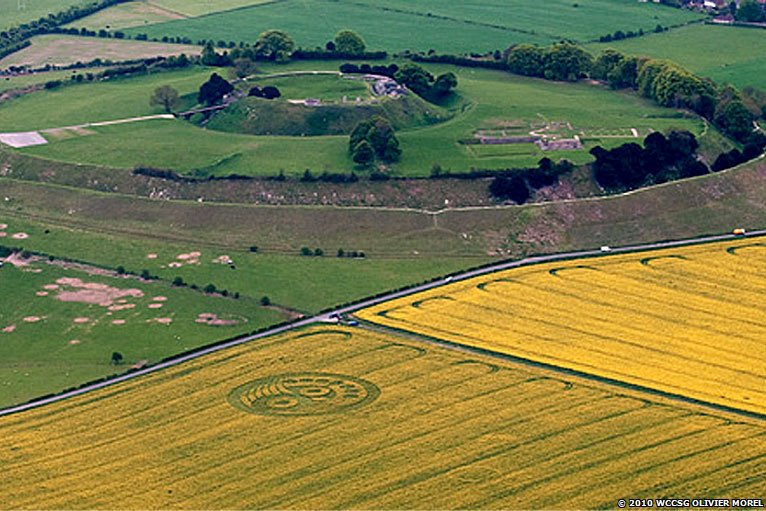
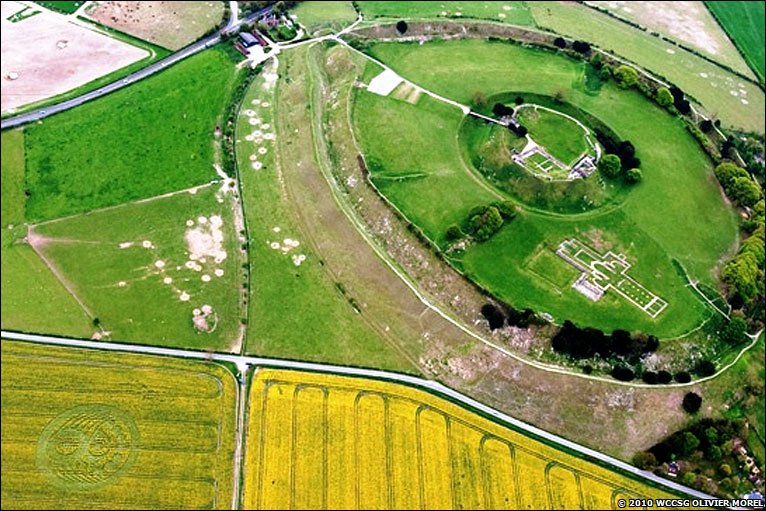
The first to be seen of that seasonal staple it is made up of curious swirls and has been ‘discovered’ in a field of oil seed rape in Wiltshire close to the remains of an Iron Age hill fort.

The crop circle lies close to the Iron Age hill fort of Old Sarum where Romans, Normans and Saxons have all since left their mark. To the right of the mound lies the outline of where the first Salisbury cathedral stood

The county is a popular spot for crop circle sightings and this one was found overlooking the historic site of Old Sarum, near Salisbury, near to where a 150ft dragonfly appeared in a field last year.
The bizarre shapes and designs are predominately found in the counties of South West England. However, they tend to pop up in other regions too and last year a 600ft jellyfish appeared in Oxfordshire – becoming the first jellyfish crop circle in the world.
The crop circle season normally begins in April with them increasing in number to a high point in July and August.
Just how these creations come into being is the subject of heated debate with some arguing they are the work of artists, while others feel they are deliberately created to bring in tourism.
The fact that many appear on ancient ‘ley lines’ leads others to believe they carry a mystical meaning.

Ley lines are supposed straight lines connecting three or more prehistoric or ancient sites which are associated by some with lines of energy and other paranormal phenomena.

However they’re formed though, tourists keep flocking to the circles every year to get a glimpse of the giant patterns.

OLD SARUM
Old Sarum was a mighty Iron Age hill fort which became the site of the first Salisbury cathedral. Chosen because of its strategic importance it was where two trade routes and the River Avon meet.
The Romans installed a garrison in the river valley below the site which was named Sorviodunum. Under the Anglo Saxons it ranked among the most considerable towns of the West Kingdom before the Normans arrived and built a castle there in 1069. The construction of the cathedral began in 1075 and it was nearly 200 years later that the second cathedral that stands today was built.

Nicholas – Stonehenge and Salisbury Tour Guide
Histouries UK – The Best Tours of Wessex

Read Full Post »

Since its initial publication in 1989 The Pillars of the Earth has been a hugely popular book at Salisbury Cathedral. It is full of drama and intriguing characters but it is also packed with carefully researched historical detail and lovingly tells the story of the building of a beautiful medieval cathedral not unlike Salisbury. The fictitious Kingsbridge created by Ken Follett is in the West Country, not far from the real city of Salisbury, early in the book Tom Builder even seeks work at the original cathedral at Old Sarum. As The Pillars of the Earth became an international best seller we began to meet more and more visitors who had been inspired to visit us by the book, from the UK but also from America, Germany and many other countries.

Many of our clients have read this book before visiting the area which greatly enhances their appreciation of Old Sarum and Salisbury Cathedral.  The announcement that the book is to be turned into a feature lenght film this year is great news for tourism in Wiltshire and for those who have visited or toured with us in the past.  Please take the time to read Ken Follet’s blog.

In 2008, as Salisbury was in the midst of celebrating its 750th anniversary year, Tandem Communications made contact with exciting news about a film of the book. A visit to Salisbury led to closer links, special effects shooting at the Cathedral and eventually a partnership. This section of our website holds a wealth of information about the film including images, video diaries and Ken Follett’s blogs. It will build as the international TV screening of the 8 hour film – starring Ian McShane, Rufus Sewell, Matthew Macfadyen, Eddie Redmayne, Hayley Atwell, Sarah Parish, Donald Sutherland, Alison Pill and Gordon Pinsent – moves closer.

The Salisbury Link to The Pillars of the Earth

Salisbury Cathedral was built in just 38 years in the 13th Century. This was quick for a medieval cathedral, and took place less than 100 years after the fictional Kingsbridge Cathedral was built in a similarly rapid timescale. The two buildings demonstrate a wealth of architectural parallels, notably the Gothic arches and rows of narrow, pointed ‘lancet’ windows, and Ken Follett has written about how Salisbury Cathedral was one of his inspirations as he researched The Pillars of the Earth.

The director of The Pillars of the Earth, Sergio Mimica-Gezzan, visited Salisbury Cathedral in 2008 and spent time taking detailed notes about the building as well as receiving input from our Consultant Archaeologist, Tim Tatton Brown. Special effects photographers followed in October 2009, meaning that elements of the real Salisbury Cathedral will be seen on screen, woven into the stunning location photography shot in Hungary and Austria, when the 8 hour film makes its TV debut in 2010.

A fabulous personal link between Cathedral and film became apparent as location shooting began when David Oakes, who plays the evil William Hamleigh, mentioned that as well as being educated at Bishop Wordsworth School in the Salisbury Cathedral Close he was also the son of a current Canon of Salisbury Cathedral – Jeremy Oakes!

The book revolves around the building of a beautiful medieval cathedral, built to the glory of God. As the modern day Salisbury Cathedral continues to the serve the purpose for which it was built, a current generation of craftsmen keeps the skills practiced by Tom Builder and Jack Jackson alive as they work to protect, restore and safeguard the building’s beauty for future generations.

Keep checking back as the airing of the film moves closer for more parallels, and some interesting differences, between the fictional Kingsbridge and the real Salisbury Cathedral!

http://www.the-pillars-of-the-earth.tv/

Nicholas
Salisbury and Stonehenge Tour Guide
Histouries UK – The Best Tours in British History

Read Full Post »

« Newer Posts