Feeds:
Posts
Comments

Archive for the ‘sightseeing’ Category

VisitWiltshire has launched a new handy sized Wiltshire Downs & Market Towns pocket guide and map, offering helpful information as part of an on-going campaign to attract and retain visitors to the county.
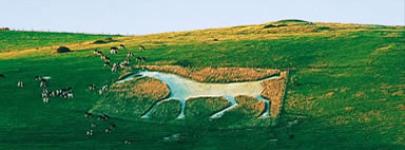
Wilsthire White Horse

The 24-page pocket guide details a host of attractions and activities to suit all ages, with information about events and festivals, food and drink, history and heritage, and the great outdoors.

David Andrews Chief Executive of VisitWiltshire highlighted the need for the guide: “This new guide is all part of the work we’re doing to celebrate the diversity of the county’s tourism product and to raise the profile of Wiltshire as a must-see holiday destination.  This is a new title for us and I’m particularly pleased that we’ve had such strong support in producing this guide from the local travel industry.”

The Wiltshire Downs are home to some of the UK’s most exciting and iconic attractions including:

The White Horses cut into the chalk hillside
The Ridgeway long distance path, which has been called the oldest road in Britain
Crofton Pumping Station, which houses the oldest working beam engine in the world
Caen Hill locks, arguably the most impressive flight of locks in the UK
Avebury, one of the most important Megalithic monuments in Europe consisting of 200 standing stones in two great circles.  This is combined with a massive bank and ditch which covers more than 28 acres
The new guide is split into clear sections making it easy for visitors to find just what they are looking for.  Amongst the highlights are events listings, suggestions for days out and plenty of pages dedicated to food and drink.  There is also a map showing the location of each individual attraction and activity.

David Dawson, Chair of Devizes Area Tourism Partnership and Director of Wiltshire Heritage Museum said, “We are delighted that VisitWiltshire has produced this timely new Wiltshire Towns & Market Towns Pocket Guide.  Given all the changes to tourism in Devizes lately it’s fantastic to see VisitWiltshire proactively targeting new visitors in this way, informing them of the best to see and do in the area.  Many of our attractions are now acting as mini tourist information centres and will be stocking the guide for anyone to use.”

As well as local circulation, the print run of 30,000 copies will be distributed proactively as part of VisitWiltshire’s marketing drive to bring additional visitors to the county.  Additional content is available to visitors online at www.visitwiltshire.co.uk.

Copies of the free ‘Pocket Guide and Map’ are available from VisitWiltshire by calling 0845 602 7323 or can be downloaded from the internet by visiting www.visitwiltshire.co.uk.

 The Best Tours in Wessex
HisTOURies UK – Mystical Landscape, Magical Tours

Read Full Post »

The results of our readers’ vote for Britain’s best building are in. Did your favourite win?

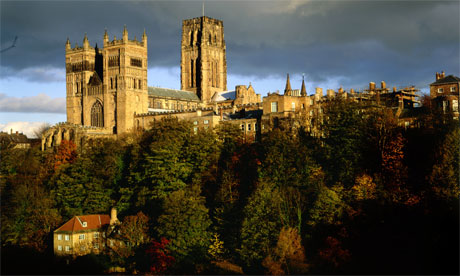
And the winner is...Durham Cathedral is the readers' choice for Britain's best building

And the winner is...Durham Cathedral is the readers' choice for Britain's best building


When we asked which British building you thought deserved to take the final place in our Britain’s best building series, we got a wonderful response and a vast range of suggestions from the very old Stonehenge to the not even finished Shard. But there was one building that was nominated time and time again. Napoleon471 said it is ‘the most beautiful building in the UK’ . gabbyannie commented that it’s “quite wonderful in the daytime, but transformed into a breathtaking sight after dark” and Rosiebriar declared that “the magnificence of its setting high on the peninsula, the grandeur of its architecture dating from 1093, World Heritage status and the endorsement by Dr Bill Bryson all commend this greatest of British buildings.” After three days of voting, the readers’ choice for Britain’s best building is Durham Cathedral. You picked wisely: there are few finer buildings of any period in Europe.

With its commanding setting on a headland high above the River Wear, Durham Cathedral is unmissable, and magnificent. Its architecture is at once powerful and poetic, a monument to the Norman invaders who created it from 1093. But, although clearly designed to dominate the region, the muscular cathedral is most beautiful when you step through its west front and face the length of the incomparable nave. Such beauty and such tragedy, too; here, 1,700 of the 3,000 Scottish soldiers imprisoned by Cromwell within these unbreachable walls died from wounds, disease and starvation; and here, meddling Georgian architects came to mess about with the venerable fabric. And yet, Durham Cathedral has survived and, today, is probably in better shape than it has been in hundreds of years.

The Best Tours in British History
HisTOURies UK

Read Full Post »

The ancient standing stones at Avebury, lie between Swindon and Devizes on the A4361. Avebury rings are a World Heritage site and attracts thousands of visitors annually, who are no doubt intrigued by the mystery that surrounds their construction.
Avebury Stone Circle
The henge is believed to date back to around 2600BC; just what motivated our ancestors to construct such an elaborate site and their ultimate purpose in doing so remains largely a mystery. It has been suggested (one of many theories) it may have been used as a place of worship and sacrifice. Some favour an astral observatory, difficult to prove I shouldn’t wonder, in view of the fact that many of the stones are missing and any alignment with the stars must be considered near impossible. Others believe it had a connection with Silbury Hill (see sidebar for more info)and was used to gauge the seasons for agriculture. Whatever the reasons for its construction, its true purpose still eludes archaeologists and scholars to this day.

It is unfortunate that not all of Avebury’s 154 sarsen stones (most likely quarried and transported on wooden rollers from the Marlborough hills) have survived. Of the three rings and the Avenue that make up the henge, only 36 stones are still standing. Many were destroyed or buried (some still are) in massive pits during the 14th century by devout local Christians because a) they believed them to be the harbingers of ill luck and b) to eradicate pagan worship from the monument.

It was during the 18th century that the stones came under attack once more, not from zealous Christians this time but from local construction workers who decided it would be a jolly good idea to utilizes the stones to construct several of the cottages in the village; the grand 15th century Tudor manor and the modernization of 12th century church of St. James. Some of these magnificent stones even went to cobble the streets of Devizes seven miles to the south.

It wasn’t until the intervention and purchase of the site by Marmalade tycoon and archaeologist – Alexander Keiller in the 1930’s, that the destruction ceased. Keiller was responsible for much of the conservation and re-erection of the stones. His work was interrupted during the outbreak of the WWII and remains unfinished to this day, unfinished because there are still stones which lay buried.

Keiller purchased Avebury Manor in 1937 and utilized and modernized the stable block to house a museum of his work and findings. Although small, it is well worth a visit.

Folklore

Folklore has evolved over a millennia regarding the alleged power of Avebury’s standing stones. A fascination has grown for these enigmatic sarsens, which appear to cast their spell on many who see them. The stones are often referred to as ‘grey wethers’ on account of their resemblance to grazing sheep when seen from a distance. Some believe the sarsens have healing properties and by a ‘hugging’ one, it will release its magical properties and cure most ills. Others have claimed whilst hugging a stone, to have felt vibrations emanating from within its very core. ‘Stone hugging’ is a common sight at Avebury. Often when I have been driving past, I can pretty much guarantee that someone will be flat against a stone, adopting a pose reminiscent of the crucifixion and gazing heavenward in eager anticipation of “the vibe‘. I think “the vibe,” can more than likely be attributed to the rumble and subsequent vibration of traffic passing close by on the A4361. There’s nout queerer than folk and Avebury attracts them in swarms – bless ‘em. As mentioned earlier, the locals used to believe the stones were harbingers of ill luck, so hugging one is probably not such a good idea.

Dowsers, crystal pendulum swingers, new age folk, druids, pagans and an assortment of other folk all looking for that something, descend on the village annually, and why not, everyone to their own I say.

With all the magic, mystery and ancient rituals which have grown up around the stones, you would have thought the circle would be a paranormal hotspot. If truth be known, the opposite is very much the case, especially when compared to the generous helping of ghostly history from the likes of The Red Lion pub, which stands within the circle; the resplendent Tudor Manor and the 12th century church of St. James. All these buildings positively exude tales to chill you to the marrow. The few hauntings and folklore that have been reported from the henge are as follows:

Back in the Sixties, a woman driving through the village late at night, reported seeing ghostly figures dressed in period costumes dancing amongst the stones. I would question, that what she actually saw, was probably nothing more than one of the many rituals and parties which take place regularly at Avebury.

There are claims of dwarf like creatures seen darting amongst the stones in the dead of night and of a spectrum of tiny twinkling lights believed by some to be fairy folk. These lights have been seen countless times dancing above the stones, especially the mysterious Diamond Stone, which is located at the north-west quadrant, a stone incidentally, said to uproot itself and crosses the A4361 at the stroke of midnight, no mean feat at around 40 tonnes.

The henge is thought to have several ley lines (hypothetical veins of invisible energy beneath the earth, said to connect ancient megalithic sites, monuments and even buildings, particularly churches) which dowsers especially believe crisscross beneath the henge and are most likely responsible for generating subterranean “earth energy.”

Avebury is a fascinating place and well worth a visit, if only to marvel at its construction and debate its mystery. That said, the claims surrounding the stones abilities will, I’m sure, stretch even the most vivid of imaginations.

Links:
http://hauntedwiltshire.blogspot.com
http://www.nationaltrust.org.uk/main/w-avebury
http://www.StonehengeTours.com

Guided tours of Stonehenge and Avebury Stone Circle
HisTOURies UK – The Best Tours in Ancient History
Mystical Landscape, magical tours………….

Read Full Post »

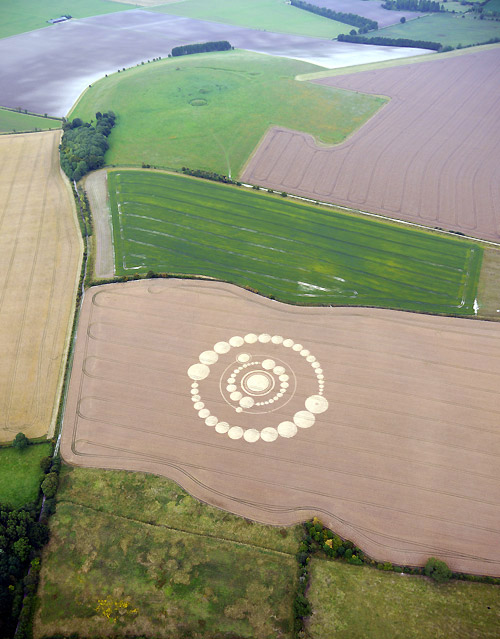
Another circle ‘crops up’ in Wiltshire -Windmill Hill (2), nr Avebury Stone Circle , Wiltshire. Reported 26th July.

Another amazing cropcircle has appeared in Wiltshire.  If you are not visiting with a local tour guide please respect the ‘crop circle etiquette’-see below.


CROP CIRCLE ETIQUETTE: Guidelines for visiting formations
FOR VISITING THE CROP CIRCLES.

In our attempt to become more responsible for giving out information on the locations for the Circles, we have published a Code of Conduct which was drawn up by the National Farmers Union in collaboration with the Centre for Crop Circle Studies. The Connector does not want to deny our readers the chance to visit a Crop Circle. It merely reminds you to ask for their permission to enter their fields.
 

Do not go onto private land unless you have permission from the farmer or landowner. If you can’t find the farmer or landowner to ask permission-you have no right to enter private property.

IF you can not find the farmer DO NOT enter the field.

IF you wander into a formation without permission and a farmer catches you, DO NOT argue with him if he wishes you to leave his land.

Better still – go with a local tour guide who knows exactly where they are, how to get there and has permission from the farmer.

Wilthire Crop Circle Tour Guide
HisTOURies UK – Mystical landscape, magical tours……..

Read Full Post »

THE first two crop circles of the summer have appeared close to Stonehenge.Stonehenge crop circle

Both lie in a barley field just off the A360, near Airman’s Corner.

Francine Blake of the Wiltshire Crop Circle Study Group said the first, which is 170ft in diameter, is an important symbol similar to one from the ancient Mayan culture, lying east-west and linking past and future.

Some enthusiasts have pointed out that it is identical to a logo used by the anarchist punk band Crass 30 years ago, representing the idea that great power will eventually destroy itself.

The second symbol, of two circles touching, measures 130ft by 80ft, and is said to relate to a partial solar eclipse on July 1.
Link: http://www.salisburyjournal.co.uk/news/9132878.Crop_circles_appear/?ref=ms

Visit this and other mysterious crop circles in the Wessex area with one of our private guided tours
HisTOURies UK – Mystical landscape, magical tours…………

Read Full Post »

Bath | Stonehenge | Paganism | Ley Lines| Druids | Masonic Lodge

It is said that the Circus is joined to the Royal Crescent by a ley-line, that they
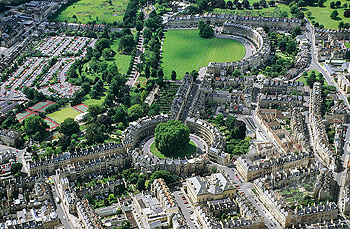
The Royal Circus is the same circumference as Stonehenge

represent the sun and the moon, and that Brock St which links them is the most paranormally active street in Bath!  The circumference of the Circus also matches – almost exactly – that of the inner circle of rocks at Stonehenge, the most famous druid monument of them all.

The Circus really does epitomise the elegance of Georgian Bath. Beautiful curved terraces of Bath limestone sweep round in a circle, and it doesn’t take much to imagine the ladies and gentlemen of society on this street. So charming and respectable – but look closer….

The Circus was designed by the architect John Wood, who had a fascination with Paganism. He incorporated his interest into the buildings around the crescent, all of which are adorned with Pagan and naturalistic carvings such as pan pipes and mystical figures, each one quite individual. At the top of each house is an acorn. The circular crescent represents the sun, and the Royal Crescent, which he also designed, represents the moon. It is said that the road that connects the two is an ancient ley line.

John Wood the Elder – Stanton Drew Circle and Stonehenge.

Bath is famed for its neo-classical architecture but what underpins the thinking of the 18th century architect John Wood when he drew the designs for The Circus is a strange mish-mash of legend and myth, this of course is the age of the new ‘druidism’ that took hold when such figures as William Stukeley called such places as Stonehenge the Druidical Temple.

Fertile imaginations played with the ideas of sacrificial wicker constructions filled with victims, and Wood took it much further and in his book – A Description of Bath, he writes a history for Bath that is at once absurd yet full of that energetic imaginings that are still to be found in today’s new age books.
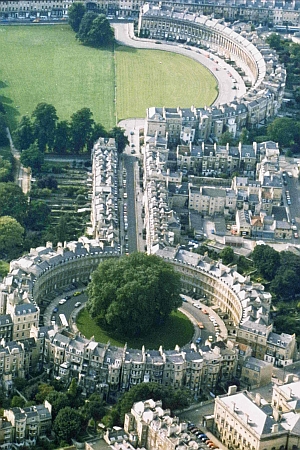
To understand why Wood designed The Circus as he did one must go back to the myths that formed the literature of the 18th century. Wood, though including neo-classical forms in the building, was not returning to a Roman past but a pre-Roman past steeped in the myths of a Britannic origin. The myth can be found in the 12th century writings of Geoffrey of Monmouthshire, and according to (R. S. Neal – Bath, A Social History) a 16th century edition of Monmouth’s book written in Paris was very much alive in the oral tradition of Bath. Putting stone circles and Druids together seems rather strange, but Wood thought that the chief ensign of the Druids was a ring.

So as he began to plan his city on paper, he incorporated the pagan elements, but also he was relating the pagan symbol of the circle back to Jewish symbolism, therefore Christian, and then British and Greek, which led quite nicely to the “Divine Architect” who was of course God. This is all creative flummery, a mixing of ideas, so when we look at The Circus we see classical lines, but with little touches of druidism – in the acorns that sit atop the surrounds of the roofs – and the frieze which incorporates specific symbols of Masonic details.

First  though must come the story of Bladud, the founding father of Bath, an exiled prince because of his leprosy, whilst out herding pigs one day happened to notice that the pigs loved to roll in the hot muds of the spring. Bladud also tried this and was cured, and then went on to found the city of Bath on the spot. Our mythical King Bladud is given a date of 480 BC, and as Wood saw it Bladud created the city about the size of Babylon. Bladud was a descendant of a Trojan prince, a high priest of Apollo and a ‘Master of Pythagoras’. Therefore this high priest was a devotee of the heliocentric systems of the planets from which the Pythagorean system was derived. That the Works of Stantondriu (Stanton Drew) form a perfect model of the Pythagorean system of the planetary world

Do the 108 acorns on the parapets refer to the story of ‘Prince Bladud’ (the founder of Bath) or a reference to the Druids and oak trees ?

At Stanton Drew it must have taken him many hours, with his assistant wandering round taking measurements of the circles, which were probably at this time partly covered in orchards. There was a precedence for this fascination with megalithic stones, Stukeley and Inigo Jones were all entranced by these heathen stones of an earlier age, and the development of myths round druidic religions were already forming and capturing imaginative minds – a bit like today.

Now Stanton Drew was, according to Wood, the university for British Druids, which thereby made Bath the metropolitan city seat of the British Druids. ‘And since there is an apparent connection between the ancient works of Akmanchester (Bath) and those of Stantondriu, it seems manifest that the latter constituted the University of the British Druids; that this was the university which King Bladud, according to Merlyn of Caledon planted; that it was at Stantondrui the king feated his four Athenian colleagues and that they were not only the heads of the British Druids in those early ages, but, under Bladud, the very founder of them‘ 

The Circus is based on a diameter of 318 feet, Wood’s rough measurements of the circumference of the stone circle at Stonehenge, the terraced houses form a perfect circle around a ‘timber’ circle of planted trees in the centre. There is an early drawing by J.R.Cozens which shows hitching stone post for the horses arranged symmetrically round the The Circus which would give the allusion of stones.

Wood also incorporated into his thinking the hills around Bath, giving them various titles such as Sun and Moon Hill, and The Parade is also aligned on Solsbury Hill which had an Iron Age settlement on top. The Royal Crescent built by his son John Wood the Younger, was crescent shaped representing the moon.

Where you might ask is the masonic symbolism, well it is only seen from the air, taking The Circus as the round part of the key walk down Gay Street to Queens Square which is square, and you will see the ‘key’ of Bath.

What is a Ley Line?
Ley lines are alleged alignments of a number of places of geographical interest, such as ancient monuments and megaliths, natural ridge-tops and water-fords. Their existence was suggested in 1921 by the amateur archaeologist Alfred Watkins, in his books Early British Trackways and The Old Straight Track. Watkins theorized that these alignments were created for ease of overland trekking by line of sight navigation during neolithic times and had persisted in the landscape over millennia.  In more recent times, the term ley lines has come to be associated with spiritual and mystical theories about land forms, including Chinese feng shui.

 I wonder if the fashionable Georgians who lived in these houses knew of the symbolism?
Links:
Stonehenge and Bath Tour Guide
HisTOURies – The Best Tours in British History

Read Full Post »
What was there before Stonehenge?

Stonehenge is a multiphased monument ie built in phases over a long period of time. It was built between 3000 and 2000 BC, but is part of a much larger ceremonial landscape which dates back somewhere up to 10,500 years ago. The earliest monuments in the landscape are markedSite of mesolithic post holes in the car park at Stonehenge by 3 small white discs on the tarmac at the lower end of the car-park. Chances are you will drive over them if you visit! The white discs mark where wooden postholes stood during the early mesolithic – the hunter gatherers – at least 3,500 years before the first phase of Stonehenge.Later features which predate Stonehenge that can still be seen are the Cursus and barrows or burial mounds. You will need more time or to go on a specialist tour to see these features.

Early ditch and bank at Stonehenge.

Though people had been meeting and using the landscape for some considerable time beforehand, the first phase of Stonehenge dates to between 3000 and 2920 BC with the creation of a ditch with internal bank. The bank has the appearance of a ‘…string of sausages’ and may have been upto 2m high though it is now much eroded.The dating of this part of the monument is believed to be fairly accurate because of the large amount of good dating evidence from antler and bone found in the ditch. After that the date for every other stage of Stonehenge is somewhat tenuous and subject to great debate.

Was there a timber phase at Stonehenge?

At the moment the theory is that from its beginnings to around 2600 BC there was a timber phase at Stonehenge. This included 56 timber posts just inside the bank and the post holes were later filled with cremated human remains and now known as Aubrey holes.In 2008 Aubrey hole 7 was opened by the Stonehenge Riverside Project and it looks more like a hole for a stone rather than timber. It may be that stones were here from the start rather than later. The results from the most recent dig are due out in 2011 so we may have the 3rd major rewrite of the Stonehenge story within 20 years!

Early stone phase.

Current dating assumptions suggest the first stones to arrive were the ‘bluestones’ from the Preseli Hills in west Wales. Bluestones inside StonehengeBluestone is a generic term for several types of volcanic rocks and each of them at Stonehenge weighs 4 – 6 tons.They are the ones that stand about man height as one looks into the stones. They don’t look blue until dressed (ie shaped) and the outer covering of the stone removed.You can how blue on a tour out of hours to the inner circle.
The bluestones were originally set in double concentric arcs with the open end facing the south/southwest. When removed they were filled are now known as Q & R holes.
Artist's impression of bluestone henge discovered in September 2009.In its final layout there are estimated to be 79 or 80 bluestones. An exciting discovery in September 2009 at the end of the Avenue where it meets the River Avon was a series of stone holes possibly holding bluestones. This ‘Bluestone’ henge may have held 24 stones. If the 56 Aubrey holes held stone rather than timbers it may be that there were two separate monuments that became united as the finishing phase of Stonehenge.

Late stone phase.

Around 2400 BC sees the arrival from 19 miles to the north of 75 sarsen stones. A very hard form of silicified sandstone it lies on or just below the ground surface. A circle of 30 uprights were erected in the outer circle each weighing around 25 tonnes. These were topped with 30 lintels each weighing 6 – 7 tonnes. Jointing to sarsens at Stonehenge.The lintels don’t rely on gravity to keep them in place they have mortice & tenon, and tongue & groove joints that we would normally find in a wood setting, but in stone. Each of the lintels also has some shaping on the inner and outer circular face to produce not far off a perfect circle.
The 5 trilithons (tri=3, lithon=stone) stand like a set of croquet hoops arranged in a horshoe shape in the centre of the circle. They step up in height as they go from the outer two to the remains of the Great Trilithon in the centre. Only 3 of the 5 trilithons still stand.

Final phase.

Around 2000BC the bluestones were re-erected. The altar stone was placed in the circle. Some realignments of external stones took place.

What is Stonehenge for?

Hundreds if not thousands of theories abound. A temple to the sun? Probably, but more about winter solstice sunset after which the days get lighter and warmer, rather than the more popularly attended summer solstice sunrise. A necropolis? Certainly. There are probably more than a tousand burials in the immediate area. Druidic temple? Probably not. They were a later ‘priesthood’ and the neo druids are an 18th century invention. A mystery?. Certainly.

Links:  http://www.english-heritage.org.uk/daysout/properties/stonehenge/
http://www.StonehengeTours.com#

Stonehenge Guided Tours
HisTOURies UK – The Best Tours in Ancient History

Read Full Post »

The unseasonably warm spring weather has not only brought forward many summer flowers – it has sparked the usual round of crop circles.

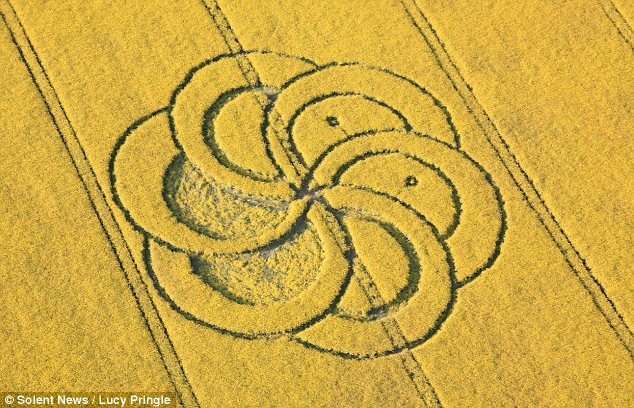
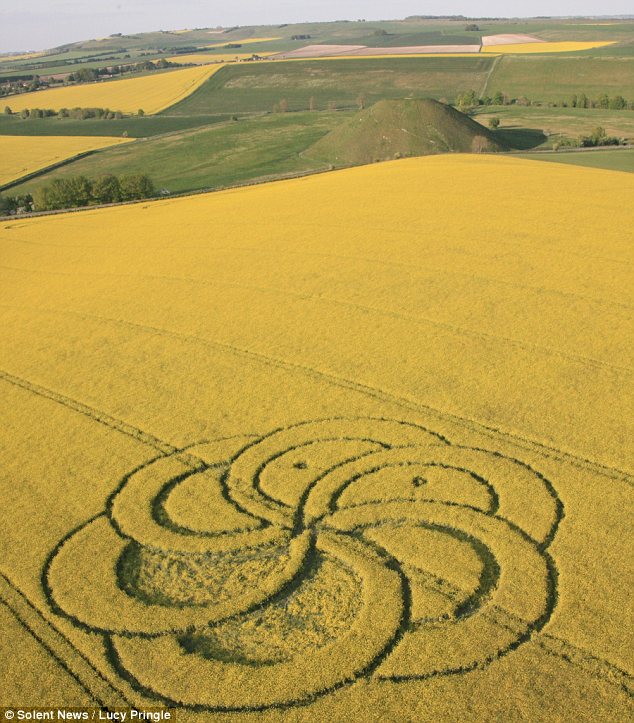
An elaborate 100ft circle which appeared overnight has caused a stir after it was found in a field of oil seed rape near Silbury Hill, Wiltshire.

The extraordinary floral creation is comprised of six interlocking ‘petal’ like crescents.

The ancient site, the tallest prehistoric man-made mound in Europe, is considered a hot spot for the bizarre phenomena and this new design proves the crop circle season is now under way.

Expert Lucy Pringle, widely known as an international authority on crop circles, believes this is the first ‘proper’ design of the year.

She added: ‘The start of the season is always exciting, I never know what’s going to happen for the rest of the year.

‘The latest circle is a floral pattern, I’ve never seen this before. There’s never been one identical to another.’

crop-circle-avebury

Miss Pringle, from Petersfield, Hants, is a founder member of the Centre for Crop Circle Studies.

She has conducted years of research in to the physiological and psychological effects reported by people after visiting the formations.

She says her findings suggest there are measured changes in human hormones and brain activity following contact with the circles.

The new ‘floral’ design is the latest in a long line of patterns to be spotted in the UK over the years.

Previous formations have included stars, triangles, birds, complicated three dimensional geometric shapes and even intricate patterns with hidden mathematical codes.

One, discovered in 2008 near Wroughton in Wiltshire, was thought to represent the first ten digits of pi, the ratio of the circumference of a circle to its diameter.
Link: http://www.dailymail.co.uk/news/article-1383035/First-crop-circle-season-appears-historic-Wiltshire-field.html

Crop Circle Tours 2011:  We operate guided tours of Wiltshire including all the best crp circles.  We know where they are, when thay happen and get you inside – a unique experience.  THere are already more formations in Wiltshire that we are visiting

http://www.histouries.co.uk/crop-circle-tours.htm

Crop Circle Tour Guide
HisTOURis UK – Private guided tours of Wessex

Read Full Post »

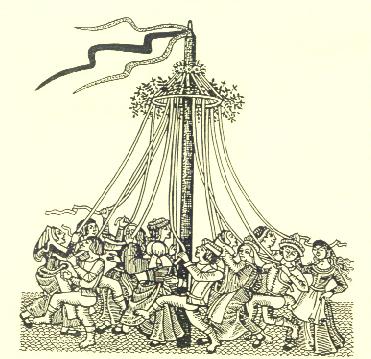
The first day of the month of May is known as May Day. It is the time of year when warmer weather begins and flowers and trees start to blossom. It is said to be a time of love and romance. It is when people celebrate the coming of summer with lots of different customs that are expressions of joy and hope after a long winter.

Traditional English May Day celebrations include Morris dancing, crowning a May Queen and dancing around a Maypole.

The beginning of Summer

Although summer does not officially begin until June, May Day marks its beginning. May Day celebrations have been carried out in England for over 2000 years.

The Romans celebrated the festival of Flora, goddess of fruit and flowers, which marked the beginning of summer. It was held annually from April 28th to May 3rd.

How was May Day Celebrated in the past?

It was custom for every one to go a-Maying early on May Day. Herrick, a 17th century English poet wrote:

There’s not a budding boy, or girl, this day,
But is got up, and gone to bring in May.

Decorating Houses

May Day began early in the morning. People would go out before sunrise in order to gather flowers and greenery to decorate their houses and villages with in the belief that the vegetation spirits would bring good fortune.

Washing in the early morning dew

Girls would make a special point of washing their faces in the dew of the early morning. They believed this made them very beautiful for the following year. copyright of protectbritain.com

May Queen

May Queen
The rest of the day was given over to various festivities. There was dancing on the village green, archery contest and exhibitions of strength. The highlight of the day was the crowning of the May Queen, the human replica of Flora. By tradition she took no part in the games or dancing, but sat like a queen in a flower-decked chair to watch her ‘subjects’.

May Day Garlands

Young girls would make May Garlands. They covered two hoops, one at right angles inside the other, with leaves and flowers, and sometimes they put a doll inside to represent the goddess of Spring.

In some parts of Britain, May 1st is called Garland Day.

The first of May is Garland Day
So please remember the garland.
We don’t come here but once a year,
So please remember the garland.

May Day Lifting

There was once a tradition in England of ‘lifting’ where a gang of young men would lift a pretty girl in a flower bedecked chair on May day. Then the girl would choose a boy on May 2nd.

May Day Tricks

In the North of England, the first of May was a kind of late ‘April Fooling’ when all sorts of pranks would take place and ‘May Gosling’ was the shout if you managed to trick someone. The response would be:

‘May Goslings past and gone. You’re the fool for making me one!’

Recommended Events in Wiltshire this May Day: 
http://www.english-heritage.org.uk/daysout/events/robin-hood-ow-1-Jan/
http://www.english-heritage.org.uk/daysout/events/time-travellers-go-medieval-os-30-Jan/
http://www.wherecanwego.com/whatsonengland/Wiltshire/events.aspx

Enjoy Wiltshire!
Stonehenge Tour Guide
HisTOURies UK – The Best Tours in Wesex

Read Full Post »

Modern tourist attractions such as the London Eye and Cornwall’s £86 million Eden Project rank alongside historic sites including Stonehenge among the “Seven Wonders of Britain”, according to a survey published today.

The British equivalent to the original Seven Wonders of the World span a 4,000-year period from prehistoric Stonehenge in Wiltshire to the 450ft wheel which was erected on the South Bank of the River Thames to mark the millennium.

The remaining four attractions on the list were Big Ben and the Houses of Parliament, York Minster, Windsor Castle and Hadrian’s Wall.

More than 2,500 adults from across Britain took part in the survey, which was commissioned by the Yellow Pages telephone directory.

A parallel survey of teenagers aged between 13 and 17 also recognised traditional attractions but listed Staffordshire theme park Alton Towers as one of their favourites.

Both adults and teenagers agreed on their choice for the Eighth Wonder of Britain – defined as a culturally significant site that is not currently regarded as a tourist attraction – by selecting the Angel of the North, Antony Gormley’s giant sculpture on the outskirts of Gateshead.

Alan Britten, English Tourism Council chairman, said: “It’s the mixture of old and new attractions that is a source of fascination for overseas tourists and a source of pride among the people who live here.

“The Yellow Pages survey reflects our own experience of the endless allure of these ‘must-see’ sites. They are the crown jewels of our tourist attractions.”

John Condron, chief executive of Yell, publisher of Yellow Pages, said: “We hope this timely survey encourages people to get out and explore or rediscover the ‘Wonders’ in their own regions.”

 
The ‘seven wonders of Britain’


The London Eye and Eden Project rank alongside historic sites such as Stonehenge among the ‘seven wonders of Britain’, according to a survey commissioned by Yellow Pages. Here, in no particular order, are the seven winners.
 
Big Ben Big Ben, London
Photo: Peter Jordan, PA
 
Hadrian's Wall Hadrian’s Wall, Northumberland
Photo: John Giles, PA
More arts news
 
Eden Project Eden Project, Cornwall
Photo: Barry Batchelor, PA
 
London Eye London Eye
Photo: Martin Argles, Guardian
 
Windsor Castle Windsor Castle, Berkshire
Photo: Tim Ockenden, PA
 
Stonehenge Stonehenge, Wiltshire
Photo: Sean Smith, Guardian
 
York Minster York Minster, Yorkshire
Photo: John Giles, PA
 
The ‘eighth wonder of Britain’


Angel of the North Angel of the North
Antony Gormley’s giant sculpture on the outskirts of Gateshead, the winner among ‘culturally significant sites not currently regarded as tourist attractions’.
Photo: Owen Humphreys, PA


Good choice!
The Best Tours in British History
HisTOURies UK – Private Guided Tours

Read Full Post »

« Newer Posts - Older Posts »