Feeds:
Posts
Comments

Archive for the ‘stone circle’ Category

HISTORIANS in Penmaenmawr believe their ancient landscapes can rival some of the UK’s top tourist attractions.

Druids Circle

Druids Circle

Dennis Roberts and David Bathers of the Stori Pen Historical Society hope to have historical sites such as the Graiglwyd axe factory and the Druid’s Circle in the Snowdonia National Park into a UNESCO World Heritage site.

“To have a World Heritage Site would be immense for Penmaenmawr and the whole of Conwy,” said David.

The Graiglwyd axe factory is a Neolithic site where it is thought funerary tools were forged for use at the nearby Druid’s Circle, a collection of 30 stones 80ft in diameter.

// <![CDATA[
if (typeof dartOrd == 'undefined') dartOrd=Math.random()*10000000000000000000;
if (typeof tm.zones == 'undefined') {tm.zones = "";}

(function (x) { if (tm.defer) {tm.defer.defer(x); } else { document.write(x);}})('’);
// ]]>

Excavations at this site have unearthed various relics, including the cremated remains of a child.

“There’s an Iron Age hill fort and there are also Bronze Age sites up there, where people came and settled,” said David.

“There’s a lot of stone areas where Neolithic man used to work.

“The area used to be immensely popular in the 19th century.

“With the right conditions put forward I’m confident it would be recognised.”

David added that it would be years until the site could be put forward for the UNESCO award.

Dennis Roberts is chairman of Penmaenmawr Historical Society.

“We are trying to make people aware of what is available in Penmaenmawr,” he said.

“There’s so much behind Penmaenmawr and Llanfairfechan, the area behind the mountains is extremely rich in prehistory. It would rival some of the Bronze Age sites in Britain.”

The historians plan to organise a trail in the mountains that will highlight the sites, before proposals are put to the United Nations Educational, Scientific and Cultural Organisation. They also plan to put a leaflet together.

Lesley Griffiths of the Penmaenmawr Tourist Association welcomed the proposals: “It’s brilliant news, if it comes to fruition.

“It would be extremely beneficial in that it would bring tourists to the sites. It would put Penmaenmawr back on the map.”

Cllr Ken Stevens added: “Areas of Penmaenmawr have some of the oldest industrial sites in Wales. Not a lot of people know what Penmaenmawr has. I wish them all the luck with it, I think we deserve it.”

Other British UNESCO World Heritage Sites include Stonehenge, the Giant’s Causeway, the Tower of London and Canterbury Cathedral

Stonehenge Tour Guide
HisTOURies UK – The Best Tours in Ancient History

Read Full Post »

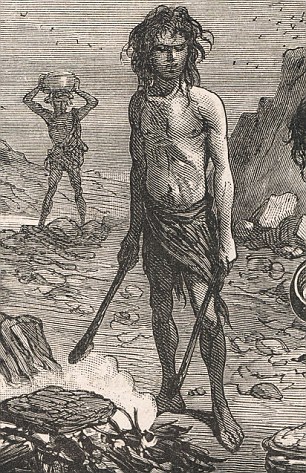
HE HAS become a byword for an unfeeling brute, but it now seems that Neanderthal Man could simply be deeply ­misunderstood.

Neanderthal Man had a sensitive and caring side, according to new research

Neanderthal Man had a sensitive and caring side, according to new research

Evidence unveiled yesterday suggests that behind that ­low-brow, sloping forehead and crudely ­jutting jaw, lurked a rather ­sensitive and compassionate soul.

Researchers said the sub-­species of modern humans, who lived in Europe and Asia between 230,000 and 29,000 years ago, were actually caring, sharing types who looked after the sick and vulnerable.

The evidence included the remains of a child with a ­congenital brain abnormality who, far from being abandoned, lived to be five or six years old because of ­nurturing.

The researchers, who used new techniques such as neuro-imaging, also cited a ­partially blind caveman with a deformed arm and feet who may have been looked after for 20 years.

Further proof that Neanderthals were committed to the welfare of others was said to lie in their long adolescence – which they could have reached only if older relatives had looked after them.

Dr Penny Spikins, who led the study byYork University’s Archaeology Department, said in the journal Time and Mind: “Compassion is perhaps the most fundamental human ­emotion. It binds us together. The archaeological record has an important story to tell about the prehistory of compassion.”

Stonehenge and Ancient Britain Tour Guide
HisTOURies UK – The Best Tours in History

Read Full Post »

Druidry has been recognised as an official religion in Britain for the first time, thousands of years after its adherents first worshipped in the country.

The Druid Network has been given charitable status by the Charity Commission for England and Wales, the quango that decides what counts as a genuine faith as well as regulating fundraising bodies.

It guarantees the modern group, set up in 2003, valuable tax breaks but also grants the ancient religion equal status to more mainstream denominations. This could mean that Druids, the priestly caste in Celtic societies across Europe, are categorised separately in official surveys of religious believers

Supporters say the Charity Commission’s move could also pave the way for other minority faiths to gain charitable status.

Phil Ryder, Chair of Trustees for The Druid Network, said it had taken four years for the group to be recognised by the regulator. “It was a long and at times frustrating process, exacerbated by the fact that the Charity Commissioners had no understanding of our beliefs and practices, and examined us on every aspect of them. Their final decision document runs to 21 pages, showing the extent to which we were questioned in order to finally get the recognition we have long argued for,” he said.

Emma Restall Orr, founder of The Druid Network, added: “The Charity Commission now has a much greater understanding of Pagan, animist, and polytheist religions, so other groups from these minority religions – provided they meet the financial and public benefit criteria for registration as charities – should find registering a much shorter process than the pioneering one we have been through.”

In its assessment of the Druid Network’s application, the Charity Commission accepts that Druids worship nature, in particular the sun and the earth but also believe in the spirits of places such as mountains and rivers as well as “divine guides” such as Brighid and Bran.

The document lists the “commonality of practice” in Druidry, including its eight major festivals each year; rituals at different phases of the moon; rites of passage and gatherings of bards on sacred hills, known as “gorsedd”.

All charities must now demonstrate their benefit to the public, and Druidry was said to qualify since its followers are keen to conserve Britain’s heritage as well as preserve the natural environment.

The document even addresses the claims made by the Romans about Druids committing human sacrifice, but finds “no evidence of any significant detriment or harm” arising from modern beliefs.

It notes that although there are only 350 members of the Druid Network, a BBC report in 2003 claimed as many as 10,000 people followed the ancient faith across the country.

Membership of the Network costs £10 a year but ritual ceremonies such as that marking the summer solstice at Stonehenge are open to all.

Stonehenge Tour Guide
HisTOURies UK.  The Best Tours in Wiltshire

Read Full Post »

Although Druids are believed to have existed throughout Celtic societies in Europe during the Iron Age, almost all the surviving evidence about them is found in the writings of later Roman authors.
Druids at Stonehenge

Julius Caesar wrote one of the first, and most detailed, accounts of Druids, explaining that along with the “knights” they were the highest-ranking orders in Gallic societies.

He said they were “engaged in things sacred” but Druids also appeared to function as judges, as they decreed “rewards and punishments” if there were murders or disputes over boundaries or inheritance.

Although they worshipped nature, Caesar claimed that Druids made human sacrifices to appease the gods including burning people to death inside “figures of vast size”, a ritual depicted vividly in the classic horror film, The Wicker Man.

Tacitus claimed the altars of Druids in Anglesey were “drenched with the blood of prisoners” while other Roman authors told how they sacrificed white bulls in groves formed of oak trees.

Pliny described Druids as “magicians” who wore white robes and used golden sickles to cut mistletoe, a sacred plant which they believed had healing powers. This description lives on in the figure of Getafix, the Druid in the Asterix books.

Druidry was suppressed during the Roman occupation but interest in it was revived in the 18th century as the ancient stone circles at Avebury and Stonehenge – which actually pre-date Druids – were examined properly for the first time.

Followers began to hold ceremonies known as “gorsedd”, where bards would gather on hills or sacred mounds, with the first held at Primrose Hill in 1792.

These events continue, particularly at the Eisteddfod celebration of traditional Welsh culture where the Archbishop of Canterbury, Dr Rowan Williams, and the former Chief Constable of North Wales, Richard Brunstrom, have both been inducted as honorary Druids and given Bardic names.

Druids hold festivals eight times a year to mark stages in the solar and lunar cycles. At the summer solstice, Druids gather at Stonehenge to greet the dawn. One of the best-known modern Druids, who has often led protests against restricted access to the site, is a former soldier who changed his name to King Arthur Pendragon.

See also ‘Stonehenge recognised as a religion in England’ October 2nd 2010

Stonehenge Tour Guide
HisTOURies UK – The Best Tours in Ancient History

Read Full Post »

Stonehenge was attracting sightseers thousands of years ago, archeologists say, after discovering the remains of a Bronze Age boy from the Mediterranean.

The teen is believed to have been part of a wealthy group that travelled 2,500 kilometres from southern Europe to Britain. He died, probably from illness, and was buried about a kilometre away while still wearing an expensive amber necklace.

The discovery of The Boy with the Amber Necklace suggests the stone circle would have been a place of pilgrimage or sightseeing as long as 4,000 years ago.

“They may have come to trade, but visited Stonehenge along the way. It would have been an awesome sight,” said Andrew Fitzpatrick, part of the Wessex Archeology team that made the find.

Stonehenge may have been a top international tourist attraction in prehistoric times – just as it is today.

Stonehenge Tour Guide
HisTOURies UK – The Best Tours in ancient History

Read Full Post »

A million visitors from around the world flock to Stonehenge every year. But the monument’s status as an international attraction is nothing new.

Yesterday scientists said the stones were attracting overseas tourists thousands of years ago – after discovering that a Bronze Age teenage boy buried there around 1550BC grew up in the Mediterranean.

The boy – aged 14 or 15 – had travelled to Britain from Spain, Italy, Greece or France, crossing the English Channel in a primitive wooden boat, they said.

He was placed in a simple grave alongside an amber necklace just a mile from the stone circle.

Known as the Boy in the Amber Necklace, his is the third burial site of a foreigner discovered at the World Heritage site in the past few years.

The finds raise the intriguing possibility that Stonehenge was attracting tourists and pilgrims from across the globe thousands of years ago.

Archaeologists have previously shown that the Amesbury Archer – a man buried with a treasure trove of copper and gold and discovered in 2002 – was born in the Alps.

They also believe that the Boscombe Bowmen – a group of seven men, women and children found the following year – originated from Wales, the Lake District or Brittany.

Professor Jane Evans, who traces the birthplace of Bronze Age skeletons using a chemical analysis of teeth, believes the visitors were travelling to Britain specifically to see Stonehenge.

‘If you went to Westminster Abbey today and looked at the people buried there, how many are Londoners?

‘I don’t think many because the great, the good and famous are buried at Westminster Abbey,’ said Prof Evans of the British Geological Survey.

The boy's skeleton was discovered in 2002.The boy’s skeleton was discovered in 2002 at Stonehenge. Today scientists revealed that he must have been born and brought up in the Mediterranean

‘Stonehenge in a similar way is obviously a very important place and people from all sorts of origins came to Stonehenge and were buried there.’

The boy’s virtually intact skeleton was discovered at Boscombe Down, a mile from Stonehenge, by Wessex Archaeology during a housing development.

The remains were radiocarbon dated to around 1550BC – a time when the monument was already more than 1,500 years old.

Prof Evans said: ‘He’s about 14 to 15 years old and he’s buried with this beautiful necklace. From the position of his burial, his age, and this necklace, it suggests he’s a person of significant status and importance.’

She used a slither of tooth enamel the size of a nail clipping to trace his origins.

BeadsThe amber beads that were found buried by his side more than 3,500 years ago

By analysing the ratio of two different forms – or isotopes – of oxygen, the professor found that the boy came from a warmer climate.

And an isotopic comparison of the mineral strontium, which is absorbed by the body from plants, revealed that he was born and grew up in the Mediterranean.

The boy's grave was alongside dozens of other graves at the site but it was the only one that was not from BritainThe boy’s grave was alongside dozens of other graves at the site but it was the only one that was not from Britain

In contrast, the Amesbury Archer, who was buried 1,000 years earlier, was most likely to have been raised in the Alpine foothills of Germany, Prof Evans said.

Mike Pitts, editor of British Archaeology, said: ‘Archaeologists for a long time have been fighting the idea that there was any migration going on at this time.

‘But, clearly, there were individuals moving across huge distances.’

The Boy with the Amber Necklace was found alongside dozens of other graves.

However, all other skeletons studied so far at the site were raised in Britain. Dr Andrew Fitzpatrick, of Wessex Archaeology, said: ‘We don’t know why these people made these long journeys.

‘It’s possible they were coming to visit Stonehenge but we know people had been travelling great distances for thousands of years for trade and exploration.’

Stonehenge was built by early Bronze Age farmers – who lived in homes made of wooden stakes, twigs, chalk and clay – in stages between 3000BC and 2400BC.

It was actively used for at least another 1,000 years.

Stonehenge Tour Guide
HisTOURies UK – The Best Tours in Ancient History

Read Full Post »

LEADING experts on Stonehenge will be gathering in Salisbury to debate the monument’s purpose next weekend.

The event, called Solving Stonehenge, is part of Salisbury & South Wiltshire Museum’s 150th anniversary conference on October 2 and 3, 2010

The main speakers will be Professor Tim Darvill, Professor Mike Parker Pearson, Mike Pitts and Julian Richards.

The debate will be chaired by Andrew Lawson.

Museum director Adrian Green said: “This is the first time that all the leading Stonehenge archaeologists have been gathered together for a public debate in recent times.

“With all their conflicting opinions about the role of the monument, and the opportunity for the public to quiz the archaeologists, this promises to be a thought-provoking event.”

There will also be a paper about recent survey work at Stonehenge by English Heritage archaeologist David Field on Saturday afternoon and a tour of the Stonehenge landscape on Sunday afternoon.

Stonehenge has been a vital part of the history of Salisbury Museum. The first official guidebook to the stones was written by former curator and director Frank Stevens in 1916.

The museum’s collections contain finds from every major excavation at the site, and since Victorian times it has had permanent displays about the monument.

Tickets for the whole conference, including a buffet, are £60 for members and £75 for non-members. Separate tickets for the Stonehenge debate are £15.

Stonehenge Tour Guide
HisTOURies UK – Bespoke Guided Tours of Ancient Britain

Read Full Post »

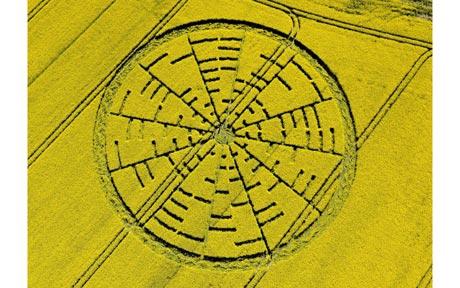
Crop circles were revealed as a hoax almost 20 years ago, so why do so many people still flock to Wiltshire, convinced of their extraterrestrial powers?

Wiltshire’s a beautiful county and it’s an idyllic Friday evening at the Barge Inn, Honeystreet. Boats are moored on the canal that runs past the pub, there’s a White Horse etched into the chalk just down the road and in the pub’s back room the ceiling is painted with images of Stonehenge, errant cherubim and crop circles. ‘It is,’ one local tells me, ‘the Sistine Chapel of Wiltshire.’

The Barge indeed is Crop Circle Central – there’s even Croppie ale for sale – and circle aficionados arrive to camp here from all over the world: in the visitors’ book Kerry from Australia has written: ‘Great crop circles! Great people!’, while Miranda and Trond from Norway say: ‘Great to be back at Croppie HQ!’ No wonder an official at the Wiltshire Tourist Board tells me that they love crop circles; together with the numinous delights of Stonehenge and Avebury Rings they’re the county’s biggest draws.

Last year was a bumper year for fantastically elaborate, large crop formations – 70 or so, many within spitting distance of the Barge and one taking three nights to fully emerge – and in early August this year, more than 45 had been reported. And, remarkably, in June the scientific journal, Nature, ran a piece on them.

They’ve certainly lured a shaven-headed David Cheeseman down from Lewisham and he’s sitting in the pub’s back room, looking at photos of recent formations.
He has, he tells me, in the past done ‘night watches’ on nearby Milk Hill, hoping to see circles emerge, and he’s even photographed much-revered-in-Croppie-circles balls of light flying around. ‘What do I think make crop circles?’ he says. ‘Well, some are man-made and some aren’t. And the ones that aren’t man-made, it’s something energetic. I can’t say it’s extraterrestrials but…’

Andreas, Doreen, Pauline and Philip – four jolly Belgians camping in the Barge’s grounds – have no such caveats. ‘We come every year for the circles,’ says Doreen, a headmistress, unzipping her hoodie to reveal a sky-blue crop circle T-shirt. ‘And we’re normal! We’re just like you!’ Up to a point; they believe the ‘Space Brothers’ make some of the circles. ‘The man-made ones have no energy. We were in one today – so vulgar. But if you go into one made by the Space Brothers, you can’t stay too long – it’s so powerful it makes you feel ill.’

Mike and Sue are camping, too, and Sue is adamant. ‘They’re all man-made. And,’ she says with a grin, ‘there’s fewer this year because of the recession; cutbacks have to be made everywhere.’ That seems a bit unfair: 45 is a decent number, but it’s true to say they’re wider spread this year – possibly, one all-too-human circle-maker tells me, because the farmers near Honeystreet were miffed by last year’s abundance.

For, yes, humans have laid claim to making almost every circle known about. But their beauty, complexity and mysteriousness are such that not everyone is persuaded that a group of soi-disant artists, moving through the fields at night with planks, tape measures and garden rollers, could create such glorious formations. Particularly when the first circle-makers to tell their tale to the media were two pint-loving sixtysomething watercolourists from Hampshire called Dave Chorley and Doug Bower.

More spiritually, they’re documented by the Wiltshire Crop Circle Study Group, whose coordinator is a charming, softly spoken French-Canadian called Francine Blake. Their office, in Devizes, is stuffy and full of papers, so we speak in the car park; Francine – wavy, white hair, dark pink top, linen trousers – is excited because a new circle has been reported near Warminster: ‘The first since 1998!’ She has been studying the circles since 1989 and moved to Wiltshire in 1991, after a particularly beautiful, highly symbolic formation appeared at Barbury Castle.

In those pre-internet days, Francine only learnt of Barbury after it had been harvested – not for nothing are circles known as ‘temporary temples’ – and that prompted her move to Wiltshire. Now she and her ‘six or so’ staff send planes up to photograph the circles, publish a magazine called The Spiral and produce ravishing calendars of the best formations. She and her colleagues have also sent off soil samples from fields where formations have appeared to Defra’s predecessor and to laboratories abroad.

She spoke, she tells me, to ‘the head scientist’ at Defra’s predecessor and ‘he explained that the composition of the soil was completely changed – completely different to the rest of the field. That it had an input of energy so powerful it can create silica out of the soil. There are only two things that can do that: one is the passage of a glacier, which is obviously not happening. And the other one is the input of heat with the magnitude of a direct bolt of lightning. And that’s several thousand degrees of heat.’

There’s more: US labs have, she says, also found that the plants ‘have been subjected to very short, very intense bursts of energy. That burst of energy – before it disperses – affects our cameras, affects our compasses, makes people dizzy, makes dogs sick – a lot of people have had that.’

Ask Francine what she gets from the circles and she replies: ‘A sense of wonder. Which is something not many people feel these days. We’re so dull, so suspicious, so limited in our way of thinking.’ She speaks, tenderly, about the beauty of the circles, of how the lain corn seems to ‘flow like water’, of how each formation teaches each person something more about the field they’re expert in: the American Indian finds a message from Gaia, the Tai Chi guru a new form of Tai Chi, the physicist – well, one physicist said to her: ‘Quantum physics? Forget quantum physics. This is far beyond.’

As for mathematics, earlier this year a formation appeared at Wilton Windmill, which seemed like Euler’s Identity, one of the most beautiful equations known to man. Alas, one mathematician pointed out that the formulation was so executed that its translation from binary code was altered from an ‘i’ to a ‘hi’, which could, the mathematician said, ‘be somebody’s idea of a joke’. Worse, the ‘h’ could be a nod to Planck’s Constant – and planks are used by human circle-makers to create their formation.

No wonder Francine is suspicious of the media, and certainly of me. ‘My hopes,’ she says, sweetly, ‘are not very high for this interview. We tend to have very inaccurate, depressingly trivial articles on crop circles.’

But at least she’ll be interviewed, unlike Michael Glickman, a long-term luminary of the circle scene, whose mathematical interpretations of the phenomena are far too abstruse for me. Instead, he lets rip with a majestic telephonic tirade. ‘The media are stupid, narrow-minded, bigoted and boringly predictable. I want nothing more than sensible treatment of the most important event on planet Earth.

‘The hoaxers are the most constant con tricksters and liars in the world,’ Glickman says. ‘They are out fundamentally to deceive; we are out fundamentally to tell the truth. Hoaxers have never made a circle of quality. We’ve seen what they can do and it’s crummy. It’s the difference between a five-star meal in Lyons and a Big Mac.’

That’s Francine’s position, too, and the Earl of Haddington’s. ‘There are greater artists at work [than the hoaxers],’ he says. ‘Indeed there are. But so many are man-made. You have to wait.’

Lord Haddington, who’s taken a keen and sympathetic interest in circles since the late Eighties, tells me he thinks all this year’s are made by man; Francine disagrees and is certain that it’s physically impossible for such work to be done in a short summer’s night. So off she directs me to a recent circle near a Saxon flint church at Chisbury.

It’s a five-pointed star, surrounded by five chevrons, 10 diamond shapes and 41 mini-circles – I’ll later read, on Crop Circle Connector, that ‘it seems to call our attention to a close conjunction between Planet Venus and the bright star Regulus in Leo’. It’s gorgeous, though better in the photo, but I don’t feel anything. And my tape recorder works.

Which doesn’t surprise Rob Irving, the main author of The Field Guide: The Art, History and Philosophy of Crop Circle Making. It was to Irving that a Wiltshire policeman uttered the immortal line: ‘I don’t want to get involved in a philosophical discussion with you, sir, but they can’t all be hoaxes.’ Irving would take issue with the word ‘hoax’ because it presupposes that there are ‘genuine’ circles, though he does think it possible that weird winds may have brought about some circles.

Irving’s a big fellow, with a bit of beard below his lip, greying hair and a black T-shirt. He’s 53 and first got involved in the Croppie scene in ‘1990, 1991’. He started to make circles, he says, ‘because people said it couldn’t be done’. He’d gone to a talk about circles and the speaker, a ‘field officer’ for the Centre for Crop Circle Studies, had said: ‘While we don’t know what’s creating circles, we know what isn’t – and it’s not humans.’ He laughs.

Soon Irving was out in the fields, with planks, tape measures, ropes, gardening poles and a diagram: ‘You make your first circle and it’s visited and probably ridiculed as being man-made. And in the space of two or three outings, you learn quickly. You go from stumbling, blind human to God-like extraterrestrial within weeks. Within weeks, you’re producing “the real thing”.’

Now he’s a poacher turned gamekeeper, occasionally doing commercial circles for the likes of Mitsubishi, but essentially an artist and doctoral researcher into art and the landscape, which is, partly, what he sees crop circles as being about. As to their originators, Irving says, tongue only half in cheek, Doug Bower is ‘the greatest artist of the 20th century – or the most provocative’.

Doug Bower? Well, it was he and Dave Chorley who swirled the first crop circle, back in 1976, after a few drinks at the Percy Hobbs, at Cheesefoot Head, near Winchester. They’d been talking about UFOs and the books by Arthur Shuttlewood, a journalist on the Warminster Times, about UFOs over Warminster and what his paper called the ‘Warminster Thing’. Might it not be fun, they thought, to swirl some UFO landing pads of their own?

So, first with iron rods and then with plank stompers, a loping stride and a circular wire sight dangling from Doug’s cap, they started off. They kept it up for four years, barely creating a ripple of interest. Then the Wiltshire Times ran the headline: ‘Mystery circles – the return of “The Thing”?’

Cerelogogy, as crop circle study became known, was born. One researcher attributed the phenomenon to ‘plasma vortices’ – essentially wind effects that produced the swirling; and as Doug and Dave expanded their repertoire to incorporate straight lines and pictograms, so did the plasma vorticist expand his thesis. Others embraced more esoteric explanations, such as psychokinetic downloading from the collective unconscious, UFOs and higher intelligences. And the number of circles grew and grew, many of them 30 miles from Doug and Dave’s patch, and highly complicated. Doug and Dave were clearly not alone.

Still, it was Doug and Dave who went public in 1991: Doug told television cameras that there was nothing like being in a field of English corn at two in the morning, after a few pints and some cheese rolls, stomping corn.

Interestingly, the ITN report on their self-disclosure said: ‘This doesn’t mean all the circles are fake. After all, one counterfeit coin doesn’t make all coins counterfeit.’ And, among some devoted cerelogists, it became accepted wisdom that 80 per cent were man-made and 20 per cent ‘genuine’.

But a display of circle-making by a team of young engineers who won the 1992 International Crop Circle Making Competition was a revelation to the maverick biologist, Rupert Sheldrake: ‘For flattening the crop, they used a roller consisting of a piece of PVC piping with a rope through it, pushing it with their feet. To get into the crop without leaving footprints, they used two lightweight aluminium stepladders with a plank between them, acting as a bridge. For marking out a ring, they used a telescopic device projecting from the top of an aluminium stepladder. A string was attached to the end of it in such a way that by holding the string and walking in a circle around this central position a perfect ring could be marked out without leaving any trace on the ground in the middle.’ That’s complicated kit.

Mark Pilkington, a writer and publisher who helped with some of the more beautiful and complex late Nineties/early Noughties formations, talks of teams of three or four, using only the planks et al. It is, he says: ‘Physically and mentally hard work. Even after a modest job, you’re flat out. It’s often disorienting. I’ve worked on formations and when I’ve seen the photographs afterwards, I’ve thought: “Bloody hell! How did we do that?” ’

The designs are marvellous: perhaps it’s no wonder that, as Pilkington says, some cerelogists believe human ‘circle makers are channels for a greater force and that some formations are made by divine intervention’. Certainly, when Pilkington has told people what he’s done, he’s got into near fights: people want to believe. Such antipathy has gone to extremes: according to one of their number, one group of circle-makers had ‘potatoes stuck up their exhausts, wing mirrors ripped off our cars and threats of violence’.

Irving thinks people want to take ‘a vacation from rationalism’. And, he adds, it’s particularly the case that ‘people associate certain landscapes with legends. That’s why circles come to sacred sites: Avebury and Stonehenge galvanise this idea of mystery. I see it as a feedback route: people go to a certain place with certain expectations. Then something happens and they leave satisfied.’

It’s to sustain the mystery, he says, that circle-makers never claim authorship of a particular circle: ‘In our culture, art is all to do with artists: it’s about whodunit, not about what art does. With the circles, it’s about the effect they have on people.’

On the afternoon I meet him at the Barge Inn, Irving finishes his pint of Croppie and takes me to see what he classifies as ‘a schematic plan of a set of cruciform solids’ – or a formation that looks from above like a cross-hatched 3D image that reminds Irving of a pharmacist’s sign. It’s on Cley Hill, near Warminster, and in its middle are a collecting box (suggested fee £2) and a plastic folder containing an aerial photo and a copy of the Crop Circle Etiquette Guide. Irving nods appreciatively: ‘They’ve gone the extra mile. Normally, this would be set in a circle, but they’ve gone to the trouble of putting an outline round the thing.’

We move back towards my car. A couple appears and the woman asks if we’ve been at the circle. They’re Inga and Erik, and they’re Dutch, over here to look at circles. They were at Chisbury yesterday, and it was perfect: they’re very keen to see the Cley Hill formation. And what, I ask, do they think brought the circles into being?

Inga smiles, knowingly. ‘You mean, are they man-made, or not?’ She smiles again. ‘That’s mystic: that’s a mystery.’ And off they go, ready for a sense of wonder.

There are still some crop circles to view in the Wilthire area and Histouries UK will continue to offer private ‘crop circle’ tours.
Seeing is believing – the main crop circle saeson kinks off on May 2011 and contimues through to September 2011.  Why not join a guided tour of Stonehenge and Avebury and experience a ‘real’ crop circle for yourself.

HisTOURies UK – The Best Tours of Wiltshire
Wessex Tour Guide
Read Full Post »

If you are heading northwards into Shakespeare country independantly, choose the route the Bard himself would have travelled.  Stratford-upon-Avon from Chipping Norton through chocolate box Olde England

The Rollwrights

When Shakespeare made his way from London to the family home in Stratford-upon-Avon, it is safe to assume he did not shove his quills in the boot of a Vauxhall Astra and tear along three lanes of tarmac. No.

The M40 is hardly a journey fit for the Bard and – anachronisms aside – the road he would have taken after Oxford is the current A3400.

On the map it looks fairly unremarkable: the names of the villages it passes through are not well known; the countryside is not national parkland, and there are few sites you would find in a guidebook to Britain. Yet the journey through the Cotswolds is unrivalled for capturing the kind of rural England not often seen outside E H Shepard illustrations. If there was one road on which to dump a Japanese tourist in search of that long-lost lid-of-the-biscuit-tin scene, this is it.

The road begins as a branch from the A44 just outside the market town of Chipping Norton. Though the A3400 continues northwards beyond Stratford, we will focus on the first stretch, which would have made up the final hours of the Bard’s commute from London. If you want to make the journey from London, turn off the M40 at junction 10 and follow signs to Chipping Norton – a market town that is well worth stopping in, despite it being home to Jeremy Clarkson.

Within a few minutes of beginning the road, a stone sign reads “Cotswolds: area of outstanding natural beauty”. Then as if on cue, the countryside unfurls itself in front of the road, a cliché of English charm. Even the forecourt shop at the Shell garage is built in the warm yellow of Cotswold limestone.

It is easy to miss the road’s first notable landmark, but it is worth studying the map to make sure you don’t. The Rollright Stones – otherwise known as the Stonehenge of Oxfordshire – are not signed from the road, but lie just next to it. After three miles of the A3400, you will find a small turn-off to the village of Little Rollright – the stones are just a few hundred yards down this turning, hidden behind a rather unpromising-looking layby. Far from the fenced off slabs at Stonehenge, this Neolithic site is completely unguarded, allowing you to see it almost in its original setting. The most impressive of the ancient monuments is The King’s Men, a ceremonial stone circle dating from 2500BC.

Back on the road, it is now time to cross a county border, an event which is worth noting, if only because – unlike Oxfordshire – Warwickshire has not taken pity on its motorists and turned off its speed cameras. Soon after, you reach Long Compton, a village which, as its name suggests, is the longest in the Cotswolds. If you have been driving from London, this is an ideal spot to stop and eat, firstly because it has a fine gastro pub and a farm shop selling delicious home-made rolls, but also because it’s a picturesque place to stretch your legs.

The road continues through the village until you reach Long Compton’s church, St Peter and St Paul on the left. The 13th-century building boasts a unique lychgate which has a small room above it, giving it the look of a tree-less treehouse.

The next big place is Shipston on Stour. This market town, built around a pretty cobbled square, has seen better days. It is worth a stop, however, if you have a fondness for the kind of shops rendered redundant elsewhere. Expect to find bric-a-brac shops with genuine antiques next to rather threadbare Paddington Bears and broken teapots; hardware stores that still sell nails by the nail, and window displays that have the owner’s dog wandering through them.

After Shipston, the road reverts to small villages and fields. Hedgerows and small farms pass by on either side, punctuated by “tractors turning” signs, stone walls so neatly tessellated they have made concrete superfluous and shut-looking farm shops. The prettiest of these villages is Newbold on Stour, which still has its traditional pub, village green and bowls club and is the kind of village that – from the outside at least – seems to have been unblemished by the designer welly brigade.

A couple more miles later you reach the River Avon. Crossing over it on a bridge flanked by armies of swans and barges, the Royal Shakespeare Company’s theatre comes into view – now you are officially in Shakespeare country.

Bespoke Guided sightseeing tours
Needless to say, we feel the best way to explore the Cotswolds is to arrange a private tour.  Your own vehicle and expert local guide!   This can often be cheaper than the larger more in-personal coach tours and offer greater flexibility.

British Tour Guide
HisTOURies UK – The Best Tours in British History

Read Full Post »

Later Silbury – Archaeological evaluation of the fields south of Silbury Hill, Wiltshire.

This project aims to evaluate the Roman settlement in the fields south of Silbury Hill, to improve our understanding of a poorly-understood phase of activity around the monument and to provide information to help with its future care within the Stonehenge, Avebury and Associated Sites World Heritage Site.

English Heritage’s Silbury Hill Conservation Project started in 2001, following a series of collapses within the Hill. In 2007, and research and rescue excavation stabilised the Hill and consolidated it for the future.

As part of the Conservation Project, English Heritage’s Geophysical Survey team carried out extensive surveys of the fields around the monument. You can read a summary of their results in Research News (Issue 10: Winter 2008-09, pages 10-13).

In the large field south of the A4 – a Roman road – extensive evidence for archaeological features shows clearly in the magnetometer survey, and ground-penetrating radar has added the details of several large stone buildings to the picture.  We think that this is a Roman roadside settlement or small town. Roman activity around Silbury has been known since the 19thcentury, when wells and middens were excavated. In the 1990s, air photographs and excavation provided new evidence for stone buildings set along a trackway on the slopes of Waden Hill, east of Silbury.

Being able to see the layout of an extensive settlement was a new and exciting discovery. It has raised many questions about the area around Silbury Hill and how it was used in the Roman period – and many of these can only be answered by excavation.

So this summer, as part of the new Later Silbury project, archaeologists and archaeological scientists from our Research Department based at Fort Cumberland are excavating some evaluation trenches in the fields south of the Hill.

We aim to: 

  • Understand more about the settlement itself – what activities can we find evidence for? When was it occupied? Is there any evidence for its ritual or religious role?
  • Investigate its relationship to Silbury Hill and surroundings – how did it fit in with the ritual landscape of Silbury Hill and Avebury, more than 2000 years after they were built?
  • Find out more about the past environment and use of the landscape around the hill and in the Winterbourne and Kennet valleys.
  • See how well the archaeological remains survive, and how deeply they are buried – this will help plan the management of the site and its safe preservation.
Silbury Hill

Silbury Hill

Silbury Hill is huge; it is likely to have involved roughly 4 million man-hours of work and 500,000 tonnes of material.

The largest man-made mound in Europe, mysterious Silbury Hill compares in height and volume to the roughly contemporary Egyptian pyramids. Probably completed in around 2400 BC, it apparently contains no burial. Though clearly important in itself, its purpose and significance remain unknown. There is no access to the hill itself.

It is part of the Avebury World Heritage Site.

Stonehenge and Avebury Stone Circle Tour Guide
HisTOURies UK Tours – Bringing History alive

Read Full Post »

« Newer Posts - Older Posts »