Feeds:
Posts
Comments

Archive for the ‘stone circle’ Category

Streaking down towards Stonehenge across the path of all the other stars in the sky, this shooting star is hurtling to Earth at 135,000 miles per hour – 100 times the speed of Concorde.

The smaller, diagonal lines on the photo are normal stars, with the long-exposure photography tracing their movement in the sky as Earth revolves.

The longer, almost vertical streak of light is the shooting star, which stems from grains of dust left behind by the comet Swift-Tuttle as it sweeps through space.

A meteor streaks past stars in the night sky over Stonehenge in Salisbury Plain

A meteor streaks past stars in the night sky over Stonehenge in Salisbury Plain.  More personal photos will be uploaded later this week.

Stonehenge Tour Guide
HisTOURies UK – Guided Tours of Stonehenge Stone Circle

Read Full Post »

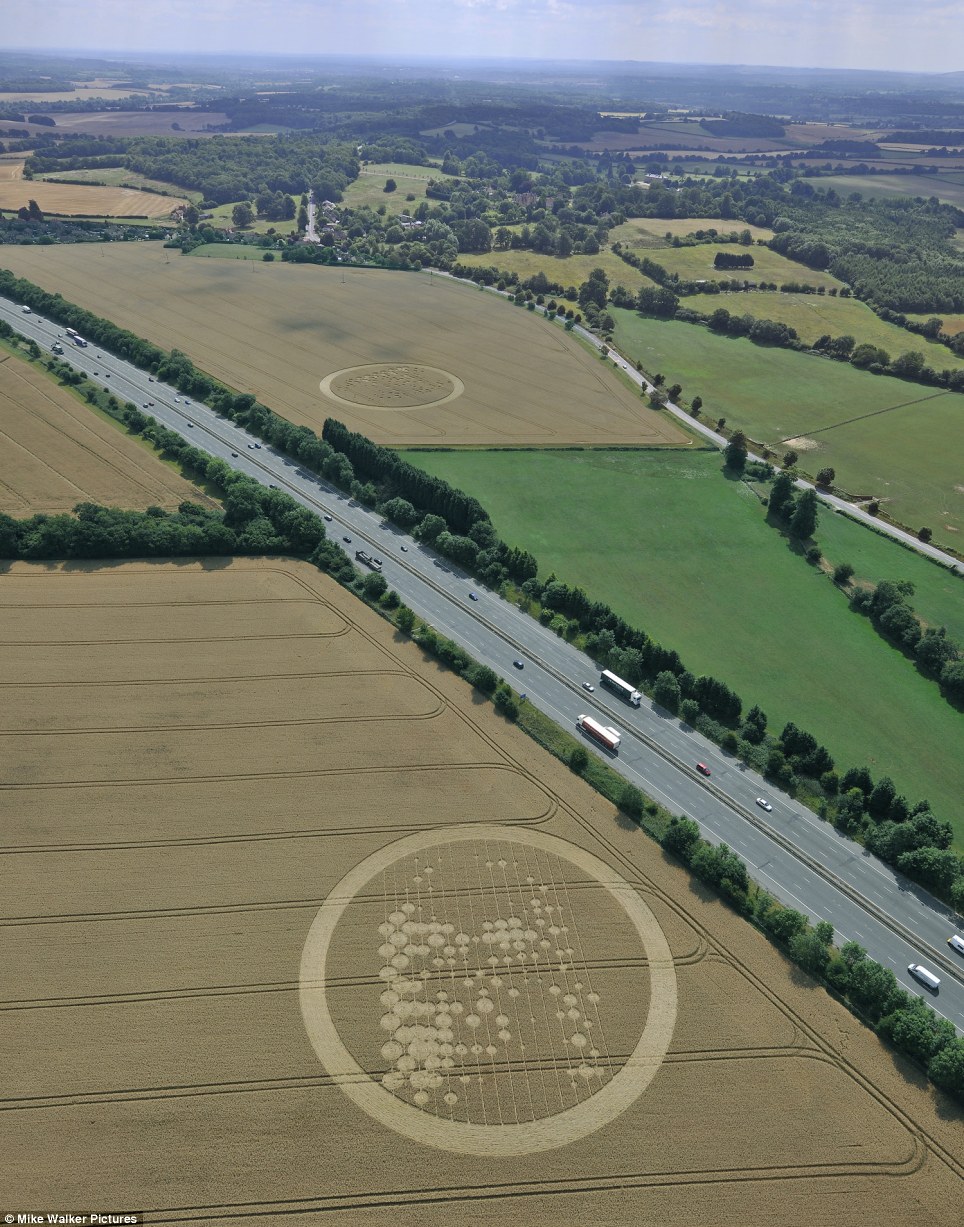
Drivers speed along one of Britain’s busiest motorways completely oblivious to the Holy presence that surrounds them.
Crop Circle
For two crop circles depicting the face of Jesus Christ have appeared on either side of the M4 near Hungerford in Berkshire.
The two almost identical circles, both 250ft in diameter, seem to portray Jesus Christ in an image resembling the world famous Shroud of Turin.

The two crop circles in fields of wheat either side of the M4 near Hungerford, Berkshire, both resemble the face of Jesus Christ in the world famous Shroud of Turin

The Shroud of Turin is believed by many to be the cloth used to cover Christ at the time of his burial and the face on the shroud is believed to be the face of Jesus himself.
Crop circle expert, Karen Alexander, said: ‘These circles are causing quite a stir in the crop circle community. The last time a face appeared as a crop circle was in 2002 when an alien face appeared at Sparsholt in Hampshire. Farmers whose land is used to make the circles worry that they will be inundated with visitors seeking a religious experience.’
But with the Harvest Festival approaching, they may regard the crops in the fields of wheat as a good omen.

Crop Circle Tour Guide
HisTOURies UK – The Best Tours in Wessex

Read Full Post »

Stonehenge - a wooden neighbour has been discovered
 Stonehenge – a wooden neighbour has been discovered

Stonehenge had a previously unknown wooden “twin” just 900m to its north-west, according to remarkable new archaeological investigations.

Using the ground-penetrating equivalent of an X-ray, scientists have discovered what appears to have been a circle of massive timber obelisks, constructed more than 4,200 years ago.

The newly discovered “henge” would have been visible from Stonehenge itself – and seems to have been part of a wider prehistoric ritual and religious landscape. Roughly 25m in diameter, it was almost the same size as the central part (the circle of standing stones) at Stonehenge itself.
The newly discovered monument – almost certainly some sort of Neolithic temple – is thought to have consisted of 24 wooden obelisks, each around 75cm in diameter and therefore potentially up to 8m high. The circle of obelisks was enclosed by an inner ditch and probable outer bank.

 Of potential significance is the fact that the newly found henge “mirrors” a similar monument (this time long known to archaeologists) on the other side of Stonehenge – 1,300m south-east of the famous monument. Like the newly discovered site, it is in direct line of sight of Stonehenge and had two entrances. All three monuments would have been roughly aligned.

 The discovery of the site north-west of the stone circle suggests that the Stonehenge landscape was even more complex than people have thought – and archaeologists are now keen to find further unknown elements of it.

The archaeologists – from Birmingham, Bradford, St Andrews and Vienna Universities – are trying to map the unknown aspects of the Stonehenge landscape without digging a single hole.

Instead of conventional excavations, they are using X-ray-style systems which look beneath the ground surface. The techniques – including magnetometry, ground-penetrating radar, electrical imaging and resistivity – are likely to yield huge amounts of previously unknown information about what the Stonehenge landscape looked like 40 to 50 centuries ago.

 Over the next four years the survey, led by Professor Vince Gaffney of Birmingham University’s Institute of Archaeology and Antiquity, is likely to produce hundreds of millions of pieces of information from 14 sq km of countryside which will then be collated and analysed to produce a detailed map.  “Some 90 per cent of the Stonehenge landscape is still terra incognita. Our survey will hopefully begin to remedy our current lack of knowledge,” explained Professor Gaffney. “The discovery will significantly change the way we think about the landscape around Stonehenge.”

 The newly discovered prehistoric temple was found using the subsurface archaeological detection system known as magnetometry, which measures the differences in interaction with the Earth’s magnetic field produced by different layers or deposits of earth or rock.

 Detecting variations in the strength of the magnetic field revealed the existence of the enclosure ditches and the pits believed to have held the timber obelisks at the newly discovered henge.

 Stonehenge Tourist Guide
HisTOURies UK – Stonehenge Guided Sightseeing Trips

Read Full Post »

SALISBURY will be the talk of the art world next year when a John Constable exhibition is staged at the city’s museum.

The summertime show is being organised to mark the 200th anniversary of the artist’s arrival in Salisbury. His visits to his friend John Fisher, the then Bishop of Salisbury, are widely accepted as inspiring some of his greatest paintings.

The Constable & Salisbury exhibition will see a multi-million pound collection brought together from both private owners and major art museums.

A final list of Constable’s paintings is still to be confirmed, but the show starting in May next year will include some of the artist’s most important work including several depicting the cathedral and the Harnham Water Meadows.

Richard Morgan, who has led a committee of art enthusiasts in developing the project, announced the three-month exhibition this week.

“This will be a 50-piece collection never seen before. It is work that will be gathered from the leading British galleries and others including the Fitzwilliam in the USA, National Gallery Washington and the Louvre in Paris.”

He was guest speaker at a garden party held by Salisbury law firm Wilsons in the grounds of the museum.

Mr Morgan added: “Museums can change places, just as we have seen in Liverpool and St Ives, and we are planning great changes in this museum.”

He said thanks in part to funding from the English Heritage Lottery Fund they hoped to radically change Salisbury Museum and the Constable exhibition was part of this.

Stephen Oxley, senior partner at Wilsons, said his firm had a tradition of supporting the arts in the city and they were delighted to be a sponsor of this project. “We have worked with the museum and its people for many years and when they approached us in 2008 with an idea from Lord Congleton to put on an exhibition, the likes of which had never been done before, we jumped at the chance to be involved.”

Adrian Green, director of Salisbury Museum, said: “It is almost impossible to view Salisbury Cathedral without thinking of Constable, therefore it is surprising that there has never been a major exhibition of his work in the city.

“As an archaeologist I particularly find Constable’s lesser known views of Old Sarum and Stonehenge evocative. One of Constable’s final exhibits at the Royal Academy was a magnificent watercolour of Stonehenge, shown there in 1836, which will be a major highlight of the exhibition for me.”

Salisbury Tour Guide
HisTOURies UK – The best tours of Salsibury, Stonehenge and Wessex

Read Full Post »

An image detailing the new 'henge'
Archaeologists say the find is “exceptional”

Archaeologists have discovered a second henge at Stonehenge, described as the most exciting find there in 50 years.

 The circular ditch surrounding a smaller circle of deep pits about a metre (3ft) wide has been unearthed at the world-famous site in Wiltshire.

 Archaeologists conducting a multi-million pound study believe timber posts were in the pits.

 Project leader Professor Vince Gaffney, from the University of Birmingham, said the discovery was “exceptional”.

 The new “henge” – which means a circular monument dating to Neolithic and Bronze Ages – is situated about 900m (2,950ft) from the giant stones on Salisbury Plain.

It’s a timber equivalent to Stonehenge”

 End Quote Professor Vince Gaffney University of Birmingham

Images show it has two entrances on the north-east and south-west sides and inside the circle is a burial mound on top which appeared much later, Professor Gaffney said.

 “You seem to have a large-ditched feature, but it seems to be made of individual scoops rather than just a straight trench,” he said.

 “When we looked a bit more closely, we then realised there was a ring of pits about a metre wide going all the way around the edge.

 “When you see that as an archaeologist, you just looked at it and thought, ‘that’s a henge monument’ – it’s a timber equivalent to Stonehenge.

 “From the general shape, we would guess it dates backs to about the time when Stonehenge was emerging at its most complex.

 “This is probably the first major ceremonial monument that has been found in the past 50 years or so.

 ‘Terra incognita’

“This is really quite interesting and exceptional, it starts to give us a different perspective of the landscape.”

 Data from the site is being collected as part of a virtual excavation to see what the area looked like when Stonehenge was built.

 Speculation as to why the 4,500-year-old landmark was built will continue for years to come, but various experts believe it was a cemetery for 500 years, from the point of its inception.

 In 2008, the first excavation in nearly half a century was carried out at the iconic site on Salisbury Plain.

 This latest project is being funded by the Ludwig Boltzmann Institute for Archaeological Prospection and Virtual Archaeology, in Vienna, and the University of Birmingham, and is assisted by the National Trust and English Heritage.

 Professor Gaffney said he was “certain” they would make further discoveries as 90% of the landscape around the giant stones was “terra incognita” – an unexplored region.

 “The presumption was this was just an empty field – now you’ve got a major ceremonial monument looking at Stonehenge,” he said.

 Stonehenge Tour Guide
HisTOURies UK – The Best Tours in British History

Read Full Post »

A dwelling, thought to be 4,500 years old, has been discovered by archaeologists in Wiltshire.

S
 “It looks as if we have a Neolithic building. We’re talking about four and a half thousand years old – so about 2400 or 2500BC.

Excavation work at the prehistoric site of Marden Henge, near Devizes, started three weeks ago and experts say the find has “exceeded expectations”.

 Marden Henge no longer has any standing stones and is said to be one of Britain’s least understood ancient sites.

 The work is scheduled to last for three more weeks.

 Archaeologist Jim Leary, from English Heritage, said: “It’s absolutely fabulous. It’s exceeded all of our expectations.

I don’t think we’re looking at a normal house. I think we’re looking at something equivalent to a priest’s quarters.””We have some wonderful finds coming up and some very fresh looking flint flakes and some pieces of pottery, but far and away the most exciting find so far is over in trench C.  – English Heritage

 “Up until a few years ago it would have been unique but a couple of years ago archaeologists were digging at Durrington Walls and they found a number of these buildings.

 “I don’t think we’re looking at a normal house. I think we’re looking at something equivalent to a priest’s quarters.

 “We do seem to have a hearth and it seems that whoever lived there was a very clean person and regularly cleaned out the hearth.

 “Just outside the front door we can see this long spread of charcoal and general rubbish material.

“It contains really good fresh flint flakes, pottery, bone pins – things that don’t normally survive on archaeological sites. We’re getting a really good insight into life in that building.”

 Stonehenge Tour Guide
HisTOURies UK – The Best Tours Wiltshire

Read Full Post »

« Newer Posts