Feeds:
Posts
Comments

Archive for the ‘Stonehenge’ Category

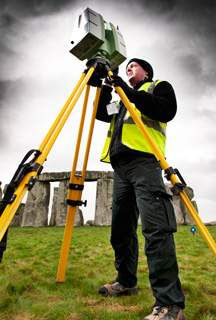
STATE of the art technology is being used to create the most accurate digital model ever of Stonehenge English Heritage is using a combination of modern 3D laser scanning and digital imaging technology to survey every inch of every stone that makes up the prehistoric monument.

The survey includes all the visible faces of the standing and fallen stones of Stonehenge, including Station, Heel and Slaughter stones, as well as the top of the horizontal lintels which have never before been surveyed at this level of detail.

Despite the vast amount of archaeological activity and academic study into Stonehenge and its landscape over the centuries, relatively little is known about the lichen-covered surfaces of the sarsens and bluestones that make up the stone circle.

The availability of high resolution laser scanners that can produce highly accurate surface models means that it is now possible to record details and irregularities on the stone surfaces down to a resolution of 0.5mm. It is also hoped that secrets hidden underneath the thick cover of lichens may be revealed in the analysis using sophisticated software.

The study serves a number of purposes. It will provide precise base-line data to monitor the physical condition of the monument which is subjected to daily weathering.

Digital data of this unprecedented level of detail will also be a valuable resource to anyone who is tasked with producing reconstruction models, drawings and computer generated images of the monument for public understanding and interpretation, including the English Heritage interpretation team who is working on the new displays of the proposed visitor centre.

Understanding of the known Neolithic “dagger” and Bronze Age carvings as well as modern graffiti carvings might also be enhanced, and new ones might be discovered.

Dave Batchelor, English Heritage’s Stonehenge archaeologist, said: “The surfaces of the stones of Stonehenge hold fascinating clues to the past. They are like manuscripts, a whole palimpsest of the ideas, efforts and idiosyncrasies that marked the lives of people over millennia. I look forward very much to seeing what we are about to find.”

http://www.english-heritage.org.uk/about/news/stonehenge-in-high-definition/

Stonehenge Tour Guide
HisTOURies UK – The Best Tours in British History

Read Full Post »

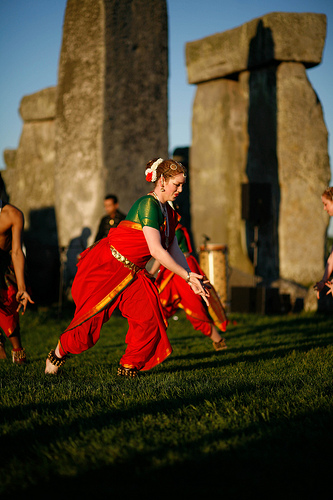
The Festival returns in 2011 with a packed programme of theatre, dance, circus, film, music and spoken word in locations around the historic city.

On the Festival’s opening night the sky becomes a stage in a performance by world famous Argentine company Voalà.The programme also includes a new music commission, WhereTwo Worlds Touch; outdoor performances of classic Shakespeare;and a performance by Jasmin Vardimon Company.

Read Salisbury International Arts Festival Brochure 2011 – Download

This year’s programme will reflect a focus on the themes of China, Dance and Air, and events will take place across the region in locations as diverse as Salisbury Cathedral, Old Wardour Castle and Stonehenge.

Background to Salisbury Festival
The Festival blazed into life in July 1973. Since then, over a million people have enjoyed outstanding performances of theatre, dance, film and every kind of music, plus literary events and the visual arts. From mid-May to early June each year, the beautiful historic city of Salisbury is transformed as people flock to the Festival, enjoying both ticketed events and free performances

If you are in the UK during May and June this year why not come and stay in Salisbury during this wonderful event.  Even take a tour to Stonehenge ?

http://www.salisburyfestival.co.uk/

Stonehenge and Salisbury Tour Guide
HisTOURies UK – The Best Tours in Wessex

Read Full Post »

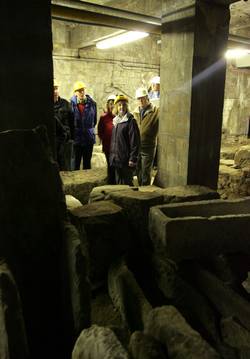
A chance to go ‘behind the scenes’ at the Roman Baths Museum.

Roman Bath Tunnel Tours

The tour includes

·        The main museum stone store with material dating from Roman to Victorian times from all parts of Bath and the surrounding area

·        The King’s Spring Borehole supplying water to the Pump Room and the new Thermae Bath Spa buildings

·        Georgian vaults under Bath Street and the water pipe that supplies the spa

·        Rooms of the Roman bath house not on public display, including the unusual circular laconicum

·        The chance to handle some of the items which have been excavated in Bath and are now stored in the various vaults.

Although we do walk through most of the public areas of the site we do not stop in them and visitors are advised to visit them before or after the tunnel tour, during the normal public opening hours

A chance to look ‘behind-the-scenes’ at the stores of the Roman Baths Museum. See and handle objects in the reserve collections and find out why and how they care for them. 
Visit the vaults around the Roman Baths. See parts of the Roman Baths and temple not on public display and discover the hidden Georgian and Victorian history of the site. Numbers are strictly limited so advance booking is necessary on 01225 477779

http://www.romanbaths.co.uk/

The Roman Baths is one of the largest tourist attractions in South West England. Find out more about charges, opening times and the facilities that we offer at the Roman Baths in the links to the left. Please allow at least 2 hours to get the most from your visit.  Bath is often combined with a day trip to Stonehenge and the Cotswolds from London.  A private guided tour allows over 2 hours in Bath rather than the 45 minutes many coach operators allow.

Stonehenge and Bath Tour Guide
HisTOURies UK – The Best Tours in History

Read Full Post »

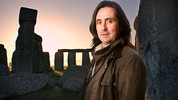
Neil Oliver tells the epic story of how Britain and its people came to be over thousands of years of ancient history – the beginnings of our world forged in ice, stone, and bronze.

About the Programme

A History Of Ancient Britain will turn the spotlight onto the very beginning of Britain’s story. From the last retreat of the glaciers 12,000 years ago, until the departure of the Roman Empire in the Fifth Century AD this epic series will reveal how and why these islands and nations of ours developed as they did and why we have become the people we are today. The first series transmits in early 2011 and there will be a following series in 2012.

As well as being a presenter, Neil is also an archaeologist, historian and author. He began his television career in 2002 with the BBC2 series ‘Two Men in a Trench’. This battlefield archaeology series explored iconic British battle sites, focusing on human stories, tragedies and drama.

Neil became a familiar face on television thanks to the hugely popular, award winning programme, ‘Coast’, in which the landscapes, history, geography and people of the British Isles are given centre stage in a continuing voyage of discovery, remembrance and reminiscence.

Neil also presented ‘A History of Scotland’ on BBC 1 and BBC2. In this series he revealed how the story of his native Scotland is instrumental to the history of, not only Britain, but also Europe and much of the wider world.
Neil Oliver takes us on an epic journey expoloring how Britain and its people came to be.
Watch the trail here
Neil Oliver’s official website

Stonehenge and Ancient Britain Tour Guide
HisTOURies UK – The Best Tours in History

Read Full Post »

The Hero Walk – In support of our wounded – 26th June 2011
The Hero Walk is a very tough challenge over the high chalk downs and ridge ways of Wiltshire and Salisbury Plain. At 26 miles it forms a marathon for runners and a great challenge for walkers. This challenge is a diverse trek over marathon distance, going back through 6,000 years of British history; the magnificent prehistoric stone circles of Avebury and Stonehenge need little introduction. The challenge will start in Avebury, where we will be able to get up close to the ancient stones before heading off via the mysterious ancient landmark of Silbury Hill. Silbury is the tallest man-made mound in Europe, however its purpose is still unknown.

Stonehenge - Avebury walk 2011

Stonehenge - Avebury walk 2011

We will then cross the spectacular chalk downs dotted with ancient earth-works, burial mounds and get up close to the enigmatic white horses carved into the chalk. In clear weather we will be able to see more here, as views of other valleys open up to us. The route takes in the highest point in Wiltshire (295m) and travels through the most active crop circle area in the world – keep your eyes open!

Crossing into MOD land you will either walk (or run!) through stunning areas little used by the general public, that have become a haven for wildlife and plants. Our route continues to undulate but the main hills are behind us and we start to anticipate the finish line at the World Heritage Site of Stonehenge. A short section of quiet road is a sign that we are nearing civilisation, and before long the world-renowned ancient circle of stones looms on the horizon before us. There is then time to celebrate with fellow walkers and runners before returning home. We look forward to seeing you there!

Avebury to Stonehenge Hero Walk 2011 Itinerary . . .

The 26-mile walk will take approximately 8-9 hours for fit and strong walkers. Our day starts at Avebury, which lies at the centre of one of the greatest surviving concentrations of Neolithic and Bronze Age monuments in Western Europe. We’ll enjoy Avebury’s magic in the quiet of the early morning before heading via the Silbury Hill.

Help for Heroes 
Help for Heroes

Dropping down into the village of Alton Barnes, we follow the Kennet and Avon canal east. From there we head south and join the White Horse trail to the Pewsey White Horse from where we have fabulous views of the surrounding chalk landscape. We descend the hill and continue along the trail to the Kennet and Avon Canal; this is a fabulous example of industrial revolution engineering. Crossing into MOD land we will either walk (or run!) through stunning areas little used by the general public and a haven for wildlife and plants. After this long day of great views and leg-stretching hills we will reach the final destination: Stonehenge, the most famous stone circle in the world.

DONATE NOW – CLICK HERE
REGISTER ONLINE
http://www.helpforheroes.org.uk/challenges-2011-avebury-stonehenge.html

Proud Sponsors
HisTOURies UK – The Best Tours of Wiltshire

Read Full Post »

Filming in Wiltshire

Wiltshire is a perfect loction for film and television productions. Working with South West Screen, VisitWiltshire and Wiltshire Council seek to encourage new productions and film making in the area, making it a very ‘film friendly’ part of England. Film Friendly

Wiltshire is a favourite with filmmakers, taking centre stage in a whole range of productions from swashbuckling adventures to Jane Austin classics. Wiltshire continues to be popular with television and film crews, making an ideal location for anything from traditional period dramas to gothic horror films featuring Hollywood stars.

The county was used as the backdrop in productions such as The Wolfman, Harry Potter and the Half Blood Prince and Creation, as well as TV series such as Lark Rise to Candleford and Tess of the D’Urbervilles.

Wilton House (photo: Will Pryce)Anyone who enjoyed the cinema version of Pride and Prejudice, starring Keira Knightley and Matthew Macfadyen, will recognise not only Wilton House – which doubled as Pemberley, the family seat of Mr Darcy – but also the magnificent gardens at Stourhead, where Lizzie initially rejects his proposal of marriage.

Filming The Young Victoria at WiltonThe film on the life of Queen Victoria: Momentum Pictures’ The Young Victoria, features Wilton House. Wilton was used to double for Rosenau Castle, Prince Albert’s Coburg and Buckingham Palace.

The National Trust’s Mompesson House in Salisbury’s Cathedral Close achieved celebrity status as the London home of Mrs Jennings in the 1995 Oscar-winning version of Sense and Sensibility, when the leading parts were played by Emma Thompson, Kate Winslet and Alan Rickman. Wilton House’s Double Cube room was also used for ballroom scenes in the film.

Channel 4's Team Team at Salisbury Cathedral
Salisbury Cathedral took centre stage in the TV production of Mr Harvey Lights a Candle and Old Wardour Castle experienced some modern-day drama when it was used for the filming of Robin Hood, Prince of Thieves, while other starring roles have been played by Breamore House and Church (Thomas Hardy’s The Woodlanders); Heale House (The Portrait of a Lady) and Houghton Lodge (The Buccaneers and Agatha Christie’s Murder at the Vicarage).

Stonehenge is an iconic location – used in the BBC production of Tess of the D’Urbervilles; the lake at Fonthill Bishop was used in the film Chocolat, and Trafalgar House near Salisbury has been used for several films including Amazing Grace.

Filming Cranford at LacockThe village of Lacock, with its cottages and inns dating back to the 15th century was the backdrop to the recent BBC production of Cranford. The village is much admired by film makers; the National trust village and nearby Abbey has played host to a variety of classic films and costume dramas including Pride and LacockPrejudice, Harry Potter and the 2008 film production of The Other Boleyn Girl.

Castle Combe has been called the “prettiest village in England”. A favourite with film makers this stunning village is located at the southern tip of the Cotswolds. The village has played host to many filming productions, the most famous of these being Doctor Doolittle filmed in and around the village in 1966, and recently the village had a major role in Stardust and The Wolf Man.

Lark Rise to Candleford (photo: BBC)Pride and Prejudice was also filmed at Luckington Court, Chippenham, the BBC Tess of the D’Urbervilles was also filmed in Corsham, Walk Away and I Stumble for ITV was filmed in Calne and Chippenham, and North Wiltshire is also the location for the BBC’s Lark Rise to Candleford. The unspoilt streets of  Bradford on Avon make the town a perfect location for films. Scenes from the Charles Darwin biopic, Creation, were filmed in the town.

Longleat house and safari park has been used for a number of film productions and is the location for the BBC’s Animal Park.

Wiltshire also has more unusual film locations: aircraft hangars and runways at Kemble and Hullavington, and with such a big presence on Salisbury Plain, the British Army has many locations available for filming. Swindon provides a useful urban location a short distance from London along the M4 motorway or by train, the STEAM railway museum and designer shopping village provides hstorical and contemporary locations. Swindon has been used as a backdrop for film, television drama and advertising. Norman Foster’s Renault building in West Swindon appeared in the James Bond film A View to a Kill and the Motorola Building in North Swindon was used as a filming location for the James Bond film The World is Not Enough. The National Science Museum outpost at Wroughton airfield, the house of Lydiard Park and the Cotswold Water Park provide unique locations near Swindon.

The Young Victoria filmed at Wilton House

Scenes from Saving Private Ryan were set on the Wiltshire Downs.Kennet“Africa and the plains of America are just over an hour away from London”, or so the movie makers have found. Rolling hills, majestic horizons, open skies and a real sense of space, together with a South West Screen “Film Friendly” star rated council are just some of the reasons for filming in the area.

VisitWiltshire staff will smooth the way for a hassle free shoot.

>>Read more about filming in Wiltshire in an article in Your Wiltshire magazine

Wiltshire can offer Neolithic monuments, stone circles, Saxon and Civil War battlefields, peaceful villages where the old rural traditions are still alive, or historic towns such as Devizes and Marlborough both with unique shopping quarters which make them stand apart. Marlborough has reputedly one of the widest high streets in Europe and is home to Marlborough College, while Devizes has an impressive Market Place.
The area has first class road and rail links with the rest of the country and over half of it is designated an Area of Outstanding Natural Beauty. The area is rich in industrial heritage related to the Kennet and Avon Canal and local industries such as brewing still survive today, with beer still delivered to local hostelries by dray. 

Filming near Marlborough and Devizes include: Time Team – Reconstruction of a timber structure that was excavated at Durrington, Walk Away and I’ll Stumble – Tamzin Outhwaite (2 part drama featuring Avebury), Flog it – Pewsey, How Long is a Piece of String – Savernake Forest and Kennet and Avon Canal, History Mysteries – Open University, and Derek Acorah’s Ghost Town – Devizes, and Wilton Windmill was used for The Victorian Farm produced by Lion TV for the BBC series The Victorian Farm.

The Wolfman filmed in Wiltshire

  Latest NewsCastle Combe
Steven Spielberg  filming War Horse in Castle Combe

Hollywood director Steven Spielberg has to shot his most recent film in Castle Combe.  Based on the 1982 book by author Michael Morpurgo, the War Horse, it will feature Sherlock actor Benedict Cumberbatch and Harry Potter star Emily Watson among the cast. The film is now in post-production and is due for release by Disney in 2011.

>>View coverage of the filming in The Daily Telegraph
http://www.visitwiltshire.co.uk/

We offer private guided sightseeing tours of all these locations.
Wiltshire Tour Guide
HisTOURies UK – The Best Tours in History

Read Full Post »
Today, we must celebrate John Aubrey’s dramatic rediscovery of Avebury – the world’s largest prehistoric stone circle. 

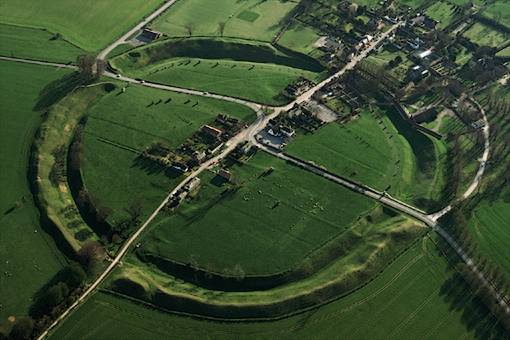
Avebury Stone Circle today: with its ditches excavated, unsightly cottages demolished, and unnecessary enclosures removed, it’s difficult to imagine the snarl of 17th-century domestic chaos that greeted John Aubrey’s visionary gaze that January morn.

Avebury Stone Circle today: with its ditches excavated, unsightly cottages demolished, and unnecessary enclosures removed, it’s difficult to imagine the snarl of 17th-century domestic chaos that greeted John Aubrey’s visionary gaze that January morn.

Whilst out hunting with fellow royalists during the English Civil War, exactly three hundred and sixty-two years ago. For Aubrey’s heroic retrieval of this vast but (by then) long forgotten Stone Age temple confronted the then-accepted notion that only the coming of the Romans had forced a degree of culture upon the barbaric Ancient British, and also confounded the then-popular 17th-century belief – propounded by the highly influential Scandinavian antiquaries Olaus Magnus and Ole Worm – that all such megalithic culture had its archaic origins in Europe’s far north. Indeed, so rich were the cultural implications of John Aubrey’s re-discovery that – come the fall of Oliver Cromwell’s 11-year-long Commonwealth and the subsequent Restoration of the Monarchy – even the returned King Charles II would himself insist on taking one of Aubrey’s celebrated tours of the Avebury area. But how could the world’s largest stone circle have suffered such a total cultural extinction in the first place? Why, the Avebury standing stones themselves must average at least ten feet in height apiece, while the temple’s enormously bulky northern and southern entrance stones rivalled even nearby Stonehenge’s celebrated trilithons. And how could Avebury’s vast 400-metre-diameter earthen embankment and the equally deep ditch that encircled these huge monoliths have for several centuries become invisible even to local historians? Ironically perhaps, the initial blame for this pagan temple’s centuries in cultural oblivion goes not to scheming Christians but to the 5th century arrival from Germany of another group of pagans – the invading Saxons – who, recognising Avebury’s possible use as a defended settlement, broke with the traditions of the previous Roman and Romano-British occupiers by setting up their homes and farmsteads directly within the mighty earth banks of the temple itself. Blasphemers! Thereafter, many centuries of harsh day-to-day living within the Avebury henge conspired to obscure then finally obliterate all physical traces of this vast Earthen Temple. Saxon ploughing within the henge tumbled soil into the deep ditches, which silted up considerably and became repositories of household refuse. Residents fearful of disturbing the ‘Devil’s work’ incorporated the Avebury megaliths into the hedges of their allotments, gardens, fields, and even saved energy by employing those monoliths most vertically aligned as supporting walls for their stone cottages. And when villagers lost their fears of the stones, deep pits were dug into whose depths several of the most intrusive monoliths were unceremoniously tumbled. Thereafter, the magnificent geometric shape of this robust 4,500 year-old landscape temple became lost in the chaos of domesticity; until that fateful day three hundred and sixty-two years ago, that is, when John Aubrey and his friend Dr. Walter Charleton joined their hunting party and galloped westwards across Fyfield Down along the chalky London-Bath ‘rode’. Aubrey himself recounts in his posthumously published two-volume tome Monumenta Britannica:

“The chase led us at length through the village of Avebury, into the closes there: where I was wonderfully surprised at the sight of those vast stones: of which I had never heard before… I observed in the enclosures some segments of rude circles, made with these stones; whence I concluded, they had been in the old time complete.”

It’s been my experience that no story about Avebury ever concludes without some vicious act of destruction by some pious know-it-all or other; this On This Deity entry is no different. For, despite King Charles II’s fascination with the Avebury stone circle, it was his return to the English throne that prompted the temple’s most vivid and desperate period of destruction. For in their determination to stamp out the Non-Conformism of Cromwell’s time, Charles II’s paranoid Restoration Government in 1665 passed the Five Mile Act (or Non-Conformist Act 1665), which specifically forbade all itinerant Non-Conformist preachers from speaking within five miles of their old parishes. Avebury stone circle is nine miles south of Swindon, eight miles north-east of Devizes, five miles west of Marlborough and six miles east of Calne. Non-conformist preachers throughout northern Wiltshire looked to the ancient pagan temple and regarded the Five Mile Act as a divine sign: let us make our new home here, and every pagan stone we break we’ll make righteous by incorporating it into our Non-Conformist church. And so to Avebury they did come and such destruction so they did: the church remains at the circle’s centre even to this day, self-effacing and easily overlooked but engorged nevertheless with as many splendid sarsen stones of that former 4,500 year-old monument as those Non-Conformist preachers could muster. Our hero John Aubrey would, for his pains, die unpublished and in penury. Today, however, his legend burns with an unquenchable fame due to that pioneering archaeological tome Monumenta Britannica, that gossipy biography of his many contemporaries Brief Lives, and – most of all – for that splendid vision of Avebury exactly three hundred and sixty-two years ago today. To John Aubrey – Culture Hero and how!
http://www.onthisdeity.com

Stonehenge and Avebury Tour Guide
HisTOURies UK – The Best Tours of Ancient Britain

Read Full Post »

When we thing of chalk hill figures in Wiltshire we all immediatly think of ‘chalk horses’, however Britain has many other chalk hill figures scattered across the British Isles – some new, some old.
Just west of Salisbury and close to Stonehenge is the Fovant Badges:

The Fovant Badges, Wiltshire

History of the Fovant Badges
When the 1914-1918 war broke out, there was a need to find accommodation for the New Army. In many areas, training and transit camps were established for troops leaving for, and returning from, the battlefields in northern France. One of these areas was the village of Fovant, in Wiltshire and its neighbours Compton Chamberlayne and Sutton Mandeville. The villages and the fields in the shadow of the chalk downs became a military camp, complete with barracks, a hospital, parade areas, shooting practice ranges, a camp cinema and YMCA huts. A military railway was constructed to serve the camp, branching off the main line railway from London to the southwest

Thousands of men from all parts of Britain and overseas lived for a while in the area, passed on to the Western Front and returned from it. Many never returned but gave their lives on the battlefields in France. Others died of their wounds in the hospital or from disease. Rows of silent War Graves in Fovant and other nearby churchyards are testimony to their presence. In remembrance of their colleagues, many of the regiments carved into the hillside replicas of their cap badges. Many of these no longer survive, but by the end of WW1 there were some twenty discernible badges.

Local workers from Fovant and the surrounding villages, supported by Regimental Associations maintained the Badges after WWI. During WWII, the badges became overgrown in order to disguise landmarks, which might assist enemy aircraft. Weather and time, as well as the effects of grazing cattle, caused decay. After the end of WWII, the Fovant Home Guard platoons formed themselves into an Old Comrades Association and undertook the task of restoration. It was in the period of 1948/51 that the two Wiltshire regimental badges were cut and in 1970 the Royal Signals badge was added.

In 1961, the Old Comrades Association was reformed as ‘The Fovant Badges Society’ with redefined, more positive objectives related to the maintenance and preservation of the Badges and the holding of the annual Drumhead Service. The Society became a charitable organisation and in 1994 adopted a new constitution, which governs its operation and objectives; these are the preservation and maintenance of the Regimental Crests cut on the chalk downs.

The Society was determined, aided by much public and international interest, that the Badges should remain an historic, fitting and truly visible memorial to the soldiers who passed through Fovant and its neighbouring villages on their way to the Great War, many never to return.


By 2000, there were only twelve discernable badges on the downs. A new management structure was put in place and, in consultation with professional civil engineers, a survey of the condition of the badges was made. It appeared that the Fovant Badges were unique in their detail and posed difficult restoration problems relating to the slope of the hill, the complexity of design, and their sizes. These vary; the Australian Badge, the largest, measures 51m x 32m, which is just under half the area of a football pitch.

The Trustees, faced with a potential bill of £350,000 upwards for restoration and large annual sums for increased maintenance thereafter, realised that the task facing them had to be brought to realistic proportions. They decided, with much sadness, that the objective should be the restoration and maintenance of the military crests on Fovant Down. These are clearly visible from a lay-by in Fovant whilst passing along the A30 road between Shaftesbury and Wilton. There is also a public footpath from the road to the village of Broad Chalke, which passes by the area of the Badges. This inevitably meant that the Map of Australia on Compton Down and the crests of the Royal Warwickshire Regiment and the 7th Battalion, City of London Regiment on Sutton Down would continue their decline. These badges would, in addition, have posed intractable problems because of the nature of the ground and their more advanced state of decay. Also, the YMCA badge on Fovant Down would be allowed to fade away.

Since the badges lay on open private farmland, with the movement of cattle unrestricted, it was clearly essential that large expenditure had to be used with good effect. A crucial first step was, therefore, to ensure the long lasting protection of the Badges. In co-operation with the farm owners, application was made to English Heritage to have the Badges scheduled as Ancient Monuments. Scheduling was granted in 2001 by the Department of Culture, Media and Sport placing all twelve badges, including those not being restored, under the protection of the government.

The estimated cost of the more limited objective was £220,000 and a national appeal was formally launched at the annual Drumhead Service in July 2001. The response to this was very positive and sufficient sums were assured by the end of 2001 to allow work to commence in 2002. Work experience by contractors, Dean and Dyball Construction Ltd, Ringwood, and favourable weather in 2002 allowed more work than anticipated to be done. This led to five badges being restored in 2002 and the remaining three (including the Royal Signals Badge who undertake their own maintenance and restoration) were completed in 2003.

The appeal has been successful. We are enormously grateful to our many benefactors – too large to name them all – but special mention must be made of the significant support given by the Heritage Lottery Fund, the Daily Mail And General Trust, the Pilgrim Trust, the Clothworkers’ Foundation, the Australian Department of Veterans’ Affairs and Salisbury District Council. And also to the very many private donations from throughout the country.

The Badges were originally constructed by cutting outlines into the rough tussocks of grass down to the underlying soil using such tools as were available in 1916. Chalk from external sources was then hauled manually from chalk dumps and used to fill in the areas exposed.

SLOPE PROBLEMS
profile before restoration – section through large chalk areas

Restoration problems involved work being carried out on a hillside that sloped at about 30 degrees and where a combination of grass, chalk and rain makes for a hazardous working environment. All chalk hills suffer from surface soil movement or ‘creep’. This causes ridges to develop above and below the horizontal chalk outlines and distorts the view of the badges from the A30 road. These so-called ‘eyebrows’ had to be removed.

Existing chalk on the Badges was removed to a depth of 150mm, stabilising the slope where necessary using geotextile materials together with one metre long metal rods, and replacing the excavated areas with compacted new chalk. On a large badge this required handling about 50 tonnes of chalk out of and into the site. As each badge is restored it is fenced to prevent cattle damage which had occurred in previous years.

The restoration of the eight military crests on Fovant Down was completed by the end of June 2003.However that is not the end of the story. The annual cost of maintenance is above the current, and projected future, income level of the Society. If we cannot achieve the necessary level of funding to carry out effective annual maintenance work then the long-term existence of these memorials as visible emblems on the Downs must be in doubt.

External links:
WW1 military badges – Fovant Badges Society
http://googlesightseeing.com/2009/08/the-fovant-badges/
The Stonehenge Tour Company
The Fovant Regimental Badges in Wiltshire England UK

Fovant Badges – Fovant History
Wiltshire Heritage Museum Home Page
Related post Chalk Hill Figures – :
Needless to say we offer guided tours of all the chalk hill figures in Wessex (some dating back to 3000BC) and can include other tourist attractions including Salisbury, Stonehenge, Bath, Avebury and Dorset

Wessex Tour Guide
HisTOURies UK – The Best Tours in Wiltshire and Dorset

Read Full Post »

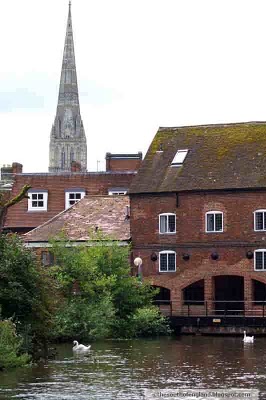
Salisbury and Stonehenge are separated by some 20 minutes drive, so after having had visited the prehistoric megaliths, it would be simply unforgivable to not pop in on this medieval town (though it has the status of city), which is first of all famed by its 13th century gothic cathedral.
The construction of Salisbury cathedral became one of those rare examples where only one generation of people was involved. That’s why, having had been erected during less than 40 years, this attired in stone lace structure represents a purest specimen of early English Gothic. The gracefully soared 123 metres spire is deceptively light. Actually its weight (with the weight of the tower) amounts to 6500 tonnes!

salisbury cathedral

Considering the fact that the foundation of Salisbury cathedral extends deep down the soggy ground only for 5 metres, it only remains to wonder how it has been still withstanding such load yet to admire the craftsmanship of medieval builders.
Inside of Salisbury cathedral it is as much mesmerizingly beautiful as outside. The sunlight, flowing through the vibrant stained glass windows, softens that characteristic gothic solemnity and makes it more warm and friendly. Apart from good looks the cathedral prides itself on keeping one of the 4 copies of Magna Carta, having been remained from the time of John Lackland, as well as the oldest working clock in the world dated by 14th century.

salisbury cathedral

In the confines of the spacious Cathedral Close nestle picturesque buildings of different époques and styles. Mompesson House (on the left from the High Street Gate) is a typical sample of English Baroque with gorgeous plasterwork and elegant interior that became the set for “Sense and Sensibility”, starring Emma Thompson and Hugh Grant. Malmesbury House (just by Sarum College) is quite often associated with the name of distinguished composer of the 18th century George Frideric Handel. It is believed that this is where he gave his first concert in Britain, to be exact in the room above the Saint Ann’s Gate. Salisbury and South Wiltshire Museum, situated in an ancient building of the 13th century opposite Salisbury cathedral, houses not only the curious artefacts having been found in the process of excavations near Stonehenge but also possesses the exhibits of the time of Romans and Saxons, the pieces telling about Salisbury’s social life in the Middle Ages, great collections of costumes and paintings.
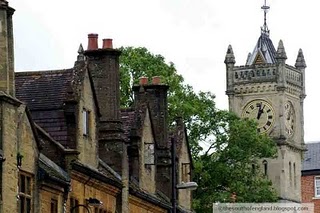
sarum collegeSalisbury is one of those provincial towns where no one can help oneself but meander around the narrow little streets enjoying the tranquillity far from boisterous metropolises. Everything is so snugly compact in comparison with the cities with high population. So there is even its own “Little Ben”, though probably “Little Tower” would suited this clock tower better, because it was built on the site of the former prison.
While walking along Salisbury, scrutinizing the old houses, amidst which there is a good deal of colourful timber-framed ones, and dropping in on little souvenir shops, the time unnoticeably flies by. And getting hungry organism suddenly begins to focus attention not on “that lovely little house” but on those with the signboards “pub”, “restaurant” or “café” on them. Though it doesn’t take too long to find a place for having a meal, because there are plenty of pubs and restaurants for every taste.
salisbury wiltshireSome of them can be interesting not only from gastronomic point of view, but also from historic. In this list for instance are: the restaurant at “The Old Mill” placed in the building of an old paper mill of the 12th century, “The coach and horses” built in 13th century, “The haunch of venison” on the Market Place. That last one exists at least from the 14th century and it doesn’t only keep a vivid atmosphere of the past. Between the ground and first floors is yet another one small area for visitors, pretentiously called “The house of Lords”. There, in the tiny baking oven, a cut mummified hand clenching the playing cards has been put on display. It was found during the refurbishment of the restaurant and alleged to be of an unlucky gambler, having had been punished for his cheating. That part of dead body doubtfully raises someone’s appetite but definitely increases the popularity of the place.
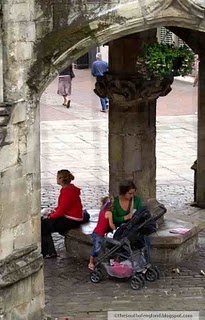
salisbury wiltshireAcross from “The haunch of venison” is an unusual stone construction. It’s called Poultry Cross, though visually it looks more like a stone marquee. In the 15th century, when Market Place was wider, there were four Crosses. In those days they functioned as departments in the modern supermarkets. So in the Middle Age there were: Cheese/ Milk Cross, Poultry Cross, Wool/Yard Cross and Barnwell Cross where the livestock was being sold. Nowadays this only remained Poultry Cross is the sort of a town summerhouse, a perfect spot for making a date or take shelter from a heavy shower.
In spite of such worldwide neighbour like Stonehenge, Salisbury, having its own charisma, doesn’t fade in the rays of the megaliths fame at all. Salisbury is like a main spice in the dish, it makes the trip to Stonehenge more complete. Without it that “megalithic delicacy” might be a little bit mild.
External links:
Visit Salisbury and Wiltshire Tourist website – www.VisitWiltshire.co.uk
Salisbury Cathedral – www.salisburycathedral.org.uk
Stonehenge – www.Stonehenge-Stone-Circle.co.uk
Salisbury and Stonehenge Tours – www.StonehengeTours.com

Southern England log : http://thesouthofengland.blogspot.com
Tours from London – www.Welcome2London.co.uk
Needless to say we can organise private guided tours of Salisbury and Stonehenge for small groups.  These tours can depart from Salisbury, Bath, Glastonbury or London

Salisbury Tour Guide
HisTOURies UK – The Best Tours in ancient Wiltshire

Read Full Post »

More than 2,000 people gathered in the snow of Stonehenge to celebrate the winter solstice.

Druids, lead by Arthur Pendragon (centre), take part in the winter solstice at Stonehenge in Wiltshire

Druids, lead by Arthur Pendragon (centre), take part in the winter solstice at Stonehenge in Wiltshire

Despite the actual sunrise, – which took place at 08.09am – being obscured by mist, Peter Carson of English Heritage said: “Stonehenge looked spectacular in the snow and it was a great way for people to start their festive season.”

The Pagan community came out in force to celebrate the annual festival, along with many whom were merely curious to experience the event.

As well as the traditional Druid and Pagan ceremonies, a snowball fight erupted as people enjoyed the cold weather.

“The popularity of the winter solstice has grown over the years as more is known about Stonehenge and the winter solstice and the whole celebration has grown in popularity, ” Mr Carson said.

Lance Corporal Paul Thomas, a serving soldier of 15 years who fought in Iraq, was “knighted” with a sword by a Druid calling himself King Arthur Pendragon.
The word solstice comes from the Latin phrase for “sun stands still”. During the winter solstice the sun is closer to the horizon than at any other time in the year, meaning shorter days and longer nights. The day after the winter solstice marks the beginning of lengthening days, leading up to the summer solstice in June.

The Sun’s passage through the sky appears to stop, with it seeming to rise and set in the same two places for several days. Then the arc begins growing longer and higher in the sky, reaching its peak at the summer solstice.

The solstices happen twice a year because the Earth is tilted by 23.5 degrees as it orbits the sun. Since ancient times people have marked the winter and summer solstices.

The stones at Stonehenge are aligned with the sunlight on both the summer and winter solstices. These times told prehistoric farmers that harvest was coming or that the shortest day of winter had passed.

Recent excavations of animal bones at the site suggest that huge midwinter feasts were held at Stonehenge, with cattle moved there to be slaughtered for the solstice celebrations.
External links:
http://www.telegraph.co.uk/news/picturegalleries/uknews/8219063/Druids-gather-in-the-snow-and-ice-at-Stonehenge-for-the-winter-solstice-sunrise.html
http://visit-stonehenge.blogspot.com/2010/12/stonehenge-summer-solstice-tour-2011.html
http://blog.stonehenge-stone-circle.co.uk/2010/12/21/stonehenge-winter-solstice-21stdecember-2010/
http://www.telegraph.co.uk/news/uknews/8219230/Druids-and-Pagans-celebrate-winter-solstice-at-Stonehenge.html

Stonehenge Tour Guide
HisTOURies UK – The Best Tours of Ancient Britain

Read Full Post »

« Newer Posts - Older Posts »