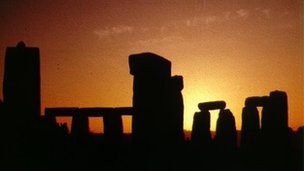
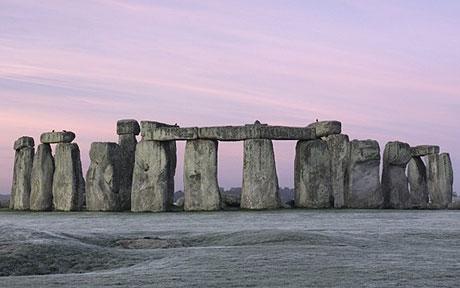
Two previously undiscovered pits have been found at Stonehenge which point to it once being used as a place of sun worship before the stones were erected.
The pits are positioned on celestial alignment at the site and may have contained stones
The pits are positioned on celestial alignment at the site and may have contained stones, posts or fires to mark the rising and setting of the sun.
An international archaeological survey team found the pits as part of the Stonehenge Hidden Landscapes Project.
The team is using geophysical imaging techniques to investigate the site.
The archaeologists from the University of Birmingham and the Ludwig Boltzmann Institute for Archaeological Prospection in Vienna have been surveying the subsurface at the landmark since summer 2010.
Procession route
It is thought the pits, positioned within the Neolithic Cursus pathway, could have formed a procession route for ancient rituals celebrating the sun moving across the sky at the midsummer solstice.
A Cursus comprises two parallel linear ditches with banks either side closed off at the end.
Also discovered was a gap in the northern side of the Cursus, which may have been an entrance and exit point for processions taking place within the pathway.
These discoveries hint that the site was already being used as an ancient centre of ritual prior to the stones being erected more than 5,000 years ago, the team said.
Archaeologist and project leader at Birmingham University, Professor Vince Gaffney, said: “This is the first time we have seen anything quite like this at Stonehenge and it provides a more sophisticated insight into how rituals may have taken place within the Cursus and the wider landscape.”
The detailed route for the Olympic torch announced today sees the flame visiting more than 50 West Country communities, and passing historic landmarks including Stonehenge and Glastonbury Tor.
More than 95 per cent of the population will be within ten miles of the torch as it makes a snaking journey from Cornwall to London’s Olympic Stadium.
Torchbearers will carry it in relay. On parts of the journey it will go via horseback, bicycle, tram and steam-train.
People in Somerset will have plenty of opportunity to see the torch, despite the fact that back in 2009 the Conservative-led County Council refused to bid for it to pass through.
Resources portfolio holder Councillor David Huxtable said at the time that the cost in traffic management and disruption would be too high. But the London Organising Committee of the Olympic and Paralympic Games had an ambition to ensure that it reached most people. Many thousands of people are expected to welcome the flame along the route each day and celebrate the achievements of the torchbearers in parks, squares and streets.
Lord Coe, chairman of the Games organising committee, said: “I’m delighted that the Olympic torch relay will take the 2012 Games to almost every corner of the UK and that we have achieved our ambition to take the flame to within an hour’s journey of 95 per cent of the population.”
The route in the West
On May 21 the torch will travel to Porlock, Minehead, Dunster, Carhampton, Washford, Williton and Taunton.
May 23: Flax Bourton, Backwell Farleigh, Backwell West Town, Nailsea, Failand, Leigh Woods, back to Bristol, then on to Chippenham, Calne, Marlborough, Chiseldon, Wroughton, Royal Wootton Bassett, Swindon, Stroud, Painswick, Brockworth, Shurdington and Cheltenham.
May 24: Gloucester, Maisemore, Hartpury, Corse and Staunton and on to Ledbury, Bartestree, Lugwardine and Hereford.
July 11: Ludgershall, Tidworth, Amesbury, The Winterbournes and Salisbury.
Samhain marks one of the two great doorways of the Celtic year, for the Celts divided the year into two seasons: the light and the dark, at Beltane on May 1st and Samhain on November 1st. Some believe that Samhain was the more important festival, marking the beginning of a whole new cycle, just as the Celtic day began at night. For it was understood that in dark silence comes whisperings of new beginnings, the stirring of the seed below the ground. Whereas Beltane welcomes in the summer with joyous celebrations at dawn, the most magically potent time of this festival is November Eve, the night of October 31st, known today of course, as Halloween.
Samhain (Scots Gaelic: Samhuinn) literally means “summer’s end.” In Scotland and Ireland, Halloween is known as O�che Shamhna, while in Wales it is Nos Calan Gaeaf, the eve of the winter’s calend, or first. With the rise of Christianity, Samhain was changed to Hallowmas, or All Saints’ Day, to commemorate the souls of the blessed dead who had been canonized that year, so the night before became popularly known as Halloween, All Hallows Eve, or Hollantide. November 2nd became All Souls Day, when prayers were to be offered to the souls of all who the departed and those who were waiting in Purgatory for entry into Heaven. Throughout the centuries, pagan and Christian beliefs intertwine in a gallimaufry of celebrations from Oct 31st through November 5th, all of which appear both to challenge the ascendancy of the dark and to revel in its mystery.
In the country year, Samhain marked the first day of winter, when the herders led the cattle and sheep down from their summer hillside pastures to the shelter of stable and byre. The hay that would feed them during the winter must be stored in sturdy thatched ricks, tied down securely against storms. Those destined for the table were slaughtered, after being ritually devoted to the gods in pagan times. All the harvest must be gathered in — barley, oats, wheat, turnips, and apples — for come November, the faeries would blast every growing plant with their breath, blighting any nuts and berries remaining on the hedgerows. Peat and wood for winter fires were stacked high by the hearth. It was a joyous time of family reunion, when all members of the household worked together baking, salting meat, and making preserves for the winter feasts to come. The endless horizons of summer gave way to a warm, dim and often smoky room; the symphony of summer sounds was replaced by a counterpoint of voices, young and old, human and animal.
In early Ireland, people gathered at the ritual centers of the tribes, for Samhain was the principal calendar feast of the year. The greatest assembly was the ‘Feast of Tara,’ focusing on the royal seat of the High King as the heart of the sacred land, the point of conception for the new year. In every household throughout the country, hearth-fires were extinguished. All waited for the Druids to light the new fire of the year — not at Tara, but at Tlachtga, a hill twelve miles to the north-west. It marked the burial-place of Tlachtga, daughter of the great druid Mogh Ruith, who may once have been a goddess in her own right in a former age.
At at all the turning points of the Celtic year, the gods drew near to Earth at Samhain, so many sacrifices and gifts were offered up in thanksgiving for the harvest. Personal prayers in the form of objects symbolizing the wishes of supplicants or ailments to be healed were cast into the fire, and at the end of the ceremonies, brands were lit from the great fire of Tara to re-kindle all the home fires of the tribe, as at Beltane. As they received the flame that marked this time of beginnings, people surely felt a sense of the kindling of new dreams, projects and hopes for the year to come.
The Samhain fires continued to blaze down the centuries. In the 1860s the Halloween bonfires were still so popular in Scotland that one traveler reported seeing thirty fires lighting up the hillsides all on one night, each surrounded by rings of dancing figures, a practice which continued up to the first World War. Young people and servants lit brands from the fire and ran around the fields and hedges of house and farm, while community leaders surrounded parish boundaries with a magic circle of light. Afterwards, ashes from the fires were sprinkled over the fields to protect them during the winter months — and of course, they also improved the soil. The bonfire provided an island of light within the oncoming tide of winter darkness, keeping away cold, discomfort, and evil spirits long before electricity illumined our nights. When the last flame sank down, it was time to run as fast as you could for home, raising the cry, “The black sow without a tail take the hindmost!”
Even today, bonfires light up the skies in many parts of the British Isles and Ireland at this season, although in many areas of Britain their significance has been co-opted by Guy Fawkes Day, which falls on November 5th, and commemorates an unsuccessful attempt to blow up the English Houses of Parliament in the 17th century. In one Devonshire village, the extraordinary sight of both men and women running through the streets with blazing tar barrels on their backs can still be seen! Whatever the reason, there will probably always be a human need to make fires against the winter’s dark.
Divination at Halloween
Samhain was a significant time for divination, perhaps even more so than May or Midsummer’s Eve, because this was the chief of the three Spirit Nights. Divination customs and games frequently featured apples and nuts from the recent harvest, and candles played an important part in adding atmosphere to the mysteries. In Scotland, a child born at Samhain was said to be gifted with an d� shealladh, “The Two Sights” commonly known as “second sight,” or clairvoyance.
Apple Magic
At the heart of the Celtic Otherworld grows an apple tree whose fruit has magical properties. Old sagas tell of heroes crossing the western sea to find this wondrous country, known in Ireland as Emhain Abhlach, (Evan Avlach) and in Britain, Avalon. At Samhain, the apple harvest is in, and old hearthside games, such as apple-bobbing, called apple-dookin’ in Scotland, reflect the journey across water to obtain the magic apple.
Dookin’ for Apples
Place a large tub, preferably wooden, on the floor, and half fill it with water. Tumble in plenty of apples, and have one person stir them around vigorously with a long wooden spoon or rod of hazel, ash or any other sacred tree.
Each player takes their turn kneeling on the floor, trying to capture the apples with their teeth as they go bobbing around. Each gets three tries before the next person has a go. Best to wear old clothes for this one, and have a roaring fire nearby so you can dry off while eating your prize!
If you do manage to capture an apple, you might want to keep it for a divination ritual, such as this one:
The Apple and the Mirror
Before the stroke of midnight, sit in front of a mirror in a room lit only by one candle or the moon. Go into the silence, and ask a question. Cut the apple into nine pieces. With your back to the mirror, eat eight of the pieces, then throw the ninth over your left shoulder. Turn your head to look over the same shoulder, and you will see and in image or symbol in the mirror that will tell you your answer.
(When you look in the mirror, let your focus go “soft,” and allow the patterns made by the moon or candlelight and shadows to suggest forms, symbols and other dreamlike images that speak to your intuition.)
Dreaming Stones
Go to a boundary stream and with closed eyes, take from the water three stones between middle finger and thumb, saying these words as each is gathered:
I will lift the stone
As Mary lifted it for her Son,
For substance, virtue, and strength;
May this stone be in my hand
Till I reach my journey’s end.
(Scots Gaelic) Togaidh mise chlach,
Mar a thog Moire da Mac,
Air bhr�gh, air bhuaidh, ‘s air neart;
Gun robh a chlachsa am dh�rn,
Gus an ruig mi mo cheann uidhe.
Carry them home carefully and place them under your pillow. That night, ask for a dream that will give you guidance or a solution to a problem, and the stones will bring it for you.
Article from ‘The Stonehenge Stone Circle’ Website
I don’t normally do articles on ancient sites outside of my own Country, Britain. However I felt this was a significant discovery in Europe and has a Stonehenge connection.
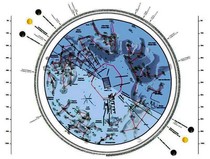
General plan of the early Celtic burial mound with sky constellations.
A huge early Celtic calendar construction has been discovered in the royal tomb of Magdalenenberg, nearby Villingen-Schwenningen in Germany’s Black Forest. The order of the burials around the central royal tomb fits exactly with the sky constellations of the Northern hemisphere.
Whereas Stonehenge was orientated towards the sun, the more than 100-meters-wide burial mound of Magdalenenberg was focused towards the moon. The builders positioned long rows of wooden posts in the burial mound to be able to focus on the Lunar Standstills. These Lunar Standstills happen every 18.6 year and were the corner stones of the Celtic calendar.
Archaeo-astronomic research resulted in a date of Midsummer 618 BCE, which makes it the earliest and most complete example of a Celtic calendar focused on the moon.
After the complete destruction of the Celtic culture by Rome, these types of calendars were completely forgotten.The full dimensions of the lost Celtic calendar system have now come to light again in the monumental burial mound of Magdalenenberg.
Like other European Iron Age tribal societies, the Celts practiced a polytheistic religion. Rites and sacrifices were carried out by priests known as druids. The Celts did not see their gods as having human shapes until late in the Iron Age. Celtic shrines were situated in remote areas such as hilltops, groves, and lakes.
Roman reports of the druids mention ceremonies being held in sacred groves. La Tène Celts built temples of varying size and shape, though they also maintained shrines at sacred trees and votive pools.
Druids fulfilled a variety of roles in Celtic religion, serving as priests and religious officials, but also as judges, sacrificers, teachers, and lore-keepers. Druids organized and ran religious ceremonies, and they memorized and taught the calendar. Other classes of druids performed ceremonial sacrifices of crops and animals for the perceived benefit of the community. Neo-druidism is still practiced today.
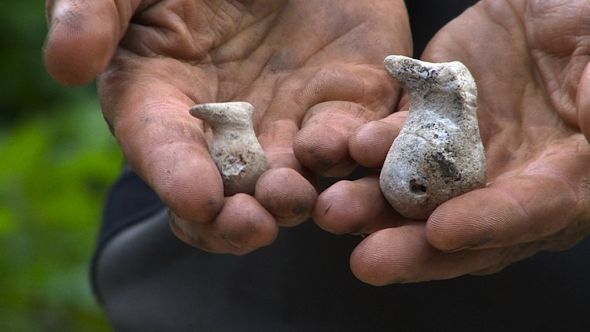
A pair of carved stone ducks unearthed at Vespasian’s Camp near Stonehenge are believed to be the oldest known figurines found in the UK, and are amongst other findings that suggest the sacred site was in use several thousand years before the megalith itself was constructed.
Two stone carvings, in the shape of ducks, dated to around 700 BC. (Luke Beaman/The Open University)
Led by archeologist David Jacques at The Open University, several students uncovered a hoard of artifacts from the mid-Stone Age, including a ceremonial dagger, the remains of an aurochs feast, and more than 5,000 flints and tools.
“We thought it was probably a mixed cache of early prehistoric tools, and assumed some were contemporary with Stonehenge,” Jacques said in a press release.
“When we took them back to Cambridge and a number of experts suggested they were all Mesolithic, we started to get very excited.”
The team found evidence of a fire with over 200 cooked animal bones from at least one aurochs, which were radiocarbon dated back to about 6,250 BC, more than 3,000 years before the giant stone circle was erected.
“Mesolithic people were nomadic hunter-gatherers who would have had temporary settlements,” Jacques explained.
“Salisbury Plain would have been something like the Serengeti with herds of animals roaming across it, and people could have used the hills that sort of create a basin around it as vantage points from which to see the movement of animals.”
Now extinct, aurochs were a type of large cattle that once roamed Eurasia and North Africa, reaching almost two meters in height.
“An aurochs was something like a large minivan in size,” Jacques said. “To catch an animal this big would have been a major feat.”
“It would have fed a lot of people. It’s likely there was a large gathering, possibly as many as 100 people, who cooked and feasted on the aurochs.”
Meanwhile, the ducks were dated back to 700 BC, and the dagger to around 1,400 BC. The figurines are believed to be part of a Bronze Age tradition based on casting sacrificial offerings into water.
Only a few other Mesolithic artifacts have previously been found in the area. Field archeologist Tom Lyons at Oxford Archaeology East said in the release that the discovery is highly significant.
“It’s really exciting to get such a cache of material,” he said. “This certainly makes this find nationally important, if not internationally important”
No comprehensive guide to our islands’ buildings should exclude Hadrian’s Wall or Stonehenge
Jonathan Glancey’s introduction to the Guardian’s Guide to British Architecture encourages a reading of architecture and an immersion in its language (Architecture: an autobiography, 10 September). The buildings “tell tales of people who have lived, loved and worked inside them”. The stories of buildings’ birth, life and death, their design and fabrication, use and abuse, rebirths and ruin, are indeed the narrative that describes a society and its architecture.
Yet the guide as a whole surely misses the deep and longer story of British architecture. Joseph Rykwert’s seminal work The Idea of the Town views the myths and rituals of many previous civilisations; Glancey only allows a brief view of “eight millennia” of architecture with a mention of “the cities and ziggurats (towers) of ancient Sumeria, now hidden from the world in the deserts of southern Iraq”.
Surely Britain is allowed its ancients: does the history of architecture only start with the arrival of Christianity, the dominant force in architecture? Surely it should include places deep in our psyche and defining the last six millennia. Where are the precise fabrications of Stonehenge, and the domestic and environmental connectivity exhibited at Skara Brae? Where are the Romans’ technical marvels, Hadrian’s Wall, and their integrated plumbing and heating?
Are we witnessing an editing moment similar to the TV series Civilisation; or perhaps these Unesco world heritage sites are seen as just buildings, like Nikolaus Pevsner’s bicycle shed – and therefore written out of the story? They were important enough for John Wood, the designer of the Circus in Bath, to survey Stonehenge; and earlier Christopher Wren, a great baroque master, allegedly visited and marked the stones. Peter Ackroyd, in his Hawksmoor novel, develops a narrative that connects Wren at Stonehenge to the death of Wren’s son at the Pyramids of Giza.
Glancey compares the reading of literary greats to the reading of buildings, yet he misses the sensory duet between body and buildings, exemplified by Georges Perec, who combined mathematical and literary puzzles across the life of a Parisian apartment block in Life: a Users Manual. My own favourite from Dickens is a body landscape duet from Great Expectations as Magwitch turns Pip in Cooling churchyard, creating a large-scale metaphoric Thames rotation, moving London west to east.
For me as an architect and tutor, the longer view of British architecture, with civilisations waxing and waning in the face of creative and destructive environmental change, wields salutary lessons.
We can take fictional futures that use the deep and modern past such as those of China Miéville, JG Ballard and Italo Calvino. Digging beyond Calvino’s Invisible Cities, one arrives at the architecture of Cosmicomics, and a fascination in new and rare materials, scientific concepts that become mythical in the Italian’s hand – they are hinted at in your guide’s article on new materials.
Guided tours of Stonehenge HisTOURies UK – Mystical Landscape, Magical Tours
Another crop circle in the United Kingdom was found on July 29. Like most crop circles, little to nothing is known about how, who or what created it. As mysterious as Stonehenge, crop circles continue to stump the brightest scientists and UFO fanatics alike.
Crop circles are a flattening of wheat, barley, rye, maize, and other crops. Cases have been documented for more than 40 years now in over 20 countries, but mainly in the United Kingdom — and more specifically in southern England. Circle makers typically avoiding being caught by working at night.
In July, a crop circle appeared across the field from Stonehenge, adding mystery to what was an already mind-boggling location. Many people believe that crop circles are an act of aliens, God, or mankind; some believe they spawn from earth’s magnetic field and energy. Yet, no one theory has proven what crop circles are, why they are here, or what created them
More than 2,000 different shapes have been recorded, and mathematical analysis has revealed the use of construction lines, invisible to the eye, are used to design the patterns. However, how these circles are created, or who is creating them remains a burning question many would like answered.
Crop circles and physics
In this month’s Physics World edition, Richard Taylor, director of the Materials Science Institute at the University of Oregon, states that physics and the arts are grouping together to work toward solving the secrets behind the ever complex crop circles.
According to Taylor, via EurekAlert.org, “physics could potentially hold the answer, with crop-circle artists possibly using the Global Positioning System (GPS) as well as lasers and microwaves to create their patterns, dispensing with the rope, planks of wood and bar stools that have traditionally been used.”
Microwaves, Taylor suggests, could be used to make crop stalks fall over and cool in a horizontal position — a technique that could explain the speed and efficiency of the artists and the incredible detail that some crop circles exhibit.
However, Taylor states that “Crop-circle artists are not going to give up their secrets easily. This summer, unknown artists will venture into the countryside close to your homes and carry out their craft, safe in the knowledge that they are continuing the legacy of the most science-oriented art movement in history.”
“It may seem odd for a physicist such as Taylor to be studying crop circles,” said Matin Durrani, editor of Physics World, “but then he is merely trying to act like any good scientist — examining the evidence for the design and construction of crop circles without getting carried away by the side-show of UFOs, hoaxes and aliens.”
Crop circles: Rob Dickinson and John Lundberg
Rob Dickinson and John Lundberg are known crop circle artists residing in the UK. On their personal website, the artists/circle makers address one researcher’s findings on crop circles.
Dickinson and Lundberg wrote:
“With our unique insider’s perspective to the crop circle phenomenon we’ve always known crop circle research has centered on beliefs – rather than empirical derived evidence. Without studying the detail of researchers’ statements this is a difficult point to demonstrate, let alone articulate in sound bites in the media.
“During the summer of 2000 the media focused on crop circle researcher Colin Andrews assertions that 80% of circles were man made and 20% were the product of some kind of magnetic energy. Colin was featured on almost every TV and radio channel, often with us arguing that Colin’s estimate…was just that, an estimate without substantial proof, or evidence.
“Andrews [has] presented erroneous information to support their own beliefs and to inflate their importance and perceived knowledge of the subject. In the case of Andrews, the media accepted his statements with little skepticism or scrutiny, and his beliefs have been portrayed as scientific fact across the globe.”
Andrews replied:
“I have invested my reputation, profession and marriage in trying to resolve the apparent puzzle. At this point I have proven to myself that you and your friends (and others before) are at least 80 percent of that puzzle and if you are proud of that, so be it. I am proud to have put myself on the line to be honest with my conclusions. The 80/20 percent have not made me friends amongst those who want to believe everything comes from ET’s etc.
“I look forward to the day you make my job and that of serious fellow researchers easy and post all the formations you have made and call them what they are man made art – without all the deliberate deception and trouble making.”
Visit Wiltshire and see a crop circle for yourself. Seeing is believing!
Stonehenge Tour Guide HisTOURies UK – Mystical landscape, magical tours
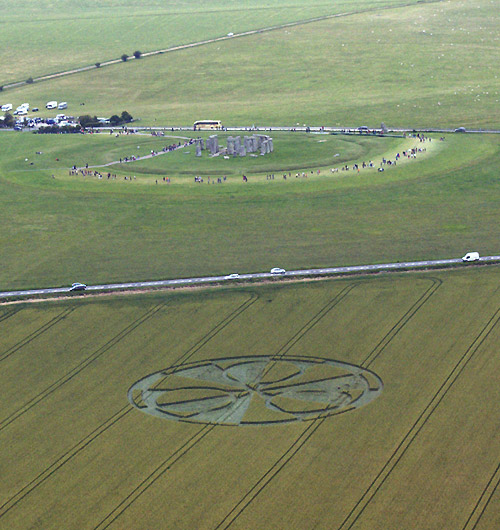
THE first two crop circles of the summer have appeared close to Stonehenge.
Both lie in a barley field just off the A360, near Airman’s Corner.
Francine Blake of the Wiltshire Crop Circle Study Group said the first, which is 170ft in diameter, is an important symbol similar to one from the ancient Mayan culture, lying east-west and linking past and future.
Some enthusiasts have pointed out that it is identical to a logo used by the anarchist punk band Crass 30 years ago, representing the idea that great power will eventually destroy itself.
Visit this and other mysterious crop circles in the Wessex area with one of our private guided tours HisTOURies UK – Mystical landscape, magical tours…………
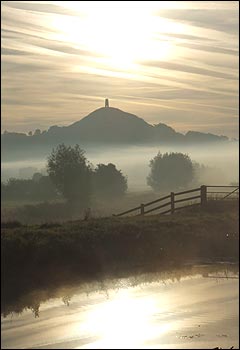
There are so many myths associated with Glastonbury that it is difficult
Glastonbury Tor
to know where to begin to talk about them. There are two main streams of legend that surround Glastonbury, though they twine around each other to some degree. The two streams revolve around the romantic figures of Joseph of Arimathea and King Arthur. Let’s take them one at a time.
Joseph of Arimathea Joseph was the Biblical figure who took Jesus’ body after the crucifixion. According to some legends he was actually Jesus’ uncle, and had visited Britain years before with Jesus in the pursuit of his interests in the tin trade. It appears that there actually was a strong Jewish presence in the west of England at that time, and many of the tin miners may have been Jewish settlers.
At any rate, when Jesus died, Joseph thought it prudent to flee Palestine, and after many travails he came to Britain with a company of followers. He brought with him the Holy Grail, the cup used by Jesus at the Last Supper. Some versions of the legend have it that the Grail contained two drops of blood captured from Jesus’ side when he was wounded on the cross.
When Joseph came to Britain he was granted land at Glastonbury by the local king. When he arrived at Glastonbury, Joseph stuck his thorn staff in the earth, whereupon it rooted and burst into bloom. A cutting from that first tree was planted in the grounds of the later Glastonbury Abbey, where it continued to bloom every year therafter at Christmas time. There is still a thorn tree in the Abbey grounds, of a variety native to the Holy Lands, and it does indeed bloom around Christmas time.
Joseph was said to have established the first church in England at Glastonbury, and archaeological records show that there may well have been an extremely early Christian church here. What happened to the Holy Grail is another matter. Some legends have it that Joseph buried the Grail at the foot of Glastonbury Tor, whereupon a spring of blood gushed forth from the ground.
There is a well at the base of the Tor, Chalice Well, and the water that issues from it does indeed have a reddish tinge to it, from the iron content of the water.
Other legends have it that the Holy Grail was interred with Joseph when he died, in a secret grave. The search for the mysterious Grail emerges again and again in the tales of Glastonbury.
Further legends tell that the church founded by Joseph continued for many years. Eventually it became a monastery, and one of the first abbots was the future St Patrick, who was born in the west country.
King Arthur and Glastonbury
Legends of King Arthur swirl about Glastonbury like a tantalizing fog from the nearby Somerset marshes. The nearby hill fort at South Cadbury has long been suggested as the location for Camelot. Indeed, excavations of South Cadbury suggest that it was in use during the early 6th century, which is the likeliest era for the real Arthur to have lived.
The association of Arthur and Glastonbury goes back at least to the early Middle Ages. In the late 12th century the monks of Glastonbury Abbey announced that they had found the grave of Arthur and Guinivere, his queen. According to the monks, an excavation found a stone inscribed “Here lies Arthur, king.” Below the stone they found the bones of a large man, and the smaller skeleton of a woman. The monks reburied the bones in the grounds of the abbey, where they were a very handy draw for pilgrims. The site of the grave can be seen today in the abbey grounds.
Glastonbury Tor, the enigmatic conical hill that rises above Glastonbury, has been linked with the Isle of Avalon, where King Arthur was buried after his death. This isn’t so farfetched as it may sound, for a millennium ago the water level was much higher, and the tor would indeed have been an island. Avalon was also called “the isle of glass” which does suggest similarities to the name “Glastonbury”.
The Holy Grail, the object of Arthur’s questing, is said to be buried beneath Glastonbury Tor, and has also been linked to Chalice Well at the base of the Tor.
One final myth of Arthur at Glastonbury: the landscape around Glastonbury is said to have been moulded and shaped so that the features (such as roads, churches, and burial mounds) create a zodiac calendar replete with Arthurian symbology. Like so many of the Arthurian myths, so much is open to interpretation and your own predisposition to believe or disbelieve.
Glastonbury Abbey
Is there a place more steeped in legend and myth than Glastonbury? Probably not. Legend holds that the earliest church here was founded by St. Joseph of Arimathea in about 60AD, and that when he planted his staff in the earth a thorn tree burst forth.
In the grounds of the ruined Benedictine monastery there is a thorn tree of a variety common to the Middle East which is given to bloom around Christmas time.
By the late Middle Ages Glastonbury had become the richest abbey in England, due to the heavy pilgrimage trade. It was rich enough to build an inn for well-to-do pilgrims (the George Inn, on nearby High Street, which still welcomes guests 500 years later). The best preserved building in the abbey grounds is the old Abbot’s Kitchen (see photo), a curious square building which appears round due to its octagonal roof. In the abbey grounds are the reputed graves of King Arthur and Queen Guinevere, which were conveniently discovered by the Glastonbury monks in the 12th century, when the abbey needed a financial boost. Outside the grounds are the abbey tithe barn, which now serves as the Somerset Rural Life Museum (well worth a visit), and 4 miles away at Mere is the abbey’s Fish House, were fish was salted and cured.
The abbey is entered through the Abbey Gatehouse an imposing arched gateway located on off Magdalene Street. Visitors pass through a fascinating museum depicting life at Glastonbury during the Middle Ages, and then enter the Abbey grounds proper. The first building you see on entering the grounds is St Mary’s Chapel, a roofless structure that boasts wonderful architectural details, from the recessed arches of the door to the repetitive arcading that rings the interior. Look up, where the curious small towers at each corner of the chapel seem almost Georgian in style.
If you continue past the chapel you will soon reach the Abbot’s Kitchen, probably the most recognizable symbol of the Abbey, and subject of numerous postcards! This is a peculiar building, with a high octagonnal tower over a square base bedecked with gargoyles. The interior is notable for the very large ovens and the high dome supported on reed-thin vaulting ribs.
Return from the Abbot’s Kitchen towards St Mary’s Chapel and you will pass a small sign on the green lawn. This marks the old burial ground, where, in the 12th century, monks conveniently found bones beneath an engraved stone indicating the burial place of legendary King Arthur. The bones and those presumed to belong to Arthur’s queen, Guinivere, were reburied within the Abbey Church, where a small memorial can be seen.
The grounds of Glastonbury Abbey emanate a sense of calm and peace; it is truly a magical place, and taken as a whole with the other attractions of this ancient town, make Glastonbury well worth an extended visit.
The Trundle near Chichester, Sussex, is one of the first large monuments built in Britain
Researchers have developed a new dating technique that has given the first detailed picture of the emergence of an agricultural way of life in Britain more than 5,000 years ago.
A new analysis of artefacts recovered from the first monuments built in Britain shows that the Neolithic period had a slow start followed by a rapid growth in trade and technology.
Scientists say the new approach can be used to unravel the detailed sequence of events of many more important moments in human prehistory.
It relies in part on radio-carbon dating – counting the amount of a radioactive type of carbon atom in decaying matter. But the methodology also incorporates many other dating sources, together with some powerful statistical analysis, to produce far more discrete timings for happenings in the past.
The Neolithic period in Britain occurred between 4000 and 2000BC.
It was when people took up agriculture as a way of life and stopped being nomadic hunter-gatherers.
It also saw the emergence of trade across the British Isles and the development of new technologies. But until now, we have had only a rather coarse picture of the chronology of events during this eventful period in our history.
The new analysis by Dr Alex Bayliss, an English Heritage dating expert, has brought the occurrences of that time into sharper focus.
“We can start to tell a bigger story and write a history for the prehistory of Neolithic Britain,” she told BBC News.
“What we thought before was very imprecise. We simply knew that all sorts of different sites and all sorts of new kinds of practices started to happen sometime in the 500 or 600 years of the early Neolithic in Britain.
“We’ve actually now been able to give a timetable, or story of what happened when, to disentangle these things so that we can start to see why certain things may have followed others.”
According to Dr Bayliss’s analysis, Neolithic farming practices began in south-east England probably a few decades before 4,000BC. But then they spread very, very slowly, taking about two centuries to reach western parts of England. And then, she says, there was a sudden increase in activity.
“Monuments, cattle, sheep, the whole farming way of life, bursts across Britain and suddenly – having taken 200 years from getting from Kent to Gloucestershire – it then takes 50 years to get from Cheltenham to Aberdeen.”
The new dating also indicates that by 3700-3800BC, early Britons had developed pottery with regional styles of decorations. Long-distance trading networks were also being established in stone axes and certain other types of pottery
Windmill Hill, a large Neolithic causewayed enclosure in Avebury, was previously thought to have been built around 3700-3100 BC. The new dating shows it was built in 3700-3640 BC
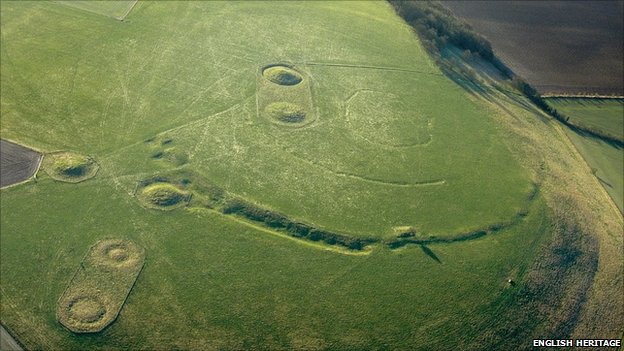
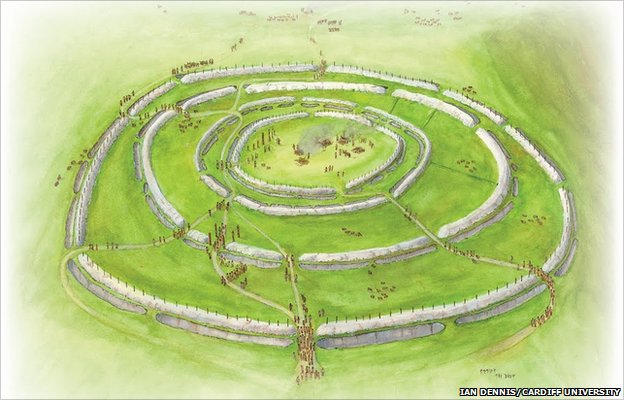
Of particular interest are the first monuments that were built in Britain, called causewayed enclosures. These were made up of concentric rings of ditches and banks – the largest of which can span 300m (1,000ft).
It had been thought that they spread slowly across the country over five centuries. But the new dating approach suggests they spread rapidly within 75 years.
This revelation has been described by archaeologists working on the project as Britain’s first “building boom”.
Professor Alistair Whittle of Cardiff University said: “With more accurate dating, the Neolithic period is no longer the sleepy, hazy swathe of time where it is the default position to lump everything together.
“This research fundamentally challenges the notion that little happened among our Stone Age farmers. We can now think about the Neolithic period in terms of more rapid changes, constant movement of people and fast diffusion of ideas.”
Collective violence
One interpretation of these events is that once the initial “pioneer” phase of the Neolithic period was over, independent groups of people came over from the continent and set up villages across Britain and social structures began to form.
These social structures led to the construction of the enclosures for people to gather and possibly for chieftains to emerge and amass power.
The new dating suggests that there was more collective violence once the enclosures were built. Several of them, particularly in western Britain, were attacked by large numbers of people with showers of arrows, and enclosures’ ramparts were burned down.
This indicates that the enclosures created a hierarchy that was being contested in some way.
The new dating technique involves comparing carbon dates with other markers in the archaeological record. On its own carbon dating is imprecise, but when it is cross-reference with documented events it allows researchers to more accurately date artefacts.
Researchers say this new methodology could in principle be used shed further light on any significant event in our prehistory, such as the emergence of farming in China and the collapse of the Mayan civilisation in the Americas.
A reconstruction of the Whitehawk causewayed enclosure in the South Downs, Sussex
Why not visit Windmill Hill and nearby Avebury and learn more about Neolithic Britain?
Stonehenge and Avebury stone Circle Tour Guide HisTOURies UK – The Best Tours of Ancient Wiltshire


 Legends of King Arthur swirl about Glastonbury like a tantalizing fog from the nearby Somerset marshes. The nearby hill fort at South Cadbury has long been suggested as the location for Camelot. Indeed, excavations of South Cadbury suggest that it was in use during the early 6th century, which is the likeliest era for the real Arthur to have lived.
 Probably not. Legend holds that the earliest church here was founded by St. Joseph of Arimathea in about 60AD, and that when he planted his staff in the earth a thorn tree burst forth.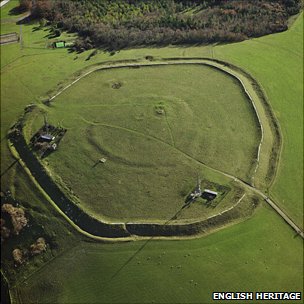
 HisTOURies U.K Tours

 Wessex Guided Tours