Feeds:
Posts
Comments

Archive for the ‘visit wiltshire’ Category

Saturday 28 January – Saturday 12 May 2012.  When the climate changes from warm to freezing, the plants and animals you rely on for food and clothing die out or disappear, how would YOU survive? 

Packed full of fun activities set alongside Ice Age animal bones and the oldest objects made by people found in this area, this exhibition looks at how the earliest people survived over 300,000 years ago. 

Specially suited for primary school ages or families, but with something of interest for everyone, you will be asked to think about whether you think you could have lived in a time before farming, when people survived by hunting and gathering and when extreme climate change threatened their existence. 

 Plus, there is free admission for children (with an accompanying paying adult) if you enter our Cave Art competition. Click here to print out one of the cave art pictures to colour in or complete with your own design. Bring your finished work into the museum together with a completed entry form to claim your free entry to the exhibition. We will also display your picture in the exhibition and you have chance to win a special Behind the Scenes tour with the Museum’s Director who will even let you touch a real mammoth bone!

To give you a few ideas about what real cave art was like, follow these links.

http://www.bbc.co.uk/history/handsonhistory/ancient-britain.shtmlhttp://www.bbc.co.uk/history/handsonhistory/ancient-britain.shtml

Mystical Landscape, Magical Tours
HisTOURies UK – Salisbury and Stonehenge Guided Tours

Read Full Post »

A huge winter solstice feast might have taken place around Stonehenge some 4,500 years ago.

Abundant cattle and pig bones recently unearthed a few miles from the megalithic site suggest that prehistoric people celebrated the connection between the stone circle and the sky with hundreds of roasts.
Stonehenge

According to initial research led by Mike Parker Pearson of the University of Sheffield, U.K., the animals were walked from different places and for hundreds of miles to be slaughtered immediately after arrival at Durrington Walls, a massive circular earthwork, or henge, two miles northeast of Stonehenge. 

Parker Pearson’s research has shown that this site attracted people in droves as far back as Neolithic times.

“The considerable quantities of pig and cattle bones, pottery, flint arrowheads and lithic debris indicate that occupation and consumption were intense,” wrote Parker Pearson, who has was awarded a grant of £750,000 to analyse a range of materials found at the site.

So far, the archaeologist has found no evidence that Durrington was permanently inhabited. He believes that the intense human activity was linked to feasting during the solstices.

“The small quantities of stone tools other than arrowheads, the absence of grinding querns and the lack of carbonised grain indicate that this was a ‘consumer’ site. The midsummer and midwinter solstice alignments of the Durrington and Stonehenge architecture suggest seasonal occupation,” Parker Pearson said.

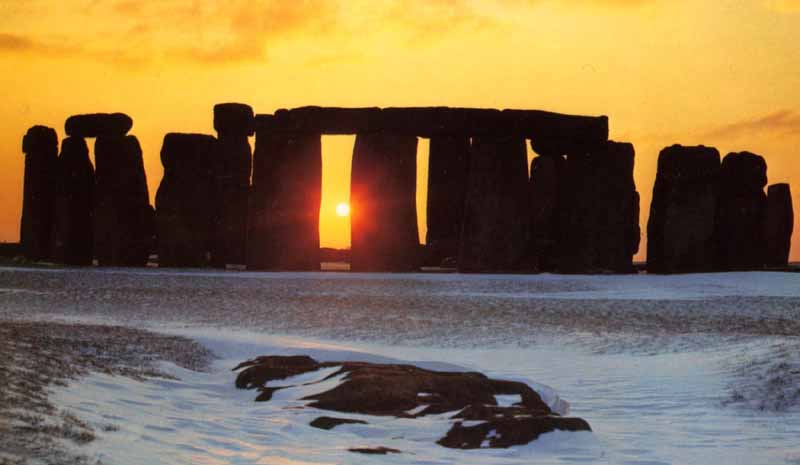
This year the winter solstice will be celebrated at Stonehenge on the morning of Thursday, December 22nd 2011

Stonehenge will open at 7.45 a.m. for people who brave the cold to watch the sun rise shortly after 8 a.m.

Full Article:  http://news.discovery.com/

 
Stonehenge Tour Guide.  Mystical Landscape, Magical Tours….
HisTOURies UK – The Best Tours in Ancient Britain

Read Full Post »

A TRADITION dating back 5,000 years is to be recreated in Amesbury to mark the mid-winter solstice.

Stonehenge Winter Solstice

Stonehenge Winter Solstice

The town is holding its first lantern parade for centuries and hundreds of people are expected to take part.

The procession will take place on Wednesday, December 21 and walkers will set off from Stonehenge as the sun sets at about 4pm.

Carrying glowing lanterns, they will follow the original processional route of the Avenue away from the stones and walk across farmland before entering Amesbury and arriving in the town centre at 5.30pm.

Mulled wine, mince pies, craft stalls and plenty of festive cheer will be there to greet the walkers as they arrive.

Art students at Avon Valley College have teamed up with Amesbury based A&R Metalcraft to produce a lantern to lead the procession.

The lantern, which will be carried by a Solstice Fairy, will be kept burning through the night before being retured to Stonehenge at sunrise on the mid winter solstice.

It will then go on show at the Forge Gallery in Amesbury where people will be able to display their photographs, poems and pictures of the lantern parade in a large community collage.

“It’s going to be wonderful,” said Michelle Topps from the gallery. “Salisbury has its cathedral, Bath its waters and Amesbury has its ancestors.

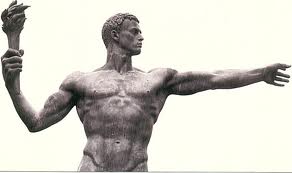
“By remembering them we can establish a real sense of place for both locals and visitors alike. People have settled in Amesbury for 8,000 years and their influence is everywhere”. Mayor Andy Rhind-Tutt said: “This is a fantastic opportunity for our community to come together for this magical experience, recreating a 5,000 year old tradition and especially during the build up to the Olympics, when we will see the real torch travel through our town. I hope this will create a legacy for the future at this festive time of year and as many people as possible join in.”

Everyone is invited to take part in the parade and lantern kits and vouchers are available from the Bowman Centre, community shop or the Forge Gallery for £5 from Wednesday, December 7.

The voucher will entitle you to a lift to Stonehenge from Amesbury town centre on a Wilts & Dorset bus and refreshments after the parade. They are available to buy separately for £2 if people already have a lantern.

Full article: http://www.salisburyjournal.co.uk

Stonehenge Guided Tours
HisTOURies UK – Mystical Landscape, Magical Tours

Read Full Post »

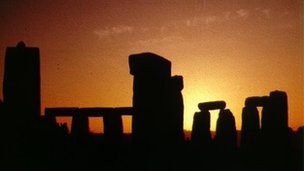
Two previously undiscovered pits have been found at Stonehenge which point to it once being used as a place of sun worship before the stones were erected.

The pits are positioned on celestial alignment at the site and may have contained stones

The pits are positioned on celestial alignment at the site and may have contained stones

The pits are positioned on celestial alignment at the site and may have contained stones, posts or fires to mark the rising and setting of the sun.

An international archaeological survey team found the pits as part of the Stonehenge Hidden Landscapes Project.

The team is using geophysical imaging techniques to investigate the site.

The archaeologists from the University of Birmingham and the Ludwig Boltzmann Institute for Archaeological Prospection in Vienna have been surveying the subsurface at the landmark since summer 2010.

Procession route

It is thought the pits, positioned within the Neolithic Cursus pathway, could have formed a procession route for ancient rituals celebrating the sun moving across the sky at the midsummer solstice.

A Cursus comprises two parallel linear ditches with banks either side closed off at the end.

Also discovered was a gap in the northern side of the Cursus, which may have been an entrance and exit point for processions taking place within the pathway.

These discoveries hint that the site was already being used as an ancient centre of ritual prior to the stones being erected more than 5,000 years ago, the team said.

Archaeologist and project leader at Birmingham University, Professor Vince Gaffney, said: “This is the first time we have seen anything quite like this at Stonehenge and it provides a more sophisticated insight into how rituals may have taken place within the Cursus and the wider landscape.”

More on this story: http://www.bbc.co.uk/news/uk-england-wiltshire-15917921

Stonehenge Special Acess Tours  – beyond the fences: http://www.histouries.co.uk/stonehenge/private-access-tour.htm

Tours of Stonehenge and Wessex
HisTOURies UK – Mystical Landscape, Magical Tours

Read Full Post »

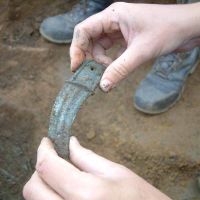
An exciting new Bronze Age hoard discovered in west Wiltshire (near Stonehenge)  has just gone on display at Salisbury Museum. It was found a month ago in a field near Tisbury by a metal detectorist. He reported the first object, a spearhead, to the Wiltshire Finds Liaison Officer. A team of archaeologists then excavated the remaining objects and recorded how they lay in the ground.

The hoard of over 100 copper alloy objects is over 2,700 years old and dates to the late Bronze Age and early Iron Age. It consists of tools – axe heads, chisels, sickles, gouges, and weapons – spearheads, daggers, knives, swords and scabbard fittings. It is the most important hoard to have been found in Wiltshire since the discovery of the Salisbury Hoard in the 1980s.

It is very unusual for a hoard of this significance to be on display in a regional museum before it has been assessed by the experts at the British Museum. The hoard will only be on display until Saturday 26 November – it will then go to the British Museum for assessment and the local coroner will need to hold an inquest to determine whether it is Treasure Trove.

See the Salisbury Journal for an article about the hoard.

 The hoard will only be on display until Saturday 26 November

Salisbury Museum – http://www.salisburymuseum.org.uk/

Wessex Guided Tours
HisTOURies UK – Mystical Landscape, Magical Tours

Read Full Post »

Out of Earth Exhibition

Out of Earth Exhibition

Renowned potter Chris Carter and archaeologist Martin Green share their fascination with the prehistoric past of Cranborne Chase.  Through art and artefact, they reveal a story of the humans that occupied the landscape before history was written.

Out of the Earth explores a dialogue between artist and archaeologist as they respond to the objects excavated from flint-rich soils of Cranborne Chase.  Artefacts from Martin’s own museum, which displays the finds he has discovered over the years, will be on display alongside Chris’s artwork and objects from Salisbury Museum and Wiltshire Heritage Museum.  Together, the objects describe and uncover the imprints left by farming, community and ritual activities in the past.

Chris and Martin describe themselves as ‘sons of the soil’, both having been raised on farms in the countrysides of Warwickshire and Dorset.  They met following a BBC4 radio show ‘Open Country’ which featured Down Farm on Cranborne Chase.  Martin had been excavating there since he inherited it in 1979 and Chris’s interest in the Chase landscape soon developed into a passion for exploring it through his art.

The exhibition shows new developments in Chris’s work and is itself a testimony to the continuing influence of prehistoric people on us today as their artistry, communities and ritual activities are re-discovered through archaeology.  Chris describes the way he searches for his pots in the clay as akin to the archaeologist’s search for an object in the earth.  Cranborne Chase has encouraged his art to take new routes which have seen him sculpting from flint and creating 2D collage works.  A deep-seated influence of the landscape and farming is apparent in his work; his pots suggest the sinuous twist of the plough and the symmetry of the stone axe, whilst the surface textures reflect the processes of people and nature on the landscape.

Both pot and artefact have a power and contemplative quality that makes Out of the Earth an exhibition not to be missed.  Here, the passion for the Cranborne landscape and for the people who lived on and moulded it, is deep-seated, inherent and heartfelt.  The stories revealed are told by two people who know the landscape intimately, both inside and out, and can tell those stories with an authority and understanding that cannot be disputed. 

Link: http://www.salisburymuseum.org.uk/exhibitions/exhibitions/174-out-of-the-earth.html
Sponsors: The Stonehenge Tour Company – www.StonehengeTours.com

Well worth a visit!

HisTOURies UK – Mystical Landscape, Magical Tours
The Best Tours in British History

Read Full Post »

The detailed route for the Olympic torch announced today sees the flame visiting more than 50 West Country communities, and passing historic landmarks including Stonehenge and Glastonbury Tor.

Olympic FlameMore than 95 per cent of the population will be within ten miles of the torch as it makes a snaking journey from Cornwall to London’s Olympic Stadium.

Torchbearers will carry it in relay. On parts of the journey it will go via horseback, bicycle, tram and steam-train.

People in Somerset will have plenty of opportunity to see the torch, despite the fact that back in 2009 the Conservative-led County Council refused to bid for it to pass through.

Resources portfolio holder Councillor David Huxtable said at the time that the cost in traffic management and disruption would be too high. But the London Organising Committee of the Olympic and Paralympic Games had an ambition to ensure that it reached most people. Many thousands of people are expected to welcome the flame along the route each day and celebrate the achievements of the torchbearers in parks, squares and streets.

Lord Coe, chairman of the Games organising committee, said: “I’m delighted that the Olympic torch relay will take the 2012 Games to almost every corner of the UK and that we have achieved our ambition to take the flame to within an hour’s journey of 95 per cent of the population.”

The route in the West

On May 21 the torch will travel to Porlock, Minehead, Dunster, Carhampton, Washford, Williton and Taunton.

May 22: Ilminster, Yeovil, Ilchester, Somerton, Street, Glastonbury, Coxley, Wells, Croscombe, Shepton Mallet, Frome, Southwick, Trowbridge, Bradford-on-Avon, Bath, Bitton, Longwell Green, Hanham, and Bristol.

May 23: Flax Bourton, Backwell Farleigh, Backwell West Town, Nailsea, Failand, Leigh Woods, back to Bristol, then on to Chippenham, Calne, Marlborough, Chiseldon, Wroughton, Royal Wootton Bassett, Swindon, Stroud, Painswick, Brockworth, Shurdington and Cheltenham.

May 24: Gloucester, Maisemore, Hartpury, Corse and Staunton and on to Ledbury, Bartestree, Lugwardine and Hereford.

July 11: Ludgershall, Tidworth, Amesbury, The Winterbournes and Salisbury.

July 12: Salisbury, Wilton, Barford St Martin, Fovant, Ludwell, Shaftesbury, Fontmell Magna, Iwerne Minster, Stourpaine, Blandford Forum, Winterborne Whitechurch, Milborne St Andrew, Puddletown, Dorchester, Winterbourne Abbas, Bridport, Chideock, Lyme Regis, Burton Bradstock, Abbotsbury, Portesham, Chickerell, Wyke Regis, Osprey Quay, Portland, Weymouth.

July 13: Portland Bill, Southwell, Weston, Easton, Fortuneswell, Weymouth, Preston, Osmington, Winfrith Newburgh, Wool, Corfe Castle, Swanage, Stoborough, and Wareham.

HisTOURies UK – Ready for the 2012 Olympics

Read Full Post »

A metal detector enthusiast located more than 100 bronze items, thought to be about 2,700 years old, on a farmland site which is being kept secret.

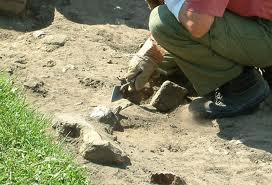
Having first found a spearhead, he decided not to disturb the ground and notified archaeologists, who were able to conduct a meticulous excavation.

The finds, from the late Bronze Age and early Iron Age, include tools such as chisels, axe heads and gouges, and weapons including fragments of a sword and scabbard and more spearheads.

Experts are hugely excited about the hoard, which is still being catalogued. They are not prepared to guess at its value yet but say it is the biggest in the area since the Salisbury Hoard – now in the British Museum – was discovered in the 1990s.

Salisbury & South Wilts Museum director Adrian Green said: “It’s a very rare and important find, and it’s still fresh out of the ground. This was not previously a known archaeological site. The guy was just metal detecting as a hobby.

“What was significant about it was that he very responsibly told the finds liaison officer for the county, Katie Hinds, who is paid by the British Museum to record finds made by chance like this, rather than just digging it up himself and potentially losing valuable archaeological information.

“This was brilliant, and exactly what we want detectorists to do. She was able to arrange a specialist team to go and dig it up. That’s very important from an academic point of view.

“You could count on two hands the number of Bronze Age hoards which have been recorded professionally by archaeologists in this way.”

The hoard will go to the British Museum to be assessed and there will be an inquest to determine whether it is treasure trove.

If so, Salisbury Museum will have a chance to raise funds to buy it.

Neither the finder nor the landowner wish to be identified
Link : http://www.salisburyjournal.co.uk/news/9336972.Ancient_artefacts_unearthed_in_Tisbury/

The Best Tours in Wessex
HisTOURies UK.  Mystical Landscape, Magical Tours

Read Full Post »

VisitWiltshire has launched a new handy sized Wiltshire Downs & Market Towns pocket guide and map, offering helpful information as part of an on-going campaign to attract and retain visitors to the county.
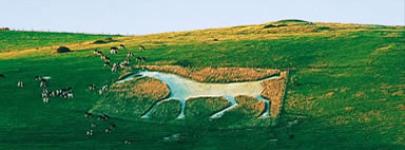
Wilsthire White Horse

The 24-page pocket guide details a host of attractions and activities to suit all ages, with information about events and festivals, food and drink, history and heritage, and the great outdoors.

David Andrews Chief Executive of VisitWiltshire highlighted the need for the guide: “This new guide is all part of the work we’re doing to celebrate the diversity of the county’s tourism product and to raise the profile of Wiltshire as a must-see holiday destination.  This is a new title for us and I’m particularly pleased that we’ve had such strong support in producing this guide from the local travel industry.”

The Wiltshire Downs are home to some of the UK’s most exciting and iconic attractions including:

The White Horses cut into the chalk hillside
The Ridgeway long distance path, which has been called the oldest road in Britain
Crofton Pumping Station, which houses the oldest working beam engine in the world
Caen Hill locks, arguably the most impressive flight of locks in the UK
Avebury, one of the most important Megalithic monuments in Europe consisting of 200 standing stones in two great circles.  This is combined with a massive bank and ditch which covers more than 28 acres
The new guide is split into clear sections making it easy for visitors to find just what they are looking for.  Amongst the highlights are events listings, suggestions for days out and plenty of pages dedicated to food and drink.  There is also a map showing the location of each individual attraction and activity.

David Dawson, Chair of Devizes Area Tourism Partnership and Director of Wiltshire Heritage Museum said, “We are delighted that VisitWiltshire has produced this timely new Wiltshire Towns & Market Towns Pocket Guide.  Given all the changes to tourism in Devizes lately it’s fantastic to see VisitWiltshire proactively targeting new visitors in this way, informing them of the best to see and do in the area.  Many of our attractions are now acting as mini tourist information centres and will be stocking the guide for anyone to use.”

As well as local circulation, the print run of 30,000 copies will be distributed proactively as part of VisitWiltshire’s marketing drive to bring additional visitors to the county.  Additional content is available to visitors online at www.visitwiltshire.co.uk.

Copies of the free ‘Pocket Guide and Map’ are available from VisitWiltshire by calling 0845 602 7323 or can be downloaded from the internet by visiting www.visitwiltshire.co.uk.

 The Best Tours in Wessex
HisTOURies UK – Mystical Landscape, Magical Tours

Read Full Post »

« Newer Posts