Feeds:
Posts
Comments

Archive for the ‘wessex’ Category

About 53,000 coins were found buried in a field in Somerset
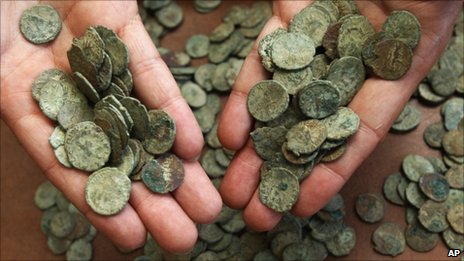
A hoard of more than 52,500 Roman coins discovered in a Somerset field has been declared treasure.

Dave Crisp, from Wiltshire, found the coins – dating from the 3rd Century AD – in April buried near Frome.

“I’ve been metal detecting since 1988 and it’s the most exciting and important find I’ve made,” he said.

A British Museum spokesman said the 160kg find was the largest single coin haul found in one pot and was probably intended as a religious offering.

Most of the coins, which are made from debased silver or bronze, are currently at the British Museum in London and includes examples from AD286 to 293 during the reign of Carausius who was the first Roman emperor to strike coins in Britain.

A small selection has gone on display at Frome Library.

Mr Crisp had earlier found a hoard of 60 silver coins in the same field before he discovered the larger pot of coins.
The coins date from the 3rd Century AD

That find was also declared treasure earlier.

Somerset County Council Heritage Service can buy the treasure for the Museum of Somerset, which is due to reopen in 2011, under the Treasure Act.

Following the ruling by East Somerset coroner Tony Williams, Mr Crisp, who works as a chef in the NHS, said: “It was a foregone conclusion that treasure would be declared today.”

He said he did not know what reward he was going to get, but would split whatever he did get equally with the farmer who owned the land according to their agreement and the law.

It has been suggested the reward could be up to £1m.

When asked how a share of the money would change his life, Mr Crisp said he did not know but added: “I’m coming up for retirement… I’ll work until I’m 65 then I’ll see.”

He added it was not the money that mattered.

“This is what matters, I’m the finder of the largest single hoard of Roman coins ever.

“I’ll always be the finder, unless someone beats me of course. There are a lot more pots out there.”

The landowner, whose surname is not being released to deter further treasure hunters, said: “I have always loved history but I never expected anything as important, exciting or old as this to be found on my land.”

WHAT IS TREASURE TROVE?

  • Where the owner of a find cannot be traced, it normally belongs to the landowner but anything declared “treasure” belongs to the Crown
  • Anyone making find that could be treasure must report it to a coroner
  • An inquest will then determine its status
  • Treasure must be at least 300 years old
  • Once something is declared treasure, the finder may be able to keep it, or an institution, such as the British Museum, may buy it
  • Objects are not treasure if their owners can be traced or if they are found on the shore but do not come from a shipwreck

  • In pictures: Roman coin hoard
  • A British Museum spokesman said the Treasure Valuation Committee would recommend a value for the hoard in October, which would be paid out when the finder, landowner and museum agreed with the valuation.

    Anna Booth, from the Portable Antiquities Scheme (PAS), said of the reward: “It will be fairly substantial but how substantial, we don’t know.

    “If they find lots of rare coins, the price could go up. It won’t be millions, but beyond that it is hard to speculate.

    “Once it has been evaluated, the British Museum will be given a chance to acquire it. If not, the local museum will have it.

    “The British Museum has already said it hopes the find will be acquired by the Museum of Somerset.

    “We are now going to be on a fundraising drive to get the money.”

    • The story of the excavation will be told in a new BBC Two archaeology series, Digging for Britain, presented by Dr Alice Roberts and made by 360production, to be broadcast in August.

      British Tour Guide
      HisTOURies UK – The Best Tours in Histoy

    Read Full Post »

    SALISBURY will be the talk of the art world next year when a John Constable exhibition is staged at the city’s museum.

    The summertime show is being organised to mark the 200th anniversary of the artist’s arrival in Salisbury. His visits to his friend John Fisher, the then Bishop of Salisbury, are widely accepted as inspiring some of his greatest paintings.

    The Constable & Salisbury exhibition will see a multi-million pound collection brought together from both private owners and major art museums.

    A final list of Constable’s paintings is still to be confirmed, but the show starting in May next year will include some of the artist’s most important work including several depicting the cathedral and the Harnham Water Meadows.

    Richard Morgan, who has led a committee of art enthusiasts in developing the project, announced the three-month exhibition this week.

    “This will be a 50-piece collection never seen before. It is work that will be gathered from the leading British galleries and others including the Fitzwilliam in the USA, National Gallery Washington and the Louvre in Paris.”

    He was guest speaker at a garden party held by Salisbury law firm Wilsons in the grounds of the museum.

    Mr Morgan added: “Museums can change places, just as we have seen in Liverpool and St Ives, and we are planning great changes in this museum.”

    He said thanks in part to funding from the English Heritage Lottery Fund they hoped to radically change Salisbury Museum and the Constable exhibition was part of this.

    Stephen Oxley, senior partner at Wilsons, said his firm had a tradition of supporting the arts in the city and they were delighted to be a sponsor of this project. “We have worked with the museum and its people for many years and when they approached us in 2008 with an idea from Lord Congleton to put on an exhibition, the likes of which had never been done before, we jumped at the chance to be involved.”

    Adrian Green, director of Salisbury Museum, said: “It is almost impossible to view Salisbury Cathedral without thinking of Constable, therefore it is surprising that there has never been a major exhibition of his work in the city.

    “As an archaeologist I particularly find Constable’s lesser known views of Old Sarum and Stonehenge evocative. One of Constable’s final exhibits at the Royal Academy was a magnificent watercolour of Stonehenge, shown there in 1836, which will be a major highlight of the exhibition for me.”

    Salisbury Tour Guide
    HisTOURies UK – The best tours of Salsibury, Stonehenge and Wessex

    Read Full Post »

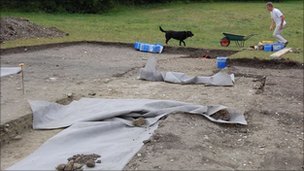
    A dwelling, thought to be 4,500 years old, has been discovered by archaeologists in Wiltshire.

    S
     “It looks as if we have a Neolithic building. We’re talking about four and a half thousand years old – so about 2400 or 2500BC.

    Excavation work at the prehistoric site of Marden Henge, near Devizes, started three weeks ago and experts say the find has “exceeded expectations”.

     Marden Henge no longer has any standing stones and is said to be one of Britain’s least understood ancient sites.

     The work is scheduled to last for three more weeks.

     Archaeologist Jim Leary, from English Heritage, said: “It’s absolutely fabulous. It’s exceeded all of our expectations.

    I don’t think we’re looking at a normal house. I think we’re looking at something equivalent to a priest’s quarters.””We have some wonderful finds coming up and some very fresh looking flint flakes and some pieces of pottery, but far and away the most exciting find so far is over in trench C.  – English Heritage

     “Up until a few years ago it would have been unique but a couple of years ago archaeologists were digging at Durrington Walls and they found a number of these buildings.

     “I don’t think we’re looking at a normal house. I think we’re looking at something equivalent to a priest’s quarters.

     “We do seem to have a hearth and it seems that whoever lived there was a very clean person and regularly cleaned out the hearth.

     “Just outside the front door we can see this long spread of charcoal and general rubbish material.

    “It contains really good fresh flint flakes, pottery, bone pins – things that don’t normally survive on archaeological sites. We’re getting a really good insight into life in that building.”

     Stonehenge Tour Guide
    HisTOURies UK – The Best Tours Wiltshire

    Read Full Post »

    « Newer Posts