Feeds:
Posts
Comments

Archive for the ‘wessex’ Category

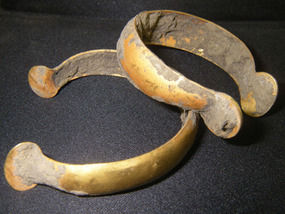
THESE beautiful Bronze Age gold bracelets are the highlights of finds at the site of a new road.

The bracelets, nearly 3,000 years old, were spotted lying on top of a pile of earth dug up from a trench.

Archaeologists are digging on the site of the planned road near Ramsgate, Kent, before builders move in

The bracelets are among 10,000 finds unearthed so far.

The dig on the East Kent Access Road on the Isle of Thanet between Ramsgate and Sandwich is the biggest archaeological excavation in the country this year, involving 150 archaeologists supported by 91 volunteers. It has revealed a huge amount about how people were living on the Isle of Thanet from earliest times.

The remains of prehistoric burial monuments, Iron Age enclosures and a village which would have seen the Roman invasion are among the remarkable discoveries made by the dig, now almost complete.

Simon Mason, Kent County Council’s principal archaeological officer, found the bracelets, dating back to around 700BC.

He said: “It was incredible – a really exciting find. I couldn’t believe it when I saw them. It’s the first time I have found gold in 20 or 30 years as an archaeologist. “They looked too good to be real. When we washed them and cleaned them we realised they were something special.”

It is thought they were child­ren’s bracelets that may have been buried as a worship offering. They were found together, one pushed inside the other.

There is evidence of a Bronze Age settlement on the find site, and five hoards of bronze objects of a similar age have been found in the same area. Mr Mason added: “Their real value to me as an archaeologist is how they contribute to the story we are putting together from our excavations on the road.

“With all the thousands of everyday objects we have dug up they are really helping to shed new light on the lives of prehistoric, Roman and Saxon people in Thanet.”

Dr Andrew Fitzpatrick from Oxford Wessex Archaeology said: “The gold bracelets are stunning.”

The Portable Antiquities Scheme

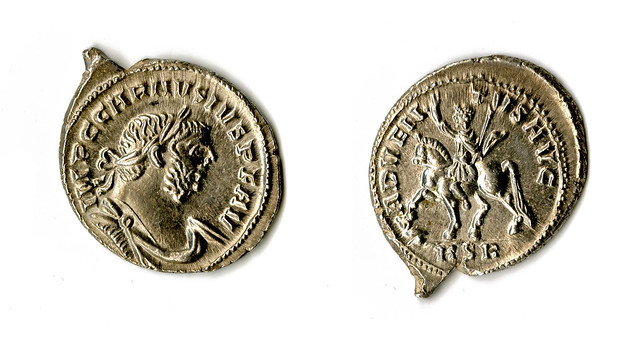
Frome Silver denarius of Carausius 286-93 Adventus (13 3) Composite image

The Portable Antiquities Scheme is a voluntary scheme to record archaeological objects found by members of the public in England and Wales. Every year many thousands of objects are discovered, many of these by metal-detector users, but also by people whilst out walking, gardening or going about their daily work. Such discoveries offer an important source for understanding our past.

This website provides background information on the Portable Antiquities Scheme, news articles, events listings and access to our database of objects and images.

The Treasure Act

All finders of gold and silver objects, and groups of coins from the same findspot, which are over 300 years old, have a legal obligation to report such items under the Treasure Act 1996. Now prehistoric base-metal assemblages found after 1st January 2003 also qualify as Treasure. This website provides further information for finders of potential Treasure

Bespoke Guided Tours of Ancient Britain
HisTOURies UK – The Best Tours in Wiltshire

Read Full Post »

Dry weather makes 2010 ‘vintage year for archaeology’ says English Heritage Britain’s dry early summer has made 2010 a “vintage year for archaeology” with crop marks revealing several hundred new sites, according to English Heritage.

The hot, dry conditions in May and June allowed aerial researchers to identify ancient sites visible through the appearance of crop marks in one of the busiest years for such finds since the long, hot summer of 1976. A Roman camp near Bradford Abbas, Dorset, was revealed in June after three sides became visible in rain-parched fields of barley. The lightly built defensive enclosure would have provided basic protection for Roman soldiers while on manoeuvres in the first century AD and is one of only four discovered in the south west of England.

  Crop marks are produced when barley or wheat growing over buried features develop at a different rate from those growing next to them because differences in the depth of soil and the availability of nutrients. English Heritage said ”full advantage” was taken of the conditions, which allowed hundreds of crop mark sites to be photographed from the air. The conditions also allowed existing sites to be photographed in greater detail. Newton Kyme, near Tadcaster, North Yorkshire, was shown to not only be home to a Roman fort dating back 2,000 years but also a larger, stronger defence built in 290AD. Stone walls up to three metres thick and a ditch 15 metres wide were revealed by an image taken from a Cessna light aircraft. Dave MacLeod, an English Heritage senior investigator based in York, said: ”It’s hard to remember a better year. ”Cropmarks are always at their best in dry weather, but the last few summers have been a disappointment. ”This year we have taken full advantage of the conditions. We try to concentrate on areas that in an average year don’t produce much archaeology. ”Sorties to the West Midlands and Cumbria, together with more local areas such as the Yorkshire Wolds and Vale of York, have all been very rewarding.” Flights over the Holderness area of the East Riding proved particularly productive with around 60 new sites, mainly prehistoric, found in just one day including livestock and settlement enclosures. English Heritage said some sites which have not been visible since the drought of 1976 reappeared this summer. Damian Grady, a Swindon-based English Heritage senior investigator, said: ”Promising signs started to emerge in late May when the dry conditions had started to reveal cropmarks on well drained soils, especially river gravels and chalk in the east and south east of England. ”By June it became clear that the continuing dry conditions would produce good results across most of the country. ”We then targeted areas that do not always produce cropmarks, such as clay soils, or have seen little reconnaissance in recent years due to recent wet summers or busy airspace. ”Unfortunately July saw deterioration in the weather which reduced the amount of flying we could do and the cropmarks started to disappear just before the harvest got under way.” Mr Grady added: ”It will take some time to take stock of all the sites we have photographed, but we expect to discover several hundred new sites across England.” Crop marks are produced when crops growing over buried features develop at a different rate to those growing immediately adjacent. For example, over a soil filled ditch the deeper soil may provide better moisture retention and more nutrients allowing the crop to grow faster and taller. Over a buried wall, for example, the shallower soil may produce a stunted crop and one more liable to parching under dry conditions.
The first record of aerial surveys dates back to 1906 when Stonehenge was photographed from above from a hot air balloon.
Wiltshire Tour Guide
HisTOURies – The Best Tours in British History

Read Full Post »

Later Silbury – Archaeological evaluation of the fields south of Silbury Hill, Wiltshire.

This project aims to evaluate the Roman settlement in the fields south of Silbury Hill, to improve our understanding of a poorly-understood phase of activity around the monument and to provide information to help with its future care within the Stonehenge, Avebury and Associated Sites World Heritage Site.

English Heritage’s Silbury Hill Conservation Project started in 2001, following a series of collapses within the Hill. In 2007, and research and rescue excavation stabilised the Hill and consolidated it for the future.

As part of the Conservation Project, English Heritage’s Geophysical Survey team carried out extensive surveys of the fields around the monument. You can read a summary of their results in Research News (Issue 10: Winter 2008-09, pages 10-13).

In the large field south of the A4 – a Roman road – extensive evidence for archaeological features shows clearly in the magnetometer survey, and ground-penetrating radar has added the details of several large stone buildings to the picture.  We think that this is a Roman roadside settlement or small town. Roman activity around Silbury has been known since the 19thcentury, when wells and middens were excavated. In the 1990s, air photographs and excavation provided new evidence for stone buildings set along a trackway on the slopes of Waden Hill, east of Silbury.

Being able to see the layout of an extensive settlement was a new and exciting discovery. It has raised many questions about the area around Silbury Hill and how it was used in the Roman period – and many of these can only be answered by excavation.

So this summer, as part of the new Later Silbury project, archaeologists and archaeological scientists from our Research Department based at Fort Cumberland are excavating some evaluation trenches in the fields south of the Hill.

We aim to: 

  • Understand more about the settlement itself – what activities can we find evidence for? When was it occupied? Is there any evidence for its ritual or religious role?
  • Investigate its relationship to Silbury Hill and surroundings – how did it fit in with the ritual landscape of Silbury Hill and Avebury, more than 2000 years after they were built?
  • Find out more about the past environment and use of the landscape around the hill and in the Winterbourne and Kennet valleys.
  • See how well the archaeological remains survive, and how deeply they are buried – this will help plan the management of the site and its safe preservation.
Silbury Hill

Silbury Hill

Silbury Hill is huge; it is likely to have involved roughly 4 million man-hours of work and 500,000 tonnes of material.

The largest man-made mound in Europe, mysterious Silbury Hill compares in height and volume to the roughly contemporary Egyptian pyramids. Probably completed in around 2400 BC, it apparently contains no burial. Though clearly important in itself, its purpose and significance remain unknown. There is no access to the hill itself.

It is part of the Avebury World Heritage Site.

Stonehenge and Avebury Stone Circle Tour Guide
HisTOURies UK Tours – Bringing History alive

Read Full Post »


FEATURED EVENT

Wednesday 18th August to Sunday 22nd August 2010 11am – 5pm
Old Sarum, Wiltshire

Tommies and Trenches. We pay tribute to the the soldiers who fought for us in the Great War. Visit the trench, learn about life at home and then join us at the weekend as we are joined by more soldiers from the Great War Society and Meg the pack mule who will demonstrate how animals were used during the war. An English Heritage event

2010
29th / 31st October 2010
Warwickshire Exhibition Centre, The Fosse Way, Leamington Spa, CV31 1XN

INTERNATIONAL LIVING HISTORY FAIR. Currently staged twice a year in February and October, the International Living History Fair has become the primary multi-period market place for re-enactors, historical interpreters and historical enthusiasts across Europe. The International Living History Fair exists to provide a market place, a meeting place and a fabulous opportunity for all, visitors and re-enactors alike, to meet and discuss all periods of our historical past. Many of Europe’s best artisans, craftsmen and traders are on hand happy to advise on and provide a huge array of items and replicas of our historical heritage. Admission Charges £3.50
(Children 5 – 15 £1.50)

More details:
http://www.livinghistoryfairs.com

PREHISTORIC BRITAIN  4000BC – 43AD

4th and 5th September 2010
Chiltern Open Air Museum, Chalfont St. Giles, Bucks HP8 4AB

Iron Age Weekend.


43AD – 410

Monday 30th August 2010
Binchester Roman Fort, nr. Bishop Auckland, Co. Durham

Roma Antiqua and Legio IX re-occupy Binchester. See military equipment like sling-staffs, bows and arrows and even a catapult being put to use on the battlefield!

25th & 26th September 2010
Caldicot Castle, Caldicot, Monmouthshire, NP26 4HU

Romans & Britons Re-enactment Event. Experience the new province of Britannia brought to life through living history and combat displays by The Vicus. See how they lived, their craftsmanship and how Romano-British civilians, armoured Roman soldiers and native warriors coexisted in the 1st Century AD.

Second Weekend in Every Month
Veralamium Museum, StyAlbans

Legion XIIII on Guard. Verulamium Museum is invaded every second weekend in the monthby Roman soldiers who demonstrate the tactics and equipment of the Roman Imperial Army. Free.
Contact  01727 751 810


410 – 1066

14th August 2010  10.30am – 5pm
Sutton Hoo, Suffolk

Anglo-Saxon Encampment with Ealdfaeder. Come and see how the Anglo Saxons lived. Watch demonstrations of craft and cookery, listen to Anglo Saxon tales and learn about clothing and weaponry.

29th & 30th August 2010
Rockingham Castle, Rockingham, Market Harborough, Leicestershire LE16 8TH

Vikings! of Middle England. The Vikings return! Be prepared for battles, horses, pageant, living history camp and much more. Noon to 5pm.

Every night throughout the year
Market Square, Ripon, North Yorkshire

Every night, in a tradition dating from  886 A.D.,  at 9 pm. the Wakeman blows his horn in the Market Square at the four corners of the Obelisk to ‘set the watch’. The City has 3 ‘sounding’ horns, the oldest of which (no longer blown because of antiquity) is known as the ‘Charter’ horn and is dated A.D. 886 since, according to ancient tradition, it symbolised the granting of ‘charter rites’ to Ripon in that year. The second horn is dated 1690; the third, an African Ox horn (blown daily today) was given to the city in 1865 by the then serving Mayor.

1066 – 1216

Saturday 7th August & Sunday 8th August 2010 10am – 5pm
1066 Battle of Hastings, Abbey and Battlefield, East Sussex

Saxons and Normans. Step inside a world of Saxons and Normans. Witness soldiers preparing armour, see tradesmen carrying out woodwork and learn about traditional cooking methods. An English Heritage event

Tuesday 10th August & Wednesday 11th August 2010 10am – 5pm
Carisbrooke Castle, Isle of Wight

Time Travellers Go….Normans and Saxons. Step inside a world of Saxons and Normans. Witness soldiers preparing armour, see tradesmen carrying out woodwork and learn about traditional cooking methods. An English Heritage event

1216 – 1485

Saturday 21st August & Sunday 22nd August 2010 11am – 4pm
Conisbrough Castle, South Yorkshire

Medieval Castle Clash. Watch the Escafeld re-enactors gather for courtly pursuits of archery, dancing and presentations of the arming of knights as the mighty castle of Conisbrough becomes the stage for the medieval pageant of the knights. Be sure not to miss the dramatic conclusion with the main Tournament of Knights at 3pm.

Wednesday 25th August & Thursday 26th August 2010 11am – 4pm
Warkworth Castle and Hermitage, Northumberland

Soldiers of the Roses. Discover the assassins before they strike! Come to Warkworth Castle and unlock the intricate medieval living history, listen in to the dramatic dialogue of the armoured Knights and livery men taking part in hand to hand medieval combat. It is the summer of 1464 and the Scots intend to withdraw support from the exiled Lancastrians and sue for peace with Edward IV. Gather at the castle to pledge your allegiance to the house of York or Lancaster.

VIDEO SHORT:
Wars of the Roses Re-enactment, Kenilworth Castle 2007

First weekend of every month, July to September 2010 11am – 4pm

The largest restored medieval aisled hall in Wales will open its doors to visitors the first weekend of every month from July to September with a costumed guided tour and medieval living history displays in the grounds, including 15th century cooking, crafts and archery. The day offers a unique insight into life in medieval Wales and is supported by the local heritage group ‘History Matters’ and reenactors from the ‘Montgomery Levy’ living history society.


1485 – 1603

Tuesday 3rd August & Wednesday 4th August 2010 11am – 4pm
Warkworth Castle and Hermitage, Northumberland

Gruesome Tudors. Tudor England could be a gruesome place. Discover the head chopping antics of King Henry VIII with light hearted performances of ‘Top of the Chops”! Plus, meet the Executioner and the Barber Surgeon and a variety of other gory characters and hear their terrible tales.

Sunday 29th August & Bank Holiday Monday 30th August 2010 11am – 5pm
Kenilworth Castle and Elizabethan Garden, Warwickshire

Kenilworth through the Ages. Join us as we take a step back into Kenilworth’s turbulent past, from the Normans who built the castle to the Tudors who lived here. Explore the living history camps and allow our arena displays to tell stories of the castles history.


THE  1603 – 1714Sunday 29th August & Bank Holiday Monday 30th August 2010 11am – 5pm
Goodrich Castle, Herefordshire

Siege of Goodrich. Join the Wardour garrison as we step back to the Civil War and witness displays of life from over 360 years ago. 2010 marks the 21st anniversary of the group, who have been authentically recreating life from this period at many castles throughout the country. Witness the siege of the castle complete with musket firings, plus visit the living history camp to see displays of cookery, weaving and surgery. Enjoy music inside the castle plus families can have fun taking part in traditional games and a quiz.

31st October 2010  11am – 5pm
Caldicot Castle, Caldicot, Monmouthshire NP26 4HU

All Hallows Highwaymen! Meet the Highway robbers of the past in person & hear their tales of adventure, but watch out! The local constable and Militia have got wind of this gathering of rouges, and things could certainly turn sour.
A living history day with 17th Century Life3 and Times.

VIDEO SHORT:
The Kings Army March, Whitehall, London, 31st January 2010

On the 31st January 2010 The English Civil War Society carried out The King’s Army March, following the route taken by Charles I to the place of his death.

BRITAIN 1714 – 1837

14th August 2010 – Gates open 4.30pm
Althorp Hall, Northamptonshire

Battle Proms 2010. Before the afternoon’s entertainment begins, there’s time to visit the fascinating Napoleonic encampment6.45pm Napoleonic Cavalry and Infantry displays. The ‘age of elegance’ is expertly brought to life as the Napoleonic Association demonstrate the skills needed to survive on the battlefields of the period. It’s acaptivating and colourful display of top-class horsemanship; expect lances, rifles, chivalry and plenty of cheering!  7.25pm Evening gun salute byThe English Field Artillery Company, answered by infantry musket fire.

7.30pm – 10.00pm The Musical Programme – New English Concert Orchestra. The historic rumble of the Spitfire engine will accompany the beautiful opening pieces of the musical programme, as a meticulously choreographed aerial display is executed in the skies over the concert arena. In true Battle Proms style, the evening continues with awealth of triumphal classics including Tchaikovsky’s 1812 Overture with live cannon fire, and of course the signature piece which gives this special event its name:Beethoven’s ‘Battle Symphony, a work which was originally composed to include thefiring of 193 cannon as part of the score.

The Battle Proms is the only regular concert in the world to rise dramatically to this challenge using live cannon with real black powder explosions, each fired electronically according to the original score by the orchestra’s percussionist. Add to this a sky lit with precisely and expertly launched fireworks, and you truly have a spectacle of unforgettable dramatic impact.

Then it’s time to warm up your singing voice for the traditional flag-waving proms finale, including favourites Jerusalem, Rule Britannia and Land of Hope and Glory, culminating in a dazzling firework spectacular!

More details: http://www.battleproms.com/Althorp-Park-14-August-2010

THE AGE 1837 – 1901

7th & 8th August 2010  10am – 5pm
Blists Hill Victorian Town, Ironbridge, Shropshire

Soldiers of the Queen Weekend. Find out about the life of a soldier during the reign of Queen Victoria, and see a military camp on the Green at Blists Hill Victorian Town, Ironbridge.

21st – 29th August 2010
Llandrindod Wells, Powys, LD1 5DG

Llandrindod Wells Victorian Festival. Llandrindod Wells is proud to present the leading Victorian Festival in the UK today.  Set in the beautiful heart of Wales, it is held in the last full week of August before the Bank Holiday. As Llandrindod was a thriving spa resort in the Victorian era it seems natural to base the Festival on the Victorian theme.  The town’s unspoilt architecture provides a perfect backdrop to the celebrations, and on Temple Gardens and Middleton Street we have ideal venues for the many different types of street entertainment provided free  throughout the day. The 9 day Festival will be incorporating some new events and street entertainment with some of the old favourites which regular Festival-goers have come to love. More details: http://www.victorianfestival.co.uk/

29th & 30th August 2010  11am – 5pm
Pendennis Castle, Cornwall

A Grand Victorian Fayre. Experience 19th century entertainment at its finest! Marvel at the breathtaking gymkhana skills, enjoy the silliness of the Victorian side show as we challenge you to count the fleas in the Victorian flea circus, meet the “Soldiers of the Queen” and don’t forget to curtsey for Her Majesty as she passes by. Plus, there’s traditional music from a local Cornish brass band who are here to entertain the Queen and a grand parade around the castle.

26th September 2010 1pm-3pm
London: starting at Guildhall Yard, Gresham Street, London EC2

Costermongers’ Harvest Festival Parade. A parade of a marching band, street traders (“Costermongers”), Pearly Kings and Queens and Victorian Characters from 1-3pm, starting at Guildhall Yard, Gresham Street EC2 London. This is followed by a Harvest Festival service at 3-4pm at St Mary Le Bow Church, Cheapside EC2. A “harvest festival” is a traditional thanksgiving ceremony, to give thanks after crops have been harvested successfully.

ERA AND WW1
1901 – 1918

Wednesday 18th August to Sunday 22nd August 2010 11am – 5pm
Old Sarum, Wiltshire

Tommies and Trenches. We pay tribute to the the soldiers who fought for us in the Great War. Visit the trench, learn about life at home and then join us at the weekend as we are joined by more soldiers from the Great War Society and Meg the pack mule who will demonstrate how animals were used during the war.


An Edwardian Banquet. Our 7 course Edwardian Banquet takes place every Saturday night and is served by staff in Edwardian tails and the girls in mob caps and aprons ( as in ‘Upstairs Downstairs’). All the food is presented to guests as it would be at one of Edward VII’s banquets. There is a short interlude by an actress describing Lillie Langtry’s and Edwards’s story in words and music.

Last Sunday of Every Month: Sun. 29th August 2010
The Forties Experience, Lincolnsfields Children’s Centre, Bushey Hall Drive, Bushey Herts. WD23 2ES

1940s Experience Days – 1940s House Open Days. Open last Sunday of each month. More details: 01923 233841.

11th & 12th September 2010 10am – 6pm
The Royal Airforce Museum, Grahame Park Way, Hendon, London NW9 5LL

Battle of Britain 70th Anniversary Living History Weekend. Bring the whole family to the RAF Battle of Britain Living History Weekend to watch re-enactments and learn more about life during the battle. This year, the RAF Museum is inviting visitors to remember the conflict which took place in the skies during WWII and is often dubbed the nation’s “finest hour”. Highlights include:

  • Flypast by a Spitfire and Hurricane from the Battle of Britain Memorial Flight (weather permitting)
  • Living history areas with re-enactors
  • Performance by the RAFA band
  • Film screenings of the Battle of Britain and Deep Blue Sky in the Museum’s 250-seat cinema
  • Archive film footage from the Battle of Britain including the White Eagle which examines the contribution made by Polish Fighter Pilots during the Battle of Britain, andFighter Pilot which shows actual Battle footage
  • Outdoor vintage vehicle display

HisTOURies UK – Bringing History Alive
Bespoke Private Guided Tours of England

Read Full Post »

Streaking down towards Stonehenge across the path of all the other stars in the sky, this shooting star is hurtling to Earth at 135,000 miles per hour – 100 times the speed of Concorde.

The smaller, diagonal lines on the photo are normal stars, with the long-exposure photography tracing their movement in the sky as Earth revolves.

The longer, almost vertical streak of light is the shooting star, which stems from grains of dust left behind by the comet Swift-Tuttle as it sweeps through space.

A meteor streaks past stars in the night sky over Stonehenge in Salisbury Plain

A meteor streaks past stars in the night sky over Stonehenge in Salisbury Plain.  More personal photos will be uploaded later this week.

Stonehenge Tour Guide
HisTOURies UK – Guided Tours of Stonehenge Stone Circle

Read Full Post »

First sighting of Perseids in Wiltshire

Perseids

The Perseids are particles left in the wake of the Swift-Tuttle comet

A Wiltshire man was startled to see a bright light in the sky travelling fast on Saturday 7 August.

Daniel Hodder from Salisbury was travelling along the A303 when he spotted the object.

He said: “We saw an enormous light in the sky north of Amesbury. We could only assume it was a meteorite.

“It was a very bright, white and blue light moving incredibly fast to our right-hand side, there was a long stream, a long tail of about 400 or 500 metres.”

Andy Burns from the Wiltshire Astronomical Society had a straightforward explanation for what Daniel and several other people witnessed on the day.

He said: “What has been seen is a meteor, not a meteorite. A meteorite actually lands on the earth and is a lump of rock or stone that you can pick up. A meteor is a stone in the atmosphere that burns up.

“What we are seeing is the beginnings of the Perseids meteor shower. This tallies with the very bright fireball that has been seen in the north. You don’t need a telescope to see this type of phenomenon, you can see it with the naked eye.”

Daniel Hodder from Salisbury spotted the Perseids on Saturday 7 August

The Perseids are visible between 23 July and 22 August every year, but peak activity is expected on the nights of 12 and 13 August with around 80 meteors per hour.

Like most meteor showers, the Perseids can be traced to the orbit of a comet, in this case that of Swift-Tuttle.

The meteors consist of dust-sized particles which burn up on entering the Earth’s atmosphere, at an altitude of 60 to 70 miles, as the Earth passes through the trail left by the comet.

It’s consistently impressive display can be traced as far back as 36AD when Chinese astronomers noted high numbers of meteors.

The best way to observe them is to look towards the northeast after dark. They appear to originate from the constellation of Perseus, which at midnight lies just below the easily recognisable ‘W’ of Cassiopeia.

The highest frequency of meteors is likely just after midnight but with the moon, just past full, the best time to look for the ‘shooting stars’ will be between 9:00pm and 10:00pm when the moon is still low.

The chalk downland of Salisbury Plain near Stonehenge was named by the National Trust in 2009 as one of the seven best places in the UK to witness the Perseids.

They consider that light pollution in towns and cities has increased so much in recent years, that the countryside is the perfect environment to witness such astronomical spectacles as the Perseids.

Stonehenge has been voted the best place to witnes this meteor shower

Stonehenge Tour Guide
HisTOURies UK – The Best Tours of Stonehenge and Wiltshire

Read Full Post »

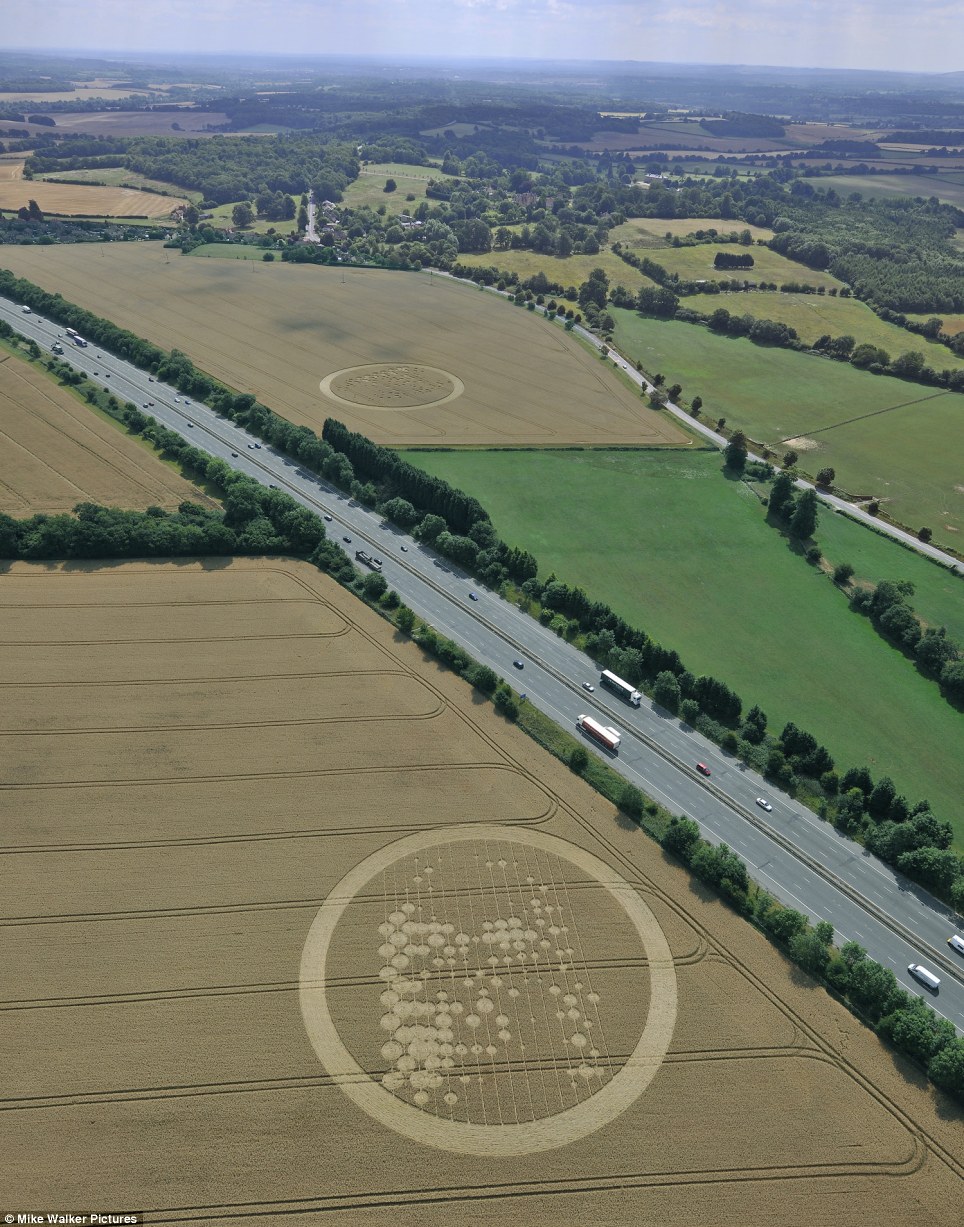
Drivers speed along one of Britain’s busiest motorways completely oblivious to the Holy presence that surrounds them.
Crop Circle
For two crop circles depicting the face of Jesus Christ have appeared on either side of the M4 near Hungerford in Berkshire.
The two almost identical circles, both 250ft in diameter, seem to portray Jesus Christ in an image resembling the world famous Shroud of Turin.

The two crop circles in fields of wheat either side of the M4 near Hungerford, Berkshire, both resemble the face of Jesus Christ in the world famous Shroud of Turin

The Shroud of Turin is believed by many to be the cloth used to cover Christ at the time of his burial and the face on the shroud is believed to be the face of Jesus himself.
Crop circle expert, Karen Alexander, said: ‘These circles are causing quite a stir in the crop circle community. The last time a face appeared as a crop circle was in 2002 when an alien face appeared at Sparsholt in Hampshire. Farmers whose land is used to make the circles worry that they will be inundated with visitors seeking a religious experience.’
But with the Harvest Festival approaching, they may regard the crops in the fields of wheat as a good omen.

Crop Circle Tour Guide
HisTOURies UK – The Best Tours in Wessex

Read Full Post »

Stonehenge - a wooden neighbour has been discovered
 Stonehenge – a wooden neighbour has been discovered

Stonehenge had a previously unknown wooden “twin” just 900m to its north-west, according to remarkable new archaeological investigations.

Using the ground-penetrating equivalent of an X-ray, scientists have discovered what appears to have been a circle of massive timber obelisks, constructed more than 4,200 years ago.

The newly discovered “henge” would have been visible from Stonehenge itself – and seems to have been part of a wider prehistoric ritual and religious landscape. Roughly 25m in diameter, it was almost the same size as the central part (the circle of standing stones) at Stonehenge itself.
The newly discovered monument – almost certainly some sort of Neolithic temple – is thought to have consisted of 24 wooden obelisks, each around 75cm in diameter and therefore potentially up to 8m high. The circle of obelisks was enclosed by an inner ditch and probable outer bank.

 Of potential significance is the fact that the newly found henge “mirrors” a similar monument (this time long known to archaeologists) on the other side of Stonehenge – 1,300m south-east of the famous monument. Like the newly discovered site, it is in direct line of sight of Stonehenge and had two entrances. All three monuments would have been roughly aligned.

 The discovery of the site north-west of the stone circle suggests that the Stonehenge landscape was even more complex than people have thought – and archaeologists are now keen to find further unknown elements of it.

The archaeologists – from Birmingham, Bradford, St Andrews and Vienna Universities – are trying to map the unknown aspects of the Stonehenge landscape without digging a single hole.

Instead of conventional excavations, they are using X-ray-style systems which look beneath the ground surface. The techniques – including magnetometry, ground-penetrating radar, electrical imaging and resistivity – are likely to yield huge amounts of previously unknown information about what the Stonehenge landscape looked like 40 to 50 centuries ago.

 Over the next four years the survey, led by Professor Vince Gaffney of Birmingham University’s Institute of Archaeology and Antiquity, is likely to produce hundreds of millions of pieces of information from 14 sq km of countryside which will then be collated and analysed to produce a detailed map.  “Some 90 per cent of the Stonehenge landscape is still terra incognita. Our survey will hopefully begin to remedy our current lack of knowledge,” explained Professor Gaffney. “The discovery will significantly change the way we think about the landscape around Stonehenge.”

 The newly discovered prehistoric temple was found using the subsurface archaeological detection system known as magnetometry, which measures the differences in interaction with the Earth’s magnetic field produced by different layers or deposits of earth or rock.

 Detecting variations in the strength of the magnetic field revealed the existence of the enclosure ditches and the pits believed to have held the timber obelisks at the newly discovered henge.

 Stonehenge Tourist Guide
HisTOURies UK – Stonehenge Guided Sightseeing Trips

Read Full Post »

Salisbury Museum is based in the King’s House, a grade I listed building located opposite Salisbury Cathedral. We have a small but friendly staff, supported by over 100 volunteers. We offer a variety of services, including the opportunity to hire this unique location for corporate events and activities.

About the Museum

About SAlisbury MuseumThe Museum is located in the King’s House, situated in the glorious setting of the Cathedral Close. The King’s House is a Grade I listed building, the history of which stretches back to the 13th Century. It formerly housed a teacher training college and was the inspiration for an episode in Thomas Hardy’s novel Jude the Obscure.

The main strength of the Museum rests in its archaeological collections: these include prehistoric material from South Wiltshire, including Stonehenge; the Pitt Rivers’ Wessex collection; and a fine medieval collection including finds from Old Sarum, Clarendon Palace and the city itself. In addition we have fascinating displays of costume and ceramics, and regular temporary exhibitions.

The Museum is a limited liability company (no. 1826436) and a registered charity (no. 289850). It is Accredited by the Museums, Libraries and Archives Council (no. 878). Its archaeological collections in particular are of national significance and they received Department for Culture, Media and Sport Designated status in 1998.

Salisbury Museum receives some funding from Wiltshire Council, but most of our income derives from a variety of other sources including admission charges, membership, donations and legacies.

The Museum’s mission is to provide a creative and responsive museum, which collects, preserves and presents objects and information of significance relating to the past of Salisbury and south Wiltshire.

Its purpose is to encourage learning, research, publication and enjoyment of its collections, seeking to do this in a professional, friendly and stimulating way. It aims to provide a lively service for the benefit of the whole community within Salisbury and south Wiltshire, as well as for students, scholars, and visitors from this country and around the world.

Whats on2010:

07 Aug 2010 – 14 Aug 2010 Medieval Hats, Masks and Shields Lecture Hall For Families
10 Aug 2010 Art Day – Gorgeous Georgians Lecture Hall For Families
17 Aug 2010 Science Day – Build a Sun Dial Lecture Hall For Families
20 Aug 2010 Make a Mosaic Meetings Room For Families
22 Aug 2010 Romeo and Juliet: Illyria Theatre Company Back Garden Plays
24 Aug 2010 Art Day – Scrap Animals Lecture Hall For Families
31 Aug 2010 Science Day – Design a Wind Sock Lecture Hall For Families
14 Sep 2010 Surveying Historic Buildings: the changing techniques and use of 3d imagery in building recording Lecture Hall Lectures
02 Oct 2010 – 03 Oct 2010 Conference: 150 Years of Salisbury Museum Lecture Hall Events
06 Oct 2010 – 24 Nov 2010 Medieval Life: a series of lectures by Nick Griffiths Lecture Hall Courses
07 Oct 2010 ‘A History of his Affections’: The importance of Salisbury in the wider context of Constable’s art Lecture Hall Lectures
12 Oct 2010 A Day in the Life: a Master Gunner on the Mary Rose Lecture Hall Lectures
20 Oct 2010 – 15 Jan 2011 Walls of Sound Major Exhibition Galleries Exhibitions
20 Oct 2010 Organised Chaos, a series of cock-ups in Royal and Military events Lecture Hall Lectures
03 Nov 2010 SARUM, the Inspiration of Salisbury Lecture Hall Lectures
09 Nov 2010 Collingbourne Ducis – Update Lecture Hall Lectures
17 Nov 2010 Clarendon Lecture Hall Lectures
14 Dec 2010 Bodies from the Bog: what science has told us about the bog people Lecture Hall Lectures

Whilst visiting Salisbury please take the time to visit the Salisbury Museum.

Stonehenge and Salisbury Tour Guide
HisTOURies UK – The Best Tours in Wiltshire

Read Full Post »

For those who have been on tour with me recently talking about the mysterious ‘warminster triangle’ – thought you may find this intersesting.  Watch this –  Pie in the Sky, a BBC TV programme from 1966 presented by Kenneth Hudson, which investigated the mysterious objects seen above Warminster

Warminster’s long and controversial UFO history began early on Christmas Day, 1964.

Arthur Shuttlewood reported in his book The Warminster Mystery: “The air was brazenly filled with a menacing sound.

“Sudden vibrations came overhead, chilling in intensity.

“They tore the quiet atmosphere to raucous rags and descended upon her savagely. Shockwaves pounded at her head, neck and shoulders.”

Other such “sonic attacks” which occurred at around the same time in different locations around the town were later reported. Shuttlewood, at the time was the features editor on the local weekly newspaper, The Warminster Journal.

Within weeks, the floodgates opened, and the phenomenon was christened “The thing” by the locals, as no one had actually seen anything that could be attributed to the cause. The townsfolk had never heard of UFOs or ‘flying saucers’ at the time.

Strange objects

By June 1965, strange objects were being seen in the skies around the town. Shuttlewood amassed a sizable file on these sightings, and it was not until September, 1965, when he reported seeing a UFO from his home, that he became a believer in the enigma.

Shuttlewood soon became the voice and champion of The Warminster mystery.

Gordon Faulkner's Warminster 'UFO' photo

The iconic image of Warminster’s UFO was taken by Gordon Faulkner in 1965

Some students of the Warminster enigma believe that Shuttlewood became so immersed in the whole concept, that logic went out of the window as far as he was concerned.

The iconic image of Warminster’s UFO activity is a photograph, taken by Gordon Faulkner in 1965. It shows a typical ‘flying saucer’, which is so enlarged that the grain of the film emulsion is clearly visible.

Faulkner handed the picture to Shuttlewood, and told the reporter to “do as he seemed fit with it”.

Shuttlewood handed it to the Daily Mirror. It was printed in the paper on 10 September 1965. It gained the town a vast amount of publicity, and some would say, notoriety.

Within weeks, thousands of people began to converge on the town to see this strange phenomenon for themselves. Such was the concern of the local populace, that a public meeting was held in the town over the August Bank Holiday.

Pie in the Sky

BBC West filmed a half-hour documentary in 1966, entitled Pie in the Sky. Of all the programmes made about the town, this is by far the most level and fair.

Shuttlewood was by now contemplating writing a book on the events in the town. The Warminster Mystery was published in 1967 by Neville Spearman, followed a year later by Warnings from Flying Friends, which was self-published by Shuttlewood.

Sightings of “The thing” continued, but, by the early 1970s, they were beginning to decline.

This was partly due to Warminster being old news, and the numbers of sky-watchers on the hill dropped due in main to lack of nationwide publicity.

Arthur Shuttlewood

Arthur Shuttlewood was Features Editor for the Warminster Journal

A local UFO buff, Ken Rogers, began publishing The Warminster UFO newsletter in August, 1971.

Shuttlewood’s third book on the phenomenon was UFOs: Key to the New Age, which was published in 1971. This book, of all the titles written by Shuttlewood, is probably the most contentious of all. Shuttlewood’s own personal theories seem, by today’s standards to be quite absurd.

The Warminster UFO newsletter continued publication into 1973. Shuttlewood, it seems took a sabbatical from writing books for a number of years, but still took an active part in sky-watches and the local UFO scene.

In the same year, The Warminster mystery was published in paperback by Tandem books.

The Fountain Journal

Late in 1975, or early 1976 saw a new research centre open in the town. The Fountain Centre, located in Carlton Villa, Portway, was run by Peter and Jane Paget.

Along with Jane’s mother, Mrs Margaret Tedder-Shepperd, the Pagets renamed the property Star House with the intention of running not only a research facility in the town, but to offer bed and breakfast to sky-watchers who were visiting the town.

Another project they planned was the publication of The Fountain Journal, a bi-monthly magazine centred on the UFO sightings reported in and around the Warminster area.

Fountain Journal

In the 1970s, a magazine about UFO sightings in the area was published

Shuttlewood joined the editorial team early on, before the publication of issue one.

The first three issues, which were edited by the Pagets, Mrs Tedder-Shepherd and Arthur Shuttlewood, contained much more information on the local UFO scene than later issues.

This was in part due to the input of Shuttlewood himself, until he had a protracted period of ill-health.

Shuttlewood bowed out, and at around the same time, The Flying Saucerers, was published in November 1976.

Mrs Tedder-Shepherd, who was a co-owner of the centre and had a 50% stake in the property, withdrew her support, leaving the Pagets to continue to run the centre with rapidly dwindling funds.

With mounting pressures on them and the local UFO researchers becoming more hostile towards the Fountain Centre, the publication of the Fountain Journal became more sporadic. Issue 11, dated only 1977, was the last to be published.

Another research group, UFO – Info, had set up in the town. This new group, which, unlike the Fountain Centre, was run and staffed by unpaid volunteers.

Shuttlewood had two further books published in the late 1970s – UFO Magic in Motion, and his final book, More UFOs over Warminster in 1979.

Arthur Shuttlewood died in Warminster in 1996. With his death, the last lingering memories slowly faded away.

Warminster enigma

So what does the future hold for Warminster and its rich and diverse UFO history? Warminster will always remain an enigma. It is now largely forgotten in the annals of British UFO history.

Whether Warminster was a cultural/social event or a genuine Ufocal, far too much time has now passed for any accurate investigations to be made.

One thing is certain however. Despite all the new research into the phenomena in this quiet Wiltshire town all I can say is this: something strange did happen there. I know. For a time, I was part of it.

For more information visit Kevin Goodman’s UFO Warminster website.~

Stonehenge Tour Guide
HisTOURies UK – The most mysterious tours in Wiltshire (Ha, ha)

Read Full Post »
« Newer Posts - Older Posts »