Feeds:
Posts
Comments

Archive for the ‘Wiltshire’ Category

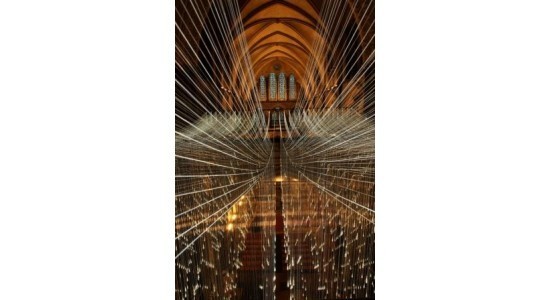
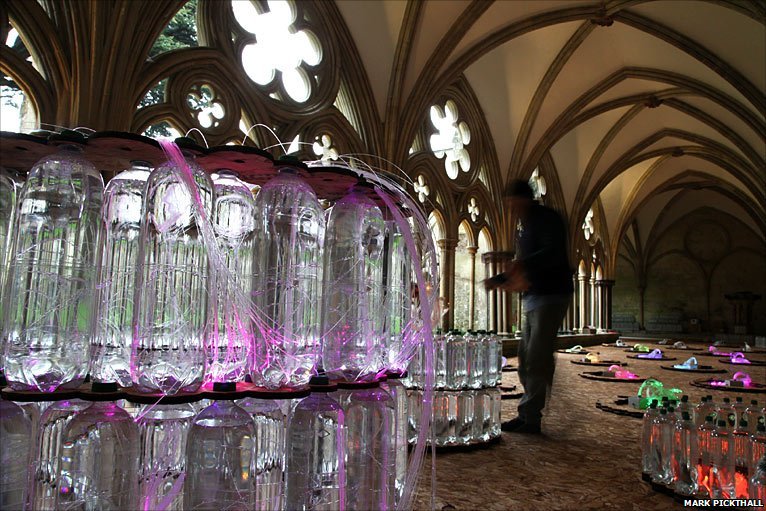
Bruce Munro’s ‘Light Shower’ is now installed high in the Cathedral’s Spire Crossing where, from Monday 29 November, it will be switched on all day and light will cascade through the fibre optics to the 2,000 teardrop shaped diffusers. Light as gossamer, Light Shower is simply incredibly beautiful. It will stay in the Cathedral until the end of February.

Light Showers Number Crunching:
40,000 metres of fibre
1984 teardrop diffusers
32 rows of 64 drops
8 x 150 watt metal halide projectors
400 man hours to make
232 man hours to install

Bruce Munro’s Water Towers, a maze of huge towers made of stacked recycled water bottles, will be installed in the cloisters in early January 2011. They are illuminated with fibre optics powered by energy-conserving LED lamps, and will change colour synchronized to choral music.

Bruce Munro’s work is currently showing at ‘Contemplating the Void’ at the Guggenheim in New York. His acclaimed Field of Light was seen at the Eden Project in 2008/9. “I am deeply honoured to be invited to show at Salisbury Cathedral” says Munro. “It is a truly amazing building, a magnificent example of English Medieval architecture and craftsmanship.

His new exhibition starts the Friday (14th) at the Cathedral
Salisbury Cathedral: http://www.salisburycathedral.org.uk/
Salisbury, Wiltshire, The South of England. The city of the oldest clock in the world and neighbour of the most famous megaliths in the world.

This display is well worth a visit!
Salisbury and Stonehenge Tour Guide
HisTOURies UK – The Best Tours in Wessex

Read Full Post »

Today, we must celebrate John Aubrey’s dramatic rediscovery of Avebury – the world’s largest prehistoric stone circle. 

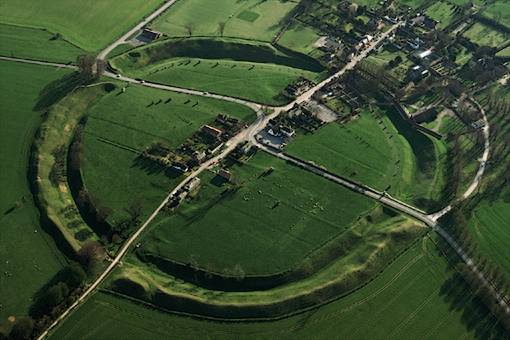
Avebury Stone Circle today: with its ditches excavated, unsightly cottages demolished, and unnecessary enclosures removed, it’s difficult to imagine the snarl of 17th-century domestic chaos that greeted John Aubrey’s visionary gaze that January morn.

Avebury Stone Circle today: with its ditches excavated, unsightly cottages demolished, and unnecessary enclosures removed, it’s difficult to imagine the snarl of 17th-century domestic chaos that greeted John Aubrey’s visionary gaze that January morn.

Whilst out hunting with fellow royalists during the English Civil War, exactly three hundred and sixty-two years ago. For Aubrey’s heroic retrieval of this vast but (by then) long forgotten Stone Age temple confronted the then-accepted notion that only the coming of the Romans had forced a degree of culture upon the barbaric Ancient British, and also confounded the then-popular 17th-century belief – propounded by the highly influential Scandinavian antiquaries Olaus Magnus and Ole Worm – that all such megalithic culture had its archaic origins in Europe’s far north. Indeed, so rich were the cultural implications of John Aubrey’s re-discovery that – come the fall of Oliver Cromwell’s 11-year-long Commonwealth and the subsequent Restoration of the Monarchy – even the returned King Charles II would himself insist on taking one of Aubrey’s celebrated tours of the Avebury area. But how could the world’s largest stone circle have suffered such a total cultural extinction in the first place? Why, the Avebury standing stones themselves must average at least ten feet in height apiece, while the temple’s enormously bulky northern and southern entrance stones rivalled even nearby Stonehenge’s celebrated trilithons. And how could Avebury’s vast 400-metre-diameter earthen embankment and the equally deep ditch that encircled these huge monoliths have for several centuries become invisible even to local historians? Ironically perhaps, the initial blame for this pagan temple’s centuries in cultural oblivion goes not to scheming Christians but to the 5th century arrival from Germany of another group of pagans – the invading Saxons – who, recognising Avebury’s possible use as a defended settlement, broke with the traditions of the previous Roman and Romano-British occupiers by setting up their homes and farmsteads directly within the mighty earth banks of the temple itself. Blasphemers! Thereafter, many centuries of harsh day-to-day living within the Avebury henge conspired to obscure then finally obliterate all physical traces of this vast Earthen Temple. Saxon ploughing within the henge tumbled soil into the deep ditches, which silted up considerably and became repositories of household refuse. Residents fearful of disturbing the ‘Devil’s work’ incorporated the Avebury megaliths into the hedges of their allotments, gardens, fields, and even saved energy by employing those monoliths most vertically aligned as supporting walls for their stone cottages. And when villagers lost their fears of the stones, deep pits were dug into whose depths several of the most intrusive monoliths were unceremoniously tumbled. Thereafter, the magnificent geometric shape of this robust 4,500 year-old landscape temple became lost in the chaos of domesticity; until that fateful day three hundred and sixty-two years ago, that is, when John Aubrey and his friend Dr. Walter Charleton joined their hunting party and galloped westwards across Fyfield Down along the chalky London-Bath ‘rode’. Aubrey himself recounts in his posthumously published two-volume tome Monumenta Britannica:

“The chase led us at length through the village of Avebury, into the closes there: where I was wonderfully surprised at the sight of those vast stones: of which I had never heard before… I observed in the enclosures some segments of rude circles, made with these stones; whence I concluded, they had been in the old time complete.”

It’s been my experience that no story about Avebury ever concludes without some vicious act of destruction by some pious know-it-all or other; this On This Deity entry is no different. For, despite King Charles II’s fascination with the Avebury stone circle, it was his return to the English throne that prompted the temple’s most vivid and desperate period of destruction. For in their determination to stamp out the Non-Conformism of Cromwell’s time, Charles II’s paranoid Restoration Government in 1665 passed the Five Mile Act (or Non-Conformist Act 1665), which specifically forbade all itinerant Non-Conformist preachers from speaking within five miles of their old parishes. Avebury stone circle is nine miles south of Swindon, eight miles north-east of Devizes, five miles west of Marlborough and six miles east of Calne. Non-conformist preachers throughout northern Wiltshire looked to the ancient pagan temple and regarded the Five Mile Act as a divine sign: let us make our new home here, and every pagan stone we break we’ll make righteous by incorporating it into our Non-Conformist church. And so to Avebury they did come and such destruction so they did: the church remains at the circle’s centre even to this day, self-effacing and easily overlooked but engorged nevertheless with as many splendid sarsen stones of that former 4,500 year-old monument as those Non-Conformist preachers could muster. Our hero John Aubrey would, for his pains, die unpublished and in penury. Today, however, his legend burns with an unquenchable fame due to that pioneering archaeological tome Monumenta Britannica, that gossipy biography of his many contemporaries Brief Lives, and – most of all – for that splendid vision of Avebury exactly three hundred and sixty-two years ago today. To John Aubrey – Culture Hero and how!
http://www.onthisdeity.com

Stonehenge and Avebury Tour Guide
HisTOURies UK – The Best Tours of Ancient Britain

Read Full Post »

When we thing of chalk hill figures in Wiltshire we all immediatly think of ‘chalk horses’, however Britain has many other chalk hill figures scattered across the British Isles – some new, some old.
Just west of Salisbury and close to Stonehenge is the Fovant Badges:

The Fovant Badges, Wiltshire

History of the Fovant Badges
When the 1914-1918 war broke out, there was a need to find accommodation for the New Army. In many areas, training and transit camps were established for troops leaving for, and returning from, the battlefields in northern France. One of these areas was the village of Fovant, in Wiltshire and its neighbours Compton Chamberlayne and Sutton Mandeville. The villages and the fields in the shadow of the chalk downs became a military camp, complete with barracks, a hospital, parade areas, shooting practice ranges, a camp cinema and YMCA huts. A military railway was constructed to serve the camp, branching off the main line railway from London to the southwest

Thousands of men from all parts of Britain and overseas lived for a while in the area, passed on to the Western Front and returned from it. Many never returned but gave their lives on the battlefields in France. Others died of their wounds in the hospital or from disease. Rows of silent War Graves in Fovant and other nearby churchyards are testimony to their presence. In remembrance of their colleagues, many of the regiments carved into the hillside replicas of their cap badges. Many of these no longer survive, but by the end of WW1 there were some twenty discernible badges.

Local workers from Fovant and the surrounding villages, supported by Regimental Associations maintained the Badges after WWI. During WWII, the badges became overgrown in order to disguise landmarks, which might assist enemy aircraft. Weather and time, as well as the effects of grazing cattle, caused decay. After the end of WWII, the Fovant Home Guard platoons formed themselves into an Old Comrades Association and undertook the task of restoration. It was in the period of 1948/51 that the two Wiltshire regimental badges were cut and in 1970 the Royal Signals badge was added.

In 1961, the Old Comrades Association was reformed as ‘The Fovant Badges Society’ with redefined, more positive objectives related to the maintenance and preservation of the Badges and the holding of the annual Drumhead Service. The Society became a charitable organisation and in 1994 adopted a new constitution, which governs its operation and objectives; these are the preservation and maintenance of the Regimental Crests cut on the chalk downs.

The Society was determined, aided by much public and international interest, that the Badges should remain an historic, fitting and truly visible memorial to the soldiers who passed through Fovant and its neighbouring villages on their way to the Great War, many never to return.


By 2000, there were only twelve discernable badges on the downs. A new management structure was put in place and, in consultation with professional civil engineers, a survey of the condition of the badges was made. It appeared that the Fovant Badges were unique in their detail and posed difficult restoration problems relating to the slope of the hill, the complexity of design, and their sizes. These vary; the Australian Badge, the largest, measures 51m x 32m, which is just under half the area of a football pitch.

The Trustees, faced with a potential bill of £350,000 upwards for restoration and large annual sums for increased maintenance thereafter, realised that the task facing them had to be brought to realistic proportions. They decided, with much sadness, that the objective should be the restoration and maintenance of the military crests on Fovant Down. These are clearly visible from a lay-by in Fovant whilst passing along the A30 road between Shaftesbury and Wilton. There is also a public footpath from the road to the village of Broad Chalke, which passes by the area of the Badges. This inevitably meant that the Map of Australia on Compton Down and the crests of the Royal Warwickshire Regiment and the 7th Battalion, City of London Regiment on Sutton Down would continue their decline. These badges would, in addition, have posed intractable problems because of the nature of the ground and their more advanced state of decay. Also, the YMCA badge on Fovant Down would be allowed to fade away.

Since the badges lay on open private farmland, with the movement of cattle unrestricted, it was clearly essential that large expenditure had to be used with good effect. A crucial first step was, therefore, to ensure the long lasting protection of the Badges. In co-operation with the farm owners, application was made to English Heritage to have the Badges scheduled as Ancient Monuments. Scheduling was granted in 2001 by the Department of Culture, Media and Sport placing all twelve badges, including those not being restored, under the protection of the government.

The estimated cost of the more limited objective was £220,000 and a national appeal was formally launched at the annual Drumhead Service in July 2001. The response to this was very positive and sufficient sums were assured by the end of 2001 to allow work to commence in 2002. Work experience by contractors, Dean and Dyball Construction Ltd, Ringwood, and favourable weather in 2002 allowed more work than anticipated to be done. This led to five badges being restored in 2002 and the remaining three (including the Royal Signals Badge who undertake their own maintenance and restoration) were completed in 2003.

The appeal has been successful. We are enormously grateful to our many benefactors – too large to name them all – but special mention must be made of the significant support given by the Heritage Lottery Fund, the Daily Mail And General Trust, the Pilgrim Trust, the Clothworkers’ Foundation, the Australian Department of Veterans’ Affairs and Salisbury District Council. And also to the very many private donations from throughout the country.

The Badges were originally constructed by cutting outlines into the rough tussocks of grass down to the underlying soil using such tools as were available in 1916. Chalk from external sources was then hauled manually from chalk dumps and used to fill in the areas exposed.

SLOPE PROBLEMS
profile before restoration – section through large chalk areas

Restoration problems involved work being carried out on a hillside that sloped at about 30 degrees and where a combination of grass, chalk and rain makes for a hazardous working environment. All chalk hills suffer from surface soil movement or ‘creep’. This causes ridges to develop above and below the horizontal chalk outlines and distorts the view of the badges from the A30 road. These so-called ‘eyebrows’ had to be removed.

Existing chalk on the Badges was removed to a depth of 150mm, stabilising the slope where necessary using geotextile materials together with one metre long metal rods, and replacing the excavated areas with compacted new chalk. On a large badge this required handling about 50 tonnes of chalk out of and into the site. As each badge is restored it is fenced to prevent cattle damage which had occurred in previous years.

The restoration of the eight military crests on Fovant Down was completed by the end of June 2003.However that is not the end of the story. The annual cost of maintenance is above the current, and projected future, income level of the Society. If we cannot achieve the necessary level of funding to carry out effective annual maintenance work then the long-term existence of these memorials as visible emblems on the Downs must be in doubt.

External links:
WW1 military badges – Fovant Badges Society
http://googlesightseeing.com/2009/08/the-fovant-badges/
The Stonehenge Tour Company
The Fovant Regimental Badges in Wiltshire England UK

Fovant Badges – Fovant History
Wiltshire Heritage Museum Home Page
Related post Chalk Hill Figures – :
Needless to say we offer guided tours of all the chalk hill figures in Wessex (some dating back to 3000BC) and can include other tourist attractions including Salisbury, Stonehenge, Bath, Avebury and Dorset

Wessex Tour Guide
HisTOURies UK – The Best Tours in Wiltshire and Dorset

Read Full Post »

Salisbury and Stonehenge are separated by some 20 minutes drive, so after having had visited the prehistoric megaliths, it would be simply unforgivable to not pop in on this medieval town (though it has the status of city), which is first of all famed by its 13th century gothic cathedral.
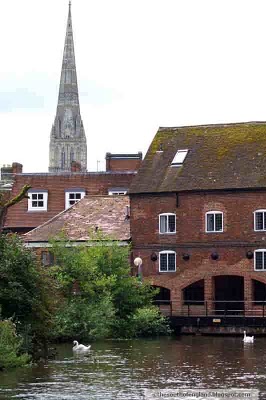
The construction of Salisbury cathedral became one of those rare examples where only one generation of people was involved. That’s why, having had been erected during less than 40 years, this attired in stone lace structure represents a purest specimen of early English Gothic. The gracefully soared 123 metres spire is deceptively light. Actually its weight (with the weight of the tower) amounts to 6500 tonnes!

salisbury cathedral

Considering the fact that the foundation of Salisbury cathedral extends deep down the soggy ground only for 5 metres, it only remains to wonder how it has been still withstanding such load yet to admire the craftsmanship of medieval builders.
Inside of Salisbury cathedral it is as much mesmerizingly beautiful as outside. The sunlight, flowing through the vibrant stained glass windows, softens that characteristic gothic solemnity and makes it more warm and friendly. Apart from good looks the cathedral prides itself on keeping one of the 4 copies of Magna Carta, having been remained from the time of John Lackland, as well as the oldest working clock in the world dated by 14th century.

salisbury cathedral

In the confines of the spacious Cathedral Close nestle picturesque buildings of different époques and styles. Mompesson House (on the left from the High Street Gate) is a typical sample of English Baroque with gorgeous plasterwork and elegant interior that became the set for “Sense and Sensibility”, starring Emma Thompson and Hugh Grant. Malmesbury House (just by Sarum College) is quite often associated with the name of distinguished composer of the 18th century George Frideric Handel. It is believed that this is where he gave his first concert in Britain, to be exact in the room above the Saint Ann’s Gate. Salisbury and South Wiltshire Museum, situated in an ancient building of the 13th century opposite Salisbury cathedral, houses not only the curious artefacts having been found in the process of excavations near Stonehenge but also possesses the exhibits of the time of Romans and Saxons, the pieces telling about Salisbury’s social life in the Middle Ages, great collections of costumes and paintings.
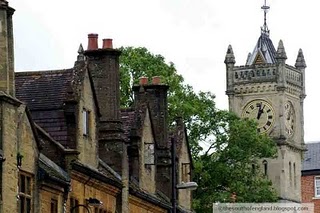
sarum collegeSalisbury is one of those provincial towns where no one can help oneself but meander around the narrow little streets enjoying the tranquillity far from boisterous metropolises. Everything is so snugly compact in comparison with the cities with high population. So there is even its own “Little Ben”, though probably “Little Tower” would suited this clock tower better, because it was built on the site of the former prison.
While walking along Salisbury, scrutinizing the old houses, amidst which there is a good deal of colourful timber-framed ones, and dropping in on little souvenir shops, the time unnoticeably flies by. And getting hungry organism suddenly begins to focus attention not on “that lovely little house” but on those with the signboards “pub”, “restaurant” or “café” on them. Though it doesn’t take too long to find a place for having a meal, because there are plenty of pubs and restaurants for every taste.
salisbury wiltshireSome of them can be interesting not only from gastronomic point of view, but also from historic. In this list for instance are: the restaurant at “The Old Mill” placed in the building of an old paper mill of the 12th century, “The coach and horses” built in 13th century, “The haunch of venison” on the Market Place. That last one exists at least from the 14th century and it doesn’t only keep a vivid atmosphere of the past. Between the ground and first floors is yet another one small area for visitors, pretentiously called “The house of Lords”. There, in the tiny baking oven, a cut mummified hand clenching the playing cards has been put on display. It was found during the refurbishment of the restaurant and alleged to be of an unlucky gambler, having had been punished for his cheating. That part of dead body doubtfully raises someone’s appetite but definitely increases the popularity of the place.
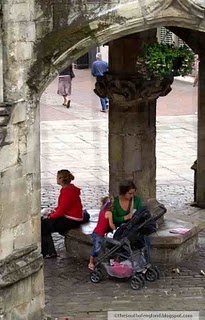
salisbury wiltshireAcross from “The haunch of venison” is an unusual stone construction. It’s called Poultry Cross, though visually it looks more like a stone marquee. In the 15th century, when Market Place was wider, there were four Crosses. In those days they functioned as departments in the modern supermarkets. So in the Middle Age there were: Cheese/ Milk Cross, Poultry Cross, Wool/Yard Cross and Barnwell Cross where the livestock was being sold. Nowadays this only remained Poultry Cross is the sort of a town summerhouse, a perfect spot for making a date or take shelter from a heavy shower.
In spite of such worldwide neighbour like Stonehenge, Salisbury, having its own charisma, doesn’t fade in the rays of the megaliths fame at all. Salisbury is like a main spice in the dish, it makes the trip to Stonehenge more complete. Without it that “megalithic delicacy” might be a little bit mild.
External links:
Visit Salisbury and Wiltshire Tourist website – www.VisitWiltshire.co.uk
Salisbury Cathedral – www.salisburycathedral.org.uk
Stonehenge – www.Stonehenge-Stone-Circle.co.uk
Salisbury and Stonehenge Tours – www.StonehengeTours.com

Southern England log : http://thesouthofengland.blogspot.com
Tours from London – www.Welcome2London.co.uk
Needless to say we can organise private guided tours of Salisbury and Stonehenge for small groups.  These tours can depart from Salisbury, Bath, Glastonbury or London

Salisbury Tour Guide
HisTOURies UK – The Best Tours in ancient Wiltshire

Read Full Post »
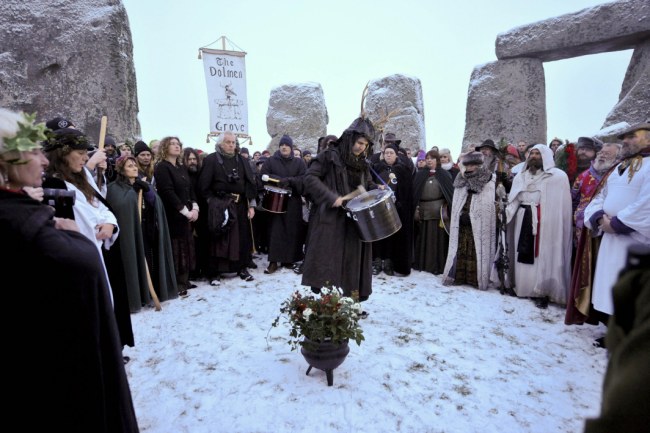
More than 2,000 people gathered in the snow of Stonehenge to celebrate the winter solstice.

Druids, lead by Arthur Pendragon (centre), take part in the winter solstice at Stonehenge in Wiltshire

Druids, lead by Arthur Pendragon (centre), take part in the winter solstice at Stonehenge in Wiltshire

Despite the actual sunrise, – which took place at 08.09am – being obscured by mist, Peter Carson of English Heritage said: “Stonehenge looked spectacular in the snow and it was a great way for people to start their festive season.”

The Pagan community came out in force to celebrate the annual festival, along with many whom were merely curious to experience the event.

As well as the traditional Druid and Pagan ceremonies, a snowball fight erupted as people enjoyed the cold weather.

“The popularity of the winter solstice has grown over the years as more is known about Stonehenge and the winter solstice and the whole celebration has grown in popularity, ” Mr Carson said.

Lance Corporal Paul Thomas, a serving soldier of 15 years who fought in Iraq, was “knighted” with a sword by a Druid calling himself King Arthur Pendragon.
The word solstice comes from the Latin phrase for “sun stands still”. During the winter solstice the sun is closer to the horizon than at any other time in the year, meaning shorter days and longer nights. The day after the winter solstice marks the beginning of lengthening days, leading up to the summer solstice in June.

The Sun’s passage through the sky appears to stop, with it seeming to rise and set in the same two places for several days. Then the arc begins growing longer and higher in the sky, reaching its peak at the summer solstice.

The solstices happen twice a year because the Earth is tilted by 23.5 degrees as it orbits the sun. Since ancient times people have marked the winter and summer solstices.

The stones at Stonehenge are aligned with the sunlight on both the summer and winter solstices. These times told prehistoric farmers that harvest was coming or that the shortest day of winter had passed.

Recent excavations of animal bones at the site suggest that huge midwinter feasts were held at Stonehenge, with cattle moved there to be slaughtered for the solstice celebrations.
External links:
http://www.telegraph.co.uk/news/picturegalleries/uknews/8219063/Druids-gather-in-the-snow-and-ice-at-Stonehenge-for-the-winter-solstice-sunrise.html
http://visit-stonehenge.blogspot.com/2010/12/stonehenge-summer-solstice-tour-2011.html
http://blog.stonehenge-stone-circle.co.uk/2010/12/21/stonehenge-winter-solstice-21stdecember-2010/
http://www.telegraph.co.uk/news/uknews/8219230/Druids-and-Pagans-celebrate-winter-solstice-at-Stonehenge.html

Stonehenge Tour Guide
HisTOURies UK – The Best Tours of Ancient Britain

Read Full Post »

The main Christmas customs were those that were common throughout

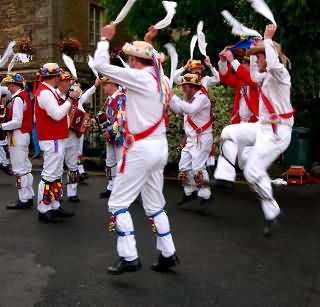
Morris Dancers

Morris Dancers

the country and which came from a time when farm labourers worked most days of the year, and often on Christmas Day morning. Mummers plays were a favourite and would normally be performed in the evenings in the big houses and farmhouses of the area. The performers would be rewarded with food and drink and, sometimes, with money. Most villages had a group of men who were the mummers and both words and actions of the play and costumes and props would be handed down from one generation to the next. Places from which mummers’ plays are remembered include, Stourton, Cricklade, Limpley Stoke, Amesbury, Maiden Bradley, Horningsham, Wootton Rivers, Woodford, Quidhampton, Stockton and Winterslow. Around Swindon in the 1830s, when it was still a small market town, they are recorded as going from door to door and, more especially, from pub to pub.

Carol singers were often groups of boys, or sometimes the church choir, who would visit the big houses of the neighbourhood collecting money. As with carol singers until the 1970s, these always gave good value by singing the full carol. At the larger houses they might sing two or three. There were some local carols, most of which have been lost, and some of these were original while others were adaptations of well known carols. At Berwick St. James it was the custom to wake up householders on Christmas morn by singing carols, which were learned by one generation from the preceding one.

An earlier tradition was wassail. Originally a fertility rite with live animals this later degenerated into processing around the streets, singing and collecting money in the wassail bowl. This happened at Cricklade where a live ox was once involved; by the 19yth century this had become a withey frame covered with a cured ox hide. In a few parts of the county, such as Everleigh, the parson organised a Christmas Ale for his parishioners, where instead of money being raised for the church the participants were provided with bread, cheese and beer. These seem to have died out in the early 17th century.

(Source: http://www.wiltshire.gov.uk/community/getfaq.php?id=194 and http://www.wiltshirefolkarts.org.uk/wfmummers.htm, A Wiltshire Christmas, by John Chandler. Alan Sutton, The Folklore of Wiltshire, by Ralph Whitlock. Batsford)

Stonehenge Tour Guide
HisTOURies UK – The Best Tours in Wesse

Read Full Post »

Had to share a few Wessex snowy pictures with you………

This slideshow requires JavaScript.

Stonehenge Tour Guide
HisTOURies UK – The Best Tours in bad weather

Read Full Post »

New video explains geophysics, 3D laser scanning and finds processing

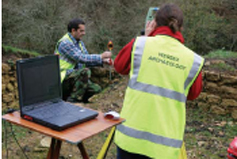
What technologies do modern archaeologists turn to? Mark Langdon speaks to experts at Wessex Archaeology to find out about the modern techniques employed at digs

Watch our experts explain how the techniques are used and how archaeology works in the supporting video:
http://kn.theiet.org/news/dec10/time-team.cfm

Geophysics is the physics of the Earth and its environment in space. Its subjects include the shape of the Earth, its gravitational and magnetic fields, the dynamics of the Earth as a whole and of its component parts, the Earth’s internal structure, composition and tectonics, the generation of magmas, volcanism and rock formation, the hydrological cycle including snow and ice, all aspects of the oceans, the atmosphere, ionosphere, magnetosphere and solar-terrestrial relations, and analogous problems associated with the Moon and other planets.

Geophysics is also applied to societal needs, such as mineral resources, mitigation of natural hazards and environmental protection. Geophysical survey data are used to analyze potential petroleum reservoirs and mineral deposits, to locate groundwater, to locate archaeological finds, to find the thicknesses of glaciers and soils, and for environmental remediation.

External links:
British Geophysical Association
Stonehenge Riverside Project
British Academy – Science and Stonehenge – summaries
Wessex Archaeology – One of the UK’s leading heritage practices

Stonehenge Tour Guide
HisTOURies UK – Private Guided Tours of Wiltshire

Read Full Post »
Few people realize that the origins of a form of Christmas was pagan & celebrated in Europe long before anyone there had heard of Jesus Christ.

Pagans at Stonehenge

Pagans at Stonehenge


No one knows what day Jesus Christ was born on. From the biblical description, most historians believe that his birth probably occurred in September, approximately six months after Passover

One thing they agree on is that it is very unlikely that Jesus was born in December, since the bible records shepherds tending their sheep in the fields on that night. This is quite unlikely to have happened during a cold Judean winter. So why do we celebrate Christ’s birthday as Christmas, on December the 25th?

The answer lies in the pagan origins of Christmas. In ancient Babylon, the feast of the Son of Isis (Goddess of Nature) was celebrated on December 25. Raucous partying, gluttonous eating and drinking, and gift-giving were traditions of this feast.

In Rome, the Winter Solstice was celebrated many years before the birth of Christ. The Romans called their winter holiday Saturnalia, honoring Saturn, the God of Agriculture. In January, they observed the Kalends of January, which represented the triumph of life over death. This whole season was called Dies Natalis Invicti Solis, the Birthday of the Unconquered Sun. The festival season was marked by much merrymaking. It is in ancient Rome that the tradition of the Mummers was born. The Mummers were groups of costumed singers and dancers who traveled from house to house entertaining their neighbors. From this, the Christmas tradition of caroling was born.

In northern Europe, many other traditions that we now consider part of Christian worship were begun long before the participants had ever heard of Christ. The pagans of northern Europe celebrated the their own winter solstice, known as Yule. Yule was symbolic of the pagan Sun God, Mithras, being born, and was observed on the shortest day of the year. As the Sun God grew and matured, the days became longer and warmer. It was customary to light a candle to encourage Mithras, and the sun, to reappear next year.

Huge Yule logs were burned in honor of the sun. The word Yule itself means “wheel,” the wheel being a pagan symbol for the sun. Mistletoe was considered a sacred plant, and the custom of kissing under the mistletoe began as a fertility ritual. Hollyberries were thought to be a food of the gods.

The tree is the one symbol that unites almost all the northern European winter solstices. Live evergreen trees were often brought into homes during the harsh winters as a reminder to inhabitants that soon their crops would grow again. Evergreen boughs were sometimes carried as totems of good luck and were often present at weddings, representing fertility. The Druids used the tree as a religious symbol, holding their sacred ceremonies while surrounding and worshipping huge trees.

In 350, Pope Julius I declared that Christ’s birth would be celebrated on December 25. There is little doubt that he was trying to make it as painless as possible for pagan Romans (who remained a majority at that time) to convert to Christianity. The new religion went down a bit easier, knowing that their feasts would not be taken away from them.Christmas (Christ-Mass) as we know it today, most historians agree, began in Germany, though Catholics and Lutherans still disagree about which church celebrated it first. The earliest record of an evergreen being decorated in a Christian celebration was in 1521 in the Alsace region of Germany. A prominent Lutheran minister of the day cried blasphemy: “Better that they should look to the true tree of life, Christ.”The controversy
External links:
http://ukpagan.com/
Stonehenge Stone Circle
http://www.paganfed.org/
http://www.pagan-network.org/site/

Stonehenge Tour Guide
HisTOURies UK – The Best Tours of Stonehenge

Read Full Post »

Us Brits love Christmas. Our ancient streets come alive as thousands of shoppers and party-goers make their way past carol singers and chestnut vendors under a canopy of shimmering festive lights. The shops are overflowing with gifts, decorations and delicious food, and there are thousands of seasonal events from carol services to wild parties as the holiday spirit takes hold

Why is England a good place to visit at Christmas time?
Christmas is Britain’s most popular holiday and is characterised by traditions that date back hundreds of years. Many Christmas customs that originated in Britain have been adopted in the United States. There is nothing more magical than wandering through a British garden on a crisp, clear winter day: the sun, low in the sky, sparkling on elegant branches; the satisfying crunch of early morning frost underfoot; the delicate scent of winter-flowering shrubs. Holly berries bring a splash of colour to the festive season. Shortly after New Year, snowdrops poke their heads through the earth. Hints of spring arrive in late February as buds begin to appear on trees and the petals of early daffodils unfold.

Bath Christmas Market

Bath Christmas Market


1. Christmas Traditions • Pantomimes • Crackers • Dinner • Decorations • Mistletoe
2. Father Christmas
3. Queens Speech
4. Boxing Day

1: (Pantomines) In the UK, the word ‘Pantomine’ means a form of entertainment, generally performed during the Christmas season. Most cities throughout UK have a form of pantomine at this time of year. The origins of British pantomine, or ‘Panto’ as they are know as today, date back to the middle ages. Panto is generally aimed at children however adults from all ages thoughly enjoy this show. Pantos are based on childrens fairy tales and legends (Aladdin, Cinderalla, Jack and the Bean Stalk). It is traditional for the audience to join in with the panto – cheering the hero or heroine and hissing at the villains. Many phrases to be learnt before seeing a panto are “He’s behind you!” and “Oh yes he is!”, although this may seem strange to be reading all will become clear when watching a British pantomine.
(Cracker) The pulling of Christmas crackers often accompanies food on Christmas Day. Invented by a London baker in 1846, a cracker is a brightly coloured paper tube, twisted at both ends, which contains a party hat, riddle and toy or other trinket. When it is pulled by two people it gives out a crack as its contents are dispersed.
(Dinner) Christmas Day sees the opening of presents and many families attend Christmas services at church. Christmas dinner consists traditionally of a roast turkey, goose or chicken with stuffing and roast potatoes. This is followed by mince pies and Christmas pudding flaming with brandy, which might contain coins or lucky charms for children. (The pudding is usually prepared weeks beforehand and is customarily stirred by each member of the family as a wish is made.) Later in the day, a Christmas cake may be served – a rich baked fruit cake with marzipan, icing and sugar frosting.
(Decorations) Christmas decorations in general have early origins. Holly, ivy and mistletoe are associated with rituals going back beyond the Dark Ages. (The custom of kissing beneath a sprig of mistletoe is derived from an ancient pagan tradition.) The Christmas tree was popularised by Prince Albert, husband of Queen Victoria, who introduced one to the Royal Household in 1840. Since 1947, the country of Norway has presented Britain annually with a large Christmas tree which stands in Trafalgar Square in commemoration of Anglo-Norwegian cooperation during the Second World War.
(Mistletoe) Mistletoe, considered sacred by the British Druids, was believed to have many miraculous powers. Among the Romans, it was symbol of peace, and, it was said that when enemies met under it, they discarded their arms and declared a truce. From this comes our custom of kissing under the mistletoe. England was the first country to use it during the Christmas season. 2.
2. (Father Christmas) The English gift giver is called Father Christmas. He wears a long red or green robe, and leaves presents in stockings on Christmas Eve. However, the gifts are not usually opened until the following afternoon. Father Christmas delivers them during the night before Christmas. The Children leave an empty stocking or pillowcase hanging at the end of the bed. In the morning they hope it will be full of presents.
3. (Queens Speech) Another traditional feature of Christmas afternoon is the Queen’s Christmas Message to the nation, broadcast on radio and television. This normally occurs in the mid afternoon after most people have eaten their Christmas Dinner. The Queen summaries the events of the year past and looks to the future. 4. (Boxing Day) Christmas day is followed by Boxing day (26th December). which takes its name from a former custom of giving a Christmas Box – a gift of money or food inside a box – to the deliverymen and trades people who called regularly during the year. This tradition survives in the custom of tipping the milkman, postman, dustmen and other callers of good service at Christmas time normally on the run up to Christmas.

A Christmas Market Christmas Markets are loved by everyone – the little wooden chalets selling all sorts of goodies and the magical atmosphere created by special Christmas fragrances of pine branches and incense and of course the hot mulled wine to keep you warm! The stalls filled with wooden smoking men, Christmas pyramids, music boxes, straw stars, angels and all manner of wooden decorations. Then you have the stalls with the lebkuchen, stollen and fresh sugared almonds – tempting you with Christmas aromas. Friends and family meet up to enjoy the day together and everyone gets absorbed in the excitement of Christmas.

Bath Christmas Market – A very traditional style English Christmas Market will be runnning every day from December 2nd – 11th selling a a wide variety of original hand crafted gifts, decorations, cards and toys. With the famous Bath Abbey and Roman Baths providing an amazing backdrop to this event, you will know that the festive season has really arrived in Bath. You will have plenty of time on tour for some Christmas shopping!
Windsor Christmas Market – A traditional German market which will be running throughout December. There will be individual wooden chalets each offering a variety of hand-made goods or sumptuous fare! Perfect for Christmas shopping!

More historical Chrismas facts coming soon. 
External Links:
Welcome2London – Christmas in the Capital

Wiltshire Tour Guide
HisTOURies UK – The Best Tours at Christmas time

Read Full Post »

« Newer Posts - Older Posts »