Feeds:
Posts
Comments

Archive for the ‘Wiltshire Heritage’ Category

With the World Heritage Site of Stonehenge, equally remarkable Avebury and the mighty Iron Age hill fort of Old Sarum, there really is plenty for the whole family to enjoy on a day out in Wiltshire. Discover the secrets of this seemingly ‘sacred landscape’ or get away from it all and explore a romantic ruined castle.

Please note English Heritage have now switched to our winter opening hours, meaning that while many properties are open at weekends, there may be restricted access during the week. Please check opening times before travelling.

PLACES TO VISIT : WILTSHIRE (ENGLISH HERITAGE)

Stonehenge

Stonehenge

Visit Stonehenge! Sun worship temple? Healing centre? Huge calendar? How did they carry the great stones so far and build this amazing structure using only basic tools?

Old Sarum

Old Sarum

Site of the original Salisbury, this mighty Iron Age hill fort was where the first cathedral once stood and the Romans, Normans and Saxons have all left their mark during 5000 years of history.

Old Wardour Castle

Old Wardour Castle

Set in landscaped grounds beside a lake in peaceful Wiltshire countryside, these 14th century ruins provide a relaxed, romantic day out for couples, families and budding historians alike.

Avebury

Avebury

With its huge circular bank and ditch and inner circle of great standing stones, covering an area of over 28 acres, Avebury forms one of the most impressive prehistoric sites in Britain

Hatfield Earthworks (Marden Henge)

Hatfield Earthworks (Marden Henge)

The earthworks of a Neolithic henge and monumental mound, by a loop in the River Avon. Recent archaeological find of building equivalent to a priest’s quarters.

Woodhenge

Woodhenge

Dating from about 2300 BC, markers now replace rings of timber posts, which once possibly supported a ring-shaped building. Discovered in 1925 when rings of dark spots were noticed in a crop of wheat.


Wessex Guided Tours
Mystical Landscape, Magical Tours

Read Full Post »

Military environmentalism.  An ocean of grassland  and a sweep of big sky. Ancient monuments loom out of the mist; camouflaged soldiers crouch in the undergrowth. Salisbury Plain is a landscape of extremes. It is the largest remaining area of chalkgrassland  in Northwest Europe and home to 2,300 prehistoric sites yet also the largest military training area on British soil.

Salisbury Plain WalkingTourYou may be surprised to discover that the presence of the military has benefitted archaeological sites and natural habitats. The walk follows public footpaths that penetrate deep into the heart of the military training area taking you out of your comfort zone and to experience a totally new kind of landscape (don’t worry, it’s safe and legal).

Walk along the largest prehistoric long barrow in Britain to a 20th century East German village. Hunt in puddles for a tiny translucent shrimp and look out for the largest bird species in Europe. The extremes of Salisbury Plain sit side by side. Use this spectacular landscape to stretch your legs, blow away the cobwebs and fire the imagination.


Map and full details: http://www.discoveringbritain.org/walks/region/south-west-england/salisbury-plain.html

HisTOURies UK
Mystical Landscape, Magical Tours

Read Full Post »

An adaptation of William Golding’s powerful novel dramatising the building of the spire of Salisbury Cathedral in the 14th century is full of strong performances, writes Jane Shilling.

The Spire, an adaptation of William Golding's novel of the same name, performed at Salisbury Playhouse.

The Spire, an adaptation of William Golding’s novel of the same name, performed at Salisbury Playhouse.

The spire of Salisbury cathedral rears over the city, its apex surmounted by an oddly festive bobble of red light. The novelist William Golding lived and taught in Salisbury for many years and his novel, The Spire, imagines the building of the great pinnacle — the tallest in England — which was added to the original structure in 1320, a century after the foundation stone was laid.

Its construction was a miracle of faith over physics. The land on which the cathedral stood was swampy, and the foundations seemed insufficient to support the additional weight. Golding’s novel imagines the spire as the vision of a driven man, Dean Jocelin, who believes that he has been commanded by God to build it to glorify Him and bring the congregation closer to heaven.

As in all acts of spiritual conviction, there is a fine tension between the exaltation of God and Jocelin’s sinful human pride. Golding’s novel brilliantly conveys this by means of Jocelin’s interior monologue. Roger Spottiswoode, who has adapted Golding’s novel for the stage, has a harder task.

Gareth Machin, the artistic director of the Salisbury Playhouse, sets his production on an all-but-bare black set of cloistral simplicity, beautifully lit by Philip Gladwell to define the sharp angles of stone and flesh – we see mortality as a constant haunting presence in the skulls so clearly visible beneath the actors’ skins.

Mark Meadows as Dean Jocelin is the image of a man in whom spiritual and temporal desires are irreconcilably and, in the end, fatally at war. He is able to override the doubts of his brethren at the Cathedral by sheer force of will, combined with the wealth of his aunt Lady Alison (a spirited performance by Sarah Moyle) who takes a highly pragmatic attitude to atoning for the sins of the flesh committed in her youth by putting the riches thus acquired to holy use. The scene in which she explains to her nephew the venal means by which his early preferment came about is a fine study in tragic-comic devastation.

Strong performances by the supporting cast, particularly Vincenzo Pellegrino as the master mason, Roger, animate this gallant essay in dramatising Golding’s vastly complex fiction. So powerful a presence is the cathedral in the drama that it would be perverse not to combine a visit to the play with a trip to the beautiful building that inspired it.

Full article: http://www.telegraph.co.uk/culture/theatre/theatre-reviews/9672496/The-Spire-Salisbury-Playhouse-review.html

Link: http://www.salisburycathedral.org.uk/news.php?id=682

Until Nov 24. Tickets:             01722 329333      ;
www.salisbury playhouse.com

On Friday 16 November, 7.30pm – 9.00pm, the Dean of Salisbury, the Very Revd June Osborne, and Gareth Machin, the play’s director, can be heard in conversation as they explore Golding’s tale of Jocelin’s vision in the very location itself, sitting underneath the spire. There will also be readings from the novel and an opportunity to ask questions. Themes include: Jocelin’s vision – was it foolish or inspired? Golding’s juxtaposition of faith and science, the challenges of staging ‘The Spire’ – and the challenges of maintaining the real spire.
Tickets, £8.00 (adults) and £2.50 (students) for ‘A burning will….exploring The Spire’ are available online from http://www.salisburycathedral.org.uk here or from Salisbury Playhouse box office,            01722 320333      . All proceeds towards the Cathedral’s Major Repair Programme.

Special tower and floor tours at Salisbury Cathedral focussing on what really happened when the 6500 tonnes tower and spire were added take place on Saturdays 3, 10 and 24 November, and Monday 5, Tuesday 13 and Thursday 22 November.
‘The Spire’ tower tours, £10.00 (£8.00 concessions), begin at 2.15pm (allow 90 minutes) Pre-booking essential online at: http://www.salisburycathedral.org.uk here or telephone            01722 555156      .
Floor tours begin at 11.00am (allow 60 minutes) No booking or tickets required – just turn up. Visitors are requested to make a donation to help towards the fabric of the Cathedral.

Further information:
Salisbury Cathedral special events based on ‘The Spire’:

Sarah Flanaghan,             01722 555148       /             07771 510811       or s.flanaghan@salcath.co.uk
Salisbury Playhouse production of The Spire
Gemma Twiselton,             01722 320117       or press@salisburyplayhouse.com
Salisbury Playhouse production of The Spire can be seen from 1 – 24 November, box office            01722 320333      .

HisTOURies UK
Mystical Landscape, Marical Tours

Read Full Post »

Saturday 13 October 2012 – Saturday 26 January 2013.

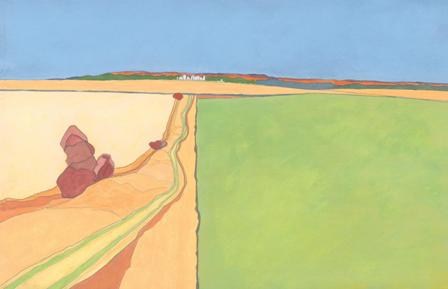
An exhibition of paintings and drawings that reflect one artist’s travels through the ancient sites of Wiltshire.  Over the last 50 years, Stonehenge and Salisbury MuseumPhilip Hughes has returned time and again to the Ridgeway, Avebury, Silbury Hill and Stonehenge.   Informed by maps, photography and electronic survey techniques, his work ranges from accurate topographical observation to abstract and emotional representation of the landscape.

The exhibition coincides with the publication of the book on Hughes’s work: Tracks: Walking the Ancient Landscapes of Britain (Thames & Hudson, 2012).

Hughes is represented by the Francis Kyle Gallery.

Salisbury Museum is based in the King’s House, a grade I listed building located opposite Salisbury Cathedral. We have a small but friendly staff, supported by over 100 volunteers. We offer a variety of services, including the opportunity to hire this unique location for corporate events and activities.

http://www.salisburymuseum.org.uk/

HisTOURies UK
Mystical Landscape, Magical Tours.

Read Full Post »

Read the story of when The Beatles came to Wiltshire to film scenes from their second film Help! on Salisbury Plain in 1965.

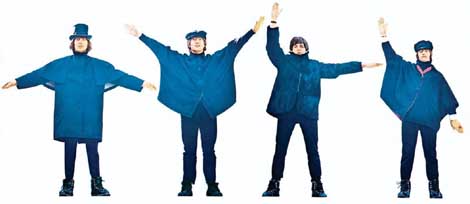
The Beatles on the Help! album cover

The Beatles on the Help! album cover

By May 1965, The Beatles truly ruled the world. Topping the charts for the seventh consecutive time with ‘Ticket To Ride’, America well and truly conquered and massive success for their first film A Hard Days Night, the year before.

This had been little more than a fun fictional account of the adventures of four lads in a pop group, shot at a few London and provincial locations and filmed in black and white, for a budget of around £200,000.

But now their second film, Help! (provisional working title Eight Arms To Hold You) was to be a much grander affair.  Double the budget, in colour, with filming at such exotic locations as the beaches of Nassau, the ski slopes of Austria and… Salisbury Plain.

The simple storyline revolved around Ringo Starr and one of his many rings. Unbeknownst to him, it was a mystical ‘sacred’ ring from the Far East, which its real owners wanted back.

Cue the movie with Ringo being pursued all over the place by the ring-chasers, with all sorts of madcap stunts surrounding their efforts to retrieve the ring from his finger. And that was about it!

In the movie, The Beatles need to do some more recordings. However, Ringo isn’t safe anywhere, so they decide to make their next record in a place of absolute military security . Where else? Salisbury Plain!

So, late in the evening of Sunday 2nd May 1965, The Beatles checked into the Antrobus Arms Hotel in Amesbury, their home for the next three days whilst on location.

Ringo and George filming 'Help!' on Salisbury Plain

The filming took place at Knighton Down, near the Larkhill army base, where the Beatles were to be shown recording their latest song.

In fact, the Salisbury sequence in the film sees them miming to the George Harrison song ‘I Need You’, which of course, he took the lead vocals for. Ironically for George, this  was never a Beatles single, only appearing on the movie soundtrack album.

The lads were ferried from the Antrobus Hotel to Larkhill each day, in a black Austin Princess limousine, with their departures and arrivals attracting huge crowds of teenagers, blocking the street through Amesbury.

Amazingly, the limo was left unlocked in the hotel garage during the day and the Salisbury Journal reported that fans looted it of Beatle caps, various items of Beatle clothing and even emptied the ashtrays for Beatle dog-ends!

The Journal also said the group were besieged, mostly by girls and had to endure some pretty dismal Salisbury Plain weather, despite it being late Spring.

The army ‘security’ for the film storyline, came via troops from 3 Division, Royal Artillery who were on exercises there at the time.

The army even kindly supplied tanks for the Fab Four to climb over and have scouting around whilst they made their recording!  It’s hard to imagine that happening today, but back then The Beatles had all doors opened for them, such was their celebrity.

On the afternoon of Thursday 6th May, with the location filming completed, The Beatles checked out of their Amesbury hotel, heading back to London.

Next day they were back in a proper film studio at Twickenham, as the making of Help! continued.

The movie had its world-premiere on 29th July 1965 at the London Pavilion, in the presence of Princess Margaret and Lord Snowdon, and with the title song already sitting at number one in the UK singles chart.

It opened at 250 leading cinemas across the country on August 11th and went on to win first prize at the International Film Festival in Rio de Janeiro that September.

There was talk of a third film, but sadly, this didn’t happen. The filming of the making of the album Let It Be in 1969 being a fly-on-the-wall documentary, not  a proper scripted movie.

The Beatles never returned to Salisbury, but they left behind a multitude of memories for those who either saw, met or even worked with them, during those three days in May, 1965.

But one thing’s for sure; that bit of Salisbury Plain was certainly immortalised for all time, by the biggest musical phenomenon the world has ever seen.

Geoff Barker – Rock and Rill Wiltshire – http://www.bbc.co.uk/wiltshire/history/rocknroll_wiltshire/

Mystical Landscape, Magical Tours
HisTOURies UK – www.HisTOURies.co.uk


Read Full Post »

Tour: Fri 31st Aug – Sun 2nd Sept 2012
Henges, burial mounds of all shapes and sizes, causewayed camps, early field systems and ‘cursus’ monuments are scattered everywhere in Wessex, forming a landscape which hints at its past, but whose story is unintelligible to the untrained eye.

Our experts have been introducing people to this, one of the richest prehistoric landscapes in the world, which lies on our very doorstep, since Andante’s inception.

Day One
Meet in the evening for an introductory lecture and dinner together in a local restaurant. Overnight in Sarum College in the beautiful Cathedral Close.

Day Two
By coach to Avebury for a full exploration of the huge Neolithic henge, so large that part of the village lies within it. It is one of the largest and best preserved of 1300 stone circles known in the British Isles. Morning walk around the henge and along the ceremonial Avenue.  We approach the stones of Avebury just as one would have done in prehistoric times.

Afternoon circular walk (2 hours) past Silbury Hill, the largest man-made mound in Europe.  The most famous of its excavators crawled into an earlier excavation chamber and recorded later:
“the sides of the open chamber provided one of the most astonishing sights that I have ever seen…it was clear that this innermost mound had been covered by a series of conical shells or cappings…the effect was of finding oneself in an enormously complicated and highly coloured layer cake of gigantic size..”
The walk continues to the Long Barrow at West Kennet and a chance to explore the chambered tomb within.  This kind of monument is the earliest known to have been built in Britain – in commemoration of the dead. Continue to the ‘Sanctuary’, a small, complex timber and stone circle on the top of Overton hill. Walking in our ancestors’ footsteps helps us try to understand their motives and methods.

Day Three
Stonehenge for an early (7.30am) visit inside the stone circle before the public arrives. This will be followed by a walk (2 hours) through the wider religious landscape – the cursus, King Barrows and Stonehenge Avenue.
A short drive takes us to Woodhenge, where the remains of wooden post settings have been found – now marked by concrete. From here there is a good view over the huge henge at Durrington Walls, site of exciting recent excavations which revealed the settlement which may have housed the builders of Stonehenge.

Return to Salisbury Museum for a visit to the Stonehenge and Prehistory Galleries. We have arranged a private demonstration of flint-knapping in the gardens here, which is not only much enjoyed, but adds considerably to your understanding of the way in which our prehistoric forebears were able to fashion all manner of implements and tools from our good local flint supplies.  In a world without metal technology this was a critical and highly sophisticated art.
Disperse about 5pm.

Should you choose to arrive earlier or stay later, you might like to visit Old Sarum, the hillfort to the north of Salisbury which was later chosen as the site of our first cathedral, or, of course,  our beautiful Gothic cathedral – straight in front of the College.

NB Most of every day will be spent walking, and you must be prepared for this, with suitable footwear and weatherproof clothing. You will also have to carry your own water, and negotiate a variety of stiles.

  • The original Andante Tour – accept no imitations!
  • We have been introducing guests to these monumental prehistoric landscapes for 26 years
  • Accommodation spectacularly situated within Salisbury cathedral close
  • Bring your hiking boots!
  • Several good cross-country walks

Read Full Post »

ARCHAEOLOGY WEEKEND

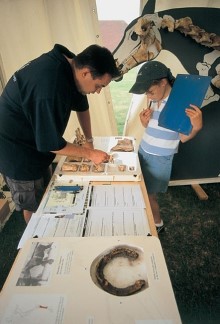
It’s the Festival of British Archaeology – this is your chance to meet a real archaeologist and to uncover artefacts from Old Sarum’s history. Enjoy a weekend for all the family with plenty of hands-on activities and crafts to keep everyone busy! Take part in a mini-dig and have a go at identifying objects lost over time.

About Old Sarum

Discover the story of the original Salisbury and take the family for a day out to Old Sarum, 2 miles north of where the city stands now. The mighty Iron Age hill fort was where the first cathedral once stood and the Romans, Normans and Saxons have all left their mark.

Today, 5,000 years of history are told through graphic interpretation panels on site. Families, heritage lovers and walkers can enjoy a great value day out at Old Sarum- you could even bring a picnic and enjoy the fantastic views across the Wiltshire countryside. The gift shop has a delicious range of ice-creams and exclusive English Heritage gifts and produce. Wooden bows and arrows are also on sale to help the kids imagine what life was like all those years ago!
DON’T MISS
The spectacular view from the ramparts at Old Sarum to the ‘new’ cathedral in the centre of Salisbury
Our interesting interpretation panels bringing 5,000 years of history to life
Old Sarum’s literary connections- you can buy some of the famous books written about the site in our shop

English Heritage: http://www.english-heritage.org.uk/daysout/properties/old-sarum/

HisTOURies UK – www.Histouries.co.uk
Mystical Landscape, Magical Tours

Read Full Post »

Chalke Valley History Festival near Salisbury is Britain’s biggest festival devoted entirely to history.

The 2012venue is the second such festival to be held in a 22 acre field set amongst the gentle downs of the Chalke Valley, surely one of the most beautiful landscapes in Britain, 12 miles south-west of Salisbury.

Chalke Valley History Festival

Chalke Valley History Festival

The Chalke Valley History Festival is in its second year now & really getting into its stride. The festival is being held just outside Ebbesbourne Wake, one of the villages within the Wilton Community Area. As well as literary talks covering an amazing variety of topics & periods in history, there are also other activities to get involved in. Among the impressive line-up of speakers at the festival, there are many household names such as Sir Max Hastings, Amanda Vickery, Jeremy Paxman, Michael Morpurgo, Ian and Victoria Hislop, Tom Holland, Dan Snow and Michael Wood.

If you’re interested in history, this is an event you won’t want to miss: “The Chalke Valley History Festival is Britain’s biggest festival devoted entirely to history. This is our second Festival and we are much bigger this year with over fifty events and an extraordinary array of speakers. Joining us are some of this country’s most popular and influential historians who are shaping our understanding of the past and setting the context for understanding the future.”

Check out the Chalke Valley History Festival website for more information & to buy tickets. http://www.cvhf.org.uk/

Another good reason to visit Wiltshire…………………..

HisTOURries UK
Mystical Landscape, Magical Tours.

Read Full Post »

Go rambling around England with your little ones, on these 10 buggy friendly walks, selected by Richard Happer from his new book Beautiful Buggy Walks: England

Avebury, Wiltshire

Avebury

Avebury

Strolling through an ancient stone circle is just the start of this adventure. Avebury’s fine historical monument also forms the hub of a cracking day’s countryside wandering. Avebury is the world’s biggest stone circle – so large it has a whole village in its centre – but it doesn’t attract the huge numbers that Stonehenge does. This walk introduces you to the circle via West Kennet Avenue, a ceremonial approach that originally had 100 pairs of stones. It’s half a mile long and still impressive. People can wander freely among the ancient monoliths, unlike Stonehenge. Tourists touch them, kids lean on them and wild-bearded men in rainbow trousers do yoga beneath them. Our tour concludes with a relaxing stretch through the surrounding fields.

OS map: Explorer 157
How far: about 3 miles
Route: Enter the field to the west of the parking area.

• Walk between the stones up West Kennet Avenue.

• When the road to your right joins the main road, cross the smaller road and walk past the trees to the embankment that runs around the ditch.

• Follow the path on top to your right. When you reach a small road, cross it and continue around the circle.

• At the main road follow the path in, towards the centre of the circle, cross the road and take the path out and around the next sector of the circle.

• Detour to your right to visit the café and visitor centre.

• Join the minor road in the village and walk west to east, right through the circle, passing the pub and the point at which you crossed the road earlier.

• You are now walking away from the circle, down a country lane; continue for 1/2 mile, passing Manor Farm, then turn right, down a byway.

• After 1/2 mile, turn right along the edge of a fi eld. Another 1/2 mile will take you back to the start.

Rest and refresh: The Red Lion pub has outdoor space (01672 539266, red-lion-pub-avebury.co.uk). The National Trust visitor centre has a spacious cafe with outside benches. Visitor centre: 01672 539250,nationaltrust.org.uk/avebury

Article Source and more walks:http://www.guardian.co.uk/travel/2012/may/06/buggy-walks-family-holidays-england 

 HisTOURies UK –www.Histouries.co.uk
Mystical Landscape, Magical tours

Read Full Post »

The Chalke Valley History Festival is planning to launch a series of History Tours in 2012, some in conjunction with the Natural High travel company.

We want to capitalise on our relationship with this country’s most compelling and authoritative historians by offering some as guides for historic tours and holidays.

Both dates and itineraries are yet to be confirmed, as are costs.  However, we are very interested to know whether there is demand for the idea from those who have enjoyed our Festival.

These Chalke Valley History Tours will vary between a few days and a week’s duration, and will be of general rather than specialist interest.

Below are some of the initial tours we are hoping to organise in our first programme of History Tours.  If you would like to learn more about them, please do let us know on info@cvhf.org.uk

THE INDIAN MUTINY
led by Professor Saul David
It began as a mutiny of East India Company sepoys in Meerut in May 1857 and was only contained after the fall of Gwalior a year later.  It rocked the British Empire to its foundations and led to the downfall of the Company.  This tour, by the world’s leading authority on the subject, will tell the story of the Indian Mutiny by visiting its main sites amidst the drama of central India.

Saul David is Professor of War Studies at the University of Buckingham and a specialist in the wars of the Victorian period.  He is particularly well placed to lead this tour; not only is he well-known and popular television historian, the Indian Mutiny was the subject matter of his PhD, and his subsequent book is considered the definitive history of this dark episode from the Raj.

ANCIENT ROME
led by Tom Holland
Was it the greatest empire the world has ever seen?  Certainly, it lasted almost a thousand years and incorporated, at its zenith, most of the known world.  This tour will focus on the city of Rome and those towns to the south, Pompeii and Herculaneum, recapturing the spirit and glory of Ancient Rome.

Tom Holland is an award-winning and highly acclaimed historian of antiquity.  Rubicon, his book on the rise and fall of the Roman Republic, was an international best-seller and was short-listed for the Samuel Johnson Prize.  He is currently working on a new book about the first Emperors.  A brilliant raconteur, Tom Holland is working exclusively for Chalke Valley History Holidays.

THE ZULU WARS
led by Dr Peter Caddick-Adams
The Battle of Isandlwana and the defence of Rorke’s Drift are two of the most dramatic events in the British Imperial story.  For the victors of each, both were triumphs over incredible odds; at Isandlwana, it was the Zulus who won the day, while at Rorke’s Drift, it was the British, in one of the most astonishing last stands in British history.  At both, many men on both sides showed incredible courage.  This tour to some of the most unspoiled battlefields in the world, will tell the story and characters of a war that resonates still to this day, and against the captivating landscape of South Africa.

Peter Caddick-Adams is the doyen of battlefield guides.  Learning his craft from the legendary Richard Holmes, he also chose Battlefield Tourism as the subject matter for his PhD.  Since then, he has worked with British and American armed forces on numerous staff rides, as well as guided politicians and leading public figures around some of the best-known battlefields in Europe and further afield.  Quite simply, Peter Caddick-Adams is one of the very best Battlefield Guides we have.

D-DAY & THE BATTLE FOR NORMANDY 1944
led by James Holland
The Battle for Normandy was one of the fiercest battles ever fought, with higher daily casualty rates than were suffered at the Somme, Passchendaele or Verdun.  From the landings themselves to the bitter fighting as the Allies inched inland, this is a tour that will include little-known sites and bunkers as well as some of the more iconic beaches and D-Day locations.  Told with a mass of anecdotes and new, searing, analysis, this will be a comprehensive guide to the D-Day battlefields, and set to the backdrop of the glorious Normandy countryside, with its wonderful food, wine and calvados.

James Holland is one of the country’s leading authorities on the Second World War, and has written and broadcast on the Battle of Britain and Dams Raid amongst other subjects. With an encyclopaedic knowledge and understanding of the war, he has also conducted Staff Rides for the military and a number of historic tours around many of the Second World War battlefields.

The excellent Chalke Valley History Festival 26th June – 1st July 2012 – http://www.cvhf.org.uk/

HisTOURies UK
Mystical Landscape, Magical Tours

Read Full Post »

« Newer Posts - Older Posts »