Scour the floor near most offices and there’ll be plenty of signs of the modern worker’s addiction to tobacco.
But archaeologists investigating a site in Bath have found evidence of the grip on life of smoking two centuries ago.
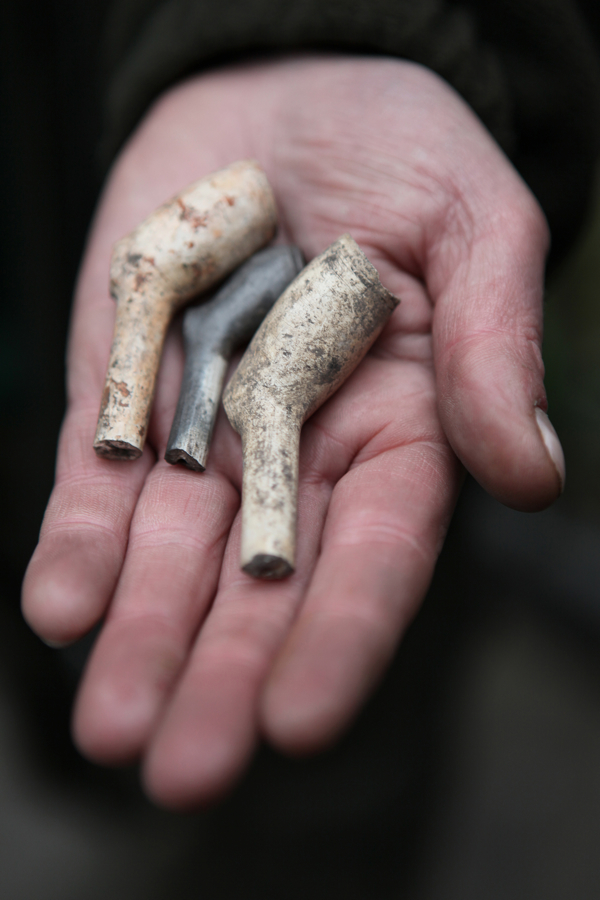
A dig at a city centre car park has unearthed clay smoking pipes.
The pipes were discovered by specialists exploring the area under the Sawclose car park.
They date back to the 19th century, when there was a factory at the site.
Senior project officer for Cotswold Archaeology Chiz Harward said: “We found quite a few clay pipes while digging. Pipes were the principal way of smoking tobacco until the late 19th century when cigarettes came in.
“Some of the bowls are still intact, which is good as clay pipes are very fragile.”
The dig is being carried out ahead of possible redevelopment in the area and the private car park behind the public spaces has been closed while the work takes place.
Meanwhile, an open day was held at the scene of a dig carried out by the Bath and Camerton Archaeological Society at Laverton near Norton St Philip.
The group is excavating a medieval building at Upper Row Farm as part of the Homefield Project, which aims to answer specific questions about settlement in the area.
The event was part of the National Festival of Archaeology, which will also see two free events at the Museum of Bath at Work this Saturday.
There will be a walking tour of the working heritage of Bathampton, presented by director of the museum Stuart Burroughs, starting at 11am from the car park of the Bathampton Mill restaurant. It will feature the Kennet and Avon Canal, and the site of the village’s Plasticine factory.
The second event is a discussion called Industrial Heritage at Risk: Bath and Beyond, led by Keith Falconer from English Heritage.
It starts at 2pm at the Julian Road museum, with a light lunch available from 1pm.
Join us on a private guided tour of Bath soon and discover more……….
The Best Tours of Stonehenge and Bath
HisTOURies UK – Mystical Landscape, Magical Tours
 by 3 small white discs on the tarmac at the lower end of the car-park. Chances are you will drive over them if you visit! The white discs mark where wooden postholes stood during the early mesolithic – the hunter gatherers – at least 3,500 years before the first phase of Stonehenge.Later features which predate Stonehenge that can still be seen are the Cursus and barrows or burial mounds. You will need more time or to go on a specialist tour to see these features.
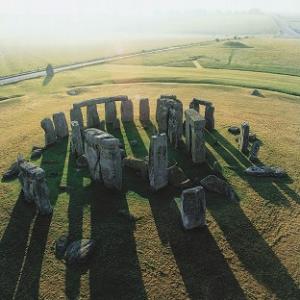
 This included 56 timber posts just inside the bank and the post holes were later filled with cremated human remains and now known as Aubrey holes.In 2008 Aubrey hole 7 was opened by the Stonehenge Riverside Project and it looks more like a hole for a stone rather than timber. It may be that stones were here from the start rather than later. The results from the most recent dig are due out in 2011 so we may have the 3rd major rewrite of the Stonehenge story within 20 years!
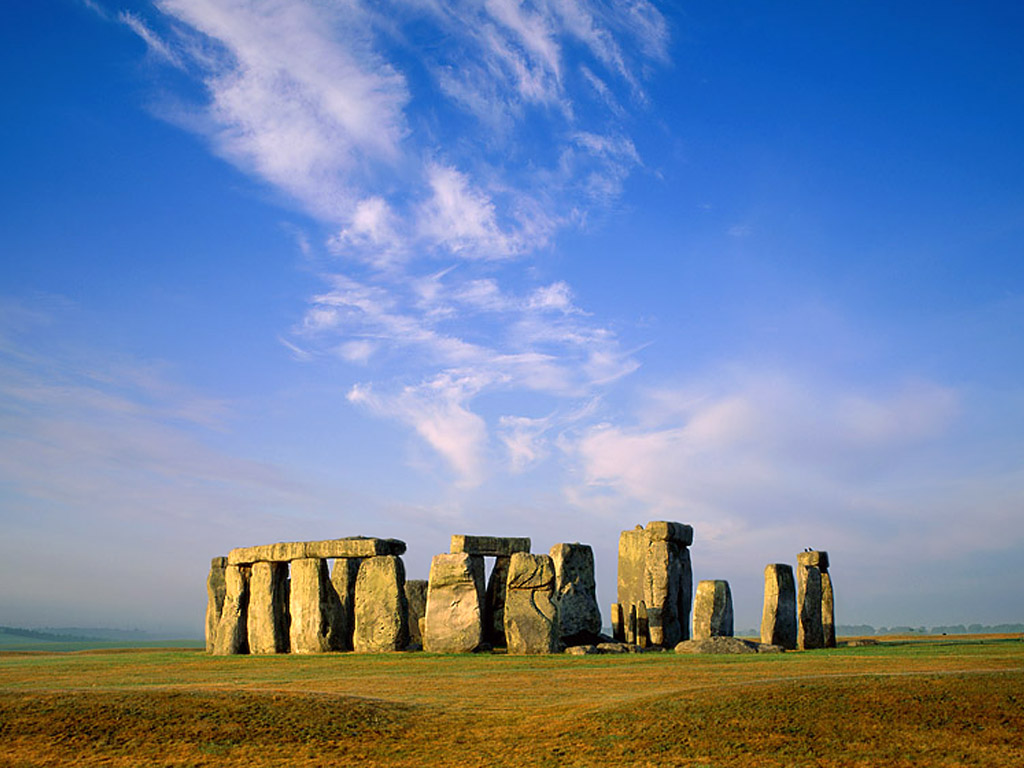
 Bluestone is a generic term for several types of volcanic rocks and each of them at Stonehenge weighs 4 – 6 tons.They are the ones that stand about man height as one looks into the stones. They don’t look blue until dressed (ie shaped) and the outer covering of the stone removed.You can how blue on a tour out of hours to the inner circle.
 In its final layout there are estimated to be 79 or 80 bluestones. An exciting discovery in September 2009 at the end of the Avenue where it meets the River Avon was a series of stone holes possibly holding bluestones. This ‘Bluestone’ henge may have held 24 stones. If the 56 Aubrey holes held stone rather than timbers it may be that there were two separate monuments that became united as the finishing phase of Stonehenge.
 The lintels don’t rely on gravity to keep them in place they have mortice & tenon, and tongue & groove joints that we would normally find in a wood setting, but in stone. Each of the lintels also has some shaping on the inner and outer circular face to produce not far off a perfect circle.

 HisTOURies U.K Tours

 Wessex Guided Tours