Feeds:
Posts
Comments

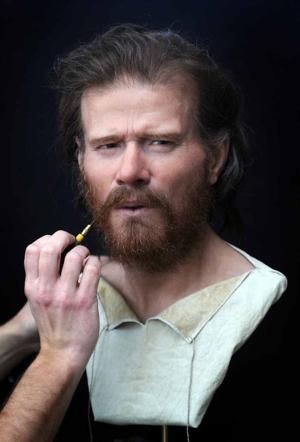
TOURISTS entering English Heritage’s new £27 million visitor centre at Stonehenge will quickly confront its most spectacular exhibit – a man who was born 500 years before the earliest stone monument appeared at the site.

Stonehenge Man would have fitted in very well on a film set (Image: English Heritage)

Stonehenge Man would have fitted in very well on a film set (Image: English Heritage)

He may have a touch of Hollywood about him, but this “Stonehenge Man” was once real. His face has been reconstructed from a 5500-year-old skeleton found in the area. Local protest groups continue to press for him to be reburied, but forensic analysis has allowed scientists to create the most lifelike model yet of an individual from British prehistory. Their work reveals how he lived and ate, and may even shed light on the origins of Stonehenge itself.

The well-preserved skeleton was discovered in an elaborate tomb in the 1860s, providing a rare example of the anatomy of Neolithic people. His face has been brought to life by Swedish sculptor Oscar Nilsson, using information from bone and tooth analyses. The length of the man’s bones, the skeleton’s weight and his age – estimated at between 25 and 40 years old – were used to determine the thickness of the skin on his face and muscle definition.

Nilsson used a vinyl copy of the skull, made by Andrew Wilson at the University of Bradford, UK, as a base for his clay reconstruction of muscles, guided by markers denoting the fleshiness of the face. He created moulded silicon skin and added pigment before punching in the hair.

Ridges on the skull reveal that this man was muscular – which is not surprising given the Neolithic lifestyle. He had highly masculine features, such as a well-defined chin and jawbone. “I had to give him a beard – there were no razors then,” says Nilsson.

Human skeletal biologist Simon Mays from the University of Southampton, UK, was unable to deduce the cause of death from the skeleton and he speculates that Stonehenge Man died of an infectious disease that killed too quickly to leave a trace on bones. Mays did, however, find two leg wounds: a deep muscle injury and a bony projection.

Tooth analysis by Alistair Pike, also at the University of Southampton, was particularly revealing. Pike extracted a section of enamel, then removed particles from different stages of the tooth’s growth. A mass spectrometer revealed the ratio of two forms, or isotopes, of strontium at the different stages, which can indicate where his drinking water came from when matched to an area’s geology.

Teeth take about four years to form, so it is possible to track the movements of an individual during that time. Stonehenge Man seems to have travelled as a child. He was born in an area of old geology, thought to be somewhere in Wales, and moved to an area matching Stonehenge when about 3 years old. If he came from Wales, says Pike, there could be a connection to the movement of bluestones, the oldest stones at Stonehenge. “The two communities may have been connected for centuries,” he says.

The man’s teeth show little wear for his age, suggesting a soft diet by prehistoric standards. The carbon isotopes in the teeth vary according to the types of plants eaten, and with the amount of nitrogen, which comes from meat in the diet. His carbon pattern shows he ate more meat than his contemporaries, possibly in stews. This and the elaborate burial suggest he was an important man in the community.

Unfortunately, the man’s teeth were unusually clean. “If we had been able to analyse his tartar, we could have identified species he was eating by sequencing proteins in trapped fragments, while bacteria could have revealed the health of his gut,” says Pike.

The team did not have enough time before the visitor centre opened to do DNA analysis of Stonehenge Man’s colouring, but this would have been difficult anyway because handling over the years has contaminated the skeleton’s DNA. They guessed at hazel eyes and dark brown hair, with a hint of ginger, to reflect probable Celtic origins.

If this model of the handsome Stonehenge Man is true to life, then he would not look out of place today. “He could be sitting next to you on the subway,” says Nilsson.
by Sandrine Ceurstemont

Details in The New Scientist:
http://www.newscientist.com/article/dn24811-stonehenge-man-not-just-a-pretty-face.html#.Usfc6pCYbIV

Wessex Guided Tours
The Best Tours in British History

heritageaction's avatarThe Heritage Journal

As prehistoric site enthusiasts we thought this was excellent. It’s part of EH’s extensive set of teaching resources and what struck us as particularly effective were the series of questions designed to get children to think a bit more deeply about any “bunch of old stones” they may visit.

“If you are visiting a prehistoric site, you can become a landscape detective… Often these sites weren’t just put anywhere but were carefully designed either to be seen from miles around or to have good views.

.

When you are being driven or are walking to the site, think about how soon you can see it… Could you see it for miles and miles or was it a surprise when you got there because it was hidden away? Did you have to walk or drive up a big hill?

.

Have a look at what you can see from the site……

View original post 157 more words

This rich archaeological landscape offers a wealth of prehistoric temples, Neolithic harvest hills for fertility rituals and communal tombs. Visit mysterious Silbury Hill, Europe’s largest artificial mound, the Neolithic communal tomb of West Kennet Long Barrow, Old Sarum, Overton Hill Sanctuary, Avebury, Britain’s largest henge and Stonehenge. These tours depart from Bath but can be organised from Salisbury or even London

At Wessex Guided Tours we aim to provide the best planned, best led and altogether the most fulfilling and enjoyable archaeological tours available.  Our private day excursions offer the best opportunity to explore and experience some of Britain’s most iconic and significant ancient sites, guided by our archaeologist guides.

We specialise in archaeology tours, and as a result we believe we offer an excellent Stonehenge Access Toursspecialist service.

Private Tours:

Our itineraries are original, imaginative, well-paced and carefully balanced. Knowledge of the subject matter and the destinations combine with detailed attention to practical matters to ensure an enriching and smooth-running experience.

If you are travelling as a small group, you can design your own day trip or simply select one of our regular itineraries but have exclusive use of the vehicle for the day. We will collect you from any location within central London, Bath or Salisbury. The duration of your vehicle hire is 8-10 hours depending on the places that you are visiting and traffic conditions on the day.

Our most popular tours include:

Stonehenge, Bath and Avebury Archaeologist Guided Tour: Walk the paths of ritual specialists and builders of Britain’s most fascinating and awe-inspiring prehistoric sites.

Stonehenge, Salisbury and Avebury Archaeologist Guided Tour: Walk the paths of ritual specialists and builders of Britain’s most fascinating and awe-inspiring prehistoric sites. Britain’s most beautiful landscapes. Visit one of England’s most impressive Cathedrals at Salisbury.

Wessex Guided Tours
The Best Tours in British History www.HisTOURies.co.uk

There is archaeological evidence that there was human activity around the hot springs on which the City of Bath is built at least 8,000 years B.C; but probably the place was too mysterious, with steam emerging from a hot, lushly vegetated swampy area for any settlement to take place here. According to legend, Prince Bladud, who had contracted leprosy, was cured after bathing in the hot muddy waters. In gratitude, Bladud founded the City of Bath around the springs in 863BC. As documented by Geoffrey of Monmouth in his 12th century ‘History of the Kings of Briton’, Bladud proceeded to become the 9th King of the Britons and supposed father of King Lear.
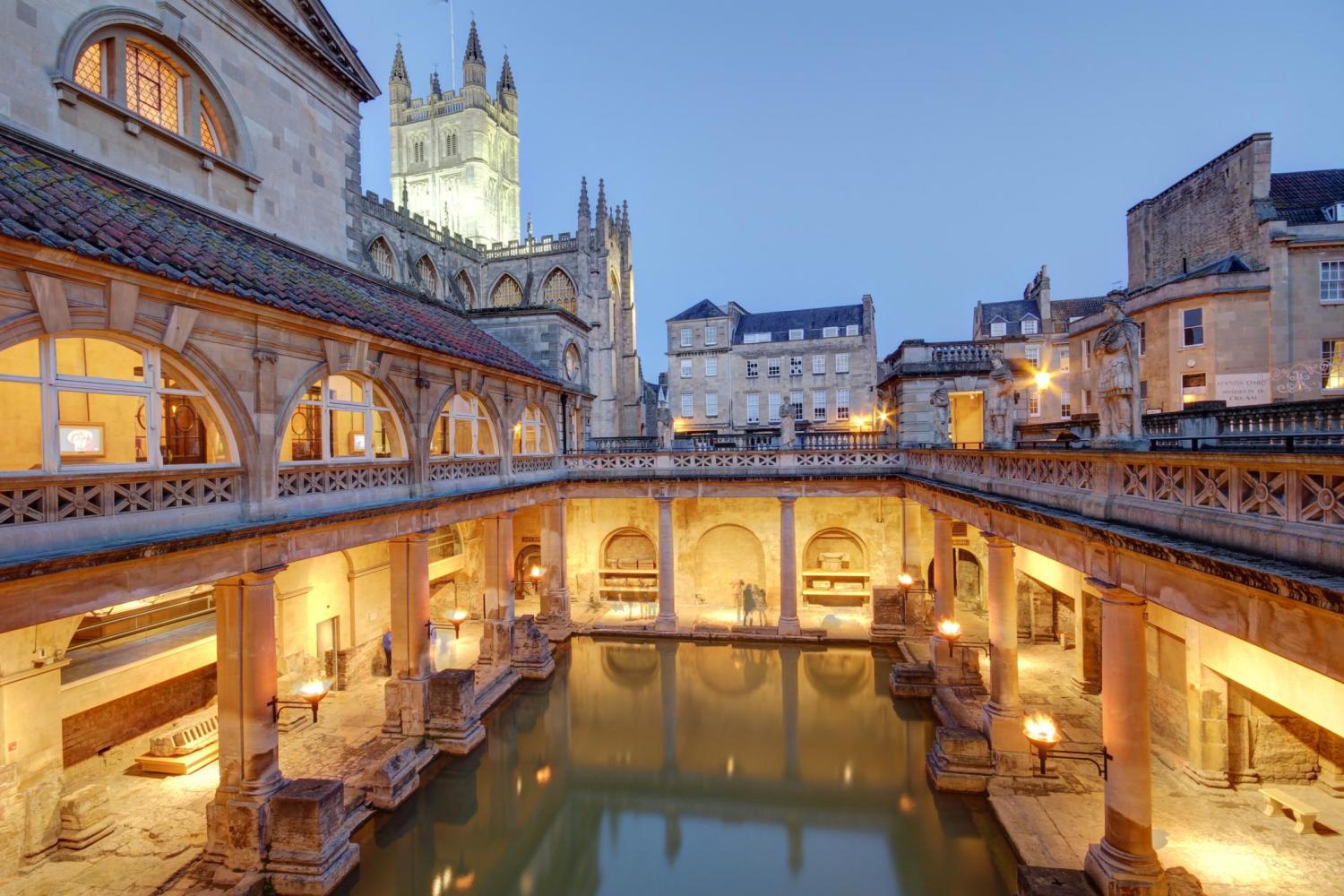
The Roman Baths

In AD 43 the Romans started the development of ‘Aquae Sulis’ as a sanctuary of rest and relaxation, not a garrison town like most Roman settlements – despite Tacitus in A.D 80 describing the taking of the waters as ‘one of the those luxuries that stimulate to vice.’ In AD 70, the Romans built a reservoir around the hot springs, and then a sophisticated series of baths and a temple dedicated to the goddess Sulis Minerva. A temple to Aesculopius, discovered near the Cross Bath provides a clue to there being a Roman bath on this site dedicated to healing, not just to relaxation.

As a religious shrine and bathing complex, Aquae Sulis attracted visitors from across Britain and Europe, foreshadowing Bath’s status as a premier tourism destination. The Romans also used the Cross and Hetling springs.

After the withdrawal of Roman ‘protection’ in 410, Aquae Sulis fell into decline, although the use of the baths continued. In 675 the name Hat Bathu first appears. The Cross Bath may possibly be named thus because the body of St Aldhelm rested there on its journey from Doulting to Malmesbury in 709. An 8th century poem in the ‘Exeter Book’ describes how “a stream gushed forth in rippling floods of hot water. The wall enfolded within its bright bosom the whole place which contained the hot flood of the baths.” It also describes how the roofless ruins of the Roman town remained standing around the bath, dramatic and mysterious. Alsi’s Bath, later the Hot Bath, was probably named after St Aelfsige, who was perhaps responsible for building a Saxon bath to replace the Roman one there.

The appointment of John of Villula as Bishop of Bath and Wells in 1088, after the destruction of much of Bath during a rebellion against William Rufus, was a significant development. A keen physician, he soon purchased from the king the royal property in the city and organised a substantial re-shaping of the street plan. The baths were almost certainly rebuilt over the Temple Precinct, and in 1138 the ‘Gesta Stephani’ described how “Through hidden pipes, springs supply waters, heated not by human skill or art, from deep in the bowels of the earth to a reservoir in the midst of arched chambers, splendidly arranged, providing in the centre of the town baths which are pleasantly warm, healthy, and a pleasure to see… From all over England sick people come to wash away their infirmities in the healing waters, and the healthy gaze at the remarkable bubbling up of the hot springs.”

The founding of St John’s Hospice by Bishop Reginald in 1174 confirms the extensive use of the waters and accommodation was provided for visitors to the Cross Bath.The three baths attracted visitors from considerable distances, especially from the 16th century (note the publication in 1562 of the first medical treatise by William Turner on the use of the waters). A religious exile during Queen Mary’s reign, he had travelled in Italy and Germany and observed many spas in operation. He suggested the need for substantial improvements, to the drainage system as well as the behaviour of the visitors, and many were carried out over the next few years: a new drainage system, segregated bathing (this did not last!), and a separate Lepers’ Bath (near the Hot Bath – before this, people with skin complaints had used the Cross Bath).

However, there were still complaints about the absence of covering over the baths and the lack of changing rooms. Despite this, Bath was now starting to attract visitors from mainland Europe. (In the early 17th century, spas also developed at Tunbridge Wells, Epsom and Harrogate.) Many doctors set up house in the ‘Bimbery’ area (the area between Beau St, Bath St, Hot Bath St and Bilbury Lane), often providing lodging rooms for visiting patients. From 1609, Bellott’s Hospital provided accommodation to enable poor visitors to obtain water treatments.

Royal visits in 1574, 1613, 1615, 1634 and 1663 increased the fame and attraction of Bath. In June 1688, James II’s wife, Mary of Modena, gave birth to the ‘Old Pretender’ nine months after bathing in the Cross Bath (which thus played a major role in provoking the Revolution of 1688).

In 1688, 1692, 1702 and 1703 Princess/Queen Anne visited Bath to take the waters and the frequency of her visits led to even greater aristocratic patronage. These visits set in motion a period of development in which Bath became ‘the premier resort of frivolity and fashion’, and led to the great rebuilding of the city to produce the 18th century layout and architecture of today’s UNESCO World Heritage Site.

The publication in 1707 of Dr William Oliver’s ‘Practical Dissertation on Bath Water’, with its emphasis on drinking as well as the more inconvenient bathing and a long list of diseases suitable for cure by these methods, helped to increase the attraction of Bath.

The Cross Bath was the most fashionable bath, as it was the most private. Musicians accompanied the bathers and chocolate was drunk by bathers relaxing around the elaborate Melfort Cross, erected in 1688 to celebrate the birth of James II’s son.

While the beneficial and healing properties of the water have always been acknowledged, modesty and decency have not always been inherent in Bath’s ‘spa culture’. John Wood the Elder writes at this time: ‘The Baths were like so many Bear Gardens, and Modesty was entirely shut out of them; people of both sexes bathing by day and night naked.’

In 1777, the Hot Bath was rebuilt to the design of John Wood the Younger. From 1783 the Cross Bath was rebuilt by Thomas Baldwin. When he was sacked by the Corporation, John Palmer took over and seems ingeniously to have moved Baldwin’s north-facing serpentine front to face east along the newly created Bath Street in the 1790s. (Baldwin’s plan for this street, together with Beau, Hot Bath and Union Streets, required the destruction of several existing medieval streets & houses, and much archaeological evidence.)

In 1788, new Private Baths (now demolished) were built between the King’s Bath and Stall Street. In the 1790s, the Great Pump Room was built to replace the now inadequate 1706 Room. While excavating the foundations for this, many of the first finds relating to the Roman Temple were made. Also at this time the Museum of Antiquities was created (now next to the entrance to Thermae), decorated in the niches outside with statues of Kings Edgar and Coel.

In the 1870 and 80s the King’s Bath was excavated by Major Charles Davis, while during the 1900s, Bath spa water was bottled and sold as Sulis Water, promising relief from rheumatism, gout, lumbago, sciatica and neuritis. After the First World War, thousands of wounded soldiers were rehabilitated in spa towns such as Bath. The public swimming pool at Beau Street was constructed in 1923 and the Cross Bath declined in status to become the ‘Tuppenny Hot’.

In 1948, following the establishment of the National Health Service, the health authorities of Bath made arrangements to provide water-cure treatments on prescription but the Hot Bath finally closed in 1976 when the Royal Mineral Water Hospital ceased to use the facility, having built a new pool in the hospital. For the previous twenty years the NHS had lost interest in hydrotherapy using natural mineral waters, believing that tap water was equally efficacious. The Tepid Bath, and the Beau Street Swimming Bath, which replaced it in 1926 survived only until 1978 when the new public swimming baths opened in North Parade. The Council, as owner, was reluctant to invest in both facilities and the NHS as user had little further interest in the old baths. The death in October 1978 of a young girl from a rare strain of meningitis possibly contracted from the natural bacteria in the earth’s strata through which the spa water passed, after she had swum in the water in a gala with the Bath Dolphins, was a further contributor to the lack of interest in investment. Bath was the third from last of the 8 great hydropathic centres in England to close; the last, Buxton, closed in 2000. However, the Roman Baths and Pump Room were soon to become one of the UK’s leading tourist attractions and this helped to establish a demand for the reopening of the spa facilities.

The restoration of Bath’s Spa, Thermae Bath Spa, is finally complete – the latest chapter in a story which goes back at least 2,000 years.

The perfect way to unwind after a day’s sightseeing, shopping or attending a conference or meeting in one of Bath’s historic venues, hotels, or even in Thermae itself, Thermae Bath Spa will use the natural hot, mineral rich waters for which Bath is rightly famous worldwide.

Bathing in those thermal waters will offer both residents and visitors a genuinely unique experience in the UK and Bath will once more be a Spa, not only in name but also in reality.

Link source: http://visitbath.co.uk/spa-and-wellbeing/history-of-baths-spa
Link: Private Guided Tours of Bath and the South West

Wessex Guided Tours
Mystical Landscape, Magical Tours
The Heritage Trust's avatarThe Heritage Trust

 
Anglo-Saxon spindle whorl with runic inscription
Private collection Great Britain
 
Measuring approximately 3.5cm in diameter, this Anglo-Saxon, biconvex cast lead spindle whorl, has an inscription on one side (in five runes) and on the other side a more commonly occurring star motif. The inscription may be a personal name or possibly a spell.


Spinning with a whorl (c) on a spindle (b) and distaff (a)
 

View original post

The Heritage Trust's avatarThe Heritage Trust

Conservator Luisa Duarte cleaning a Romano-British sculpture of an eagle and serpent
Image credit Andy Chopping. Museum of London Archaeology/PA

 
Maev Kennedy, writing in The Guardian yesterday, reports on a Romano-British sculpture recently unearthed in the City of London by archaeologists from the Museum of London.
 
A superb Roman eagle in near pristine condition, serpent prey wriggling in its beak, has been found by archaeologists in the City of London. A symbol of immortality and power, it was carefully preserved when the aristocratic tomb it decorated was smashed up more than 1,800 years ago – and is regarded as one of the best pieces of Romano-British art ever found.
 
The preservation is so startling that the archaeologists who found it a few weeks ago at the bottom of a ditch, on the last day of an excavation on a development site at the Minories, were worried in case they…

View original post 81 more words

Hundreds of treasures from the golden age of Stonehenge have gone on permanent display in England, revealing the story of the people who lived amidst the area when the monument was one of the great religious focal points of western Europe.

Housed in a large, specially-designed high security and humidity-controlled exhibition facility inside the Wiltshire2013-10-stonehenge-object-overlay-jpg Museum in Devizes, 15 miles north of the megalithic stone circle, the objects make England’s largest collection of early Bronze-Age gold.

“Stonehenge is an iconic monument, but this is the first time that such a wide range of high status objects from the spectacular burials of the people who used it, has ever been put on permanent display,” David Dawson, director of the Wiltshire Museum.

PHOTOS: Stonehenge Made to Glisten

Most of the 500 Neolithic objects on show were unearthed within a half mile radius of Stonehenge, including 30 gold pieces which were excavated in 1808 from a burial mound known as Bush Barrow.

Found by William Cunnington, Britain’s first professional archaeologist, the objects became known as the crown jewels of the “King of Stonehenge.”

Overlooking Stonehenge itself, the burial indeed contained the skeleton of a chieftain who lived almost 4,000 years ago. He was buried in regal splendor with the objects that showed his power and authority.

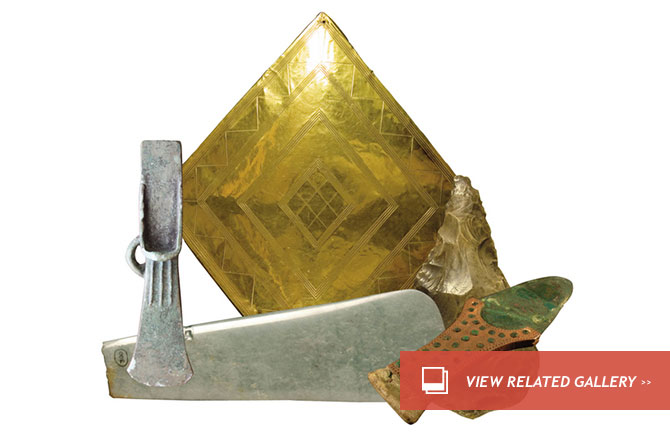
Among the treasures on display are a magnificent bronze dagger with a gold covered haft, a golden sheath for a dagger, a ceremonial axe, gold beads, necklaces, earrings, pendants and other gold jewellery, a unique jet disc (used to fasten a luxury garment), rare traces of ancient textiles and two of the finest prehistoric flint arrow head ever found.

ANALYSIS: Stonehenge Settled 5,000 Years Earlier Than Thought

“Many of the items may well have been worn by Bronze Age priests and chieftains as they worshiped inside Stonehenge,” Dawson said.

“Axes and daggers on display are identical to images of weapons carved into the giant stones of Stonehenge itself,” he added.

The exhibition’s centerpiece is the beautifully decorated gold lozenge found on the chest of the “King of Stonehenge.”

Although the purpose of the gold lozenge remains a mystery — interpretations have ranged from an elaborate button to an astronomical instrument — its precise decorations, made of impressed lines, reveals a detailed knowledge of mathematics and geometry.

“All this was done with the naked eye as there were no magnifying glasses or microscopes,” Dawson told London’s Times.

ANALYSIS: Understanding Stonehenge: Two Explanations

The museum hopes that the $1.2 million exhibition will help attract more tourists to Devizes, generating jobs in the local community.

“Devizes is mid-way between two of the world’s most important ancient monuments — the great prehistoric stone circles of Stonehenge and Avebury. Visiting the Wiltshire Museum completes the experience of seeing these two iconic sites,” Dawson said.

Image: Some of the objects on display. Credit: Wiltshire Museum

Artcle source here: http://news.discovery.com/history/archaeology/stonehenge-treasures-reveal-worshippers-sophistication-131017.htm

‘We now visit the Wiltshire Museum on our private guided tours of Stonehenge’

Wessex Guided Tours

StonehengeNews's avatarStonehenge Stone Circle News and Information

In September 1808, William Cunnington, who was Britain’s first professional archaeologist, wrote to his patron to tell him that he had discovered what were to become known as the crown jewels of the “King of Stonehenge”.

On Monday, some of the treasures he found will go on permanent public display for the first time.

Gold from the time of Stonehenge:  new prehistory galleries at the Wiltshire Bush Barrow LozangeMuseum in Devizes Opening on 14 October, a completely new display over 4 galleries will tell the story of the Stonehenge and Avebury World Heritage Site.

On display for the first time are dozens of gold items dating to the time of Stonehenge. Many were found Bronze Age burial mounds within sight of Stonehenge, and were worn by people who worshipped inside the stone circle. These nationally important objects have never been on permanent display, and are now on show as part of this…

View original post 166 more words

exploringlondon's avatarExploring London

A new permanent gallery looking at how the Royal Navy shaped individual lives and the course of British history over the 18th century opens at the National Maritime Museum in Greenwich on Monday 21st October, Trafalgar Day.Nelson, Navy, Nation charts a course from the Glorious Revolution of 1688 through to the defeat of Napoleon in 1815 and provides a setting for the museum’s many artefacts related to Vice-Admiral Lord Nelson. Among the 250 objects on display in the gallery are the uniform (with bullet hole) Nelson wore at the Battle of Trafalgar, artworks likes William Hogarth’s Captain Lord George Graham in his Cabin, a seven barreled volley gun and grim items like a surgeon’s tools including an amputation knife, bone saw and bullet forceps. There is also the last letter Nelson wrote to his daughter Horatia and mourning rings worn by close friends and family at his…

View original post 322 more words

The Heritage Trust's avatarThe Heritage Trust


Vikings: life and legend exhibition at the British Museum
 
The British Museum has announced that –
 
In March 2014 the British Museum will open the Sainsbury Exhibitions Gallery with a major exhibition on the Vikings, supported by BP. The exhibition has been developed with the National Museum of Denmark and the Staatliche Museen zu Berlin (National Museums in Berlin) and focuses on the core period of the Viking Age from the late 8th century to the early 11th century.
 
The extraordinary Viking expansion from the Scandinavian homelands during this era created a cultural network with contacts from the Caspian Sea to the North Atlantic, and from the Arctic Circle to the Mediterranean. The Vikings will be viewed in a global context that will highlight the multi-faceted influences arising from extensive cultural contacts. The exhibition will capitalise on new research and thousands of recent discoveries by…

View original post 329 more words