Feeds:
Posts
Comments

heritageaction's avatarThe Heritage Journal

The new Visitors Centre was shown off this week. It’s unfair to fully judge it yet but 3 things stood out for us (one good, one bad and one uncertain):

The look
Early on there was bitter criticism (“like an immigration detention centre” said a former Mayor of Salisbury; “incongruous” said CABE, the Government’s design watchdog). Not being design experts we can’t say if those criticisms are valid or have been met but it comes down to personal taste and it looks OK to us. More to the point we strongly empathise with the architects when they say: “If once back at home, a visitor can remember their visit to the stones but can’t remember the visitor centre they passed through on the way, we will be happy”. We also think that the main advantage of how it looks is that it can’t…

View original post 196 more words

English Heritage announced that the first phase of the long-awaited improvements to the setting and visitor experience of Stonehenge will be launched to the public on Wednesday 18th December 2013

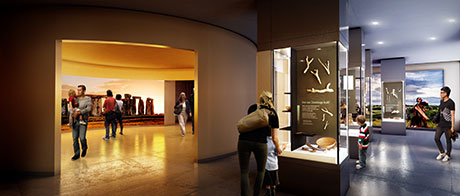
Artist’s impression of the permanent exhibition which features, among other things, precious objects on loan from the Wiltshire Heritage Museum and the Salisbury and South Wiltshire Museum

Artist’s impression of the permanent exhibition which features, among other things, precious objects on loan from the Wiltshire Heritage Museum and the Salisbury and South Wiltshire Museum

“This Will Change People’s Experience of Stonehenge Forever” 

Simon Thurley, Chief Executive of English Heritage, said: “This world famous monument, perpetually described as a mystery, finally has a place in which to tell its story. The exhibition, will change the way people experience and think about Stonehenge forever – beyond the clichés and towards a meaningful inquiry into an extraordinary human achievement in the distant past. The exhibition will put at its centre the individuals associated with its creation and use, and I am very proud with what we have to unveil to the world in December.”

From 18 December 2013, entrance to Stonehenge will be managed through timed tickets and advance booking is strongly recommended. Online booking opens on 2 December at www.english-heritage.org.uk/stonehenge.

Organise a private guided tour of Stonehenge and explore Wiltshire rich heritage
Tours depart from Bath and Salisbury: http://www.HisTOURies.co.uk

Wessex Guided Tours
The Best Tours in British History

StonehengeNews's avatarStonehenge Stone Circle News and Information

Visitors to Stonehenge will get the chance to  explore an impressive new visitor centre close to the ancient site later this  year.

English Heritage today announced that the  first phase of its long-awaited £27million improvements  to the area will be launched to the public on 18 December, in time for  winter solstice on 21 December.

The new visitor centre will house a permanent  exhibition that will offer visitors the chance to learn more about the famous  monument.

They will be able to ‘stand in the stones’  thanks to a 360-degree virtual experience before they enter a gallery where they  will be able to view nearly 300 prehistoric artefacts and displays that reveal  facts and theories about the ancient monument.

Many of the archaeological finds – which are  on loan from various museums including the Salisbury and South Wiltshire Museum  – will be on public display for the first time.

View original post 384 more words

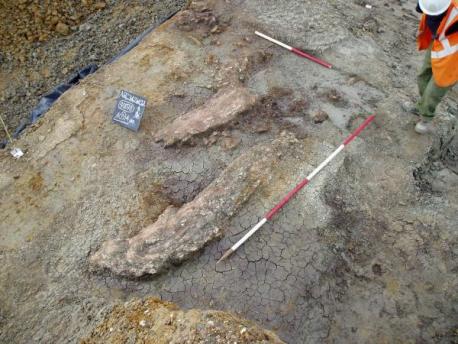
A PRE-HISTORIC elephant has revealed clues of what life was like for early humans and how it met its end.
Wessex Tours

University of Southampton lecturer and archaeologist Dr Francis Wenban-Smith discovered remains and has spent the last ten years studying the creature.

Now he has published a book that will teach other archaeologists about life for people that existed thousands of years before Neanderthals.

The extinct straight-tusked elephant was found in Ebbsfleet in Kent, below, while construction workers were preparing the build the High Speed 1 rail link between the Channel Tunnel and London.

The species was twice the size of today’s African elephant and almost four times the weight of a family car.

The 420,000-year-old remains were buried along with other creatures, including prehistoric ancestors to cattle and extinct forms of rhinoceros and lions.

It was also found surrounded by flint tools used to cut meat from carcasses, which have lead Dr Wenban-Smith to believe early humans may have eaten and possibly hunted the creature in a group.

Dr Wenban-Smith, pictured below, said: “The key evidence for elephant hunting is that, of the few prehistoric butchered elephant carcasses that have been found across Europe, they are almost all large males in their prime, a pattern that does not suggest natural death and scavenging.

“Although it seems incredible that they could have killed such an animal, it must have been possible with wooden spears.

“Rich fossilised remains surrounding the elephant skeleton, including pollen, snails and a wide variety of vertebrates, provide a remarkable record of the climate and environment the early humans inhabited.

Full article in the Salisbury Journal: http://www.salisburyjournal.co.uk/archive/2013/09/22/10690698.Prehistoric_giant_elephant_unlocks_mysteries_of_ancient_hunters/
Wessex Guided Tours

StonehengeNews's avatarStonehenge Stone Circle News and Information

Despite being one of the world’s most valued heritage sites Stonehenge has never been treated with the respect that it deserves. A new visitor centre will change the way we view this national treasure.

Pondering the enigma of the imposing stone circle that stands on Salisbury Plain early in the 17th century King James I commissioned his architect general, Inigo Jones, to prepare a report on the stones’ condition and their origins. Jones concluded that only the Romans could have built such a sophisticated structure, backing up his case with crisp drawings of the stones in a pre-ruinous state, while dismissing the ancient Britons as savages incapable of building such ‘stately structures’.

Four hundred years later much the same questions are still being asked about Stonehenge. Who built it? What was it for? But in more recent years the focus has been how best to preserve the stones…

View original post 1,840 more words

The Heritage Trust's avatarThe Heritage Trust


Natalie McCaul, Curator of Archaeology at the Yorkshire Museum, with the gold torc (right) that the Museum is hoping to buy and reunite with one found metres from it at Towton (left) already in the Museum’s collection

Dan Bean, writing in The Press yesterday, reports that –

GOLD jewellery thought to be 2,000-years-old could leave North Yorkshire, if essential funds can not be raised. The gold torcs, or bracelets, are currently on show at the Yorkshire Museum, and are the first items of Iron Age gold jewellery ever found in the north of England. Both pieces were discovered in Towton, near Tadcaster, by metal detectorists in 2010 and 2011, and are believed to have belonged to an extremely wealthy member of the Brigantes tribe, which ruled most of North Yorkshire at the time.
 
The first torc was bought by the museum in January 2012 for £25,000 raised through a public…

View original post 85 more words

The Heritage Trust's avatarThe Heritage Trust

 
Murals by pre-Raphaelite artists recently discovered at the Red House in south-east London
Image credit Linda Nylind
 
Writing in The Guardian last month Maev Kennedy reports that –
 
It began as an attempt to restore one blurry image that had been hidden for a century behind a large built-in wardrobe on William Morris’s bedroom wall. Months later, the painstaking removal of layers of paint and wallpaper revealed that an entire wall at the artist and craftsman’s first married home was painted by his young friends who would become world-famous pre-Raphaelite artists.
 
The near-lifesize figures on the wall at the Red House, now buried in south-east London suburbia at Bexleyheath, are now believed to represent the joint work of Edward Burne-Jones, Dante Gabriel Rossetti, his wife Elizabeth Siddal, Ford Madox Brown and Morris.
 
Full article here.


View original post

Mike Pitts's avatarMike Pitts Digging Deeper

car park panorama small

If you visit Stonehenge now – as huge numbers did in August – you’ll really see signs that things are changing. Work continues in the car park to prepare a turning circle at the end of what will be the stub of the old A344. The road itself as it once continued eastwards to Stonehenge Bottom has now all but gone, exposing the chalk below. Wessex Archaeology has been monitoring it, and has excavated parts of the two parallel Avenue ditches, and a small part of what looks like the lip of the Heelstone ditch, as Ollie Good kindly showed me.

My interest in this was naturally strengthened by my excavations immediately beside the road there in 1979 and 1980. We had several advantages over the modern archaeologists.

The team were almost all volunteers, archaeology students and staff from Southampton University, so brought considerable skill, but at no cost to…

View original post 444 more words

StonehengeNews's avatarStonehenge Stone Circle News and Information

  • Skull is  believed to be of a middle aged woman living in 3,300 BC
  • Unbroken  skull found on the banks of the River Avon in Worcestershire
  • Carbon  dating technology places the piece between 3,338BC and 3,035  BC
  • The  ‘exceptional’ find suggests there is an undiscovered burial site  nearby

A 5,000-year-old human skull in ‘fabulous’  condition has been discovered on the banks of a river in Worcershire by a walker  who thought it was a coconut.

Experts said the piece of ancient skull is an  ‘exceptional find’ as the intricate marks  from blood vessels are still visible on the inner surface.

The smooth dark outer side gives only a  tantalising glimpse as to what the person may have looked like, although there  are ‘tentative’ suggestions it may have belonged to a woman in middle age living  in the Neolithic period – around the time Stonehenge was built.

The skull is not…

View original post 537 more words

A planning application has been submitted to the local authority in Wiltshire to build a modern burial mound.

Developer Tim Daw  wants to construct a new “long barrow” mound near All Cannings to give people another place to leave cremated remains.

The monument is planned for land near Cannings Cross Farm near Devizes

The monument is planned for land near Cannings Cross Farm near Devizes

The ancient tradition of burying the remains of the dead within earth mounds dates to the early Neolithic period.
Mr Daw said his plan is for “a modern interpretation” of a long barrow.

Wiltshire is home to a number of long barrows, including one at West Kennett a few miles from where Mr Daw is planning his monument on land near Cannings Cross Farm.

Mr Daw said the boat-shaped structure will be made partly from sarsen stone, and will span “about the length of three buses”.

The interior will be made up of seven chambers within which box-shaped niches will be formed on up to four shelves.

Winter solstice
Each niche will be separated from the next and sealed with a lockable door.

Depending on the size of the vessel containing the cremated remains, each niche will provide storage for between six and eight containers for a family group.

Mr Daw said the monument will also be built to align directly with the sunrise of the winter solstice.

He said: “The sun rise will come up through the hills and shine right down through the length of the long barrow to the end of the passage way.”

Wiltshire Council is expected to decide on the planning application in mid-October.

Article source: http://www.bbc.co.uk/news/uk-england-wiltshire-23867760

Wessex Guided Tours