The sounds of battle will be erupting at Old Sarum when members of The Medieval Siege Society lay siege to the Castle and recreate The Wars of the Roses this Bank Holiday weekend. Enjoy displays of medieval martial skills such as swordsmanship and archery, culminating in dramatic battle re-enactments. Don’t miss the mighty medieval trebuchet in action too!
 Throughout the day visitors will be invited to step back in time and tour the living history camps, seeing how an army would live on campaign and give an insight into life for fifteenth century soldiers and their families
Sun 5 & Mon 6 May 2013 (bank holiday
More information: http://www.english-heritage.org.uk/daysout/events/siege-os-5-may/
Wessex Guided Tours
Mystical Landscape, Magical tours (www.HisTOURies.co.uk)
Posted in English Heritage, English history, events in wiltshire, old sarum, Wiltshire Heritage | Leave a Comment »

With the end of this phase of the project in sight, and the buildings almost finished, we thought it would be a good idea to dedicate the next few days blogs to each building.
Building 547
This building has been used to test a lot of our construction theories. A different method was employed in each quarter of the building. Two sections of wall were woven with a diagonal weave and two were woven horizontally.
The roof was also divided into sections which allowed us to experiment with rafter placement, ways of attaching the ringbeams and different thatching materials.
We also used this building to test our daub material before we used it on building 851.
Posted in Uncategorized | Leave a Comment »

Go behind-the-scenes and enjoy an exclusive talk and ‘first-look’ tour of the Neolithic House project, under construction, at Old Sarum. Watch the construction work as it happens and learn about the building techniques used by the volunteers leading the project.
 Time: Tours at 10am, 11.30am, 1pm, 2.30pm, 4pm (May 4th 2013)
How to Book
Purchase your tickets today using our online system below or by calling our dedicated Ticket Sales Team on 0870 333 1183 (Mon – Fri 8.30am – 5.30 Sat 9am – 5pm). Please note: Booking tickets for this event is essential as places are limited
Neolithic Houses Project
One of the most exciting features of the new visitor centre at Stonehenge will be an external gallery, which will include three reconstructed Neolithic houses. Using archaeological evidence and authentic materials, these buildings will provide a real and tangible link for visitors to the distant past. People will…
View original post 26 more words
Posted in Uncategorized | Leave a Comment »
Archaeologists, excavating near the Royal Borough, have discovered the 4400 year old skeleton of an upper class woman
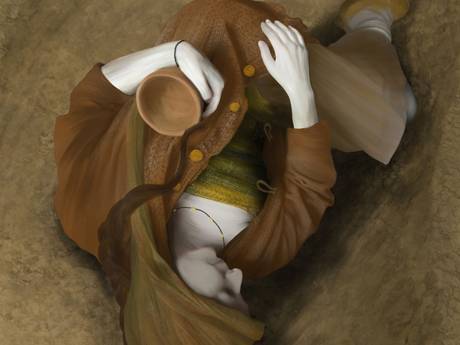
Windsor may have been popular with royalty rather earlier than generally thought.
Archaeologists, excavating near the Royal Borough, have discovered the 4400 year old gold-adorned skeleton of an upper class woman who was almost certainly a member of the local ruling elite.
She is the earliest known woman adorned with such treasures ever found in Britain.
The individual, aged around 40, was buried, wearing a necklace of folded sheet gold, amber and lignite beads, just a century or two after the construction of Stonehenge some 60 miles to the south-west. Even the buttons, thought to have been used to secure the upper part of her now long-vanished burial garment, were made of amber. She also appears to have worn a bracelet of lignite beads.
The archaeologist in charge of the excavation, Gareth Chaffey of Wessex Archaeology, believes that she may have been a person of power – perhaps even the prehistoric equivalent of a princess or queen.
It’s known that in southern Britain, some high status men of that era – the Copper Age – had gold possessions, but this is the first time archaeologists have found a woman of that period being accorded the same sort of material status.
It’s thought that the gold used to make the jewellery probably came originally from hundreds of miles to the west – and that the amber almost certainly came from Britain’s North Sea coast. The lignite (a form of coal) is also thought to have come from Britain.
The funeral rite for the potential prehistoric royal may have involved her family arranging her body so that, in death, she clasped a beautiful pottery drinking vessel in her hands. The 25 centimetre tall ceramic beaker was decorated with geometric patterns.
Of considerable significance was the fact that she was buried with her head pointing towards the south.
Men and women from the Stonehenge era were often interred in opposing directions – men’s heads pointing north and women’s heads pointing south. Europe-wide archaeological and anthropological research over recent years suggests that women may have been associated with the warm and sunny south, while mere men may have seen themselves as embodying the qualities of the colder harder north!
The woman’s skeleton and jewellery were found 18 months ago – but were kept strictly under wraps until now, following the completion of initial analyses of the woman’s bones – and metallurgical analysis of the gold.
The discovery is part of a still ongoing excavation which started a decade ago. The elite gold-and-amber-adorned Copper Age woman is merely the most spectacular of dozens of discoveries made at the site – including four early Neolithic houses, 40 Bronze Age burials, three Bronze Age farm complexes and several Iron Age settlements.
The excavations are being funded by the international cement company CEMEX, whose gravel quarry near Windsor is the site of the discoveries.
Archaeologist Gareth Chaffey of Wessex Archaeology, who is directing the ongoing excavation, said that the woman unearthed at the site “was probably an important person in her society, perhaps holding some standing which gave her access to prestigious, rare and exotic items. She could have been a leader, a person with power and authority, or possibly part of an elite family – perhaps a princess or queen.”
Posted in Archaeologists, british history, stone age, Stonehenge, Wessex Tours, Windsor | Leave a Comment »
Human beings were occupying Stonehenge thousands of years earlier than previously thought, according to archaeologists.
Research at a site around a mile from Stonehenge has found evidence of a settlement dating back to 7500BC, 5,000 years earlier than previous findings confirmed.
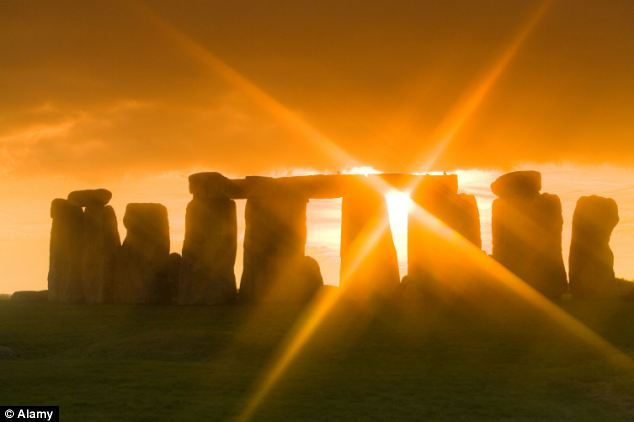
Research at a site around a mile from Stonehenge has found evidence of a settlement dating back to 7500BC, 5,000 years earlier than previous findings confirmed
And carbon-dating of material at the site has revealed continuous occupation of the area between 7500BC and 4700BC, it is being revealed on BBC One’s The Flying Archaeologist tonight.
Experts suggested the team conducting the research had found the community that constructed the first monument at Stonehenge, large wooden posts erected in the Mesolithic period, between 8500 and 7000BC.
Open University archaeologist David Jacques and friends started to survey the previously-unlooked at area around a mile from the main monument at Stonehenge, when they were still students in 1999.
The site contained a spring, leading him to work on the theory that it could have been a water supply for early man.
He said: ‘In this landscape you can see why archaeologists and antiquarians over the last 200 years had basically honed in on the monument, there is so much to look at and explore.
‘I suppose what my team did, which is a slightly fresher version of that, was look at natural places – so where are there places in the landscape where you would imagine animals might have gone to, to have a drink.
‘My thinking is where you find wild animals, you tend to find people, certainly hunter-gatherer groups, coming afterwards.
‘What we found was the nearest secure watering hole for animals and people, a type of all year round fresh water source.’
He described the site as ‘pivotal’.
Dr Josh Pollard, from Southampton University and the Stonehenge Riverside Project, said he thought the team may have just hit the tip of the iceberg in terms of Mesolithic activity focused on the River Avon around Amesbury.
‘The team have found the community who put the first monument up at Stonehenge, the Mesolithic posts 9th-7th millennia BC.
‘The significance of David’s work lies in finding substantial evidence of Mesolithic settlement in the Stonehenge landscape – previously largely lacking apart from the enigmatic posts – and being able to demonstrate that there were repeated visits to this area from the 9th to the 5th millennia BC.’
The Flying Archaeologist is being shown on BBC One (West and South) at 7.30pm tonight.
By Mark Prigg (source: http://www.dailymail.co.uk/sciencetech/article-2311173/Stonehenge-occupied-humans-5-000-years-EARLIER-thought–animal-watering-hole.html)
Wessex Guided Tours
Mystical Landscape, Magical Tours
Posted in AMESBURY’S archaeology, salisbury museum, Stonehenge and Salisbury Tours, Wessex Tours, Wiltshire Heritage | Leave a Comment »
Travel companies from across the country spent two days visiting Wiltshire’s hotspots this week in a bid by VisitWiltshire to increase tourism.
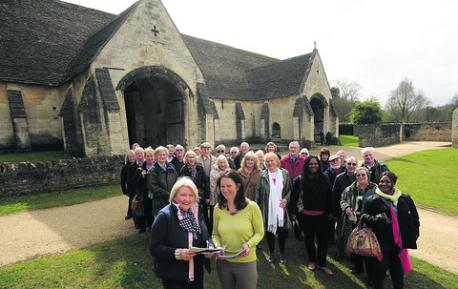
Travel company representatives during their visit to Bradford on Avon with, in the foreground, Fiona Errington from Visit Wiltshire and Julie Cooper from the town’s Tourist Information Centre
The group, made up of 48 visitors from tour operators and coach companies, spent the first day visiting Castle Combe, Longleat, Bradford on Avon and Bowood House and Hotel.
The second day took in the sights of Stonehenge, Old Sarum, Sarum College, Salisbury Cathedral and Marlborough.
David Andrews, chief executive of VisitWiltshire, said: “This event is a fantastic opportunity to show off the vast tourism offering in the county to national operators, putting Wiltshire firmly on the map.”
Julie Roberts, of Johnsons Quality Coach Travel in Warwickshire, said: “We go on quite a few of these tours to get a snapshot of different areas.
“It is a chance to see the suitability of attractions for our customers and the tours usually feature a mixture of things we already offer as well as new locations.”
Hilary Christmas, of Norman Allen Group Travel in Herefordshire, operates tours all over the world and said: “If we can be more familiar with what there is to do, it will help us no end and allow us to advertise correctly.
This tour of Wiltshire has been very positive. I have never been to Bradford on Avon and it is astoundingly beautiful.”
Peter Wragg, chairman of VisitWiltshire, said: “Tourism in Wiltshire is worth £1billion per year and employs 21,000 people. This is about getting people to visit the county and increase Wiltshire’s exposure.”
Aricle by Katie Smith – http://www.wiltshiretimes.co.uk
Wessex Guided Tours
Mystical Landscape, Magical Tours
http://www.HisTOURies.co.uk
Posted in old sarum, Salisbury Tours, sightseeing, Stonehenge, Tourism in Wiltshire, Wiltshire Heritage | Leave a Comment »

Postcards to friends of the Stonehenge and Avebury World Heritage Site

Sir John Lubbock is remembered in passing today as a nineteenth century archaeologist and politician who championed the 1882 Ancient Monuments Act and saved Avebury from development.
“Darwin’s Apprentice” is a unique book that looks beyond these headlines to reveal an important yet forgotten Darwinist through the eyes of his prehistoric archaeological and ethnographic collection. Both man and collection are witnesses to an extraordinary moment in the history of science and archaeology – the emotive scientific, religious and philosophical debate on human antiquity triggered by the publication of Darwin’s “On the Origin of Species” in 1859.
It will be published by Pen & Sword Archaeology in April 2013 to mark the centenary anniversary of John Lubbock’s death. Further details can be found here
Janet Owen
________________________________________________
This is part of a series of short “postcards” that anyone with something…
View original post 43 more words
Posted in Uncategorized | Leave a Comment »
Volunteers are helping English Heritage to test build three Neolithic houses which, in their final form, will be the highlight of the outdoor gallery of the new Stonehenge visitor centre, offering an authentic glimpse of the lifestyle and technology of the Neolithic people who built Stonehenge
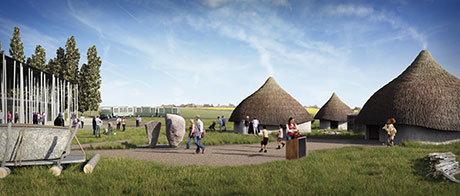
A newly released computer image of the outdoor gallery
The archaeological experiment is taking place at Old Sarum near Salisbury, using extremely rare evidence of buildings from Neolithic England recently unearthed near Stonehenge. The lessons learned from the experiment will inform their reconstruction at the new visitor centre in January 2014.
When completed, they will form the focal point of the outdoor gallery that will complement the exhibition indoors featuring important objects on loan from the Wiltshire Heritage Museum and the Salisbury and South Wiltshire Museum.
The three houses have been selected from about ten that were discovered in 2006 and 2007 by Professor Mike Parker Pearson at Durrington Walls, a large henge monument 3km north-east of Stonehenge which was believed to be the largest Neolithic settlement in north-west Europe.
Radiocarbon tests show that these buildings date from around the same time as the sarsen stones were being put up at Stonehenge, about 2,500 BC. From the vast amount of remains of animal bones and pottery near the houses, it seems as if late Neolithic people were gathering at Durrington on a seasonal basis, probably at midwinter. As well as the houses, there were several timber monuments and an avenue linking the complex to the River Avon.
Not Everyday Domestic Dwellings
It is thought that these houses were not typical everyday domestic dwellings but that people lived in them for certain periods in the year. The scale of the site and the evidence of feasting and a high-nutrition diet raise the distinct possibility that the occupiers were involved with the construction of and celebrations at Stonehenge.
The excavation uncovered the floors of the houses and the stake holes where the walls once stood. Above ground, the appearance of the houses is unknown. One of the aims of this project is to test different materials and structures to see which ones work best.
“An Immediate and Sensory Link to the Past”
Susan Greaney, Senior Properties Historian at English Heritage, said: “The reconstructed houses will be an immediate and sensory link to the distant past, and will bring visitors as close as they can to appreciate what life was like for the extraordinary individuals who built Stonehenge.
“We have lots of evidence to inform this reconstruction, but there is also a lot of educated guess work. Building the prototypes will enable us to test things such as the roofing structure, roofing materials and various construction techniques, and learn more about late Neolithic people, their tools and technology, ideas of comfort and privacy and social organisation, among other things.”
Volunteers started building the prototypes at Old Sarum in early March and are expected to finish the experiment in May. They have also helped in the collection of raw materials, in some cases using prehistoric tools such as flint axes. Materials include 12 tonnes of chalk, 2,500 rods of hazel or willow wattling, 10 oak logs, 600 bundles of sedge, 600 bundles of water reed and hundreds of timber stakes and rafters.
Public Events
On 5th and 6th May and from 25th to 27th May, the public can take part in open days at Old Sarum, Wiltshire, to see the Neolithic house prototypes. Guided tours including hands-on activities are available. Tickets can be purchased at the door. For more information please contact 0800 333 1183.
Wessex Guided Tours
Mystical Landscape, Magical Tours
Posted in Guided Tours, Salisbury, Stonehenge, visit wiltshire | Leave a Comment »
Well worth a visit, these houses look great so far……
An experiment is under way here in Wiltshire to find out more about Neolithic building methods.
Using archaeological evidence unearthed from nearby Durrington Walls, three structures are being built at Old Sarum Castle, near Salisbury.
The English Heritage project aims to discover what was the most efficient way of building with locally-sourced materials.
The final reconstructions will be built at Stonehenge later this year.
They will be put up outside the new visitor centre.
The experiment is part of a £27m English Heritage scheme looking at how the setting of the ancient monument can be improved.
The recreated Neolithic buildings will form part of an “interactive and experiential” external exhibition at the 3,500-year-old World Heritage site.
The Dorset-based Ancient Technology Centre has been commissioned to construct the three prototype homes.
Luke Winter from the centre said the project aimed to look at what type of buildings may have been…
View original post 73 more words
Posted in Uncategorized | Leave a Comment »
Blog Archive
-
HisTOURies U.K Tours
- There’s more to this English county than just Stonehenge. Visit Wiltshire.
- Private Driver Guided Stonehenge Tours Departing from Salisbury.
- Private Driver-Guided Stonehenge Sightseeing Tours Departing from Bath.
- Stonehenge special access guided inner circle trips from London, Bath or Salisbury. Experience Stonehenge at dawn or dusk with a private VIP tour!
- Visiting Stonehenge? Our expert tour guides can turn the amazing experience of seeing the stones for the first time, into an enlightening one.
-
HISTOURIES PAGES
HISTOURICAL BLOGS
- January 2025 (1)
- December 2024 (1)
- October 2023 (1)
- February 2022 (1)
- March 2021 (1)
- December 2019 (1)
- January 2019 (2)
- June 2018 (2)
- December 2017 (3)
- June 2017 (1)
- May 2017 (5)
- February 2017 (5)
- January 2017 (9)
- December 2016 (5)
- November 2016 (5)
- October 2016 (3)
- July 2016 (1)
- April 2016 (1)
- March 2016 (1)
- February 2016 (5)
- January 2016 (1)
- October 2015 (2)
- September 2015 (2)
- May 2015 (3)
- March 2015 (1)
- February 2015 (2)
- January 2015 (7)
- December 2014 (3)
- October 2014 (5)
- September 2014 (4)
- March 2014 (2)
- February 2014 (1)
- January 2014 (4)
- November 2013 (4)
- October 2013 (8)
- September 2013 (6)
- August 2013 (7)
- July 2013 (3)
- June 2013 (5)
- May 2013 (10)
- April 2013 (8)
- March 2013 (6)
- February 2013 (2)
- January 2013 (3)
- December 2012 (3)
- November 2012 (7)
- October 2012 (7)
- September 2012 (5)
- August 2012 (2)
- July 2012 (6)
- June 2012 (3)
- May 2012 (5)
- April 2012 (3)
- March 2012 (4)
- February 2012 (7)
- January 2012 (5)
- December 2011 (3)
- November 2011 (7)
- October 2011 (8)
- September 2011 (9)
- August 2011 (7)
- July 2011 (7)
- June 2011 (4)
- May 2011 (5)
- April 2011 (4)
- March 2011 (10)
- February 2011 (7)
- January 2011 (11)
- December 2010 (12)
- November 2010 (12)
- October 2010 (17)
- September 2010 (13)
- August 2010 (9)
- July 2010 (12)
- June 2010 (6)
- May 2010 (6)
- April 2010 (13)
- March 2010 (22)
- February 2010 (26)
HISTOURIES UK

STONEHENGE TOURS
April 2026 M T W T F S S 1 2 3 4 5 6 7 8 9 10 11 12 13 14 15 16 17 18 19 20 21 22 23 24 25 26 27 28 29 30  Visit London
- An error has occurred; the feed is probably down. Try again later.
 Wessex Guided Tours