Feeds:
Posts
Comments

The people who built Stonehenge 5000 years ago probably had the same pallid complexion of many modern inhabitants of the UK. Now it seems that the humans occupying Britain and mainland Europe only lost the darker skins of their African ancestors perhaps just 6000 years earlier, long after Neanderthals had died out. The finding confirms that modern Europeans didn’t gain their pale skin from Neanderthals – adding to evidence suggesting that European Homo sapiens and Neanderthals generally kept their relationships strictly platonic.

There is a clear correlation between latitude and skin pigmentation: peoples that have spent an extended period of time at higher latitudes have adapted to those conditions by losing the skin pigmentation that is common at lower latitudes, says Sandra Beleza at the University of Porto in Portugal. Lighter skin can generate more vitamin D from sunlight than darker skin, making the adaptation an important one for humans who wandered away from equatorial regions.

Those wanderings took modern humans into Europe around 45,000 years ago – but exactly when the European skin adapted to local conditions had been unclear.

Three genes

Beleza and her colleagues studied three genes associated with lighter skin pigmentation. Although the genes are found in all human populations, they are far more common in Europe than in Africa, and explain a significant portion of the skin-colour differences between European and west African populations.

By analysing the genomes of 50 people with European ancestry and 70 people with sub-Saharan African ancestry, Beleza’s team could estimate when the three genes – and pale skin – first became widespread in European populations. The result suggested that the three genes associated with paler skin swept through the European population only 11,000 to 19,000 years ago.

“The selective sweeps for favoured European [versions of the three genes] started well after the first migrations of modern humans into Europe,” says Beleza.

The finding agrees with earlier studies suggesting that modern humans did not lose their dark skins immediately on reaching Europe, says Katerina Harvati at the University of Tübingen in Germany. “[The new study] is interesting because it suggests a very late differentiation of skin pigmentation among modern humans,” she says.

An earlier analysis of ancient DNA in 40,000 and 50,000-year-old Neanderthal bones, respectively from Spain and Italy, suggested that our extinct cousins had light-coloured skin and reddish hair in their European heartland. But the Neanderthals went extinct around 28,000 years ago – long before modern humans in Europe gained a pale skin. Evidently Neanderthals did not pass these useful local adaptations on to modern humans, despite genetic evidence that the two species interbred.

Middle Eastern contact

That might seem unusual given that the two species lived cheek-by-jowl in Europe for several thousand years. But it makes sense if the interbreeding evident in the genes occurred in the Middle East, where modern humans and Neanderthals first met, says Chris Stringer at the Natural History Museum, London.

In that region, Neanderthals may have had darker skins, explaining why our species did not gain a pale skin after interbreeding with them. Indeed, a study earlier this year of ancient DNA suggested that Neanderthals living in what is now Croatia had dark skin and brown hair.

“Neanderthal skin colour was probably variable, as might be expected for a large population spread out over a large territorial expanse,” says Harvati.

Journal reference: Molecular Biology and Evolution, doi.org/h9h
Source: http://www.newscientist.com

HisTOURies UK
Mystical Landscape, magical Tours
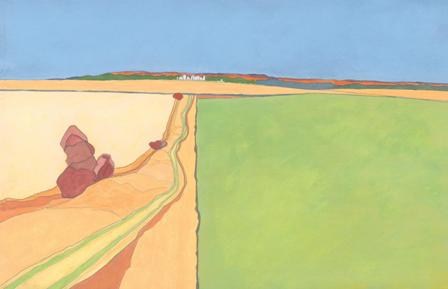
Saturday 13 October 2012 – Saturday 26 January 2013.

An exhibition of paintings and drawings that reflect one artist’s travels through the ancient sites of Wiltshire.  Over the last 50 years, Stonehenge and Salisbury MuseumPhilip Hughes has returned time and again to the Ridgeway, Avebury, Silbury Hill and Stonehenge.   Informed by maps, photography and electronic survey techniques, his work ranges from accurate topographical observation to abstract and emotional representation of the landscape.

The exhibition coincides with the publication of the book on Hughes’s work: Tracks: Walking the Ancient Landscapes of Britain (Thames & Hudson, 2012).

Hughes is represented by the Francis Kyle Gallery.

Salisbury Museum is based in the King’s House, a grade I listed building located opposite Salisbury Cathedral. We have a small but friendly staff, supported by over 100 volunteers. We offer a variety of services, including the opportunity to hire this unique location for corporate events and activities.

http://www.salisburymuseum.org.uk/

HisTOURies UK
Mystical Landscape, Magical Tours.

Christmas Market

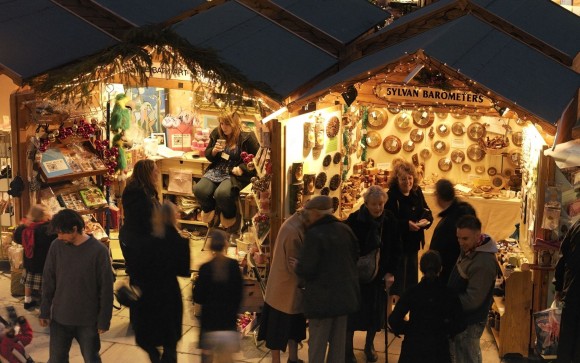
Salisbury will be hosting its first ever Christmas Market from 29 November. The Christmas Market will be taking place in the ancient Market Place in front of the city’s magnificent Guildhall.
55 beautiful chalets will be tempting visitors with stunning quality products, ideal for those who wish to find an ideal gift.

CSalisbury Christmas Marketome to Salisbury’s gorgeous new Christmas Market!

You will find it to be one of the prettiest, loveliest and most tasteful Christmas Markets in the country. With beautifully decorated chalets, inspiring and desirable gifts and gourmet foods, a warm welcome from stall holders, a Father Christmas Grotto, a spectacular lantern procession, and traditional music by local choirs and schools to serenade you while you shop, we hope we have all the ingredients for the perfect traditional Christmas.

Times & Dates  
Opening Times:   10am – 6pm
Daily  10am – 7pm    Thursday, Friday & Saturday

On the first day, the Christmas Market will open at 10am and stay open until 8pm with a big Opening Ceremony from 6pm onwards.   Closes: Sunday 16th December

About Salisbury:
Salisbury is located in the East of Wiltshire, right next to Salisbury Plain. Established in 1220 with a history settlement preceding this, the city was named Salesberie at this time. The first Cathedral was built around 1075. This was however re-sited. It has been said that an arrow was fired and the newer cathedral was built upon this spot! The cathedral holds an the best preserved copy of the Magna Carta 1275.

The town has a very vibrant nightlife with many lovely traditional pubs and modern bars. We cater for every age group and the town has a nice relaxed and friendly atmosphere.

There are many things to do in and around Salisbury. Only a few minutes away from the busy city centre, you can take a peaceful walk in the pleasant parkland. There are paths trailing through the water meadow. With an abundance of wildlife you are able to lose yourself in nature and view the beautiful Cathedral in the close distance. Or if you fancy a walk, meandre across the Water Meadow until you each the Old Mill. Now transformed into a restaurant and hotel!

Salisbury is also very close to the ancient Stonehenge! With a history dating back well over 5000 years, the Henge attracts many visitors each year and is an obvious pace of our proud English Heritage

For full details please visit www.salisburychristmasmarket.co.uk
Tourist Information: http://salisburytouristinformation.co.uk/

HisTOURies uk
Mystical Landscape, Magical Tours

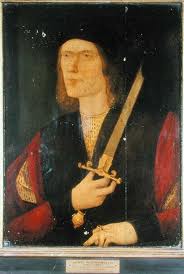
Archaeologists hunting for the remains of King Richard III may have made a crucial breakthrough – after finding human remains in the ruins of a medieval friary underneath a modern-day car park.

A team from Leicester University, which has been digging in the city centre, will today announce what it claims is “a dramatic development in the search for crucial breakthrough – after finding human remains in the ruins of a medieval friary underneath a modern-day car park.

A team from Leicester University, which has been digging in the city centre, will today announce what it claims is “a dramatic development in the search for Richard III”.

Last month, archaeologists began searching for the body of the last king of the House of York, who was defeated in battle by a Lancastrian army in 1485. They have unearthed the site of a Franciscan friary in Leicester called Grey Friars, and also believe they have found the burial place of Richard – a church – where human remains were found. The DNA material will be tested to see if matches that of a 17th-generation descendent of the monarch’s sister.
NICK CLARK – http://www.independent.co.uk

HisTOURies UK
The Best Tours in British History

Richard Taylor, a spokesman for the university, said: “What we have uncovered is truly remarkable”.

Read the story of when The Beatles came to Wiltshire to film scenes from their second film Help! on Salisbury Plain in 1965.

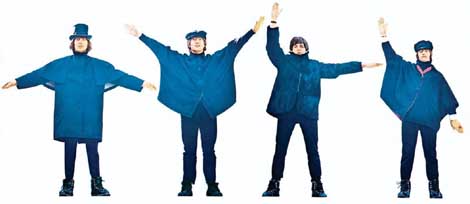
The Beatles on the Help! album cover

The Beatles on the Help! album cover

By May 1965, The Beatles truly ruled the world. Topping the charts for the seventh consecutive time with ‘Ticket To Ride’, America well and truly conquered and massive success for their first film A Hard Days Night, the year before.

This had been little more than a fun fictional account of the adventures of four lads in a pop group, shot at a few London and provincial locations and filmed in black and white, for a budget of around £200,000.

But now their second film, Help! (provisional working title Eight Arms To Hold You) was to be a much grander affair.  Double the budget, in colour, with filming at such exotic locations as the beaches of Nassau, the ski slopes of Austria and… Salisbury Plain.

The simple storyline revolved around Ringo Starr and one of his many rings. Unbeknownst to him, it was a mystical ‘sacred’ ring from the Far East, which its real owners wanted back.

Cue the movie with Ringo being pursued all over the place by the ring-chasers, with all sorts of madcap stunts surrounding their efforts to retrieve the ring from his finger. And that was about it!

In the movie, The Beatles need to do some more recordings. However, Ringo isn’t safe anywhere, so they decide to make their next record in a place of absolute military security . Where else? Salisbury Plain!

So, late in the evening of Sunday 2nd May 1965, The Beatles checked into the Antrobus Arms Hotel in Amesbury, their home for the next three days whilst on location.

Ringo and George filming 'Help!' on Salisbury Plain

The filming took place at Knighton Down, near the Larkhill army base, where the Beatles were to be shown recording their latest song.

In fact, the Salisbury sequence in the film sees them miming to the George Harrison song ‘I Need You’, which of course, he took the lead vocals for. Ironically for George, this  was never a Beatles single, only appearing on the movie soundtrack album.

The lads were ferried from the Antrobus Hotel to Larkhill each day, in a black Austin Princess limousine, with their departures and arrivals attracting huge crowds of teenagers, blocking the street through Amesbury.

Amazingly, the limo was left unlocked in the hotel garage during the day and the Salisbury Journal reported that fans looted it of Beatle caps, various items of Beatle clothing and even emptied the ashtrays for Beatle dog-ends!

The Journal also said the group were besieged, mostly by girls and had to endure some pretty dismal Salisbury Plain weather, despite it being late Spring.

The army ‘security’ for the film storyline, came via troops from 3 Division, Royal Artillery who were on exercises there at the time.

The army even kindly supplied tanks for the Fab Four to climb over and have scouting around whilst they made their recording!  It’s hard to imagine that happening today, but back then The Beatles had all doors opened for them, such was their celebrity.

On the afternoon of Thursday 6th May, with the location filming completed, The Beatles checked out of their Amesbury hotel, heading back to London.

Next day they were back in a proper film studio at Twickenham, as the making of Help! continued.

The movie had its world-premiere on 29th July 1965 at the London Pavilion, in the presence of Princess Margaret and Lord Snowdon, and with the title song already sitting at number one in the UK singles chart.

It opened at 250 leading cinemas across the country on August 11th and went on to win first prize at the International Film Festival in Rio de Janeiro that September.

There was talk of a third film, but sadly, this didn’t happen. The filming of the making of the album Let It Be in 1969 being a fly-on-the-wall documentary, not  a proper scripted movie.

The Beatles never returned to Salisbury, but they left behind a multitude of memories for those who either saw, met or even worked with them, during those three days in May, 1965.

But one thing’s for sure; that bit of Salisbury Plain was certainly immortalised for all time, by the biggest musical phenomenon the world has ever seen.

Geoff Barker – Rock and Rill Wiltshire – http://www.bbc.co.uk/wiltshire/history/rocknroll_wiltshire/

Mystical Landscape, Magical Tours
HisTOURies UK – www.HisTOURies.co.uk


TOP ARCHAEOLOGY NEWS SITES

There are many websites with the latest world archaeological news. Here are our recommendations:

  1. Archaeologica Hand-picked links to each day’s top stories. Usually about six per day.
  2. Archaeology Magazine Updated every weekday, a summary with links to about six news stories.
  3. BBC Latest Archaeology News Selected top stories – about one per day
  4. National Geographic Ancient World News Brief  summaries linked to full stories written by National Geographic reporters. About one story per day.
  5. Discovery Channel Brief summaries linked to pages, about one story per day.
  6. Stone Pages Archaeo News
  7. EurekAlert Public Releases of latest research. About 2 per week.
  8. Science Daily Brief summaries and links to full stories by Science Daily reporters. Mixed with Palaeontology stories. One per day.
  9. Archaeology News Automatic News Feed
  10. Explorator Links to David Meadow’s weekly newsletters, each containing about 50 links to the week’s stories.
  11. Archaeology in Europe Regularly updated with summaries and links. About 20 stories per week, but only Europe.
  12. Google Archaeology NewsSearch results for the last week. Automatically listed, so much irrelevant material.
  13. Yahoo Anthropology and Archaeology Automatic news feed with some irrelevant content.
  14. Topix Archaeology News A mixed collection of news storiesHisTOURies UK
    Mystical Landscape, Magical Tours

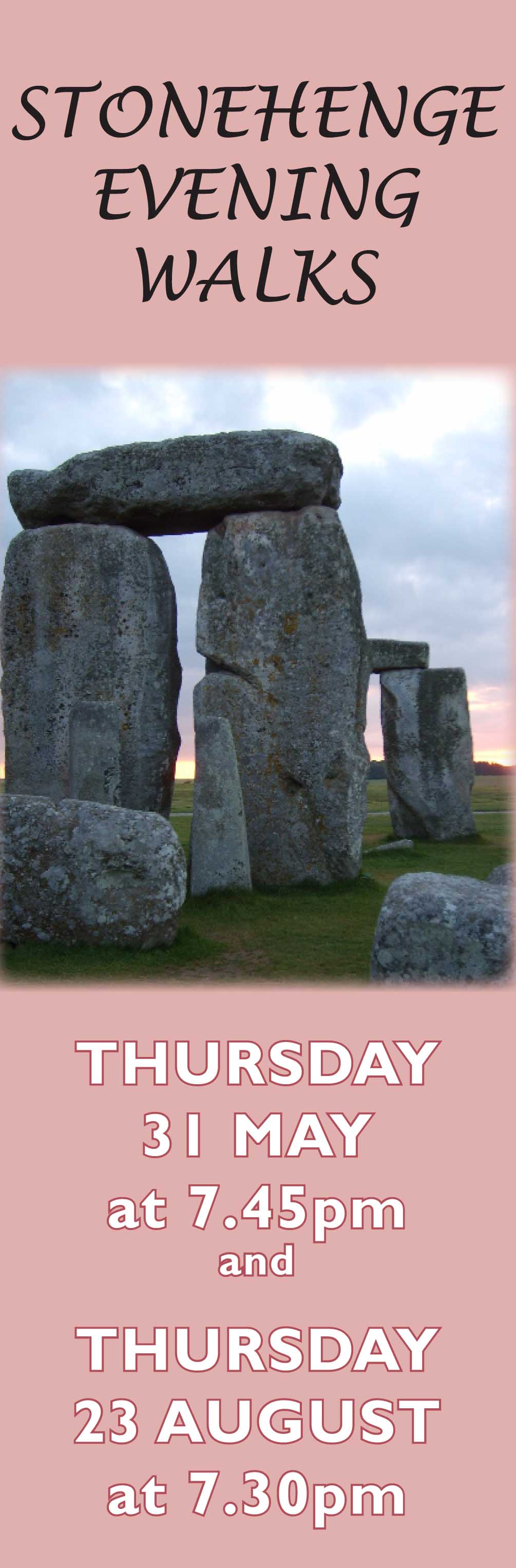
Stonehenge access toursAn opportunity to get close to the stones and learn more about the monument and the surrounding landscape.

The visits will be led by David Dawson, Director of the Society, who will point out the main features of the circle and its surrounding landscape and explain the cycle of its construction and rebuilding during the Bronze Age.

This is an opportunity to inspect and photograph (for non-commercial purposes only) the stones closely, and see the inscriptions, including the famous ‘daggers’ believed to date from prehistoric times, Wander at will inside the circle, indeed do whatever you wish other than touch, climb on the stones, picnic or play music, none of which is allowed!

23rd August (from 7.30pm to 8.30pm).

Meet at Stonehenge car park 10 minutes before booked time. Tour lasts no more than one hour.

COST
Adults £22 (WANHS members £20)*
Children £13*

Book here: http://www.wiltshireheritage.org.uk/events/index.php?Action=2&thID=710&prev=1

For information on special access inside the Stone Circle see below:


Please note that special access is limited, open to no more than groups of 20 or so, and outside normal hours. Visits are either early mornings or evenings, and not every day (the English Heritage Website has details).


It is well worth making the effort to go inside the Circle, especially if you are travelling from abroad, and it may be your only opportunity. You may hear people who have only walked around the rope barrier at a distance describe Stonehenge as ‘a pile of rocks in a field’, that’s their preception on viewing it at a distance – but nothing could be further from the truth. It is only when you get close to the stones the true and awesome scale of the structure becomes apparent. If you have read ‘Solving Stonehenge’, with the aid of its many plans and illustrations, the extraordinary achievement of the prehistoric builders in designing and setting out the massive structure to an accuracy of just a few centimetres will astonish you


HisTOURies UK
Mystical Landscape, Magical tours

Beginning at sundown on the eve of July 31st to sundown on August 1st

The Celtic Harvest Festival – Lughnasadh – also known as Lammas – is a harvest celebration beginning at sundown on the eve of the 31st of July until sundown on August 1st and derives its name from the Irish God Lugh. In Wales, this time is known simply as Gwl Awst, the August Feast. Lugh is associated with the power of sun and light, and so fires were burned in honor of Him on this day. In addition to His associations with light, Lugh is a God of Skill and Craft, a master of all human skills. On this His feast day, it is particularly appropriate that we celebrate our own abilities and skills.

“Celtic Festival of the first fruits and ripening corn “

Lugh dedicated this Celtic festival to his foster-mother, Tailtiu, the last queen of the Fir Bolg, who died from fatigue after working and clearing a great forest so that the land could be cultivated. When the men of Ireland gathered at her death-bed, she told them to hold funeral games and celebrations in her honor. As long as they were held, she prophesied Ireland would not be without song.

Lammas (was christianized as Lammas:  the word ‘Lammas’ is an Old English word meaning ‘Loaf Mass’) celebrates the first harvesting of crops, the first of three harvest festivals.  The Earth yields up Her first gifts to us … a blessing from the Mother and the product of our human hands.  It is a time to celebrate the fruitfulness of the Earth and fruits of our labors.  We have sown and nurtured, and now we are reaping the benefits in rhythm with the Earth.  In later times, the festival of Lughnasadh, but in rural areas it was often remembered as “Bilberry Sunday,” the people would gather the earth’s freely-given gifts of black berries.  As well people sang and danced jigs and reels to the music of melodeons, fiddles and flutes, and held uproarious sporting contests and races.

Corn, grains and berries are of particular significance at this holiday (see recipes below from corn, flour and grains).  Traditionally, the newly harvested grain is made into bread to be shared with all in this celebration.  Fruits and vegetables are ripe and ready for canning and preserving.  We celebrate and partake in the fullness of the Earth while beginning to make provision for the cold months ahead.

This was also an occasion for handfasting and displaying of their skills and specialized crafts.  Through the centuries, Ireland’s country-people have celebrated the harvest at revels, wakes and country fairs. Some still continue this festival today with an entertaining manner and it is usually celebrated on the nearest Sunday to August 1st, as so that a whole day could be set aside from work.

It is a time to ask ourselves:  “What are my talents?  What are my skills?   How do I express my creativity?  How do I use my abilities to re-craft my world … to add beauty …. color … richness?  Our skills may include woodworking, designing, creating, sewing and needlecraft, art, music, dance, sports or communication, organizing, healing, parenting, problem solving etc.  Whatever our talents or abilities, this is a time to recognize them and honor them, and to share our recognition of the talents and abilities of others around us.  If you have had an interest or urge to develop a particular skill or creative outlet, now might be the time to make a pledge or commitment to yourself to pursue your interest.  By offering the fruits of our labors back to the Universe we enrich both ourselves and our world.

Because Lughnasadh is a celebration of the new harvest, people cooked special ritual foods and festive meals.  If you are curious about this historic celebration and the abundance of foods prepared, please search the internet. It is a wonderful time to celebrate the abundance we receive from mother earth and be with our special loved ones.

Lammas Traditions

Lammastide was the traditional time when craft fairs and pageants were held. Long Summer evenings are beginning to get shorter.
In Ireland Lammas is traditionally a time for buying and selling, horse trading and music.
The ‘Oul Lammas Fair’, Ireland’s oldest traditional market fair, which takes place in Ballycastle, Co Antrim on the last Monday and Tuesday in August, attracts people in their thousands at festival time.

Saint Catherine was celebrated – ‘ The Catherine Wheel’ came from the Pagan rites when a wagon wheel would be tarred, set on fire and rolled down a hill – symbolizing the decline of the Sun God as the seasos wheel turns to Autumn Equinox. If the wheel went out before it reached the bottom – poor harvest, abundant if it remained lit.

St. Ciaran’s Well, Clonmacnois, County Meath – pilgrims go with torches at midnight on the first sunday in August – looking for a trout. The sun was believed to live in holy wells during the night.

Celts erected temporary hills to celebrate the harvest festival of Lammas. In Ireland a girl would be seated on the hill-top, garlanded with flowers and proclaimed the goddess of the hill. Celts would climb hills to pray to the gods and gather bilberries at Lammas.
The raising up of Celtic crosses onto stone steps recalls the Lammas tradition – Perrons – a type of man-made holy terraced mountain.

Making of the Corn Dolly from the best ears of corn taken from the last sheaf to be harvested.
This was usually kept hanging over the hearth to bring good luck, and the seeds were added to the new seeds in the Spring.

Link: http://www.mysticfamiliar.com/library/witchcraft/lughnasadh.html
L
ink: http://www.new-age.co.uk/celtic-festivals-lammas.

HisTOURies UK
Mystical Landscape, Magical Tours

Tour: Fri 31st Aug – Sun 2nd Sept 2012
Henges, burial mounds of all shapes and sizes, causewayed camps, early field systems and ‘cursus’ monuments are scattered everywhere in Wessex, forming a landscape which hints at its past, but whose story is unintelligible to the untrained eye.

Our experts have been introducing people to this, one of the richest prehistoric landscapes in the world, which lies on our very doorstep, since Andante’s inception.

Day One
Meet in the evening for an introductory lecture and dinner together in a local restaurant. Overnight in Sarum College in the beautiful Cathedral Close.

Day Two
By coach to Avebury for a full exploration of the huge Neolithic henge, so large that part of the village lies within it. It is one of the largest and best preserved of 1300 stone circles known in the British Isles. Morning walk around the henge and along the ceremonial Avenue.  We approach the stones of Avebury just as one would have done in prehistoric times.

Afternoon circular walk (2 hours) past Silbury Hill, the largest man-made mound in Europe.  The most famous of its excavators crawled into an earlier excavation chamber and recorded later:
“the sides of the open chamber provided one of the most astonishing sights that I have ever seen…it was clear that this innermost mound had been covered by a series of conical shells or cappings…the effect was of finding oneself in an enormously complicated and highly coloured layer cake of gigantic size..”
The walk continues to the Long Barrow at West Kennet and a chance to explore the chambered tomb within.  This kind of monument is the earliest known to have been built in Britain – in commemoration of the dead. Continue to the ‘Sanctuary’, a small, complex timber and stone circle on the top of Overton hill. Walking in our ancestors’ footsteps helps us try to understand their motives and methods.

Day Three
Stonehenge for an early (7.30am) visit inside the stone circle before the public arrives. This will be followed by a walk (2 hours) through the wider religious landscape – the cursus, King Barrows and Stonehenge Avenue.
A short drive takes us to Woodhenge, where the remains of wooden post settings have been found – now marked by concrete. From here there is a good view over the huge henge at Durrington Walls, site of exciting recent excavations which revealed the settlement which may have housed the builders of Stonehenge.

Return to Salisbury Museum for a visit to the Stonehenge and Prehistory Galleries. We have arranged a private demonstration of flint-knapping in the gardens here, which is not only much enjoyed, but adds considerably to your understanding of the way in which our prehistoric forebears were able to fashion all manner of implements and tools from our good local flint supplies.  In a world without metal technology this was a critical and highly sophisticated art.
Disperse about 5pm.

Should you choose to arrive earlier or stay later, you might like to visit Old Sarum, the hillfort to the north of Salisbury which was later chosen as the site of our first cathedral, or, of course,  our beautiful Gothic cathedral – straight in front of the College.

NB Most of every day will be spent walking, and you must be prepared for this, with suitable footwear and weatherproof clothing. You will also have to carry your own water, and negotiate a variety of stiles.

  • The original Andante Tour – accept no imitations!
  • We have been introducing guests to these monumental prehistoric landscapes for 26 years
  • Accommodation spectacularly situated within Salisbury cathedral close
  • Bring your hiking boots!
  • Several good cross-country walks

Archaeologists have unearthed a charred stone that suggests the Mediterranean diet came to these islands during the Iron Age

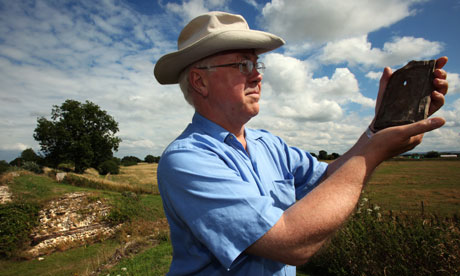
Professor Mike Fulford at the dig in Silchester. The latest find is an olive stone that dates back to Iron Age Britain. Photograph: Graham Turner for the Guardian

Professor Mike Fulford at the dig in Silchester. The latest find is an olive stone that dates back to Iron Age Britain. Photograph: Graham Turner for the Guardian

Iron Age Britons were importing olives from the Mediterranean a century before the Romans arrived with their exotic tastes in food, say archaeologists who have discovered a single olive stone from an excavation of an Iron Age well at at Silchester in Hampshire.

The stone came from a layer securely dated to the first century BC, making it the earliest ever found in Britain – but since nobody ever went to the trouble of importing one olive, there must be more, rotted beyond recognition or still buried.

The stone, combined with earlier finds of seasoning herbs such as coriander, dill and celery, all previously believed to have arrived with the Romans, suggests a diet at Silchester that would be familiar in any high street pizza restaurant.

The excavators, led by Professor Mike Fulford of Reading University, also found another more poignant luxury import: the skeleton of a tiny dog, no bigger than a modern toy poodle, carefully buried, curled up as if in sleep. However it may not have met a peaceful end.

“It was fully grown, two or three years old, and thankfully showed no signs of butchery, so it wasn’t a luxury food or killed for its fur,” Fulford said. “But it was found in the foundations of a very big house we are still uncovering – 50 metres long at least – so we believe it may turn out to be the biggest Iron Age building in Britain, which must have belonged to a chief or a sub chief, a very big cheese in the town. And whether this little dog conveniently died just at the right time to be popped into the foundations, or whether it was killed as a high status offering, we cannot tell.

“The survival of the olive stone, which was partly charred, was a freak of preservation. But there must be more; we need to dig a lot more wells.”

Fulford has been leading the annual summer excavations at Silchester, which bring together hundreds of student, volunteer and professional archaeologists, for half a lifetime, and the site continues to throw up surprises. It was an important Roman town, but deliberately abandoned in the 7th century, its wells blocked up and its buildings tumbled, and never reoccupied. Apart from a few Victorian farm buildings, it is still open farmland, surrounded by the jagged remains of massive Roman walls.

Fulford now believes that the town was at its height a century before the Roman invasion in 43AD, with regularly planned, paved streets, drainage, shops, houses and workshops, trading across the continent for luxury imports of food, household goods and jewellery, enjoying a lifestyle in Britain that, previously, was believed to have arrived with the Romans.

This sodden summer have driven the archaeologists to despair, with the site a swamp of deep mud and water bubbling up in every hole and trench.

“Conditions are the worst I can ever remember. Ironically, the wells are the easiest to work in because we have the pumps running there,” Fulford said.

The tiny dog is one of dozens that the team has excavated here over the years, including one that was buried standing up as if on guard for 2,000 years. A unique knife with a startlingly realistic carving of two dogs mating was another of the spectacular finds from one of the most enigmatic sites in the country.

Visitors can observe the archaeologists’ trench warfare this weekend, when the site opens to the public as part of the national festival of archaeology, one of thousands of events across the country.

Article by: Maev Kennedy guardian.co.uk,
Full Story: http://www.guardian.co.uk/uk/2012/jul/19/olive-stone-pre-roman-britain

HisTOURise UK – www.Histouries.co.uk
The Best Tours in British History –