Feeds:
Posts
Comments

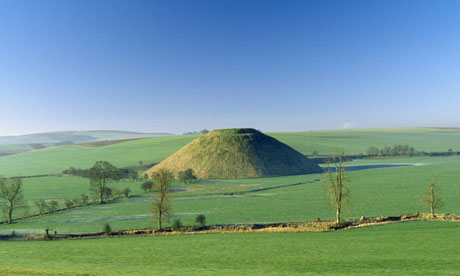
Silbury HillIN A modest house in Swindon, an 86-year-old man formulates exquisitely-detailed theories that turn conventional Wiltshire arch- aeology on its head.

If retired builder Eric Crook is right – and his belief that he’s right is unshakeable – the remains of a neolithic princess have lain deep beneath Silbury Hill for more than 4,000 years.

Even more startling is his insistence that the stones of Avebury once formed a carved amphitheatre of countless thousands of human and animal faces. These carvings would have appeared to move in flickering firelight; an illusion to thrill audiences of people who were centuries dead before Christ was born or the invading legions of Rome set foot on English soil.

These stone faces, Mr Crook says, can still be found in fragments hacked from the stones down the centuries, whether for buildings or perhaps because the powers that be disapproved of such images.

The reaction from the archaeological mainstream has so far been distinctly underwhelming, but Mr Crook, having spent well over 50 years researching and documenting his subject, is undaunted.

“Archaeologists are trained by other archaeologists,” he said. “But they are not trained in a natural learning process going through building technology.

“They learn only through what they can see. I heard of a professor who was asked the question, ‘when do you think you’ll get the answers to Silbury Hill and Avebury?’ “She said it would be another generation, but I thought to myself, ‘The answers are already there and you’re the generation behind.’”

Wiltshire, A Journeyman’s Tale, is £9.99 and can be ordered from Amazon and bookshops, ISBN978-0-7223-3900-8

Well worth touring Avebury and Silbury Hill at the moment.  There are several amazing crop circles in the area

Stonehenge and Avebury Tour Guide
HisTOURies UK – The Best Tours in Wiltshire

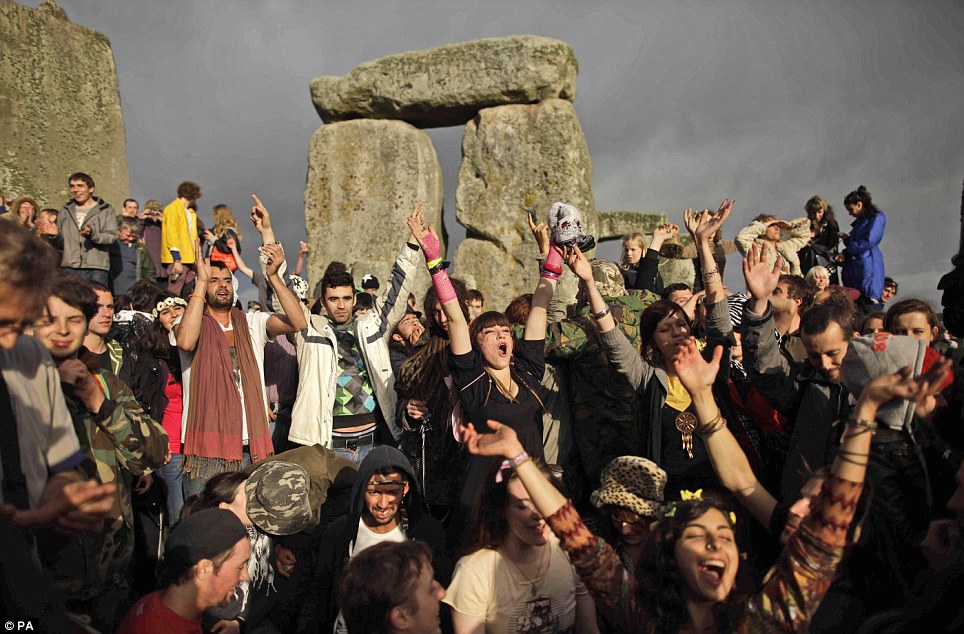
THE rain failed to dampen spirits as thousands of Druids, Pagans and tourists gathered at Stonehenge to celebrate the Summer Solstice on Tuesday morning.

About 18,000 revellers from across the country and abroad braved the weather to welcome the longest day at the ancient stone circle.

Although the sun did not make an appearance as dawn broke in an overcast sky, people enjoyed the festival atmosphere with Morris dancers, musicians and people in traditional robes.

The rain stopped before the sun rose at about 4.51am and crowds cheered as the sky started to brighten.

Denny Bartley, who travels from Essex with friends every year for the Solstice, said: “It’s been good – the Solstice is a great opportunity to catch up with old friends and I enjoy being with the other druids.”

Pagan rituals were led by senior druid King Arthur Pendragon at the Heel Stone, which included two pagan marriage ceremonies.

Mr Pendragon said: “It has been a good night. There are a lot of youngsters and a lot of people here asking all the right questions – they’re here for the right reasons.

“A lot of people came here to celebrate the birth of the sun for the longest day.”

Fewer people attended than last year, something which head of Stonehenge Peter Carson put down to the weather and the fact that the Solstice fell mid-week.

“It’s gone extremely well considering how poor the weather was. Everyone has come along and had a fantastic time yet again and they are leaving with big smiles on their faces,” said Mr Carson.

By Hannah White http://www.salisburyjournal.co.uk/

Stonehenge Tour Guide
HisTOURies UK – Private Guided Tours

 The weather may not be anything to write a postcard home about – but the West’s tourism industry enjoyed a twin boost yesterday.

Key visitor attractions featured prominently in the first global TV adverts for a decade and new research showed up to 17 million Brits will holiday at home this year.

VisitBritain, the national tourism agency, yesterday unveiled its international TV campaign to attract overseas visitors to the country.

The adverts will be screened around the world, and include Stonehenge, Glastonbury and the Cotswolds.

Stonehenge is already in the spotlight because of the summer solstice, and VisitBritain say the UNESCO World Heritage Site is one of the most important prehistoric monuments on the planet.

As well as the 5,000-year-old site, there are money Neolithic and Bronze Age monuments in the surrounding landscape, and Avebury, the largest stone circle in Europe, is nearby.

Glastonbury is synonymous with the annual music festival taking place at the weekend, with international superstars such as U2, Coldplay and Beyonce, as well as theatre and circus performers and much more.but VisitBritain also point to the ruins of Glastonbury Abbey, and the iconic Tor, along with myths and legends about the Isle of Avalon, King Arthur, Joseph of Arimathea and the Holy Grail.

The agency adds: “For many visitors, the Cotswolds represent everything that is quintessentially ‘English’, with villages and churches of honey-coloured limestone set among gentle hillsides, cottage gardens, beech woods and drystone walls.”

Historic sites include Sudeley Castle and Chedworth Roman Villa, while VisitBritain urges tourists to sample local produce such as Gloucester Old Spot pork, Tewkesbury mustard and the famous Cotswold cheeses.

Other locations in the TV adverts include London landmarks such as the Houses of Parliament and St Paul’s Cathedral, the Lake District, Snowdon in Wales, Edinburgh Castle and the Highlands.

Celebrities such as actress Dame Judi Dench, fashion icon Twiggy and chef Jamie Oliver – who has restaurants in Bath and Bristol with another opening in Cheltenham this summer – star in them.

The campaign kicks off a major marketing push that seeks to build on the global impact of the Royal Wedding, with the Olympics next year also guaranteeing the international spotlight.

It will concentrate on the current most important tourism markets, such as the US and Western Europe, and the big growth areas for the future, including China and India.

VisitBritain chief executive Sandie Dawe said: “This is our first global TV campaign for 10 years and marks the start of an ambitious marketing programme. With the eyes of the world on us, we have an opportunity to showcase Britain and then to close the sale with great travel deals and offers from our partners.

“This campaign aims to inspire visitors to come and explore for themselves. Over four years, we aim to attract four million extra overseas visitors, who will spend £2 billion across Britain.”

Meanwhile a new survey has found nearly 40 per cent of Britons will stay at home this summer as families strive to balance household finances.

Many of them will instead enjoy ‘staycations’, with the West sure to cash in.

The poll was carried out for savings bank ING Direct, and chief executive Richard Doe said: “It’s not surprising that the summer holiday is often being sacrificed.”

Visiting Britain ? Visit the West Country!

Wessex Tour Guide
HisTOURies UK – the Best Tours in Wiltshire

The Trundle near Chichester, Sussex, is one of the first large monuments built in Britain

The Trundle near Chichester, Sussex, is one of the first large monuments built in Britain

Researchers have developed a new dating technique that has given the first detailed picture of the emergence of an agricultural way of life in Britain more than 5,000 years ago.


A new analysis of artefacts recovered from the first monuments built in Britain shows that the Neolithic period had a slow start followed by a rapid growth in trade and technology.

Scientists say the new approach can be used to unravel the detailed sequence of events of many more important moments in human prehistory.

It relies in part on radio-carbon dating – counting the amount of a radioactive type of carbon atom in decaying matter. But the methodology also incorporates many other dating sources, together with some powerful statistical analysis, to produce far more discrete timings for happenings in the past.

The Neolithic period in Britain occurred between 4000 and 2000BC.

It was when people took up agriculture as a way of life and stopped being nomadic hunter-gatherers.

It also saw the emergence of trade across the British Isles and the development of new technologies. But until now, we have had only a rather coarse picture of the chronology of events during this eventful period in our history.

The new analysis by Dr Alex Bayliss, an English Heritage dating expert, has brought the occurrences of that time into sharper focus.

“We can start to tell a bigger story and write a history for the prehistory of Neolithic Britain,” she told BBC News.

“What we thought before was very imprecise. We simply knew that all sorts of different sites and all sorts of new kinds of practices started to happen sometime in the 500 or 600 years of the early Neolithic in Britain.

“We’ve actually now been able to give a timetable, or story of what happened when, to disentangle these things so that we can start to see why certain things may have followed others.”

According to Dr Bayliss’s analysis, Neolithic farming practices began in south-east England probably a few decades before 4,000BC. But then they spread very, very slowly, taking about two centuries to reach western parts of England. And then, she says, there was a sudden increase in activity.

“Monuments, cattle, sheep, the whole farming way of life, bursts across Britain and suddenly – having taken 200 years from getting from Kent to Gloucestershire – it then takes 50 years to get from Cheltenham to Aberdeen.”

The new dating also indicates that by 3700-3800BC, early Britons had developed pottery with regional styles of decorations. Long-distance trading networks were also being established in stone axes and certain other types of pottery

Windmill Hill, a large Neolithic causewayed enclosure in Avebury, was previously thought to have been built around 3700-3100 BC. The new dating shows it was built in 3700-3640 BC

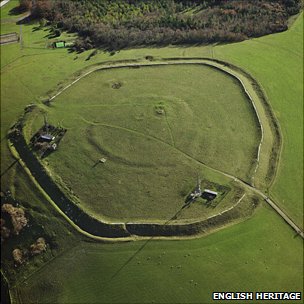
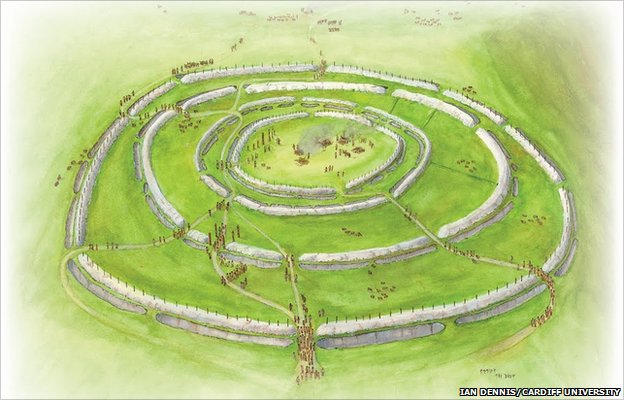
Of particular interest are the first monuments that were built in Britain, called causewayed enclosures. These were made up of concentric rings of ditches and banks – the largest of which can span 300m (1,000ft).

It had been thought that they spread slowly across the country over five centuries. But the new dating approach suggests they spread rapidly within 75 years.

This revelation has been described by archaeologists working on the project as Britain’s first “building boom”.

Professor Alistair Whittle of Cardiff University said: “With more accurate dating, the Neolithic period is no longer the sleepy, hazy swathe of time where it is the default position to lump everything together.

“This research fundamentally challenges the notion that little happened among our Stone Age farmers. We can now think about the Neolithic period in terms of more rapid changes, constant movement of people and fast diffusion of ideas.”

Collective violence

One interpretation of these events is that once the initial “pioneer” phase of the Neolithic period was over, independent groups of people came over from the continent and set up villages across Britain and social structures began to form.

These social structures led to the construction of the enclosures for people to gather and possibly for chieftains to emerge and amass power.

The new dating suggests that there was more collective violence once the enclosures were built. Several of them, particularly in western Britain, were attacked by large numbers of people with showers of arrows, and enclosures’ ramparts were burned down.

This indicates that the enclosures created a hierarchy that was being contested in some way.

The new dating technique involves comparing carbon dates with other markers in the archaeological record. On its own carbon dating is imprecise, but when it is cross-reference with documented events it allows researchers to more accurately date artefacts.

Researchers say this new methodology could in principle be used shed further light on any significant event in our prehistory, such as the emergence of farming in China and the collapse of the Mayan civilisation in the Americas.


A reconstruction of the Whitehawk causewayed enclosure in the South Downs, Sussex

Why not visit Windmill Hill and nearby Avebury and learn more about Neolithic Britain?

Stonehenge and Avebury stone Circle Tour Guide
HisTOURies UK – The Best Tours of Ancient Wiltshire


Archaeological investigation dates Marlborough Mound at around 2400 BC 

The Wiltshire landscape around Avebury and Silbury Hill is the heart of prehistoric Britain, and has World Heritage designation. Now another monument can be added to its archaeological treasures: the Marlborough Mound.

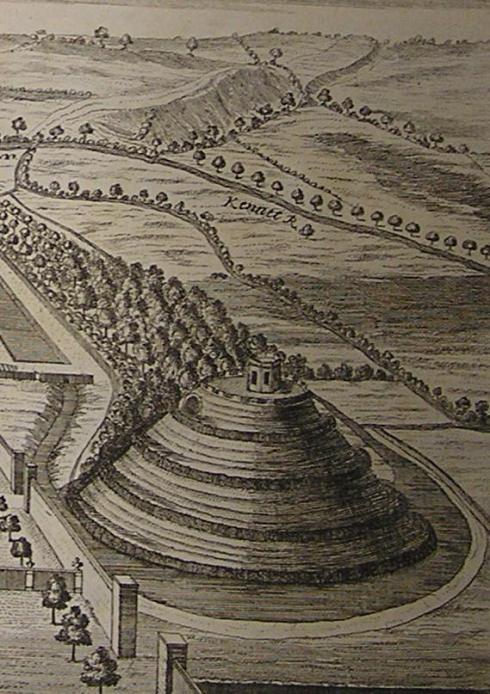
William Stukeley’s 1723 image of Marlborough “Mount”

William Stukeley’s 1723 image of Marlborough “Mount”

The Mound, in the grounds of Marlborough College, was already recognised as a feature of considerable historical significance. It was the motte on which the keep of Marlborough Castle was built fifty years after the Norman Conquest and it subsequently became the centrepiece of a major seventeenth century garden. The latest research has extended its history back by three millennia.

Recent coring of the mound at Marlborough College produced four samples of charcoal, allowing radiocarbon dating for the first time. The samples, which came from different levels in the mound, were taken from two bore holes through the height of the 19m monument, showing that it was built in the years around 2400 BC. This is the first firm evidence proving the theory that the castle motte is largely a re-used prehistoric structure of the highest national standing.

Jim Leary, who led the recent archaeological investigations for English Heritage at the nearby Silbury Hill, and is co-author of the recently published ‘The Story of Silbury Hill’ coordinated EH’s contribution, which also included radiocarbon dating. He says, “This is an astonishing discovery. The Marlborough Mound has been one of the biggest mysteries in the Wessex landscape. For centuries people have wondered whether it is Silbury’s little sister; and now we have an answer. This is a very exciting time for British prehistory”

After the prehistoric mound was re-used as a castle motte – the only known example of its kind – it became an important royal castle for the Norman and Plantagenet kings. It was occasionally the scene of major political events, such as the general oath of allegiance to King John in 1209, as well as being a favourite royal hunting lodge. In the fourteenth century the castle passed to the queens of England, and gradually became neglected.

In the seventeenth century it came into the possession of the Seymour family, and its next avatar was as a feature in a historically significant early romantic garden: a spiral ramp was cut in its side, with a hawthorn hedge enclosing the path which wound to the summit, where there was a water feature.

The Master of Marlborough College, Mr Nicholas Sampson, said: ‘We are thrilled at this discovery, which confirms the long and dramatic history of this beautiful site and offers opportunity for tremendous educational enrichment.’

The work is part of a major conservation programme being undertaken by the Marlborough Mound Trust, specially formed at the invitation of the College and under the coordination of Donald Insall Associates. The Chairman of the Trust, Mr Michael Macfadyen says, ‘The inspiration for this was our founder Eric Elstob, a former pupil at the College, whose generous legacy has provided the means for this work. He would have been totally delighted by this news.’

Links: https://www.marlboroughcollege.org

“This is an astonishing discovery. The Marlborough Mound has been one of the biggest mysteries in the Wessex landscape. For centuries people have wondered whether it is Silbury’s little sister; and now we have an answer. This is a very exciting time for British prehistory”

Wiltshire Tour Guide
HisTOURies UK - The Best Tours in Wiltshire

Bath | Stonehenge | Paganism | Ley Lines| Druids | Masonic Lodge

It is said that the Circus is joined to the Royal Crescent by a ley-line, that they
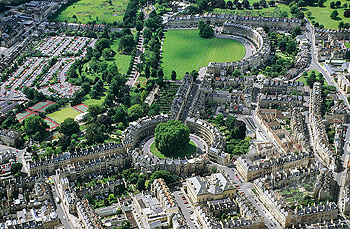
The Royal Circus is the same circumference as Stonehenge

represent the sun and the moon, and that Brock St which links them is the most paranormally active street in Bath!  The circumference of the Circus also matches – almost exactly – that of the inner circle of rocks at Stonehenge, the most famous druid monument of them all.

The Circus really does epitomise the elegance of Georgian Bath. Beautiful curved terraces of Bath limestone sweep round in a circle, and it doesn’t take much to imagine the ladies and gentlemen of society on this street. So charming and respectable – but look closer….

The Circus was designed by the architect John Wood, who had a fascination with Paganism. He incorporated his interest into the buildings around the crescent, all of which are adorned with Pagan and naturalistic carvings such as pan pipes and mystical figures, each one quite individual. At the top of each house is an acorn. The circular crescent represents the sun, and the Royal Crescent, which he also designed, represents the moon. It is said that the road that connects the two is an ancient ley line.

John Wood the Elder – Stanton Drew Circle and Stonehenge.

Bath is famed for its neo-classical architecture but what underpins the thinking of the 18th century architect John Wood when he drew the designs for The Circus is a strange mish-mash of legend and myth, this of course is the age of the new ‘druidism’ that took hold when such figures as William Stukeley called such places as Stonehenge the Druidical Temple.

Fertile imaginations played with the ideas of sacrificial wicker constructions filled with victims, and Wood took it much further and in his book – A Description of Bath, he writes a history for Bath that is at once absurd yet full of that energetic imaginings that are still to be found in today’s new age books.
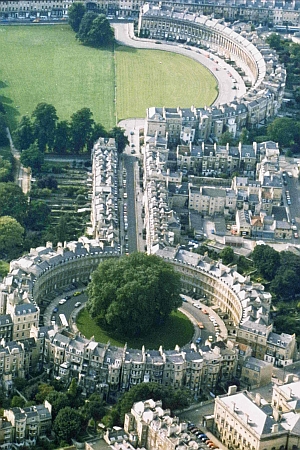
To understand why Wood designed The Circus as he did one must go back to the myths that formed the literature of the 18th century. Wood, though including neo-classical forms in the building, was not returning to a Roman past but a pre-Roman past steeped in the myths of a Britannic origin. The myth can be found in the 12th century writings of Geoffrey of Monmouthshire, and according to (R. S. Neal – Bath, A Social History) a 16th century edition of Monmouth’s book written in Paris was very much alive in the oral tradition of Bath. Putting stone circles and Druids together seems rather strange, but Wood thought that the chief ensign of the Druids was a ring.

So as he began to plan his city on paper, he incorporated the pagan elements, but also he was relating the pagan symbol of the circle back to Jewish symbolism, therefore Christian, and then British and Greek, which led quite nicely to the “Divine Architect” who was of course God. This is all creative flummery, a mixing of ideas, so when we look at The Circus we see classical lines, but with little touches of druidism – in the acorns that sit atop the surrounds of the roofs – and the frieze which incorporates specific symbols of Masonic details.

First  though must come the story of Bladud, the founding father of Bath, an exiled prince because of his leprosy, whilst out herding pigs one day happened to notice that the pigs loved to roll in the hot muds of the spring. Bladud also tried this and was cured, and then went on to found the city of Bath on the spot. Our mythical King Bladud is given a date of 480 BC, and as Wood saw it Bladud created the city about the size of Babylon. Bladud was a descendant of a Trojan prince, a high priest of Apollo and a ‘Master of Pythagoras’. Therefore this high priest was a devotee of the heliocentric systems of the planets from which the Pythagorean system was derived. That the Works of Stantondriu (Stanton Drew) form a perfect model of the Pythagorean system of the planetary world

Do the 108 acorns on the parapets refer to the story of ‘Prince Bladud’ (the founder of Bath) or a reference to the Druids and oak trees ?

At Stanton Drew it must have taken him many hours, with his assistant wandering round taking measurements of the circles, which were probably at this time partly covered in orchards. There was a precedence for this fascination with megalithic stones, Stukeley and Inigo Jones were all entranced by these heathen stones of an earlier age, and the development of myths round druidic religions were already forming and capturing imaginative minds – a bit like today.

Now Stanton Drew was, according to Wood, the university for British Druids, which thereby made Bath the metropolitan city seat of the British Druids. ‘And since there is an apparent connection between the ancient works of Akmanchester (Bath) and those of Stantondriu, it seems manifest that the latter constituted the University of the British Druids; that this was the university which King Bladud, according to Merlyn of Caledon planted; that it was at Stantondrui the king feated his four Athenian colleagues and that they were not only the heads of the British Druids in those early ages, but, under Bladud, the very founder of them‘ 

The Circus is based on a diameter of 318 feet, Wood’s rough measurements of the circumference of the stone circle at Stonehenge, the terraced houses form a perfect circle around a ‘timber’ circle of planted trees in the centre. There is an early drawing by J.R.Cozens which shows hitching stone post for the horses arranged symmetrically round the The Circus which would give the allusion of stones.

Wood also incorporated into his thinking the hills around Bath, giving them various titles such as Sun and Moon Hill, and The Parade is also aligned on Solsbury Hill which had an Iron Age settlement on top. The Royal Crescent built by his son John Wood the Younger, was crescent shaped representing the moon.

Where you might ask is the masonic symbolism, well it is only seen from the air, taking The Circus as the round part of the key walk down Gay Street to Queens Square which is square, and you will see the ‘key’ of Bath.

What is a Ley Line?
Ley lines are alleged alignments of a number of places of geographical interest, such as ancient monuments and megaliths, natural ridge-tops and water-fords. Their existence was suggested in 1921 by the amateur archaeologist Alfred Watkins, in his books Early British Trackways and The Old Straight Track. Watkins theorized that these alignments were created for ease of overland trekking by line of sight navigation during neolithic times and had persisted in the landscape over millennia.  In more recent times, the term ley lines has come to be associated with spiritual and mystical theories about land forms, including Chinese feng shui.

 I wonder if the fashionable Georgians who lived in these houses knew of the symbolism?
Links:
Stonehenge and Bath Tour Guide
HisTOURies – The Best Tours in British History
What was there before Stonehenge?

Stonehenge is a multiphased monument ie built in phases over a long period of time. It was built between 3000 and 2000 BC, but is part of a much larger ceremonial landscape which dates back somewhere up to 10,500 years ago. The earliest monuments in the landscape are markedSite of mesolithic post holes in the car park at Stonehenge by 3 small white discs on the tarmac at the lower end of the car-park. Chances are you will drive over them if you visit! The white discs mark where wooden postholes stood during the early mesolithic – the hunter gatherers – at least 3,500 years before the first phase of Stonehenge.Later features which predate Stonehenge that can still be seen are the Cursus and barrows or burial mounds. You will need more time or to go on a specialist tour to see these features.

Early ditch and bank at Stonehenge.

Though people had been meeting and using the landscape for some considerable time beforehand, the first phase of Stonehenge dates to between 3000 and 2920 BC with the creation of a ditch with internal bank. The bank has the appearance of a ‘…string of sausages’ and may have been upto 2m high though it is now much eroded.The dating of this part of the monument is believed to be fairly accurate because of the large amount of good dating evidence from antler and bone found in the ditch. After that the date for every other stage of Stonehenge is somewhat tenuous and subject to great debate.

Was there a timber phase at Stonehenge?

At the moment the theory is that from its beginnings to around 2600 BC there was a timber phase at Stonehenge. This included 56 timber posts just inside the bank and the post holes were later filled with cremated human remains and now known as Aubrey holes.In 2008 Aubrey hole 7 was opened by the Stonehenge Riverside Project and it looks more like a hole for a stone rather than timber. It may be that stones were here from the start rather than later. The results from the most recent dig are due out in 2011 so we may have the 3rd major rewrite of the Stonehenge story within 20 years!

Early stone phase.

Current dating assumptions suggest the first stones to arrive were the ‘bluestones’ from the Preseli Hills in west Wales. Bluestones inside StonehengeBluestone is a generic term for several types of volcanic rocks and each of them at Stonehenge weighs 4 – 6 tons.They are the ones that stand about man height as one looks into the stones. They don’t look blue until dressed (ie shaped) and the outer covering of the stone removed.You can how blue on a tour out of hours to the inner circle.
The bluestones were originally set in double concentric arcs with the open end facing the south/southwest. When removed they were filled are now known as Q & R holes.
Artist's impression of bluestone henge discovered in September 2009.In its final layout there are estimated to be 79 or 80 bluestones. An exciting discovery in September 2009 at the end of the Avenue where it meets the River Avon was a series of stone holes possibly holding bluestones. This ‘Bluestone’ henge may have held 24 stones. If the 56 Aubrey holes held stone rather than timbers it may be that there were two separate monuments that became united as the finishing phase of Stonehenge.

Late stone phase.

Around 2400 BC sees the arrival from 19 miles to the north of 75 sarsen stones. A very hard form of silicified sandstone it lies on or just below the ground surface. A circle of 30 uprights were erected in the outer circle each weighing around 25 tonnes. These were topped with 30 lintels each weighing 6 – 7 tonnes. Jointing to sarsens at Stonehenge.The lintels don’t rely on gravity to keep them in place they have mortice & tenon, and tongue & groove joints that we would normally find in a wood setting, but in stone. Each of the lintels also has some shaping on the inner and outer circular face to produce not far off a perfect circle.
The 5 trilithons (tri=3, lithon=stone) stand like a set of croquet hoops arranged in a horshoe shape in the centre of the circle. They step up in height as they go from the outer two to the remains of the Great Trilithon in the centre. Only 3 of the 5 trilithons still stand.

Final phase.

Around 2000BC the bluestones were re-erected. The altar stone was placed in the circle. Some realignments of external stones took place.

What is Stonehenge for?

Hundreds if not thousands of theories abound. A temple to the sun? Probably, but more about winter solstice sunset after which the days get lighter and warmer, rather than the more popularly attended summer solstice sunrise. A necropolis? Certainly. There are probably more than a tousand burials in the immediate area. Druidic temple? Probably not. They were a later ‘priesthood’ and the neo druids are an 18th century invention. A mystery?. Certainly.

Links:  http://www.english-heritage.org.uk/daysout/properties/stonehenge/
http://www.StonehengeTours.com#

Stonehenge Guided Tours
HisTOURies UK – The Best Tours in Ancient History

Chalk from Hampshire is used to re-chalk the ancient Wiltshire hill figure

Chalk from Hampshire is used to re-chalk the ancient Wiltshire hill figure

A restoration group is appealing for volunteers to help re-chalk one of Wiltshire’s oldest hill figures.

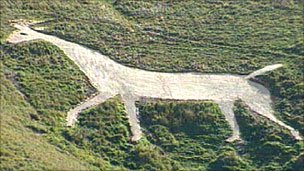
The Cherhill White horse, cut into the Marlborough Downs, is owned and maintained by the village of Cherhill.

The 232-year-old hill figure underwent a major facelift in 2002 after losing both its whiteness and its horse shape.

Since then the 18th Century landmark, the second oldest in the county, has required a “re-chalking” every two years.

“It had been continuously scraped to reveal fresh chalk but that left a three foot cliff at the top of the horse,” said the restoration group’s chairman, Rob Pickford.

“Now we top it up with extra chalk to level it with the surrounding ground.”

Yellow horse

The horse, one of nine such monuments in the county, requires up to 10 tonnes of chalk to restore it to its former splendour.

The chalk, funded by donations from visitors to the Downs, is being “brought in” after the last chalk quarry in the county at Mere closed down.

“The first top dressing we did we got the chalk from Somerset,” said Mr Pickford. “It was very yellow with bits of grey flint in it so we ended up with a yellow horse with grey spots. This year we’re getting it from a quarry in Hampshire.”

Natural erosion from the weather is normally responsible for the discolouring of the ancient monument.

However, this year’s unusually dry and sunny conditions have “bleached the chalk”.

“It’s looking quite white at the moment but in February it was looking particularly grey,” said Mr Pickford.

“And some of the boards used to hold the chalk in place have become exposed, so it does need top dressing.”

The re-chalking is due to take place on Saturday 14 May and is expected to take up to six hours.

Volunteers are being asked to meet at the Black Horse car park at 9:30 am “armed with spades.”  I am taking the kids and a picnic – see you there ?

Wiltshire’s White Horses

The Wiltshire Countryside is famous for its white horse chalk hill figures. It is thought that there have been 13 white horses in existence in Wiltshire, but only 8 are still visible today.

The oldest, largest and perhaps the most well known white horse is carved into the chalk hillside across the border in Oxfordshire. Little is known of the history of the Uffington White Horse, but it is believed to have influenced the cutting of the subsequent Wiltshire horses.

The first of the Wiltshire white horses to appear was at Westbury in 878AD, although this figure is no longer visible as a new horse was cut on top in 1778. The most recent horse was cut on the hill above Devizes to celebrate the Millennium.
Links:
http://www.bbc.co.uk/news/uk-england-wiltshire-13294489

http://www.wiltshirewhitehorses.org.uk/
http://www.StonehengeTours.com
http://www.visitwiltshire.co.uk/site/things-to-do/attractions/history-and-heritage/white-horses
We continue to offer private guided tours of Wiltshire that include ‘Chalk Hill Figures’

Wiltshite Tour Guide
HisTOURies UK – The Best Tours of Ancient Wiltshire

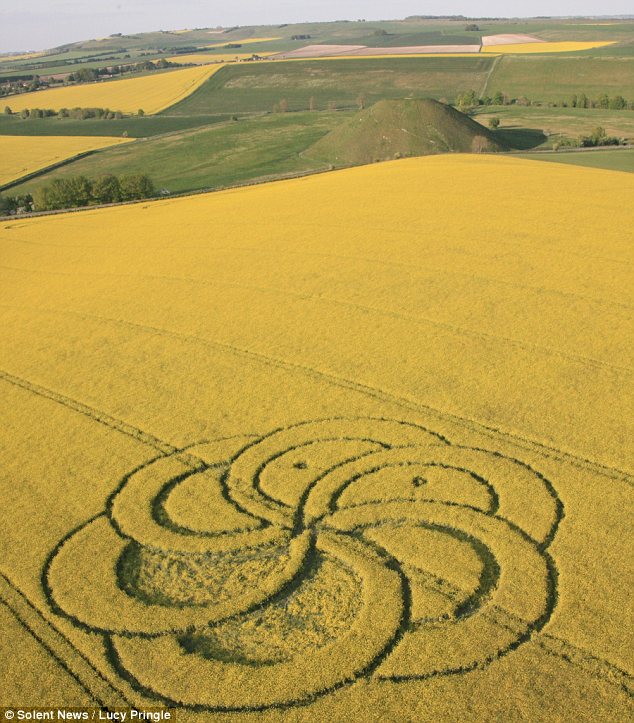
The unseasonably warm spring weather has not only brought forward many summer flowers – it has sparked the usual round of crop circles.

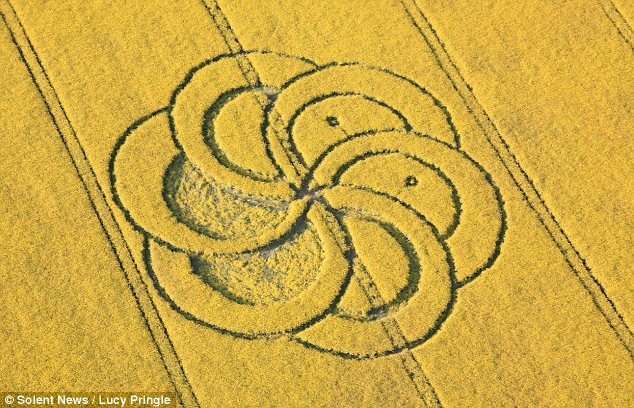
An elaborate 100ft circle which appeared overnight has caused a stir after it was found in a field of oil seed rape near Silbury Hill, Wiltshire.

The extraordinary floral creation is comprised of six interlocking ‘petal’ like crescents.

The ancient site, the tallest prehistoric man-made mound in Europe, is considered a hot spot for the bizarre phenomena and this new design proves the crop circle season is now under way.

Expert Lucy Pringle, widely known as an international authority on crop circles, believes this is the first ‘proper’ design of the year.

She added: ‘The start of the season is always exciting, I never know what’s going to happen for the rest of the year.

‘The latest circle is a floral pattern, I’ve never seen this before. There’s never been one identical to another.’

crop-circle-avebury

Miss Pringle, from Petersfield, Hants, is a founder member of the Centre for Crop Circle Studies.

She has conducted years of research in to the physiological and psychological effects reported by people after visiting the formations.

She says her findings suggest there are measured changes in human hormones and brain activity following contact with the circles.

The new ‘floral’ design is the latest in a long line of patterns to be spotted in the UK over the years.

Previous formations have included stars, triangles, birds, complicated three dimensional geometric shapes and even intricate patterns with hidden mathematical codes.

One, discovered in 2008 near Wroughton in Wiltshire, was thought to represent the first ten digits of pi, the ratio of the circumference of a circle to its diameter.
Link: http://www.dailymail.co.uk/news/article-1383035/First-crop-circle-season-appears-historic-Wiltshire-field.html

Crop Circle Tours 2011:  We operate guided tours of Wiltshire including all the best crp circles.  We know where they are, when thay happen and get you inside – a unique experience.  THere are already more formations in Wiltshire that we are visiting

http://www.histouries.co.uk/crop-circle-tours.htm

Crop Circle Tour Guide
HisTOURis UK – Private guided tours of Wessex

The first day of the month of May is known as May Day. It is the time of year when warmer weather begins and flowers and trees start to blossom. It is said to be a time of love and romance. It is when people celebrate the coming of summer with lots of different customs that are expressions of joy and hope after a long winter.

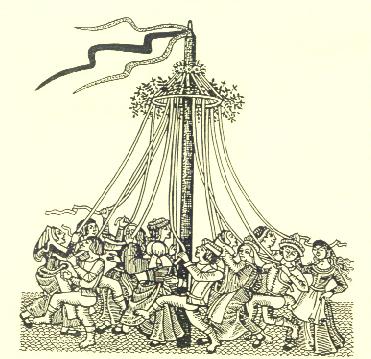
Traditional English May Day celebrations include Morris dancing, crowning a May Queen and dancing around a Maypole.

The beginning of Summer

Although summer does not officially begin until June, May Day marks its beginning. May Day celebrations have been carried out in England for over 2000 years.

The Romans celebrated the festival of Flora, goddess of fruit and flowers, which marked the beginning of summer. It was held annually from April 28th to May 3rd.

How was May Day Celebrated in the past?

It was custom for every one to go a-Maying early on May Day. Herrick, a 17th century English poet wrote:

There’s not a budding boy, or girl, this day,
But is got up, and gone to bring in May.

Decorating Houses

May Day began early in the morning. People would go out before sunrise in order to gather flowers and greenery to decorate their houses and villages with in the belief that the vegetation spirits would bring good fortune.

Washing in the early morning dew

Girls would make a special point of washing their faces in the dew of the early morning. They believed this made them very beautiful for the following year. copyright of protectbritain.com

May Queen

May Queen
The rest of the day was given over to various festivities. There was dancing on the village green, archery contest and exhibitions of strength. The highlight of the day was the crowning of the May Queen, the human replica of Flora. By tradition she took no part in the games or dancing, but sat like a queen in a flower-decked chair to watch her ‘subjects’.

May Day Garlands

Young girls would make May Garlands. They covered two hoops, one at right angles inside the other, with leaves and flowers, and sometimes they put a doll inside to represent the goddess of Spring.

In some parts of Britain, May 1st is called Garland Day.

The first of May is Garland Day
So please remember the garland.
We don’t come here but once a year,
So please remember the garland.

May Day Lifting

There was once a tradition in England of ‘lifting’ where a gang of young men would lift a pretty girl in a flower bedecked chair on May day. Then the girl would choose a boy on May 2nd.

May Day Tricks

In the North of England, the first of May was a kind of late ‘April Fooling’ when all sorts of pranks would take place and ‘May Gosling’ was the shout if you managed to trick someone. The response would be:

‘May Goslings past and gone. You’re the fool for making me one!’

Recommended Events in Wiltshire this May Day: 
http://www.english-heritage.org.uk/daysout/events/robin-hood-ow-1-Jan/
http://www.english-heritage.org.uk/daysout/events/time-travellers-go-medieval-os-30-Jan/
http://www.wherecanwego.com/whatsonengland/Wiltshire/events.aspx

Enjoy Wiltshire!
Stonehenge Tour Guide
HisTOURies UK – The Best Tours in Wesex