Feeds:
Posts
Comments

HISTORIC FEBRUARY

The following historic events happened in February

1 Feb. 1901 The royal yacht Alberta brings the body of Queen Victoria into Portsmouth harbour en route to her funeral in London tomorrow. The Queen, aged 82, died on January 22, at Osborne on the Isle of Wight.
2 Feb. 1665 British forces capture New Amsterdam, the centre of the Dutch colony in North America. The trading settlement on the island of Manhattan is to be renamed New York in honour of the Duke of York, its new governor.
3 Feb. 1730 The London Daily Advertiser newspaper publishes the first stock exchange quotations. 
4 Feb. 1926 Malcolm Campbell sets a new world land speed record of 174 mph (278 kmph) in Wales.
5 Feb. 1958 Parking meters first appear on the streets of London’s exclusive Mayfair district. The meters were first used in America in 1935. Mary Queen of Scots
6 Feb. 1783 Death of Lancelot ‘Capability’ Brown the greatest English landscape gardener. His work lives on today throughout the great estates of England. 
7 Feb. 1301 The son of King Edward I of England becomes the first English Prince of Wales.
8 Feb.  1587 Mary Queen of Scots is beheaded on the orders of her cousin England’s Queen Elizabeth I.
9 Feb. 1964 73 million Americans tune in to the Ed Sullivan Show to watch four lads from Liverpool appear for the first time – The Beatles.
10 Feb. 1354 Students at Oxford University fight a street battle with local townspeople resulting in several deaths and many people injured.
11 Feb. 1975 Iron Lady Margaret Thatcher, becomes the first woman leader of the British Conservative Party.
12 Feb. 1554 At the tender age of 16, the “nine days queen”, Lady Jane Grey is beheaded at the tower of London. William of Orange
13 Feb. 1688 A “Glorious Revolution” brings the Protestant William of Orange and his wife Mary (daughter of James II) to the throne of England after the Catholic King James II flees to France.
14 Feb. 1933 Students at Oxford University, obviously bored fighting the local townspeople, declare that they would not fight for “King and Country”.
15 Feb. 1971 Pennies, bobs and half-crowns all disappear as Britain goes decimal.
16 Feb. 1659 A cheque is used for the first time in Britain as Mr Nicholas Vanacker settles a debt.
17 Feb. 1461 Lancastrian forces defeated the Yorkists at the Battle of St. Albans.
18 Feb. 1478 George Plantagenet, Duke of Clarence died in the Tower of London said to have been drowned in a butt of his favourite malmsey wine.
19 Feb. 1897 The Women’s Institute is founded in Ontario, Canada, by Mrs Adelaide Hoodless.
20 Feb. 1938 Anthony Eden resigned as British foreign secretary after the prime minister Neville Chamberlain decided to negotiate with Italian Fascist leader Benito Mussolini.
21 Feb. 1804 British engineer Richard Trevithick demonstrated the first steam engine to run on rails.
22 Feb. 1790 Over 1,000 French troops attempted to invade Britain, landing on the Welsh coast. The brave ladies of Fishguard saved the day! The Fishguard Tapestry
23 Feb. 1863 Lake Victoria, in Africa, was declared to be the source of the River Nile by British explorers John Speke and J A Grant.
24 Feb. 1917 President Woodrow Wilson informs the US nation of the contents of an intercepted message from the German foreign minister offering Mexico an alliance against the US.
25 Feb. 1570 England’s Queen Elizabeth I is excommunicated by Pope Pius V.
26 Feb. 1791 The Bank of England issues the first ever one pound note, in part a result of the panic in London caused by the French invasion of Fishguard.
27 Feb. 1782 The British Parliament votes to abandon the American War of Independence. Perhaps they were more concerned about the potential threat to Fishguard!
28 Feb. 1900 The  four-month siege of the British garrison at Ladysmith in Natal, South Africa, ended as a relief force broke through the Boers at Spion Kop.


I will contine to add an  ‘Historical Events’ for each and every month

Simon – Tour Guide
Histouries UK – Stonehenge Tours

Druid Ceremony at Stonehenge

As a book of record the New Testament doesn’t do too well on the early life of Jesus Christ.

The large holes may explain why so many outlandish theories have been able to build up about what the Son of God got up to as a boy.

But among those myths most perpetuated is that he visited Britain

Now a film has sought to add flesh to the fable by claiming it’s perfectly plausible the Messiah made an educational trip to Glastonbury.

And Did Those Feet explores the idea that Jesus accompanied his supposed uncle, Joseph of Arimathaea, on a business trip to the tin mines of the South-West.

Whilst there, it is claimed he took the opportunity to further his maths by studying under druids.

Unsurprisingly, the documentary stops short of concluding the visit did take place, noting ‘Jesus’s shoe has not turned up’. However, the makers insist that while the visit is unproven, it is possible.

The theory is that he arrived by sea, following established trading routes, before visiting several places in the West Country.

In the film, Dr Gordon Strachan, a Church of Scotland minister, says it is plausible Jesus came to further his education. The country is thought to have been at the forefront of learning 2,000 years ago, with mathematics particularly strong.

Ted Harrison, the film’s director, said: ‘If somebody was wanting to learn about the spirituality and thinking not just of the Jews but also the classical and Greek world he would have to come to Britain, which was the centre of learning at the time.

‘Jesus was a young man curious to find out about all sorts of things.

‘We know there is a huge gap in the life of Jesus between when he was born and when his ministry started.

‘He would have come to learn what was being taught about astronomy and geometry which was being taught at “universities” run by druids at the time.’

Mr Harrison, a former BBC religious affairs correspondent, says Jesus may just have been a boy when he left the Middle East for England

Your thoughts ?

Peter – Tour Guide
Histouries UK – Stonehenge Tours.

I  just had to add this web link. This very funny sketch by the comedian Eddie Izzard about Stonehenge is sure to put a smile on your face.

Nicholas – Tour Guide
Histouries UK – Stonehenge Tours

Pagans at Stonehenge

Oh Yeah – What exactly is a Pagan ?
A brief introduction

Paganism is a spiritual way of life which has its roots in the ancient nature religions of the world. It is principally rooted in the old religions of Europe, though some adherents also find great worth in the indigenous beliefs of other countries. Such belief in the sacredness of all things can be found world-wide. Pagans see this as their heritage, and retain the beliefs and values of their ancestors in forms adapted to suit modern life. We celebrate the sanctity of Nature, revering the Divine in all things; the vast, unknowable spirit that runs through the universe, both seen and unseen.

Pagans honour the Divine in all its aspects, whether male or female, as parts of the sacred whole. Every man and woman is, to a Pagan, a beautiful and unique being. Children are loved and honoured and there is a strong sense of community. The woods and open spaces of the land, home to wild animals and birds, are cherished. Paganism stresses personal spiritual experience, and Pagans often find that experience through their relationship with the natural world that they love. We seek spiritual union with Divinity by attuning with the tides of Nature and by exploring our inner selves, seeing each reflected in the other. We believe that we should meet the Divine face to face, within our own experience, rather than through an intermediary. Although some paths do have leaders and teachers, these people act as facilitators, using their own wisdom and experience to help guide those in their care towards discovering their own sense and interpretation of the Divine. Our rites help us harmonise with the natural cycles, and so they are often held at the turning points of the seasons, at the phases of the moon and sun, and at times of transition in our lives.

There is a great variety of traditions within the broad spectrum of Paganism. This reflects the range of our spiritual experience, for we believe that everyone is unique, and so everyone’s spirituality must be equally unique. Some Pagans follow multiple Gods and Goddesses, their names familiar to all from the pages of European folklore and mythology: others focus on a single Life Force of no specific gender; yet others devote themselves to a cosmic couple – Goddess and God, or Lord and Lady. We celebrate our diversity for we believe that each person should find their spirituality according to the dictates of the quiet, inner voice of their own soul. For this reason we respect all sincere religions, and do not proselytise or seek converts. From other faiths and from society generally, we ask only tolerance.

In these days of environmental concern and eco-awareness, Pagans are often at the forefront of Green awareness. Pagans of all paths respect the rights of every living soul, whether human, animal, plant or rock. We are ever mindful of the actions of cause and effect, whether by thought or deed, upon the creatures of the Earth. We encourage free thought, creative imagination and practical human resourcefulness, believing these to be fundamental to our spending our lives in harmony with the rhythms of the natural world. We rejoice that some of our personal beliefs should now be shared by so many other people. These beliefs are the heritage of all people from our distant and common ancestors – they are equally the concern of all our descendants.

Nicholas – Tour Guide
Histouries UK – Stonehenge Tours


Professor Mike Parker Pearson and his team have been awarded a further £800,000 grant to discover exactly how the people who built Stonehenge lived, what they ate and where they came from.

The research team from the Department of Archaeology at the University of Sheffield will study how at the time of the Winter Solstice, Stone Age people would have needed to have brought livestock with them to Stonehenge to feed on. Initial research suggests the animals were brought considerable distances to this ceremonial site at this time of year.

Funded by the Arts and Humanities Research Council (AHRC) as part of their annual large grants research scheme, this new project, entitled `Feeding Stonehenge´, will allow the team to answer some key questions about Stonehenge over the next three years.

The team will develop their research further by analysing the bones of the cows slaughtered in the area 4,500 years ago to calculate where the cattle had been moved from to give a better guide of where the people had travelled from to visit the site. In addition, the archaeologists will aim to gain a better understanding of the dressing of the sarsen stones, study how the public and private spaces at Durrington Walls differ from each other and establish in which season animals were culled at Stonehenge and Durrington Walls.

The grant forms one of 34 major research grants made by the AHRC in 2009 to projects that will help further our understanding of human culture and creativity. It was awarded following the already revolutionary Stonehenge Riverside project, also led by Professor Mike Parker Pearson, which strengthened the idea that nearby Durrington Walls was part of the Stonehenge complex. The large collection of cattle jaws collected during the last few years of excavations will now undergo strontium and sulphur isotope analysis to establish where they came from.

The newest project will now see the archaeologists study the material resources required for building Stonehenge and the other henge complexes of Wessex. In addition, the team will try and ascertain whether Britain´s Copper Age started 50 years earlier than first thought. Circumstantial evidence points to copper tools being in use at Durrington Walls earlier than previously calculated. Cut-marks on animal bones should reveal whether they were made by copper daggers as opposed to flint tools.

Professor Mike Parker Pearson from the Department of Archaeology at the University of Sheffied, said: “The Stonehenge Riverside Project’s results were well beyond anyone’s expectations – archaeologists and general public alike. It has allowed us to completely re-write the story of Stonehenge. One of the unforseen outcomes is the vast quantity of new material – flint tools, animal bones, pottery, plant remains, survey data, and chemical samples – which now needs analysing.

“The new grant from the AHRC for the ‘Feeding Stonehenge’ project allows us to get the maximum information out of this unexpected wealth of remains. We are going to know so much about the lives of the people who built Stonehenge – how they lived, what they ate, where they came from. The AHRC’s grants have been crucial for helping us find out more about one of the world’s most important prehistoric monuments. They have enabled the project to develop in directions which could not possibly be predicted when we started digging.”

In early September the AHRC spent a day visiting the 2009 excavation near Stonehenge and interviewing the research team. A short video podcast is now online that offers viewers an insight in to the scale of the excavations undertaken during 2009.

Pat – Tour Guide
Histouries UK – Stonehenge Tours

Popularity of pagan festival grows as intrigued mums and dads bring their kids to winter solstice

Of course, the usual characters were there: Taloch in an antler head-dress, the archdruid Rollo Maughfling splendid in his trademark white robes and a flat cap and Arthur Pendragon, who claims to be the current incarnation of the once, and future, king.

But through the icy mist and the smoke of camp fires a different sort of crowd, wearing anoraks and woolly hats rather than ceremonial capes, also emerged to celebrate the winter solstice at Stonehenge.

Regulars have noticed that over the last few years the popularity of the winter solstice, a much quieter and gentler affair than the summer version, has grown.

As always, the pagans turn up in force to chant and dance and welcome the sun but they are being joined by people of different or no faiths who seem to be there to take a quick break from the pressures of the UK’s ever more commercial take on Christmas.

Spiro Marcetic had travelled to the Wiltshire monument from Birmingham with his wife, Alison, and their children – Evie, four, and Hector, two – to get away from it all for a few days. They stayed in a Travelodge down the road (not very druidic) and pushed the children under the subway and up to the stones in a double-buggy.

“We’re here for an anti-religious reason, if any,” said Alison. “Pagans seem to have more fun so we’d thought we’d give it a go. We’ll be celebrating Christmas but this is about showing the children that this season isn’t just about getting presents. What goes on here is more basic, more tangible.”

Jill and her 10-year-old daughter Jasmine are Stonehenge regulars. But this year they brought along Jasmine’s classmate, Ifu, and her father, Ken, who are not pagans, to show them what it was all about.

Ken said: “I think we found it very spiritual, very moving. It’s a great experience.”

Jill added: “For us this time of year is about starting to come out of the dark. It’s a very positive time of year. I think people who aren’t pagans come here to enjoy that feeling too.”

But as a mother of five and grandmother of four, Jill admits she feels compelled to celebrate Christmas, too. “I don’t have much choice but we do it as modestly as possible.”

A couple of thousand people turned out for the winter solstice last year.

There were around 600 , the numbers probably down because it was fiercely cold and the roads around Stonehenge were treacherous.

Around 300 others had turned up yesterday, believing that English Heritage was going to allow open access to the site – a chance to stray from the paths, spend time in the centre of the circle and actually touch the huge hunks of stone – on December 21.

But the celebration does not always fall on the same date as the solstice because the modern year does not correspond precisely to the solar one. English Heritage took pity and allowed them in anyway.

The winter solstice occured yesterday evening but many druid and pagan communities saw today as the first dawn after the solstice.

The archdruid Rollo launched proceedings. Little Evie emerged from her blankets to join in a chant encouraging world peace. As Rollo strayed into politics, hoping that some good may come out of the climate change talks in Copenhagen, Hector sought comfort in a Crunchie bar.

Another 10-year-old, Ashvini, kept warm by playing snowballs with his dad, Dheeraj Kulshrestha, after possibly the longest journey of everyone. They were stopping off in London en route from Ohio to India and decided to make the pilgrimage to Stonehenge for the solstice. The trip took them eight hours. “But it’s been worth it,” said Kulshrestha. “This is a unique experience.”

Eight-year-old Ben, from Devon, didn’t sound so sure. “It’s cold and I want to go home and play games on my computer.” What were his hopes for the season? “A new computer game.”

The Winter Solstice 2009 was really special and I reccommend to everyone……

Nick – Tour Guide
Histouries UK – Stonehenge Tours
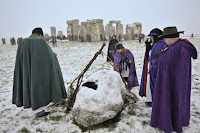
AROUND 300 pagan worshippers braved freezing temperatures to celebrate the winter solstice at Stonehenge, but turned up on the wrong day.

Dressed in traditional robes, they met at the stone circle on Monday to mark the rising of the sun on the shortest day of the year, but got their calculations wrong.

The winter solstice occurs when the tilt of the Earth’s axis is at its furthest from the Sun, resulting in the fewest hours of sunlight of the year.

Although it normally falls on December 21, the exact time of the solstice varies each year and this year the solstice was 5.47pm on Monday so, because the sun had already set, the official celebrations took place at sunrise on Tuesday.

But the hundreds of enthusiastic worshippers who turned up a day early went ahead and celebrated anyway.

English Heritage, which manages the site, decided to open the gates and welcome them even though it was the wrong day.

Hundreds more pagans and druids turned up on Tuesday morning for the official winter solstice celebrations.

I found this very funny!


I am a professional tour guide who can provide ‘private’ guided sightseeing tours of Stonehenge for small groups.
I specialise in Stonehenge and ancient Britain and can often get permission from the English Heritage to take you beyond the fences and touch the Stones after the site is closed to the public. (special access or inner circle tours)

Private tours can depart from London, Salisbury, Bath or Bristol

Some of my popular ‘favourite’ day tour itineraries include:
King Arthur Day Tour
Stonehenge
Glastonbury and King Arthurs Avalon
Challice Well Gardens (reputed buriel site of the Holy Grail
Avebury Stone Circle
Silbury Hill

Great Heritage Trail Day Tour
Stonehenge
Roman City of Bath
Lacock Village
Castle Coombe

Wessex Explorer Day Tour
Salisbury Cathedral
Old Sarum Hillfort
Stonehenge
Avebury Stone Circle
Chalk Hill figures
Buriel Mounds
Crop Circles (April to Septemeber)

However, private bespoke tours can be tailored to suit your requirements and can offer the ultimate flexibility throughout your day (s) visiting almost any location you wish to visit.

I promise a well balanced day with continuous information about not only the places we visit but England in general. My style of touring guarantees an informative, entertaining day, certainly never boring.
I frequently see so called ‘professional’ guides giving an uninspired hasty tour of tourist attractions and then demand huge tips for their ‘sloppy’ services at the end of the day.
MY MISSION STATEMENT: In the unlikely event of you not being entirely satisfied with my services I will NOT charge you!

I truly appreciate that many of you will only visit Stonehenge or England once and deserve a great experience.
I can supply 100’s of testimonials from satisfied customers (individuals/ families/groups) and have a 1st class reputation with many of the UK tour operators. (my heads getting bigger and bigger the more I write) Seriously folks, give me the opportunity to quote for your private group tour (1 – 16 passangers) and I wont disappoint.
By contacting me direct you can also ‘cut out the middle man’ i.e travel agents who add a big fat commission for doing little
Direct Email: tour.guide@rocketmail.com

Bluehenge

Bluehenge unearthed: Prehistoric site that could be famous stone circle’s little sister

The prehistoric circle has been named Bluehenge after the colour of the 27 giant stones it once incorporated
The find is already challenging conventional wisdom about how Stonehenge was built – and what it was used for.
Bluehenge was put up 5,000 years ago – around the same time as work began on Stonehenge – and appears to have been a miniature version of it.
The two circles stood together for hundreds of years before Bluehenge was dismantled. Researchers believe its stones were used to enlarge Stonehenge during one of a number of redevelopments.
Professor Tim Darvill, Stonehenge
‘We thought we knew it all, but over the last few years we have discovered that something as familiar as Stonehenge is still a challenge to explore and understand. It wouldn’t surprise me if there weren’t more circles.’
All that remains of the 60ft wide Bluehenge are the holes of 27 giant stones set on a ramped mount. Chips of blue stone found in the holes appear to be identical to the blue stones used in Stonehenge.

The four-ton monsters, made of Preseli Spotted Dolerite – a chemically altered igneous rock harder than granite – were mined in the Preseli Mountains in Pembrokeshire and then rolled, dragged and floated the 200 miles to the site on the banks of the Avon in Wiltshire.

Once installed, the stones would have been polished to a dark blue with silver flecks resembling the night sky. Bluehenge lies at the end of the ‘Avenue’ – a ritual pathway that connected Stonehenge to the Avon.
Stonehenge itself was built and rebuilt over 600 years in three main phases. The first – begun in 3000BC – saw the creation of a ditch and bank which later enclosed a circle of 56 holes for posts or stones.

Around 2600BC the site was transformed into two circles of 82 blue stones brought from the Welsh mountains.
Then, 150 years later, the ancient Britons set up 50-ton sarsen stones quarried at Marlborough, 25 miles away.
The blue stones were dug up and repositioned, and the sarsens used to create the Stonehenge familiar today. The new find changes this account of this history.

It suggests that the creators of Stonehenge originally built two circles – one with 56 stones at Stonehenge, and another with 27 at Bluehenge. The stones of the smaller circle were eventually incorporated into the bigger one.
Bluehenge was discovered by Professor Mike Parker Pearson, of Sheffield University, who argues the monuments were linked to rituals of life and death.
Julian Richards, archaeologist and presenter of BBC2 TV series Meet The Ancestors, believes, however, that such certainty is beyond our reach.

‘Any one person who says they have the answer is being a bit over-confident,’ he said.
‘If you think that Stonehenge was created, used and modified over 1,400 years then it probably was used for many different things.’
Professor Geoffrey Wainwright, who found the source of the Stonehenge stones in Wales with Professor Darvill, said: ‘This [new] henge is very important because it forms part of the picture of ceremonial monuments in the area and puts Stonehenge into context.
‘It’s no longer Stonehenge standing alone, but it has to be seen in context with the landscape.’

Lovers of prehistoric sites will have to wait until February before the full details of Bluehenge are published.
The creators of Stonehenge – who saw the Stone Age pass into the Bronze Age – were farmers who lived in small villages in huts made of wooden stakes and twigs, covered with a thick layer of clay and chalk.
Farming had been established for at least 1,000 years and the builders of Stonehenge were skilled at growing wheat and barley and keeping pigs and sheep.
Some experts believe they made cider and beer and ground wheat into flour to make bread and cakes.
But they were still forced to depend on wild fruit, peas, lentils, nuts and honey. Clothes were primitive leather coats and jackets, woollen leggings and simple shoes made of skins bound with twine.
No one knows what gods they worshipped, but the alignment of Stonehenge to the solstice shows that the Sun – and maybe the Moon – was important.

Has anybody noticed that stone henge is 1.31 miles from bluehenge and that bluehenge is 1.31 miles from woodhenge? since they worshipped the 4 seasons does that mean there is another henge? and that it could be buried 1.31 miles from stonehenge and wooodhenge to make a giant circle? you can check it out on google earth if you like :0)

Simon  – Tour Guide
Histouries UK – Stonehenge Tours


Design watchdog hits out at plans for £20m visitor centre at megalithic jewel in England’s cultural crown

Its footpaths are “tortuous”, the roof likely to “channel wind and rain” and its myriad columns – meant to evoke a forest – are incongruous with the vast landscape surrounding it.

So says the government’s design ­watchdog over plans for a controversial £20m visitor centre at Stonehenge, the megalithic jewel in England’s cultural crown. CABE, the Commission for Architecture and the Built Environment, has criticised the design of the proposed centre, claiming the futuristic building by Denton Corker Marshall does little to enhance the 5,000-year-old standing stones which attract more than 800,000 visitors each year.

Its concerns are the latest chapter in the long saga surrounding the English Heritage-backed project, and follow a ­government decision two years ago to scrap on cost grounds a highly ambitious £65m scheme to build a tunnel to reroute traffic to protect the World Heritage site.

The centre, which has been approved by Wiltshire county council planners, has divided opinion.

“We question whether, in this landscape of scale and huge horizons and with a very robust end point that has stood for centuries and centuries, this is the right design approach?” said Diane Haigh, CABE’s director of design review.

“You need to feel you are approaching Stonehenge. You want the sense you are walking over Salisbury Plain towards the stones.”

But the “twee little winding paths” were “more appropriate for an urban ­garden” than the “big scale open air ­setting the stones have”, she added.

The many columns were meant to be “lots of trunks” holding up a “very delicate roof”, she said. “Is this the best approach on what is actually a very exposed site. In particular, if it’s a windy, rainy day, as it is quite often out there, it’s not going to give you shelter. We are concerned it’s very stylish nature will make it feel a bit dated in time, unlike the stones which have stood the test of time”.

CABE believed the location of the ­centre, at Airman’s Corner, is good, and were pleased “something was happening at last”, but questioned the “architectural approach”. The centre has the full support of local architects on the Wiltshire Design Forum, and has been passed by the local planning committee. Nevertheless English Heritage recognised it was an emotional and divisive subject.

“Innovative architectural designs will always polarise opinion, and often nowhere more so that within the architectural world itself,” it said in a statement.

“The Stonehenge project has to overcome a unique set of challenges,” it said. “This has required a pragmatic approach and, following widespread consultation, we maintain the current plans offer the best solution”.

Stephen Quinlan, partner at Denton Corker Marshall, defended the design. The roof was meant to be a “sun canopy” and not offer weather protection in what was, principally “an outdoor experience”.

“It’s not an iconic masterpiece. It’s a facility to help you appreciate the Stonehenge landscape. It’s intellectually ­deferential in a big, big way to Stonehenge as a monument.

“I wouldn’t even mind if you couldn’t remember what the building looked like when you left. The visitor centre is not the destination,” Quinlan said.

However, he added: “We don’t take criticism from CABE lightly. And we are ­crawling through their comments to see if there are any improvements we can make.”