Source: 3,000 year-old wooden wheel discovered in southern England
Posted in Uncategorized | Leave a Comment »
Posted in Uncategorized | Leave a Comment »
Historical tours of Stonehenge and Avebury Stone Circle with expert guides. Collection by private car or mini bus from your Bath hotel. Ideal for families and groups.
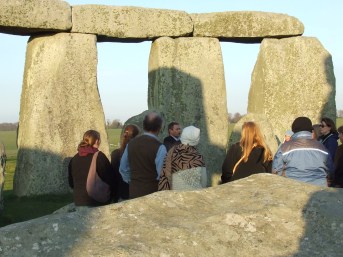
VIP Access Tour Inside Stonehenge
See the West of England‘s best loved sights – the wonder of Stonehenge and Avebury, the glorious Cotswolds, castles & gardens on our day tours from Bath in a private car or minibus. We offer half and full day tours and can also arrange special access tours at Stonehenge. In the evening at sunset after Stonehenge is closed to the public, or at sunrise before it is open, we can arrange for you to visit this awe-inspiring prehistoric monument and walk among the giant sarsen stones.
Popular tour itineraries:
Explore the World Heritage Site of Avebury Stone Circle.
Enter West Kennet Long Barrow Neolithic Tomb
View Silbury Hill, the largest prehistoric monumment in Europe.
Explore Durrington Walls, Woodhenge and the prehistoric landscape of Stonehenge.
13th Century Lacock Village and Harry Potter Film Location
Castle Combe Cotswolds Village, unaccessible to the big coaches
Enjoy a traditional country pub lunch in an historical setting
See mysterious crop circles and the Warminster Triangle
Climb Glastonbury Tor and here about the legend of King Arthur
Do a tower tour at Salisbury Cathedral and see Magna Carta.
Join one of our fixed itineraries or tailor your own.
Your Gateway to the West Country.
We can also collect you from London, Salisbury or Southampton Docks and this is a great wat to maximisee your sightseeing. Some clients prefer to travel by train to Bath from London. Our local guides will be happy to meet you at Bath’s train station with a personalised name-board. This method of travel to Bath is suitable if you would like to spend the entire day in the city and not travel in the surrounding countryside. If you would like to incorporate countryside and other historic sights en-route then it is wise to choose our flexible chauffeur guided service.
Please visit our website and contact us for a quote.
HisTOURies U.K
Mystical Landscape, Magical Tours
Posted in Stonehenge Guided Tours from Bath | Tagged Avebury Stone Circle, Cotswolds Village, Lacock, magna carta, Salisbury Cathedral, stonehenge tours, Tours from Bath, Transfer, Transport, World Heritage Sites | Leave a Comment »
‘Capability’ Brown, best known for designing gardens and landscapes at some of the country’s grandest stately homes including Blenheim Palace, Chatsworth, Highclere Castle, Burghley, Weston Park and Compton Verney.
‘Capability’ Brown’s landscape gardens are synonymous with England’s green and

NPG 6049; Capability Brown
pleasant land with their seemingly natural rolling hills, curving lakes, flowing rivers and majestic trees.
A nationwide festival and programme of events is planned with the opportunity to visit over 150 Brown gardens and landscapes in England, including some not usually open to visitors.
‘Capability’ Brown gardens
After centuries of stiff, formal and enclosed gardens, ‘Capability’ Brown transformed landscapes across England in the 18th century using a new natural style, now considered quintessentially English. He replaced heavy formality with wide open expanses, views and vistas and introduced his signature contouring hills, serpentine lakes and strategically-placed specimen trees.
This was gardening on a vast scale, creating parkland and woodland, and using trees to give the same effect as shrubs in regular gardens.
The Shakespeare of English garden design, his gift was to develop gardens and landscapes that looked natural and in harmony with the surrounding countryside even though they often involved moving thousands of tonnes of earth to create the gentle contours and installing expansive manmade lakes, that looked wonderful but were also part of practical drainage systems.
‘Capability’ Brown
An estate worker’s son, Lancelot Brown was born in August 1716 in the tiny village of Kirkharle, Northumberland.
He mastered the principles of his craft serving as a gardener’s boy at the local country house, Kirkharle Hall. By 1741 he had reached Stowe, an estate in Buckinghamshire where he quickly assumed responsibility for one of the most pioneering and magnificent landscape gardens in England. He stayed at Stowe for ten years and married Bridget Wayet in the local church. While at Stowe, he started to take independent commissions and became hugely sought after by the owners of large country house estates. The 7-mile round grounds at the Burghley estate in Lincolnshire were one of the most important commissions of his career which took more than 25 years to complete. He also practised
architecture and during the 1750s contributed to several country houses including Blenheim, Chatsworth, Harewood and Compton Verney.
Brown earned the nickname of ‘Capability’ as he told his clients that he could see the capabilities for improvement in their gardens and landscapes. He was hardworking, constantly busy and with a habit of not always charging for his work. Reportedly he refused to work in Ireland as he had not yet finished England.
Brown is associated with as many as 260 sites, a large number of which can still be seen today. By the time he died in 1783, 4,000 gardens had been landscaped according to his principles. And his design influence on parks and gardens spread across Northern Europe to Russia and through Thomas Jefferson to the United States.

‘Capability’ Brown Festival
A nationwide festival and events programme is being developed, including the opening of sites not usually accessible to visitors. More details will be released over the coming months.
At 13 major gardens including Blenheim Palace, Chatsworth and Croome, visitors will be able to see speciallycreated ‘Capability’ Brown exhibitions.
For more festival details, an interactive map of ‘Capability’ Brown gardens and landscapes and event listings, visit capabilitybrown.org
For more on England’s gardens, go to visitengland.com
HisTOURies U.K
The Best Tours in British History
http://www.HisTOURies.co.uk
Posted in 2016 History Tours, Events and Exhibitions | Tagged 2016 Exhibition, Anniversary, Blenheim Palace, Capability Brown, Chatsworth, Garden design, Gardens, Landscapes, Quintessentially English, tours, Visit England, Wessex Tours | Leave a Comment »
LONDON: Archaeologists said Tuesday they had discovered what were believed to be the best-preserved Bronze Age dwellings ever found in Britain, providing an extraordinary insight into prehistoric life from 3,000 years ago.
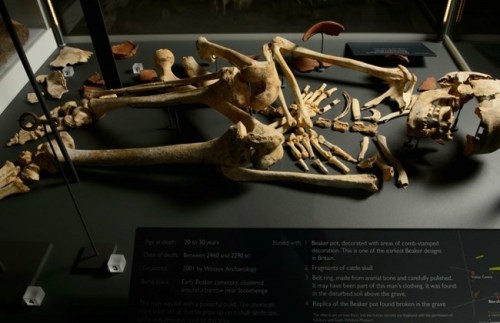
The skeleton of a man between 2460 and 2290 BC, during the early Bronze Age, and was buried near the world heritage prehistoric monument of Stonehenge is displayed at the new Stonehenge visitors centre, near Amesbury in south west England on December 11, 2013. (AFP PHOTO / LEON NEAL)
The settlement of large circular wooden houses, built on stilts, collapsed in a fire and plunged into a river where it was preserved in silts leaving them in pristine condition, Historic England said.
Discoveries from the dwellings in Whittlesey, in central England, which archaeologists said had been frozen in time and dated from between 1000-800 BC, included pots with food inside and finely woven clothing.
“We are learning more about the food our ancestors ate, and the pottery they used to cook and serve it,” Duncan Wilson, Chief Executive of Historic England, said in a statement.
“This site is of international significance and its excavation will transform our understanding of the period.”
Among the finds at the site, about two meters (6.5 ft) below the modern ground surface, are exotic glass beads forming part of a necklace, rare small cups, bowls and jars. Archaeologists also said that the site was so well preserved that even the footprints of those who lived at the site had been discovered.
There are also charred roof timbers clearly visible in one of the houses and the excavation team have speculated that those living at the settlement abandoned it in haste when it caught fire.
David Gibson, Archaeological Manager at the Cambridge Archaeological Unit, said they only usually came across a few pits or metal finds at Bronze Age sites.
“This time so much more has been preserved – we can actually see everyday life during the Bronze Age in the round,” he said. “It’s prehistoric archaeology in 3D with an unsurpassed finds assemblage in terms of range and quantity
Read the full story in the Daily Star
HisTOURies Uk
The Best Tours in British History
Posted in british history | Tagged archaeology, BC, Bronz Age, discovery, Historic England, History, Prehisoric, Stonehenge, tours | Leave a Comment »
Located in Wiltshire, England, Stonehenge is one of the world’s most iconic man-made landmarks. Tourists flock to the raised stones to ponder their origins and meaning. Are these the marks of an alien burial site? Were ancient sacrificial rituals conducted here? How were these stones raised before the advent of modern technology? Stonehenge baffles tourists (and historians) to this day as it sits isolated in the middle of the English countryside.

Recently, a group of archaeologists from the Stonehenge Hidden Landscapes Project uncovered the extensive remains of a 90-stone structure less than two miles from Stonehenge. Using remote sensing technologies, the archaeologists were able to detect the presence of the massive stone monument, which is currently buried under a bank of grass. Though the archaeologists aren’t entirely sure when the monument was built, they are able to place its construction as contemporary to Stonehenge itself, some time between 2,000 and 3,000 BC.
This new discovery means Stonehenge is not isolated and may in fact be relatively small in comparison to its newfound neighbor. Scientists and archaeologists alike are scrambling to figure out the significance of the new monument and where it figures into the history of the area.
Luckily for them, the new monument is surprisingly well-preserved, and excavation of the stones could lead to specimens more easily researchable than Stonehenge. If full excavation occurs, the monument would form a half moon that dwarfs its sister site. Preemptive hypotheses suggest the new stones might’ve been used for ancient calendar purposes, as a sacred space for religious acts, or as the wall of an arena.
In a statement released to the press by the Stonehenge Hidden Landscapes Project, Paul Garwood, Senior Lecturer in Archaeology at the University of Birmingham, reflected on the project’s game-changing discovery, “The extraordinary scale, detail and novelty of the evidence produced by the Stonehenge Hidden Landscapes Project is changing fundamentally our understanding of Stonehenge and the world around it. Everything written previously about the Stonehenge landscape and the ancient monuments within it will need to be re-written.”
Regardless of what scientists uncover, this story will be an important one to watch unfold. And in the near future, the discovery might also be a can’t-miss addition to the English travel itinerary.
By: Fiona Moriarty, Hipmunk (HUFFINGTON POST)
The Best Tours in British History
Wessex Guided Tours
Posted in Stonehenge Discovery | Tagged durrington walls, Histories, Histouries, Stonehenge Hidden Landscapes Project, stonehenge tours, UK Private Tours, visit wiltshire, Woodhenge | Leave a Comment »

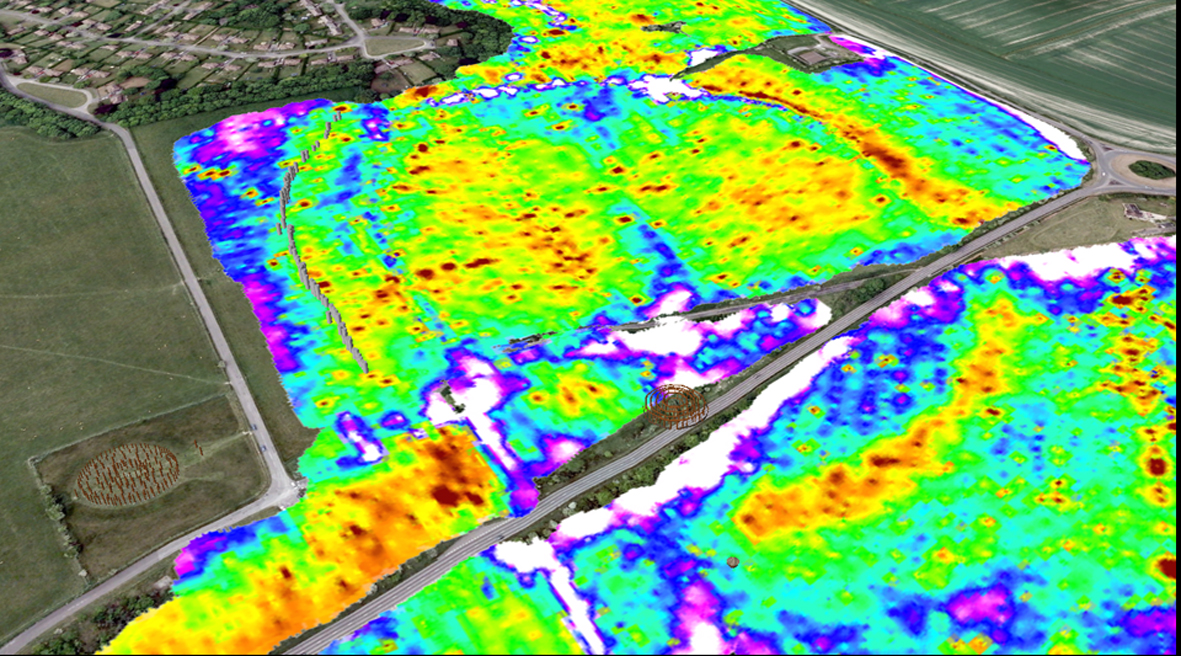 Let’s see what we’ve got. I can’t claim to know much more about the newest Stonehenge story than any other journalist. The discovery of a stone row at Durrington Walls was first announced a year ago, almost to the day. We were given little data then, however, and I seemed to be the only one who noticed! So what do we know now?
- What do they say they have found?
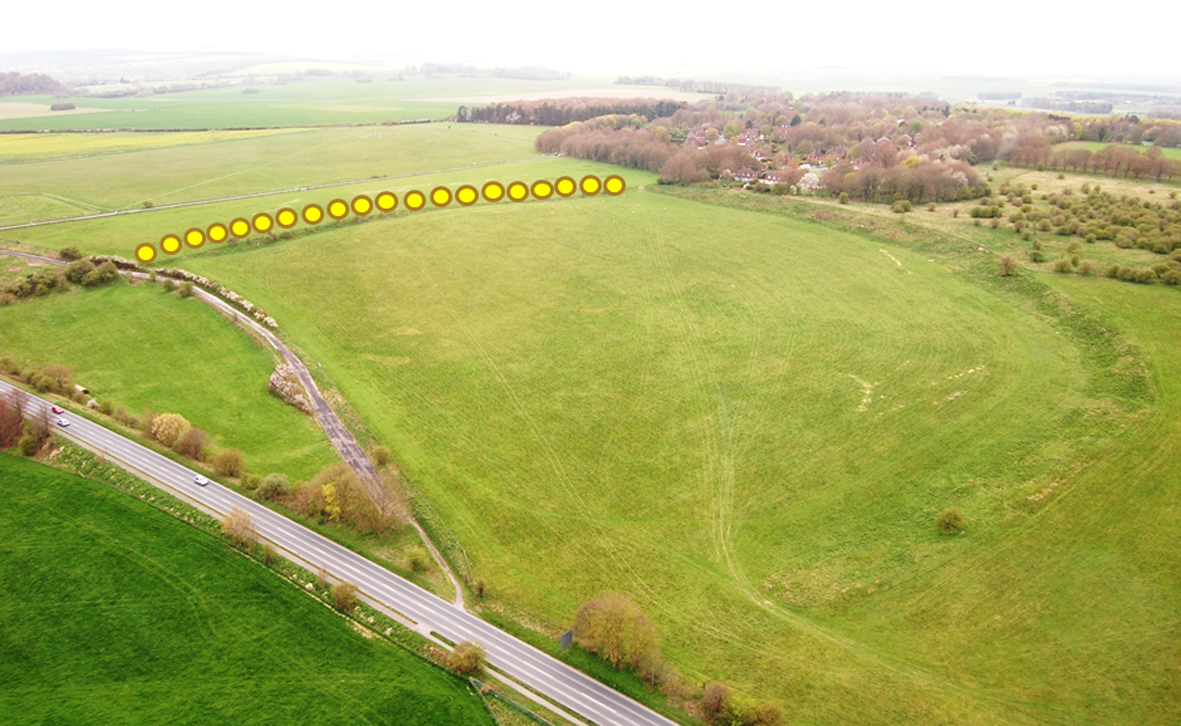 Evidence that there was once a row of up to 90 standing stones about 3km north-east of Stonehenge, west of the road between Amesbury and Durrington,. The stones, probably local sarsens, ran for at least 330m. At the east end the row stops short of the line of a modern road, and apparently does not continue beyond; at the west end it continues to the edge of the survey area, so may extend further there.
At the eastern end up to 30…
View original post 772 more words
Posted in Uncategorized | Leave a Comment »
We specialise in guided tours of the Stonehenge landscape. Explore this area with a local expert and learn more about this fascinating discovery http://www.HisTOURies.co.uk

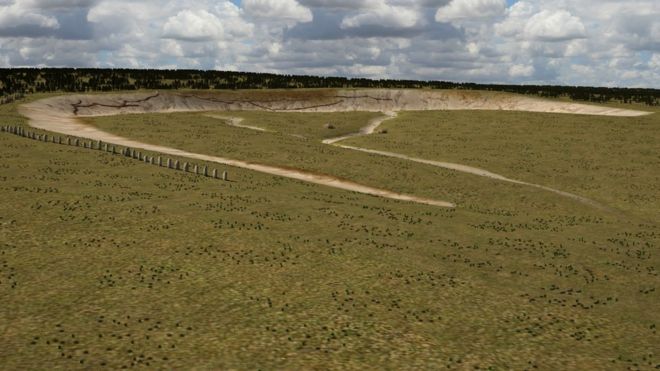
Using ground-penetrating radar, some 100 stones were found at the Durrington Walls “superhenge”, a later bank built close to Stonehenge.
The Stonehenge Living Landscapes team has been researching the ancient monument site in a five-year project.
Finding the stones was “fantastically lucky”, researchers said.
The stones may have originally measured up to 4.5m (14ft) in height and had been pushed over the edge of Durrington Walls.
The site, which is thought to have been built about 4,500 years ago, is about 1.8 miles (3km) from Stonehenge, Wiltshire.
The stones were found on the edge of the Durrington Walls “henge”, or bank, an area which had not yet been studied by researchers.
View original post 250 more words
Posted in Uncategorized | Leave a Comment »

It’s amazing what you can find when you look. Back in 2007, Dartmoor expert Alan Endecott discovered an arc of recumbent stones high up on the moor, some 1700 or so feet (525m) above sea level.
Initial investigations of the area are now completed, and what Alan discovered has been identified as a previously unknown stone circle, some 112 feet (34m) in diameter, and consisting of 30 or 31 stones with extensive views in all directions. This is the highest stone circle recorded on Dartmoor thus far.
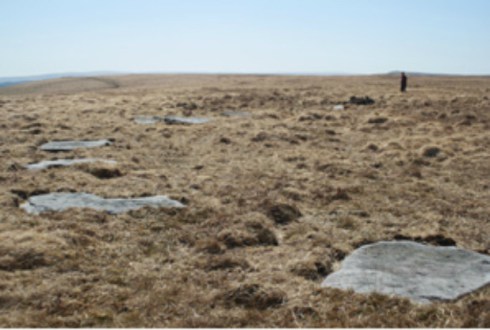
The stones were previously all thought to be upright, due to the surviving presence of packing stones and the large stones themselves, all of a similar size, may have been quarried from nearby Sittaford Tor. The location of this new circle places it within an arc of known circles in the NE moor, which includes Buttern Hill, Scorhill, Shovel Down, Fernworthy and the Grey…
View original post 139 more words
Posted in Uncategorized | Leave a Comment »
HISTOURIES PAGES
HISTOURICAL BLOGS
- January 2025 (1)
- December 2024 (1)
- October 2023 (1)
- February 2022 (1)
- March 2021 (1)
- December 2019 (1)
- January 2019 (2)
- June 2018 (2)
- December 2017 (3)
- June 2017 (1)
- May 2017 (5)
- February 2017 (5)
- January 2017 (9)
- December 2016 (5)
- November 2016 (5)
- October 2016 (3)
- July 2016 (1)
- April 2016 (1)
- March 2016 (1)
- February 2016 (5)
- January 2016 (1)
- October 2015 (2)
- September 2015 (2)
- May 2015 (3)
- March 2015 (1)
- February 2015 (2)
- January 2015 (7)
- December 2014 (3)
- October 2014 (5)
- September 2014 (4)
- March 2014 (2)
- February 2014 (1)
- January 2014 (4)
- November 2013 (4)
- October 2013 (8)
- September 2013 (6)
- August 2013 (7)
- July 2013 (3)
- June 2013 (5)
- May 2013 (10)
- April 2013 (8)
- March 2013 (6)
- February 2013 (2)
- January 2013 (3)
- December 2012 (3)
- November 2012 (7)
- October 2012 (7)
- September 2012 (5)
- August 2012 (2)
- July 2012 (6)
- June 2012 (3)
- May 2012 (5)
- April 2012 (3)
- March 2012 (4)
- February 2012 (7)
- January 2012 (5)
- December 2011 (3)
- November 2011 (7)
- October 2011 (8)
- September 2011 (9)
- August 2011 (7)
- July 2011 (7)
- June 2011 (4)
- May 2011 (5)
- April 2011 (4)
- March 2011 (10)
- February 2011 (7)
- January 2011 (11)
- December 2010 (12)
- November 2010 (12)
- October 2010 (17)
- September 2010 (13)
- August 2010 (9)
- July 2010 (12)
- June 2010 (6)
- May 2010 (6)
- April 2010 (13)
- March 2010 (22)
- February 2010 (26)
HISTOURIES UK

STONEHENGE TOURS
March 2026 M T W T F S S 1 2 3 4 5 6 7 8 9 10 11 12 13 14 15 16 17 18 19 20 21 22 23 24 25 26 27 28 29 30 31  Visit London
- An error has occurred; the feed is probably down. Try again later.
 Wessex Guided Tours