Feeds:
Posts
Comments

Archive for the ‘british history’ Category

Bath | Stonehenge | Paganism | Ley Lines| Druids | Masonic Lodge

It is said that the Circus is joined to the Royal Crescent by a ley-line, that they
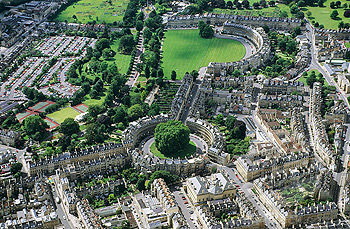
The Royal Circus is the same circumference as Stonehenge

represent the sun and the moon, and that Brock St which links them is the most paranormally active street in Bath!  The circumference of the Circus also matches – almost exactly – that of the inner circle of rocks at Stonehenge, the most famous druid monument of them all.

The Circus really does epitomise the elegance of Georgian Bath. Beautiful curved terraces of Bath limestone sweep round in a circle, and it doesn’t take much to imagine the ladies and gentlemen of society on this street. So charming and respectable – but look closer….

The Circus was designed by the architect John Wood, who had a fascination with Paganism. He incorporated his interest into the buildings around the crescent, all of which are adorned with Pagan and naturalistic carvings such as pan pipes and mystical figures, each one quite individual. At the top of each house is an acorn. The circular crescent represents the sun, and the Royal Crescent, which he also designed, represents the moon. It is said that the road that connects the two is an ancient ley line.

John Wood the Elder – Stanton Drew Circle and Stonehenge.

Bath is famed for its neo-classical architecture but what underpins the thinking of the 18th century architect John Wood when he drew the designs for The Circus is a strange mish-mash of legend and myth, this of course is the age of the new ‘druidism’ that took hold when such figures as William Stukeley called such places as Stonehenge the Druidical Temple.

Fertile imaginations played with the ideas of sacrificial wicker constructions filled with victims, and Wood took it much further and in his book – A Description of Bath, he writes a history for Bath that is at once absurd yet full of that energetic imaginings that are still to be found in today’s new age books.
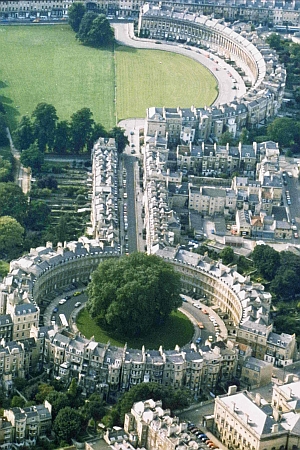
To understand why Wood designed The Circus as he did one must go back to the myths that formed the literature of the 18th century. Wood, though including neo-classical forms in the building, was not returning to a Roman past but a pre-Roman past steeped in the myths of a Britannic origin. The myth can be found in the 12th century writings of Geoffrey of Monmouthshire, and according to (R. S. Neal – Bath, A Social History) a 16th century edition of Monmouth’s book written in Paris was very much alive in the oral tradition of Bath. Putting stone circles and Druids together seems rather strange, but Wood thought that the chief ensign of the Druids was a ring.

So as he began to plan his city on paper, he incorporated the pagan elements, but also he was relating the pagan symbol of the circle back to Jewish symbolism, therefore Christian, and then British and Greek, which led quite nicely to the “Divine Architect” who was of course God. This is all creative flummery, a mixing of ideas, so when we look at The Circus we see classical lines, but with little touches of druidism – in the acorns that sit atop the surrounds of the roofs – and the frieze which incorporates specific symbols of Masonic details.

First  though must come the story of Bladud, the founding father of Bath, an exiled prince because of his leprosy, whilst out herding pigs one day happened to notice that the pigs loved to roll in the hot muds of the spring. Bladud also tried this and was cured, and then went on to found the city of Bath on the spot. Our mythical King Bladud is given a date of 480 BC, and as Wood saw it Bladud created the city about the size of Babylon. Bladud was a descendant of a Trojan prince, a high priest of Apollo and a ‘Master of Pythagoras’. Therefore this high priest was a devotee of the heliocentric systems of the planets from which the Pythagorean system was derived. That the Works of Stantondriu (Stanton Drew) form a perfect model of the Pythagorean system of the planetary world

Do the 108 acorns on the parapets refer to the story of ‘Prince Bladud’ (the founder of Bath) or a reference to the Druids and oak trees ?

At Stanton Drew it must have taken him many hours, with his assistant wandering round taking measurements of the circles, which were probably at this time partly covered in orchards. There was a precedence for this fascination with megalithic stones, Stukeley and Inigo Jones were all entranced by these heathen stones of an earlier age, and the development of myths round druidic religions were already forming and capturing imaginative minds – a bit like today.

Now Stanton Drew was, according to Wood, the university for British Druids, which thereby made Bath the metropolitan city seat of the British Druids. ‘And since there is an apparent connection between the ancient works of Akmanchester (Bath) and those of Stantondriu, it seems manifest that the latter constituted the University of the British Druids; that this was the university which King Bladud, according to Merlyn of Caledon planted; that it was at Stantondrui the king feated his four Athenian colleagues and that they were not only the heads of the British Druids in those early ages, but, under Bladud, the very founder of them‘ 

The Circus is based on a diameter of 318 feet, Wood’s rough measurements of the circumference of the stone circle at Stonehenge, the terraced houses form a perfect circle around a ‘timber’ circle of planted trees in the centre. There is an early drawing by J.R.Cozens which shows hitching stone post for the horses arranged symmetrically round the The Circus which would give the allusion of stones.

Wood also incorporated into his thinking the hills around Bath, giving them various titles such as Sun and Moon Hill, and The Parade is also aligned on Solsbury Hill which had an Iron Age settlement on top. The Royal Crescent built by his son John Wood the Younger, was crescent shaped representing the moon.

Where you might ask is the masonic symbolism, well it is only seen from the air, taking The Circus as the round part of the key walk down Gay Street to Queens Square which is square, and you will see the ‘key’ of Bath.

What is a Ley Line?
Ley lines are alleged alignments of a number of places of geographical interest, such as ancient monuments and megaliths, natural ridge-tops and water-fords. Their existence was suggested in 1921 by the amateur archaeologist Alfred Watkins, in his books Early British Trackways and The Old Straight Track. Watkins theorized that these alignments were created for ease of overland trekking by line of sight navigation during neolithic times and had persisted in the landscape over millennia.  In more recent times, the term ley lines has come to be associated with spiritual and mystical theories about land forms, including Chinese feng shui.

 I wonder if the fashionable Georgians who lived in these houses knew of the symbolism?
Links:
Stonehenge and Bath Tour Guide
HisTOURies – The Best Tours in British History

Read Full Post »

What was there before Stonehenge?

Stonehenge is a multiphased monument ie built in phases over a long period of time. It was built between 3000 and 2000 BC, but is part of a much larger ceremonial landscape which dates back somewhere up to 10,500 years ago. The earliest monuments in the landscape are markedSite of mesolithic post holes in the car park at Stonehenge by 3 small white discs on the tarmac at the lower end of the car-park. Chances are you will drive over them if you visit! The white discs mark where wooden postholes stood during the early mesolithic – the hunter gatherers – at least 3,500 years before the first phase of Stonehenge.Later features which predate Stonehenge that can still be seen are the Cursus and barrows or burial mounds. You will need more time or to go on a specialist tour to see these features.

Early ditch and bank at Stonehenge.

Though people had been meeting and using the landscape for some considerable time beforehand, the first phase of Stonehenge dates to between 3000 and 2920 BC with the creation of a ditch with internal bank. The bank has the appearance of a ‘…string of sausages’ and may have been upto 2m high though it is now much eroded.The dating of this part of the monument is believed to be fairly accurate because of the large amount of good dating evidence from antler and bone found in the ditch. After that the date for every other stage of Stonehenge is somewhat tenuous and subject to great debate.

Was there a timber phase at Stonehenge?

At the moment the theory is that from its beginnings to around 2600 BC there was a timber phase at Stonehenge. This included 56 timber posts just inside the bank and the post holes were later filled with cremated human remains and now known as Aubrey holes.In 2008 Aubrey hole 7 was opened by the Stonehenge Riverside Project and it looks more like a hole for a stone rather than timber. It may be that stones were here from the start rather than later. The results from the most recent dig are due out in 2011 so we may have the 3rd major rewrite of the Stonehenge story within 20 years!

Early stone phase.

Current dating assumptions suggest the first stones to arrive were the ‘bluestones’ from the Preseli Hills in west Wales. Bluestones inside StonehengeBluestone is a generic term for several types of volcanic rocks and each of them at Stonehenge weighs 4 – 6 tons.They are the ones that stand about man height as one looks into the stones. They don’t look blue until dressed (ie shaped) and the outer covering of the stone removed.You can how blue on a tour out of hours to the inner circle.
The bluestones were originally set in double concentric arcs with the open end facing the south/southwest. When removed they were filled are now known as Q & R holes.
Artist's impression of bluestone henge discovered in September 2009.In its final layout there are estimated to be 79 or 80 bluestones. An exciting discovery in September 2009 at the end of the Avenue where it meets the River Avon was a series of stone holes possibly holding bluestones. This ‘Bluestone’ henge may have held 24 stones. If the 56 Aubrey holes held stone rather than timbers it may be that there were two separate monuments that became united as the finishing phase of Stonehenge.

Late stone phase.

Around 2400 BC sees the arrival from 19 miles to the north of 75 sarsen stones. A very hard form of silicified sandstone it lies on or just below the ground surface. A circle of 30 uprights were erected in the outer circle each weighing around 25 tonnes. These were topped with 30 lintels each weighing 6 – 7 tonnes. Jointing to sarsens at Stonehenge.The lintels don’t rely on gravity to keep them in place they have mortice & tenon, and tongue & groove joints that we would normally find in a wood setting, but in stone. Each of the lintels also has some shaping on the inner and outer circular face to produce not far off a perfect circle.
The 5 trilithons (tri=3, lithon=stone) stand like a set of croquet hoops arranged in a horshoe shape in the centre of the circle. They step up in height as they go from the outer two to the remains of the Great Trilithon in the centre. Only 3 of the 5 trilithons still stand.

Final phase.

Around 2000BC the bluestones were re-erected. The altar stone was placed in the circle. Some realignments of external stones took place.

What is Stonehenge for?

Hundreds if not thousands of theories abound. A temple to the sun? Probably, but more about winter solstice sunset after which the days get lighter and warmer, rather than the more popularly attended summer solstice sunrise. A necropolis? Certainly. There are probably more than a tousand burials in the immediate area. Druidic temple? Probably not. They were a later ‘priesthood’ and the neo druids are an 18th century invention. A mystery?. Certainly.

Links:  http://www.english-heritage.org.uk/daysout/properties/stonehenge/
http://www.StonehengeTours.com#

Stonehenge Guided Tours
HisTOURies UK – The Best Tours in Ancient History

Read Full Post »

Chalk from Hampshire is used to re-chalk the ancient Wiltshire hill figure

Chalk from Hampshire is used to re-chalk the ancient Wiltshire hill figure

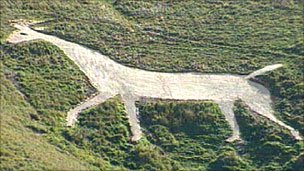
A restoration group is appealing for volunteers to help re-chalk one of Wiltshire’s oldest hill figures.

The Cherhill White horse, cut into the Marlborough Downs, is owned and maintained by the village of Cherhill.

The 232-year-old hill figure underwent a major facelift in 2002 after losing both its whiteness and its horse shape.

Since then the 18th Century landmark, the second oldest in the county, has required a “re-chalking” every two years.

“It had been continuously scraped to reveal fresh chalk but that left a three foot cliff at the top of the horse,” said the restoration group’s chairman, Rob Pickford.

“Now we top it up with extra chalk to level it with the surrounding ground.”

Yellow horse

The horse, one of nine such monuments in the county, requires up to 10 tonnes of chalk to restore it to its former splendour.

The chalk, funded by donations from visitors to the Downs, is being “brought in” after the last chalk quarry in the county at Mere closed down.

“The first top dressing we did we got the chalk from Somerset,” said Mr Pickford. “It was very yellow with bits of grey flint in it so we ended up with a yellow horse with grey spots. This year we’re getting it from a quarry in Hampshire.”

Natural erosion from the weather is normally responsible for the discolouring of the ancient monument.

However, this year’s unusually dry and sunny conditions have “bleached the chalk”.

“It’s looking quite white at the moment but in February it was looking particularly grey,” said Mr Pickford.

“And some of the boards used to hold the chalk in place have become exposed, so it does need top dressing.”

The re-chalking is due to take place on Saturday 14 May and is expected to take up to six hours.

Volunteers are being asked to meet at the Black Horse car park at 9:30 am “armed with spades.”  I am taking the kids and a picnic – see you there ?

Wiltshire’s White Horses

The Wiltshire Countryside is famous for its white horse chalk hill figures. It is thought that there have been 13 white horses in existence in Wiltshire, but only 8 are still visible today.

The oldest, largest and perhaps the most well known white horse is carved into the chalk hillside across the border in Oxfordshire. Little is known of the history of the Uffington White Horse, but it is believed to have influenced the cutting of the subsequent Wiltshire horses.

The first of the Wiltshire white horses to appear was at Westbury in 878AD, although this figure is no longer visible as a new horse was cut on top in 1778. The most recent horse was cut on the hill above Devizes to celebrate the Millennium.
Links:
http://www.bbc.co.uk/news/uk-england-wiltshire-13294489

http://www.wiltshirewhitehorses.org.uk/
http://www.StonehengeTours.com
http://www.visitwiltshire.co.uk/site/things-to-do/attractions/history-and-heritage/white-horses
We continue to offer private guided tours of Wiltshire that include ‘Chalk Hill Figures’

Wiltshite Tour Guide
HisTOURies UK – The Best Tours of Ancient Wiltshire

Read Full Post »

The first day of the month of May is known as May Day. It is the time of year when warmer weather begins and flowers and trees start to blossom. It is said to be a time of love and romance. It is when people celebrate the coming of summer with lots of different customs that are expressions of joy and hope after a long winter.

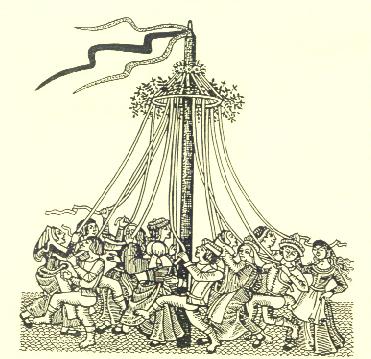
Traditional English May Day celebrations include Morris dancing, crowning a May Queen and dancing around a Maypole.

The beginning of Summer

Although summer does not officially begin until June, May Day marks its beginning. May Day celebrations have been carried out in England for over 2000 years.

The Romans celebrated the festival of Flora, goddess of fruit and flowers, which marked the beginning of summer. It was held annually from April 28th to May 3rd.

How was May Day Celebrated in the past?

It was custom for every one to go a-Maying early on May Day. Herrick, a 17th century English poet wrote:

There’s not a budding boy, or girl, this day,
But is got up, and gone to bring in May.

Decorating Houses

May Day began early in the morning. People would go out before sunrise in order to gather flowers and greenery to decorate their houses and villages with in the belief that the vegetation spirits would bring good fortune.

Washing in the early morning dew

Girls would make a special point of washing their faces in the dew of the early morning. They believed this made them very beautiful for the following year. copyright of protectbritain.com

May Queen

May Queen
The rest of the day was given over to various festivities. There was dancing on the village green, archery contest and exhibitions of strength. The highlight of the day was the crowning of the May Queen, the human replica of Flora. By tradition she took no part in the games or dancing, but sat like a queen in a flower-decked chair to watch her ‘subjects’.

May Day Garlands

Young girls would make May Garlands. They covered two hoops, one at right angles inside the other, with leaves and flowers, and sometimes they put a doll inside to represent the goddess of Spring.

In some parts of Britain, May 1st is called Garland Day.

The first of May is Garland Day
So please remember the garland.
We don’t come here but once a year,
So please remember the garland.

May Day Lifting

There was once a tradition in England of ‘lifting’ where a gang of young men would lift a pretty girl in a flower bedecked chair on May day. Then the girl would choose a boy on May 2nd.

May Day Tricks

In the North of England, the first of May was a kind of late ‘April Fooling’ when all sorts of pranks would take place and ‘May Gosling’ was the shout if you managed to trick someone. The response would be:

‘May Goslings past and gone. You’re the fool for making me one!’

Recommended Events in Wiltshire this May Day: 
http://www.english-heritage.org.uk/daysout/events/robin-hood-ow-1-Jan/
http://www.english-heritage.org.uk/daysout/events/time-travellers-go-medieval-os-30-Jan/
http://www.wherecanwego.com/whatsonengland/Wiltshire/events.aspx

Enjoy Wiltshire!
Stonehenge Tour Guide
HisTOURies UK – The Best Tours in Wesex

Read Full Post »

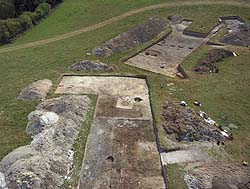
Durrington Walls Excavations“Excavations at the site of the former MOD Headquarters at Durrington have revealed deposits dating to the Late Upper Palaeolithic (Late Glacial) c. 12,000BC and evidence of human activity from the late Neolithic (2550-2200 BC) through to the modern period, with the main focus of activity dating from the Late Iron Age c.100BC to Romano-British period (AD43-410). The site is located within an archaeologically rich landscape just 1km north of the Neolithic Durrington Walls henge and between the Romano-British settlements at Figheldean and at the Packway enclosure to the north and south respectively.

Two monumental Neolithic posthole alignments, which appeared to follow the contours of high ground, contained Grooved Ware pottery. Potentially contemporary with these alignments was a natural swallow hole or sink hole 25m across which had been consolidated with a flint pebble surface which created a metalled platform covered with flint knapping debris and a broken late Neolithic flint axehead or chisel. In the Iron Age, the site comprised a number of paddocks and small fields, formed by shallow gullies and ditches.”

Full story here: http://www.themodernantiquarian.com/post/95719/news/mod_durrington.html

Reklative links: http://en.wikipedia.org/wiki/Stonehenge_Riverside_Project
http://www.sheffield.ac.uk/archaeology/research/stonehenge

Stonehenge Tour Guide
HisTOURies UK – The Best Tours of Wessex

Read Full Post »

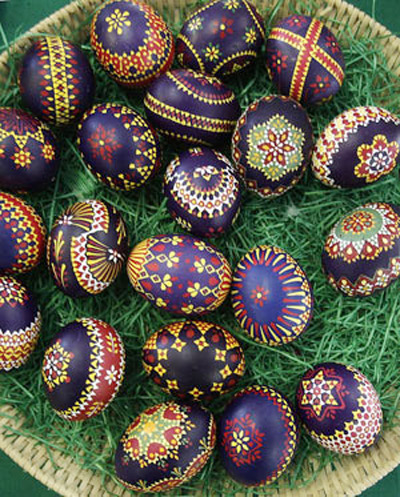
According to the Venerable Bede who lived in the 8th century the name Easter derived from the name of a pagan goddess, Eostre. She was goddess of Spring and fertility and her festival was celebrated at the Spring Equinox. Jesus was crucified in April and when the Saxons became Christians they began to celebrate his death and resurrection early in the Spring but they kept the old name Easter. Alternatively it has been suggested that Easter comes from the Saxon word for dawn.

In the early years of Christianity there was a dispute over the date of Easter. In 325 the Nicean Council decided it should be on the first Sunday after the full moon after the Spring Equinox. That is why the date of Easter changes each year.


Friday is the day of the week when the crucifixion took place. It is called Good Friday because good meant holy. On that day we eat hot cross buns. (Good meant holy). The origins of hot cross buns are obscure but in pagan times people baked buns and offered them to the gods. Cross buns with the cross representing the cross of Jesus were first mentioned in the 18th century. In the early 19th century people sold hot cross buns in the street from stalls and so they became known as ‘hot’ cross buns.


The Easter bunny was originally a hare because hares were fertility symbols in the pagan religion and they continued to be associated with Easter after people were converted to Christianity. Because people in the USA were unfamiliar with hares the Easter hare became a rabbit.


In the Middle Ages Christians were forbidden to eat eggs during Lent (the forty days before Easter). Not surprisingly people were keen to eat eggs when Easter arrived!


Some people also said that the egg represented the tomb of Jesus, or it represented the stone that was placed over the entrance of his tomb and was rolled away when he rose from the dead. (Long before Christianity eggs were a pagan symbol of fertility).


In the Middle Ages people painted Easter eggs red but by the 18th century people bought artificial eggs made of various materials to give as gifts at Easter. (Sometimes the artificial eggs contained gifts). Chocolate Easter eggs were first made in the 19th century.

http://www.visitwiltshire.co.uk
http://www.dayoutwiththekids.co.uk/search.php?county=wiltshire

Wiltshire Tour Guide
HisTOURies UK – The Best Guided Tours in Wessex

Read Full Post »

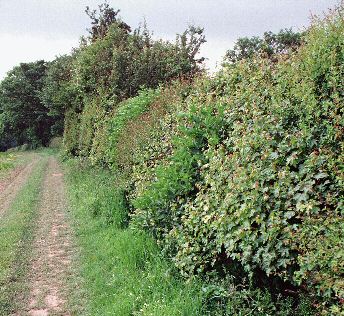
Few things have helped create the look of the English countryside more British Hedgerowthan hedgerows. Hedges have been used for a long time in England, yet for all their antiquity, much of the familiar checkerboard pattern they help create is of very recent vintage.

Hedges have been used as field boundaries in England since the times of the Romans. Excavations at Farmoor (Oxon) reveals Roman hedges made of thorn. The Anglo-Saxons also used hedgerows extensively, and many that were used as estate boundaries still exist. Although these early hedges were used as field enclosures or to mark the boundaries of one person’s property, there was no systematic planting of hedges in England until the first enclosure movement of the 13th century.

The pressures of population expansion led to a widespread clearing of land for agriculture, and the new fields needed to be marked clearly.

Later, farming expansion in the 15th century led to more widespread hedge planting, but the greatest use of hedges came in the Enclosure Movement of the 18th and 19th centuries.

The Enclosure Movement is a fancy term that historians use to describe the habit of wealthy landowners enclosing common fields for their own use, usually for the purpose of raising sheep.

Hedges are used as field boundaries in the lowland regions of England. In the highlands, such as the Yorkshire Dales, dry stone walls are commonly used.

Aerial Hedgerow ViewSo great was the need for hedges during the Enclosures, that a whole new industry sprang up supplying hawthorn plants to be used in planting new hedges.

In the process of enclosure many rural labourers lost their livelihood and had to move to the new industrial urban centres. So the next time you sigh over the timeless quality of the English hedge-shaped countryside, spare a thought for the misery and hardship caused by the erection of hedged fields to much of England’s rural population.

Hedge Facts
When: Roman, Anglo-Saxon, 13thC, 15thC, 18th-19thC
Where: Lowland areas
Why: Field boundaries
How
: planting bushes or trees and pleating them together at an angle as they grew
Materials: huge variety based on local availability, but the most common were hawthorn, blackthorn, and holly

A lot of effort and ingenuity has been brought to bear on the problem of dating hedges. Several historians have advanced mathematical formulae for calculating the age of a hedgerow based on the number of plant species found in a certain length of hedge. As an extremely rough rule of thumb, one species of hedge plant per 100 years seems to get close to the truth.

Unfortunately, recent years have seen the disappearance of many miles of English hedgerows. It is easier for modern farmers to string new metal fence wire than to maintain ancient hedgerows. Conservation efforts have introduced incentives to farmers to maintain the hedges, and losses have slowed somewhat. Estimates vary, but there may be upwards of 500,000 miles of hedgerows in England today.

Links:
http://en.wikipedia.org/wiki/Hedge
http://www.britainexpress.com
http://www.BestValueTours.co.uk

The Best Tours of the Britich Countryside
HisTOURies UK Private Guided Tours

Read Full Post »

A new film about King John further underlines history’s judgement of the medieval English monarch as a cruel tyrant. But among the dozens of bad kings and despots, why is John always the pantomime villain?

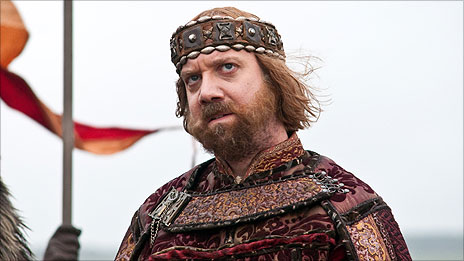
Paul Giamatti is the latest to play King John as a villain in Ironclad

Paul Giamatti is the latest to play King John as a villain in Ironclad

Surrendering lands in France, forced into a humiliating climbdown with the nobility and excommunicated by the Church. Not to mention being blamed for the murder of his nephew.

The medieval reign of King John has been characterised by disaster and his reputation languishes among the lowest for all the kings and queens of England.

This poor standing is illustrated by his persistently negative appearances in British cultural life 800 years on. Depictions on television, stage and big screen, particularly in Robin Hood films, usually present a man who is treacherous and weak.

In 1938’s The Adventures of Robin Hood, John (played by Claude Rains) is an overtaxing oppressor, while Disney’s Robin Hood showed John as a cowardly lion sucking his thumb.

A new film Ironclad, released in the UK on Friday, stars American actor Paul Giamatti as the villainous king laying siege to the noble barons in Rochester Castle, in the civil war that followed the signing of Magna Carta.

So why do we always like to bash King John?

Make no mistake, he was a bad king, says John Hudson, of the Institute of Medieval Studies at the University of St Andrews.

“He was a very considerable failure as a king. He loses a large amount of possessions inherited, in particular lands in France, like Normandy and Anjou. He manages to surrender his realm to the pope and ends up facing a huge baronial rebellion, a civil war and a war with France. In terms of failures, he is one of the worst kings.”

And his unpleasant personality compounds his mistakes, says Professor Hudson. Trying to seize control of the throne while his brother, King Richard I, was imprisoned abroad, lost him the trust of the people long before he became king himself.

“A lot of very effective medieval kings are cruel and inspire fear but he hasn’t inspired trust. For people to trust a king and fear him is essential but people don’t trust him.

“People wanted someone to be heroic and not to interfere with their lives. But John was a king who did interfere and wasn’t heroic.”

But it’s simplistic to portray John as simply evil and Richard good, like in some of the Robin Hood films, he says. At least The Lion in Winter, starring Katharine Hepburn and Peter O’Toole as John’s parents Eleanor and Henry II, portrays the family tensions acutely and gives a sense of the personal power struggles within the Plantagenet dynasty.

John grew up in a feuding family. He was born in Oxford in 1166, the youngest and favourite son of Henry II. When John was five, three of his brothers plotted against their father to seize the throne, enlisting the help of Louis VII of France and their own mother, Eleanor of Aquitaine.

The rebellion was short-lived but Henry II punished his wife by imprisoning her for 16 years. On Henry’s death in 1189, John’s brother Richard became king but he nominated his nephew, Arthur, as heir. John tried unsuccessfully to instigate a coup while his brother was in prison, captured on his way back from fighting the Crusades.

The popular image of John as a cruel tyrant began a few years after his death in 1216, after a turbulent 17 years on the throne. The chronicles of Roger Wendover, a historian and monk at St Albans, and his successor Matthew Paris, included many accounts of cruelty that have since been questioned.

‘John the punchbag’

The Tudors were more sympathetic to him, although Shakespeare’s The Life and Death of King John provides a mixed portrayal of the monarch as treacherous and ruthless, but also patriotic in standing up to Rome.

But it was the Victorians who made King John the pantomime villain he is today, says Paul Sturtevant, who is researching Hollywood depictions of the medieval period, at the University of Leeds.

“The Victorians used King John as a punchbag. Prior to the 18th and 19th Century, Robin Hood was not put in a historical place. It wasn’t about the monarch at all, just Robin Hood and his adventures.

“So the Robin Hood stories being placed in John’s reign is a recent thing. He’s portrayed as a pantomime villain because a number of accounts from the time suggest that people found him quite unpleasant as a person. So the question is to what degree those sources are accurate.”

The Victorians latched on to John’s moral failings like his cruelty and his sexual deviancy, taking mistresses married to barons, and this repulsed their newly-formed idea of medieval knights as perfect gentlemen.

“To the Victorian mindset, he was everything they didn’t want in an English king. They re-imagined the period in terms of courtly love and chivalry.”

Most historians would agree he was quite a bad king but whether he was a caricature of evil is another question entirely, he says.

King John at Runnymede John’s most famous moment is signing the Magna Carta

“Almost all the depictions of King John out there are Robin Hood ones and as a result he’s the villain, either bumbling and idiotic or in the Disney animation he’s a lion who sucks his thumb. He’s infantile, with a snake as a patsy.”

The truth is that he was an inept politician but he wasn’t a tyrant, says Mr Sturtevant. His conflicts were not with his subjects but with barons, the Pope or the French.

“I see him a bit like Barack Obama in so far as he inherited a nightmare situation from his predecessor but because he was a bad politician he didn’t help himself to get out of it.

“Richard still has a really good reputation as the heroic lion-hearted king but he spent only six months of his life in England and the rest either on crusade in Holy Land or at war in France.”

To pay for his foreign wars, not to mention a huge ransom when he was captured, Richard had raised taxes far higher than any level England had experienced. By the time John was crowned king, the cupboard was bare, but his fiscal demands led to unrest.

Mike Ibeji, who researched King John for Simon Schama’s History of Britain on the BBC, says it was in the interests of those who put John’s successor Henry III on the throne to portray him negatively. King John was very unlucky, he says, but he also made his own bad luck.

There are several times during John’s reign where he actually has the upper hand, where he’s in a position where if he just does things the right way, he’s going to end up succeeding in what he’s trying to do.

“But he always overplays his hand and goes too far because he’s in a position of power and can’t rein back. So he doesn’t have a sense of scale and that’s his biggest problem.”

For example, he quelled a rebellion in France but when his nephew and enemy Arthur then dies in his custody, the finger of suspicion points at John and the revulsion felt in France renews the revolt and leads to defeat. A kingdom that once stretched from the Scottish border to the Pyrenees was falling apart.

What John will always be remembered for, apart from antagonising Robin Hood, is signing Magna Carta, which limited royal power and restated English law. And some of his defenders say that at least he provoked the barons into introducing one of history’s most famous documents.

In the History of the English-Speaking Peoples, Winston Churchill wrote: “When the long tally is added, it will be seen that the British nation and the English-speaking world owe far more to the vices of John than to the labours of virtuous sovereigns; for it was through the union of many forces against him that the most famous milestone of our rights and freedom was in fact set up.”
http://www.bbc.co.uk/news/magazine-12603356

Visit Salisbury Cathedral in Wiltshire on a private guided tour and view the original Magna Carta

Salisbury and Stonehenge Tour Guide
HisTOURies UK – The Best Tours in History

Read Full Post »

Celtic Britain
(The Iron Age) c. 600 BC – 50 AD

Who were they? The Iron Age is the age of the “Celt” in Britain. Over the 500 or so years leading up to the first Roman invasion a Celtic culture established itself throughout the British Isles. Who were these Celts?

For a start, the concept of a “Celtic” people is a modern and somewhat

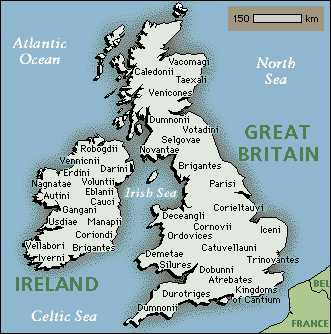
Celtic Britain was dominated by a number of tribes, each with their own well-defined territory. It is thanks to Roman chroniclers, such as Strabo, Julius Caesar, and Diodorus, that the names of individual tribes are known to us today, albeit in Romanized form.

Celtic Britain was dominated by a number of tribes, each with their own well-defined territory. It is thanks to Roman chroniclers, such as Strabo, Julius Caesar, and Diodorus, that the names of individual tribes are known to us today, albeit in Romanized form.

romantic reinterpretation of history. The “Celts” were warring tribes who certainly wouldn’t have seen themselves as one people at the time.

The “Celts” as we traditionaly regard them exist largely in the magnificence of their art and the words of the Romans who fought them. The trouble with the reports of the Romans is that they were a mix of reportage and political propaganda. It was politically expedient for the Celtic peoples to be coloured as barbarians and the Romans as a great civilizing force. And history written by the winners is always suspect.

Where did they come from? What we do know is that the people we call Celts gradually infiltrated Britain over the course of the centuries between about 500 and 100 B.C. There was probably never an organized Celtic invasion; for one thing the Celts were so fragmented and given to fighting among themselves that the idea of a concerted invasion would have been ludicrous.

The Celts were a group of peoples loosely tied by similar language, religion, and cultural expression. They were not centrally governed, and quite as happy to fight each other as any non-Celt. They were warriors, living for the glories of battle and plunder. They were also the people who brought iron working to the British Isles.

The advent of iron. The use of iron had amazing repercussions. First, it changed trade and fostered local independence. Trade was essential during the Bronze Age, for not every area was naturally endowed with the necessary ores to make bronze. Iron, on the other hand, was relatively cheap and available almost everywhere.

Hill forts. The time of the “Celtic conversion” of Britain saw a huge growth in the number of hill forts throughout the region. These were often small ditch and bank combinations encircling defensible hilltops. Some are small enough that they were of no practical use for more than an individual family, though over time many larger forts were built. The curious thing is that we don’t know if the hill forts were built by the native Britons to defend themselves from the encroaching Celts, or by the Celts as they moved their way into hostile territory.

Usually these forts contained no source of water, so their use as long term settlements is doubtful, though they may have been useful indeed for withstanding a short term siege. Many of the hill forts were built on top of earlier causewayed camps.

Celtic family life.
The basic unit of Celtic life was the clan, a sort of extended family. The term “family” is a bit misleading, for by all accounts the Celts practiced a peculiar form of child rearing; they didn’t rear them, they farmed them out. Children were actually raised by foster parents. The foster father was often the brother of the birth-mother. Got it?

Clans were bound together very loosely with other clans into tribes, each of which had its own social structure and customs, and possibly its own local gods.

Housing. The Celts lived in huts of arched timber with walls of wicker and roofs of thatch. The huts were generally gathered in loose hamlets. In several places each tribe had its own coinage system.

Farming. The Celts were farmers when they weren’t fighting. One of the interesting innovations that they brought to Britain was the iron plough. Earlier ploughs had been awkward affairs, basically a stick with a pointed end harnessed behind two oxen. They were suitable only for ploughing the light upland soils. The heavier iron ploughs constituted an agricultural revolution all by themselves, for they made it possible for the first time to cultivate the rich valley and lowland soils. They came with a price, though. It generally required a team of eight oxen to pull the plough, so to avoid the difficulty of turning that large a team, Celtic fields tended to be long and narrow, a pattern that can still be seen in some parts of the country today.

The lot of women. Celtic lands were owned communally, and wealth seems to have been based largely on the size of cattle herd owned. The lot of women was a good deal better than in most societies of that time. They were technically equal to men, owned property, and could choose their own husbands. They could also be war leaders, as Boudicca (Boadicea) later proved.

Language. There was a written Celtic language, but it developed well into Christian times, so for much of Celtic history they relied on oral transmission of culture, primarily through the efforts of bards and poets. These arts were tremendously important to the Celts, and much of what we know of their traditions comes to us today through the old tales and poems that were handed down for generations before eventually being written down.

Druids. Another area where oral traditions were important was in the training of Druids. There has been a lot of nonsense written about Druids, but they were a curious lot; a sort of super-class of priests, political advisors, teachers, healers, and arbitrators. They had their own universities, where traditional knowledge was passed on by rote. They had the right to speak ahead of the king in council, and may have held more authority than the king. They acted as ambassadors in time of war, they composed verse and upheld the law. They were a sort of glue holding together Celtic culture.

Religion. From what we know of the Celts from Roman commentators, who are, remember, witnesses with an axe to grind, they held many of their religious ceremonies in woodland groves and near sacred water, such as wells and springs. The Romans speak of human sacrifice as being a part of Celtic religion. One thing we do know, the Celts revered human heads.

Celtic warriors would cut off the heads of their enemies in battle and display them as trophies. They mounted heads in doorposts and hung them from their belts. This might seem barbaric to us, but to the Celt the seat of spiritual power was the head, so by taking the head of a vanquished foe they were appropriating that power for themselves. It was a kind of bloody religious observance.

The Iron Age is when we first find cemeteries of ordinary people’s burials (in hole-in-the-ground graves) as opposed to the elaborate barrows of the elite few that provide our main records of burials in earlier periods.

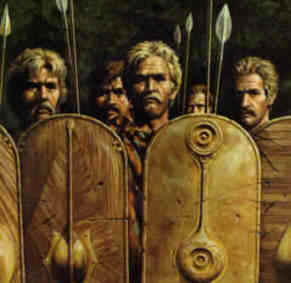
The Celts at War. The Celts loved war. If one wasn’t happening they’d be sure to start one. They were scrappers from the word go. They arrayed themselves as fiercely as possible, sometimes charging into battle fully naked, dyed blue from head to toe, and screaming like banshees to terrify their enemies.

They took tremendous pride in their appearance in battle, if we can judge by the elaborately embellished weapons and paraphernalia they used. Golden shields and breastplates shared pride of place with ornamented helmets and trumpets.

The Celts were great users of light chariots in warfare. From this chariot, drawn by two horses, they would throw spears at an enemy before dismounting to have a go with heavy slashing swords. They also had a habit of dragging families and baggage along to their battles, forming a great milling mass of encumbrances, which sometimes cost them a victory, as Queen Boudicca would later discover to her dismay.

As mentioned, they beheaded their opponents in battle and it was considered a sign of prowess and social standing to have a goodly number of heads to display.

The main problem with the Celts was that they couldn’t stop fighting among themselves long enough to put up a unified front. Each tribe was out for itself, and in the long run this cost them control of Britain.

(Note: The terms “England”, “Scotland”, and “Wales” are used purely to indicate geographic location relative to modern boundaries – at this time period, these individual countries did not exist).

Join us on a guided tour of Britain and learn more about the Celts
HisTOURies UK – The Best Tours in British History

Read Full Post »

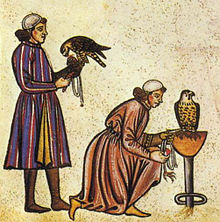
Falconry is a sport that involves the use of trained birds of prey to hunt game for humans. Although falconry is also known as hawking, in modern falconry buzzards are most commonly used.

It is believed that falconry was well established in the Middle and Far East by 2000 BC despite the earliest evidence only coming from the era around the reign of Sargon II (722-705 BC).
The Romans probably learnt falconry from the Greeks although the practice does not appear to have been widespread and there are references to Caesar using falcons to kill carrier pigeons. Falconry was probably introduced to Europe in about 400 AD when the Huns and Alans invaded from the East.

More recently falconry has become more popular particularly as a sport of kings. It was reputedly the favourite sport of every King of England from Alfred the Great to George III except for James I who spent much of his time training cormorants and ospreys to catch fish.
A lot has been written about King John’s passion for crane hawking and he often brought hunting parties to the Test Valley to fly falcons at herons. The herons were ringed before they were re-released and information about their numbers and locations are documented in the Domesday Book.

In the Middle Ages it was not just the rich who hunted with hawks. Labourers used hawks to hunt for food, often illegally and King John who wanted to improve the rewards of his own personal hunting banned people taking all feathered game from the Royal Forests which at the time covered vast areas of the British countryside.

The law provided that a hundred paupers should be fed with the proceeds of each Royal hunt but despite this if it had been enforced effectively it would still have caused much suffering and hardship. During the Middle Ages a social custom evolved in falconry known today as the Laws of Ownership. Birds of prey were allocated a rank and a man could not hawk with a bird that had a higher rank than him. The hierarchy seems to have evolved around the cost of the bird and it is not known how strictly it was adhered to.

The original list was documented in the 15th Century ‘Boke of St Albans’ on hawking, hunting and cote-armour as follows:
Emperor – The Eagle, Vulture, and Merloun
King – The Ger Falcon and the Tercel of the Ger Falcon
Prince: The Falcon Gentle and the Tercel Gentle
Duke: The Falcon of the Loch
Earl: The Falcon Peregrine Baron: The Bustard
Knight: The Sacre and the Sacret
Esquire: The Lanere and the Laneret
Lady: The Marlyon
Young Man: The Hobby
Yeoman: The Goshawk
Poor Man: The Tercell
Priest: The Sparrowhawk
Holy Water Clerk: The Musket
Knave or Servant: The Kestrel

Today anyone can practice falconry in the UK and no license is required although only captive-bred birds can be used. Despite pressure to have falconry banned it has been allowed to carry on albeit with a number of conditions attached to it. Birds must be ringed and government registered. Wild birds must not be used for falconry and all birds are DNA tested to certify their origins.

FALCONRY IN ENGLISH LANGUAGE

As Falconry has been around in the UK for nearly 2,000 years, words and phrases that falconers use for their birds have crept into everyday language.

Fed up: A hawk is termed fed up when it has a full crop (storage pouch) and therefore would not be interested in food or flying. If you are fed-up you are sat around doing nothing or bored.

Mantle: To cover or shield the food by dropping their wings over. The cover over a fireplace is now called a mantlepiece.

Cadge: A wooden frame that falcons were traditionally carried out into the hunting field on. The person carrying the cadge became known as the cadger. At the end of the day the cadger would go to the local tavern and recount the tales of how the birds had flown and in turn expect money. To cadge, now means to scrounge or beg for.

Hoodwink: To cover the bird’s eyes to keep it calm and relaxed. It now means to fool someone into doing something.

Mews:  Nowdays this is something cottages or street names are called: “something mews”. A real mews is the home to hawks and falcons, the Royal Mews in London was set up to house the monarch’s birds. The name comes from the french word “muer” which means to moult. In James I’s reign the Royal Mews stood where the National Gallery stands today and extended across Trafalgar Square down Whitehall. Many stately homes also have a mews associated with them.

Wiltshire Falconry: http://www.meredownfalconry.co.uk/

Quiz:  Anyone know where the term “Under my thumb” comes from ?

Wiltshire Tour Guide
HisTOURies UK – The Best Tours in Wessex

Read Full Post »

« Newer Posts - Older Posts »