Feeds:
Posts
Comments

Archive for the ‘England facts’ Category

On October 31st, we celebrate Halloween,thought to be the one night of the year when ghosts, witches, and fairies are especially active.

Most people think of Halloween today as simply a day when children dress up in costumes and go from home to home to “trick or treat” and collect enough candy to make any parent cringe. Halloween was much more significant in ancient times, however. October 31st was a very important day to the ancient Celts of Ireland, Scotland and Great Britain. No kidding around in costumes and trick or treat bags; Halloween was much more serious to the non-Christian Cults a thousand years ago.

Halloween remains a popular day in the U.S., Canada, Puerto Rico, Ireland, the UK, Australia, and New Zealand. Children get to dress up in their favorite costumes and ring doorbells throughout their neighborhood to collect as much candy as possible. In the United States’ Halloween is the second most popular holiday (after Christmas) for decorating and reaps a huge financial bounty of retail selling of frightening costumes to children and adults alike, decorations and candy. But for eons, the history of Halloween encompased ancient beliefs about the world – both living and dead.

Understanding the history of Halloween can perhaps help you decide what to let your children take part in, and what to keep your children away from. Also, knowing the origin of Halloween and its history can also help Christians view the adult, youth, and child activities associated with Halloween celebrations in the light of Christ’s truth.

What Is The History of Halloween?
Halloween originated among the Irish Celts, Scots and Anglo-Saxons in Britain long before the Christian era. Originally called Samhain, it was a time when they believed the division between the worlds of the living and the dead became very thin and when ghosts and spirits were free to wander as they wished. The name “Halloween” is a shorter form for the Gaelic name All-hallow-evening. Pope Boniface IV instituted All Saints’ Day in the 7th century as a time to honor saints and martyrs, replacing the pagan festival of the dead. In 834, Gregory III moved All Saint’s Day to Nov. 1, thus making Oct. 31 All Hallows’ Eve (‘hallow’ means ‘saint’).

On the night of Samhain, it was believed spirits of the restless dead and mischievous spirits would freely roam about with humans and during this one night spirits were able to make contact with the physical world as their magic was at its height. The Celts believed that by allowing the dead to have access to the world on this one evening, they would be satisfied to return to the land of the dead. The Celtic people would put out food offerings to appease the spirits who might inflict suffering and violence on them and Celtic priests would offer sacrifices, animal and human, to the gods for the purpose of chasing away the evil, frightening spirits. They built fires where they gave sacrifices to the Celtic deities to ensure protection from the dead spirits. Samhain was also a time when it was customary for the pagans to use the occult practice of divination to determine the weather for the coming year, the crop expectations, and even who in the community would marry whom and in what order.

When Rome took over their land, the Samhain was integrated with two other Roman festivals: Feralia and a festival to honor Pomona, the Roman goddess of fruit and trees. By the time Christianity come on the scene, Halloween had already taken root from the pagan beliefs and was integrated into Christian practices. As the Europeans found their way to the New World, they brought with them their traditions which soon evolved to fit their new country.

Many customs still observed today come from these ancient beliefs. For example, the elaborately carved jack-o-lantern is said to have been named after the Irish story of a greedy, hard-drinking gambling man, Stingy Jack, who tricked the Devil into climbing a tree and trapped him there by carving a crude cross into the trunk of the tree. In revenge for being stuck in the tree, the Devil cursed Jack and made him walk the earth at night for eternity. The jack-o-lantern of today is carved with a scary face to keep Jack and other spirits from entering their homes.

A problem for the Celtic people was… if the souls of dead loved ones could return that night, so could anything else, human or not, nice or not-so-nice. So, to protect themselves on such an occasion, these superstitious people would masquerade as one of the demonic hoard, wearing masks and other disguises and blackening the face with soot to hopefully blend in unnoticed among them. This is the source of modern day Halloween costumes portraying devils, imps, ogres, and other demonic creatures.

 Should Christians Celebrate Halloween?
For Christians, the origins, history, and current practices of Halloween has its root in Satan, the author of deception.

He was a murderer from the beginning, not holding to the truth, for there is no truth in him. When he lies, he speaks his native language, for he is a liar and the father of lies. [John 8:44]

While some might say that Halloween is now only a fun children’s holiday, it should be noted how much the modern day American practices and modern day witchcraft have in common with the ancient beliefs of the Celtic people. Contrary to some beliefs, the historic Samhain was not a time for witches and the worship Satan. Samhain was the end of the crop season and the official beginning of autumn. The ancient Celts celebrated a successful crop season on Samhain, giving thanks for the bounty of the harvested crops. The satanic celebrations now observed on Halloween is a more recent invention of more contemporary Satanists who have focused more on this season as a time when the dead can easily communicate with the living therefore making divinations and sacrifices more attainable. Modern day Halloween has thus become a mixture of ancient beliefs, occult practices and a highly commercialized children’s holiday.

While some people consider celebrating Halloween to be a sin, others simply feel that Halloween quite simply shouldn’t be a holiday at all! A few Southern states have been known to ban trick-or-treating on Halloween, especially when it happens to fall on a Sunday. Halloween parties are renamed “fall festivals” and children replaced scary costumes with costumes of Bible figures, historical figures, or no costume at all.

Considering that Satan is the father of lies, it can be understood how many are confused and deceived about this holiday. Like Christmas and Easter, both Christian celebrations, the true origins of Halloween, a non-Christian celebration, are eons old and some of the true meanings of the traditions of these celebrations have been distorted over time. In recent times, Christmas appears to be more about presents, parades and feasts than about celebrating the birth of Jesus Christ. Traditions surrounding Halloween have followed the same fate. All too often we think of Halloween merely as a time of dressing up in costumes in going trick or treating around the neighborhood. In antiquity, the traditions of Halloween were of enormous significance throughout Scotland, Ireland and Britain.

Have a spooky one!  I will be at Avebury Stone Circle for the Samhain gathering.

Stonehenge Tour Guide
HisTOURies UK – The Best Tours in Wessex
Read Full Post »

A project to find the 100 events and places that played the most significant role in shaping the English language has been launched.

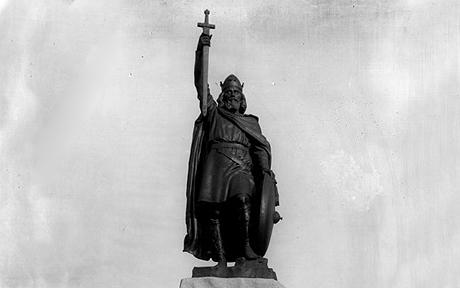
King Alfred of Wessex, the first person to call the language 'English'
King Alfred of Wessex, the first person to call the language ‘English’


From the Anglo-Saxon invasion of the fifth century to modern-day waves of immigration, the English language has been shaped by countless episodes in history.

Now The English Project, a charity dedicated to promoting the language, is compiling a list of the 100 most important events and locations which have made English what it is today

The journey starts in Lakenheath in Suffolk, where the Undley Bracteate medallion was found, dated to 475 and bearing the first evidence of written English.

Then in 731 the Venerable Bede completed his Historia Ecclesiastica Gentis Anglorum in Jarrow, Tyne and Wear – the first text to speak of the English language and the English people.

And by 871 King Alfred of Wessex, the first person to call the language “English”, was ordering translations from Latin into West Saxon, a dialect of Old English.

In recent times the language has adapted again and again, on its way to becoming the common tongue of 1.8 billion people worldwide.

The charity has already compiled a list of 20 of the most important events in the history of the language, and wants the public to help produce the final list of 100 crucial events
Bill Lucas, a trustee of the English Project and professor of learning at the University of Winchester, said: “This is a wonderful way of engaging people in a wider conversation about the English Language.

“We want to get the nation really thinking about the stories behind our evolving language.

“How, for example, do you rate the relative significance of Shakespeare’s Stratford-upon-Avon, versus London’s part in the birth of the world wide web?

“English has now become the lingua franca of the world. It is the most exciting and exotic language partly because of its capacity to incorporate so many elements of other languages, and somehow to make these dynamic, descriptive and always exciting.

“The history of Britain and the history of the English language are also very closely intertwined.

“We’re excited about hearing people’s ideas about the places and events they think have shaped the language.”

Submit your suggestions on the charity’s website, www.englishproject.org

The 20 events and places nominated so far:

Date: 475

Lakenheath, Suffolk

The Undley Bracteate medallion, found at Lakenheath, has been dated to 475 and provides the first evidence of written English

Date: 731

Jarrow, Tyne and Wear

The Venerable Bede completed his Historia Ecclesiastica Gentis Anglorum. Although writing in Latin, he was the first person to speak of the English language and the English people.

Date: 871

Winchester, Hampshire

Translations from Latin into the West Saxon dialect of Old English were commissioned by King Alfred of Wessex between 871 and 899. He is the first person known to have called the language “English”.

Date: 1066

Hastings, Sussex

William the Conqueror and his Norman army defeated King Harold at the Battle of Hastings, bringing with them a language that transformed English over the next 300 years.

Date: 1171

Waterford, Ireland

King Henry II of England landed in Waterford, beginning the worldwide exportation of English beyond the island of Great Britain – even though he himself mainly spoke French.

Date: 1362

Westminster, London

On October 13 the Chancellor of England opened Parliament with a speech in English rather than French for the first time.

Date: 1400

Westminster Abbey, London

Geoffrey Chaucer was buried in the Abbey. In 1556 he was moved into a more splendid tomb, beginning the tradition of burying great writers in Poets’ Corner.

Date: 1476

Westminster, London

William Caxton introduced printing to England, which became a huge force in the spread of English language literature.

Date: 1564

Stratford-upon-Avon, Warwickshire

William Shakespeare, regarded by many as the greatest writer in the English language, is born.

Date: 1604

Hampton Court, Surrey

King James’s Hampton Court Conference set a translation team working on what came to be known as the King James Bible, published in 1611.

Date: 1665

Oxford

The first newspaper in English was the London Gazette, first published in Oxford in 1665 as the Oxford Gazette.

Date: 1709

Lichfield, Staffordshire

The birthplace of Samuel Johnson, creator of A Dictionary of the English Language. Published in 1755, it set new standards for the writing of English prose.

Date: 1847

South Charlotte Street, Edinburgh

The birthplace of Alexander Graham Bell who invented the telephone in 1876, initiating a major stage in worldwide communication.

Date: 1901

Poldhu, Cornwall

In 1901, Guglielmo Marconi sent the first radio transmission to St John’s, Newfoundland. North American and British English began to converge again after 300 years of separation.

Date: 1922

Portland Place, London

The British Broadcasting Company (BBC) begins transmission, influencing dramatically the way English language is used and spoken.

Date: 1945

Menlove Avenue, Liverpool

John Lennon lived here from the age of five. With his fellow Beatles, he revolutionised popular song.

Date: 1955

London

Tim Berners-Lee, who invented the World Wide Web, is born. English is the dominant language of the internet, and the net is a major factor in the globalisation of English.

Date: 1988

Plumstead, London

Patrick Chukwuem Okogwu, also known as rap artist Tinie Tempah, is born. Rap music shows the English language at its flexible best.

Date: 1997

Nicolson Street, Edinburgh

JK Rowling wrote much of Harry Potter and the Philosopher’s Stone in Nicolson’s Café. Published in June 1997, the series of books started a worldwide reading phenomenon.

Date: 2003

UK

On Valentine’s Day, mobile phone usage was so widespread that for the first time, more people said “I luv u” by text than said “I love you” by post. Text English is a new and thriving form of the language.

British Tour Guide
HisTOURies UK – The Besy Tours in British History

Read Full Post »

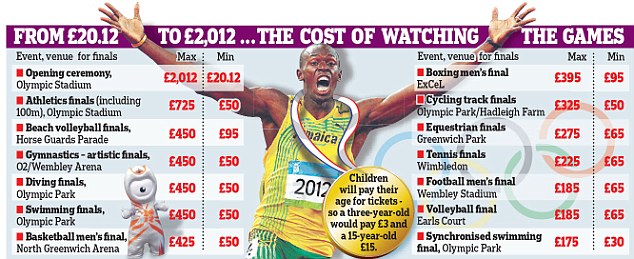
Tickets to watch the 2012 Olympic Games will be among the most expensive in British sporting history, it’s been revealed.

Sports fans will pay as much as £2,012 for the best seats at the opening ceremony, while the same seats at the closing ceremony will cost £1,500.

The most expensive sport will be the athletics, to be held at the new 80,000-seat Olympic Stadium.

A coveted ticket to the men’s 100m final will cost as much as £725 – the equivalent of £76 a second based on Usain Bolt’s world record.

Beach volleyball, gymnastics, diving and swimming will also be among the most expensive finals to watch, at £450 for the best seats, with the basketball finals close behind at £425.
The prices – which exclude corporate tickets – easily exceed those charged for the finals of the FA Cup, Wimbledon tennis and Premier League football matches.

LONDON 2012 TICKETS – THE FACTS

WHAT CAN I WATCH?
There are 26 Olympic sports but 39 disciplines in total. There will be 302 medal events and 649 sessions of sport to watch.

HOW MANY TICKETS WILL BE SOLD?
A higher-than-expected 8.8million.

HOW MUCH WILL THEY COST?
The price will vary according to the event. Each event will have different ticket prices, ranging from £20 to £725.

Organisers say 90 per cent will cost £100 or less, two-thirds will be £50 or less and 30 per cent £20 or less.

There will also be 11 free ticket sessions for sports such as triathlon, the marathon, race walking, road cycling and sailing.

ARE THERE SPECIAL OFFERS?
Yes, for around 220 sessions and 1.3 million tickets.
Children 16 and under on July 27 2012 will pay their age.

Those 60 and older on the same date will play a flat £16.

This offer will not include tickets for any final but will cover every sport.

Wheelchair prices include a companion seat.

Children will also be able to go along thanks to a ticket share scheme. 50,000 tickets have gone to the London Mayor, 50,000 to the Government and 25,000 to sporting bodies.

The Mayor’s tickets will go to children in London, the Government’s to secondary schools around the UK.

WHEN DO TICKETS GO ON SALE?
March 2011.

WHERE DO I FIND OUT MORE?
Register online at http://www.tickets.london2012.com

However, games organiser Locog insisted taxpayers had not been priced out of the event they had funded and said 90 per cent of tickets would cost £100 or less.

A third of tickets will cost £20 or under, with Olympic chiefs unable to keep their promise that they would sell half of tickets at this price.

Some 1.3million tickets will be reserved at special prices for children and people over 60.

Under the ‘pay your age’ scheme, 10-year-olds will pay £10, 11-year-olds £11 and so on.

Those over 60 will pay a flat £16.

Event bosses face pressure to make £400million from ticket sales, while ensuring that the 26 sports remain affordable and that the stadiums are full – avoiding a repeat of the near-empty stadiums at some of the Commonwealth Games events in India this month.

London 2012 chairman Sebastian Coe described it as ‘the daddy of all ticket strategies’, adding: ‘We have three clear principles for our ticketing strategy: tickets need to be affordable and accessible to as many people as possible, tickets are an important revenue stream for us to fund the Games, and our ticketing plans have the clear aim of filling our venues to the rafters.’

Events such as the marathon, cycling road race and time trial and triathlon will be free because they are on public roads, although grandstands at the finish area will be ticketed.

The cheapest events include the shooting finals with a top price of £40, sailing at £55 and the modern pentathlon at £75.

There are 8.8million tickets available, with 6.6million of these available to the public from March 2011.

The rest will go to broadcasters, sponsors and the 204 overseas Olympic committees.

Some 1.7million people have registered on the london2012.com website, which will guide them in applying for tickets for the 26 sports, split into 649 sessions.

The Government wants each school in Britain to receive six free tickets, but London Mayor Boris Johnson is trying to find sponsorship for a further 75,000 to be given to London pupils so one in eight can attend the Games.

Lord Coe said: ‘We made a promise to inspire young people to choose sport and our ticket prices will get as many young people as possible to the Games.’

Olympics Minister Hugh Robertson added: ‘I am confident we will have packed stadiums and venues.’

Make your tour plans well in advance.  Escape the city for a day and join a private guided sightseeing tour.  Contact us in advance for any travel arrangements you may need. 

Tourist Guide
HisTOURies UK – The Best Tours of Britain

Read Full Post »

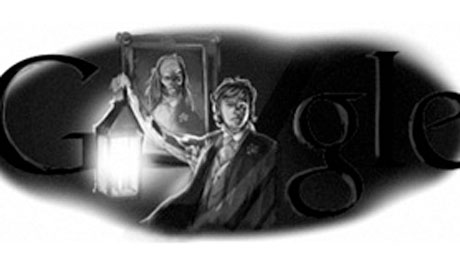
Oscar Wilde: Google doodle features The Picture of Dorian Gray

Oscar Wilde, writer, poet, playwright, wit and gay icon. His 156th birthday is celebrated with a Google doodle

“Illusion is the first of all pleasures”, Oscar Wilde once said.

So it is fitting then that the Google doodle has changed again, this time to celebrate what would have been the 156th birthday of one of the greatest writers, poets and playwrights who ever lived.

The design pays tribute to the Irishman by featuring a portrait from The Picture of Dorian Gray – the first and only novel published by Wilde.

The work was published in Lippincott’s Monthly Magazine in 1890. It was revised and published as a novel a year later.

“An artist should create beautiful things, but should put nothing of his own life into them,” Wilde wrote in the first chapter.

In a review of the 2009 film, starring Colin Firth and Ben Barnes, Darragh McManus said in the Guardian, “For me, Dorian Gray is special – not necessarily Wilde’s best work but unique in his canon – because it’s so sincere: ineffably, inescapably, absolutely. It’s a very good novel anyway: moving, exciting, full of dread, angst, horror, lucidity … and a great love, I think, for mankind and for the artist’s own self.”

Besides films, there have been plays, readings, exhibitions, walks and other events to mark Dorian Gray.

But Oscar Fingal O’Flahertie Wills Wilde, who came into the world in 1854 (“genius is born – not paid”, he once said), was most well known for his stage masterpiece, The Importance of Being Earnest. It opened in 1895 in London.

His other short stories and poems include The Happy Prince and Other Tales. For the stage he wrote Lady Windermere’s Fan, A Woman of No Importance and An Ideal Husband.

In addition to his literary fame, Wilde remains a gay icon.

Although he married and had two sons, in 1891 the writer started an affair with Lord Alfred Douglas, dubbed ‘Bosie’.

In 1895, Wilde sued Bosie’s father for libel as the Marquis of Queensberry had accused him of homosexuality.

He was arrested and tried for gross indecency, sentenced to two years hard labour for sodomy.

During his time in prison he penned De Profundis, a monologue and autobiography addressed to Bosie.

He also took up the issue of inhuman prison conditions in The Ballad of Reading Gaol, which he wrote on his release in 1897.

Wilde died broke in a hotel in Paris, aged 45, on November 30 1900.

One of many misconceptions about Wilde is that he died of syphilis, but recent research claims a rare ear infection took his life.

Writing about his “hero” in the Guardian last year, writer Michael Holroyd said, “What I came to value was the charming way he arrived at deeply unpopular opinions … He was an extraordinarily brave writer. ”

Wilde’s work touched many people. Even the Vatican’s official newspaper last year praised a book written about the playwright.

In 2000 Wilde fans marked the 100th anniversary of his death with a service in Westminster Abbey.

My personl favourite:

“It only tkes me one drin to get drunk, I just cant remember if its the 14th or 14th”

British Tour Guide
HisTOURies UK – The Best Tours in History

Read Full Post »

Let’s be clear, we’re not trying to pull the wool over anyone’s eyes…our often inclement weather is no secret.

Still, it’s reassuring to know that foreign visitors who set foot on our green and pleasant lands don’t love Britain any less because of the rubbish weather.

Routemaster bus crossing Westminster Bridge in central London, during heavy fog‘Could you tell me the way to Big Ben? Behind the blanket of fog you say? Thanks…’ 1000 tourists questioned said they wouldn’t be dissuaded from visiting Britain because of the weather.
New research from VisitBritain has found that tourists – from more than 30 countries worldwide – wouldn’t be put off visiting our shores by the prospect of grey skies.

1,000 potential travellers were asked how much they agreed with the line: ‘I would not want to visit Britain because of the weather there’.

On a scale from 1 to 7, where the latter was ‘strongly agree’, the average score came out at 2.76 – a clear vote of confidence that poor weather rarely dissuades tourists from actually visiting.

It seems foreign travellers are under no illusions that they’ll be met with sunshine though, with around half of those questioned agreeing that ‘wet and foggy’ was an accurate general description of British weather.

 VisitBritain chief executive Sandie Dawe said: ‘This survey shows that Britain’s weather is not as bad as folklore would have us believe.

‘Visitors do not come with a belief that should a few drops of rain fall then their trip will be ruined.’

A brush with an umbrella doesn’t detract from the appeal of the country’s museums, castles and ancient attractions, continues Dawes.

‘Our research also tells us that visitors from overseas come here to experience our world-class heritage and culture, be this Tate Liverpool, Edinburgh Castle, the British Museum or Stonehenge.’

 It never rains on my tours – and thats a promise!  I have 1000’s of satisfied customers who have toured with me who will vouch for me.

Stonehenge Tour Guide
HisTOURies UK – The best ‘sunny’ tours in Britain

Read Full Post »

Not since 1996, when England hosted the European Championships, has the country held a major sporting event. In 2012 that is set to change as London becomes the venue for the Olympic Games.

Having hosted the Summer Olympics twice previously – in 1908 and 1948 – the English capital certainly has history with the event, but even still there are surprises abound with improvements needed to stadiums, transport and accommodation.

With around seven million permanent residents, it’s hard to imagine how the city’s infrastructure will cope with the extra influx of athletes and sports fans that will be descending on the city from the end of July – traditionally a busy tourist season in any year.

The International Olympic Committee has been thinking about this since 2005 – when the games were awarded to London – so big changes are expected in the city. The world famous underground has seen changes, with an expansion made to the East London Line and upgrades have been made to the North London Line and the Docklands Light Railway as well.

On top of this a brand new rail service has been created – named in Olympic fashion as the Javelin – which features bullet trains that will speedily take passengers across the city.

There are expected to be around eight million tickets for the Olympics available, with half of them priced under £20 to ensure bustling crowds at all events. This means all visitors – from those in top range hotels to those in budget hotels in London – will be able to snap up tickets for at least part of the extravaganza.

Sensibly, accommodation for the Olympians will be spread across the city to ensure all competitors are housed close to where they need to be to compete, rather than in an all encompassing Olympic Village as per tradition, but a tradition that has become outdated as the games have grown and the events no longer all take place in one place.

The events will be taking place in a mixture of old venues that the city is known for – such as Wembley, Lord’s and the O2 Arena – as well as specially constructed arenas. As well as new sporting venues, the city will see other new buildings going up. The Shard, for example, is due to be finished in May 2012 and standing at 1017 feet it is sure to be a major sight on the London skyline.

Paul Buchanan writes for a digital marketing agency. This article has been commissioned by a client of said agency. This article is not designed to promote, but should be considered professional content.

Hotels in London Must Shape Up for 2012 Olympics

Not since 1996, when England hosted the European Championships, has the country held a major sporting event. In 2012 that is set to change as London becomes the venue for the Olympic Games.

Having hosted the Summer Olympics twice previously – in 1908 and 1948 – the English capital certainly has history with the event, but even still there are surprises abound with improvements needed to stadiums, transport and accommodation.

With around seven million permanent residents, it’s hard to imagine how the city’s infrastructure will cope with the extra influx of athletes and sports fans that will be descending on the city from the end of July – traditionally a busy tourist season in any year.

The International Olympic Committee has been thinking about this since 2005 – when the games were awarded to London – so big changes are expected in the city. The world famous underground has seen changes, with an expansion made to the East London Line and upgrades have been made to the North London Line and the Docklands Light Railway as well.

On top of this a brand new rail service has been created – named in Olympic fashion as the Javelin – which features bullet trains that will speedily take passengers across the city.

There are expected to be around eight million tickets for the Olympics available, with half of them priced under £20 to ensure bustling crowds at all events. This means all visitors – from those in top range hotels to those in budget hotels in London – will be able to snap up tickets for at least part of the extravaganza.

Sensibly, accommodation for the Olympians will be spread across the city to ensure all competitors are housed close to where they need to be to compete, rather than in an all encompassing Olympic Village as per tradition, but a tradition that has become outdated as the games have grown and the events no longer all take place in one place.

The events will be taking place in a mixture of old venues that the city is known for – such as Wembley, Lord’s and the O2 Arena – as well as specially constructed arenas. As well as new sporting venues, the city will see other new buildings going up. The Shard, for example, is due to be finished in May 2012 and standing at 1017 feet it is sure to be a major sight on the London skyline.

London is the most expensive place to stay in Europe, according to a recent survey, and that news has emerged at the same time as tourism minister Margaret Hodge has warned that hotels in the capital must shape up in order to be ready for the 2012 Olympics.

 The average cost of staying in a London hotel has leapt by a staggering 12% since April, and now averages £119 per night across the capital. Although not as expensive as New York or the world’s most expensive place for a one-night stay, Moscow, the rates are remarkably high considering that two-thirds of all London hotels are unrated. The figures show that even relatively meagre two-star accommodation in London averages £88 per night and guests have to typically stump up £109 to stay in three-star rated hotels.

 Tourism minister Hodge is worried that the combination of highly priced accommodation and the large percentage of non-rated hotels will damage the reputation of the city, and is keen for the hotel industry to get itself in order. She said: “If the tourist industry is to reap the potential £2.1 billion from the 2012 Olympic Games, then 85% of London’s hotels must be accredited before then.”

 Hodge is concerned that many people attending the 2012 Olympics will be coming to London for the first time and therefore wants their experience of the city to be a positive one. She added:

 “Hosting the 2012 Olympics is a huge opportunity for London and the UK tourism industry. In five years London will welcome millions of first-time visitors and we will want them to come back time and again – hopefully bringing their family and friends. It’s all about creating a lasting and positive legacy for the capital.”

But, the government doesn’t expect the capital’s hotels to do it all by themselves. A recently unveiled multi-agency strategy entitled: “Winning – A Tourism Strategy for 2012 and Beyond” has been drawn up by the Department for Culture, Media and Sport aided by Visit Britain, Visit London, and an assortment of Regional Development Agencies, aiming to give positive advice and limited financial assistance to the hotel industry throughout London and the UK.

Now that the gauntlet has been thrown down for hotels in London to make significant improvements, it is important that they respond positively if they are to fulfil the government’s aim of making the 2012 Olympic Games the start of a lasting legacy
If you are planning a trip to the UK in 2012 you may save some time and money visiting these web sites:
http://www.Welcome2London.org.uk
http://www.BestValueTours.co.uk
http://www.HisTOURies.co.uk
http://www.LondonTown.com

British Tourist Guide
HisTOURies UK – The Best Tours in British History

Read Full Post »

Today is Wednesday, September 16th, the 265th day of 2010. There are 100 days left in the year.

Highlights in history on this date:

1499 – Turks ravage Vicenza in Italy.

1550 – Holy Roman Empire fleet captures vessel Port of Africa at Mehedia in Tunis, naval headquarters of Turkish corsair Dragut.

1609 – The king of Spain orders the deportation of the baptized former Muslims known as Moriscos.

1711 – Rio de Janeiro is captured by the French.

1792 – French Republic is proclaimed and revolutionary calendar goes into effect.

1862 – U.S. President Abraham Lincoln issues the Emancipation Proclamation, declaring all slaves in the Confederate States free as of Jan. 1, 1863.

1914 – A German submarine sinks three British cruisers in one hour off the Dutch coast; the German cruiser Emden shells Madras in India.

1927 – Slavery is abolished in Sierra Leone in Africa.

1940 – The Vichy French governor-general concludes an agreement that makes Indochina the largest Japanese military staging ground in southeast Asia.

1949 – The Soviet Union explodes its first atomic bomb.

1955 – Hurricane Janet, the most violent Caribbean hurricane of the season, causes almost 600 deaths around the islands.

1960 – A U.S. Marine Corps DC-6 plane en route from Japan to the Philippines crashes in the ocean 290 kilometers (180 miles) south of Okinawa. All 29 passengers are killed.

1965 – A cease-fire is declared in the war between India and Pakistan, but both sides subsequently violate it.

1970 – Arab chiefs of state send envoys to meet with King Hussein and Yasser Arafat to persuade them to find a way to contain the fighting between the Jordanian Army and Palestinian guerrillas.

1974 – Official death toll in hurricane that swept Honduras is put at 5,000.

1975 – Sara Jane Moore fails in an attempt to shoot U.S. President Gerald Ford outside a San Francisco hotel.

1980 – Iraqi tanks enter Iran, marking the beginning of the Iran-Iraq War as a full-scale conflict.

1986 – Two hijackers seize Soviet airliner at Ural Mountains airport and kill two passengers before security agents recapture plane and shoot the hijackers.

1988 – The government of Canada apologizes for the World War II internment of Japanese-Canadians and promises compensation.

1989 – F. W. De Klerk takes over as president of South Africa.

1990 – Jordan’s King Hussein appeals to United States in televised message to withdraw its troops from Saudi Arabia to avert “death, destruction and misery.”

1992 – Azerbaijani-armed forces mount an offensive against the disputed enclave Nagorno-Karabakh.

1993 – Abkhazian rebels in Georgia shoot down second passenger plane in two days, killing 80.

1994 – NATO aircraft strike at Serbian targets near Sarajevo after U.N. troops patrolling the city came under machine-gun and rocket fire.

1995 – America’s Time Warner Inc. and Turner Broadcasting System Inc. announce a merger with Time Warner purchasing TBS in a deal valued at $7.5 billion, creating the world’s largest media company.

1996 – Typhoon Violet veers into the North Pacific after killing seven and setting off landslides that paralyzed transportation in Japan.

1997 – U.S. President Bill Clinton, speaking at the United Nations, announces he will submit to the Senate a treaty banning all nuclear explosions.

1998 – Troops from South Africa and Botswana cross into Lesotho and storm the royal palace, touching off a gunbattle with protesters.

1999 – Dutch journalist Sander Thoenes is killed and two others assaulted in separate attacks in East Timor blamed on anti-independence militiamen.

2001 – Pope John Paul II visits Kazakhstan and Armenia and cautions against allowing Sept. 11 terrorist attacks on the United States to create divisions between Muslims and Christians.

2004 – The U.S. military drops an espionage charge against a Muslim interpreter accused of spying at the camp for terror detainees at the U.S. military base in Guantanamo Bay, Cuba. It is the third Guantanamo spy case of the year to fall apart.

2005 – Bosnia’s top international official orders the Bosnian Serb Finance Minister to identify the origins of illegal payments made to the Serb Democratic Party after the party’s bank accounts were frozen because of fraud.

2006 – Pope Benedict XVI invites Muslim envoys to meet with him at his summer residence for what the Holy See says is urgently needed dialogue following a crisis ignited by his remarks on Islam and violence.

2007 – Monks leading swelling demonstrations against Myanmar’s military regime march past barricades to the home of Nobel Peace laureate Aung San Suu Kyi, increasing pressure on the junta.

2008 _ The first excavation of Stonehenge in more than 40 years has uncovered evidence that the stone circle drew ailing pilgrims from around Europe for what they believed to be its healing properties, archaeologists say.

2009 – Al-Qaida releases a new 106-minute long video predicting President Barack Obama’s downfall at the hands of the Muslim world to mark the 8th anniversary of the Sept. 11, 2001 attacks against the U.S.

Today’s Birthdays:

Michael Faraday, British physicist (1791-1862); Caroline Astor, U.S. aristocrat of New York high society (1830-1908); Erich von Stroheim, German director and actor (1885-1957); Louis Botha, South African soldier-statesman (1862-1919); John Houseman, U.S. stage/radio actor (1902-1988); Fay Weldon, British writer (1931–); Joan Jett, U.S. rock singer (1960–).

Most importantly
100 Shopping days to Christmas!

British Tour Guide
HisTOURies UK Tours – The Best Tours in History

Read Full Post »

Pope Benedict will soon be arriving in the UK.  I am surprised at the lack of tacky Papal souvenirs for sale on the streets of Britain. Past Papal visits in other countries have produced such wonders as this Pope Soap on Rope

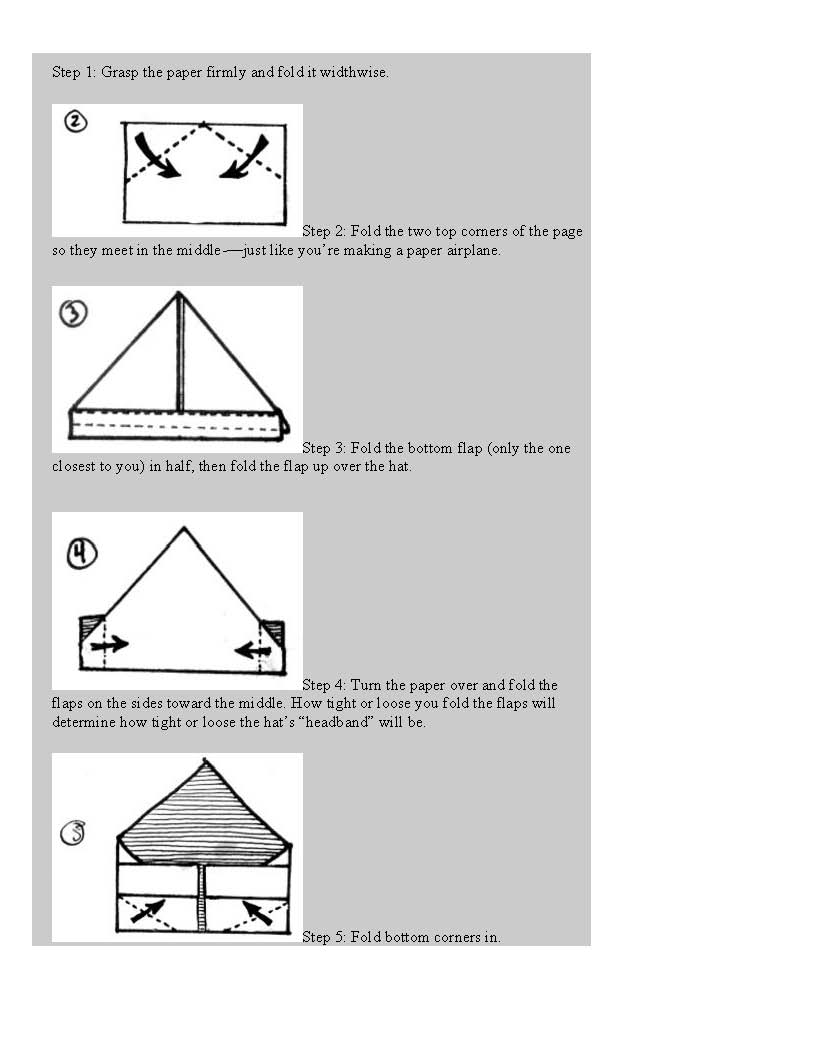
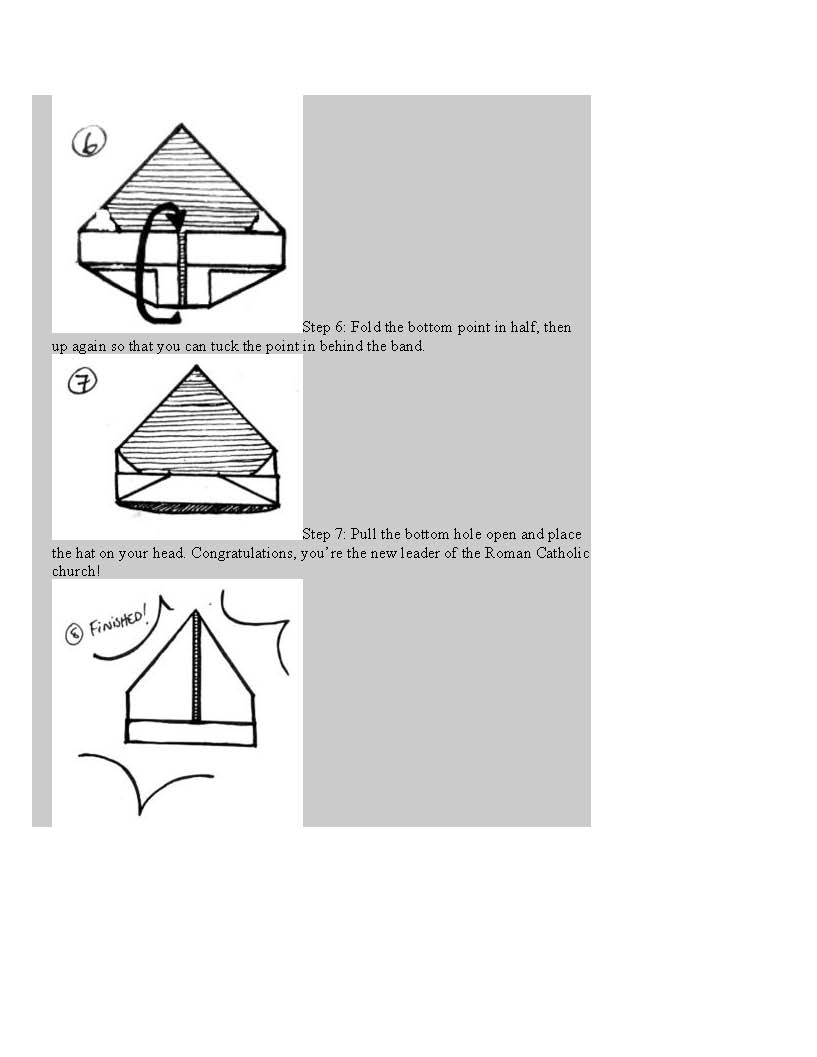
So in the spirit of his arrival, I offer you simple instructions on how to make your very own Pope Hat. Any newspaper will do, but I prefer to use the News of the World. There’s a link at the top of my blog page that will take you to a pdf version of this. Print it out and freak your friends out at the office, on the street, on the underground. Just a little fun arts and crafts for those with slightly twisted minds.

No offence intended!  I did promise some funny blogs……….

British Tour Guide
HisTOURies UK – The Best Tours in Catholic History

Read Full Post »

When Pope John Paul II arrived in 1982, he famously kissed the ground and declared: “Today, for the first time in history, a Bishop of Rome sets foot on English soil. This fair land, once a distant outpost of the pagan world, has become, through the preaching of the Gospel, a beloved and gifted portion of Christ’s vineyard.”

He went on to preach in Canterbury Cathedral and during the visit became friends with the Archbishop of Canterbury, Robert Runcie. It seemed to set the seal on an end to centuries of anti-Catholicism in Britain, and open the door to a new era in ecumenical endeavour where anything, even reunion, seemed possible.

But that was in a different century, and that Pope and that Archbishop are dead.

This Pope will walk into a storm of protest. Secularists are already planning a series of marches against him wherever he goes. The National Secular Society will launch its Protest the Pope Coalition later this week.

Peter Tatchell, the gay rights campaigner, is among those planning online petitions against the visit.

There will be no visit to Canterbury Cathedral this time, after the Pope announced plans for the Anglican Ordinariate to welcome into the church of Rome disaffected members of the Church of England and other present and former Anglicans.

Even the Queen sent an emissary, Earl Peel, her Lord Chamberlain, to talk to the Archbishop of Westminster, Vincent Nichols, and find out what was intended by the new conversion plans.

The Pope is certain to use his civic address at Westminster Hall, a place revered by Catholics as the place where martyrs for the faith such as St Thomas More and the Jesuit St Edmund Campion were tried and condemned, to issue challenges to the Government on social and moral issues.

The Pope, 83, has a commendable lack of regard for protocol. Maybe he feels time is running out and he cannot hang around on niceties.

The Archbishop of Canterbury, Dr Rowan Williams, had merely a few days notice of the Anglican Ordinariate and was visibly discomfited.

But even the Pope’s own Archbishop of Westminster, highly rated in Rome, had almost no notice of the “conversion” plan. Archbishop Nichols was also taken by surprise by the Pope’s confirmation of his visit to Britain in September.

The Queen issued the formal invitation to the Pope only last month after months of negotiations between government departments and the Holy See as to what status the visit should have.

Although the itinerary is still in draft form, the Pope’s visit is scheduled to begin in Scotland.

Pope Benedict XVI will fly straight from Rome to Edinburgh on September 16, where, as a head of state, he will be received by the Queen at Holyrood Palace in the afternoon. He is due to see the monarch there rather than Buckingham Palace because the visit coincides with her annual holiday to Balmoral.

He will also visit Glasgow, before making his way south in what is only the second papal visit to Britain since the Reformation and the first state visit.

The high point will be the beatification of Cardinal Newman, the 19th-century Anglican convert to Catholicism, in Birmingham on September 19.

The Pope has since his youth as a seminarian been an avid student of the writings of Cardinal Newman and in his address to the bishops yesterday he described him as an “outstanding example of faithfulness to revealed truth”.

As well as his address in Westminster Hall there is likely to be an academic address at Oxford University.

Having spoken at the Catholic Chaplaincy at Fisher Hall at Cambridge University in 1988, Pope Benedict XVI has for years nurtured a dream of speaking at Oxford. He raised the possibility of such an occasion with the last Archbishop of Westminster, Cardinal Cormac Murphy-O’Connor, in Rome shortly after becoming Pope. Lord Patten of Barnes, Chancellor of Oxford and a leading lay Catholic, has formally invited the Pope to speak there.

The only departure from normal protocol around formal visits by heads of state will be that the Pope, 83, will stay with the Papal Nuncio in Wimbledon rather than in Buckingham Palace.

Perhaps, all things considered, that is for the best.

British Tour Guide
HisTOURies UK – The Best Tours in History

Read Full Post »

They were crammed together and buried side by side, stripped of all clothing and personal possessions.

Force of circumstance determined this most impersonal and undignified resting place.

For the men buried in mass graves at a ruined York church were the soldiers of Oliver Cromwell’s Parliamentary army.

Roundhead soldiersSkeleton army: The remains found in York, one of 10 mass graves containing Roundhead soldiers

The Roundheads were not killed in combat but probably by infectious disease during the gruelling English Civil War siege of the city.

Oliver CromwellLeader: Oliver Cromwell led the Roundhead cavalry

Their comrades went on to defeat King Charles I’s Cavaliers at the Battle of Marston Moor in 1644 and turn the tide of the war.

But history forgot the more than 100 souls who probably never made it to the battleground.

Now, more than 350 years later, archaeologists have unearthed the graves and their skeletons to reveal the story of Cromwell’s forgotten soldiers.

Routine excavations in 2007 at the site of a medieval church, south of York’s historic city walls, led to the uncovering of ten mass graves.

Archaeologists knew from previous discoveries that the ‘lost’ 11th century church of All Saints in Fishergate had once been there. However, these newlydiscovered graves took archaeologists forward 600 years to a time when the country was split in two by a bloody civil war.

The position of the graves showed they were dug at a time when only the shell of the abandoned church remained. They varied in size, with the smallest containing four skeletons and the largest 18.

RoundheadsDelicate work: An archaeologist examines one of the 350-year-old bodies


RoundheadsNo ceremony: The bodies were evidently buried with some haste

The skeletons were arranged neatly in parallel rows, mostly laid on their side or face down in the dirt, and were packed together like sardines in a can. Larger graves had a second row where the heads of one row overlapped the feet of another.

PSALMS BEFORE BATTLE

Roundheads

Cromwell’s Parliamentary army in 1644 was a loose collection of regional fighting groups, unified the following year as the New Model Army.

The intention was to enforce strict discipline in return for regular pay of eight pence per day for the infantry and two shillings for the cavalry.

It was the first British army to wear the famous red coat uniform. The infantry had muskets or pikes, the troopers carried a sword and two pistols.

Derided by Royalists as the ‘new noddle’ army, it became an effective force under the command of Sir Thomas Fairfax, with Cromwell initially in charge of the cavalry

Officers were appointed on merit rather than status. One colonel was a shoemaker.

Cromwell preferred soldiers who were devoted Puritans like himself and sang psalms before battle. Their close-cropped hair led to the term Roundheads.

No buckles, buttons or jewellery were found, indicating they were probably buried naked. In total there were 113 skeletons.

It was not possible to establish the sex of them all, but 87 were male, most between the ages of 35 and 49.

Details of the find are revealed in Current Archaeology magazine in a report by experts Lauren McIntyre and Graham Bruce.

Analysis of the skeletal remains indicated they were not wounded and did not die in battle. But most had conditions, such as spinal joint disease, caused by excessive physical labour.

‘The skeletons are likely to represent a military group who all died within a short period,’ said the authors.

‘Given the probable 17th century date, it is likely that they relate to the Civil War.’

York was a Royalist stronghold and was besieged by a Parliamentary force of 30,000 between April and July 1644.

The siege ended soon after both armies clashed in fields outside York at Marston Moor  –  the largest single battle of the Civil War.

Evidence suggests that the 113 bodies could well have been Cromwell’s soldiers who died from disease while laying siege to the city.

Although the Royalist army was well-provided for behind the city walls, the besieging Parliamentary forces suffered severe deprivation, making them susceptible to illness and diseases such as dysentery and typhoid.

The skeletons are being kept for further study at the University of Sheffield’s archaeology department.

British Tour Guide.  Bespoke Guided Sightseeing Tours
HisTOURies – The Best Tours in History

Read Full Post »

« Newer Posts - Older Posts »