|
HisTOURies UK – Bringing History Alive |
Archive for the ‘England facts’ Category
Living History Events in the UK – 2010
Posted in archaeology, british history, England facts, History, sightseeing tours, UK Tourism updates, wessex, Wiltshire on August 16, 2010| Leave a Comment »


Brits Given Tips On How To Treat Foreigners – Olympics 2012
Posted in England facts, Funny, London Olympics 2010, sightseeing tours, UK Tourism updates on August 13, 2010| Leave a Comment »

The Worlds gone mad…………………..
The ‘quango’ VisitBritain has issued a guide book aimed at the British on how to treat overseas visitors during the Olympics. Unbelievable ???
Please take the time to read some of the advice below, this is not one of my hoax blogs – its completely true! The ironic thing is that VisitBritain is staffed with ‘non Brits’………………
If you happen to meet a Mexican during the 2012 Olympics, don’t mention the war – that is just one of the pieces of advice being given to Brits on how to treat foreign visitors during the Games.
The war in question is the 1845-6 war with the United States. Instead you should try talking about Mexican art or museums.
They have been written by the agency’s staff, who are natives of the countries featured.
Britain is ranked 14th out of 50 when it comes to the welcome it gives to foreign visitors, but some wish they had received a more exuberant welcome from their hosts.
The comprehensive catalogue of cultural norms and traditions should ensure that you do not unwittingly offend any guests – or feel slighted because of a lack of understanding.
For example, the advice says that you should never call a Canadian an American.
Similarly, steer clear of physical contact when meeting someone from India for the first time.
Pouring wine for an Argentinean may seem to be an innocuous enough task, but it is in fact a cultural minefield – pouring it backwards represents hostility.
When Japanese people smile they may not be happy, in fact they could be the complete opposite.
Talking to them with your hands in your pockets will cause offence.
Remember Arabs are not used to being told what to do.
VisitBritain advice
Sandie Dawe MBE, CEO of VisitBritain, said making visitors to Britain feel welcome was “absolutely vital” for the UK economy.
She said: ”Overseas visitors spend more than £16bn a year in Britain, contributing massively to our economy and supporting jobs across the country.”
She added: “With hundreds of thousands of people thinking of coming to Britain in the run up to the Olympic and Paralympic Games in 2012, this new advice is just one of the ways that VisitBritain is helping the tourism industry care for their customers – wherever they come from.”
Other pieces of advice include:
:: Winking is considered a rude gesture in Hong Kong.
:: The Chinese are very suspicious – talking about poverty, failure or death could cause offence.
:: Visitors from the United Arab Emirates don’t take kindly to being bossed around.
:: When accepting thanks, Koreans will typically say “No, no.” The remark should be interpreted as “You are welcome”.
:: The term “Poms”, which is used by Australians and New Zealanders, is a term of endearment, rather than a insult.
:: Snapping your fingers in the presence of a Belgian is regarded as impolite.
:: Do not imply that Polish people drink too much.
For those visiting London and the UK during the Olympics 2012 remember to book well in advance, we already have private tours booked for the summer of 2012.
Personalised tours of London and Britain
HisTOURies UK – The Best Tours during the London Olympics
Home Sweet Stone-age Home: Britain’s first house at 10,500 years old is uncovered by archaeologists
Posted in archaeology, british history, England facts, History, sightseeing tours, Stonehenge on August 12, 2010| Leave a Comment »
It is cramped, draughty and unlikely to win any design awards. But, according to archaeologists, this wooden hut is one of the most important buildings ever created in Britain.
The newly discovered circular structure – as shown in our artist’s impression – is the country’s oldest known home.
Built more than 6,000 years before Stonehenge, it provided shelter from the icy winds and storms that battered the nomadic hunters roaming Britain at the end of the last ice age.
 Ancient find: Manchester University student Ruth Whyte on the archaelogical dig in Flixton near Scarborough which has unearthed an 11,000 year old tree and remains
 Pictures from the dig where archaeologists believe that one of the first houses in Britain may have been buried
The remains of the 11ft-wide building, discovered near Scarborough, North Yorkshire, have been dated to at least 8,500BC. It stood next to an ancient lake and close to the remains of a wooden quayside.
Dr Chantal Conneller, from the University of Manchester, said it was between 500 and 1,000 years older than the previous record holder, a building found at Howick, Northumberland.
‘This changes our ideas of the lives of the first settlers to move back into Britain after the end of the last ice age,’ she said. ‘We used to think they moved around a lot and left little evidence.
‘Now we know they built large structures and were very attached to particular places in the landscape.’
None of the wood used to make the building has survived. Instead, archaeologists found the tell-tale signs of 18 timber posts, arranged in a circle. The centre of the structure had been hollowed out and filled with organic material.
 STONEAGE HOUSE
The researchers believe the floor was once carpeted with a layer of reeds, moss or grasses and that there may have been a fireplace.
Dr Conneller said the hut was used for at least 200 to 500 years – and may have been abandoned for long stretches.
‘We don’t know much about it and we don’t know what it was used for,’ she said. ‘It might have been a domestic structure, although you could only fit three or four people in it. It could have been a form of ritual structure because there is evidence of ritual activity on the site.’
Previous archaeological digs have unearthed head-dresses made from deer skulls close to the hut, along with remains of flints, the paddle of a boat, antler tools, fish hooks and beads.
 Archaeologists have been excavating at the Mesolithic site Star Carr since 2003
The researchers also found a large wooden platform alongside the ancient – and long vanished – lake at Star Carr. It was made from timbers which were split and hewn.
The platform, which may have been a quay, is the earliest evidence of carpentry in Europe. At the time, Britain was connected to the rest of Europe. The occupiers of the hut were nomads who migrated from an area now under the North Sea to hunt deer, wild boar, elk and wild cattle.
Dr Nicky Milner, from the University of York, said: ‘This is a sensational discovery and tells us so much about the people who lived at this time.
‘From this excavation, we gain a vivid picture of how these people lived. For example, it looks like the house may have been rebuilt at various stages.
 The ancient Star Carr site is located not far from the Yorkshire town of Scarborough
‘It is also likely there was more than one house and lots of people lived here. And the artefacts of antler, particularly the antler headdresses, are intriguing, as they suggest ritual activities.’
Although Britain had been visited by hunter-gatherers for hundreds of thousands of years, it was only at the end of the last ice age, when the glaciers finally retreated from Scotland, that the country became permanently occupied.
Thousands of miles away, in the ‘Fertile Crescent’ of Mesopotamia, the earliest farmers were learning how to sow seeds and domesticate animals in a discovery that would transform the world – and herald the age of villages, writing and civilisation.
But in northern Europe, the hunter-gatherer way of life that had served prehistoric man for millennia remained unchallenged.
 A depiction of a stone-age house in Ireland. The original building at Star Carr would have looked very similar to this, with thatched roof and circular shape
Salisbury and Stonehenge Tour Guide
HisTOURies UK – The Best Tours in British History
Castle Combe Village – Spielberg’s ‘Warhorse’ being filmed in September 2010
Posted in England facts, History, sightseeing tours, UK Tourism updates, Wiltshire on August 9, 2010| Leave a Comment »
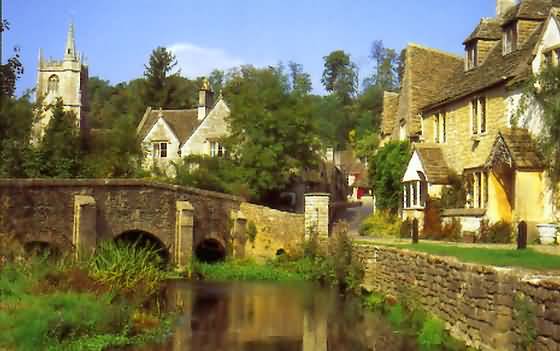
War Horse is a film that Steven Spielberg announced plans for production. War Horse is intended for release in 2011. It will be the film version of the play of the same name, which is a stage adaptation of the book War Horse, a children’s fiction novel by Michael Morpurgo first published in Great Britain in 1982.
OSCAR-winning actor Sir Anthony Hopkins is set to shoot scenes for his latest film in Castle Combe and Lacock this Autumn.
Hollywood film crews have approached both village parish councils after finding perfect locations for the remake of the 1941 horror flick The Wolfman.
The news comes just months after the penultimate Harry Potter movie was filmed in Lacock.
Chairman of the Lacock Tenants Association Leo Stevens attended a meeting with 50 residents last Tuesday.
He said: “The general reaction was positive and people seemed interested in getting involved with the project.
“As long as the filmmakers take our needs into consideration I think everything will go smoothly.
“I am involved with the project and am tracking down a blacksmiths for them to use in the movie.
“Filming in Lacock has just become an ordinary event these days and people don’t really batter an eyelid when a famous actor crosses the path in front of them.
“We are just waiting for more details from the production company and then we can move forward.”
The production company, part of Universal Pictures, is keen to use the Tithe Barn as the main location and possibly some shots of the High Street.
They want to fill the inside of the barn with blocks of ice, to resemble an ice house, used in the nineteenth century to store dead bodies.
The period film follows the life of Laurence Talbot, a successful actor, who returns to his hometown after his brother goes missing amid rumours of werewolves.
Film crews were also keen to shoot some scenes in Castle Combe, which is still reeling from its Hollywood debut in Stardust last year.
Jean Sheard, who owns the Lacock bakery on Church Street said: “I am really excited about seeing Sir Anthony Hopkins – he is such a huge star.
Lets hope we dont have a repeat of previous holywood films ?
Castle Combe never recovered from its engineered fame. In 1966 it was occupied for three months by a film company making Dr Dolittle with Rex Harrison, Samantha Eggar and Anthony Newley. Men with loud voices and earth-moving equipment built a harbour below Castle Combe’s bridge and made everyone take down their television aerials and link their sets to a communal cable attached to a hidden mast during the filming
Filming starts in September and we will continue to take small group tours to Castle Combe and Lacock – a great phot opportunity.
Cotswolds Tour Guide
HisTOURies UK – The Best Tours in History
What have the Romans ever done for us ?
Posted in british history, England facts, Funny, History, UK Tourism updates, Wiltshire on July 27, 2010| Leave a Comment »
For the ‘Monty Python’ fans……………………
This scene still bring tears to my eyes.
Life of Brian (1979) (aka Monty Python’s Life of Brian) is a satirical film by the Monty Python comedy troupe about a man who is born at the same time as (and next door to) Jesus, and whose life parallels his.
Reg: What Jesus blatantly fails to appreciate is that it’s the meek who are the problem.
Hope you enjoyed as much as I did.
HisTOURies UK – The Best Tours in Roman History
Archaeologists unearth Neolithic henge at Stonehenge
Posted in archaeology, british history, England facts, stone circle, Stonehenge, Stonehenge Visitor Centre on July 22, 2010| 1 Comment »

Archaeologists say the find is “exceptional”
Archaeologists have discovered a second henge at Stonehenge, described as the most exciting find there in 50 years.
The circular ditch surrounding a smaller circle of deep pits about a metre (3ft) wide has been unearthed at the world-famous site in Wiltshire.
Archaeologists conducting a multi-million pound study believe timber posts were in the pits.
Project leader Professor Vince Gaffney, from the University of Birmingham, said the discovery was “exceptional”.
The new “henge” – which means a circular monument dating to Neolithic and Bronze Ages – is situated about 900m (2,950ft) from the giant stones on Salisbury Plain.
It’s a timber equivalent to Stonehenge”
End Quote Professor Vince Gaffney University of Birmingham
Images show it has two entrances on the north-east and south-west sides and inside the circle is a burial mound on top which appeared much later, Professor Gaffney said.
“You seem to have a large-ditched feature, but it seems to be made of individual scoops rather than just a straight trench,” he said.
“When we looked a bit more closely, we then realised there was a ring of pits about a metre wide going all the way around the edge.
“When you see that as an archaeologist, you just looked at it and thought, ‘that’s a henge monument’ – it’s a timber equivalent to Stonehenge.
“From the general shape, we would guess it dates backs to about the time when Stonehenge was emerging at its most complex.
“This is probably the first major ceremonial monument that has been found in the past 50 years or so.
‘Terra incognita’
“This is really quite interesting and exceptional, it starts to give us a different perspective of the landscape.”
Data from the site is being collected as part of a virtual excavation to see what the area looked like when Stonehenge was built.
Speculation as to why the 4,500-year-old landmark was built will continue for years to come, but various experts believe it was a cemetery for 500 years, from the point of its inception.
In 2008, the first excavation in nearly half a century was carried out at the iconic site on Salisbury Plain.
This latest project is being funded by the Ludwig Boltzmann Institute for Archaeological Prospection and Virtual Archaeology, in Vienna, and the University of Birmingham, and is assisted by the National Trust and English Heritage.
Professor Gaffney said he was “certain” they would make further discoveries as 90% of the landscape around the giant stones was “terra incognita” – an unexplored region.
“The presumption was this was just an empty field – now you’ve got a major ceremonial monument looking at Stonehenge,” he said.
Stonehenge Tour Guide
HisTOURies UK – The Best Tours in British History
(Not so much) peace and love: Farmer’s fury as crop circle appears next to heart-shaped wood on Summer Solstice
Posted in England facts, Funny, Stonehenge, Wiltshire, Wiltshire Crop Circles on June 29, 2010| Leave a Comment »
The summer solstice is traditionally a time of peace and love.
So it was particularly fitting that this crop circle should appear in a field in Wiltshire yesterday – right next to a heart-shaped wood.
But the sentiment wasn’t exactly shared by the farmer whose land the circle appeared on. He blasted the design an ‘act of vandalism’.
 Unusual: The 200-foot crop circle appeared alongside a heart-shaped wood on the Summer Solstice
A man claiming to be Gavin Davies, the farm’s manager, posted an angry message on a website run by crop circle enthusiasts, urging them not to encourage people to visit the field.
He said: ‘I have this morning noticed the circle on land that I manage.
‘I do not support this vandalism, and demand that this circle, and the location are not reported on your website.
‘We will be posting notices on the field stating we do not allow access to the circle, and will regularly monitor the field to ensure this is obeyed.’
Mr Davies said he was concerned visitors could trample on his crops, destroying them in the process.
More…
He said: ‘At this stage, the crop remains harvestable, and as a result, we will leave the circle intact.
‘If visitors to the site ignore our notices, and continue to walk into the crop, we will mow out the circle.
‘I will be taking advice from the local police, and legal advice from our solicitors to counter this act of vandalism.
‘Please let the teams behind the circles know they are not welcome here. If we get anymore, we will be forced to mow them out to avoid the hassle. I thank you for your assistance.’
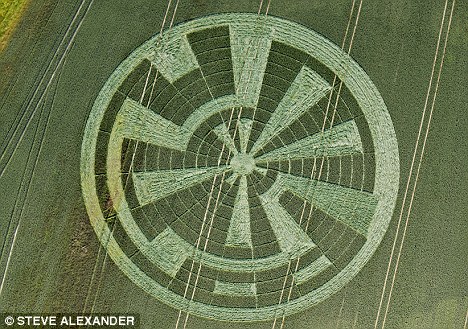 Detailed: The design is striking – but it has angered the farm manager, who branded the crop circle an ‘act of vandalism’
Crop circle fans were earlier trying to de-code the 200 foot design which sprung up in a field near Marlborough on the longest day of the year.
Crop circle expert Karen Alexander said: ‘It appears to be a complicated mathematical formula and there have been several circles in the area over the years that represent Pi.
‘The fact it has appeared next to a heart-shaped wood suggests there is something more significant to the message, especially as it appeared on the Summer Solstice – the longest day of the year.’
Nicholas – Crop Circle Tour Guide
HisTOURies UK – The Best Tours in History
Sun rises on a successful Stonehenge solstice
Posted in England facts, sightseeing tours, Stonehenge, Stonehenge private tours, Wiltshire on June 25, 2010| Leave a Comment »
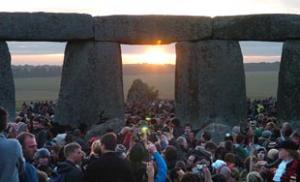
Sun rise at Stonehenge
CLEAR skies meant the thousands of revellers who flocked to Stonehenge got to enjoy a beautiful sunrise at this year’s Summer Solstice on Monday morning.
About 20,000 druids, pagans and revellers from across the country and abroad travelled to the famous Wiltshire landmark to celebrate the longest day of the year.
Numbers were lower than last year’s record-breaking event, which fell on a weekend and had a crowd of 36,500, but for the first time in recent years clouds didn’t block the view of the sunrise at just before 5am.
As the sky started to brighten the Widders Border morris dancers performed several routines next to the Hele Stone, before druids performed rituals and hailed the sun.
Revellers filled the stone circle and the crowd cheered as the sun came up between the stones.
Druid King Arthur Pendragon said: “I thought this year went exceedingly well. It was a nice crowd and a nice atmosphere and with a great spirit of co-operation – how could it not be a successful solstice?
“Lots of pagans say they are fed up with the revellers but I don’t have that view. Even if they initially come for the wrong reasons, they return for the right ones in the end.
“It’s the spirit of the place, Stonehenge itself, that draws people here and even if they don’t respect the stones the first time they do by the next year.”
No major incidents were reported. Wiltshire Police made 34 arrests – one on suspicion of possession of an offensive weapon, two minor thefts, two for assault, three for possession with intent to supply drugs, one drink driving, nine drunk and disorderly and 16 possession of drugs. A police spokesman said they were happy with how the event had gone and, despite the arrests, the solstice had been mostly peaceful.
Rhanks to all that joined me on the sunrise, a good time was hads by all. I will be uploading my photos later in the day and would appreciate your input
Nicholas – Stonehenge Tour Guide
HisTOURies UK
Summer solstice celebrations at Stonehenge hit by funding blow
Posted in England facts, sightseeing tours, Stonehenge, Stonehenge private tours, Wiltshire on June 22, 2010| Leave a Comment »
Summer solstice revellers disappointed that coalition government will cut funding to new Stonehenge visitor centre

Summer solstice revellers disappointed that coalition government will cut funding to new Stonehenge visitor centre Sometimes the police come in for criticism, while at other times English Heritage attracts the ire of the druids, ravers, hippies and sun lovers who turn out for the summer solstice at Stonehenge. At today’s celebrations there was a political target – David Cameron and the coalition government – following the announcement that government funding for a visitor centre at the ancient monument was being cut. The outcry from solstice revellers was led by the unmistakeable figure of Arthur Pendragon, a druid who believes he is an incarnation of the once and future king. Pendragon, who rejoices in the title of battle chieftain of the council of British druid orders, said he was not surprised that the £10m funding was dropped. “I knew the writing was on the wall. I knew the new government wouldn’t stump up the money. It’s no surprise but, still, it’s a disgrace. This wouldn’t happen anywhere else in the world.” Pendragon has campaigned for 20 years for a new visitor centre at the World Heritage site and to close at least one of the busy roads that surround the stones. Tourists are often shocked at the state of the centre and amazed that traffic is allowed to roar past so close. Last year Gordon Brown promised £10m towards a £25m scheme to build a glass and timber centre and to shut the nearby A344. The scheme was expected to win planning permission soon and the project was due to be completed in 2012 to coincide with the staging of the Olympics in the UK. Last week the government announced the funding would be pulled. English Heritage, which manages the site, said it was “extremely disappointed”, arguing that transforming Stonehenge was “vital to Britain’s reputation and to our tourism industry”. It said it would try to find the funding from elsewhere. Pendragon said he was worried about how the shortfall would be met: “I don’t want to see them making up any shortfall with a public-private partnership. I don’t want to see Americans going home with T-shirts reading: ‘I’ve been to McDonald’s Stonehenge’. “All they’ve got to do is go to an investment banker with a decent proposal. Nearly a million visitors come through here every year. Any investment bank will see that it’s a money spinner. “It’s not as if they aren’t good for the money. Being English Heritage, they’ve got a castle or three they can put up as collateral. “We’ve been 20 years waiting for this visitor centre, faffing about. They can borrow the money and build the bloody visitor centre. That’s what I intend to make sure they do.” Rollo Maughfling, archdruid of Stonehenge and Britain, greeted the rising of the sun with a blast on his trumpet – which sounded not unlike a vuvuzela. “It’s been a wonderful, warm night,” he said. Around 20,000 people turned up to mark the solstice and by dawn there had been 30 arrests for minor offences. It was also the first time the solstice sun had peeped from behind the clouds since 2003. While campaigning tends to be left to Pendragon, Maughfling said it was a druid’s duty to get involved in politics when the need arose – and it had now arisen. “You have to tangle with politics to make sure that, for example, our national shrines and temples are looked after,” he said. “Look at any of the stories of druids in ancient British literature and ancient Irish literature, there have been times when the security of the land has been in the hands of druids as well as kings. Druids have taken sides in all kinds of matters. We can’t stand apart from it all.” Peter Carson, head of Stonehenge for English Heritage, said he was pleased at how the solstice went but disappointed at the withdrawal of funding. “But it’s not over yet,” he said. “Let’s see what we can do. Maybe there is a way forward. The project has a great deal of support. It will ensure a suitable setting for Stonehenge and it will upgrade considerably the very poor facilities we currently have.” Sky, a pagan from Devon, broke off from a drumming session to explain how crucial it was that Stonehenge was improved. “It’s the most wonderful place and it’s a disgrace that we’re still waiting for a new visitor centre and for improvements to the roads. I bring people here from abroad sometimes. They’re amazed by the stones – but also amazed at how crummy the facilities are. I’d like that David Cameron to come down here and tell us why Stonehenge, our national treasure, is being treated so shabbily.”
Nicholas – Stonehenge Tour Guide
HisTOURies UK Tours
Is Stonehenge worth £51m? Doing the maths on the famous stone circle
Posted in England facts, Stonehenge, Stonehenge private tours, UK Tourism updates, Wiltshire on May 28, 2010| Leave a Comment »
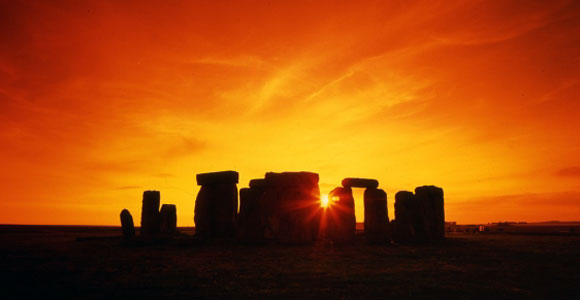
Here’s a novel suggestion for how the government can help reduce the massive public deficit: sell Stonehenge. A survey of 500 estate agents, among other monuments studied, has placed the price of the ancient stone circle at a cool £51 million. It’s a drop in the ocean of the £156 billion gap between government income and expenditure. But it’s a start.
Okay, so we’re not really advocating putting one of Britain’s most prized historic monuments up for sale: UNESCO would have some angry words to say about that. And it doesn’t even bare thinking how the druids will react. But the survey does shed light on just how much heritage sites are worth. Elsewhere, a price tag of £5.2 million was placed on 10 Downing Street, while Windsor Castle’s value was reckoned at £391 million.
But are the sums on Stonehenge correct? Shouldn’t such an internationally-renowned, popular and iconic monument be worth so much more?
In recent years Christie’s auction house has sold the likes of the Egyptian statue of Ka-Nefer and his family for a tidy £1.9 million, the Canford Assyrian relief for the princely sum of £7.7 million, and the Jenkins Venus for a whopping £7.9 million.
Counting just the 18 large standing stones, the 10 giant stones of the inner circle and the central altar stone at Stonehenge, by a very unscientific breakdown, that £51 million price tag on the Neolithic monument gives its 29 key constituent parts an approximate value of just £1.7 million a piece. That’s lower than each of the Christie’s sales listed above.
Theoretically speaking, don’t these figures at least suggest the total price tag should be a bit higher? Surely a super-wealthy antiquities collector would be prepared to pay megabucks to have a Stonehenge megalith in their living room? Or possibly even a trilith framing their front door?
And what about admission fees? Stonehenge presently attracts around 900,000 visitors a year, at an average price of about £5 per head. Multiply that long-term – by 25 years, say – and that means the monument is worth over £112 million. Consider too that visitor figures will most likely increase in years to come, and factor in revenue from merchandising, and £51 million begins to sound like a snip.
“It’s quite a challenge for estate agents more used to valuing suburban semis to put an accurate valuation on a royal castle or ancient monument,” commented Nigel Lewis, a property analyst at FindaProperty.com, who ran the survey. “But there was a surprising amount of agreement between the different agents we spoke to.”
Clearly estate agents have done their sums, too. They consider many different factors when it comes to judging the value of a property – location, age, whether it’s in need of improvement and so on. Stonehenge doesn’t lack for a good spot, situated on sheep-nibbled rolling Wiltshire countryside. But at 4,500 years vintage it could hardly be described as a new build, while its state of repair is questionable to say the least. And then there’s that ugly car park plonked right across the road since the 1960s (although it’s soon to be removed).
Also, unless Stonehenge’s new owners were to scrap already scaled-down plans for a new visitor centre – current cost £25 million – then that’s a big chunk of change they’ll need to lay out straight after being handed the keys to the front gate. But £51 million still sounds like far too low an asking price.
Someone buying a historic British monument isn’t actually as ridiculous as it sounds. Missourian businessman Robert P. McCulloch in 1968 purchased the old 19th century London Bridge designed by engineer John Rennie (or at least its stone cladding) from the City of London for $2 million dollars. He then shipped it to the United States, where it was rebuilt across Lake Havasu in Arizona as the gateway to a mock-English community. Legend has it that McCulloch mistakenly believed he was actually buying Tower Bridge – a story he vehemently denied.
It’d be a tragedy to see Stonehenge similarly packed-up and shipped off elsewhere. But Number 10 or Windsor Castle? Times are tight, after all.
Video: Spring Equinox Celebrations and Druids at Stonehenge
Digs, Discovery and Disaster: A History of Archaeology at Stonehenge
How to Celebrate the Summer Solstice 2010 at Stonehenge
The Stonehenge Stone Circle website
Article from the Heritage Key website with thanks
Nicholas – Stonehenge Tour Guide
HisTOURies UK – The Best Tours in History
Blog Archive
-
HisTOURies U.K Tours
- There’s more to this English county than just Stonehenge. Visit Wiltshire.
- Private Driver Guided Stonehenge Tours Departing from Salisbury.
- Private Driver-Guided Stonehenge Sightseeing Tours Departing from Bath.
- Stonehenge special access guided inner circle trips from London, Bath or Salisbury. Experience Stonehenge at dawn or dusk with a private VIP tour!
- Visiting Stonehenge? Our expert tour guides can turn the amazing experience of seeing the stones for the first time, into an enlightening one.
-
HISTOURIES PAGES
HISTOURICAL BLOGS
- January 2025 (1)
- December 2024 (1)
- October 2023 (1)
- February 2022 (1)
- March 2021 (1)
- December 2019 (1)
- January 2019 (2)
- June 2018 (2)
- December 2017 (3)
- June 2017 (1)
- May 2017 (5)
- February 2017 (5)
- January 2017 (9)
- December 2016 (5)
- November 2016 (5)
- October 2016 (3)
- July 2016 (1)
- April 2016 (1)
- March 2016 (1)
- February 2016 (5)
- January 2016 (1)
- October 2015 (2)
- September 2015 (2)
- May 2015 (3)
- March 2015 (1)
- February 2015 (2)
- January 2015 (7)
- December 2014 (3)
- October 2014 (5)
- September 2014 (4)
- March 2014 (2)
- February 2014 (1)
- January 2014 (4)
- November 2013 (4)
- October 2013 (8)
- September 2013 (6)
- August 2013 (7)
- July 2013 (3)
- June 2013 (5)
- May 2013 (10)
- April 2013 (8)
- March 2013 (6)
- February 2013 (2)
- January 2013 (3)
- December 2012 (3)
- November 2012 (7)
- October 2012 (7)
- September 2012 (5)
- August 2012 (2)
- July 2012 (6)
- June 2012 (3)
- May 2012 (5)
- April 2012 (3)
- March 2012 (4)
- February 2012 (7)
- January 2012 (5)
- December 2011 (3)
- November 2011 (7)
- October 2011 (8)
- September 2011 (9)
- August 2011 (7)
- July 2011 (7)
- June 2011 (4)
- May 2011 (5)
- April 2011 (4)
- March 2011 (10)
- February 2011 (7)
- January 2011 (11)
- December 2010 (12)
- November 2010 (12)
- October 2010 (17)
- September 2010 (13)
- August 2010 (9)
- July 2010 (12)
- June 2010 (6)
- May 2010 (6)
- April 2010 (13)
- March 2010 (22)
- February 2010 (26)
HISTOURIES UK

STONEHENGE TOURS
April 2026 M T W T F S S 1 2 3 4 5 6 7 8 9 10 11 12 13 14 15 16 17 18 19 20 21 22 23 24 25 26 27 28 29 30  Visit London
- An error has occurred; the feed is probably down. Try again later.
 Wessex Guided Tours