Feeds:
Posts
Comments

Archive for the ‘sightseeing tours’ Category

Engineers are to carry out emergency repairs on an 18th Century bridge in Bath after cracks were found in a support.

Subsidence was found in a basement built into the base of Pulteney Bridge.

Pultney Bridge

Pultney Bridge

Bath and North East Somerset Council (Banes) said mortar from previous repair work had shifted but there was no danger of the bridge collapsing.

The council wants to close the historic structure to traffic, but some residents are objecting to the plans.

Banes says the bridge – a Grade I listed structure – is unsuitable for modern traffic.

They submitted a closure plan before the current repair work was needed.

However, some residents fear the bridge’s closure would cut them off from the city centre.

The issue had been due to go before the council on 3 November, but this has now been put back to some time in 2011.

A temporary scaffolding system is being put in place to support the bridge until permanent repairs can get under way.

History of Pultney Bridge

Pulteney Bridge (Photo Bath and North East Somerset Council)

Pulteney Bridge is one of the most admired buildings in a beautiful city.

Pulteney Bridge is one of only four bridges lined with shops in the world, but Robert Adam’s creation has more than novelty value. His graceful composition is one of the unqualified successes of English Palladianism and provides the perfect integrating link between two halves of a Palladian city.

Across the River Avon from Bath lay the 600 acre estate of Bathwick. This was entirely rural when it was inherited by Frances Pulteney in October 1767, but its potential was obvious. No other English spa could rival Bath in this period and the city was in the midst of a building boom. Frances was married to an Edinburgh lawyer, William Johnstone Pulteney, and this energetic and frugal Scot immediately began to make plans to develop his wife’s estate. His first problem was that the only direct route from Bath to Bathwick was by ferry. By February 1768, he was conferring with Bath City Council about a new bridge. At first Pulteney contemplated just a simple, functional bridge, designed by a local architect, but by the summer of 1770 the brothers Adam were involved and the plans had undergone a dramatic change.

Pulteney Bridge by Thomas Malton 1785 (Victoria Art Gallery, Bath)

Pulteney had approached the Adams with his new town in Bathwick in mind. We may guess that Robert Adam then suggested putting shops on the bridge. He had visited both Florence and Venice, where he would have seen the ancient Ponte Vecchio and the striking Ponte di Rialto. But the most direct influence on Adam was clearly Andrea Palladio’s rejected design for the Rialto. Stripped of its heavier ornamentation, this tribute to ancient Rome emerged from Adam’s hands as the coolest of English understatements.

England also had housed bridges of medieval origin, but by the 18th century these were being seen as impediments to traffic. Adam’s designs therefore caused some consternation in Bath. The Corporation, who had not been consulted, wrote to Pulteney in protest. They evidently thought it perverse that after London and Bristol had cleared their bridges of houses, he was proposing to bring this outdated phenomenon to Bath. But Pulteney remained adamant. Perhaps the prospect of the bridge paying for itself through shop rents appealed to his love of economy. Pulteney Bridge by Thomas Malton 1779 (Victoria Art Gallery, Bath)

Adam planned a row of eleven small shops on each side, with staircases to attics above. Lofty Venetian windows formed the centrepiece of his design for the river façades, while matching Venetian doors faced the street. These were echoed in a pattern of recessed, columned windows, creating an interesting play of light and shadow for passers-by. Malton’s aquatint gives us our only view of these lovely street façades, subsequently much altered.

Pulteney Bridge was complete and ready for occupation in late 1773, but tenants were slow to come forward. The shock of the American War of Independence had fallen like an axe on Bath’s development. The plans for Bathwick were shelved and for many years, Adam’s elegant and urbane bridge led out onto meadows, rather than a Palladian townscape. When building eventually began in March 1788, it was Thomas Baldwin, a Bath architect, who provided the detailed plans. Pulteney Bridge was left as Adam’s only work in Bath.

Pulteney at least had the tact to see Adam to his grave before desecrating his handiwork. On 26 March 1792, less than a month after Adam’s death, a lease of most of the bridge was granted, with Baldwin’s plans for conversion to larger shops. The roof was raised and the windows transformed into bays. No doubt it all made sound commercial sense, but Adam’s street elevations were utterly ruined.

This was just the first of many distortions of Adam’s original vision. Disaster struck in September 1799, when a pier gave way after high floods. The remaining pier collapsed when the river rose in a great storm in November 1800. The houses on the north side were so badly damaged that Pulteney seriously considered dismantling the whole structure and building a single-span iron bridge, designed by his protégé Thomas Telford. But in the end only the north side was rebuilt. Adam’s pavilions were reduced to token pediments, but at least the design had unity.

It was not to last. 19th-century shopkeepers altered windows, or cantilevered out over the river as The north side of Pulteney Bridge in 1872 (Victoria Art Gallery, Bath)the fancy took them. By 1948, the buildings had become pathetic travesties of the original design, as Walter Ison sadly noted.

But the tide was already on the turn. Bath City Council showed concern to retain the Adam features of the bridge as early as 1903, when the south-west pavilion had to be moved. In January 1936, Pulteney Bridge was scheduled as a national monument. The Council already owned a few of the shops on it; now they bought the rest and the following year the City Surveyor carefully traced Adam’s own plans and designed a restored façade.

But war intervened. The restoration was finally executed in time for the Festival of Britain in 1951. Then in 1975 the Georgian Group partially restored the southern street facade to mark European Architectural Heritage Year. Now the restored bridge is a delight to photographers and one of the enduring images of Bath that visitors take away with them.

We operate tours of the city of Bath and they can depart from London or Salisbury

Stonehenge Tour Guide
HisTOURies UK – The Best Tours in History
Read Full Post »

A project to find the 100 events and places that played the most significant role in shaping the English language has been launched.

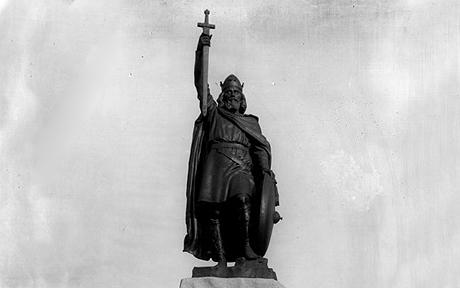
King Alfred of Wessex, the first person to call the language 'English'
King Alfred of Wessex, the first person to call the language ‘English’


From the Anglo-Saxon invasion of the fifth century to modern-day waves of immigration, the English language has been shaped by countless episodes in history.

Now The English Project, a charity dedicated to promoting the language, is compiling a list of the 100 most important events and locations which have made English what it is today

The journey starts in Lakenheath in Suffolk, where the Undley Bracteate medallion was found, dated to 475 and bearing the first evidence of written English.

Then in 731 the Venerable Bede completed his Historia Ecclesiastica Gentis Anglorum in Jarrow, Tyne and Wear – the first text to speak of the English language and the English people.

And by 871 King Alfred of Wessex, the first person to call the language “English”, was ordering translations from Latin into West Saxon, a dialect of Old English.

In recent times the language has adapted again and again, on its way to becoming the common tongue of 1.8 billion people worldwide.

The charity has already compiled a list of 20 of the most important events in the history of the language, and wants the public to help produce the final list of 100 crucial events
Bill Lucas, a trustee of the English Project and professor of learning at the University of Winchester, said: “This is a wonderful way of engaging people in a wider conversation about the English Language.

“We want to get the nation really thinking about the stories behind our evolving language.

“How, for example, do you rate the relative significance of Shakespeare’s Stratford-upon-Avon, versus London’s part in the birth of the world wide web?

“English has now become the lingua franca of the world. It is the most exciting and exotic language partly because of its capacity to incorporate so many elements of other languages, and somehow to make these dynamic, descriptive and always exciting.

“The history of Britain and the history of the English language are also very closely intertwined.

“We’re excited about hearing people’s ideas about the places and events they think have shaped the language.”

Submit your suggestions on the charity’s website, www.englishproject.org

The 20 events and places nominated so far:

Date: 475

Lakenheath, Suffolk

The Undley Bracteate medallion, found at Lakenheath, has been dated to 475 and provides the first evidence of written English

Date: 731

Jarrow, Tyne and Wear

The Venerable Bede completed his Historia Ecclesiastica Gentis Anglorum. Although writing in Latin, he was the first person to speak of the English language and the English people.

Date: 871

Winchester, Hampshire

Translations from Latin into the West Saxon dialect of Old English were commissioned by King Alfred of Wessex between 871 and 899. He is the first person known to have called the language “English”.

Date: 1066

Hastings, Sussex

William the Conqueror and his Norman army defeated King Harold at the Battle of Hastings, bringing with them a language that transformed English over the next 300 years.

Date: 1171

Waterford, Ireland

King Henry II of England landed in Waterford, beginning the worldwide exportation of English beyond the island of Great Britain – even though he himself mainly spoke French.

Date: 1362

Westminster, London

On October 13 the Chancellor of England opened Parliament with a speech in English rather than French for the first time.

Date: 1400

Westminster Abbey, London

Geoffrey Chaucer was buried in the Abbey. In 1556 he was moved into a more splendid tomb, beginning the tradition of burying great writers in Poets’ Corner.

Date: 1476

Westminster, London

William Caxton introduced printing to England, which became a huge force in the spread of English language literature.

Date: 1564

Stratford-upon-Avon, Warwickshire

William Shakespeare, regarded by many as the greatest writer in the English language, is born.

Date: 1604

Hampton Court, Surrey

King James’s Hampton Court Conference set a translation team working on what came to be known as the King James Bible, published in 1611.

Date: 1665

Oxford

The first newspaper in English was the London Gazette, first published in Oxford in 1665 as the Oxford Gazette.

Date: 1709

Lichfield, Staffordshire

The birthplace of Samuel Johnson, creator of A Dictionary of the English Language. Published in 1755, it set new standards for the writing of English prose.

Date: 1847

South Charlotte Street, Edinburgh

The birthplace of Alexander Graham Bell who invented the telephone in 1876, initiating a major stage in worldwide communication.

Date: 1901

Poldhu, Cornwall

In 1901, Guglielmo Marconi sent the first radio transmission to St John’s, Newfoundland. North American and British English began to converge again after 300 years of separation.

Date: 1922

Portland Place, London

The British Broadcasting Company (BBC) begins transmission, influencing dramatically the way English language is used and spoken.

Date: 1945

Menlove Avenue, Liverpool

John Lennon lived here from the age of five. With his fellow Beatles, he revolutionised popular song.

Date: 1955

London

Tim Berners-Lee, who invented the World Wide Web, is born. English is the dominant language of the internet, and the net is a major factor in the globalisation of English.

Date: 1988

Plumstead, London

Patrick Chukwuem Okogwu, also known as rap artist Tinie Tempah, is born. Rap music shows the English language at its flexible best.

Date: 1997

Nicolson Street, Edinburgh

JK Rowling wrote much of Harry Potter and the Philosopher’s Stone in Nicolson’s Café. Published in June 1997, the series of books started a worldwide reading phenomenon.

Date: 2003

UK

On Valentine’s Day, mobile phone usage was so widespread that for the first time, more people said “I luv u” by text than said “I love you” by post. Text English is a new and thriving form of the language.

British Tour Guide
HisTOURies UK – The Besy Tours in British History

Read Full Post »

David Crisp said the valuation was "fair"

David Crisp said the valuation was "fair"

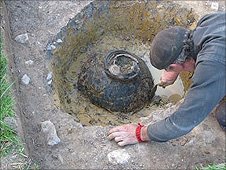
A hoard of more than 52,500 Roman coins found in a field in Somerset has been valued at £320,250.

The coins were discovered in April by Dave Crisp, from Wiltshire, who will share the sum with the landowner.

Mr Crisp said: “I’m very, very happy with that. I think it’s a fair valuation.”

Somerset County Council hopes to buy the hoard, one of the largest finds of Roman coins in Britain, for display at the Museum of Somerset.

The Treasury Valuation Committee was responsible for determining a value for the find.

The council’s heritage service has received £40,250 from the Art Fund towards the appeal.

‘Important’ discovery

The charity will also match every pound donated by the public up to the value of £10,000.

Steve Minnitt, head of museums for Somerset County Council, said the Frome hoard was one of the most important discoveries made in Somerset in recent years.

He said: “As such, we feel that it’s a find that really needs saving for the people of Somerset, so we’re launching the campaign now.”

The Somerset Archaeological and Natural History Society has also donated £10,000 to the fund.

Under the Treasure Act, the local authority has four months to raise the money, although this deadline can be extended if necessary.

Mr Crisp, a hospital chef, intends to buy a new car with part of his reward money but intends to continue working until his retirement in August 2011.

Stonehenge Guide
HisTOURies UK – The Best Tours in History

Read Full Post »

Tickets to watch the 2012 Olympic Games will be among the most expensive in British sporting history, it’s been revealed.

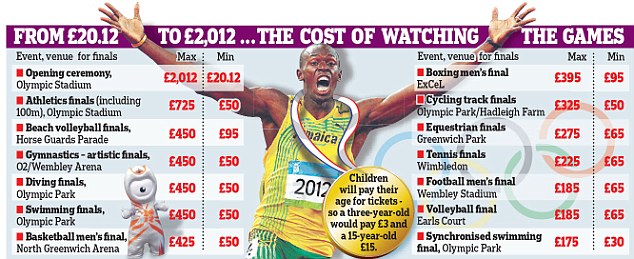
Sports fans will pay as much as £2,012 for the best seats at the opening ceremony, while the same seats at the closing ceremony will cost £1,500.

The most expensive sport will be the athletics, to be held at the new 80,000-seat Olympic Stadium.

A coveted ticket to the men’s 100m final will cost as much as £725 – the equivalent of £76 a second based on Usain Bolt’s world record.

Beach volleyball, gymnastics, diving and swimming will also be among the most expensive finals to watch, at £450 for the best seats, with the basketball finals close behind at £425.
The prices – which exclude corporate tickets – easily exceed those charged for the finals of the FA Cup, Wimbledon tennis and Premier League football matches.

LONDON 2012 TICKETS – THE FACTS

WHAT CAN I WATCH?
There are 26 Olympic sports but 39 disciplines in total. There will be 302 medal events and 649 sessions of sport to watch.

HOW MANY TICKETS WILL BE SOLD?
A higher-than-expected 8.8million.

HOW MUCH WILL THEY COST?
The price will vary according to the event. Each event will have different ticket prices, ranging from £20 to £725.

Organisers say 90 per cent will cost £100 or less, two-thirds will be £50 or less and 30 per cent £20 or less.

There will also be 11 free ticket sessions for sports such as triathlon, the marathon, race walking, road cycling and sailing.

ARE THERE SPECIAL OFFERS?
Yes, for around 220 sessions and 1.3 million tickets.
Children 16 and under on July 27 2012 will pay their age.

Those 60 and older on the same date will play a flat £16.

This offer will not include tickets for any final but will cover every sport.

Wheelchair prices include a companion seat.

Children will also be able to go along thanks to a ticket share scheme. 50,000 tickets have gone to the London Mayor, 50,000 to the Government and 25,000 to sporting bodies.

The Mayor’s tickets will go to children in London, the Government’s to secondary schools around the UK.

WHEN DO TICKETS GO ON SALE?
March 2011.

WHERE DO I FIND OUT MORE?
Register online at http://www.tickets.london2012.com

However, games organiser Locog insisted taxpayers had not been priced out of the event they had funded and said 90 per cent of tickets would cost £100 or less.

A third of tickets will cost £20 or under, with Olympic chiefs unable to keep their promise that they would sell half of tickets at this price.

Some 1.3million tickets will be reserved at special prices for children and people over 60.

Under the ‘pay your age’ scheme, 10-year-olds will pay £10, 11-year-olds £11 and so on.

Those over 60 will pay a flat £16.

Event bosses face pressure to make £400million from ticket sales, while ensuring that the 26 sports remain affordable and that the stadiums are full – avoiding a repeat of the near-empty stadiums at some of the Commonwealth Games events in India this month.

London 2012 chairman Sebastian Coe described it as ‘the daddy of all ticket strategies’, adding: ‘We have three clear principles for our ticketing strategy: tickets need to be affordable and accessible to as many people as possible, tickets are an important revenue stream for us to fund the Games, and our ticketing plans have the clear aim of filling our venues to the rafters.’

Events such as the marathon, cycling road race and time trial and triathlon will be free because they are on public roads, although grandstands at the finish area will be ticketed.

The cheapest events include the shooting finals with a top price of £40, sailing at £55 and the modern pentathlon at £75.

There are 8.8million tickets available, with 6.6million of these available to the public from March 2011.

The rest will go to broadcasters, sponsors and the 204 overseas Olympic committees.

Some 1.7million people have registered on the london2012.com website, which will guide them in applying for tickets for the 26 sports, split into 649 sessions.

The Government wants each school in Britain to receive six free tickets, but London Mayor Boris Johnson is trying to find sponsorship for a further 75,000 to be given to London pupils so one in eight can attend the Games.

Lord Coe said: ‘We made a promise to inspire young people to choose sport and our ticket prices will get as many young people as possible to the Games.’

Olympics Minister Hugh Robertson added: ‘I am confident we will have packed stadiums and venues.’

Make your tour plans well in advance.  Escape the city for a day and join a private guided sightseeing tour.  Contact us in advance for any travel arrangements you may need. 

Tourist Guide
HisTOURies UK – The Best Tours of Britain

Read Full Post »

Daredevil happenings at cathedral…
SHOPPERS in Salisbury may have spotted some strange shenanigans going on at Salisbury Cathedral on Thursday.

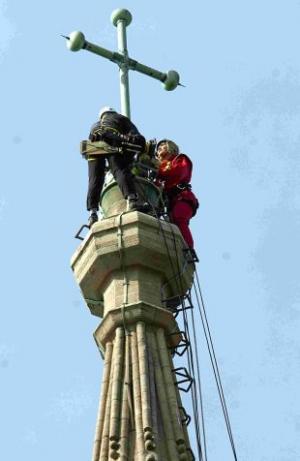
Blue Peter presenter Helen Skelton was joined by a steeplejack and an abseiling camerman to change the four red light bulbs on the spire.

The group climbed up inside the spire to the weather door, which is 12 metres below the summit and is the point at which they had to continue the climb to the top on the outside.

About the Cathedral:

The Cathedral Church of the Blessed Virgin Mary in Salisbury

Salisbury is unique amongst medieval English cathedrals, built within one century with no substantial later additions. The building itself is remarkable, a testimony to the faith and practical skills of those who erected it.

But it is much more than an historical monument. It is the Cathedral Church of the Salisbury diocese and so the Mother Church of several hundred parishes in Wiltshire and Dorset. It is a centre of pilgrimage for hundreds of thousands of visitors every year. Every day, week in week out, for century after century, God is worshipped here. Above all it is a place of prayer.
Salisbury and Stonehenge Tour Guide
HisTOURies UK – The Best Tours in History
Read Full Post »

Wessex is the ancient kingdom of the West Saxons that defeated its rivals and created England. The counties of Essex, Middlesex and Sussex remain with us to recall the East, Mid and South Saxons that Wessex conquered but when King Edgar of Wessex was crowned as the first King of England in Bath in 973, Wessex, the dominant and most civilised of the Anglo-Saxon states, ceased to be a government entity.

Kingdom of Wessex Map

Kingdom of Wessex Map

The area with which Histouries UK is concerned was recognised in the early ninth century when the four West Saxon shires, now Counties, were created. The name of each reflected the name of the town on which the surrounding shire was dependent. They were:

West Saxon Shire Shire Town Present County
Dornsaete Dorchester Dorset
Somersaete Somerton Somerset
Wiltunscir Wilton Wiltshire
Hamtunscir Southampton Hampshire

The history of the area goes back much further than this. Its Neolithic inhabitants built a large number of sacred hills, camps, rings, barrows and henges to honour their dead, celebrate the seasons or mark their boundaries. Wessex has an almost unparallelled wealth of archaeological sites including Avebury and Stonehenge. It is a land of myths and legends. Among them are the story of Joseph of Aramathea bringing the Holy Grail to Glastonbury and, perhaps above all the legends, that of King Arthur and the Knights of the Round Table.

Wessex reached its peak in the ninth and tenth centuries and especially in the reign of Alfred the Great, one of the most remarkable men in England’s long history. He was not only a military genius who reformed the army and established the navy. He was also a learned man who greatly influenced the development of the English language and whose laws formed a base for much of the English law we know today.

In 1066, the Normans came to conquer and brought great changes with them. The name of Wessex fell into the background but the area remained important in the flow of English history. The concentration of its heritage with us now, bears witness to this. In more recent times, the work of writers, Thomas Hardy, in particular, has breathed new life into the use of “Wessex”to represent an area and now there are hundreds of companies that have it as part of their name.

WESSEX TODAY

Destination Wessex describes it this way:

“Wessex is the land of King Arthur and King Alfred, of Jane Austen and Thomas Hardy, of Bath and Stonehenge. It was the birthplace of England and England’s heritage remains very much part of the Wessex way of life. It is a land of beautiful countryside, historic market towns and ancient villages not far from London, but in every other way very far from the pressure, pace and congestion of the urban world.”

The four counties have a rural culture. Major urban communities such as Bristol, Swindon and Southampton are situated near the perimeter. Elsewhere, there is a feeling of timeliness. What you see has been there for hundreds of years and there it will be hundreds of years from now. The industrial revolution largely passed it by and, while the modern world may have a degree of physical presence, the flow of Wessex life and the priorities of its people stay much as they were.

The area has a common sense of place that is made up of green fields, hedges and woods, of stone, thatch, village churches and historic inns, of architecture and archaeology, of cows and sheep and horses and wildlife, and a serene balance between man and nature. County boundaries do not affect this. Unless there is a sign to tell you, you will not know when you cross, for example, from Somerset into Dorset. But, if you leave Wessex to go towards London, you feel the change. The pressure, the degree of urgency, the congestion begins to evidence itself. The sense of place has changed.

Wessex is a destination that overseas visitors will recognise, much as they recognise the Cotswolds or the Lake District. It is unique, compact and readily accessible. Beneath its common sense of place is a wealth of variety that can offer memorable holidays to a wide range of visitors. Come and stay for a few days and get to know Wessex, the heart of ancient England.

Cultural Wessex

Wessex Life. Rural, peaceful and timeless. The small market towns and villages, the churches and pubs, the local fairs and festivals, the farms and fields and hedgerows. And the people who live there. The annual Bath & West Show, market days in the small towns, race meetings, and village open garden days. They all reflect the Wessex way of life.

Christian Heritage Five cathedrals, twelve abbeys and some of the finest churches in England. Ecclesiastical history is also reflected in Bishop’s palaces, legends and tradition.

Family History Over the centuries, many people have migrated from Wessex, especially to North America. Wessex has excellent Records Offices where comprehensive data is maintained and family history associations keen to help visitors in tracing their ancestors.

Antiques Antique shops and dealers, shows and auctions are features of life in Wessex. Bath, Bradford on Avon, Shepton Mallet and Sherborne are well known antique centres .

Literary Wessex Jane Austen, Thomas Hardy, Anthony Trollope, William Wordsworth, Samuel Coleridge, Evelyn Waugh, T.S.Eliot, John Betjeman, Geoffrey Chaucer, T. E Lawrence and many other outstanding literary figures have close associations with Wessex.

Arts and Crafts The arts are very much in evidence. The Theatre Royal in Bath, the Bournemouth Symphony Orchestra and the choirs of the cathedrals are perhaps the best known but there are also the local theatres, auditoriums, art galleries and craft centres. Music and drama festivals, art exhibitions and book fairs are scheduled every year.

Historical Wessex

Wessex in History From prehistory to the age of aviation. Special periods of interest are the bronze and iron age settlements, the Roman Wessex, the Saxon kingdom that gave birth to England, the Norman Conquest, Elizabethan Wessex, the Civil War and the Eighteenth century.

Historic Houses of Wessex There are 75 historic houses from which to choose. Some of them medieval, some Tudor and many from the seventeenth and eighteenth centuries. Each reflects the society, culture and history of its time. Also included are some of the charming smaller manor houses.

Architecture The vast collection of ecclesiastical, military, manor house and domestic architecture in Wessex means that the area contains excellent examples of almost every period of architecture in England: Roman, Saxon, Norman, Medieval, Elizabethan, Jacobean, Georgian and Victorian.

Archaeology 40 archaeological sites are in the Wessex inventory including two World Heritage Sites, Stonehenge and Avebury, and the fortress of King Arthur at Cadbury.

Military Heritage This ranges from forts and castles and fortified manor houses to battle sites, regimental history and the outstanding naval, army and air force museums

Veterans Many military personnel from USA, Canada, Australia and elsewhere were based in Wessex during the Second World War. Many left from Wessex harbours on D-Day. The area has many memories for them and much interest for their families.

Download PDF  tourist map of the Wessex area

Wessex Tour Guide
HisTOURies UK  – The Best Guided Tours in Wiltshire

Read Full Post »

Let’s be clear, we’re not trying to pull the wool over anyone’s eyes…our often inclement weather is no secret.

Still, it’s reassuring to know that foreign visitors who set foot on our green and pleasant lands don’t love Britain any less because of the rubbish weather.

Routemaster bus crossing Westminster Bridge in central London, during heavy fog‘Could you tell me the way to Big Ben? Behind the blanket of fog you say? Thanks…’ 1000 tourists questioned said they wouldn’t be dissuaded from visiting Britain because of the weather.

New research from VisitBritain has found that tourists – from more than 30 countries worldwide – wouldn’t be put off visiting our shores by the prospect of grey skies.

1,000 potential travellers were asked how much they agreed with the line: ‘I would not want to visit Britain because of the weather there’.

On a scale from 1 to 7, where the latter was ‘strongly agree’, the average score came out at 2.76 – a clear vote of confidence that poor weather rarely dissuades tourists from actually visiting.

It seems foreign travellers are under no illusions that they’ll be met with sunshine though, with around half of those questioned agreeing that ‘wet and foggy’ was an accurate general description of British weather.

 VisitBritain chief executive Sandie Dawe said: ‘This survey shows that Britain’s weather is not as bad as folklore would have us believe.

‘Visitors do not come with a belief that should a few drops of rain fall then their trip will be ruined.’

A brush with an umbrella doesn’t detract from the appeal of the country’s museums, castles and ancient attractions, continues Dawes.

‘Our research also tells us that visitors from overseas come here to experience our world-class heritage and culture, be this Tate Liverpool, Edinburgh Castle, the British Museum or Stonehenge.’

 It never rains on my tours – and thats a promise!  I have 1000’s of satisfied customers who have toured with me who will vouch for me.

Stonehenge Tour Guide
HisTOURies UK – The best ‘sunny’ tours in Britain

Read Full Post »

Set in the peaceful Wiltshire countryside beside a lake, Old Wardour Castle, near Tisbury was once one of the most daring and innovative homes in Britain. It was built in the 14th century as a lightly fortified luxury residence for comfortable living and lavish A knight holding a sword in the air with St George's Cross flag in the backgroundentertainment. Today the castle ruin provides a relaxed, romantic day out for couples, families and budding historians alike.

An audio tour, included in the ticket price, tells of Old Wardour’s eventful past and the fighting it saw during the Civil War. The badly damaged castle became a fashionable romantic ruin, and in the 18th century was incorporated into the landscaped grounds of the New Wardour House (not managed by English Heritage, no public access to New Wardour House or grounds).  Today, visitors can still climb the turrets and even imagine themselves as extras in the Hollywood blockbuster movie, Robin Hood Prince of Thieves, part of which was filmed here.

SPOOKY TOURS @ Wardour Castle – Hallowen 2010

  • Date: Sat 30 & Sun 31 Oct 2010
  • Property:
    Old Wardour Castle
  • <!–

  • Children’s Event :
  • –>

  • Time: Tours at 5pm (children’s tour), 6.15pm, 7.30pm and 8.30pm
  • <!–

  • Booking :
  • –>

  • Suitable for: Everyone

Experience the eerie night-time surroundings of this haunted heritage site. Travel back to a time when gruesome goings-on were commonplace. We dare those of you who think you are brave enough to join our seriously scary and sometimes light-hearted homage to the past residents of Old Wardour, who refuse to leave. For younger visitors and the faint-hearted a much less terrifying alternative will take place earlier in the day.

Wardour Castle is close to Salisbury, Stonehenge and Bath and could easily be combined into a day tour
Wiltshire Tour Guide
HisTOURies UK – The Best Tours in Wessex

Read Full Post »

With the market as the highlight, the UNESCO World Heritage city of Bath is fast becoming known as ‘the Christmas City’.

Each year, the beautiful area between the stunning Bath Abbey and the internationally renowned visitor attraction, the Roman Baths, is transformed into a Christmas shopper’s haven – the Bath Christmas Market.  Theyare delighted to announce that the Bath Christmas Market will run for an additional 7 days this year – a total of 18 days!  Dates for the Bath Christmas Market 2010 are 25th November – 12th December 2010. 

In the heart of Bath’s main shopping district, 123 traditional wooden chalets adorn the streets; each one offering unique, handmade and unusual gifts, decorations and food items – everything you will need for the perfect Christmas celebration. 

The sound of carols echoing around the Abbey creates an extra special atmosphere at the Bath Christmas Market.  This is complimented by a full programme of entertainment at the event – carol singers, children’s entertainers and musicians that add to the festive ambience. 

View of Main Square  View of chalets and Bath Abbey

View of chalets and Bath Abbey  View of chalets and shoppers 

View of Main Square and Roman Baths   View of Main Square and Bath Abbey

View of Main Square and Roman Baths  View of Main Square and Bath Abbey

 Its a great time of year to explore Bath, join a coach tour from London or organise a private guided tour (from London, Salisbury or Bath)

If you can stay a night or two.  Click here for discount Hotels in Bath

Bath Toursit Guide
HisTOURies UK – The Best Tours in History
Read Full Post »

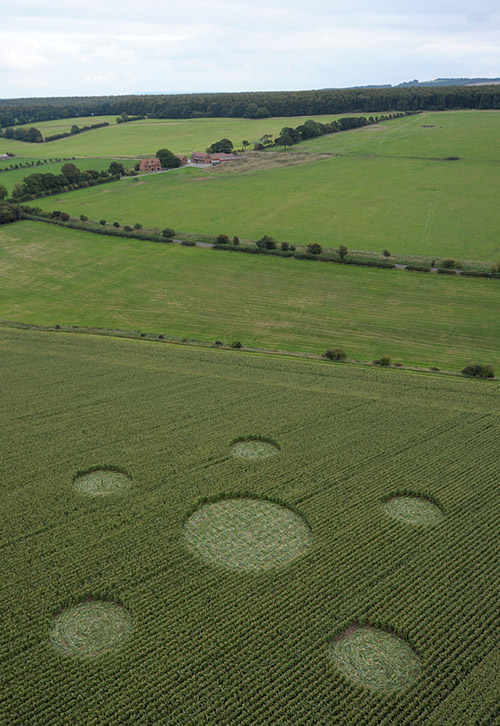
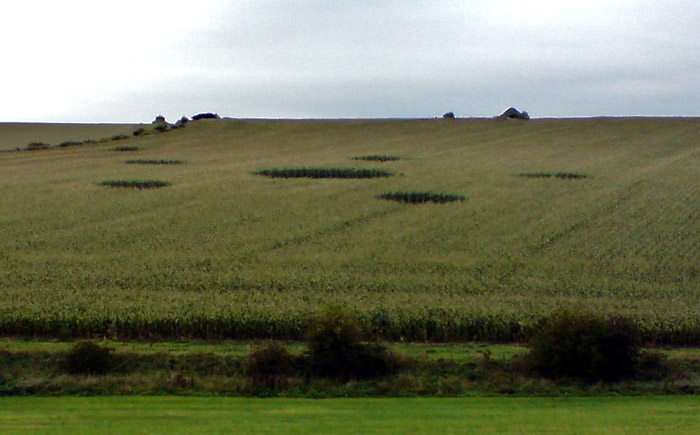
Just finished a guided tour of Avebury and discovered this stunning crop circle on Overton Hill, nr Lockeridge, Wiltshire.
 

I have included my image taken on my phone and managed to get hold of an aerial image.  It’s very unusual to discover crop circles this late in the year and particularly unusual to see one in the maize field.  To my knowledge this is the last remaining circle in Britain.  There is another one at Avebury, however the farmer got a little annoyed with people walking into his field and drove his tractor through the pattern.

I will be constantly in the area and will keep you ‘croppies’ updated

Stonehenge Tour Guide
HisTOURies UK

Map Ref: SU133666

Read Full Post »

« Newer Posts - Older Posts »