Feeds:
Posts
Comments

Archive for the ‘Stonehenge’ Category

Stonehenge, the most famous of our English megalithic monuments, has excited the attention of the historian and the legend-lover since early times. According to some of the medieval historians it was erected by Aurelius Ambrosius to the memory of a number of British chiefs whom Hengist and his Saxons treacherously murdered in A.D. 462. Others add that Ambrosius himself was buried there. Giraldus Cambrensis, who wrote in the twelfth century, mingles these accounts with myth. He says, “There was in Ireland, in ancient times, a pile of stones worthy of admiration called the Giants’ Dance, because giants from the remotest part of Africa brought them to Ireland, and in the plains of Kildare, not far from the castle of Naas, miraculously set them up. These stones (according to the British history) Aurelius Ambrosius, King of the Britons, procured Merlin by supernatural means to bring from Ireland to Britain.”

This ancient enigma keeps everyone inquiring what truth lies in those huge stones and luckily you have come upon a site that will help you realize everything about Stonehenge.

You have wound upon an educational articles not as old as Stonehenge, but sure one of the oldest and very likely the first covering all faces of this mystical monolithic construction.

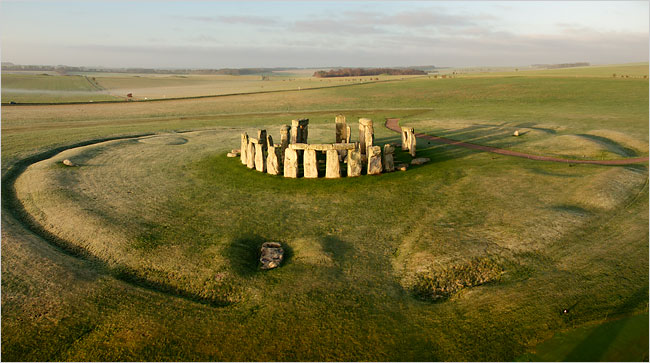
From the present ruined state of Stonehenge it is not possible to state with certainty what was the original arrangement, but it is probable that it was approximately as follows (see the following picture):


There was an outer circle of about thirty worked upright stones of square section (picture 2). On each pair of these rested a horizontal block, but only five now remain in position. These ‘lintels’ probably formed a continuous architrave (Pl. I). The diameter of this outer circle is about 97½ feet, inner measurement. The stones used are sarsens or blocks of sandstone, such as are to be found lying about in many parts of the district round Stonehenge.

Picture 2. Plan of Stonehenge in 1901. (After Archæologia.) The dotted stones are of porphyritic diabase.

Well within this circle stood the five huge trilithons (a-e), arranged in the form of a horseshoe with its open side to the north-east. Each trilithon, as the name implies, consists of three stones, two of which are uprights, the third being laid horizontally across the top. The height of the trilithons varies from 16 to 21½ feet, the lowest being the two that stand at the open end of the horseshoe, and the highest that which is at the apex. Here again all the stones are sarsens and all are carefully worked. On the top end of each upright of the trilithons is an accurately cut tenon which dovetails into two mortices cut one at each end of the lower surface of the horizontal block. Each upright of the outer circle had a double tenon, and the lintels, besides being morticed to take these tenons, were also dovetailed each into its two neighbours.

Within the horseshoe and close up to it stand the famous blue-stones, now twelve in number, but originally perhaps more. These stones are not so high as the trilithons, the tallest reaching only 7½ feet. They are nearly all of porphyritic diabase. It has often been asserted that these blue-stones must have been brought to Stonehenge from a distance, as they do not occur anywhere in the district. Some have suggested that they came from Wales or Cornwall, or even by sea from Ireland. Now, the recent excavations have shown that the blue-stones were brought to Stonehenge in a rough state, and that all the trimming was done on the spot where they were erected. It seems unlikely that if they had been brought from a distance the rough trimming should not have been done on the spot where they were found, in order to decrease their weight for transport. It is therefore possible that the stones were erratic blocks found near Stonehenge.

Within the horseshoe, and near its apex, lies the famous “Altar Stone” (A), a block measuring about 16 feet by 4. Between the horseshoe and the outer circle another circle of diabase stones is sometimes said to have existed, but very little of it now remains.

The whole building is surrounded by a rampart of earth several feet high, forming a circle about 300 feet in diameter. An avenue still 1200 feet in length, bordered by two walls of earth, leads up to the rampart from the north-east. On the axis of this avenue and nearly at its extremity stands the upright stone known as the Friar’s Heel.

In 1901, in the course of repairing the central trilithon, careful excavations were carried out over a small area at Stonehenge. More than a hundred stone implements were found, of which the majority were flint axes, probably used for dressing the softer of the sandstone blocks, and also for excavating the chalk into which the uprights were set. About thirty hammer-stones suitable for holding in the hand were found. These were doubtless used for dressing the surface of the blocks. Most remarkable of all were the ‘mauls,’ large boulders weighing from 36 to 64 pounds, used for smashing blocks and also for removing large chips from the surfaces. Several antlers of deer were found, one of which had been worn down by use as a pickaxe.

Note:

More Overmuch nine hundred stone rings subsist in the British Isles. Of these, Stonehenge is the most best known.

The megalithic monuments of Britain and Europe pre-history those of the oriental Mediterranean, Egyptian, Mycenaean and Greek civilization.

The Druids had nothing to do with the building of the stone rings. Druids are known to have taken their ritual activities generally in sacred forest woodlet.

Nicholas – Stonehenge and Salisbury Tour Guide
HisTOURies UK – The Best Tours in History
Read Full Post »

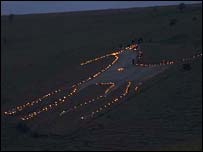
Lighting up the horses There have been occasions when white horses have been lit up at night, and it appears that there was once a tradition of doing this, at one or more of the horses, but information on this is scarce. The occasions known to me are described below, with the horses listed in alphabetical order. Alton Barnes This horse has been lit up on a number of occasions in recent years. On the night of the winter solstice in December 2001, the Wiltshire Crop Circle Study Group lit the Alton Barnes white horse by candlelight. Some twenty-five people arranged tea lights in jars around the outline of the horse, on what was a very cold, wet and windy night. The jars were laid on their sides, which provided protection from the rain. The effect was dramatic, and despite the wind inevitably extinguishing some of the lights, the horse was still lit late that evening. The group hope to make this an annual event. This information was kindly supplied by Kate Fenn and Deirdre Edwards. The WCCSG arranged to light this horse again on 21st December 2002. I accompanied about a dozen members of the group who set out from Knap Hill car park at dusk in thick fog and rain. In the fog the party became separated, and only half reached the horse! Those of us who got there had between us only about a third of the total number of jars and tea lights that had been brought, but nonetheless we managed to light the horse to good effect, even though it could only be seen from nearby due to the fog. The horse was again lit by the WCCSG on 21st December 2004. The following is an extract from Melanie Gambrill’s account of the event: It turned out to be a great day weatherwise, with the sky clearing in the afternoon so we could watch a beautiful sunset before lighting the horse. Lots of people came so we got the candles and jars ready to light very quickly. As the sun set and the daylight started to fade we lit the candles. It must have been amazing to watch the horse being lit from a distance as the lighting progressed up the horse’s head, along the tail and up the legs until it was completely aglow. As darkness fell the horse lights became brighter and brighter. We could see vehicles stopping along the road below as people paused to view the lit horse. You can find Melanie’s full account and photos of the event here on the Swirled News website. I believe the horse has been lit every year since 2004, up to and including 2008. Cherhill The Cherhill white horse was floodlit to mark the coronation of King George VI and Queen Elizabeth in 1937. A generator was set up in the valley below, and cables were run up to the site. The letters G E were marked out with red bulbs above the horse, and several large floodlights were arranged to light the horse itself. The letters were lit for five seconds, then the horse for ten seconds, with this pattern repeating continuously. This illumination took place every night during coronation week, except for two nights when very thick fog prevailed. Devizes The new Devizes white horse was completed in September 1999. Later that year, on the evening of New Year’s Eve, the horse was very effectively lit by Pearce Civil Engineering, from dusk through to dawn on New Year’s Day 2000. Pewsey The new Pewsey white horse was constructed in 1937 to mark the coronation of King George VI. After construction it was floodlit for coronation week, and apart from thick fog on two nights the effect was very good. Westbury The Westbury white horse was lit up in 1900, and again in 1950, with equipment provided by the army. Apparently the effect was spectacular, and the horse looked as if it was floating in the sky. In 1950 traffic in Westbury and Bratton came almost to a standstill as drivers slowed down to look. Some local people hoped the horse would be lit up again in 2000 but this didn’t happen. There is local interest in repeating the event, however, and it may be that it will be done again on some future date.

Nicholas – Stonehenge Tour Guide

HisTOURies – The Best Tours in British History

Read Full Post »

From the grassy deserted plains of southern England rises a circle of standing stones, some of them up to 24 feet tall. For centuries they have towered over visitors, offering tantalizing hints about their prehistoric past. For centuries, everyone who has stood before them has wondered the same thing: Who built this mysterious rock monument? And why?

“Since Stonehenge was built and rebuilt over a period of centuries, no one group has sole credit for its construction, but the main building seems to have been done by a people known as the ‘Beaker Folk,’” says Benjamin Hudson, professor of History and Medieval Studies at Penn State. The Beaker Folk (who earned their name from the distinctive inverted bell-shaped pottery drinking vessels they made) scattered throughout prehistoric western Europe.

The earliest construction at Stonehenge began about 3000 B.C., says Hudson, with a stone circle inside a ditch and bank. Within that circle lay a timber building; researchers have excavated from the site about 56 pits containing the remains of human cremations.

Construction continued for 600 years, in several phases of landscaping: Burial mounds (most pointing east-to-west) and ceremonial pathways were added to the site. In 2400 B.C., the builders erected the large sandstone blocks which give the site its name. (Coined by Henry of Huntingdon, a twelfth-century English historian, “Stonehenge” means “hinged or supported stones.”)

The means of moving those enormous standing stones has provoked centuries of speculation, with theories ranging from demonic powers to Merlin’s magic to alien technology. The reality is much more ordinary, says Hudson. “Much of the construction was little more than putting enough men under a stone to move it into place,” he notes, “although some basic engineering was required for the larger stones and the lintels.” One theory holds that the builders used simple inclines and levers to move the stones into place. Like the Egyptian pyramid-builders, the Stonehenge constructors relied more on brute labor than sophisticated technology.

Though one of the most complete and monumental examples of Neolithic and Bronze Age construction, Stonehenge was not alone in its time. Hudson notes one estimate that places it among 300 surviving stone monuments throughout the British Isles—including the famous stone circle in Avebury. The connections between and among these sites often remain murky, and undoubtedly many creations of the Beaker Folk have returned to nature, leaving few traces of their existence.

“Stonehenge forces us to reconsider the period of history that is not accompanied by written records,” Hudson says. Since the builders left no explanation, the precise purpose of their work remains obscure. One theory sees Stonehenge as a temple, pointing to the elaborate landscaping surrounding the site. More recently, historians and archaeologists have suggested it provided an observatory for either moon or sun cults. The Beaker Folk are believed to have been sun worshipers who aligned Stonehenge with certain important sun events, such as mid summer and winter solstices.

While the absence of records makes it nearly impossible to be certain about Stonehenge’s purpose, the site itself does leave us with a portrait of Beaker Folk society. “The building of the monument required knowledge of civil engineering, transportation, and quarrying,” he says. “The society that constructed it was wealthy enough to afford such an expensive venture and it also had a developed theology that provided the guidance for the designs whose meanings still elude us.”

Perhaps it is that elusive meaning that has, for centuries, drawn people to Stonehenge, to sit and wonder among the silent stones.

David – Stonehenge Tour Guide
HisTOURies UK – Bringing History alve

Read Full Post »

This Saturday marks the point at which the sun rises directly over the equator – the Spring Equinox. And while most of us will be wrapped up warm in bed at 5am, up to five thousand hardy souls will be braving the Wiltshire weather to welcome in the equinox at Stonehenge – including us.

This is the second of the four ‘sky points’ in our Wheel of the Year and it is when the sun does a perfect balancing act in the heavens.

At the Spring (or Vernal) Equinox the sun rises exactly in the east, travels through the sky for 12 hours and then sets exactly in the west. So all over the world, at this special moment, day and night are of equal length hence the word equinox which means ‘equal night’.

Of course, for those of us here in the northern hemisphere it is this equinox that brings us out of our winter.

For those in the southern hemisphere, this time is the autumnal equinox that is taking you in to your winter. And this is very much how I think of the equinoxes – as the ‘edges’ of winter. This is why they can be quite hard on our bodies as it is a major climatic shift, so it is a good time to give a boost to your immune system with natural remedies and cleansing foods.

Here in Wiltshire (as with the rest of rural Britain), it was traditional to drink dandelion and burdock cordials at this time as these herbs help to cleanse the blood and are a good tonic for the body after its winter hardships.

As the Vernal Equinox heralds the arrival of spring, it is a time of renewal in both nature and the home, so time for some spring-cleaning!

This is more than just a physical activity, it also helps to remove any old or negative energies accumulated over the dark, heavy winter months preparing the way for the positive growing energy of spring and summer.

As with all the other key festivals of the year, there are both Pagan and Christian associations with the Spring Equinox.

To Pagans, this is the time of the ancient Saxon goddess, Eostre, who stands for new beginnings and fertility.

This is why she is symbolized by eggs (new life) and rabbits/hares (fertility).

Her name is also the root of the term we give to the female hormone, oestrogen.By now, you may be beginning to see the Christian celebration derived from this festival – Easter.

And this is the reason why the ‘Easter Bunny’ brings us coloured eggs (and if you’re lucky chocolate ones!) at this time of year.

So, as nature starts to sprout the seeds that have been gestating in her belly throughout the winter, maybe you can start to think about what you want to ‘sprout’ in your life now and start to take action.

The Celtic Wheel

Have you ever wondered why we feel full of energy in the summer but slow down and want to stay-in in the winter? And why does Nature burst with life in the spring yet start to ‘go to sleep’ in the autumn?

It’s because we are all responding to the changing energies of the different seasons and our Celtic ancestors were exquisitely aware of this.

They followed this seasonal flow of energy around a ‘Wheel of the Year’, honouring the changes with celebrations that kept them in touch with heaven and earth.

There are eight key points in the year – four Quarter days that mark changes in the sky, and four Cross-quarter days that celebrate changes in the land.

The Wheel of the Year

The Wheel of the Year
© Apogee

I find it helps to think of the year as a clock face with mid-winter, the first Quarter day, at 12 ‘o clock.

This is the Winter Solstice (Dec 20th-23rd), which is also known as the shortest day and is the darkest point of the year. The Solstices are when the sun seems to ‘stand still’ in the sky.

Opposite this at 6 ‘o’ clock is the Summer Solstice (June 20th-23rd) – the longest day of the year and the point of highest energy.


At 3 ‘o clock is the Spring Equinox (March 20th-23rd) and, at 9 ‘o clock, the Autumn Equinox (Sept 20th-23rd).


An equinox is when night and day are of equal length.

These are like the edges of winter and often take a hard toll on our bodies.

In between these ‘sky points’ are the Cross-quarter days which mark ‘gear shifts’ in the energy of the earth. These times are also important agriculturally.

Imbolc (Beginning of February) is when the first lambs are born and ewe’s milk is available again after the long winter. The year is beginning to stir and wake-up.

Beltane (Beginning of May) is the transition from spring to summer when Nature is pumping with life-force and fertility.

Lammas (Beginning of August) is the time of ripeness and when the earth starts to give up her harvest.

Samhain (Beginning of November) is the end/beginning of the Celtic year. It is a time when the veil between the worlds is thinnest and it is possible to commune with the ancestors.

There is great joy in being aware of the seasons in this way and celebrating them in simple ways.

As the year unfolds, we will look in detail at the eight energy-points of the year and the ways in which they affect us.

We will also look at how these festivals have been celebrated in Wiltshire, both past and present.

Nicholas – Stonehenge Tour Guide
HisTOURies UK – The Best Tours in History
 

Read Full Post »

The first of our new series of weekly walks, provided by the National Trust, is a ramble around mysterious Durrington Walls in Wiltshire, with views towards Stonehenge.

View Durrington Walls: Walk of the week in a larger map

THE EXPERT’S VIEW

Mike Dando, Head Warden: “The walk starts at the largest henge monument in the country and takes you past ancient monuments such as Round Barrows and the ‘Cuckoo Stone’ where it is easy to imagine the landscape as it was some 4,000 years ago. The walk takes in beautiful grazed grassland, strips of mature Beech trees and offers fantastic views across the Stonehenge Landscape.

Download an OS map of this walk  
© Reproduced by permission of Ordnance Survey. All rights reserved. OS licence no. AL 100018591

“My favourite part of this walk would have to be walking past the New King Barrows, the large Bronze Age burial mounds. A stop here on a warm summers’ day, listening to the skylarks and the beech leaves rustling, is hard to beat, especially on top of the view over to Stonehenge itself.

“Unique to this walk is the sense of being in an ancient and sacred place; the combination of the natural and historic sights is simply spectacular. My top tip for first time walkers would be to bring binoculars to take in the wildlife and views.”

ESSENTIALS

Start: Woodhenge car park

Grid ref: SU151434

Map: OS Landranger 184

Getting there

  • Bus: Wilts & Dorset 5 or 6, between Salisbury, Pewsey, Marlborough and Swindon. Service 16 from Amesbury, request stop at Woodhenge
  • Rail: Salisbury station, 9 miles from Woodhenge car park
  • Road: Woodhenge car park is 1¾ miles north of Amesbury, follow signs from A345

Distance, terrain and accessibility

4 mile (6.4km) across open access land, including Rights of Way, with gates, at several points. The ground is uneven in places, with a few short, steep slopes. Sheep graze the fields and there are ground-nesting birds, so please keep dogs under control.

Local facilities

  • Picnic area (not NT) and information panel at Woodhenge car park
  • WCs
  • Outdoor café
  • Picnic area (not NT) at Stonehenge car park, 0.75 miles from this walking route.

THINGS TO LOOK OUT FOR

Durrington Walls: The largest complete henge in Britain is 500m in diameter and encloses a natural valley. It once contained timber circles and what appear to have been shrines. The area outside the ditch and bank was once a settlement, perhaps containing hundreds of houses, making Durrington Walls potentially the largest village in north-west Europe at the time. People travelled for miles to feast and take part in ceremonies, probably at the midwinter solstice. Woodhenge stood nearby as an impressive timber circle surrounded by a bank and ditch.

The Cuckoo Stone: This standing stone now lies on its side, but over millennia it has been a focus for Bronze Age urn burials, an Iron Age boundary line and Roman remains. It is made of sarsen, a kind of sandstone, the same as the largest stones in the Stonehenge stone circle. The reason for its name remains a mystery.

The Stonehenge Avenue: A two mile long ceremonial way linking Stonehenge with the River Avon and crossing King Barrow Ridge. Interestingly, Durrington Walls is also connected to the river, leading experts to believe the Avon symbolically linked the two monuments, forming part of a ritual journey; maybe leading to the afterlife.

DIRECTIONS

Download an OS map of this walk
© Reproduced by permission of Ordnance Survey. All rights reserved. OS licence no. AL 100018591

1. At Woodhenge car park, go through the gate nearest to you and into a field. Walk downhill into Durrington Walls (taking care of rabbit holes).

2. At the centre of Durrington Walls, looking around you, you can appreciate the nature of the henge as an enclosed valley. Standing here 4,500 years ago, you would have been viewing several “shrines” around the slopes. Next, turn left and walk to the corner of this field. Pass through gates either side of the road, heading towards a low rock.

3. The Cuckoo Stone is one of very few stones in the area that is made from sarsen – most local rock is chalk or flint. From here, continue forwards to the next gate.

4. You are now on the route of the old military railway between Amesbury and Larkhill; turn right and follow the path.

5. When you reach a crossroads and National Trust sign to King Barrow Ridge, turn left and follow the shaded bridleway.

6. At the junction, turn right through a gate to continue along the ridge, crossing the Stonehenge Avenue on your way to a line of 200-year-old beech trees and a fine view of Stonehenge. At winter solstice, Neolithic people may have marked the occasion of the midwinter sunset at Stonehenge, before travelling to Durrington Walls to celebrate the new sunrise.

7. Continue forward to New King Barrows, a fine row of Early Bronze Age burial mounds, originally capped in white chalk so they would have been visible from a far distance. Return to point 6, turn right and follow the stony track to point 8.

8. Take a left turn through a gap in the hedge, to join the old military railway once more. This leads back to the gate in the corner of the Cuckoo Stone field.

9. Head across the grassland to Woodhenge and back to Woodhenge car park.

Pat – Stonehenge Tour Guide
HISTOURIES UK  –  The Best Tours in History

Read Full Post »

The British Isles have been populated by human beings for hundreds of thousands of years, but it was the introduction of farming around 7,000 years ago that began a process of radical change.

The dawn of farming

Human beings have been living in the part of northern Europe that is today called Britain for about 750,000 years. For most of that time, they subsisted by gathering food like nuts, berries, leaves and fruit from wild sources, and by hunting.

Over the millennia there were phases of extreme cold, when large areas of Britain were covered in ice, followed by warmer times. Around 10,000 years ago, the latest ice age came to an end. Sea levels rose as the ice sheets melted, and Britain became separated from the European mainland shortly before 6000 BC.

The introduction of farming was one of the biggest changes in human history.

The people living on the new islands of Britain were descendants of the first modern humans, or Homo sapiens, who arrived in northern Europe around 30,000 – 40,000 years ago. Like their early ancestors they lived by hunting and gathering.

The introduction of farming, when people learned how to produce rather than acquire their food, is widely regarded as one of the biggest changes in human history.

This change happened at various times in several different places around the world. The concept of farming that reached Britain between about 5000 BC and 4500 BC had spread across Europe from origins in Syria and Iraq between about 11000 BC and 9000 BC.

Neolithic revolution?

The change from a hunter-gatherer to a farming way of life is what defines the start of the Neolithic or New Stone Age. In Britain the preceding period of the last, post-glacial hunter-gatherer societies is known as the Mesolithic, or Middle Stone Age.

It used to be believed that the introduction of farming into Britain was the result of a huge migration or folk-movement from across the Channel. Today, studies of DNA suggest that the influx of new people was probably quite small – somewhere around 20% of the total population were newcomers.

Farming took 2,000 years to spread across the British Isles.

So the majority of early farmers were probably Mesolithic people who adopted the new way of life and took it with them to other parts of Britain. This was not a rapid change – farming took about 2,000 years to spread across all parts of the British Isles.

Traditionally the arrival of farming is seen as a major and rapid change sometimes called the ‘Neolithic revolution’. Today, largely thanks to radiocarbon dates, we can appreciate that the transition from hunter-gatherer to farmer was relatively gradual.

We know, for example, that hunters in the Mesolithic ‘managed’ or tended their quarry. They would make clearings in woodland around sources of drinking water, and probably made efforts to see that the herds of deer and other animals they hunted were not over-exploited.

The switch from managed hunting to pastoral farming was not a big change. The first farmers brought the ancestors of cattle, sheep and goats with them from the continent. Domestic pigs were bred from wild boar, which lived in the woods of Britain.

Neolithic farmers also kept domesticated dogs, which were bred from wolves. It is probable that the earliest domesticated livestock were allowed to wander, maybe tended by a few herders.

Sheep, goats and cattle are fond of leaves and bark, and pigs snuffle around roots. These domestic animals may have played a major role in clearing away the huge areas of dense forest that covered most of lowland Britain.

Burial and belief

Stonehenge stone circle, near Amesbury, Wiltshire Stonehenge stone circle, near Amesbury, Wiltshire  ©

Neolithic farmers also brought with them the first seed grains of wheat and barley, which had been bred many millennia earlier from wild grasses that grew in region of modern-day Iraq.

Initially, cereals were probably grown in garden plots near people’s houses. Once harvested, the grain needed to be stored and protected from natural pests and from raiding parties.

This tended to encourage a more settled way of life than that of the Mesolithic communities, who would move around the country on a seasonal pattern, following the animals, birds and fish they hunted.

The ‘henge’ monuments, like Stonehenge, incorporate lunar and solar alignments.

In many cases the earliest Neolithic sites (approx 4000 – 5000 BC) occur alongside late Mesolithic settlements, or in areas that we know were important in post-glacial times.

From the start of the fourth millennium BC (about 3800 BC), we see a move into new areas that had not been settled or exploited previously.

This period, sometimes referred to as the Middle Neolithic, also witnesses the appearance of the first large communal tombs, known as long barrows, or mounds, and the earliest ceremonial monuments, known as ’causewayed’ enclosures.

Here people from communities in a particular region would gather together, probably at regular intervals, to socialise, to meet new partners, to acquire fresh livestock and to exchange ceremonial gifts.

During these ceremonies, rituals took place which often involved the burial of significant items, such as finely-polished stone axeheads, complete pottery vessels, or human skulls.

Some of the great ceremonial monuments of the Middle Neolithic, such as the so-called ‘passage’ graves, were aligned according to the position of the sun during the winter or summer solstice.

The long passage of a passage grave could be carefully positioned to allow the sun on the shortest few days of the year to shine directly into the central burial chamber. Passage graves were also constructed to provide good acoustics, and it seems most probable that they were the scenes of ritual or religious theatrical performances.

The so-called ‘henge’ monuments, like the famous Stonehenge, seem to have developed out of the causewayed enclosures from around 3000 BC.

They also incorporate lunar and solar alignments which are seen as a means of uniting the physical and social structures of human societies with the powers of the natural world.

The Bronze Age

Neolithic houses were usually rectangular thatched buildings made from timber with walls of wattle (woven hazel rods) smeared with a plaster-like ‘daub’ (made from clay, straw and cow dung).

Some of the larger buildings were the size and shape of a Saxon hall and may well have been communal. Most others were smaller and would have been adequate for a family of six to ten people.

The appearance of metal marks an important technological development, especially in the control of fire.

Neolithic houses are far more commonly found in Scotland and Ireland than in England or Wales, where communities may have retained a more mobile pattern of life, involving fewer permanent buildings.

The first bronzes appear in Britain in the centuries just before 2500 BC, which is the usually accepted start date for the Bronze Age.

On the European mainland the arrival of bronze was preceded by copper tools of the Chalcolithic or Copper Age, but in Britain tin and copper appear at about the same time as bronze.

Although the appearance of metal marks an important technological development, especially in the control of fire, it does not seem to bring a big change in the way that people lived their lives in the Early Bronze Age.

Henges, for example, continue in use, but the larger communal tombs, such as long barrows and passage graves, are replaced by smaller round barrows.

Many of these contain an initial or ‘primary’ burial, often of an important man or woman, who may be buried with distinctive and highly decorated pottery known as ‘Beakers’, together with bronze or tin metalwork such as daggers or axes. Sometimes fine goldwork rings, bracelets and earrings adorned the bodies.

In many instances the round barrows of the Early Bronze Age (2500-1500 BC) continue in use, as smaller or ‘satellite’ burials and cremations are dug into the main primary mound.

These places were clearly important gathering places for people and they were often carefully placed in the landscape either to be seen over a large area, or to mark the beginning or end or a community’s land-holding or territory.

Houses in the Early Bronze Age were usually round with a conical roof and a single entrance.

Accelerated change

The Ringlemere gold cup, found in Ringlemere, Kent The Ringlemere gold cup, found in Ringlemere, Kent  ©

The Middle Bronze Age (1500 – 1250 BC) marks an important period of change, growth and probably of population expansion too. There was a fundamental shift in burial practice away from barrow burial, towards cremation in large open cemeteries where ashes were placed in specially-prepared pottery urns.

Settlements consisted of round houses which were often grouped together, possibly for defence, but possibly too because people preferred to live near one another.

During this period we find an increasing number of metalwork hoards, where dozens, sometimes hundreds of spearheads, axes and daggers were placed in the ground – often in a wet or boggy place, a practice that would continue right through the Iron Age.

The Late Bronze Age saw the start of the so-called ‘Celtic’ way of life.

Certain hoards found in south western Britain contained large numbers of fancy bronze ornaments, such as elaborate dress-fasteners, rings, pins, brooches and bracelets.

The Middle Bronze Age also sees the first field systems in Britain, indicating growing pressure on the land as the numbers of people and animals increased.

The Late Bronze Age (1250-800 BC) is marked by the arrival of new styles of metalwork and pottery, but otherwise life continued much as before. Horse-riding became more popular and Late Bronze Age swords were designed as slashing weapons – resembling the cavalry cutlass.

Houses were still round, a pattern that would continue into the Iron Age, but a number of large hall-like rectangular houses are also known.

The field systems of the Middle Bronze Age continued in use and were enlarged. In the uplands of Britain the Late Bronze Age saw the first construction of a few hillforts and the start of the so-called ‘Celtic’ way of life.

Pat – Salisbury Tours
HISTOURIES – The Best Tours in British History

Read Full Post »

The team which discovered the site of a second stone circle, 500 years older than the nearby Stonehenge has won a prestigious archaeology award.

professor Thomas (right) with the co-Directors of the Stonehenge project <!–

Strapline text to go here.

–>

The sensational discovery of a 5000 year-old “Blue Stonehenge” was made by a team led by archaeologists from Manchester, Sheffield and Bristol Universities on the West bank of the River Avon last year.

The Stonehenge Riverside Project – as they are known – won the Research Project of the Year award at the Current Archaeology awards held at the British Museum.

The Stonehenge Riverside Project is funded by the Arts and Humanities Research Council and the Royal Archaeological Institute.

The award was given following an online vote by readers of Britain’s biggest archaeology magazine.

The new circle was 10m in diameter and was surrounded by a henge – a ditch with an external bank.

However, the stones were at some point removed, leaving behind nine uncovered holes. The team believe they were probably part of a circle of 25 standing stones.

The outer henge around the stones was built around 2,400 BC, but distinctive chisel-shaped arrowheads found in the stone circle indicate that the stones were put up as much as 500 years earlier.

When the newly discovered circle’s stones were removed by Neolithic tribes, they may, according to the team, have been dragged to Stonehenge, to be incorporated within its major rebuilding around 2500 BC.

Archaeologists know that after this date, Stonehenge consisted of about 80 Welsh stones and 83 local, sarsen stones. Some of the bluestones that once stood at the riverside probably now stand within the centre of Stonehenge.

Professor Julian Thomas, from The University of Manchester and a co-director of the Stonehenge Riverside Project, said: “We are delighted to win this award  – and it’s a tribute to the team who have done such a great job.

“We are still coming to terms with this truly sensational discovery: it’s amazing the circle of bluestones were dragged from the Welsh Preseli mountains, 150 miles away around 5,000 years ago.

“It adds weight to the theory that the River Avon linked a ‘domain of the living’ – marked by timber circles and houses upstream at the Neolithic village of ‘Durrington Walls’ – with a ‘domain of the dead’ marked by Stonehenge and this new stone circle.

“The Stonehenge Riverside Project also discovered a Late Neolithic settlement outside the enormous henge at Durrington Walls, upriver from Stonehenge, and a series of contemporary timber buildings and other structures in and around Durrington which may have been ceremonial in character.”
 

Notes for editors

The Stonehenge Riverside Project is run by a consortium of university teams.  It is directed by Prof. Mike Parker Pearson of Sheffield University, with co-directors Dr Josh Pollard (Bristol University), Prof. Julian Thomas (The University of Manchester), Dr Kate Welham (Bournemouth University) and Dr Colin Richards (The University of Manchester).  The 2009 excavation was funded by the National Geographic Society, Google, the Society of Antiquaries of London, and the Society of Northern Antiquaries.

Most of the circle remains preserved for future research and the 2009 excavation has been filled back in.

Nicholas – Stonehenge Tour Guide
HISTOURIES – The Best Tours in British History

Read Full Post »

One man can build construction like Stonehenge this video shows it.
BUILDING STONEHENGE – THIS MAN CAN MOVE ANYTHING – CLICK HERE

The largest stones at Stonehenge weigh around 112,000 lbs and those of the Great Pyramid over 150,000 lbs. nor were they moved on a flat concrete base… good effort though.

Wally Wallington has demonstrated that he can lift a Stonehenge-sized pillar weighing 22,000 lbs and moved a barn over 300 ft. What makes this so special is that he does it using only himself, gravity, and his incredible ingenuity.

He is a retired carpenter with 35 years experience in construction. In his work experience, over the years, many times he had to improvise on tools to get the job done. At one of these times, about 12 years ago, He had to remove some 1200 lb. saw cut concrete blocks from an existing floor. The problem was that he did not have a machine that could reach some of the blocks. The only obvious answer was to break the blocks into smaller pieces with a sledgehammer and load them into a wheelbarrow. To him, that seemed to be too much work at the time, so he improvised. Using a few rocks and leverage, He removed the blocks from below the floor to an area that the machine could reach them for removal. After doing this several times, the technique became very easy and quick. This experience make him consider the possibility that people may have used this technique before modern day equipment was available.

Nine years later, after retiring, he decided to explore this on his own. He brought home a one ton block of concrete from a job. Once he got home, he realized that he had to use his techniques to get the block off the truck. After unloading, he found that his technique allowed him to move the block around the yard with very little effort. At that time, his family became very interested in what their “crazy dad” was up to ” this time”.

In a few days, he decided that one ton block was no longer challenging, so he made some bigger blocks to play with. Within a few months he was moving, rolling, standing on end, and stacking them on top of each other.He found that he could easily move a 2400 lb. block 300 ft. per hour with little effort, and a 10,000 lb. block at 70 ft. per hour without any machine, only by himself. He also stood two 8 ft. 2400 lb. blocks on end and placed another 2400 lb. block on top. This took about two hours per block. He found that one man, working by himself, without the use of wheels, rollers, pulleys, or any type of hoisting equipment could perform the task.

A year after beginning project, his son needed a pole barn moved, due to a desired property split. He decided to put his techniques on test. The wood building was a 30 ft. by 40 ft. and 16 ft. tall. It weighed over 10 tons. In order to move the building, they added another 5 tons of bracing and reinforcement. The conditions were not good. At first, the field was muddy and they could only work for a few hours a week. Working by himself, he found out that he could move the building at a speed of 6 ft. per hour. With help of his son, they doubled that speed. After 40 man-hours of labor, they moved the building over 200 ft.

For many years people have tried to solve the mystery of the Egyptian pyramids, some even claiming extra terrestrial intervention. Similar works were done in different places on earth and at different times in history and there has to be a more accurate explanation. He believe that skilled individuals performed the work, because he found out that this job could easily be done using only primitive tools and physics, only simple wooden tools and gravity is needed for moving heavy weight. There’s no need to lift weight to move it from place to place. Stones make excellent fulcrums and pivot points.

Following this I have found that ancient legends from around the world are true. Some megaliths could have been set in place by as few as one man. I could build The Great Pyramid of Giza, using my techniques and primitive tools. On a twenty-five year construction schedule, (working forty hours per week at fifty weeks per year, using the input of myself to calculate) I would need a crew of 520 people to move blocks from the main quarry to the site and another 100 to move the blocks on site. For hoisting I need a crew of 120 (40 working and 80 rotating). My crew can raise 7000 lb. 100 ft. per minute. I have found the design of the pyramid is functional in it’s own construction. No external ramp is needed.

Following this some of ancient legends from around the world are true. Some megaliths could have been set in place by as few as one man. He said that he could build The Great Pyramid of Giza, using this techniques and primitive tools. On a twenty-five year construction schedule, working forty hours per week at fifty weeks per year,  he would need a crew of 520 people to move blocks from the main quarry to the site and another 100 to move the blocks on site. For hoisting he needs a crew of 120 (40 working and 80 rotating). His crew can raise 7000 lb. 100 ft. per minute. He have found the design of the pyramid is functional on it’s own construction. No external ramp is needed. So many myths about pyramids are falling in water.

more info: http://www.theforgottentechnology.com/

My comments: 

I think it’s odd that people don’t give credit to our ancestors for their ingenuity. This guy has shown it IS possible to erect such monuments through sheer ingenuity. I mean, we’re only talking about 6,000 years ago or so. It’s not like people weren’t as resourceful then as they are today…these people weren’t idiots.  
No-one knows. Anything is speculation. Good speculation, but speculation nonetheless

Nicholas – Stonehenge Tour Guide
HISTOURIES UK – The Best Tours in History

Read Full Post »

For those interested in this phenomena I will be updating this blog frequently with all the latest formations (including pictures)  in the Wilshire area this summer.  We do have the highest numbers of crop circles in the world and highest number if UFO sightseeings in Europe – mysterious stuff eh ?
Seeing really is believing……………..
Watch this space ……………….

A crop circle

Introduction

There are many unknown factors to the crop circle phenomenon and under such circumstances it is best to stick to facts. Crop circles are happening in our reality here and now, and as the designs are imprinted in real fields in the countryside, they can be visited and studied at close hand.

Many people, several of whom live in Wiltshire full time, are actively engaged in full time research in an attempt to establish what this phenomenon is about and where it is leading us.  Since 1980 thousands of designs have been investigated and recorded in databases worldwide. This is impressive by anyone’s standard.

The Study of Crop Circles is based on facts:

  • Crop Circles exist.
  • They are found all over the world.
  • More than 6,000 have been documented since 1980.
  • Over the last twenty years analyses of thousands of plant and soil specimens from hundreds of formations worldwide have been carried out in laboratories in various countries, and most extensively in the UK and in the USA.  
  • These analyses show that the cellular structure of the plants has been strongly affected and that the composition of the soil greatly altered in crop circles (man made designs exhibit no such results).
  • Their designs are based on complex geometry, ancient symbology and advanced mathematics.
  • They can be decoded.
  • The message that comes through is important for mankind at present.


a crop circle

A crop circle

A crop circle

A crop circle

A crop circle

a crop circle

A crop circle

A crop circle

A crop circle

A crop circle

A crop circle

A crop circle

A crop circle

A crop circle

Simon – Crop Circle Tour Guide

HISTOURIES UK – Wessex Tours

Read Full Post »

Just read this in my morning newspaper – wow. I will do some more reserach and update you all.
For Dr. Robert Mason, an archaeologist with the Royal Ontario Museum, it all began with a walk last summer. Mason conducts work at the Deir Mar Musa al-Habashi monastery, out in the Syrian Desert. Finds from the monastery, which is still in use today by monks, date mainly to the medieval period and include some beautiful frescoes.

Photo courtesy Dr. Robert Mason. One of the corbelled stone structures found in the Syrian desert. Archaeologists suspect that its an ancient stone tomb. In the front of it are the remains of a stone circle.

Dr. Mason explains that he “went for a walk” into the eastern perimeter of the site – an area that hasn’t been explored by archaeologists. What he discovered is an ancient landscape of stone circles, stone alignments and what appear to be corbelled roof tombs. From stone tools found at the site, it’s likely that the features date to some point in the Middle East’s Neolithic Period – a broad stretch of time between roughly 8500 BC – 4300 BC.

It is thought that in Western Europe megalithic construction involving the use of stone only dates back as far as ca. 4500 BC. This means that the Syrian site could well be older than anything seen in Europe.

At a recent colloquium in Toronto, Canada, Mason described his shock at discovering the apparent tombs, stone circles and stone alignments: “I was standing up there thinking, oh dear me, I’ve wandered onto Salisbury Plain,”

At the southern end of the landscape there are three apparent tombs. They are about eight metres in diameter and each of them “actually has a chamber in the middle”. The roof is corbelled which suggests that beneath them is “something you would want to seal in.” Each of these corbelled structures had a stone circle beside it, which is about two meters in diameter.

Dr. Mason cautioned that the team did not have the chance to do more than survey the area, so it’s still possible that these corbelled structures could have a purpose other than burial. More work also needs to be done to get a precise date of construction.

Dr. Mason set out to look for more stone circles and chambered structures. This time he brought a monk with him, from the monastery:

“Lurking around in the hills above a Syrian military base with a digital camera in one hand and a GPS unit in the other is the sort of thing that makes you want to have a monk in your presence,” he explained.

The two of them went to a rock outcrop – a place that would have been a good source of flint in ancient times – where he found the remains of several corbelled structures. In the valley below they found another corbelled structure with a stone circle right beside it.

The monk who travelled with him sensed that this high outcrop would have been of great importance to the people who lived here. “This is a high place” he told Mason.

As Mason gazed at the landscape, from the height of the outcrop, he saw stone lines, also known as alignments, going off in different directions. Dr. Mason has a strong background in geology, and knew immediately that these could not be natural features.

“I know what rocks look like, where they belong – these rocks don’t belong in that.”

One of stone lines was “very bizarre,” snaking its way up a hill. Mason followed the line and found that it led to the “biggest complex of tombs of all.”

This particular stone structure has three chambers and was probably the burial place for “the most important person.” In the front of the tomb are the remains of a stone circle. Dr. Mason can’t confirm for sure that this was used as a tomb, until further archaeological work takes place.

The lithics the team found in the landscape are also quite unusual – they don’t seem to be made from local material. Mason explained that local flint is white or dark red, but the material they found is “very good quality brown chert.”

The Neolithic period is a time period when people in the Middle East were beginning to grow crops and adopt farming. They didn’t live in settlements larger than a village. There were no cities in the Middle East or anywhere else in the world.

Professor Edward Banning is a University of Toronto anthropology professor and Neolithic period expert, and has done extensive fieldwork in the Middle East, including Jordan. He said that we need to be careful about drawing conclusions before more fieldwork is done.

“Virtually all the burials that archaeologists have ever discovered from Neolithic sites in that part of the world come from inside settlements – in fact even below floors and houses,” he said. If the corbelled structures are confirmed as burial structures, then this site will represent something new.

“It’s possible that this landscape that Dr. Mason has identified could be an example of off-site burial practices in the Neolithic which would be very interesting.”

This would help settle a mystery that archaeologists have long faced. Banning said that while burials have been found in Neolithic settlements, “Those burials are not high enough in number to account for the number of people who must have died in those settlements. So a number of us for many years have assumed that there must have been off-site mortuary practices of some kind.”

Dr. Mason goes a step further. He says that this site “sounds like Western Europe” and he wonders if this could be an early example of the stone landscapes seen at places like Stonehenge.

Dr. Julian Siggers of the Royal Ontario Museum, another Neolithic specialist, pointed out that it has been argued that agriculture spread from the Near East to Europe. This find creates a question – could these stone landscapes have travelled with them?

“It’s such an important hypothesis if it’s right that it’s worth telling people about now,” said Mason. “We’ve found something that’s never been found in the Middle East before.”

Professor Banning is sceptical about this idea. He said that stone structures are found throughout the world, pointing to the dolmens found in East Asia. He claims that people in Western Europe could have developed the techniques independently of the people who built the landscape near the Deir Mar Musa al-Habashi monastery.

Prof. Banning also said that Mason’s site may not be entirely unique in the Near and Middle East. He said that archaeologists have detected, via satellite photos, what appear to be cairns and stone circles in other areas, including the deserts of Jordan and Israel. However, he admits that most of these things have not received a lot of archaeological investigation.

That situation is about to change. Dr. Mason plans to return to the Deir Mar Musa al-Habashi site this summer with a team of Neolithic experts. The results of their investigations may well put Britain’s Stonehenge in the shade.

Top 10 Ancient Sites in Syria

Bluestonehenge and other recent results from The Stonehenge Riverside Project

Neolithic Europe

Nicholas – Tour Guide
HISTOURIES UK – Stonehenge Tours

Read Full Post »

« Newer Posts - Older Posts »