One of our guides has just reported a crop circle report, the very first in Britain! One is next to Old Sarum Castle, the other is directly oppisite Stonehenge Stone Circle. We will post more details the next 254 hours but here are some pics……………… Needless to say we are currently taking clients to these circles en-route to Stonehenge
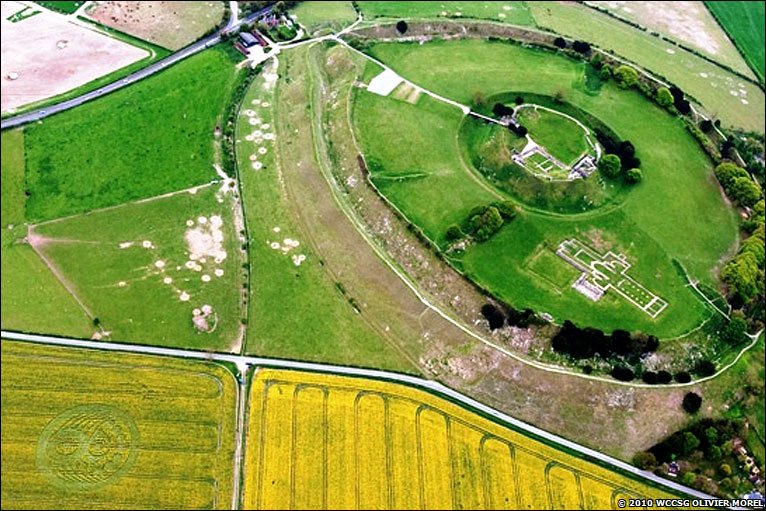

Pat – UK Crop Circle Tours
HisTOURies UK – The Best Tours in Wessex
Archive for the ‘UK Tourism updates’ Category
Wiltshire Crop Circle – 1st for 2010
Posted in England facts, Funny, sightseeing tours, Stonehenge, Stonehenge private tours, UK Tourism updates, Wiltshire, Wiltshire Crop Circles on May 11, 2010| Leave a Comment »
Salisbury Cathedral and the Pillars of the Earth
Posted in british history, England facts, History, Salisbury Cathedral, sightseeing tours, Stonehenge private tours, UK Tourism updates, Wiltshire on May 9, 2010| Leave a Comment »
Since its initial publication in 1989 The Pillars of the Earth has been a hugely popular book at Salisbury Cathedral. It is full of drama and intriguing characters but it is also packed with carefully researched historical detail and lovingly tells the story of the building of a beautiful medieval cathedral not unlike Salisbury. The fictitious Kingsbridge created by Ken Follett is in the West Country, not far from the real city of Salisbury, early in the book Tom Builder even seeks work at the original cathedral at Old Sarum. As The Pillars of the Earth became an international best seller we began to meet more and more visitors who had been inspired to visit us by the book, from the UK but also from America, Germany and many other countries.
Many of our clients have read this book before visiting the area which greatly  enhances their appreciation of Old Sarum and Salisbury Cathedral. The announcement that the book is to be turned into a feature lenght film this year is great news for tourism in Wiltshire and for those who have visited or toured with us in the past. Please take the time to read Ken Follet’s blog.
In 2008, as Salisbury was in the midst of celebrating its 750th anniversary year, Tandem Communications made contact with exciting news about a film of the book. A visit to Salisbury led to closer links, special effects shooting at the Cathedral and eventually a partnership. This section of our website holds a wealth of information about the film including images, video diaries and Ken Follett’s blogs. It will build as the international TV screening of the 8 hour film – starring Ian McShane, Rufus Sewell, Matthew Macfadyen, Eddie Redmayne, Hayley Atwell, Sarah Parish, Donald Sutherland, Alison Pill and Gordon Pinsent – moves closer.
The Salisbury Link to The Pillars of the Earth
Salisbury Cathedral was built in just 38 years in the 13th Century. This was quick for a medieval cathedral, and took place less than 100 years after the fictional Kingsbridge Cathedral was built in a similarly rapid timescale. The two buildings demonstrate a wealth of architectural parallels, notably the Gothic arches and rows of narrow, pointed ‘lancet’ windows, and Ken Follett has written about how Salisbury Cathedral was one of his inspirations as he researched The Pillars of the Earth.
The director of The Pillars of the Earth, Sergio Mimica-Gezzan, visited Salisbury Cathedral in 2008 and spent time taking detailed notes about the building as well as receiving input from our Consultant Archaeologist, Tim Tatton Brown. Special effects photographers followed in October 2009, meaning that elements of the real Salisbury Cathedral will be seen on screen, woven into the stunning location photography shot in Hungary and Austria, when the 8 hour film makes its TV debut in 2010.
A fabulous personal link between Cathedral and film became apparent as location shooting began when David Oakes, who plays the evil William Hamleigh, mentioned that as well as being educated at Bishop Wordsworth School in the Salisbury Cathedral Close he was also the son of a current Canon of Salisbury Cathedral – Jeremy Oakes!
The book revolves around the building of a beautiful medieval cathedral, built to the glory of God. As the modern day Salisbury Cathedral continues to the serve the purpose for which it was built, a current generation of craftsmen keeps the skills practiced by Tom Builder and Jack Jackson alive as they work to protect, restore and safeguard the building’s beauty for future generations.
Keep checking back as the airing of the film moves closer for more parallels, and some interesting differences, between the fictional Kingsbridge and the real Salisbury Cathedral!
http://www.the-pillars-of-the-earth.tv/
Nicholas
Salisbury and Stonehenge Tour Guide
Histouries UK – The Best Tours in British History
Happy St.Georges Day!
Posted in british history, England facts, History, UK Tourism updates, tagged celebrate, raise the flag, St.Georges Day history on April 23, 2010| Leave a Comment »
Why we should celebrate St George’s Day
St George’s Day should be the beginning of a rebellion against a teaching of history that reduces our past to a mere aperitif to modern times
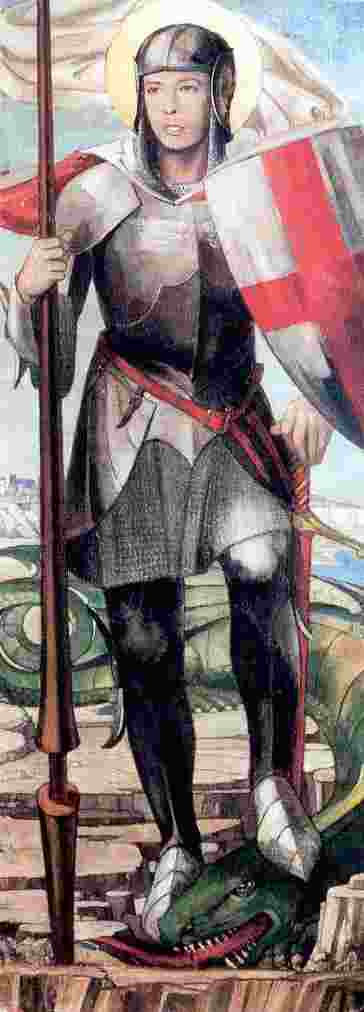
Saint George
April 23rd, the happy conjunction of St George’s Day and Shakespeare’s birthday should be a love feast for England to which all are invited.
We constantly underestimate the appetite of some of the most recent arrivals on our shores to understand our island story and be part of writing some new chapters. The festival of St George and Shakespeare is a good opportunity to trace the way we have come and to develop, in fresh ways, our common story
One of the great advantages of George as a patron saint is that so little is known of him beyond the fact that, whatever he was, he was not English. He was supposed to have been a soldier who died as a martyr for the faith at the hands of the Roman Emperor on April 23rd 304. His principal cult was centred on Lydda [Lod] a town, on the road from Joppa to Jerusalem. His shrine is revered by Christians and Muslims alike.
It is already clear that the 21st century will enforce a re-assessment of our place in the world and put a strain on our social cohesion. If, as the people of England, we are to play a creative part in this new world of promise and peril we should not be hobbled by any hankering for past glories but made free of the resources which come from rich memories.
If we have a richly stored memory of the narrative of English history – the comings and goings, the conflicts over principle, the struggles for identity, not least when we were a second-rate power on the extremity of Europe – then we shall have the possibility of responding creatively to the changes which this century will bring.
The notion that an erasure of memory leads to the growth of a marvellously tolerant society is nonsense. Eventually, there will be fierce resentment. If the virtues and the traditional culture of England become unmentionable by respectable politicians then the symbols of Englishness will be appropriated by those who have only the slightest grasp of the rich story they claim as their own.
To be genuinely hospitable one must have a home. A genuine narrative of English history with its Celtic; Danish; Norman; Jewish; Huguenot; Afro-Caribbean; Scots and Irish and now Muslim enrichments is a corrective to any exclusive racial cult.
St George’s Day should be the beginning of a rebellion against a teaching of history that reduces our past to a mere aperitif to modern times; a brief ascent to the pinnacle of enlightenment on which we are currently supposed to be standing.
I was deeply shocked recently to inspect the GCSE history syllabus which had been inflicted upon one of my children. It was dominated by Twiggy and the Vietnam War with a brief excursion into ancient history, represented by the Wall Street Crash of 1929.
The story of the dragon slain by St George and “which envenomed all the country” is recounted in Jacobus de Voragine’s Golden Legend, englished by William Caxton. Church authorities rejected the dragon as authentic history at a very early date. Pope Gelasius when he reformed the calendar in 494 classified George as one of those “whose acts are known only to God”. But symbolically and artistically the dragon was to have a great future.
The dragon which needs to be slain today is the dumbing down of our culture and the denigration of the story of the peoples of this island by those who cannot see anything good beyond the narcissistic annals of the sensitive self.
Despite recent debates about his precise birthday, April 23rd is also the traditional day for celebrating Shakespeare; part of the birthright of all English speakers. It is good to see that there is no reticence about this subject in Stratford upon Avon where a three day party for the bard is being planned.
Obviously much more is known about William Shakespeare than about St George but in many ways he is even more of an enigma. The compassionate complexity of his genius is such that he is constantly enlisted as a partisan for all kinds of incompatible causes. The history plays amply demonstrate his appreciation of the deceitfulness of political bombast but he put into the mouth of the dying John of Gaunt patriotic words which every school child knew before the ban on learning poetry by heart made a void in our inner spaces. What kind of sectarian loves will occupy the vacuum if we are not able to celebrate “this blessed plot, this earth, this realm, this England”?
Thank God we are the heirs to Shakespeare’s comprehensive work. Simply rehearsing bland universals like “tolerance”, admirable though they are, or intoning various abstract synonyms for “fairness” cannot engage our affections or offer a cordial for drooping spirits. Abstract principles gain the power to transform lives when they are married to examples and embedded in stories which convey some of the energy and ambiguity of real life.
The point is that we do not require a univocal idealization of our country or a roseate view of English history as some kind of cross-gartered rural idyll. But our children deserve a rich account of the narrative of England which will give them the resources to make an informed and original response to the 21st century. They need a narrative of England which does not palliate the crimes and injustices; does not edit out the debates between Catholics and Protestants, Anglicans and Puritans, the argument between the followers of Hobbes and the protagonists of Locke but which also insists on the glory and the grit of the Northern industrial towns; the cosmopolitan wonder of mercantile London and the hard earned ease of the suburbs.
I hope that we shall hang out our flags on April 23rd and plan for more pageants and parties in the years to come. The story goes on, neither confined to the day before yesterday nor starting now. Just as in the past, newer arrivals are a vital part of the new chapters which are being added. If we fail to work at constructing a common story which does justice to our rich and varied inheritance then we shall face a sectarian future.
“I see you stand like greyhounds in the slips,
Straining upon the start. The game’s afoot:
Follow your spirit: and, upon this charge
Cry, God for Harry! England and St George!”
The Rt Rev Dr Richard Chartres is Bishop of London
Nicholas – Salisbury and Stonehenge Tour Guide
HISTOURIES UK TOURS – Bringing History alive
Celebrate St. George’s Day!
Posted in british history, England facts, Funny, History, UK Tourism updates, tagged 2010, April 23rd, brityish tours, sain george, uk events on April 21, 2010| Leave a Comment »
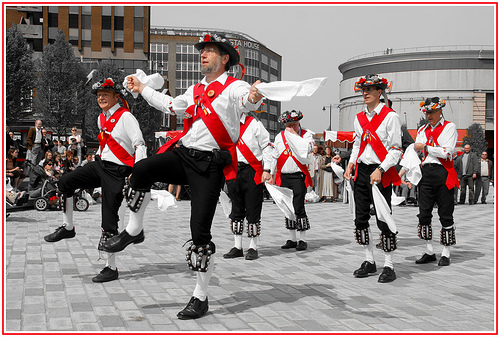
Morris Dancers
England lags far behind the rest of Europe in the number of bank holidays we get. A bank holiday on Saint Georges Day would be a great opportunity for all the English (regardless of colour or religion) to recognise what binds us together – instead of concentrating on our differences.
Everything from football to fish & chips, and cricket to curry could be celebrated on our national day.
Northern Ireland already has a bank holiday on St. Patrick’s Day, the Scottish Parliament has introduced a voluntary Bank Holiday on St. Andrew’s Day and the Welsh Assembly agree that St. David’s Day should be a holiday.
Help us persuade the government to give England a bank holiday on St Georges Day. Book the day off work on Friday 23 April, 2010. If we all take a holiday on the same day it will send a powerful message to those in charge.
Celebrate St. Georges Day with friends and family.
Click here to sign our pledge to support a bank holiday on St Georges Day. Thank you.
Some St George’s Day events 2010
If you’re looking for ideas then look no further. Scroll down for a list of great events taking place around the English regions on St George’s Day this year and find out more about the some of the history and legend surrounding St George.
South West
Yate Heritage Centre, South Gloucestershire

Kick St. George’s Day off with a procession, starting at 10:15am on the April 24. After the procession there will be folk singers and musicians, Morris dancing, storytelling, brass bands, a special rugby tournament, art and sport awards, craft workshops, games, petanque, face painting, craft stalls and food at venues around Yate & District Heritage Centre, St. Mary’s Church, the White Lion and St. Mary’s School.
Heart of England
Tamworth Castle, Staffordshire
 Mark St. George’s Day with a medieval extravaganza at Tamworth Castle. Witness soldiers preparing for battle, lords and ladies going about their daily lives and servants keeping the household running. There’ll be demonstrations, living history and arts and crafts events to enjoy.
Birmingham’s St George’s Day Celebrations
 Celebrate St. George’s Day with music, dance, children’s entertainment and food and drink stalls including a hog roast. At the Victoria Square stage you’ll find one of England’s finest brass bands. There’s also folk music and a tribute band to Roxy Music as well as live music from local band Deluka. There’ll be an English market selling traditional arts and crafts.
East Midlands
St. George’s Festival, Leicester City Centre
 The Leicester St. George’s Festival celebrates the old and the new with a fun-filled weekend of activities and events. Celebrations start at Leicester Market on April 23, followed by the Family Festival on Saturday 24 at Orton Square and ending with the Annual Parade on Sunday 25.
South East
Crofton Lions Festival of St. George, Stubbington Green & Recreation Ground, near Portsmouth
 Join Town Criers calling for a Loyal Toast to mark Queen Elizabeth II’s birthday on April 21. On the 24 there’ll be a Village Fayre, which will include the WEOROD Living History: Early Medieval Encampment. There will also be combat displays, archery, riding, traditional crafts, Morris dancing, Turkish dancers, a jester, Punch & Judy shows and hog roasts. If you still want more, there’ll be fancy dress competitions, a painting competition and a photographic display of ‘Images of England’.
St. George’s Weekend & Grand Concert, Cowes, Isle of Wight
 Enjoy a grand Last Night of the Proms style concert at Cowes Yachthaven Events Centre on Friday evening April 23 followed by a weekend of family fun. With a Fancy Dress Parade from East Cowes to Northwood Park, Cowes, marching bands, dancing displays, Punch and Judy Show, Tug of War and food stalls, they’ll be plenty to keep you occupied. On Sunday, there’s a display of Classic Cars and Motorbikes.
London
Trafalgar Square
 Join Londoners as they gather to celebrate in Trafalgar Square. They’ll be live bands and street entertainers putting on a very English display complete with food stalls. With Shakespeare’s Birthday on the same day, head across the river to the Globe Theatre for workshops and interactive fun and games.
St. George’s Day Rugby, Twickenham Stadium
 London Wasps will battle against Bath in this celebratory fixture at Twickenham. Through Wasps official charity, the Dallaglio Foundation, the St. George’s Day Game will raise money for Help for Heroes, an organisation that supports service personnel injured in combat.
North West
St. George Festival, Albert Square, Manchester City Centre
 With a mixture of entertainment, food, market stalls and music to celebrate England’s patron saint, this three-day event promises something for everyone. The festival starts on St. George’s Day – April 23 and runs through to Sunday 25.
North East
The Rhythm Kings British Jazz, various locations in North Tyneside
 Catch up with The Rhythm Kings as they play classic traditional English jazz for St. George’s Day.
Find them at North Shields (Bedford Street) between 10am and 11am, at Wallsend (bandstand, outside the Forum) 12.30pm-1.30pm, and at Whitley Bay (town centre) 3pm-4pm, on Saturday April 24.
Yorkshire
St George Tournament & Festival, Morley, Leeds
 With a knight on horseback, re-enactments of battles, falcon displays, a market, 100 long-bow archers, tug of war, vintage cars and a fairground, this event promises to offer something for everyone. The event starts Saturday, April 17 and ends Sunday, April 18.
George – London Tour Guide
Histouries ~ UK Tours ‘Bringing History alive’
St Georges Day – April 23rd 2010
Posted in british history, England facts, Funny, History, UK Tourism updates, tagged dragon, england, pagan, patriotic, saint george and the dragon, st george on April 19, 2010| Leave a Comment »
As St Georges Day approaches I thought we would explore the history this week and ’10 Ways to celebrate St Georges Day’
A History of St. George
Who was St George? What is myth and what is fact? Did he really slay the Dragon? Why is he such a popular Saint, celebrated in so many Countries, Races, Religions and Organisations?
The celebration of St George’s Day is currently fairly low key in England and much more celebrated elsewhere. However, the Society and its members are clearly succeeding in their constant efforts to revive St. George’s Day as the day on which to celebrate being English.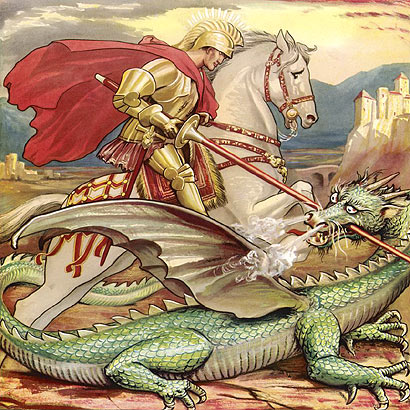
There are many legends in many cultures about St. George, but they all have a common theme; he must have been an outstanding character in his lifetime, for his reputation to have survived for almost 1,700 years!
Most authorities on the subject seem to agree that he was born in Cappadocia in what is now Turkey, in about the year 280 AD. It is probable that from his physical description, he was of Darian origin, because of his tall stature and fair hair. He enlisted into the Cavalry of the Roman Army at the age of 17, during the reign of the Emperor Diocletian and very quickly established a reputation amongst his peers, for his virtuous behaviour and physical strength; his military bearing, valour and handsome good looks.
He quickly achieved the rank of Millenary or Tribunus Militum, an officer’s rank roughly equivalent to a full Colonel, in charge of a regiment of 1,000 men and became a particular favourite of his Emperor. Diocletian was a skilled military tactician and strict disciplinarian, who set himself the task of rejuvenating the morale of the citizens of Rome by reviving the prevailing traditions and paganism of Rome. It may be recalled that this was a time of high inflation and civil unrest and one outcome of this was the increasing influence of Christianity.
Diocletian’s second in Command was Galerius, the conqueror of Persia and an avid supporter of the Pagan religion. As a result of a rumour that the Christians were plotting the death of Galerius, an edict was issued that all Christian Churches were to be destroyed and all scriptures to be burnt. Anyone admitting to being a Christian, would lose his rights as a citizen, if not his life.
As a consequence, Diocletian took strict action against any alternative forms of religion in general and the Christian faith in particular. He achieved the reputation of being perhaps the cruellest persecutor of Christians at that time.
Many Christians feared to be loyal to their God; but, having become a convert to Christianity, St. George acted to limit the excesses of Diocletian’s actions against the Christians. He went to the city of Nicomedia where, upon entering, he tore down the notice of the Emperor’s edict. St. George gained great respect for his compassion towards Diocletian’s victims.
As news spread of his rebellion against the persecutions St. George realised that, as both Diocletian and Galerius were in the city, it would not be long before he was arrested.He prepared for the event by disposing of his property to the poor and he freed his slaves.
When he appeared before Diocietian, it is said that St. George bravely denounced him for his unnecessary cruelty and injustice and that he made an eloquent and courageous speech. He stirred the populace with his powerful and convincing rhetoric against the Imperial Decree to persecute Christians. Diocietian refused to acknowledge or accede to St. George’s reasoned, reproachful condemnation of his actions. The Emperor consigned St George to prison with instructions that he be tortured until he denied his faith in Christ.
St George, having defended his faith was beheaded at Nicomedia near Lyddia in Palestine on the 23rd of April in the year 303 AD.
Stories of St. George’s courage soon spread and his reputation grew very quickly. He soon became known in Russia and the Ukraine as the Trophy Bearer and his remains are said to have been buried in the church that bears his name in Lydda. However, his head was carried to Rome, where it was preserved in the Church that is also dedicated to him.
St George was beatified by the Roman Catholic Church and is recognised in the liturgy of the Russian Orthodox and Greek Orthodox Churches as well as the Roman Catholic Church. He has been revered in the Ukraine since Christianity was established in 988 AD by Volodymyr the Great the Prince of the Kyivan empire. The Romanesque Monastic order in Prague established St. George’s Church in the Castle in the year 920AD and in the year 1119 AD the Cathedral of St George was founded in Novgorod. His reputation for virtue and chivalrous conduct became the spiritual inspiration of the Crusaders and by this time the pennant or flag with a red cross on a white or silver background became prominent as a means of recognition by English Knights. It was also worn on breast plates.
In the year 1348 King Edward Ill established the Knights of the Garter, which is the oldest order of Chivalry in Europe. The Order of the Garter was dedicated to the Blessed Virgin Mary, Edward the Confessor and St George. The Insignia of the order consists of a collar and badge appendant known as the George, the Star, the Garter and the Sash with the Investment Badge called the lesser George. This is a gold and richly enamelled representation of St George on horseback slaying the dragon.
A similar representation of St George can be seen in our Armorial Bearings and in the collar and appendant that officers of The Royal Society wear.
In 1352 the College of St George was established in Windsor, with 6 Chorister boys and since then, St George’s school has played an important role in the daily worship and on State Occasions in the Queen’s Free Chapel of St George in Windsor Castle. By providing free education and sustenance for the boys, a priceless musical inheritance in choral worship has been established and their numbers increased until the Plague struck in 1479 when the numbers were reduced from thirteen to six again but recovered to thirteen by Michaelmas in 1482.
It was in the year 1415 AD that St. George became the Patron Saint of England when English Soldiers under Henry V won the battle of Agincourt.
In 1497 in the reign of Henry VIII, the pennant of the Cross of St. George was flown by John Cabot when he sailed to Newfoundland and it was also flown by Sir Francis Drake and Sir Walter Raleigh. In 1620 it was the flag that was flown by the Mayflower when the Pilgrim Fathers arrived in Plymouth Massachusetts. It is also the flag of the Church of England and as such is known throughout Christendom.
In the year 1728 AD Maximilian II Emanuel, the Elector of Bavaria, established by Papal Bull The Royal Military Order of St George, as a means of honouring distinguished military service for it was clear that by this time, his name had become associated with the purity of spirit, selfless devotion to duty and boundless courage and valour in the face of adversity. In more recent times, St George was chosen as the patron saint of Scouting, because of the ideals that he represents and it is interesting to note that he is also the Patron Saint of Barcelona in Catalonia, Aragon, Russia, Bavaria, Beirut, Czechoslovakia, Portugal, Lithuania and Hungary, to name but a few. Virtually every country in Europe and the Commonwealth has a church dedicated to St. George.
During World War 2 King George V1 established the George Cross for outstanding acts of Civilian Valour and one of the earliest recipients was the Island of Malta, for its outstanding courage in~ the face of the constant bombardment by the Italian and German Airforce. It is, coincidentally, the Island that was so closely associated and governed by the Crusaders who arrived from the Island of Rhodes in the 14″ Century, following their 200 year war with the Turks.
The legends about St George spread far and wide and it was claimed that near the town of Silene in Libya, a dragon dwelt, keeping the population in terror. To satiate him the population tethered an animal, until they had no more. They then provided human sacrifices and in ultimate desperation, a young princess was selected, the king’s daughter named Cleolinda. The story then relates how St. George rode up on his white charger, dismounted and fought the monster on foot; until it eventually succumbed. He then dragged the dying monster into the city, using the girdle of the Princess and slew the dragon in front of the people. St. George was greeted as their saviour and the King offered him a bag of gold as a reward for saving his daughter. This he refused and asked that it be given to the poor.
The story is a powerful allegory, emblematic of the triumph of good over evil; but it also teaches of enduring Christian faith in the extreme and the trust that at all times should be placed in the Almighty by the invocation of the name of St. George, Soldier, Saint and Martyr.
In the 13″ Century, there was a Guild of St. George to which the Honourable Company of Pikemen were related before evolving into the Honourable Artillery Company. Many regiments of the Army still celebrate St. George’s Day with great ceremony.
In Barcelona, it is traditional to give a book as a token of St. George’s Day, whilst in Russia and the Ukraine the day is celebrated by Spring Festivals and Picnics to celebrate the end of winter. In the world of Scouting, it is the first day for camping.
David – Bath and Salisbury Tour Guide
HISTOURIES UK – The Best Tours in British History
Heathrow Airport Closed – Volcanic Ash
Posted in England facts, History, UK Tourism updates, tagged act of god, customer refunds, customer service, heathrow airport, iceland, london hotels, london tour operators, travel compensations, uk airports, volcanic ash on April 18, 2010| Leave a Comment »
Volcanoes Pose a Threat to Aircraft Safety
“London travel industry and travel trade press praise ‘Histouries UK’ for swift customer refunds and excellent customer service”*
The most feared damage to planes is volcanoes and the resulting smoke. The smoke emerging from the volcanoes can damage the air frame and the engine of the plane because it contains many small rock particles and glass. They can fretfully choke the modern avionics. The volcanic smoke can polish the wind screen of the plane completely as a result the pilot may lose visibility.
If we peep into the history of volcanoes and plane crashes we would come to know that this interaction took place almost 80 times in the air crash history. The damages caused by the volcanic clouds resulted in taking lives of more than 500 people in two Boeing 747 flights. These historical reasons are the base of delaying of flights in Northern Europe, as the volcanic clouds have surrounded Iceland and other areas today causing the passengers to wait.
The presence of volcanic smoke in the troposphere causes the jet engine to cease entirely and leaves the passengers and the pilot at the mercy of air. The fear of volcanoes has doubled with the increase in the air traffic. The figures say that air traffic is increasing at a rate of 5 percent per year. On the other hand the uncertainty attached to the volcano eruption has added fuel to the fire
*Travel Compensation
“London Travel industry praises Histouries UK for excellent customer service”
Unlike many unscrupulous London tour operators we have refunded all customers in FULL if they were unable to join any of our tours due to flight disruptions at UK airports this past week and we will continue to offer ‘half price’ sightseeing tours to those people stuck at airports and unable to fly home. We hope the situation improves soon and we look forward to welcoming those clients who will be arriving later this week.
The Manager
HISTOURIES UK – The Best Tours in History
London Olympic Games 2012
Posted in England facts, History, UK Tourism updates, tagged 2012, london events, london olympics, london tours, olympic tours, olympic venue, sports on April 12, 2010| Leave a Comment »
 The 2012 Summer Olympic Games will be held in London from 27 July to 12 August 2012, followed by the 2012 Paralympic Games from 29 August to 9 September.
This will be the third time London has hosted the games having also done so in 1908 and 1948. Discover more about the history of London Olympics (see below).
The 2012 Olympics will take place in a host of new venues as well as using existing and historic facilities. Many of the new facilities will be reused and the plans are part of the regeneration of Stratford and Lower Lea Valley in east London. More Olympic venue information.
The London Organising Committee for the Olympic Games is charged with running the games following the success of the bid and is chaired by Lord Coe. Construction of the venues and infrastructure is in the hands of the Olympic Delivery Authority (ODA). See our Olympics Structure and Finance page for more details.
The London 2012 Olympic logo has created considerable controversy and the spiralling cost of the games is likely to be a ongoing problem.
History of the Olympics in London
A time-line of events leading up the London 2012 Olympic Games
1908 |
Summer Olympics held in LondonThe Games of the IV Olympiad) were the third to be hosted outside of Athens and were scheduled to take place in Rome, but the eruption of Mount Vesuvius on 7 April 1906 required the Italian Government to redirect funds away from the Olympics. The events took place between 27 April 1908 and 31 October 1908, with 22 nations participating in 110 events. The British team easily topped the unofficial medal count, finishing with three times as many medals as the second-place United States. |
1944 |
1944 Summer Olympics CancelledThe Summer Olympics of 1944 were to be held in London having been awarded in 1939. However, they were cancelled due to World War II. In lieu of the Olympics, a small celebratory sporting competition was held in Lausanne, at IOC HQ. |
1948 |
The 1948 Summer OlympicsThe 1948 Games were the first to be held after World War II, with the 1944 Summer Olympics having been cancelled due to the war. 59 nations (Germany and Japan had not been invited) competed in 136 events between 29 July 1948 and 14 August 1948. due to security reasons. British athletes finished 12th in the unofficial medal count with only 23 medals. |
2000 |
The UK BidsIn December 2000 a report from the British Olympic Association was shown to Government ministers. They had been working on the bid since 1997. |
2005 |
The London 2012 Olympic bid was announced as the winner of the bidding process on 6 July 2005. |
2008 |
2008 Summer OlympicsTo be held in Beijing, China between August 8, 2008 and August 24, 2008. Concerns have been raised that many events will be compromised by problems with pollution and air quality. |
2012 |
2012 Summer OlympicsThe Games will take place between 27 July 2012 and 12 August 2012. 2012 Summer Paralympic GamesThe fourteenth Paralympics and will take place between 29 August 2012 and 9 September 2012 at the Summer Olympics venues in London. |
Olympics 2012 Structure and Finance Links
How the Olympic Games in London are being managed financed
BOA
The British Olympic Association works with the Olympic Governing Bodies and selects the team from the best sportsmen and women in the UK for the the 28 summer and 7 winter Olympic sports. The BOA is depends on commercial sponsorship and fund raising income and is independent of the UK Government.
DCMS
The Department for Culture, Media and Sport are the lead Government department for the 2012 Olympic Games and Paralympic Games, working closely with the Olympic organisations and other Government departments to deliver the 2012 Games, ensure that they leave a lasting legacy and create maximum benefits for London and the UK as a whole.
LOCOG
The London Organising Committee for the Olympic Games is charged with running the games following the success of the bid and is chaired by Lord Coe.
ODA
The Olympic Delivery Authority is responsible for the construction of the venues and infrastructure to support the 2012 Games.
www.london2012.com/en/ourvision/ODA/
We will keep you up to date with all the developments of the London Olympics 2012
We have already recieved multiple bookings for private bespoke tours throughout 2012 so if you are visiting during that period then plan ahead and book well in advance – you have been warned!! We can help with advance tour reservations, secure transport arrangements and all your travel needs.
Nicholas – British Tour Guide
HISTOURIES UK – The Best Tours in History
Stonehenge Private Access Tour at Sunrise – Beyond the fences
Posted in History, Stonehenge, Stonehenge private tours, UK Tourism updates, tagged english heritage, guided trips, inner circle, private access tours, salibury guided tours, Stonehenge on April 12, 2010| Leave a Comment »
Thought I would upload these images that I took (very early) this morning from the inner circle of Stonehenge. Sunrise was at 6.40 am and we had perfect weather. I was with a family from Ohio who were overwhelmed with the experience. We then went onto visit Avebury Stone Circle, Silbury Hill and West Kennet long Barrow. A great day was had by all


Mike – Stonehenge Tour Guide
HISTOURIES UK – The Best Tours in History
ENGLAND MY ENGLAND
Posted in british history, England facts, Funny, History, UK Tourism updates, tagged british, british tours, england, europe, goverment, queen and country, st george, union jack on April 5, 2010| Leave a Comment »
Goodbye to my England, So long my old friend
Your days are numbered, being brought to an end
To be Scottish, Irish or Welsh that’s fine
But don’t say your English, that’s way out of line.
The French and the Germans may call themselves such
So may Norwegians, the Swedes and the Dutch
You can say you are Russian or maybe a Dane
But don’t say your English ever again
At Broadcasting House the word is taboo
In Brussels it’s scrapped. In Parliament too
Even Schools are affected. Staff do as they’re told
They must not teach children about England of old.
Writers like Shakespeare, Milton and Shaw
The pupils don’t learn about them anymore
How about Agincourt, Hastings, Arnhem or Mons ?
When England lost hosts of her very brave sons.
We are not Europeans, how can we be ?
Europe is miles away, over the sea
We’re the English from England, let’s all be proud
Stand up and be counted – Shout it out loud!
Let’s tell our Government and Brussels too
We’re proud of our heritage and the Red, White and Blue
Fly the flag of Saint George or the Union Jack
Let the world know – WE WANT OUR ENGLAND BACK!!
IF YOU ARE ENLISH, PASS IT ON
Copyright 2010 – Histouries UK – British Tour Guide

St George
British Summer Time begins……
Posted in british history, England facts, History, UK Tourism updates, tagged british summer time, bst on March 29, 2010| Leave a Comment »
Changing the clocks
In the UK, we all change our clocks and watches by one hour, twice a year.
Last Sunday in March
We add an hour and go onto what is called British Summer Time (BST).Last Sunday in October
We put our clocks back one hour and adhere to Greenwich Mean Time (GMT).
Why do we change our clocks?
We’ve been changing our clocks forwards and backwards in the UK since 1916. It’s all to do with saving the hours of daylight, and was started by a man called William Willett, a London builder, who lived in Petts Wood in Kent (near our school).
William Willett first proposed the idea of British Summer Time in 1907 in a pamphlet entitled ‘The Waste of Daylight’. Willett had noticed that the summer mornings light was wasted while people slept, and that the time would be better utilised in the afternoon by putting the clocks forward. After campaigning for years the British Government finally adopted the system a year after Willett’s death
What time do the clocks change?
The clocks are always changed at 01:00 GMT (02:00 BST).
In the Autumn (October), as we are on BST (British Summer Time) before the clocks change, we change the clocks at 02:00.
In the Spring (March) we are already on GMT so change the clocks at 01:00
Henry – Stonehenge Tour Guide
Histouries UK – Travel through time on one of our tours
Blog Archive
-
HisTOURies U.K Tours
- There’s more to this English county than just Stonehenge. Visit Wiltshire.
- Private Driver Guided Stonehenge Tours Departing from Salisbury.
- Private Driver-Guided Stonehenge Sightseeing Tours Departing from Bath.
- Stonehenge special access guided inner circle trips from London, Bath or Salisbury. Experience Stonehenge at dawn or dusk with a private VIP tour!
- Visiting Stonehenge? Our expert tour guides can turn the amazing experience of seeing the stones for the first time, into an enlightening one.
-
HISTOURIES PAGES
HISTOURICAL BLOGS
- January 2025 (1)
- December 2024 (1)
- October 2023 (1)
- February 2022 (1)
- March 2021 (1)
- December 2019 (1)
- January 2019 (2)
- June 2018 (2)
- December 2017 (3)
- June 2017 (1)
- May 2017 (5)
- February 2017 (5)
- January 2017 (9)
- December 2016 (5)
- November 2016 (5)
- October 2016 (3)
- July 2016 (1)
- April 2016 (1)
- March 2016 (1)
- February 2016 (5)
- January 2016 (1)
- October 2015 (2)
- September 2015 (2)
- May 2015 (3)
- March 2015 (1)
- February 2015 (2)
- January 2015 (7)
- December 2014 (3)
- October 2014 (5)
- September 2014 (4)
- March 2014 (2)
- February 2014 (1)
- January 2014 (4)
- November 2013 (4)
- October 2013 (8)
- September 2013 (6)
- August 2013 (7)
- July 2013 (3)
- June 2013 (5)
- May 2013 (10)
- April 2013 (8)
- March 2013 (6)
- February 2013 (2)
- January 2013 (3)
- December 2012 (3)
- November 2012 (7)
- October 2012 (7)
- September 2012 (5)
- August 2012 (2)
- July 2012 (6)
- June 2012 (3)
- May 2012 (5)
- April 2012 (3)
- March 2012 (4)
- February 2012 (7)
- January 2012 (5)
- December 2011 (3)
- November 2011 (7)
- October 2011 (8)
- September 2011 (9)
- August 2011 (7)
- July 2011 (7)
- June 2011 (4)
- May 2011 (5)
- April 2011 (4)
- March 2011 (10)
- February 2011 (7)
- January 2011 (11)
- December 2010 (12)
- November 2010 (12)
- October 2010 (17)
- September 2010 (13)
- August 2010 (9)
- July 2010 (12)
- June 2010 (6)
- May 2010 (6)
- April 2010 (13)
- March 2010 (22)
- February 2010 (26)
HISTOURIES UK

STONEHENGE TOURS
March 2026 M T W T F S S 1 2 3 4 5 6 7 8 9 10 11 12 13 14 15 16 17 18 19 20 21 22 23 24 25 26 27 28 29 30 31  Visit London
- An error has occurred; the feed is probably down. Try again later.
 Wessex Guided Tours