Feeds:
Posts
Comments

Archive for the ‘wessex’ Category

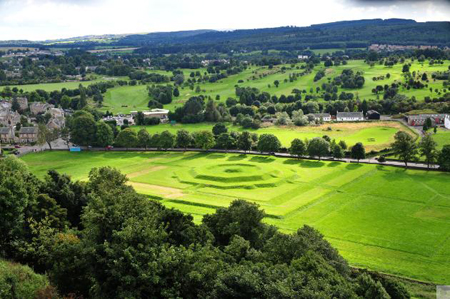
Archaeologists searching for King Arthur’s round table have found a “circular feature” beneath the historic King’s Knot in Stirling.

The King's Knot in the grounds of Stirling Castle

The King's Knot in the grounds of Stirling Castle

The King’s Knot, a geometrical earthwork in the former royal gardens below Stirling Castle, has been shrouded in mystery for hundreds of years.

Though the Knot as it appears today dates from the 1620s, its flat-topped central mound is thought to be much older.

Writers going back more than six centuries have linked the landmark to the legend of King Arthur.

Archaeologists from Glasgow University, working with the Stirling Local History Society and Stirling Field and Archaeological Society, conducted the first ever non-invasive survey of the site in May and June in a bid to uncover some of its secrets.

Their findings were show there was indeed a round feature on the site that pre-dates the visible earthworks.

Historian John Harrison, chair of the SLHS, who initiated the project, said: “Archaeologists using remote-sensing geophysics, have located remains of a circular ditch and other earth works beneath the King’s Knot.

“The finds show that the present mound was created on an older site and throws new light on a tradition that King Arthur’s Round Table was located in this vicinity.”

Stories have been told about the curious geometrical mound for hundreds of years — including that it was the Round Table where King Arthur gathered his knights.

Around 1375 the Scots poet John Barbour said that “the round table” was south of Stirling Castle, and in 1478 William of Worcester told how “King Arthur kept the Round Table at Stirling Castle”.

Sir David Lindsay, the 16th century Scottish writer, added to the legend in 1529 when he said that Stirling Castle was home of the “Chapell-royall, park, and Tabyll Round”.

It has also been suggested the site is partly Iron Age or medieval, or was used as a Roman fort.

Extensive work on the royal gardens was carried out in the early 17th century for Charles I, when the mound is thought to have taken its current form.

The first known record of the site being called the King’s Knot is from 1767, by which time it was being leased for pasture.

Locals refer to the grassy earthworks as the “cup and saucer”, but aerial photographs taken in 1980 showed three concentric ditches beneath and around the King’s Knot mound, suggesting an earthwork monument had preceded it.

The new survey — funded by Historic Scotland and Stirling City Heritage Trust — used the latest scientific techniques to showing lost structures and features up to a metre below the ground.

It also revealed a series of ditches south of the main mound, as well as remains of buildings, and more recent structures, including modern drains which appear at the northern end of the gardens.

Mr Harrison, who has studied the King’s Knot for 20 years, said: “It is a mystery which the documents cannot solve, but geophysics has given us new insights.

“Of course, we cannot say that King Arthur was there, but the feature which surrounds the core of the Knot could explain the stories and beliefs that people held.”

Archaeologist Stephen Digney, who coordinated the project, said: “The area around Stirling Castle holds some of the finest medieval landscapes in Europe.

“This investigation is an exciting first step in a serious effort to explore, explain and interpret them. The results so far suggest that Scotland’s monarchs integrated an ancient feature into their garden, something we know happened in other countries too.

“We are looking forward to the next stage in September when we hope to refine some of the details.”

Dr. Kirsty Owen, Cultural Heritage Adviser at Historic Scotland, added: “The project has the potential to add to our knowledge of the landscape context of the medieval and early modern occupation of Stirling Castle.

“The ditches identified may intriguingly be part of historically documented earlier garden features, or if prehistoric in origin could add to our scant knowledge of prehistoric activity at Stirling Castle.

“We look forward to seeing the results of the next phase of investigations.”Futher work including a ground-penetrating radar survey, is now planned to take place next month to find out more.

A small display of the interim results can be seen close to the site at the Smith Museum.

Wessex Tour Guide – Mystical Landscape, Magical Tours
HisTOURies UK – Private Guided Tours

Read Full Post »

CELTIC AND ROMAN TOWNS

The Celts who lived in Britain before the Roman invasion of 43 AD could be said to have created the first towns. Celts in southern England lived in hill forts, which were quite large settlements. (Some probably had thousands of inhabitants). They were places of trade, where people bought and sold goods and also places were craftsmen worked. The Romans called them oppida.
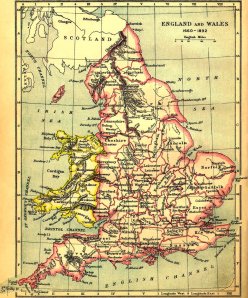
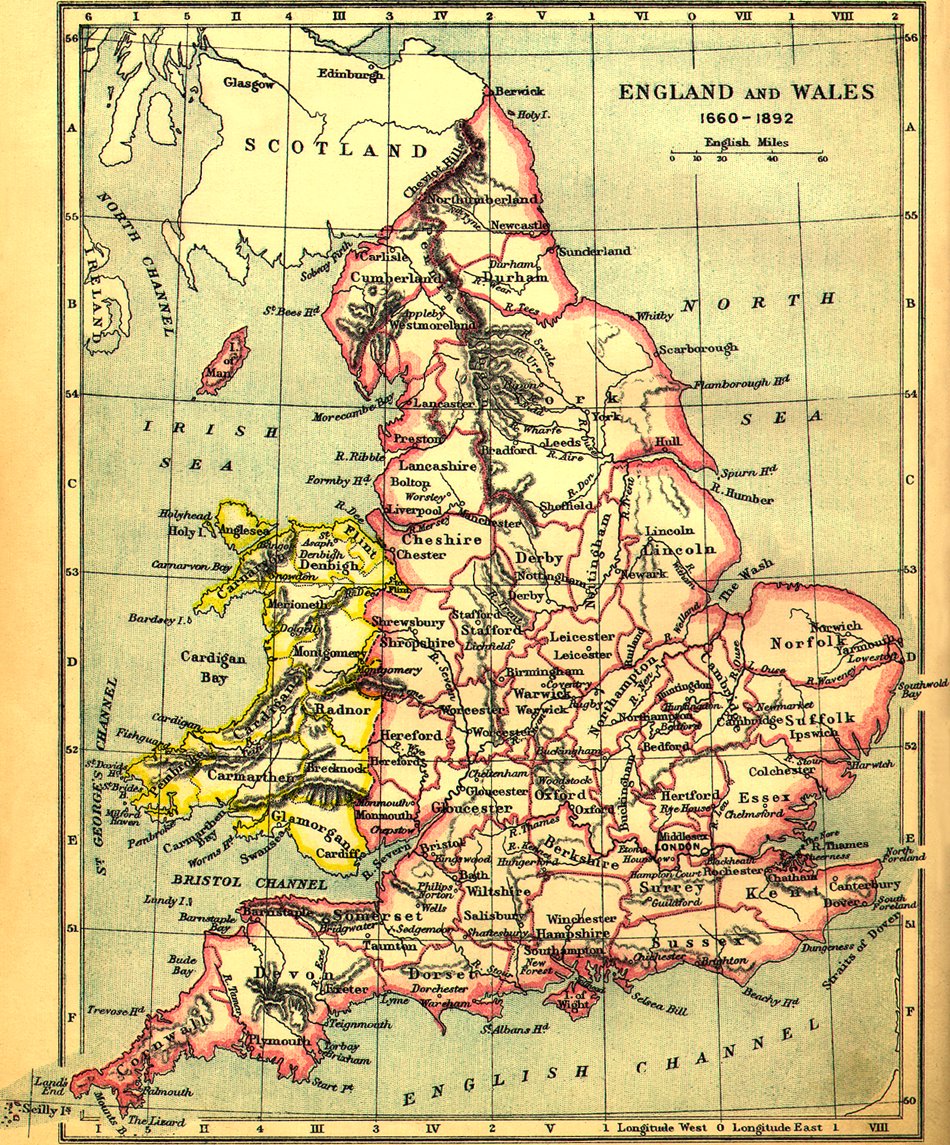
Old England MapHowever the Romans created the first settlements that were undoubtedly towns. Some Roman towns grew up near forts. The soldiers provided a market for the townspeople’s goods. Some were founded as settlements for retired legionaries. Some were founded on the sites of Celtic settlements.

Roman towns were usually laid out in a grid pattern. In the centre was the forum or market place. It was lined with public buildings.

Life in Roman towns was highly civilised with public baths and temples. At least some of the buildings were of stone with glazed windows. Rich people had wall paintings and mosaics.

However Roman towns would seem small to us. The largest town, London, may have had a population of only 35,000. The next largest town was probably Colchester with a population of around 12,000. Roman Cirencester may have had a population of 10,000. Most towns were smaller. Roman Chichester probably only had around 3,000 to 4,000 inhabitants.

Then in the 4th century Roman towns declined and in the 5th century town life broke down.

SAXON TOWNS

From the 5th century Angles, Saxons and Jutes invaded England. At first the invaders avoided living in towns. However as trade grew some towns grew up. London revived by the 7th century (although the Saxon town was, at first, outside the walls of the old Roman town). Southampton was founded at the end of the 7th century. Hereford was founded in the 8th century. Furthermore Ipswich grew up in the 8th century and York revived.

However towns were rare in Saxon England until the late 9th century. At that time Alfred the Great created a network of fortified settlements across his kingdom called burhs. In the event of a Danish attack men could gather in the local burh. However burhs were more than forts. They were also market towns.

Some burhs were started from scratch but many were created out of the ruins of old Roman towns. Places like Winchester rose, phoenix like, from the ashes of history.

TOWNS IN THE MIDDLE AGES

The thing that would strike us most about medieval towns would be their small size. By the time of the Domesday Book in 1086 London probably had a population of about 18,000. Winchester, the capital of England, probably had about 8,000 people. At that time a ‘large’ town, like Lincoln or Dublin had about 4,000 or 5,000 inhabitants and a ‘medium sized’ town, like Colchester had about 2,500 people. Many towns were much smaller.

However during the 12th and 13th centuries most towns grew much larger. (London may have had a population of around 45,000). Furthermore many new towns were created across Britain. Trade and commerce were increasing and there was a need for new towns. Some were created from existing villages but some were created from scratch. In those days you could create a town simply by starting a market. There were few shops so if you wished to buy or sell anything you had to go to a market. Once one was up and running craftsmen and merchants would come to live in the area and a town would grow.

In the Middle Ages most towns were given a charter by the king or the lord of the manor. It was a document granting the townspeople certain rights. Usually it made the town independent and gave the people the right to form their own local government.

In 1348-49 British towns were devastated by the Black Death. However most of them recovered and continued to prosper. Another danger in medieval towns was fire and many suffered in severe conflagrations.

ENGLISH TOWNS 1500-1800

In Tudor times towns remained small (although they were a vital part of the economy). The only exception was London. From a population of only about 60,000 or 70,000 at the end of the 15th century it grew to about 250,000 people by 1600. Other towns in Britain were much smaller. The next largest town was probably Bristol, with a population of only around 20,000 in 1600.

Nevertheless in the 16th century towns grew larger as trade and commerce grew. The rise in town’s populations was despite outbreaks of plague. It struck all the towns at intervals in the 16th and 17th century but seems to have died out after 1665. Each time it struck a significant part of the town’s population died but they were soon replaced by people from the countryside.

In the 18th century conditions in most towns improved (at least for the well off). Bodies of men called Improvement Commissioners or Paving Commissioners were formed with powers to pave, clean and light the streets (with oil lamps). Many towns also employed night watchmen. Most towns gained theatres and private libraries. However despite some improvements 18th century towns would seem dirty and crowded to us.

TOWNS IN THE 19TH CENTURY

From the late 18th century the industrial revolution transformed Britain. Many villages or small market towns rapidly grew into industrial cities. However, although most towns gained gas light in other ways conditions were appalling. They were dirty, overcrowded and unsanitary. Lack of building regulations meant poor peoples houses were often hovels. Not surprisingly British towns suffered outbreaks of cholera in 1832 and in 1848.

However in the late 19th century things improved. Most towns built sewers and created a clean water supply. New housing regulations meant that new houses were much better. Furthermore public parks and public libraries were created. At the end of the 19th century and the beginning of the 20th most towns changed to electric street lighting.

At the end of the 19th century transport in towns was improved. From c.1880 horse drawn trams ran in the streets of many towns. At the beginning of the 20th century they were replaced by electric trams. In the 1930s most trams were replaced by trolley buses (buses that ran on overhead lines). However by the late 1950s most trolley buses had been replaced by motor buses.

Meanwhile a new kind of town had arisen – the seaside town. At the end of the 18th century spending time by the sea became fashionable with the wealthy. At first only they could afford it but from the mid-19th century trains made it easier for poorer people to reach the seaside. From the 1870s bank holidays (and for some skilled workers paid annual holidays) made the day at the seaside popular and many resorts boomed.

TOWNS IN THE 20TH CENTURY

At the beginning of the 20th century councils began the work of demolishing the dreadful 19th century slums. They also began building council houses. The work of slum clearance continued in the 1920s and 1930s. More council houses were built at that time. However most of the houses built in between the wars were private.

The 1920s and 1930s were difficult ones for northern towns as the traditional industries such as coal mining, ship building and textiles all declined. They suffered mass unemployment. However in the Midlands and the South some towns prospered with new industries such as electronics and car making.

During the Second World War many British towns suffered severely from German bombing. So many people were made homeless that after the war ‘prefab’ houses were built. They were made in sections in factories and could be assembled in a few days.

In the 1950s, 1960s and 1970s slum clearance began anew. Vast swathes of old houses were demolished and replaced with council accommodation. Unfortunately much of it was in the form of high-rise flats, which suffered from social problems. In the late 20th century the emphasis changed from demolishing old houses to renovating them.

Furthermore following an act of 1946 new towns were built. Villages or small market towns were selected to take the ‘overflow’ populations of large cities like London. The new towns were greatly enlarged. New houses and factories were built to take the ‘immigrants’ from the big cities. It was the first time since the Middle Ages that large numbers of new towns were created. Among the new towns were Andover, Basingstoke, Crawley and Stevenage,

Meanwhile many town centres were ‘redeveloped’ in the 1960s and new shopping centres and car parks were built. Ironically at the same time increasingly strenuous efforts were made to protect old buildings.

In the late 20th century many northern towns suffered from the decline and even extinction of traditional manufacturing industries. However at the end of the century many managed to reinvent themselves and attract new service industries. In some towns trams were reintroduced.

British Tour Guide
HisTOURies UK The Best Tours in History

Read Full Post »
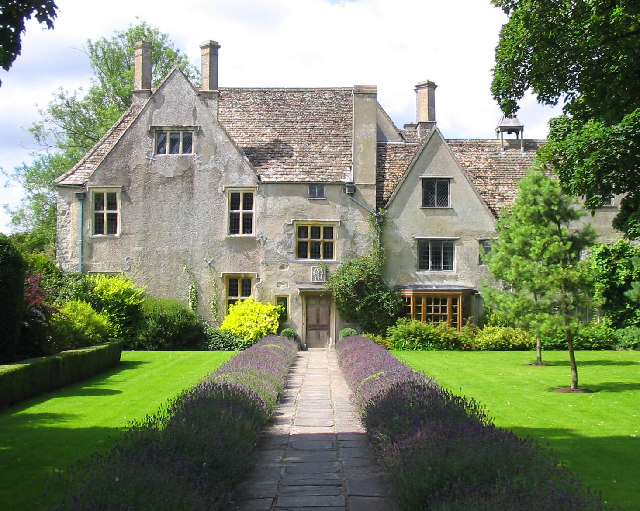
Penelope Keith hosts To The Manor Reborn at AveburyA manor house in Wiltshire is to be completely restored for a new BBC One series presented by Penelope Keith.

Avebury Manor House

Avebury Manor House

The four hour-long episodes will see the National Trust property Avebury Manor refurbished by a team of historians, experts, and volunteers.

Keith, who played snobbish aristocrat Audrey fforbes-Hamilton in the sitcom To The Manor Born, will be joined by Flog It! presenter Paul Martin.

To the Manor Reborn will be broadcast later in the year.

The series will follow the refurbishment of the 500-year-old property in Avebury as it is brought back to life.

Teams of craftsmen, furniture makers and interior design experts will restore the interior of the Grade I listed house to reflect its long history.

‘Push the boundaries’

BBC One controller Danny Cohen said: “Our partnership with the National Trust on this ambitious project encapsulates so many of the BBC’s ambitions.

“The channel aims to keep engaging audiences in new ways and this series offers them the chance to follow the story on screen, and to experience it first hand.”

Sarah Staniforth, the museums and collections director for the National Trust, said: “It is not only a unique opportunity to engage viewers in the history of interior design and architecture but is also a way for the trust to push the boundaries in bringing properties to life.”

Among the guests on To The Manor Reborn will be architectural expert Dan Cruickshank and gardener David Howard.

Avebury Manor will be closed for much of the year while the series is being filmed. It will be reopened as an “immersive experience” in the autumn.

Avebury Manor and Garden

An establishment of monastic origins, the present buildings dates from early 16th century with Queen Anne alterations and Edwardian renovations. The gardens are of an Edwardian style and features much topiary.

Link: http://www.nationaltrust.org.uk/main/w-vh/w-visits/w-findaplace/w-avebury/w-visit-avebury_filming-at-avebury-manor.htm

Wessex Tour Guide – The Best Tours in Ancient Histort
HisTOURies UK – Mystical landscape, magical tours

Read Full Post »

The ancient standing stones at Avebury, lie between Swindon and Devizes on the A4361. Avebury rings are a World Heritage site and attracts thousands of visitors annually, who are no doubt intrigued by the mystery that surrounds their construction.
Avebury Stone Circle
The henge is believed to date back to around 2600BC; just what motivated our ancestors to construct such an elaborate site and their ultimate purpose in doing so remains largely a mystery. It has been suggested (one of many theories) it may have been used as a place of worship and sacrifice. Some favour an astral observatory, difficult to prove I shouldn’t wonder, in view of the fact that many of the stones are missing and any alignment with the stars must be considered near impossible. Others believe it had a connection with Silbury Hill (see sidebar for more info)and was used to gauge the seasons for agriculture. Whatever the reasons for its construction, its true purpose still eludes archaeologists and scholars to this day.

It is unfortunate that not all of Avebury’s 154 sarsen stones (most likely quarried and transported on wooden rollers from the Marlborough hills) have survived. Of the three rings and the Avenue that make up the henge, only 36 stones are still standing. Many were destroyed or buried (some still are) in massive pits during the 14th century by devout local Christians because a) they believed them to be the harbingers of ill luck and b) to eradicate pagan worship from the monument.

It was during the 18th century that the stones came under attack once more, not from zealous Christians this time but from local construction workers who decided it would be a jolly good idea to utilizes the stones to construct several of the cottages in the village; the grand 15th century Tudor manor and the modernization of 12th century church of St. James. Some of these magnificent stones even went to cobble the streets of Devizes seven miles to the south.

It wasn’t until the intervention and purchase of the site by Marmalade tycoon and archaeologist – Alexander Keiller in the 1930’s, that the destruction ceased. Keiller was responsible for much of the conservation and re-erection of the stones. His work was interrupted during the outbreak of the WWII and remains unfinished to this day, unfinished because there are still stones which lay buried.

Keiller purchased Avebury Manor in 1937 and utilized and modernized the stable block to house a museum of his work and findings. Although small, it is well worth a visit.

Folklore

Folklore has evolved over a millennia regarding the alleged power of Avebury’s standing stones. A fascination has grown for these enigmatic sarsens, which appear to cast their spell on many who see them. The stones are often referred to as ‘grey wethers’ on account of their resemblance to grazing sheep when seen from a distance. Some believe the sarsens have healing properties and by a ‘hugging’ one, it will release its magical properties and cure most ills. Others have claimed whilst hugging a stone, to have felt vibrations emanating from within its very core. ‘Stone hugging’ is a common sight at Avebury. Often when I have been driving past, I can pretty much guarantee that someone will be flat against a stone, adopting a pose reminiscent of the crucifixion and gazing heavenward in eager anticipation of “the vibe‘. I think “the vibe,” can more than likely be attributed to the rumble and subsequent vibration of traffic passing close by on the A4361. There’s nout queerer than folk and Avebury attracts them in swarms – bless ‘em. As mentioned earlier, the locals used to believe the stones were harbingers of ill luck, so hugging one is probably not such a good idea.

Dowsers, crystal pendulum swingers, new age folk, druids, pagans and an assortment of other folk all looking for that something, descend on the village annually, and why not, everyone to their own I say.

With all the magic, mystery and ancient rituals which have grown up around the stones, you would have thought the circle would be a paranormal hotspot. If truth be known, the opposite is very much the case, especially when compared to the generous helping of ghostly history from the likes of The Red Lion pub, which stands within the circle; the resplendent Tudor Manor and the 12th century church of St. James. All these buildings positively exude tales to chill you to the marrow. The few hauntings and folklore that have been reported from the henge are as follows:

Back in the Sixties, a woman driving through the village late at night, reported seeing ghostly figures dressed in period costumes dancing amongst the stones. I would question, that what she actually saw, was probably nothing more than one of the many rituals and parties which take place regularly at Avebury.

There are claims of dwarf like creatures seen darting amongst the stones in the dead of night and of a spectrum of tiny twinkling lights believed by some to be fairy folk. These lights have been seen countless times dancing above the stones, especially the mysterious Diamond Stone, which is located at the north-west quadrant, a stone incidentally, said to uproot itself and crosses the A4361 at the stroke of midnight, no mean feat at around 40 tonnes.

The henge is thought to have several ley lines (hypothetical veins of invisible energy beneath the earth, said to connect ancient megalithic sites, monuments and even buildings, particularly churches) which dowsers especially believe crisscross beneath the henge and are most likely responsible for generating subterranean “earth energy.”

Avebury is a fascinating place and well worth a visit, if only to marvel at its construction and debate its mystery. That said, the claims surrounding the stones abilities will, I’m sure, stretch even the most vivid of imaginations.

Links:
http://hauntedwiltshire.blogspot.com
http://www.nationaltrust.org.uk/main/w-avebury
http://www.StonehengeTours.com

Guided tours of Stonehenge and Avebury Stone Circle
HisTOURies UK – The Best Tours in Ancient History
Mystical Landscape, magical tours………….

Read Full Post »

Another crop circle in the United Kingdom was found on July 29. Like most crop circles, little to nothing is known about how, who or what created it. As mysterious as Stonehenge, crop circles continue to stump the brightest scientists and UFO fanatics alike.

Crop circles are a flattening of wheat, barley, rye, maize, and other crops. Cases have been documented for more than 40 years now in over 20 countries, but mainly in the United Kingdom — and more specifically in southern England. Circle makers typically avoiding being caught by working at night.

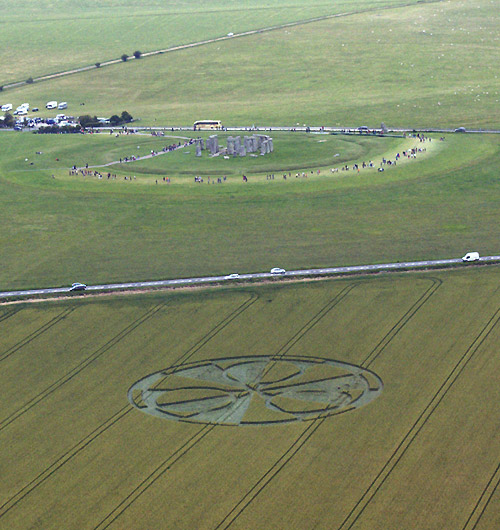
In July, a crop circle appeared across the field from Stonehenge, adding mystery to what was an already mind-boggling location. Many people believe that crop circles are an act of aliens, God, or mankind; some believe they spawn from earth’s magnetic field and energy. Yet, no one theory has proven what crop circles are, why they are here, or what created them

More than 2,000 different shapes have been recorded, and mathematical analysis has revealed the use of construction lines, invisible to the eye, are used to design the patterns. However, how these circles are created, or who is creating them remains a burning question many would like answered.

Crop circles and physics

In this month’s Physics World edition, Richard Taylor, director of the Materials Science Institute at the University of Oregon, states that physics and the arts are grouping together to work toward solving the secrets behind the ever complex crop circles.

According to Taylor, via EurekAlert.org, “physics could potentially hold the answer, with crop-circle artists possibly using the Global Positioning System (GPS) as well as lasers and microwaves to create their patterns, dispensing with the rope, planks of wood and bar stools that have traditionally been used.”

Microwaves, Taylor suggests, could be used to make crop stalks fall over and cool in a horizontal position — a technique that could explain the speed and efficiency of the artists and the incredible detail that some crop circles exhibit.

However, Taylor states that “Crop-circle artists are not going to give up their secrets easily. This summer, unknown artists will venture into the countryside close to your homes and carry out their craft, safe in the knowledge that they are continuing the legacy of the most science-oriented art movement in history.”

“It may seem odd for a physicist such as Taylor to be studying crop circles,” said Matin Durrani, editor of Physics World, “but then he is merely trying to act like any good scientist — examining the evidence for the design and construction of crop circles without getting carried away by the side-show of UFOs, hoaxes and aliens.”

Crop circles: Rob Dickinson and John Lundberg

Rob Dickinson and John Lundberg are known crop circle artists residing in the UK. On their personal website, the artists/circle makers address one researcher’s findings on crop circles.

Dickinson and Lundberg wrote:

“With our unique insider’s perspective to the crop circle phenomenon we’ve always known crop circle research has centered on beliefs – rather than empirical derived evidence. Without studying the detail of researchers’ statements this is a difficult point to demonstrate, let alone articulate in sound bites in the media.

“During the summer of 2000 the media focused on crop circle researcher Colin Andrews assertions that 80% of circles were man made and 20% were the product of some kind of magnetic energy. Colin was featured on almost every TV and radio channel, often with us arguing that Colin’s estimate…was just that, an estimate without substantial proof, or evidence.

“Andrews [has] presented erroneous information to support their own beliefs and to inflate their importance and perceived knowledge of the subject. In the case of Andrews, the media accepted his statements with little skepticism or scrutiny, and his beliefs have been portrayed as scientific fact across the globe.”

Andrews replied:

“I have invested my reputation, profession and marriage in trying to resolve the apparent puzzle. At this point I have proven to myself that you and your friends (and others before) are at least 80 percent of that puzzle and if you are proud of that, so be it. I am proud to have put myself on the line to be honest with my conclusions. The 80/20 percent have not made me friends amongst those who want to believe everything comes from ET’s etc.

“I look forward to the day you make my job and that of serious fellow researchers easy and post all the formations you have made and call them what they are man made art – without all the deliberate deception and trouble making.”

Visit Wiltshire and see a crop circle for yourself.  Seeing is believing!

Stonehenge Tour Guide
HisTOURies UK – Mystical landscape, magical tours

Read Full Post »

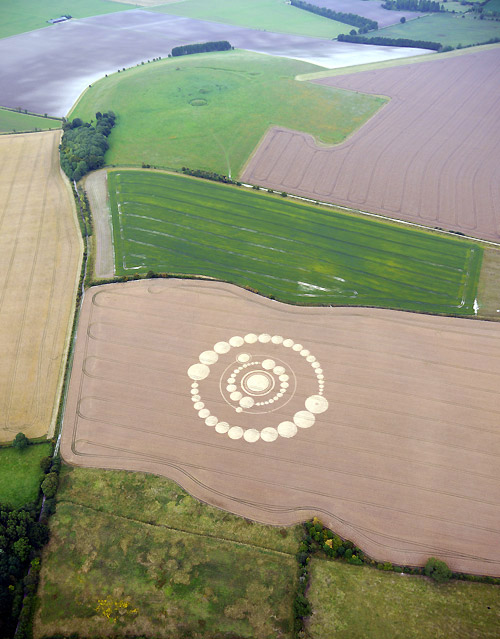
Another circle ‘crops up’ in Wiltshire -Windmill Hill (2), nr Avebury Stone Circle , Wiltshire. Reported 26th July.

Another amazing cropcircle has appeared in Wiltshire.  If you are not visiting with a local tour guide please respect the ‘crop circle etiquette’-see below.


CROP CIRCLE ETIQUETTE: Guidelines for visiting formations
FOR VISITING THE CROP CIRCLES.

In our attempt to become more responsible for giving out information on the locations for the Circles, we have published a Code of Conduct which was drawn up by the National Farmers Union in collaboration with the Centre for Crop Circle Studies. The Connector does not want to deny our readers the chance to visit a Crop Circle. It merely reminds you to ask for their permission to enter their fields.
 

Do not go onto private land unless you have permission from the farmer or landowner. If you can’t find the farmer or landowner to ask permission-you have no right to enter private property.

IF you can not find the farmer DO NOT enter the field.

IF you wander into a formation without permission and a farmer catches you, DO NOT argue with him if he wishes you to leave his land.

Better still – go with a local tour guide who knows exactly where they are, how to get there and has permission from the farmer.

Wilthire Crop Circle Tour Guide
HisTOURies UK – Mystical landscape, magical tours……..

Read Full Post »

THE first two crop circles of the summer have appeared close to Stonehenge.Stonehenge crop circle

Both lie in a barley field just off the A360, near Airman’s Corner.

Francine Blake of the Wiltshire Crop Circle Study Group said the first, which is 170ft in diameter, is an important symbol similar to one from the ancient Mayan culture, lying east-west and linking past and future.

Some enthusiasts have pointed out that it is identical to a logo used by the anarchist punk band Crass 30 years ago, representing the idea that great power will eventually destroy itself.

The second symbol, of two circles touching, measures 130ft by 80ft, and is said to relate to a partial solar eclipse on July 1.
Link: http://www.salisburyjournal.co.uk/news/9132878.Crop_circles_appear/?ref=ms

Visit this and other mysterious crop circles in the Wessex area with one of our private guided tours
HisTOURies UK – Mystical landscape, magical tours…………

Read Full Post »

Stories of yokels getting the better of townies pepper British folklore – perhaps the best known being one reading of the Nottinghamshire legend The Wise Men of Gotham .
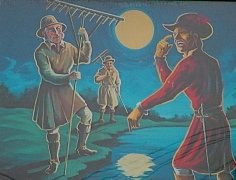
Wiltshire MoonrakerRivalling that tale is the Wiltshire story of The Moonrakers, so dear to the heart of the county that to this day anyone born in Wiltshire is known as a Moonraker.
The story goes that a couple of lads from a village near Devizes were involved in the spirits trade, and were not troubling the Excise with paperwork or duties. Depending on the source they were either distilling ‘brandy’ themselves, or obtaining it through illicit channels. These two entrepreneurs were warned of a raid by the Revenue, so for want of time and better cover they hid their contraband, including a couple of barrels of the good stuff, in a pond.

When the customs officials arrived it was unfortunately a clear night, with a full moon and not a breath of wind to stir the water’s surface. The Wiltshire lads could see the barrels clearly, so they quickly came up with a ruse: grabbing rakes they waded into the pond and used the implements to disturb surface and silt, masking the tuns. When the Revenue men spotted them and asked what they were doing, the yokels replied they were raking the moon in the pond in order to gather cheese from it. The clever Revenue men shook their heads at the peasants’ stupidity and searched the rest of the village, then finding nothing moved on.

Wiltshire Tour Guide
HisTOURies UK – The Best Tours in British History

Read Full Post »

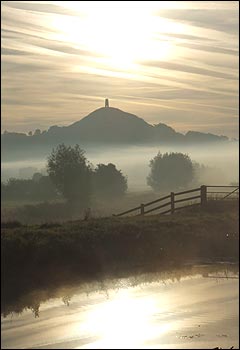
Legends of Glastonbury

There are so many myths associated with Glastonbury that it is difficult

Glastonbury Tor

Glastonbury Tor

to know where to begin to talk about them. There are two main streams of legend that surround Glastonbury, though they twine around each other to some degree. The two streams revolve around the romantic figures of Joseph of Arimathea and King Arthur. Let’s take them one at a time.

Joseph of Arimathea
Joseph was the Biblical figure who took Jesus’ body after the crucifixion. According to some legends he was actually Jesus’ uncle, and had visited Britain years before with Jesus in the pursuit of his interests in the tin trade. It appears that there actually was a strong Jewish presence in the west of England at that time, and many of the tin miners may have been Jewish settlers.

At any rate, when Jesus died, Joseph thought it prudent to flee Palestine, and after many travails he came to Britain with a company of followers. He brought with him the Holy Grail, the cup used by Jesus at the Last Supper. Some versions of the legend have it that the Grail contained two drops of blood captured from Jesus’ side when he was wounded on the cross.

When Joseph came to Britain he was granted land at Glastonbury by the local king. When he arrived at Glastonbury, Joseph stuck his thorn staff in the earth, whereupon it rooted and burst into bloom. A cutting from that first tree was planted in the grounds of the later Glastonbury Abbey, where it continued to bloom every year therafter at Christmas time. There is still a thorn tree in the Abbey grounds, of a variety native to the Holy Lands, and it does indeed bloom around Christmas time.

Joseph was said to have established the first church in England at Glastonbury, and archaeological records show that there may well have been an extremely early Christian church here. What happened to the Holy Grail is another matter. Some legends have it that Joseph buried the Grail at the foot of Glastonbury Tor, whereupon a spring of blood gushed forth from the ground.

There is a well at the base of the Tor, Chalice Well, and the water that issues from it does indeed have a reddish tinge to it, from the iron content of the water.

Other legends have it that the Holy Grail was interred with Joseph when he died, in a secret grave. The search for the mysterious Grail emerges again and again in the tales of Glastonbury.

Further legends tell that the church founded by Joseph continued for many years. Eventually it became a monastery, and one of the first abbots was the future St Patrick, who was born in the west country.

King Arthur and Glastonbury

Glastonbury Abbey, where King Arthur is said to lie buriedLegends of King Arthur swirl about Glastonbury like a tantalizing fog from the nearby Somerset marshes. The nearby hill fort at South Cadbury has long been suggested as the location for Camelot. Indeed, excavations of South Cadbury suggest that it was in use during the early 6th century, which is the likeliest era for the real Arthur to have lived.

The association of Arthur and Glastonbury goes back at least to the early Middle Ages. In the late 12th century the monks of Glastonbury Abbey announced that they had found the grave of Arthur and Guinivere, his queen. According to the monks, an excavation found a stone inscribed “Here lies Arthur, king.” Below the stone they found the bones of a large man, and the smaller skeleton of a woman. The monks reburied the bones in the grounds of the abbey, where they were a very handy draw for pilgrims. The site of the grave can be seen today in the abbey grounds.

Glastonbury Tor, the enigmatic conical hill that rises above Glastonbury, has been linked with the Isle of Avalon, where King Arthur was buried after his death. This isn’t so farfetched as it may sound, for a millennium ago the water level was much higher, and the tor would indeed have been an island. Avalon was also called “the isle of glass” which does suggest similarities to the name “Glastonbury”.

The Holy Grail, the object of Arthur’s questing, is said to be buried beneath Glastonbury Tor, and has also been linked to Chalice Well at the base of the Tor.

One final myth of Arthur at Glastonbury: the landscape around Glastonbury is said to have been moulded and shaped so that the features (such as roads, churches, and burial mounds) create a zodiac calendar replete with Arthurian symbology. Like so many of the Arthurian myths, so much is open to interpretation and your own predisposition to believe or disbelieve.

Glastonbury Abbey
Is there a place more steeped in legend and myth than Glastonbury? Glastonbury AbbeyProbably not. Legend holds that the earliest church here was founded by St. Joseph of Arimathea in about 60AD, and that when he planted his staff in the earth a thorn tree burst forth.

In the grounds of the ruined Benedictine monastery there is a thorn tree of a variety common to the Middle East which is given to bloom around Christmas time.

By the late Middle Ages Glastonbury had become the richest abbey in England, due to the heavy pilgrimage trade. It was rich enough to build an inn for well-to-do pilgrims (the George Inn, on nearby High Street, which still welcomes guests 500 years later). The best preserved building in the abbey grounds is the old Abbot’s Kitchen (see photo), a curious square building which appears round due to its octagonal roof. In the abbey grounds are the reputed graves of King Arthur and Queen Guinevere, which were conveniently discovered by the Glastonbury monks in the 12th century, when the abbey needed a financial boost. Outside the grounds are the abbey tithe barn, which now serves as the Somerset Rural Life Museum (well worth a visit), and 4 miles away at Mere is the abbey’s Fish House, were fish was salted and cured.

The abbey is entered through the Abbey Gatehouse  an imposing arched gateway located on off Magdalene Street. Visitors pass through a fascinating museum depicting life at Glastonbury during the Middle Ages, and then enter the Abbey grounds proper. The first building you see on entering the grounds is St Mary’s Chapel, a roofless structure that boasts wonderful architectural details, from the recessed arches of the door to the repetitive arcading that rings the interior. Look up, where the curious small towers at each corner of the chapel seem almost Georgian in style.

If you continue past the chapel you will soon reach the Abbot’s Kitchen, probably the most recognizable symbol of the Abbey, and subject of numerous postcards! This is a peculiar building, with a high octagonnal tower over a square base bedecked with gargoyles. The interior is notable for the very large ovens and the high dome supported on reed-thin vaulting ribs.

Return from the Abbot’s Kitchen towards St Mary’s Chapel and you will pass a small sign on the green lawn. This marks the old burial ground, where, in the 12th century, monks conveniently found bones beneath an engraved stone indicating the burial place of legendary King Arthur. The bones and those presumed to belong to Arthur’s queen, Guinivere, were reburied within the Abbey Church, where a small memorial can be seen.

The grounds of Glastonbury Abbey emanate a sense of calm and peace; it is truly a magical place, and taken as a whole with the other attractions of this ancient town, make Glastonbury well worth an extended visit.

Visitor Information
Glastonbury Abbey
The Abbey Gatehouse
Magdalene Street
Glastonbury
Somerset
UK
BA6 9EL
Web: http://www.glastonburyabbey.com
Email: nfo@glastonburyabbey.com
 
Join us on a private guided tour of the West Country.   Visit Glastonbury, Stonehenge and Avebury Stone Circle.

Mystical Landscape, Magical Tours……………….
HisTOURies UK – The Best Tours in History

Read Full Post »
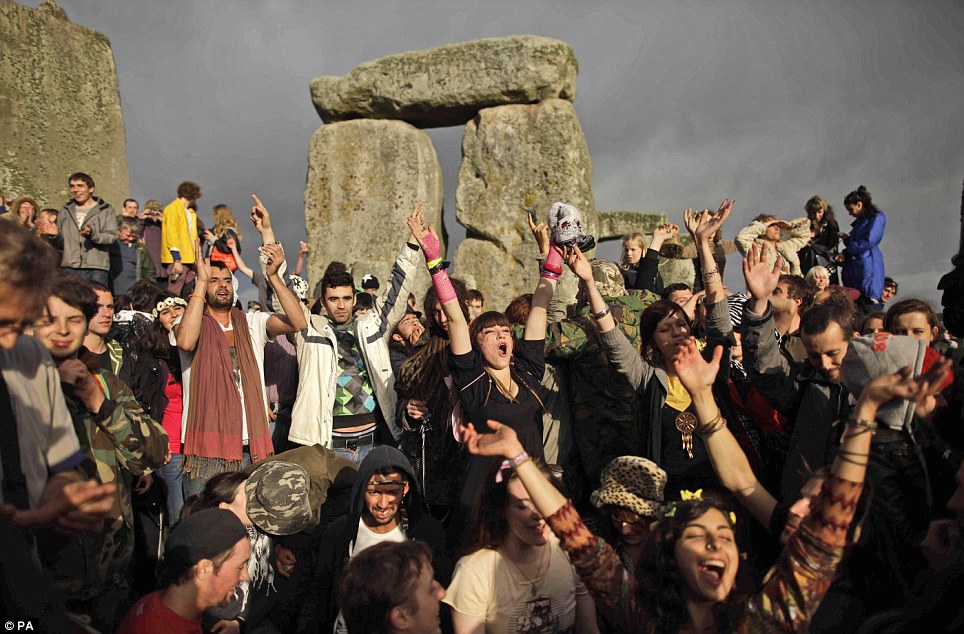
THE rain failed to dampen spirits as thousands of Druids, Pagans and tourists gathered at Stonehenge to celebrate the Summer Solstice on Tuesday morning.

About 18,000 revellers from across the country and abroad braved the weather to welcome the longest day at the ancient stone circle.

Although the sun did not make an appearance as dawn broke in an overcast sky, people enjoyed the festival atmosphere with Morris dancers, musicians and people in traditional robes.

The rain stopped before the sun rose at about 4.51am and crowds cheered as the sky started to brighten.

Denny Bartley, who travels from Essex with friends every year for the Solstice, said: “It’s been good – the Solstice is a great opportunity to catch up with old friends and I enjoy being with the other druids.”

Pagan rituals were led by senior druid King Arthur Pendragon at the Heel Stone, which included two pagan marriage ceremonies.

Mr Pendragon said: “It has been a good night. There are a lot of youngsters and a lot of people here asking all the right questions – they’re here for the right reasons.

“A lot of people came here to celebrate the birth of the sun for the longest day.”

Fewer people attended than last year, something which head of Stonehenge Peter Carson put down to the weather and the fact that the Solstice fell mid-week.

“It’s gone extremely well considering how poor the weather was. Everyone has come along and had a fantastic time yet again and they are leaving with big smiles on their faces,” said Mr Carson.

By Hannah White http://www.salisburyjournal.co.uk/

Stonehenge Tour Guide
HisTOURies UK – Private Guided Tours

Read Full Post »

« Newer Posts - Older Posts »