Feeds:
Posts
Comments

Archive for the ‘Wiltshire’ Category

Modern tourist attractions such as the London Eye and Cornwall’s £86 million Eden Project rank alongside historic sites including Stonehenge among the “Seven Wonders of Britain”, according to a survey published today.

The British equivalent to the original Seven Wonders of the World span a 4,000-year period from prehistoric Stonehenge in Wiltshire to the 450ft wheel which was erected on the South Bank of the River Thames to mark the millennium.

The remaining four attractions on the list were Big Ben and the Houses of Parliament, York Minster, Windsor Castle and Hadrian’s Wall.

More than 2,500 adults from across Britain took part in the survey, which was commissioned by the Yellow Pages telephone directory.

A parallel survey of teenagers aged between 13 and 17 also recognised traditional attractions but listed Staffordshire theme park Alton Towers as one of their favourites.

Both adults and teenagers agreed on their choice for the Eighth Wonder of Britain – defined as a culturally significant site that is not currently regarded as a tourist attraction – by selecting the Angel of the North, Antony Gormley’s giant sculpture on the outskirts of Gateshead.

Alan Britten, English Tourism Council chairman, said: “It’s the mixture of old and new attractions that is a source of fascination for overseas tourists and a source of pride among the people who live here.

“The Yellow Pages survey reflects our own experience of the endless allure of these ‘must-see’ sites. They are the crown jewels of our tourist attractions.”

John Condron, chief executive of Yell, publisher of Yellow Pages, said: “We hope this timely survey encourages people to get out and explore or rediscover the ‘Wonders’ in their own regions.”

 
The ‘seven wonders of Britain’


The London Eye and Eden Project rank alongside historic sites such as Stonehenge among the ‘seven wonders of Britain’, according to a survey commissioned by Yellow Pages. Here, in no particular order, are the seven winners.
 
Big Ben Big Ben, London
Photo: Peter Jordan, PA
 
Hadrian's Wall Hadrian’s Wall, Northumberland
Photo: John Giles, PA
More arts news
 
Eden Project Eden Project, Cornwall
Photo: Barry Batchelor, PA
 
London Eye London Eye
Photo: Martin Argles, Guardian
 
Windsor Castle Windsor Castle, Berkshire
Photo: Tim Ockenden, PA
 
Stonehenge Stonehenge, Wiltshire
Photo: Sean Smith, Guardian
 
York Minster York Minster, Yorkshire
Photo: John Giles, PA
 
The ‘eighth wonder of Britain’


Angel of the North Angel of the North
Antony Gormley’s giant sculpture on the outskirts of Gateshead, the winner among ‘culturally significant sites not currently regarded as tourist attractions’.
Photo: Owen Humphreys, PA


Good choice!
The Best Tours in British History
HisTOURies UK – Private Guided Tours

Read Full Post »

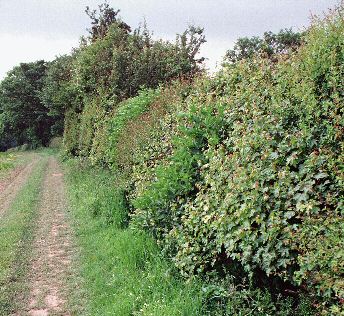
Few things have helped create the look of the English countryside more British Hedgerowthan hedgerows. Hedges have been used for a long time in England, yet for all their antiquity, much of the familiar checkerboard pattern they help create is of very recent vintage.

Hedges have been used as field boundaries in England since the times of the Romans. Excavations at Farmoor (Oxon) reveals Roman hedges made of thorn. The Anglo-Saxons also used hedgerows extensively, and many that were used as estate boundaries still exist. Although these early hedges were used as field enclosures or to mark the boundaries of one person’s property, there was no systematic planting of hedges in England until the first enclosure movement of the 13th century.

The pressures of population expansion led to a widespread clearing of land for agriculture, and the new fields needed to be marked clearly.

Later, farming expansion in the 15th century led to more widespread hedge planting, but the greatest use of hedges came in the Enclosure Movement of the 18th and 19th centuries.

The Enclosure Movement is a fancy term that historians use to describe the habit of wealthy landowners enclosing common fields for their own use, usually for the purpose of raising sheep.

Hedges are used as field boundaries in the lowland regions of England. In the highlands, such as the Yorkshire Dales, dry stone walls are commonly used.

Aerial Hedgerow ViewSo great was the need for hedges during the Enclosures, that a whole new industry sprang up supplying hawthorn plants to be used in planting new hedges.

In the process of enclosure many rural labourers lost their livelihood and had to move to the new industrial urban centres. So the next time you sigh over the timeless quality of the English hedge-shaped countryside, spare a thought for the misery and hardship caused by the erection of hedged fields to much of England’s rural population.

Hedge Facts
When: Roman, Anglo-Saxon, 13thC, 15thC, 18th-19thC
Where: Lowland areas
Why: Field boundaries
How
: planting bushes or trees and pleating them together at an angle as they grew
Materials: huge variety based on local availability, but the most common were hawthorn, blackthorn, and holly

A lot of effort and ingenuity has been brought to bear on the problem of dating hedges. Several historians have advanced mathematical formulae for calculating the age of a hedgerow based on the number of plant species found in a certain length of hedge. As an extremely rough rule of thumb, one species of hedge plant per 100 years seems to get close to the truth.

Unfortunately, recent years have seen the disappearance of many miles of English hedgerows. It is easier for modern farmers to string new metal fence wire than to maintain ancient hedgerows. Conservation efforts have introduced incentives to farmers to maintain the hedges, and losses have slowed somewhat. Estimates vary, but there may be upwards of 500,000 miles of hedgerows in England today.

Links:
http://en.wikipedia.org/wiki/Hedge
http://www.britainexpress.com
http://www.BestValueTours.co.uk

The Best Tours of the Britich Countryside
HisTOURies UK Private Guided Tours

Read Full Post »

The Festival returns in 2011 with a packed programme of theatre, dance, circus, film, music and spoken word in locations around the historic city.

On the Festival’s opening night the sky becomes a stage in a performance by world famous Argentine company Voalà.The programme also includes a new music commission, WhereTwo Worlds Touch; outdoor performances of classic Shakespeare;and a performance by Jasmin Vardimon Company.

Read Salisbury International Arts Festival Brochure 2011 – Download

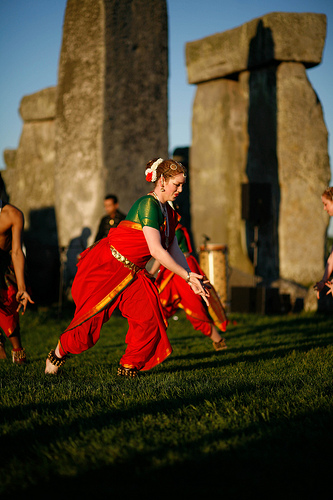
This year’s programme will reflect a focus on the themes of China, Dance and Air, and events will take place across the region in locations as diverse as Salisbury Cathedral, Old Wardour Castle and Stonehenge.

Background to Salisbury Festival
The Festival blazed into life in July 1973. Since then, over a million people have enjoyed outstanding performances of theatre, dance, film and every kind of music, plus literary events and the visual arts. From mid-May to early June each year, the beautiful historic city of Salisbury is transformed as people flock to the Festival, enjoying both ticketed events and free performances

If you are in the UK during May and June this year why not come and stay in Salisbury during this wonderful event.  Even take a tour to Stonehenge ?

http://www.salisburyfestival.co.uk/

Stonehenge and Salisbury Tour Guide
HisTOURies UK – The Best Tours in Wessex

Read Full Post »

Loosely speaking, thatching is the use of straw or grasses as a building material. Using thatch for roofing goes back as far as the Bronze Age in Britain. At Shearplace Hall in Dorset there are remains of a round hut that shows signs of thatching.

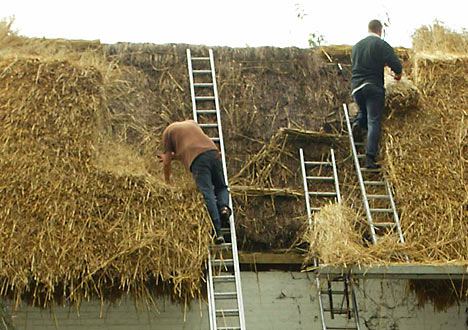
Thatching a roof is an age-old tradition. Not only is it environmentally friendly but also very much back in vogue

Thatching a roof is an age-old tradition. Not only is it environmentally friendly but also very much back in vogue

Thatched cottages and farm buildings were the norm in rural Britain for a millennium or more. Why the attraction to thatch? First of all, the building practices of bygone Britain ran to lightweight, irregular materials, such as wattle and daub walls, and cruck beams. These walls were simply not made to take much weight, and thatch was by far the lightest weight material available.

The study of materials used in thatch buildings can get pretty obscure, but basically, people used whatever was available locally.

This meant materials as diverse as broom, sedge, sallow, flax, grass, and straw. Most common is wheat straw in the south of England, and reeds in East Anglia. Norfolk reed is especially prized by thatchers, although in northern England and Scotland heather was frequently used.

Although thatch was primarily used by the poor, occasionally great houses used this most common of materials. In 1300 the great Norman castle at Pevensey (Sussex) bought up 6 acres of rushes to roof the hall and chambers. Much later, in the late 18th century thatched cottages became an extremely popular theme with the “picturesque” painters, who tried to portray an idealized (Romantic/sanitized) version of nature.

Churches also used thatch frequently. In one humorous episode the parish church at Reyden, near Southwold, was roofed in 1880 with thatch on the side of the church hidden from the road, and with tiles on the side facing the road. Presumably the tiles looked more elegant than the more commonplace thatch.

What caused the decline of thatching? Primarily better transportation. The growing railway network in the Victorian era meant that cheap slate from Wales became easily available all over Britain. Agricultural machinery, particularly the combine harvester, had the unfortunate effect of making wheat straw unusable for thatching. This made Norfolk reed all the more prized, and now the latter material is grown specifically for use in thatching.

So how does one thatch a cottage? First the thatch is tied in bundles, then laid in an underlayer on the roof beams and pegged in place with rods made of hazel or withy.

Then an upper layer is laid over the first, and a final reinforcing layer added along the ridgeline. It is at the ridgeline that the individual thatcher leaves his personal “signature”, a decorative feature of some kind that marks the job as his alone. One lovely cottage I saw on a bicycle tour near Glastonbury (Somerset) has a row of thatch birds marching proudly along the ridge of the roofline!

Although thatching, like many rural crafts, has suffered from the encroachment of “civilisation”, many property owners today recognize the value of keeping their cottages thatched, if for no other reason than that thatched cottages fetch a prime price on the real estate market!

Well thank goodness, for those of us who love traditional British architecture! Sure, it is “corny” but to this anglophile North American at least, nothing says “Great Britain” so much as the sight of a beautiful whitewashed cottage, a blooming rose bush climbing a trellis beneath a roof of weathered thatch. Long live the thatcher!

The phrase “Its raining cats and dogs”
You’ve heard of thatch roofs, well that’s all they were. Thick straw, piled high, with no wood underneath. They were the only place for the little animals to get warm. So all the pets; dogs, cats and other small animals, mice, rats, bugs, all lived in the roof. When it rained it became slippery so sometimes the animals would slip and fall off the roof. Thus the saying, “it’s raining cats and dogs.”

There are more thatch work in Wiltshire than any other county in Britain.  Join us on a private tour of Wessx and learm more about the history of this tradional craft.

Links: 

THE NATIONAL COUNCIL OF MASTER THATCHERS ASSOCIATIONS

Wiltshire Tour Guide
HisTOURies UK – The Best Tours in British History

Read Full Post »

Start: Avebury |Finish: Old Sarum
Distance: Approximately 42 miles

Wiltshire is a county of history and mystery set in a dramatic landscape. The combination of heritage and scenery provides a truly memorable day out. So come with us on a journey through the countryside and across the ages as we go back to the time of our prehistoric ancestors. Hundreds of thousands of years may have passed but all over the county there’s evidence of human activity from the end of the Ice Age through the Stone, Bronze and Iron Ages right up to the invasion of the Romans in AD43.

Click here for audio / visual tour

This driving tour will take you through the heart of Wiltshire. En route you’ll discover more about how our enigmatic and mysterious ancestors lived, worked, fought and died.

This tour can be undertaken in a variety of ways; as a day-long journey, in short sections or you can use the information as a guide to individual visits.

You might also consider embarking on the tour using public transport but keeping up to date with bus service and timetable changes will require plenty of preparation.

Before you set off make sure that you’re properly equipped. Nothing beats a really good Ordnance Survey map, marked with contours and ancient monuments. A compass and a torch would also be useful. Some of these historical gems are in fields and away from roads or footpaths, so good walking boots are a must. Some sites have few or no facilities and it’s also worth noting that mobile phone coverage can’t be guaranteed in parts of rural Wiltshire. For news of road works or route closures, check BBC Local Radio and bbc.co.uk/travelnews

This guide has been produced with the generous assistance of Phil Harding, Wessex Archaeology, English Heritage, Wiltshire Council Archaeology Service, Bob Clarke, Martin Kellett, David Dawson and the Wiltshire Heritage Museum in Devizes.

Stonehenge and Avebury Tour Guide
HisTOURies UK – The Best Tours in Wiltshire

Read Full Post »

Celtic Britain
(The Iron Age) c. 600 BC – 50 AD

Who were they? The Iron Age is the age of the “Celt” in Britain. Over the 500 or so years leading up to the first Roman invasion a Celtic culture established itself throughout the British Isles. Who were these Celts?

For a start, the concept of a “Celtic” people is a modern and somewhat
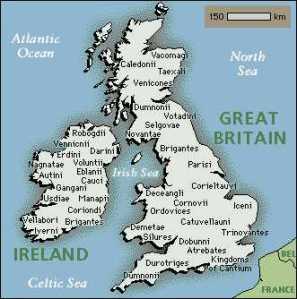
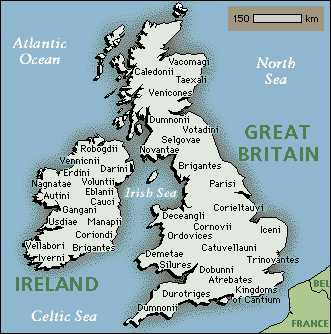
Celtic Britain was dominated by a number of tribes, each with their own well-defined territory. It is thanks to Roman chroniclers, such as Strabo, Julius Caesar, and Diodorus, that the names of individual tribes are known to us today, albeit in Romanized form.

Celtic Britain was dominated by a number of tribes, each with their own well-defined territory. It is thanks to Roman chroniclers, such as Strabo, Julius Caesar, and Diodorus, that the names of individual tribes are known to us today, albeit in Romanized form.

romantic reinterpretation of history. The “Celts” were warring tribes who certainly wouldn’t have seen themselves as one people at the time.

The “Celts” as we traditionaly regard them exist largely in the magnificence of their art and the words of the Romans who fought them. The trouble with the reports of the Romans is that they were a mix of reportage and political propaganda. It was politically expedient for the Celtic peoples to be coloured as barbarians and the Romans as a great civilizing force. And history written by the winners is always suspect.

Where did they come from? What we do know is that the people we call Celts gradually infiltrated Britain over the course of the centuries between about 500 and 100 B.C. There was probably never an organized Celtic invasion; for one thing the Celts were so fragmented and given to fighting among themselves that the idea of a concerted invasion would have been ludicrous.

The Celts were a group of peoples loosely tied by similar language, religion, and cultural expression. They were not centrally governed, and quite as happy to fight each other as any non-Celt. They were warriors, living for the glories of battle and plunder. They were also the people who brought iron working to the British Isles.

The advent of iron. The use of iron had amazing repercussions. First, it changed trade and fostered local independence. Trade was essential during the Bronze Age, for not every area was naturally endowed with the necessary ores to make bronze. Iron, on the other hand, was relatively cheap and available almost everywhere.

Hill forts. The time of the “Celtic conversion” of Britain saw a huge growth in the number of hill forts throughout the region. These were often small ditch and bank combinations encircling defensible hilltops. Some are small enough that they were of no practical use for more than an individual family, though over time many larger forts were built. The curious thing is that we don’t know if the hill forts were built by the native Britons to defend themselves from the encroaching Celts, or by the Celts as they moved their way into hostile territory.

Usually these forts contained no source of water, so their use as long term settlements is doubtful, though they may have been useful indeed for withstanding a short term siege. Many of the hill forts were built on top of earlier causewayed camps.
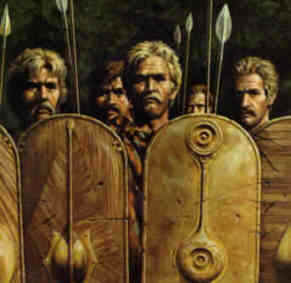
Celtic family life.
The basic unit of Celtic life was the clan, a sort of extended family. The term “family” is a bit misleading, for by all accounts the Celts practiced a peculiar form of child rearing; they didn’t rear them, they farmed them out. Children were actually raised by foster parents. The foster father was often the brother of the birth-mother. Got it?

Clans were bound together very loosely with other clans into tribes, each of which had its own social structure and customs, and possibly its own local gods.

Housing. The Celts lived in huts of arched timber with walls of wicker and roofs of thatch. The huts were generally gathered in loose hamlets. In several places each tribe had its own coinage system.

Farming. The Celts were farmers when they weren’t fighting. One of the interesting innovations that they brought to Britain was the iron plough. Earlier ploughs had been awkward affairs, basically a stick with a pointed end harnessed behind two oxen. They were suitable only for ploughing the light upland soils. The heavier iron ploughs constituted an agricultural revolution all by themselves, for they made it possible for the first time to cultivate the rich valley and lowland soils. They came with a price, though. It generally required a team of eight oxen to pull the plough, so to avoid the difficulty of turning that large a team, Celtic fields tended to be long and narrow, a pattern that can still be seen in some parts of the country today.

The lot of women. Celtic lands were owned communally, and wealth seems to have been based largely on the size of cattle herd owned. The lot of women was a good deal better than in most societies of that time. They were technically equal to men, owned property, and could choose their own husbands. They could also be war leaders, as Boudicca (Boadicea) later proved.

Language. There was a written Celtic language, but it developed well into Christian times, so for much of Celtic history they relied on oral transmission of culture, primarily through the efforts of bards and poets. These arts were tremendously important to the Celts, and much of what we know of their traditions comes to us today through the old tales and poems that were handed down for generations before eventually being written down.

Druids. Another area where oral traditions were important was in the training of Druids. There has been a lot of nonsense written about Druids, but they were a curious lot; a sort of super-class of priests, political advisors, teachers, healers, and arbitrators. They had their own universities, where traditional knowledge was passed on by rote. They had the right to speak ahead of the king in council, and may have held more authority than the king. They acted as ambassadors in time of war, they composed verse and upheld the law. They were a sort of glue holding together Celtic culture.

Religion. From what we know of the Celts from Roman commentators, who are, remember, witnesses with an axe to grind, they held many of their religious ceremonies in woodland groves and near sacred water, such as wells and springs. The Romans speak of human sacrifice as being a part of Celtic religion. One thing we do know, the Celts revered human heads.

Celtic warriors would cut off the heads of their enemies in battle and display them as trophies. They mounted heads in doorposts and hung them from their belts. This might seem barbaric to us, but to the Celt the seat of spiritual power was the head, so by taking the head of a vanquished foe they were appropriating that power for themselves. It was a kind of bloody religious observance.

The Iron Age is when we first find cemeteries of ordinary people’s burials (in hole-in-the-ground graves) as opposed to the elaborate barrows of the elite few that provide our main records of burials in earlier periods.

The Celts at War. The Celts loved war. If one wasn’t happening they’d be sure to start one. They were scrappers from the word go. They arrayed themselves as fiercely as possible, sometimes charging into battle fully naked, dyed blue from head to toe, and screaming like banshees to terrify their enemies.

They took tremendous pride in their appearance in battle, if we can judge by the elaborately embellished weapons and paraphernalia they used. Golden shields and breastplates shared pride of place with ornamented helmets and trumpets.

The Celts were great users of light chariots in warfare. From this chariot, drawn by two horses, they would throw spears at an enemy before dismounting to have a go with heavy slashing swords. They also had a habit of dragging families and baggage along to their battles, forming a great milling mass of encumbrances, which sometimes cost them a victory, as Queen Boudicca would later discover to her dismay.

As mentioned, they beheaded their opponents in battle and it was considered a sign of prowess and social standing to have a goodly number of heads to display.

The main problem with the Celts was that they couldn’t stop fighting among themselves long enough to put up a unified front. Each tribe was out for itself, and in the long run this cost them control of Britain.

(Note: The terms “England”, “Scotland”, and “Wales” are used purely to indicate geographic location relative to modern boundaries – at this time period, these individual countries did not exist).

Join us on a guided tour of Britain and learn more about the Celts
HisTOURies UK – The Best Tours in British History

Read Full Post »

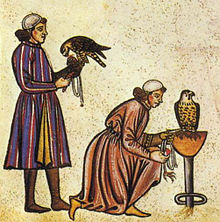
Falconry is a sport that involves the use of trained birds of prey to hunt game for humans. Although falconry is also known as hawking, in modern falconry buzzards are most commonly used.

It is believed that falconry was well established in the Middle and Far East by 2000 BC despite the earliest evidence only coming from the era around the reign of Sargon II (722-705 BC).
The Romans probably learnt falconry from the Greeks although the practice does not appear to have been widespread and there are references to Caesar using falcons to kill carrier pigeons. Falconry was probably introduced to Europe in about 400 AD when the Huns and Alans invaded from the East.

More recently falconry has become more popular particularly as a sport of kings. It was reputedly the favourite sport of every King of England from Alfred the Great to George III except for James I who spent much of his time training cormorants and ospreys to catch fish.
A lot has been written about King John’s passion for crane hawking and he often brought hunting parties to the Test Valley to fly falcons at herons. The herons were ringed before they were re-released and information about their numbers and locations are documented in the Domesday Book.

In the Middle Ages it was not just the rich who hunted with hawks. Labourers used hawks to hunt for food, often illegally and King John who wanted to improve the rewards of his own personal hunting banned people taking all feathered game from the Royal Forests which at the time covered vast areas of the British countryside.

The law provided that a hundred paupers should be fed with the proceeds of each Royal hunt but despite this if it had been enforced effectively it would still have caused much suffering and hardship. During the Middle Ages a social custom evolved in falconry known today as the Laws of Ownership. Birds of prey were allocated a rank and a man could not hawk with a bird that had a higher rank than him. The hierarchy seems to have evolved around the cost of the bird and it is not known how strictly it was adhered to.

The original list was documented in the 15th Century ‘Boke of St Albans’ on hawking, hunting and cote-armour as follows:
Emperor – The Eagle, Vulture, and Merloun
King – The Ger Falcon and the Tercel of the Ger Falcon
Prince: The Falcon Gentle and the Tercel Gentle
Duke: The Falcon of the Loch
Earl: The Falcon Peregrine Baron: The Bustard
Knight: The Sacre and the Sacret
Esquire: The Lanere and the Laneret
Lady: The Marlyon
Young Man: The Hobby
Yeoman: The Goshawk
Poor Man: The Tercell
Priest: The Sparrowhawk
Holy Water Clerk: The Musket
Knave or Servant: The Kestrel

Today anyone can practice falconry in the UK and no license is required although only captive-bred birds can be used. Despite pressure to have falconry banned it has been allowed to carry on albeit with a number of conditions attached to it. Birds must be ringed and government registered. Wild birds must not be used for falconry and all birds are DNA tested to certify their origins.

FALCONRY IN ENGLISH LANGUAGE

As Falconry has been around in the UK for nearly 2,000 years, words and phrases that falconers use for their birds have crept into everyday language.

Fed up: A hawk is termed fed up when it has a full crop (storage pouch) and therefore would not be interested in food or flying. If you are fed-up you are sat around doing nothing or bored.

Mantle: To cover or shield the food by dropping their wings over. The cover over a fireplace is now called a mantlepiece.

Cadge: A wooden frame that falcons were traditionally carried out into the hunting field on. The person carrying the cadge became known as the cadger. At the end of the day the cadger would go to the local tavern and recount the tales of how the birds had flown and in turn expect money. To cadge, now means to scrounge or beg for.

Hoodwink: To cover the bird’s eyes to keep it calm and relaxed. It now means to fool someone into doing something.

Mews:  Nowdays this is something cottages or street names are called: “something mews”. A real mews is the home to hawks and falcons, the Royal Mews in London was set up to house the monarch’s birds. The name comes from the french word “muer” which means to moult. In James I’s reign the Royal Mews stood where the National Gallery stands today and extended across Trafalgar Square down Whitehall. Many stately homes also have a mews associated with them.

Wiltshire Falconry: http://www.meredownfalconry.co.uk/

Quiz:  Anyone know where the term “Under my thumb” comes from ?

Wiltshire Tour Guide
HisTOURies UK – The Best Tours in Wessex

Read Full Post »

The Hero Walk – In support of our wounded – 26th June 2011
The Hero Walk is a very tough challenge over the high chalk downs and ridge ways of Wiltshire and Salisbury Plain. At 26 miles it forms a marathon for runners and a great challenge for walkers. This challenge is a diverse trek over marathon distance, going back through 6,000 years of British history; the magnificent prehistoric stone circles of Avebury and Stonehenge need little introduction. The challenge will start in Avebury, where we will be able to get up close to the ancient stones before heading off via the mysterious ancient landmark of Silbury Hill. Silbury is the tallest man-made mound in Europe, however its purpose is still unknown.

Stonehenge - Avebury walk 2011

Stonehenge - Avebury walk 2011

We will then cross the spectacular chalk downs dotted with ancient earth-works, burial mounds and get up close to the enigmatic white horses carved into the chalk. In clear weather we will be able to see more here, as views of other valleys open up to us. The route takes in the highest point in Wiltshire (295m) and travels through the most active crop circle area in the world – keep your eyes open!

Crossing into MOD land you will either walk (or run!) through stunning areas little used by the general public, that have become a haven for wildlife and plants. Our route continues to undulate but the main hills are behind us and we start to anticipate the finish line at the World Heritage Site of Stonehenge. A short section of quiet road is a sign that we are nearing civilisation, and before long the world-renowned ancient circle of stones looms on the horizon before us. There is then time to celebrate with fellow walkers and runners before returning home. We look forward to seeing you there!

Avebury to Stonehenge Hero Walk 2011 Itinerary . . .

The 26-mile walk will take approximately 8-9 hours for fit and strong walkers. Our day starts at Avebury, which lies at the centre of one of the greatest surviving concentrations of Neolithic and Bronze Age monuments in Western Europe. We’ll enjoy Avebury’s magic in the quiet of the early morning before heading via the Silbury Hill.

Help for Heroes 
Help for Heroes

Dropping down into the village of Alton Barnes, we follow the Kennet and Avon canal east. From there we head south and join the White Horse trail to the Pewsey White Horse from where we have fabulous views of the surrounding chalk landscape. We descend the hill and continue along the trail to the Kennet and Avon Canal; this is a fabulous example of industrial revolution engineering. Crossing into MOD land we will either walk (or run!) through stunning areas little used by the general public and a haven for wildlife and plants. After this long day of great views and leg-stretching hills we will reach the final destination: Stonehenge, the most famous stone circle in the world.

DONATE NOW – CLICK HERE
REGISTER ONLINE
http://www.helpforheroes.org.uk/challenges-2011-avebury-stonehenge.html

Proud Sponsors
HisTOURies UK – The Best Tours of Wiltshire

Read Full Post »

Filming in Wiltshire

Wiltshire is a perfect loction for film and television productions. Working with South West Screen, VisitWiltshire and Wiltshire Council seek to encourage new productions and film making in the area, making it a very ‘film friendly’ part of England. Film Friendly

Wiltshire is a favourite with filmmakers, taking centre stage in a whole range of productions from swashbuckling adventures to Jane Austin classics. Wiltshire continues to be popular with television and film crews, making an ideal location for anything from traditional period dramas to gothic horror films featuring Hollywood stars.

The county was used as the backdrop in productions such as The Wolfman, Harry Potter and the Half Blood Prince and Creation, as well as TV series such as Lark Rise to Candleford and Tess of the D’Urbervilles.

Wilton House (photo: Will Pryce)Anyone who enjoyed the cinema version of Pride and Prejudice, starring Keira Knightley and Matthew Macfadyen, will recognise not only Wilton House – which doubled as Pemberley, the family seat of Mr Darcy – but also the magnificent gardens at Stourhead, where Lizzie initially rejects his proposal of marriage.

Filming The Young Victoria at WiltonThe film on the life of Queen Victoria: Momentum Pictures’ The Young Victoria, features Wilton House. Wilton was used to double for Rosenau Castle, Prince Albert’s Coburg and Buckingham Palace.

The National Trust’s Mompesson House in Salisbury’s Cathedral Close achieved celebrity status as the London home of Mrs Jennings in the 1995 Oscar-winning version of Sense and Sensibility, when the leading parts were played by Emma Thompson, Kate Winslet and Alan Rickman. Wilton House’s Double Cube room was also used for ballroom scenes in the film.

Channel 4's Team Team at Salisbury Cathedral
Salisbury Cathedral took centre stage in the TV production of Mr Harvey Lights a Candle and Old Wardour Castle experienced some modern-day drama when it was used for the filming of Robin Hood, Prince of Thieves, while other starring roles have been played by Breamore House and Church (Thomas Hardy’s The Woodlanders); Heale House (The Portrait of a Lady) and Houghton Lodge (The Buccaneers and Agatha Christie’s Murder at the Vicarage).

Stonehenge is an iconic location – used in the BBC production of Tess of the D’Urbervilles; the lake at Fonthill Bishop was used in the film Chocolat, and Trafalgar House near Salisbury has been used for several films including Amazing Grace.

Filming Cranford at LacockThe village of Lacock, with its cottages and inns dating back to the 15th century was the backdrop to the recent BBC production of Cranford. The village is much admired by film makers; the National trust village and nearby Abbey has played host to a variety of classic films and costume dramas including Pride and LacockPrejudice, Harry Potter and the 2008 film production of The Other Boleyn Girl.

Castle Combe has been called the “prettiest village in England”. A favourite with film makers this stunning village is located at the southern tip of the Cotswolds. The village has played host to many filming productions, the most famous of these being Doctor Doolittle filmed in and around the village in 1966, and recently the village had a major role in Stardust and The Wolf Man.

Lark Rise to Candleford (photo: BBC)Pride and Prejudice was also filmed at Luckington Court, Chippenham, the BBC Tess of the D’Urbervilles was also filmed in Corsham, Walk Away and I Stumble for ITV was filmed in Calne and Chippenham, and North Wiltshire is also the location for the BBC’s Lark Rise to Candleford. The unspoilt streets of  Bradford on Avon make the town a perfect location for films. Scenes from the Charles Darwin biopic, Creation, were filmed in the town.

Longleat house and safari park has been used for a number of film productions and is the location for the BBC’s Animal Park.

Wiltshire also has more unusual film locations: aircraft hangars and runways at Kemble and Hullavington, and with such a big presence on Salisbury Plain, the British Army has many locations available for filming. Swindon provides a useful urban location a short distance from London along the M4 motorway or by train, the STEAM railway museum and designer shopping village provides hstorical and contemporary locations. Swindon has been used as a backdrop for film, television drama and advertising. Norman Foster’s Renault building in West Swindon appeared in the James Bond film A View to a Kill and the Motorola Building in North Swindon was used as a filming location for the James Bond film The World is Not Enough. The National Science Museum outpost at Wroughton airfield, the house of Lydiard Park and the Cotswold Water Park provide unique locations near Swindon.

The Young Victoria filmed at Wilton House

Scenes from Saving Private Ryan were set on the Wiltshire Downs.Kennet“Africa and the plains of America are just over an hour away from London”, or so the movie makers have found. Rolling hills, majestic horizons, open skies and a real sense of space, together with a South West Screen “Film Friendly” star rated council are just some of the reasons for filming in the area.

VisitWiltshire staff will smooth the way for a hassle free shoot.

>>Read more about filming in Wiltshire in an article in Your Wiltshire magazine

Wiltshire can offer Neolithic monuments, stone circles, Saxon and Civil War battlefields, peaceful villages where the old rural traditions are still alive, or historic towns such as Devizes and Marlborough both with unique shopping quarters which make them stand apart. Marlborough has reputedly one of the widest high streets in Europe and is home to Marlborough College, while Devizes has an impressive Market Place.
The area has first class road and rail links with the rest of the country and over half of it is designated an Area of Outstanding Natural Beauty. The area is rich in industrial heritage related to the Kennet and Avon Canal and local industries such as brewing still survive today, with beer still delivered to local hostelries by dray. 

Filming near Marlborough and Devizes include: Time Team – Reconstruction of a timber structure that was excavated at Durrington, Walk Away and I’ll Stumble – Tamzin Outhwaite (2 part drama featuring Avebury), Flog it – Pewsey, How Long is a Piece of String – Savernake Forest and Kennet and Avon Canal, History Mysteries – Open University, and Derek Acorah’s Ghost Town – Devizes, and Wilton Windmill was used for The Victorian Farm produced by Lion TV for the BBC series The Victorian Farm.

The Wolfman filmed in Wiltshire

  Latest NewsCastle Combe
Steven Spielberg  filming War Horse in Castle Combe

Hollywood director Steven Spielberg has to shot his most recent film in Castle Combe.  Based on the 1982 book by author Michael Morpurgo, the War Horse, it will feature Sherlock actor Benedict Cumberbatch and Harry Potter star Emily Watson among the cast. The film is now in post-production and is due for release by Disney in 2011.

>>View coverage of the filming in The Daily Telegraph
http://www.visitwiltshire.co.uk/

We offer private guided sightseeing tours of all these locations.
Wiltshire Tour Guide
HisTOURies UK – The Best Tours in History

Read Full Post »
Key Facts

Sport: Sailing, Paralympic Sailing
Capacity: No seats at venue
New or existing? Existing, Permanent
Travel and Tours: See below

Location and regeneration

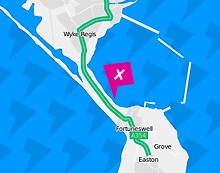
The venue is a combination of the Weymouth and Portland National Sailing Academy (WPNSA) and the adjoining commercial marina, in Dorset on England’s south coast.

It has kick-started the regeneration of the former Naval Air Station at Portland, now known as Osprey Quay, where new residential, commercial and marina facilities are already underway. It is an exposed spot at the western end of the English Channel, providing some of the best natural Sailing waters in the UK, with facilities on land to match.

About Weymouth Bay and Portland Harbour

Weymouth Bay and Portland Harbour provides some of the best natural sailing waters in the UK, with facilities on land to match.

The site has already hosted numerous international sailing events, including the 2006 ISAF World Youth Championships attended by over 60 nations.

Getting ready

Work to enhance the sailing facilities at Weymouth and Portland has been completed. The enhancements to the existing WPNSA facilities include a new permenant 250m slipway and new lifting and mooring facilities.

The project was completed on budget and ahead of schedule, providing world-class facilities for elite athletes and the local community more than three years before the Games.

During the Games

Sailing has historically been a non-ticketed event. We are currently reviewing our ticketing strategy with a view to bringing a spectator experience to suit various levels. This may include free ‘Live Sites’; quiet cliff observation points; ticketed venues with TV, tracking and commentary; and ticketed and specific spectator boats.

The ticketing review process is currently underway.

After the Games

The National Sailing Academy will benefit from the improved facilities that the Games will leave behind, providing a state-of-the-art facility for elite training, competition and local community use.

This use has already started: from a community programme through to hosting the Olympic Windsurfing discipline, RS:X class World Championship in 2009. This events programme is extensive and will also include hosting the IFDS (Paralympic Sailing) World Championship in 2011.

About Weymouth
Weymouth’s heritage as a seaport and fishing centre is overshadowed by its 18th century renaissance as a watering-place, and its more recent revival as a popular seaside resort. Most of the finest buildings are remnants of the town’s glory days as a Georgian resort, but there are even earlier houses to be found, including the converted Tudor cottages on Trinity Street.

George III lived in Weymouth, at Gloucester House (now a hotel). Reminders of the monarch are not hard to find; his likeness is cut into the turf of a hill outside the town, and a large statue stands on the busy seafront near the Tourist Information Centre.

 The seafront is the hub of activity in Weymouth, a stretch of golden sand bestrewn with deckchairs and crowded with sun seekers in summer. More relaxing perhaps are the opportunities for fishing and boating in the area. Within walking distance of the town centre are two nature reserves. Radipole Lake is home to birds who love open water, reedbeds and scrubby bushes, and Lodmore offers flood meadows, rough pasture and saltmarsh habitat.

 Weymouth is located between two Heritage Coasts (Purbeck and West Dorset Heritage Coast), and inland from the sea the entire surrounding region has been designated an Area of Outstanding Natural Beauty. The town is just north-east of the Isle of Portland, a wonderfully isolated coastal area tenuously joined to the mainland by the narrow sweep of Chesil Beach. Portland is excellent bird-watching territory, with Pulpit Rock a good spot to observe puffins during the early summer. On the north-east coast of the Isle is Portland Castle, one of the best-preserved of Henry VIII’s coastal defenses.

Weymouth Beach
Weymouth Beach

Another, more modern defensive structure is Nothe Fort, built on a headland jutting into Portland Harbour in 1860. It was in service until 1956, and has since been transformed into a living museum, tracing the history of the fort, and in particular the role of Weymouth in the Second World War.

High speed ferries leave Weymouth harbour for the Channel Islands and St. Malo, in France.

Tours and Transport
Histouries UK are able to offer guided sightseeing tours of this stunning part of southern Britain including Dorset and Wiltshire.  We are able to offer tours from London to Weymouth visiting Stonehenge, Salisbury, Bath etc on route and vice-versa – ideal for famailies and small groups.  Maximise your time in Britain during the 2012 Olympics and book a tour (well in advance)

External links:
HisTOURies UK – Private guided tours
Coach Tours and Transport during the Olympics

London Tourist Information
http://www.london2012.com/games/venues/weymouth-and-portland.php
Visit Weymouth and Visit Portland
The Official Tourist Information Website for Weymouth and Portland

Dorset Tourist Guide
Histouries UK – The Best Tours of Dorset and Wilsthire

Read Full Post »

« Newer Posts - Older Posts »