Feeds:
Posts
Comments

Mike Pitts's avatarMike Pitts Digging Deeper


All over the place really. On my first summer solstice visit in 1971 it was little more than a gaggle of people sleeping in the ditch around the stones. These two photos from Julian Richards’ excellent collection published by English Heritage show where it went from there: first immediately outside the earthwork to the south-west, so that it faced the rising sun on June 21; then across the road into what we call the Cursus field, National Trust land between Byway 12 and the Fargo Plantation. At its greatest extent it did run onto the Cursus itself (thanks for the comment, Francis Stoner), and spread eastwards into the Avenue field. Damage was reported at the time to the woodland at Fargo and to some of the barrows.

It’s high time a proper academic study was done of this story. There must be a great deal of information out there…

View original post 45 more words

heritageaction's avatarThe Heritage Journal

It seems English Heritage has launched a new push to get more volunteers ….

EH Volunteering@EHVolunteering 28 June

Welcome to the official English Heritage volunteer twitter! Follow us to find out about volunteering at English Heritage 

Good luck to them, they have always relied on an army of dedicated volunteers. But note the timing, 28 June, just 2 days after Simon Thurley’s upbeat message to members announcing how he was “delighted” that half of EH was to be floated off as a charity. EH can’t say so of course but things are going to be very tough for them. It doesn’t need much working out to know the sums won’t add up unless the number of unpaid workers is increased and even then they won’t add up (there’s a limit to how much more you can charge for already…

View original post 112 more words

StonehengeNews's avatarStonehenge Stone Circle News and Information

The Wiltshire Museum in Devizes is opening new prehistory galleries in the autumn.

The centrepiece of the stunning new displays are the objects buried with the Bush Barrow Chieftain almost 4,000 years ago. He was buried close to Stonehenge with the objects that showed his power and authority– a gold lozenge, a ceremonial mace and a gold-decorated dagger.These are just some of the rich Bronze Age objects that are on display for the first time in new high security showcases. Gold ornaments, amber necklaces, ritual costume, polished stone axes and bronze daggers tell the story of the people who lived at the time when Stonehenge, Avebury and Marden henges were great ceremonial centres.


The displays feature models and full-size reconstructions that bring archaeology to life. There is lots for children to do, with trails and quizzes, a chance to build Stonehenge and Bronze Age clothes to try on.

Some of…

View original post 82 more words

The major Roman fort complex was spotted on parched grassland near Brecon, Powys, and the marching camp near Caerwent in Monmouthshire.
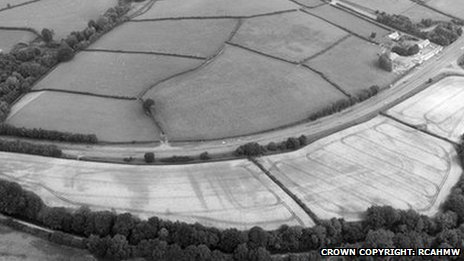
A tip-off from Dr Jeffrey Davies studying coin finds in central Wales led to this discovery of a previously unrecorded Roman fort complex

A tip-off from Dr Jeffrey Davies studying coin finds in central Wales led to this discovery of a previously unrecorded Roman fort complex

Aerial archaeologist Toby Driver said he could not believe his eyes when he spotted the fort fromthe air.

Scores of Iron Age farms and forts were also found in Pembrokeshire and the Vale of Glamorgan.

The crop of summer discoveries follow similarly exciting Bronze Age ones made during last winter’s snow.

Dr Driver, from the Royal Commission on the Ancient and Historical Monuments of Wales (RCAHMW), said 2013’s spell of hot weather has left him reflecting on some of the most significant finds since 2006.

‘Rare discovery’

He targeted reconnaissance flights in a light aircraft to where the drought conditions were most severe across the length and breadth of Wales.

When crop marks show in drought conditions Dr Driver said the Royal Commission’s aerial survey only has a few weeks to record the sites before rain or harvest removes them.

The Roman fort complex discovery near Brecon was a “rare discovery for Wales” and was made following a tip from Dr Jeffrey Davies, who he has been working with on another project – the Abermagwr Roman villa excavations near Aberystwyth.

“Jeffrey Davies noticed an anomaly in Roman coin finds near Brecon, reported under the Portable Antiquities Scheme (PAS),” explained the aerial archaeologist.

“He had a hunch that the coins, of the Emperor Claudius, could indicate a lost early Roman fort, and passed a grid reference to me the day before a flight into central Wales.

Iron Age settlement

“I couldn’t believe my eyes when the pilot and I approached the location and saw fading crop marks of a major Roman fort complex, lost beneath fields and a road for nearly 2,000 years.”

Between Caerwent and Chepstow, the aerial survey pinpointed only the second Roman overnight marching camp in Monmouthshire which Dr Driver said appears to show a small expeditionary force on manoeuvres, perhaps in the years around 50 AD.

“Because the campaigns against the tenacious Silures were documented by Roman historians, we expect more camps in south east Wales than we currently know about,” he added.

West of Caerwent, a “remarkable” Iron Age settlement was also revealed.

In Pembrokeshire, one of the largest and most complex Iron Age defended farms in Pembrokeshire was found at Conkland Hill, Wiston, while in the Vale of Glamorgan more Iron Age settlements were discovered close to the Roman villa at Caermead, Llantwit Major.

Dr Driver added: “Given the decades of aerial survey in the region around Caerwent, these surprise discoveries show the continuing need for aerial archaeology in Wales.”

In the winter, surveys in the snow uncovered Bronze Age burial mounds in the Vale of Glamorgan and a moated site at Llangorse lake, near Brecon.

The Royal Commission will now begin cataloguing and mapping the discoveries to make the information more widely available online.

Source: http://www.bbc.co.uk/news/uk-wales-23628630

HisTOURies UK
The best Tours in British History

heritageaction's avatarThe Heritage Journal

sil81

Whilst wider interest is particularly welcome in the jewel in the Stonehenge and Avebury World Heritage Site crown, as many may be attracted to visit yet remain unaware there is no public access to this ancient mound the following reminder of Silbury Hill’s history is perhaps in order:

This largest prehistoric chalk built structure in the world was started 4,500 years ago, but it has been closed to the public since 1974 due to the erosion of prehistoric archaeology by climbers. Having been purchased by Sir John Lubbock in the 1870s in order to protect it, Silbury Hill is still privately owned by Lord Avebury and is in the guardianship of English Heritage. Silbury Hill is safeguarded by legislation under the Ancient Monument Preservation Act, having been one of the first monuments placed under its protection in 1882, it is also protected by SSSI status because of its extraordinary long…

View original post 127 more words

The four surviving original copies of Magna Carta will be brought together in 2015 for the first time in history, the British Library has announced.

Magna Carta
Magna Carta inspired the US Constitution and the Universal Declaration of Human Rights.

The event will take place over three days and launch a year of celebrations across the UK and the world to mark the document’s 800th anniversary.


The document is seen as the cornerstone of Britain’s constitution, outlining a set of basic rights.

There are four surviving copies of Magna Carta – two copies belong to the British Library, one copy is owned by Lincoln Cathedral and one by Salisbury Cathedral.

All three organisations will be involved in the event, which will be held at the British Library in London.

‘National significance’

The library said it would be a “once-in-a-lifetime opportunity for researchers and the public to see the documents side-by-side”.

The manuscripts will be examined by some of the world’s leading experts.

The library said the unification of the documents would allow them to be studied much more closely, particularly faded or obscured parts of the text.

Historians would also be able to look for new clues about the identity of the writers of the texts, which is still unknown.

The charter was issued by King John as a way solving the political crisis he faced when powerful barons rebelled against him and captured London.

Although almost all the clauses have been repealed in modern times, the document established a number of important principles that have been copied around the world.

These include the principle that no-one is above the law – including the king – the right to a fair trial, and limits on taxation without representation.

It inspired the US Constitution and the Universal Declaration of Human Rights.

Claire Breay, lead curator of medieval and earlier manuscripts at the British Library, said: “Magna Carta is the most popular item in the library’s treasures gallery, and is venerated around the world as marking the starting point for government under the law.”

The Dean of Salisbury, the Very Reverend June Osborne, praised the values of social justice in Magna Carta and said she hoped the unification would increase awareness of the charter “to a huge new audience”.

The Very Reverend Philip Buckler, Dean of Lincoln, said bringing together all four copies would be of “national significance” and would mark a “pivotal point” in the anniversary year.

Lincoln Cathedral will be opening a new purpose-built Magna Carta centre in Lincoln Castle during the anniversary year

Source: http://www.bbc.co.uk/news/uk-23304764

Join us on a tour of Salisbury and see the Magna Carta on Salisbury Cathedral

Wessex Guided Tours
The Best Tours in British History

You can get hands-on with history this summer with over 1,000 events nationwide bringing our archaeology to life during the 23rd Festival of Archaeology,13-28 July 2013.

“The Festival is a fantastic opportunity to get out, look at and do archaeology!” 

About the Festival of ArchaeologyThe Festival – coordinated by the Council for British Archaeology – is a great opportunity to discover your inner archaeologist and to meet the experts. Whether you are young or old, enthusiast or beginner, there will be something for everyone.

If you’ve always wanted to have a go at archaeology, handle real finds, try out calligraphy and potmaking or even shoot an arrow our hands-on events will give you a chance to experience the excitement of the past for yourself. We also have events where you can ask the experts about your own finds. You can even volunteer at a dig and see archaeology at work.

The events will kick off the summer holidays with excavation open days, behind-the-scenes tours and workshops, guided walks, talks and finds identifications, family fun days, and much more. Visit our EVENTS SEARCH to see what’’s on in your area!

If you enjoy the Festival why not check out Scottish Archaeology Month which takes place in September every year. More details can be found on Archaeology Scotland’s website here.

Mick Aston, Archaeologist

“Every time we walk through a street, across a field, down a country lane or hurtle along a motorway, the ghosts and fragments of the past are all around us. Archaeology is a brilliant way of understanding and appreciating this massively important connection.”

“The Festival of Archaeology gets us even closer and celebrates Britain’s incredibly rich archaeological inheritance. There are a whole series of events organised across the country for everyone from budding archaeologists, and historians to those who just want to have fun learning more about the world we live in.”

About the Festival of Archaeology

Dig into the past at the 23rd Festival of Archaeology! Co-ordinated by the Council for British Archaeology, the Festival offers over 1,000 events nationwide, organised by museums, heritage organisations, national and country parks, universities, local societies, and community archaeologists.

http://www.archaeologyfestival.org.uk/

Wessex Guided Tours www.Histouries.co.uk
The Best Tours in British History


PEOPLE interested in volunteering in the fields of conservation and heritage can find out more at a recruitment week starting on Monday, June 24.

Organisations working in and around the Stonehenge World Heritage Site have joined together to give potential volunteers an opportunity to meet with English Heritage, Wiltshire Museum, The National Trust and Salisbury & South Wiltshire Museum to find out how they can get involved in conservation and heritage projects in the area.

With the new Stonehenge visitor centre set to open later this year there will be more chances for people to volunteer at the World Heritage Site and in the surrounding area.

Whether you are a student, retired or about to retire, unemployed or simply want to learn new skills and meet people, this event will give the opportunity for people of all ages to explore what opportunities will be available in the coming months. The volunteer recruitment event takes place at Amesbury Library from June 24 to 28.

To find out when each organisation will be represented, or for further information, contact stonehengewhs@english-heritage.org.uk or inquire at the library.

More info: http://www.salisburyjournal.co.uk/news/10490725.Find_out_more_about_Stonehenge_volunteering/?ref=rss&utm_source=twitterfeed&utm_medium=twitter

HisTOURies
Wessex Guided Tours