Feeds:
Posts
Comments

Cruising from Southampton? Flying home? Time to spare?
Why not explore some of England’s finest locations with your own personal guide. We can accommodate groups of all sizes, from individuals to large tour groups.

You choose the place, at your own pace, the itineraries are created especially for you……

Guided Tours From A Few Hours To A Day

Mini Coach Hire and ToursThere are so many wonderful places to visit within the catchment area of Southampton. Below are some of the more popular itineraries available to give you a taster of what is possible.

Our professional driver/guides are proud to showcase this region of England. You can choose from classic traditional sightseeing of places like Stonehenge, Salisbury or Winchester Cathedral, Georgian’ Bath, Glastonbury or perhaps pursue a theme where it be literary, English gardens or a pub crawl.

Our free tour planning service take great pleasure in assisting you to formulate an itinerary that fits your own individual requirements. We have a variety of guides with their own specialties and areas of interest and will assign one that is right for your tour profile.

Some Popular Itineraries From Southampton

Southampton & The Titanic

Come and discover Southampton’s Old Town, one of the gems of England. A place, with some unique features, that has played its part in history.

Go back in time at award winning museums, explore historic buildings; see how people lived here in past centuries and why the loss of the Titanic had such a devastating effect on Southampton.

Salisbury & Stonehenge Guided Tours

Just 30 minutes from Southampton is Salisbury. Famous for its Cathedral and Magna Carta this medieval city has much else besides. Stonehenge needs no introduction, you are so close to Stonehenge from Southampton its a shame if you don’t make a visit and experience the mysteries of the Stonehenge landscape.

Bath

Visit the beautiful Georgian City of Bath and take a panoramic tour of some of the finest architectural sights in Europe, including Bath Abbey, the Royal Crescent, the Circus, Assembly Rooms and the famous Pulteney Bridge. Explore the Roman Baths, built around thermal springs, which have been supplying water for over 2,000 years.

Portsmouth

Portsmouth Historic Dockyard allows you to discover these exquisite world renowned historic ships: HMS Victory and the Royal Navys most famous war ship and the worlds’ oldest commissioned ship. The Mary Rose – the only surviving 16th century warship on display anywhere in the world & HMS Warrior 1860 who made her triumphant return to Portsmouh in 1987 and now fully restored to her Victorian glory. These ships have shaped British history.

Countryside & Cottages, Cream Teas and Village Pubs

The New Forest is a former royal hunting area in the south of England. It was created in 1079 by William I (known as William the Conqueror) as a hunting area, principally of deer. It is a unique area of historical, ecological and agricultural significance, and retains many of the rural practices conceded by the Crown in historical times to local people

Picturesque Villages, bustling market towns and a special atmosphere and timelessness. Ponies and cattle roam freely around villages, following ancient forest tracks used for centuries by Commoners and their livestock. Picturesque thatched cottages tucked away in unexpected places, the New Forest has remained untouched by time, steeped in old customs and history, enabling visitors to unwind and enjoy its tranquil atmosphere.

Get To Understand Stonehenge Like Few Others From Southampton

The average tour bus spends at the very most one hour at Stonehenge. Time enough for those just curious to witness in person this world famous monument, get a few photographs, a better understanding of the mysteries of Stonehenge and perhaps a memento from the gift shop.

If you want something more than this, then this maybe is for you.

We have a team of local guides who specialise in Stonehenge and the Neolithic era. We can offer a detailed tour that explores all facets connected to Stonehenge, going well beyond what you hear on the audio tape.

Nothing is taboo, we cover in depth the archeological, planetary and mystical/pagan strands that intertwine in uncovering what Stonehenge is, and what it is all about.

Its not a dry lecture tour either, its very much a hands-on tour, we’ll track ley lines,enter inside Neolithic burial mounds and walk the ceremonial routes into the henges. You’ll also see some of the very best of the English Countryside and if you wish visit a village pub, away from the tourist crowds.

Links:
http://www.visit-southampton.co.uk/
http://www.southamptonairport.com/
http://www.londontoolkit.com

 HisTOURies UK – www.HisTOURies.co.uk
Mystical Landscape, Magical Tours

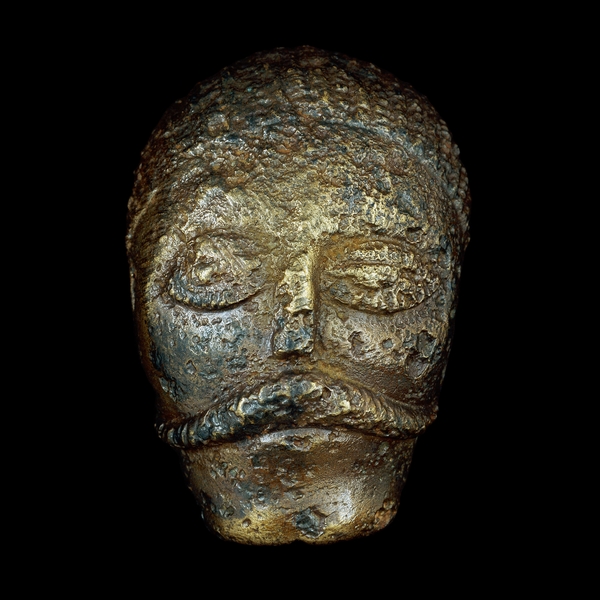
A face from the past

This face is 2000 years old. He is a mature man with hair combed back, clean-shaven except for a well-groomed moustache. Images of prehistoric Britons are very rare and in the Iron Age people were almost never shown as statues or carved as part of the decoration on objects. La Tène art styles were usually abstract and rarely showed images of people, animals or plants. This pattern changed at the very end of the Iron Age in the south east of the England. Here, there are a few pictures of Iron Age men shown on coins or as decorations on wooden buckets.

This is one of three small bronze models of men’s faces that were the decoration on a wooden bucket found in a Late Iron Age cremation burial. The grave probably belonged to someone of great importance and wealth, perhaps even a king or queen. The bucket would have looked similar to the one found in another Late Iron Age cremation burial at Aylesford, Kent. This also had men’s faces on the handle mounts.

The grave was the burial of a king or queen similar to another royal grave at Welwyn Garden City. The grave also contained two bronze jugs and a bronze pan, similar to examples from the Aylesford burial. There were also two Roman silver cups, five Roman wine amphorae and many pots.

S. James and V. Rigby, Britain and the Celtic Iron Ag (London, The British Museum Press, 1997)

I.M. Stead, Celtic art in Britain before t (London, The British Museum Press, 1987, revised edition 1997)

Source: http://www.britishmuseum.org/explore/highlights/highlight_objects/pe_prb/b/bronze_model_of_a_human_head.aspx

HisTOURies UK
The Best Tours in British History

A BUS company taking tourists to Stonehenge has said it will make scheduled stops in Amesbury again after residents expressed outrage over the lack of public transport links to the world heritage site.

Stonehenge Tour BusWilts & Dorset, which runs the Stonehenge Tour, currently only has a request stop in Amesbury for the tour, meaning many tourists dropped off by other coach companies often have to pay for a taxi to Stonehenge or are forced to walk there. For Amesbury, which is promoting itself as the centre of the Stonehenge region and encouraging tourists to visit, the lack of joined-up public transport has provided a “very bad image”.

Concerned residents told the Journal small groups of young tourists from abroad were often seen in Amesbury asking how they could get to Stonehenge.

Ann Riordan, who lives in the town said: “They are often confused about directions and I have come to fear greatly for their safety in walking along and then crossing the very busy A303.” Amesbury’s mayor Jan Swindlehurst welcomed the news from the bus company, saying: “I think the whole town council will be overjoyed – no-one could understand why Wilts & Dorset stopped it in the first place.

Stonehenge is a 365 day a year attraction – some days there may be no-one but on others there can be six or eight people, if it’s pouring with rain the last thing you want to do is walk there.

“It’s in our parish and yet we seem to be the only ones who can’t get people there.”

A spokesman for Wilts & Dorset said the bus stop in High Street near the bus station would be reinstated in about a week’s time.

Article Source: http://www.salisburyjournal.co.uk/news/10015192.Stonehenge_bus_link_restored/ (Elizabeth Kemble


The Stonehenge Tour Bus

The Stonehenge Tour Bus pictured above is the only regular public transport to Stonehenge itself. It normally runs at least hourly and more frequently in the summer months. The Stonehenge Tour Bus also allows you to stop over at Old Sarum, which is worthwhile.


The journey itself is quite scenic. The Stonehenge Tour Bus starts from Salisbury Rail Station and also picks up at the Bus Station. There is no left luggage facility at the train station but the Cat Tavern, a pub about 100 yards down the approach road of the rail station acts as the left luggage service for Salisbury – though its not advertised on the outside of the premises.


The bus works on a hop on, hop off principle. You can spend as long as you like at Stonehenge or Old Sarum, you do not have to ride on a particular schedule.
Buses depart Salisbury Station hourly from 10 a.m. daily stopping broadly in-line with the closing time of Stonehenge. You could not use this service for Special Access visits outside normal opening hours of Stonehenge.

The buses are double deck buses, so you get a great view of the countryside too. You also get a very informative commentary as you go along about Stonehenge, Salisbury and much else besides.


You can purchase tickets both on-line in advance or from the bus itself on the day.
There are several ticket options. You can opt to pay just for the tour bus or a ticket that combines the tour bus with admission to Stonehenge and Old Sarum or Stonehenge, Old Sarum and Salisbury Cathedral.


Visiting all three attractions is very much a rewarding full day out. At the end of the day do explore the centre of town and ideally find a pub or restaurant to relax before a late train out

HisTOURies UK
Mystical Landscape, Magical Tours

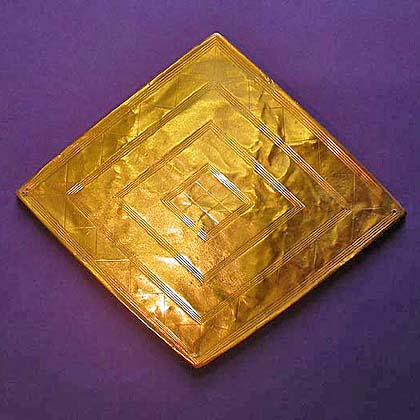
A priceless prehistoric gold lozenge excavated in the 19th century will be put on public display for the first time when the new Neolithic gallery at Wiltshire Heritage Museum in Devizes opens next year.

The museum was awarded a £370,000 grant from the Heritage Lottery Fund earlier this year to finance the new gallery, which will be built at the rear of the museum and is due to open in May.prehistoric gold lozenge

Secure display units will enable the museum to show items that were thought too valuable for public display.

Foremost of these is the large gold lozenge that was found in the Bush Barrow grave near Stonehenge, dating from around 1900BC, which was excavated by William Cunnington in 1808.

David Dawson, director of the museum, said: “A replica of the lozenge has always been on display here but as far as I am aware the original has never been put on show.

“The HLF grant has now enabled us to afford high- security measures.”

Other items from the grave to be put on show are a mace, the head of which was made from a rare flecked fossil stone from Devon, while the handle was embellished with bone zigzag mounts, and a smaller lozenge, which may well have been mounted on the handle of the mace.

There are also more recent finds in the new galleries including items from the grave of the Roundway Warrior, also excavated by William Cunnington in 1855, items from an Anglo-Saxon cemetery that was excavated in 1991 and artefacts from a dig by the Army at Barrow Clump near Figheldean on Salisbury Plain earlier this year.

Building work on the new galleries is due to begin in December and the fitting out is scheduled to run from January to the end of March. The objects will be installed during April, ready for the grand opening in May.

Dr Dawson said: “We want to open the galleries in time for our summer season.”

Full Aricle: http://www.thisiswiltshire.co.uk/news/9974709.Devizes_treasures_set_to_be_revealed/

HisTOURies UK
Mystical Landscape, Magical Tours

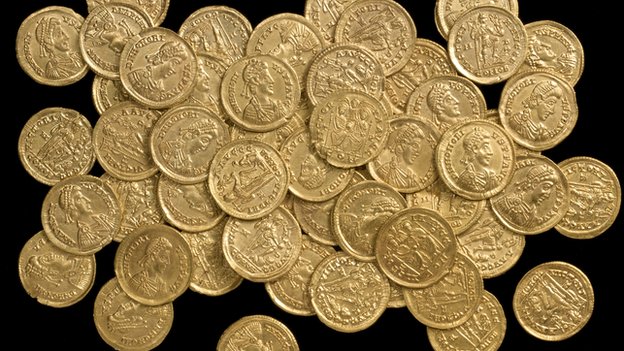
A “nationally significant” hoard of Roman gold coins has been found by a metal detectorist in Hertfordshire.

The stash - found on private land north of St Albans - is believed to be one of the largest Roman gold coin hoards discovered in the UK.

The stash – found on private land north of St Albans – is believed to be one of the largest Roman gold coin hoards discovered in the UK.

The stash – found on private land north of St Albans – is believed to be one of the largest Roman gold coin hoards discovered in the UK.

The 159 coins date to the end of the 4th Century during the final years of Roman rule in Britain. After AD 408 no more coin supplies reached the country.

The value of the hoard has not yet been assessed.

A team from St Albans City and District Council museums’ service investigated the site at the beginning of October to confirm the find.

The council said the coins were scattered across a fairly wide area and that there were “practically no other comparable gold hoards of this period”.

They were mostly struck in the Italian cities of Milan and Ravenna and issued under the Emperors Gratian, Valentinian, Theodosius, Arcadius and Honorius.

Councillor Mike Wakely called it “an exciting find of national significance” and said the coins would go on display at Verulamium Museum.

David Thorold, from the museum, said that during Roman occupation, coins were usually buried either as a religious sacrifice to the Gods, or as a secure store of wealth to recover later.

“Threat of war or raids might lead to burial in the latter case, as may the prospect of a long journey, or any other risky activity,” he said.

‘Extremely valuable’

The curator added that gold coins were “extremely valuable” and not exchanged on a regular basis.

“They would have been used for large transactions such as buying land or goods by the shipload,” he said.

“Typically, the wealthy Roman elite, merchants or soldiers receiving bulk pay were the recipients.”

The 1996 Treasure Act legally obliges finders of historic metal objects to report their discovery to the local coroner who determines whether or not it constitutes treasure.

Full article: http://www.bbc.co.uk/news/uk-england-beds-bucks-herts-19965507

HisTouries UK
The Best Tours in British History

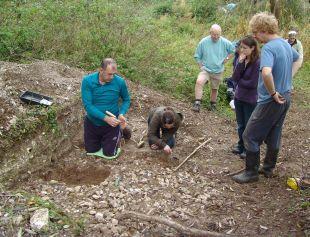
AMESBURY’S archaeology will come under the spotlight again this weekend with a significant dig on the outskirts of the town.

A BBC crew will be filming the excavations in the area known as Blick Mead for a documentary focussing on the area’s Mesolithic past. Thousands of flints and primitive tools have already been found at the site, and with many more expected to be uncovered, Amesbury could prove to be the home of the largest collection of Mesolithic finds in the country.

Although the dig is taking place on private land, the Amesbury community will be able to learn more about the discoveries at a special event taking place at the town’s new museum.

AMESBURY’S archaeology will come under the spotlight again this weekend with a significant dig on the outskirts of the town.

A BBC crew will be filming the excavations in the area known as Blick Mead for a documentary focussing on the area’s Mesolithic past.

Thousands of flints and primitive tools have already been found at the site, and with many more expected to be uncovered, Amesbury could prove to be the home of the largest collection of Mesolithic finds in the country.

Although the dig is taking place on private land, the Amesbury community will be able to learn more about the discoveries at a special event taking place at the town’s new museum.

The dig is creating widespread interest, with a leading archaeological magazine branding Amesbury “the cradle of Stonehenge”.

“With hundreds of worked flint tools appearing in every measured collection of soil sample that is wet sieved, it looks very likely that the haul of tools and finds will, in volume alone, surpass any other Mesolithic site ever found in Britain,” said Andy Rhind-Tutt, founder of the Amesbury Museum and Heritage Trust.

“Experts believe this will give sound evidence as to why Stonehenge is where it is and why our ancestors travelled hundreds of miles over thousands of years to be here.”The dig is being led by archaeologist David Jacques, who is working with a team of experts and Open University students.It will feature in a special BBC programme expected to be broadcast next year, and it is hoped the discoveries will enhance Amesbury’s bid to become a tourist destination based on its historic significance.

In addition to the special opening this weekend, Amesbury Museum is also open every Wednesday from 11am to 3pm when visitors can also use the cafe and library of local history books.

By Jill Harding – http://www.salisburyjournal.co.uk/

HisTOURies U.K
Mystical Landscape, Magical Tours

Long before the Egyptians began the pyramids, Neolithic man built a vast temple complex at the top of what is now Scotland. Robin McKie visits the astonishing Ness of Brodgar
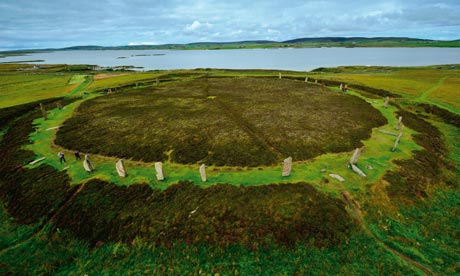
Circle of life: the Ring of Brodgar – a stone circle, or henge – is a World Heritage Site. Photograph: Adam Stanford

Circle of life: the Ring of Brodgar – a stone circle, or henge – is a World Heritage Site. Photograph: Adam Stanford

Drive west from Orkney’s capital, Kirkwall, and then head north on the narrow B9055 and you will reach a single stone monolith that guards the entrance to a spit of land known as the Ness of Brodgar. The promontory separates the island’s two largest bodies of freshwater, the Loch of Stenness and the  Loch of Harray. At their furthest edges, the lochs’ peaty brown water laps against fields and hills that form a natural amphitheatre;  a landscape peppered with giant rings of stone, chambered cairns, ancient villages and other archaeological riches.

This is the heartland of the Neolithic North, a bleak, mysterious place that has made  Orkney a magnet for archaeologists, historians and other researchers. For decades they  have tramped the island measuring and ex- cavating its great Stone Age sites. The land was surveyed, mapped and known until a recent chance discovery revealed that for all their attention, scientists had completely overlooked a Neolithic treasure that utterly eclipses all  others on Orkney – and in the rest of Europe.

This is the temple complex of the Ness of Brodgar, and its size, complexity and sophistication have left archaeologists desperately struggling to find superlatives to describe the wonders they found there. “We have discovered a Neolithic temple complex that is without parallel in western Europe. Yet for decades we thought it was just a hill made of glacial moraine,” says discoverer Nick Card of the Orkney Research Centre for Archaeology. “In fact the place is entirely manmade, although  it covers more than six acres of land.”

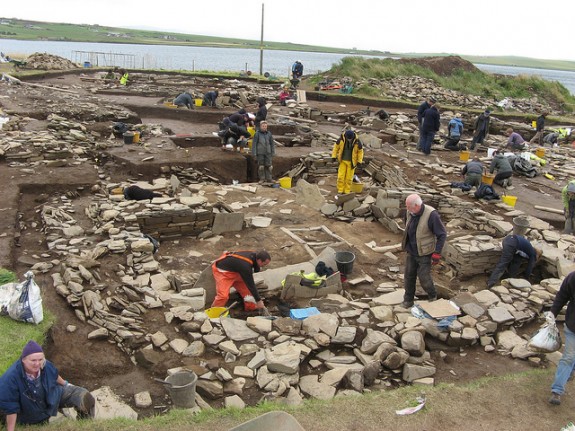
Once protected by two giant walls, each more than 100m long and 4m high, the complex at Ness contained more than a dozen large temples – one measured almost 25m square – that were linked to outhouses and kitchens by carefully constructed stone pavements. The bones of sacrificed cattle, elegantly made pottery and pieces of painted ceramics lie scattered round the site. The exact purpose of the complex is a mystery, though it is clearly ancient. Some parts were constructed more than 5,000 years ago.

The people of the Neolithic – the new Stone Age – were the first farmers in Britain, and they arrived on Orkney about 6,000 years ago. They cultivated the land, built farmsteads and rapidly established a vibrant culture, erecting giant stone circles, chambered communal tombs – and a giant complex of buildings at the Ness  of Brodgar. The religious beliefs that underpinned these vast works is unknown, however, as is the purpose of the Brodgar temples.

“This wasn’t a settlement or a place for the living,” says archaeologist Professor Colin Richards of Manchester University, who excavated the nearby Barnhouse settlement  in the 1980s. “This was a ceremonial centre, and a vast one at that. But the religious beliefs of its builders remain a mystery.”

What is clear is that the cultural energy of the few thousand farming folk of Orkney dwarfed those of other civilisations at that time. In size and sophistication, the Ness of Brodgar is comparable with Stonehenge or the wonders of ancient Egypt. Yet the temple complex predates them all. The fact that this great stately edifice was constructed on Orkney, an island that has become a byword for remoteness, makes the site’s discovery all the more remarkable. For many archaeologists, its discovery has revolutionised our understanding of ancient Britain.

“We need to turn the map of Britain upside down when we consider the Neolithic and shrug off our south-centric attitudes,” says Card, now Brodgar’s director of excavations. “London may be the cultural hub of Britain today, but 5,000 years ago, Orkney was the centre for innovation for the British isles. Ideas spread from this place. The first grooved pottery, which is so distinctive of the era, was made here, for example, and the first henges – stone rings with ditches round them – were erected on Orkney. Then the ideas spread to the rest of the Neolithic Britain. This was the font for new thinking at the time.”

It is a view shared by local historian Tom Muir, of the Orkney Museum. “The whole text book of British archaeology for this period will have to be torn up and rewritten from scratch thanks to this place,” he says.


Farmers first reached Orkney on boats that took them across the narrow – but treacherously dangerous – Pentland Firth from mainland Scotland. These were the people of the New Stone Age, and they brought cattle, pigs and sheep with them, as well as grain to plant and ploughs to till the land. The few hunter-gatherers already living on Orkney were replaced and farmsteads were established across the archipelago. These early farmers were clearly successful, though life would still have been precarious, with hunting providing precious supplies of extra protein. At the village of Knap o’Howar on Papay the bones of domesticated cattle, sheep and pigs have been found alongside those of wild deer, whales and seals, for example, while analysis of human bones from the period suggest that few people reached the age of 50. Those who survived childhood usually died in their 30s.

Discarded stone tools and shards of elegant pottery also indicate that the early Orcadians were developing an increasingly sophisticated society. Over the centuries, their small farming communities coalesced into larger tribal units, possibly with an elite ruling class, and they began to construct bigger and bigger monuments. These sites included the 5,000-year-old village of Skara Brae; the giant chambered grave of Maeshowe, a Stone Age mausoleum whose internal walls were later carved with runes by Vikings; and the Stones of Stenness and the Ring of Brodgar, two huge neighbouring circles of standing stones. These are some of the finest Neolithic monuments in the world, and in 1999 they were given World Heritage status by Unesco, an act that led directly to the discovery of the Ness of Brodgar.

“Being given World Heritage status meant we had to think about the land surrounding the sites,” says Card. “We decided to carry out geophysical surveys to see what else might be found there.” Such surveys involve the use of magnetometers and ground-penetrating radar to pinpoint manmade artefacts hidden underground. And the first place selected by Card  for this electromagnetic investigation was the Ness of Brodgar.

The ridge was assumed to be natural. However, Card’s magnetometers showed that it was entirely manmade and bristled with features that included lines of walls, concentric pathways and outlines of large buildings.  “The density of these features stunned us,”  says Card. At first, given its size, the team assumed they had stumbled on a general site  that had been in continuous use for some  time, providing shelter for people for most  of Orkney’s history, from prehistoric to  medieval times. “No other interpretation seemed to fit the observations,” adds Card. But once more the Ness of Brodgar would confound expectations.

Test pits, a metre square across, were drilled in lines across the ridge and revealed elaborate walls, slabs of carefully carved rock, and pieces of pottery. None came from the Bronze Age, however, nor from the Viking era or medieval times. Dozens of pits were dug over the ridge, an area the size of five football pitches, and every one revealed items with  a Neolithic background.

Then the digging began in earnest and quickly revealed the remains of buildings of startling sophistication. Carefully made pathways surrounded walls – some of them several metres high – that had been constructed with patience and precision.

“It was absolutely stunning,” says Colin Richards. “The walls were dead straight. Little slithers of stones had even been slipped between the main slabs to keep the facing perfect. This quality of workmanship would not be seen again on Orkney for thousands of years.”


Slowly the shape and dimensions of  the Ness of Brodgar site revealed themselves. Two great walls, several metres high, had been built straight across the ridge. There was no way you could pass along the Ness without going through the complex. Within those walls  a series of temples had been built, many on top of older ones. “The place seems to have been in use for a thousand years, with building going on all the time,” says Card.

More than a dozen of these temples have already been uncovered though only about 10% of  the site has been fully excavated so far.

“We have never seen anything like this before,” says York University archaeologist Professor Mark Edmonds. “The density of the archaeology, the scale of the buildings and the skill that was used to construct them are simply phenomenal. There are very few dry-stone walls on Orkney today that could match the ones we have uncovered here. Yet they are more than 5,000 years old in places, still standing a couple of metres high. This was a place that was meant to impress – and it still does.”

But it is not just the dimensions that have surprised and delighted archaeologists. Two years ago, their excavations revealed that  haematite-based pigments had been used to  paint external walls – another transformation  in our thinking about the Stone Age. “We see Neolithic remains after they have been bleached out and eroded,” says Edmonds. “However, it is now clear from Brodgar that buildings could have been perfectly cheerful and colourful.”

The men and women who built at the Ness also used red and yellow sandstone to enliven their constructions. (More than 3,000 years later, their successors used the same materials when building St Magnus’ Cathedral in  Kirkwall.) But what was the purpose of their construction work and why put it in the Ness of Brodgar? Of the two questions, the latter is the easier to answer – for the Brodgar headland  is clearly special. “When you stand here, you find yourself in a glorious landscape,” says Card. “You are in the middle of a natural amphitheatre created by the hills around you.”

The surrounding hills are relatively low, and a great dome of sky hangs over Brodgar, perfect for watching the setting and rising of the sun, moon and other celestial objects. (Card believes the weather on Orkney may have been warmer and clearer 4,000 to 5,000 years ago.) Cosmology would have been critical to society then, he argues, helping farmers predict the seasons –  a point supported by scientists such as the late Alexander Thom, who believed that the Ring of Brodgar was an observatory designed for studying the movement of the moon.

These outposts of Neolithic astronomy, although impressive, were nevertheless  peripheral, says Richards. The temple complex at the Ness of Brodgar was built to be the most important construction on the island. “The stones of Stenness, the Ring of Brodgar and the other features  of the landscape were really just adjuncts to that great edifice,” he says. Or as another archaeologist put it: “By comparison, everything else  in the area looks like a shanty town.”

For a farming community of a few thousand people to create such edifices suggests that the Ness of Brodgar was of profound importance. Yet its purpose remains elusive. The ritual purification of the dead by fire may be involved, suggests Card. As he points out, several of the temples at Brodgar have hearths, though this was clearly not a domestic dwelling. In addition, archeologists have found that many of the stone mace heads (hard, polished, holed stones) that litter the site had been broken in two in exactly the same place. “We have found evidence of this at other sites,” says Richards. “It may be that relatives broke them  in two at a funeral, leaving one  part with the dead and one with family as a memorial to the dead. This was a place concerned with death and the deceased, I believe.”

Equally puzzling was the fate of the complex. Around 2,300BC, roughly a thousand years after construction began there, the place was abruptly abandoned. Radiocarbon dating of animal bones suggests that a huge feast ceremony was held, with more than 600 cattle slaughtered, after which the site appears to have been decommissioned. Perhaps a transfer of power took place or a new religion replaced the old one. Whatever the reason, the great temple complex – on which Orcadians had lavished almost a millennium’s effort – was abandoned and forgotten for the next 4,000 years.
Full Article by Robin McKie – The Observer,            

For more information or to donate to the dig, go to orkneyarchaeologysociety.org.uk

HisTOURies U.K
Mystical Landscape, Magical Tours

A new find in the region surrounding the Ring of Brodgar, a stone-pillar construction mounted atop a sloping terrain, has overthrown the scientific conception of Stone Age life in the British Isles. Archeologists have uncovered a six-acre temple complex of painted stone and paved walkways, which was built five thousand years ago—before the pyramids of Egypt or even Stonehenge.

Archaeologists excavate the ruins. Photo: Susan van Gelder

Archaeologists excavate the ruins. Photo: Susan van Gelder

As Robin McKie writes in The Guardian, although the Ring of Brodgar has long been a focus of archeological excavation, a geophysical survey of the Ness of Brodgar, the region around the temple, “revealed that for all their attention, scientists had completely overlooked a Neolithic treasure that utterly eclipses all others on Orkney – and in the rest of Europe.”

What archaeologists thought to be a natural moraine, a pile of dirt and rock left over by a receding glacier, turned out to be much more. Buried beneath the dirt were “two giant walls, each more than 100m long and 4m high.” Within these walls, says McKie,

[T]he complex at Ness contained more than a dozen large temples – one measured almost 25m square – that were linked to outhouses and kitchens by carefully constructed stone pavements. The bones of sacrificed cattle, elegantly made pottery and pieces of painted ceramics lie scattered round the site. The exact purpose of the complex is a mystery, though it is clearly ancient. Some parts were constructed more than 5,000 years ago.

According to scientists working on the dig, the findings suggest the northern Orkney Islands may be spawning point for much of Stone Age British culture. As Nick Card with the Orkney Research Centre for Archaeology told The Guardian,

Orkney was the centre for innovation for the British isles. Ideas spread from this place. The first grooved pottery, which is so distinctive of the era, was made here, for example, and the first henges – stone rings with ditches round them – were erected on Orkney. Then the ideas spread to the rest of the Neolithic Britain. This was the font for new thinking at the time.

Full Article: http://blogs.smithsonianmag.com/smartnews/2012/10/archaeologists-uncover-massive-stone-age-complex-in-scotland/

HisTOURies UK
Mystical Landscape, Magical Tours

Why a guided tour is an ideal family vacation.

Taking the family on holiday can sometimes be a real balancing act.  If there are a range of children’s ages and interests to take in to consideration, not to mention the desires of the adults in tow, conflicts can sometimes arise.  Everyone gets excited about holidays and expectations run high – so what is the best way to make sure nobody is disappointed?  One option is to book a family guided tour to explore and learn more about the holiday region.  This may not be an immediately obvious idea, but there are many positives to recommend this often underrated type of excursion to families who are travelling together.

Give yourself a break

Holidays are supposed to be restful, but more often than not parents find them exhausting.  A guided tour hands over the reins to someone else that will entertain, animate, and direct proceedings for a while.  It is often the case that children absorb information far better from those other than their parents andthe enthusiasm of tour guides could inspire a real interest for the history and legends of the area in them.

See places off the tourist trail

Guided tours enable the less obvious sights of the area to be seen.  One of the main advantages of having an expert guide introduce the area is that they will know how to avoid the busy times when tourists flock to the big attractions.  They can help minimise the hassles that most people experience when travelling in unfamiliar areas and maximise the pleasure of the group.  Sometimes they will be able to negotiate price reductions for entrance fees to attractions.  There will be no arguments over map reading or the satnav sending the car up dead end lanes; the tour guide will know the area like the back of their hand and will be keen to extol its virtues.  They will be familiar with great places for lunch like the picture postcard pub with roses around the door, serving ploughman’s lunches outside at a garden table and chairs overlooking the West Country.  They will tell funny tales and give interesting facts that make the surroundings come alive.  They will have the inside story on the local area and with this privileged knowledge they will make the day unique and special.

Strengthen family bonds

In today’s modern world families increasingly spend time interacting more with computers and gaming devices than they do interacting with each other.  A guided tour offers a family the chance to bond by providing a shared experience likely to live on in their memories for a long time.

Weather proof

The weather in the United Kingdom is notoriously unreliable; however, most guided tours will not be too affected by rain.  If a day on the beach is ruled out by poor conditions, why not keep warm and dry on a guided tour of the region by minibus or car?

Do something different

Sometimes we are guilty of doing the same things year in and year out while on holiday.  We are comfortable with going to the same places, doing the same activities, and seeing the same faces.  By pushing the boundaries and doing something completely different, who knows what amazing new discoveries we could make?

Histouries UK
Mystical Landsape, Magical Tours

My local shops are already full of spooky masks, cobwebs and halloween paraphernalia. I just wanted to remind people of the ancient origins of this Celtic Festival.

Halloween or Hallowe’en is now celebrated across the world on the night of 31st October. Modern day celebrations generally involve groups of children dressed in scary costumes roaming from house to house, demanding “trick-or-treat”. Fearing the worst, intimidated householders normally hand over vast amounts of treats in the form of chocolates, sweets and candy to avoid whatever dastardly tricks may have been dreamt up by these little miscreants. The origins of these celebrations however date back thousands of years, to pagan times.

The origins of Halloween can be traced back to the ancient Celtic festival of Samhain. Until 2,000 years ago, the Celts lived across the lands we now know as Britain, Ireland and northern France. Essentially a farming and agricultural people, the Pre-Christian Celtic year was determined by the growing seasons and Samhain marked the end of summer and the harvest and the beginning of the dark cold winter. The festival symbolised the boundary between the world of the living and the world of the dead.

Massacre of the Druids

It was believed by the Celts that on the night of 31st October, ghosts of their dead would revisit the mortal world and large bonfires were lit in each village in order to ward off any evil spirits that may also be at large. Celtic priests, known as Druids, would have led the Samhain celebrations. It would also have been the Druids who ensured that the hearth fire of each house was re-lit from the glowing embers of the sacred bonfire, in order to help protect the people and keep them warm through the forthcoming long, dark winter months.

The Romans conquered much of the Celtic tribal lands when they invaded from mainland Europe in 43 AD, and over the next four hundred years of occupation and rule, they appear to have assimilated many of their own celebrations into the existing Celtic festivals. One such example may help to explain the current Halloween tradition of ‘bobbing’ for apples. The Roman goddess of fruit and trees was known as Pomona (pictured to the right), and her symbol just happened to have been that of the apple.

As the Romans moved out of Britain in the early 5th century, so a new set of conquerors began to move in. First Saxon warriors raided England’s south and east coasts. Following these early Saxon raids, from around AD430 a host of Germanic migrants arrived in east and southeast England, including Jutes from the Jutland peninsula (modern Denmark), Angles from Angeln in southwest Jutland and the Saxons from northwest Germany. The native Celtic tribes were pushed to the northern and western extremes of Britain, to present day Wales, Scotland, Cornwall, Cumbria and the Isle of Man.

In the decades that followed, Britain was also invaded by a new religion. Christian teaching and faith was arriving, spreading inwards from those northern and western extremities from the early Celtic Church, and up from Kent with the arrival of Saint Augustine from Rome in AD597. Along with the Christians arrived the Christian Festivals and amongst them “All Hallows’ Day”, also known as “All Saints Day”, a day to remember those who had died for their beliefs.

Originally celebrated on 13th May, it was Pope Gregory who had the date of the All Hallows’ feast moved to 1st November sometime in the 8th century. It is thought that in doing so, he was attempting to replace or assimilate the Celtic Samhain festival of the dead with a related but church approved celebration.

The night or evening of Samhain therefore became known as All-hallows-even then Hallow Eve, still later Hallowe’en and then of course Halloween. A special time of the year when many believe that the spirit world can make contact with the physical world, a night when magic is at its most potent.

Throughout Britain, Halloween has traditionally been celebrated by children’s games such as bobbing for apples in containers full of water, telling ghost stories and the carving of faces into hollowed-out vegetables such as swedes and turnips. These faces would usually be illuminated from within by a candle, the lanterns displayed on window sills to ward off any evil spirits. The current use of pumpkins is a relatively modern innovation imported from the United States, and we can also extend the same debt of gratitude to our friends in America for that ‘quaint’ “trick-or-treat” tradition!

Link source: http://www.historic-uk.com/CultureUK/Halloween/
Link: http://www.history.com/topics/halloween

HisTOURies UK
Mystical Landscape, Magical Tours