Feeds:
Posts
Comments

ARCHAEOLOGY WEEKEND

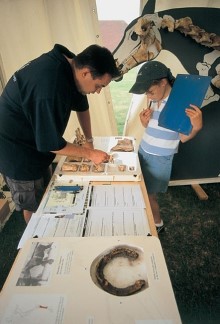
It’s the Festival of British Archaeology – this is your chance to meet a real archaeologist and to uncover artefacts from Old Sarum’s history. Enjoy a weekend for all the family with plenty of hands-on activities and crafts to keep everyone busy! Take part in a mini-dig and have a go at identifying objects lost over time.

About Old Sarum

Discover the story of the original Salisbury and take the family for a day out to Old Sarum, 2 miles north of where the city stands now. The mighty Iron Age hill fort was where the first cathedral once stood and the Romans, Normans and Saxons have all left their mark.

Today, 5,000 years of history are told through graphic interpretation panels on site. Families, heritage lovers and walkers can enjoy a great value day out at Old Sarum- you could even bring a picnic and enjoy the fantastic views across the Wiltshire countryside. The gift shop has a delicious range of ice-creams and exclusive English Heritage gifts and produce. Wooden bows and arrows are also on sale to help the kids imagine what life was like all those years ago!
DON’T MISS
The spectacular view from the ramparts at Old Sarum to the ‘new’ cathedral in the centre of Salisbury
Our interesting interpretation panels bringing 5,000 years of history to life
Old Sarum’s literary connections- you can buy some of the famous books written about the site in our shop

English Heritage: http://www.english-heritage.org.uk/daysout/properties/old-sarum/

HisTOURies UK – www.Histouries.co.uk
Mystical Landscape, Magical Tours

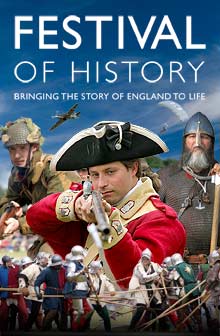
Prepare for the ultimate historical adventure as over 2,000 costumed performers bring the story of England to life over one action-packed weekend14th – 15th July 2012

HIGHLIGHTS FOR 2012

Bringing over 2,000 years of history to life, Festival of History 2012 is packed full of spectacular battle re-enactments, awesome combat displays and celebrations of daily life through the ages.

MAIN ARENA

  • The 1066 Battle of Hastings (NEW!) – Sat & Sun, 12.30pm
    For the first time at Festival of History, re-live the atmosphere and tension of one of England’s most famous conflicts, and witness the making of the most famous date in our history.
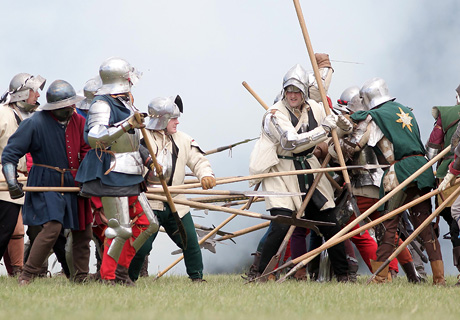
  • The Battle of Stoke Field – Sat & Sun, 11am
    See the last bloody battle of the Wars of the Roses brought to life, as the Tudor age begins and Henry VII takes the English crown.
  • Drop Zone D-Day – Sat & Sun, 4pm
    We’ve a surprise in the skies to help our heroes on the ground in a World War Two battle re-enactment.
  • Prince Malik’s Lancers – Sat & Sun, 1pm
    A favourite with all the family, enjoy this truly spectacular show of unparalleled horsemanship and skill.

PARADE GROUND

  • The Roman Imperial Army – Sat & Sun, 12.15pm & 3pm
    Witness the might and power of the Roman Empire, with a trip back to the 1st century AD.
  • Medieval Joust Tournament – Sat & Sun, 2pm
    A firm favourite returning for 2012, cheer on your champion in the 15th century full-contact joust.
  • The War of 1812 (NEW!) – Sat & Sun, 11.30am
    In the year of the Bicentenary we remember the epic conflict, fought on land and sea between the new United States of America and the British Empire.
  • Victorian Gymkhana – Sat & Sun, 11am
    Watch in wonder as our elegant Ladies and Gentlemen dazzle you with displays of skill and bravery in this Victorian equestrian show

LIVING HISTORY

  • Gladiators! – Are you ready? With awesome hand-to-hand combat displays, our Gladiators keep the ferocious ancient sport alive. And there isn’t a ‘travelator’ in sight!
  • Edwardian Falconry – Marvel at the breathtaking speed and grace of falcons in flight, learn about the history of these magnificent birds of prey and their use throughout the Edwardian era.
  • First World War Music Hall (NEW!)- If the action in the main arena gets too much, escape for a good old sing song in the First World War Music Hall. (Please note that this will replace the Victorian Music Hall previously advertised.)
  • Second World War Vintage Fashion & Beauty (NEW!) – Fancy a new look? Pick up some wartime tricks and tips at these new demonstrations of fashion from the ’40s.

AND MUCH MORE!

  • First World War Trench Experience – Extended for 2012, experience what life would have been like in the Great War in the recreated First World War trench.
  • Festival of Historical Writing – Back by popular demand!
  • Family Zone – From creating giant historical street scenes in the Family Activity Tent to sandcastle building on the Victorian Beach, there’s plenty for all the family to enjoy together.

Link: http://www.english-heritage.org.uk/daysout/events/foh-2012/

HisTOURies UK
The best Tours in British History

The 2012 Circles of Knowledge Conference will take place on 14th and 15th July 2012 (with extra tours on the 13th and 16th).  Once again we will welcome crop circle and ancient knowledge enthusiasts from all over the world and bring them together in the beautiful surroundings of Marlborough College in Wiltshire.  This year the lectures will be taking plave in the modern Ellis Theatre, offering us state of the art audio and visual facilities.

There are many unknown factors to the crop circle phenomenon and under such circumstances it is best to

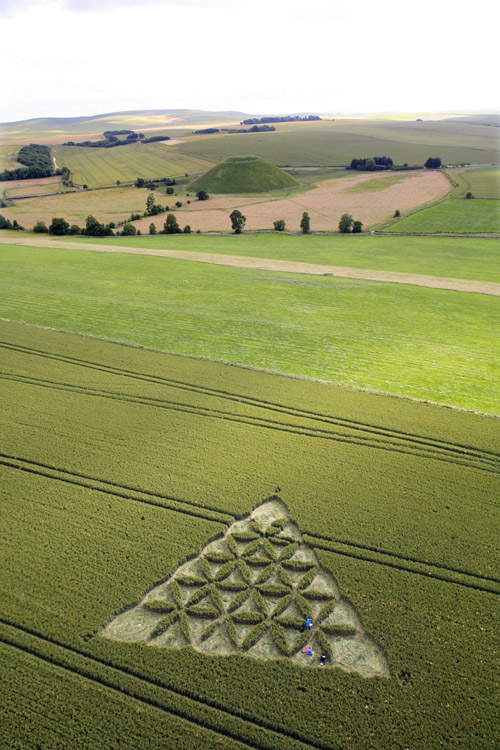
July 2012 Crop Circle

July 2012 Crop Circle near Avebury

stick to facts. Crop circles are happening in our reality here and now, and as the designs are imprinted in real fields in the countryside, they can be visited and studied at close hand.

Many people, several of whom live in Wiltshire full time, are actively engaged in full time research in an attempt to establish what this phenomenon is about and where it is leading us.  Since 1980 thousands of designs have been investigated and recorded in databases worldwide. This is impressive by anyone’s standard.

The Study of Crop Circles is based on facts:

  • Crop Circles exist.
  • They are found all over the world.
  • More than 6,000 have been documented since 1980.
  • Over the last twenty years analyses of thousands of plant and soil specimens from hundreds of formations worldwide have been carried out in laboratories in various countries, and most extensively in the UK and in the USA.
  • These analyses show that the cellular structure of the plants has been strongly affected and that the composition of the soil greatly altered in crop circles (man made designs exhibit no such results).
  • Their designs are based on complex geometry, ancient symbology and advanced mathematics.
  • They can be decoded.
  • The message that comes through is important for mankind at present.

HisTOURies UK
Mystical Landscape, Magical Tours 

After hunting for buried treasure for three decades – and not finding a great deal – even the most diligent of us might have given up.

But not Reg Mead and Richard Miles. The two amateur metal detectors kept up their search of the same area throughout the decades and have finally struck gold – or rather silver.

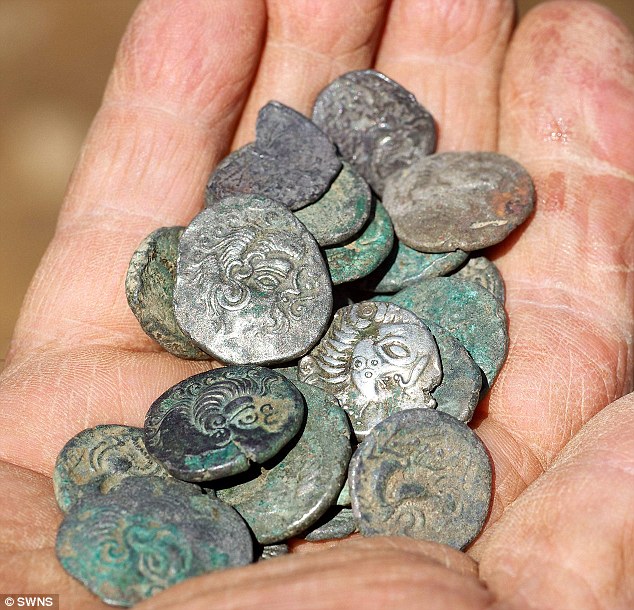
A coin in the hand: Archaeologists believe the hoard, found by two metal detectors, is worth about £10million

A coin in the hand: Archaeologists believe the hoard, found by two metal detectors, is worth about £10million


They have unearthed the largest hoard of Celtic coins ever found. Each one of the 30,000–50,000 coins is estimated to be worth around £200 each, putting the value of the haul at up to £10milion

  • Coins were buried to protect them from Julius Caesar
  • Three-quarter ton hoard estimated to be worth £10m
  • Two enthusiasts searched for three decades in field in Jersey

They are thought to be from the first century BC and were found buried 3ft deep under a hedge in a farmer’s field on Jersey.

Two thousand years ago the Channel Island – which remains a popular spot to stash large sums of money –  was a refuge for tribes fleeing what is now northern France from the invading Roman armies.

As the legions of Julius Ceasar drew closer, the treasure is thought to have been buried by a Celtic tribe called the Coriosolitae, in the hope it could be dug up once the danger had passed.

And there the coins – packed in clay and weighing a ton – have remained undisturbed until last week.

The men who discovered them, Mr Mead, 70, and Mr Miles, a customs officer in his 40s, suspected treasure was in the area three decades ago, when they heard rumours a farmer had found some silver pieces on his land. After a series of largely unsuccessful forays in the area, they unearthed a stash of 120 coins in February.

Mr Mead, a grandfather who lives with wife Ruth in St Clement, Jersey, said: ‘Richard found the first one and it was amazing – when you see him raising his hand above his head (saying) “got one”.’

The pair used a powerful metal detector known as a deepseeker to search for more treasure in the field and struck lucky last week

‘The machine picked up a really strong signal – so we immediately got in touch with professional archaeologists,’ Mr Mead said. ‘They started digging and we could not believe how many coins there were.

‘All of them were stuck together. I have been searching for things like this since 1959 and never found anything on this scale before.

‘We had been searching that land for 30 years.’

After four days of careful digging the hoard was hauled to the surface by crane. It will now be subject of an inquest to determine ownership rights

Mr Mead added: ‘I am absolutely numb at the moment. To find one haul of coins in a lifetime is rare, but to find two is just unheard of.’

The location of the find is being kept secret.

Neil Mahrer of Jersey Heritage Museum, who helped to excavate the money, said: ‘This is the biggest Celtic coin hoard ever found which is tremendously exciting.’

The previous record find was in 1935 at La Marquanderie in Jersey when more than 11,000 were discovered.

Mr Mahrer added that the coins, which are called staters and quarter staters, weigh as much as a 50p piece.

‘All the coins are silver and a common theme is a picture of a man or god’s head on one side of the coin and a horse on the other,’ he said. ‘They are covered in green corrosion because the silver is mixed with copper and copper corrodes. But they should come up again in a good condition.’

Dr Philip de Jersey, a former Celtic coin expert at Oxford University, said: ‘The find is very significant. It will add a huge amount of new information, not just about the coins themselves, but the people who were using them.’

Article by By COLIN FERNANDEZ – Daily Mail

HisTOURise UK
The Best Tours in British History

Chalke Valley History Festival near Salisbury is Britain’s biggest festival devoted entirely to history.

The 2012venue is the second such festival to be held in a 22 acre field set amongst the gentle downs of the Chalke Valley, surely one of the most beautiful landscapes in Britain, 12 miles south-west of Salisbury.

Chalke Valley History Festival

Chalke Valley History Festival

The Chalke Valley History Festival is in its second year now & really getting into its stride. The festival is being held just outside Ebbesbourne Wake, one of the villages within the Wilton Community Area. As well as literary talks covering an amazing variety of topics & periods in history, there are also other activities to get involved in. Among the impressive line-up of speakers at the festival, there are many household names such as Sir Max Hastings, Amanda Vickery, Jeremy Paxman, Michael Morpurgo, Ian and Victoria Hislop, Tom Holland, Dan Snow and Michael Wood.

If you’re interested in history, this is an event you won’t want to miss: “The Chalke Valley History Festival is Britain’s biggest festival devoted entirely to history. This is our second Festival and we are much bigger this year with over fifty events and an extraordinary array of speakers. Joining us are some of this country’s most popular and influential historians who are shaping our understanding of the past and setting the context for understanding the future.”

Check out the Chalke Valley History Festival website for more information & to buy tickets. http://www.cvhf.org.uk/

Another good reason to visit Wiltshire…………………..

HisTOURries UK
Mystical Landscape, Magical Tours.

More than ever, this Jubilee weekend will be a tribute to her.

Queen Elizabeth II has been the UK’s head of state for longer than most of its citizens can remember.

People in the UK have embraced the Diamond Jubilee, more so than in past years

People in the UK have embraced the Diamond Jubilee, more so than in past years

For 60 years she has fulfilled the role of constitutional monarch, a figure separate from politics but always in touch with events.

The person who has embodied Britain to the wider world and been a focus for unity within the country’s increasingly diverse communities.

For all of those reasons and others – not least her unflagging commitment to her role – there is perhaps a greater sense of personal regard for her than at any time since the early years of her reign back in the 1950s.

Crowds came out

Twenty-five years into her reign in 1977, Britain celebrated her Silver Jubilee – 25 years after that, in 2002, came the Golden Jubilee.

Both those jubilees started sluggishly. The 1970s was a decade of economic austerity and social transition.

The Queen had lost the glamour of her youth and Britain had lost its sense of deference to the monarchy.

“She conveys a sense of history the like of which we have not seen in Britain since the reign of her great-great-grandmother Victoria”

Voices were raised against the cost of the Silver Jubilee. There were concerns in the then Labour government of James Callaghan that it might be something of a damp squib.

It was not.

When the day of the main Jubilee celebrations arrived, the Queen came out in shocking pink and the crowds in their hundreds of thousands.

By 2002 at the time of the Golden Jubilee, the Queen had recently emerged from her most difficult time, the 1990s.

The decade brought family divisions, the death of a much-loved princess and an unprecedented degree of criticism that the monarchy was out-of-touch with public sentiment.

Courtiers at Buckingham Palace were concerned over how Britain felt about its monarchy after the recent passage of such troubled times.

They need not have worried. After another slow start – when sections of the media fretted that the Jubilee was failing to take off – the crowds again proved the doubters wrong.

Warm reception

And so to 2012, and for this Jubilee the doubters seem to have been almost completely absent.

From the first Diamond Jubilee visit in early March to the multi-cultural city of Leicester, there has been a heightened degree of interest and real warmth in the receptions the Queen has received.

The Queen and the Duchess of Cambridge are all smiles on a visit to De Mont fort University in Leicester, at the start of the Jubilee tour

The Queen and the Duchess of Cambridge are all smiles on a visit to De Mont fort University in Leicester, at the start of the Jubilee tour

True, in Leicester she brought the Duchess of Cambridge with her.

A shrewd move which linked the Queen very publicly with her grand-daughter-in-law, but notwithstanding the interest in Kate, it

was the Queen whom most people seemed keenest to see.And so it will be this Jubilee weekend. She is 86 now and has been monarch for 60 years.

She conveys a sense of history the like of which we have not seen in Britain since the reign of her great-great-grandmother Victoria, the only other British sovereign to have celebrated a Diamond Jubilee.We know that not everyone is a monarchist. Not everyone will – literally or metaphorically – be raising a glass this weekend.But all the evidence suggests that Britain remains a nation which is overwhelmingly comfortable with the monarchy, and which feels that the qualities offered by a queen such as Elizabeth II are qualities which it values and would not wish to lose.

For those reasons, on the River Thames on Sunday, outside Buckingham Palace on Monday; at St Paul’s Cathedral and along the route back to the Palace on Tuesday, and at countless street parties and beacon lightings, Britain will reaffirm its commitment and gratitude to its Queen.

Article by By Nicholas Witchell – Royal correspondent

HisTOURies UK 
Proud to be British 

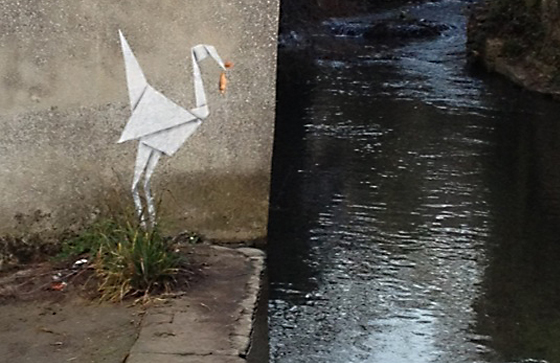
The Banksy of the river: Elusive artist’s latest work appears by a quiet countryside waterway.  Crossover graffiti artist Banksy has unveiled his latest work next to a quiet countryside waterway

Firstly, if I was the editor of the local paper, my headline for this piece would be:

“Tales of the River Banksy”.

The artwork appeared in February 2012, but this great little secret has taken a little time to surface. Still today I am not 100% convinced its the real deal, maybe because Lyme Regis seems a very distant, quiet little place for a Banksy piece to appear, but then it makes the perfect location, as it takes a while to surface…

The meaning… well your guess is as good as mine, but I like the idea it symbolises the birth of a child.

I won’t give away the exact location, although the cover  was blown on twitter a little while ago. I will just say “its by the river in Lyme Regis”…

Coincidently there are lots of rats that swim across the river just at this point, and I see them daily. So maybe that helped to inspire the location, following Banksy’s famous Rat characters…

Another great reason to visit Lyme Regis…

HisTOURies UK Tours
Needless to say we offer tours including Lyme Regis and the West Country

he Dover Boat is one of Britain’s great under-appreciated ancient artefacts.

Older than the Roman Empire. Older than Moses. It would have been in the water at the same time Stonehenge was in use. That’s about 1500 BC – 3,500 years ago.
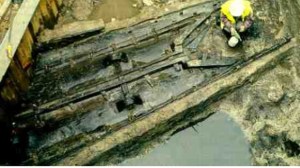
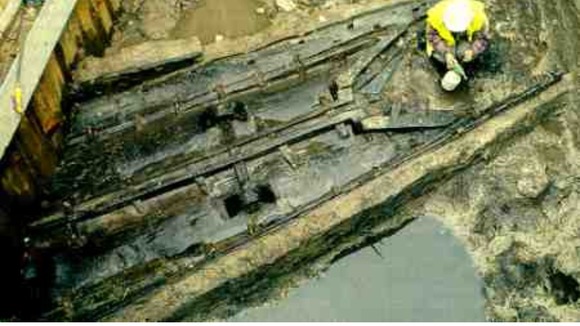
The Dover Boat after it was discovered in 1992 Photo: Dover Museum

The Dover Boat after it was discovered in 1992 Photo: Dover Museum

There would have been countless others like it of course but they have not survived. Built from planks of oak, stiched together with pieces of yew. Certainly not meant to last thousands of years, which is why the vast majority have disappeared.

So to have found one – or at least seventy per cent of one – and to have preserved and displayed it is nothing short of miraculous. There are boats or fragments of boats which may well be older; the Abydos fleet of Egypt for example or the pine canoes of China’s Zhejiang province. And wood found off the Hampshire coast at Hayling Island in the late 1990s has been carbon dated to 7,000 years ago.

What makes Dover’s boat special though is that so much of it can still be seen and appreciated thanks to a huge rescue and conservation effort.

When it was first discovered during roadworks in Dover town centre it stunned archaeologists. But every hour the timbers were exposed it was effectively rotting away. And so teams of historians and archaeologists swung into action by the roadside. The boat was cut into sections, measured, recorded and cleaned. The bits were taken to a shed in Dover Harbour where they were kept wet in large and hastily-constructed water tanks. Later the ancient wood was strengthened using liquid wax, freeze-dried at the Mary Rose Trust in Portsmouth and finally put back together using an adjustable crane.
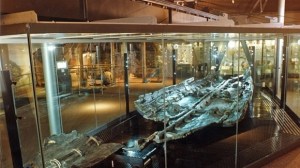
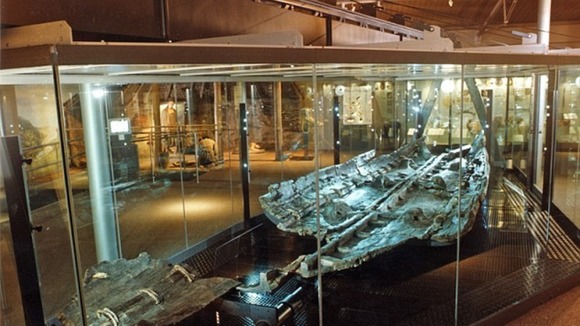
The preserved Bronze Age Boat in Dover Museum Credit: Dover Museum

The preserved Bronze Age Boat in Dover Museum Credit: Dover Museum

The Dover Boat is one of Britain’s great under-appreciated ancient artefacts.

Older than the Roman Empire. Older than Moses. It would have been in the water at the same time Stonehenge was in use. That’s about 1500 BC – 3,500 years ago.

There would have been countless others like it of course but they have not survived. Built from planks of oak, stiched together with pieces of yew. Certainly not meant to last thousands of years, which is why the vast majority have disappeared.

So to have found one – or at least seventy per cent of one – and to have preserved and displayed it is nothing short of miraculous. There are boats or fragments of boats which may well be older; the Abydos fleet of Egypt for example or the pine canoes of China’s Zhejiang province. And wood found off the Hampshire coast at Hayling Island in the late 1990s has been carbon dated to 7,000 years ago.

What makes Dover’s boat special though is that so much of it can still be seen and appreciated thanks to a huge rescue and conservation effort.

When it was first discovered during roadworks in Dover town centre it stunned archaeologists. But every hour the timbers were exposed it was effectively rotting away. And so teams of historians and archaeologists swung into action by the roadside. The boat was cut into sections, measured, recorded and cleaned. The bits were taken to a shed in Dover Harbour where they were kept wet in large and hastily-constructed water tanks. Later the ancient wood was strengthened using liquid wax, freeze-dried at the Mary Rose Trust in Portsmouth and finally put back together using an adjustable crane.

Then came another battle – to keep the Dover Boat where it belonged. A world-famous museum was said to have bid for it but had the idea of keeping it in pieces. In the end there was a massive fund-raising initiative and a great gallery was built in Dover Museum with a sealed glass chamber that now keeps the precious object safe in perpetuity.

And all the time historians have been looking at it, examining it, working out how it was built.

Seeing how it would have been hewn from the timbers of mighty trees that would have grown all the way down to the shoreline back then.

Seeing how it would not have had a sail, perhaps not even a rudder. Difficult to tell because the back of the boat is missing.

Seeing how it would have been rowed by about a dozen men using huge oars.

Maybe they wave-tested it off the Kent coast. Maybe it pootled upriver. Debate has raged over whether the Dover Boat was robust enough to have taken to the seas and therefore establish a claim to be one of the world’s oldest surviving seagoing vessels.

It or something like it would surely have rowed along the coast of Southern Britain, hugging the coastline in case it shipped too much water. How can we say that? What evidence do we have to back this up?

Well there are artefacts found in Dover from this time period from as far away as Dorset. Logical to think of them having been brought by sea rather than carried overland in what would have been a cumbersome and time-consuming journey.

And so above and beyond all the theories about why and how our boat was built emerges a tantalising possibility.

That it was put together by people who did not just have skills passed down over a few generations, but boat-building knowledge accrued in their communities over hundreds if not thousands of years.

That something very similar to our rickety-looking, oak-planked, yew-stitched craft was crossing the English Channel and also the oceans way back in Stone Age times.

Imagine what light that would cast on our knowledge of the spread and dispersment of peoples, societies, cultures, even entire civilisations, in that yawning chasm of time before recorded history.

The Dover Boat is that significant. A rare treasure.

Article from ITV News: http://www.itv.com/news/meridian/2012-05-12/dover-boat-personal-view/

The Best Guided Tours in British History
HisTOURies UK 
Go rambling around England with your little ones, on these 10 buggy friendly walks, selected by Richard Happer from his new book Beautiful Buggy Walks: England

Avebury, Wiltshire

Avebury

Avebury

Strolling through an ancient stone circle is just the start of this adventure. Avebury’s fine historical monument also forms the hub of a cracking day’s countryside wandering. Avebury is the world’s biggest stone circle – so large it has a whole village in its centre – but it doesn’t attract the huge numbers that Stonehenge does. This walk introduces you to the circle via West Kennet Avenue, a ceremonial approach that originally had 100 pairs of stones. It’s half a mile long and still impressive. People can wander freely among the ancient monoliths, unlike Stonehenge. Tourists touch them, kids lean on them and wild-bearded men in rainbow trousers do yoga beneath them. Our tour concludes with a relaxing stretch through the surrounding fields.

OS map: Explorer 157
How far: about 3 miles
Route: Enter the field to the west of the parking area.

• Walk between the stones up West Kennet Avenue.

• When the road to your right joins the main road, cross the smaller road and walk past the trees to the embankment that runs around the ditch.

• Follow the path on top to your right. When you reach a small road, cross it and continue around the circle.

• At the main road follow the path in, towards the centre of the circle, cross the road and take the path out and around the next sector of the circle.

• Detour to your right to visit the café and visitor centre.

• Join the minor road in the village and walk west to east, right through the circle, passing the pub and the point at which you crossed the road earlier.

• You are now walking away from the circle, down a country lane; continue for 1/2 mile, passing Manor Farm, then turn right, down a byway.

• After 1/2 mile, turn right along the edge of a fi eld. Another 1/2 mile will take you back to the start.

Rest and refresh: The Red Lion pub has outdoor space (01672 539266, red-lion-pub-avebury.co.uk). The National Trust visitor centre has a spacious cafe with outside benches. Visitor centre: 01672 539250,nationaltrust.org.uk/avebury

Article Source and more walks:http://www.guardian.co.uk/travel/2012/may/06/buggy-walks-family-holidays-england 

 HisTOURies UK –www.Histouries.co.uk
Mystical Landscape, Magical tours

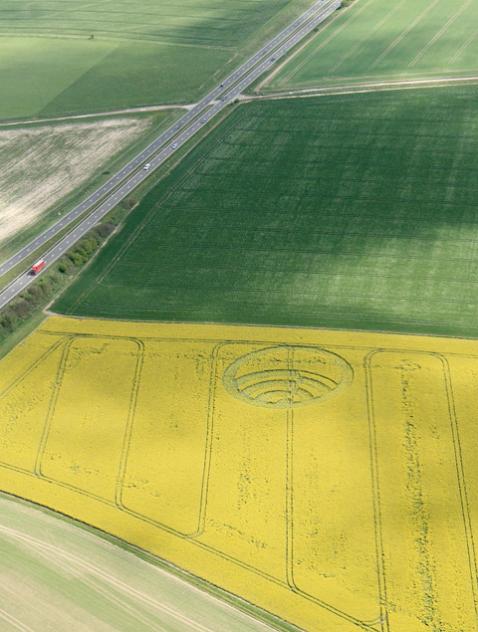
The weather may be more like November than May but the first crop circles have appeared in Wiltshire fields.Wilshire Crop Circle 2012

The first one was reported on April 15 at Hill Barn, near East Kennett in oil seed rape but a more striking one is currently visible, also in oil seed rape, also known as canola, at Yarnbury Castle  near Winterbourne Stoke.

This one was reported on April 28. It will be interesting to see how drier weather and more prolific crops affect the number of formations that appear over the next three months.

Mystical Landscape, Magical Tours