Feeds:
Posts
Comments

London Olympics

The Worlds gone mad…………………..
The ‘quango’ VisitBritain has issued a guide book aimed at the British on how to treat overseas visitors during the Olympics.  Unbelievable ???
Please take the time to read some of the advice below, this is not one of my hoax blogs – its completely true!  The ironic thing is that VisitBritain is staffed with ‘non Brits’………………
If you happen to meet a Mexican during the 2012 Olympics, don’t mention the war – that is just one of the pieces of advice being given to Brits on how to treat foreign visitors during the Games.
The war in question is the 1845-6 war with the United States. Instead you should try talking about Mexican art or museums.
 They have been written by the agency’s staff, who are natives of the countries featured.

Britain is ranked 14th out of 50 when it comes to the welcome it gives to foreign visitors, but some wish they had received a more exuberant welcome from their hosts.

The comprehensive catalogue of cultural norms and traditions should ensure that you do not unwittingly offend any guests – or feel slighted because of a lack of understanding.

For example, the advice says that you should never call a Canadian an American.

Similarly, steer clear of physical contact when meeting someone from India for the first time.

Pouring wine for an Argentinean may seem to be an innocuous enough task, but it is in fact a cultural minefield – pouring it backwards represents hostility.

 When Japanese people smile they may not be happy, in fact they could be the complete opposite.

 Talking to them with your hands in your pockets will cause offence.

Remember Arabs are not used to being told what to do.


VisitBritain advice


 Sandie Dawe MBE, CEO of VisitBritain, said making visitors to Britain feel welcome was “absolutely vital” for the UK economy.

 She said: ”Overseas visitors spend more than £16bn a year in Britain, contributing massively to our economy and supporting jobs across the country.”

She added: “With hundreds of thousands of people thinking of coming to Britain in the run up to the Olympic and Paralympic Games in 2012, this new advice is just one of the ways that VisitBritain is helping the tourism industry care for their customers – wherever they come from.”

 Other pieces of advice include:

:: Winking is considered a rude gesture in Hong Kong.

 :: The Chinese are very suspicious – talking about poverty, failure or death could cause offence.

:: Visitors from the United Arab Emirates don’t take kindly to being bossed around.

:: When accepting thanks, Koreans will typically say “No, no.” The remark should be interpreted as “You are welcome”.

:: The term “Poms”, which is used by Australians and New Zealanders, is a term of endearment, rather than a insult.

:: Snapping your fingers in the presence of a Belgian is regarded as impolite.

:: Do not imply that Polish people drink too much.

 For those visiting London and the UK during the Olympics 2012 remember to book well in advance, we already have private tours booked for the summer of 2012. 

Personalised tours of  London and Britain
HisTOURies UK – The Best Tours during the London Olympics

First sighting of Perseids in Wiltshire

Perseids

The Perseids are particles left in the wake of the Swift-Tuttle comet

A Wiltshire man was startled to see a bright light in the sky travelling fast on Saturday 7 August.

Daniel Hodder from Salisbury was travelling along the A303 when he spotted the object.

He said: “We saw an enormous light in the sky north of Amesbury. We could only assume it was a meteorite.

“It was a very bright, white and blue light moving incredibly fast to our right-hand side, there was a long stream, a long tail of about 400 or 500 metres.”

Andy Burns from the Wiltshire Astronomical Society had a straightforward explanation for what Daniel and several other people witnessed on the day.

He said: “What has been seen is a meteor, not a meteorite. A meteorite actually lands on the earth and is a lump of rock or stone that you can pick up. A meteor is a stone in the atmosphere that burns up.

“What we are seeing is the beginnings of the Perseids meteor shower. This tallies with the very bright fireball that has been seen in the north. You don’t need a telescope to see this type of phenomenon, you can see it with the naked eye.”

Daniel Hodder from Salisbury spotted the Perseids on Saturday 7 August

The Perseids are visible between 23 July and 22 August every year, but peak activity is expected on the nights of 12 and 13 August with around 80 meteors per hour.

Like most meteor showers, the Perseids can be traced to the orbit of a comet, in this case that of Swift-Tuttle.

The meteors consist of dust-sized particles which burn up on entering the Earth’s atmosphere, at an altitude of 60 to 70 miles, as the Earth passes through the trail left by the comet.

It’s consistently impressive display can be traced as far back as 36AD when Chinese astronomers noted high numbers of meteors.

The best way to observe them is to look towards the northeast after dark. They appear to originate from the constellation of Perseus, which at midnight lies just below the easily recognisable ‘W’ of Cassiopeia.

The highest frequency of meteors is likely just after midnight but with the moon, just past full, the best time to look for the ‘shooting stars’ will be between 9:00pm and 10:00pm when the moon is still low.

The chalk downland of Salisbury Plain near Stonehenge was named by the National Trust in 2009 as one of the seven best places in the UK to witness the Perseids.

They consider that light pollution in towns and cities has increased so much in recent years, that the countryside is the perfect environment to witness such astronomical spectacles as the Perseids.

Stonehenge has been voted the best place to witnes this meteor shower

Stonehenge Tour Guide
HisTOURies UK – The Best Tours of Stonehenge and Wiltshire

It is cramped, draughty and unlikely to win any design awards. But, according to archaeologists, this wooden hut is one of the most important buildings ever created in Britain.

The newly discovered circular structure – as shown in our artist’s impression – is the country’s oldest known home.

Built more than 6,000 years before Stonehenge, it provided shelter from the icy winds and storms that battered the nomadic hunters roaming Britain at the end of the last ice age.

Ancient find: Manchester University student Ruth Whyte on the archaelogical dig in Flixton near Scarborough which has unearthed an 11,000 year old tree and remainsAncient find: Manchester University student Ruth Whyte on the archaelogical dig in Flixton near Scarborough which has unearthed an 11,000 year old tree and remains

Pictures from the dig where archaeologists believe that one of the first houses in Britain may have been buriedPictures from the dig where archaeologists believe that one of the first houses in Britain may have been buried

The remains of the 11ft-wide building, discovered near Scarborough, North Yorkshire, have been dated to at least 8,500BC. It stood next to an ancient lake and close to the remains of a wooden quayside.

Dr Chantal Conneller, from the University of Manchester, said it was between 500 and 1,000 years older than the previous record holder, a building found at Howick, Northumberland.

‘This changes our ideas of the lives of the first settlers to move back into Britain after the end of the last ice age,’ she said. ‘We used to think they moved around a lot and left little evidence.

‘Now we know they built large structures and were very attached to particular places in the landscape.’

None of the wood used to make the building has survived. Instead, archaeologists found the tell-tale signs of 18 timber posts, arranged in a circle. The centre of the structure had been hollowed out and filled with organic material.

STONEAGE HOUSESTONEAGE HOUSE

The researchers believe the floor was once carpeted with a layer of reeds, moss or grasses and that there may have been a fireplace.

Dr Conneller said the hut was used for at least 200 to 500 years – and may have been abandoned for long stretches.

‘We don’t know much about it and we don’t know what it was used for,’ she said. ‘It might have been a domestic structure, although you could only fit three or four people in it. It could have been a form of ritual structure because there is evidence of ritual activity on the site.’

Previous archaeological digs have unearthed head-dresses made from deer skulls close to the hut, along with remains of flints, the paddle of a boat, antler tools, fish hooks and beads.

Archaeologists have been excavating at the Mesolithic site Star Carr since 2003 Archaeologists have been excavating at the Mesolithic site Star Carr since 2003

The researchers also found a large wooden platform alongside the ancient – and long vanished – lake at Star Carr. It was made from timbers which were split and hewn.

The platform, which may have been a quay, is the earliest evidence of carpentry in Europe. At the time, Britain was connected to the rest of Europe. The occupiers of the hut were nomads who migrated from an area now under the North Sea to hunt deer, wild boar, elk and wild cattle.

Dr Nicky Milner, from the University of York, said: ‘This is a sensational discovery and tells us so much about the people who lived at this time.

‘From this excavation, we gain a vivid picture of how these people lived. For example, it looks like the house may have been rebuilt at various stages.

The ancient Star Carr site is located not far from the Yorkshire town of ScarboroughThe ancient Star Carr site is located not far from the Yorkshire town of Scarborough


‘It is also likely there was more than one house and lots of people lived here. And the artefacts of antler, particularly the antler headdresses, are intriguing, as they suggest ritual activities.’

Although Britain had been visited by hunter-gatherers for hundreds of thousands of years, it was only at the end of the last ice age, when the glaciers finally retreated from Scotland, that the country became permanently occupied.

Thousands of miles away, in the ‘Fertile Crescent’ of Mesopotamia, the earliest farmers were learning how to sow seeds and domesticate animals in a discovery that would transform the world – and herald the age of villages, writing and civilisation.

But in northern Europe, the hunter-gatherer way of life that had served prehistoric man for millennia remained unchallenged.


A depiction of a stone-age house in Ireland.A depiction of a stone-age house in Ireland. The original building at Star Carr would have looked very similar to this, with thatched roof and circular shape

Salisbury and Stonehenge Tour Guide
HisTOURies UK – The Best Tours in British History


War Horse
is a film that Steven Spielberg announced plans for production. War Horse is intended for release in 2011. It will be the film version of the play of the same name, which is a stage adaptation of the book War Horse, a children’s fiction novel by Michael Morpurgo first published in Great Britain in 1982.

OSCAR-winning actor Sir Anthony Hopkins is set to shoot scenes for his latest film in Castle Combe and Lacock this Autumn.

Hollywood film crews have approached both village parish councils after finding perfect locations for the remake of the 1941 horror flick The Wolfman.

The news comes just months after the penultimate Harry Potter movie was filmed in Lacock.

Chairman of the Lacock Tenants Association Leo Stevens attended a meeting with 50 residents last Tuesday.

He said: “The general reaction was positive and people seemed interested in getting involved with the project.

“As long as the filmmakers take our needs into consideration I think everything will go smoothly.

“I am involved with the project and am tracking down a blacksmiths for them to use in the movie.

“Filming in Lacock has just become an ordinary event these days and people don’t really batter an eyelid when a famous actor crosses the path in front of them.

“We are just waiting for more details from the production company and then we can move forward.”

The production company, part of Universal Pictures, is keen to use the Tithe Barn as the main location and possibly some shots of the High Street.

They want to fill the inside of the barn with blocks of ice, to resemble an ice house, used in the nineteenth century to store dead bodies.

The period film follows the life of Laurence Talbot, a successful actor, who returns to his hometown after his brother goes missing amid rumours of werewolves.

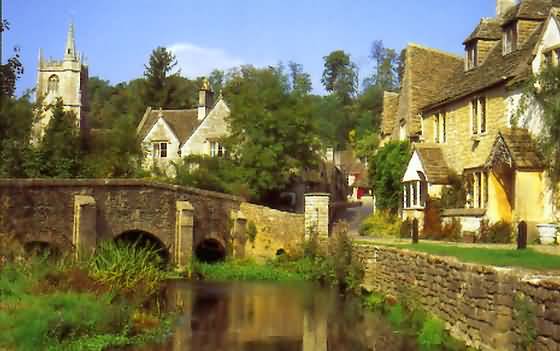
Film crews were also keen to shoot some scenes in Castle Combe, which is still reeling from its Hollywood debut in Stardust last year.

Jean Sheard, who owns the Lacock bakery on Church Street said: “I am really excited about seeing Sir Anthony Hopkins – he is such a huge star.

Lets hope we dont have a repeat of previous holywood films ?
Castle Combe never recovered from its engineered fame. In 1966 it was occupied for three months by a film company making Dr Dolittle with Rex Harrison, Samantha Eggar and Anthony Newley. Men with loud voices and earth-moving equipment built a harbour below Castle Combe’s bridge and made everyone take down their television aerials and link their sets to a communal cable attached to a hidden mast during the filming

Filming starts in September and we will continue to take small group tours to Castle Combe and Lacock – a great phot opportunity.

Cotswolds Tour Guide
HisTOURies UK – The Best Tours in History

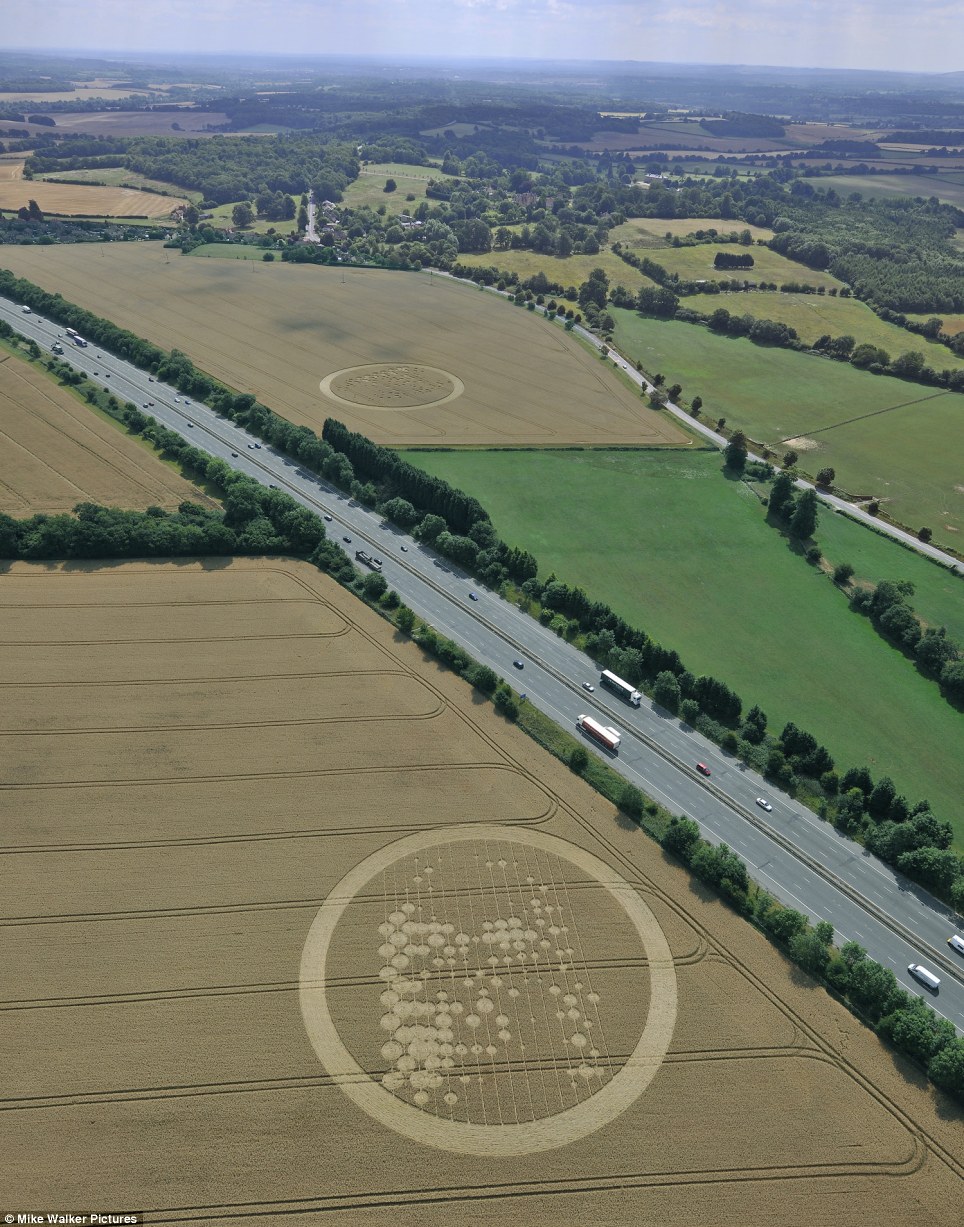
Drivers speed along one of Britain’s busiest motorways completely oblivious to the Holy presence that surrounds them.
Crop Circle
For two crop circles depicting the face of Jesus Christ have appeared on either side of the M4 near Hungerford in Berkshire.
The two almost identical circles, both 250ft in diameter, seem to portray Jesus Christ in an image resembling the world famous Shroud of Turin.

The two crop circles in fields of wheat either side of the M4 near Hungerford, Berkshire, both resemble the face of Jesus Christ in the world famous Shroud of Turin

The Shroud of Turin is believed by many to be the cloth used to cover Christ at the time of his burial and the face on the shroud is believed to be the face of Jesus himself.
Crop circle expert, Karen Alexander, said: ‘These circles are causing quite a stir in the crop circle community. The last time a face appeared as a crop circle was in 2002 when an alien face appeared at Sparsholt in Hampshire. Farmers whose land is used to make the circles worry that they will be inundated with visitors seeking a religious experience.’
But with the Harvest Festival approaching, they may regard the crops in the fields of wheat as a good omen.

Crop Circle Tour Guide
HisTOURies UK – The Best Tours in Wessex

For the ‘Monty Python’ fans……………………
This scene still bring tears to my eyes.
Life of Brian
(1979) (aka Monty Python’s Life of Brian) is a satirical film by the Monty Python comedy troupe about a man who is born at the same time as (and next door to) Jesus, and whose life parallels his.

 Reg: What Jesus blatantly fails to appreciate is that it’s the meek who are the problem.

Reg: But apart from the sanitation, the medicine, education, wine, public order, irrigation, roads, the fresh-water system, and public health, what have the Romans ever done for us?


Hope you enjoyed as much as I did.

British Tour Guide
HisTOURies UK – The Best Tours in Roman History
Stonehenge - a wooden neighbour has been discovered
 Stonehenge – a wooden neighbour has been discovered

Stonehenge had a previously unknown wooden “twin” just 900m to its north-west, according to remarkable new archaeological investigations.

Using the ground-penetrating equivalent of an X-ray, scientists have discovered what appears to have been a circle of massive timber obelisks, constructed more than 4,200 years ago.

The newly discovered “henge” would have been visible from Stonehenge itself – and seems to have been part of a wider prehistoric ritual and religious landscape. Roughly 25m in diameter, it was almost the same size as the central part (the circle of standing stones) at Stonehenge itself.
The newly discovered monument – almost certainly some sort of Neolithic temple – is thought to have consisted of 24 wooden obelisks, each around 75cm in diameter and therefore potentially up to 8m high. The circle of obelisks was enclosed by an inner ditch and probable outer bank.

 Of potential significance is the fact that the newly found henge “mirrors” a similar monument (this time long known to archaeologists) on the other side of Stonehenge – 1,300m south-east of the famous monument. Like the newly discovered site, it is in direct line of sight of Stonehenge and had two entrances. All three monuments would have been roughly aligned.

 The discovery of the site north-west of the stone circle suggests that the Stonehenge landscape was even more complex than people have thought – and archaeologists are now keen to find further unknown elements of it.

The archaeologists – from Birmingham, Bradford, St Andrews and Vienna Universities – are trying to map the unknown aspects of the Stonehenge landscape without digging a single hole.

Instead of conventional excavations, they are using X-ray-style systems which look beneath the ground surface. The techniques – including magnetometry, ground-penetrating radar, electrical imaging and resistivity – are likely to yield huge amounts of previously unknown information about what the Stonehenge landscape looked like 40 to 50 centuries ago.

 Over the next four years the survey, led by Professor Vince Gaffney of Birmingham University’s Institute of Archaeology and Antiquity, is likely to produce hundreds of millions of pieces of information from 14 sq km of countryside which will then be collated and analysed to produce a detailed map.  “Some 90 per cent of the Stonehenge landscape is still terra incognita. Our survey will hopefully begin to remedy our current lack of knowledge,” explained Professor Gaffney. “The discovery will significantly change the way we think about the landscape around Stonehenge.”

 The newly discovered prehistoric temple was found using the subsurface archaeological detection system known as magnetometry, which measures the differences in interaction with the Earth’s magnetic field produced by different layers or deposits of earth or rock.

 Detecting variations in the strength of the magnetic field revealed the existence of the enclosure ditches and the pits believed to have held the timber obelisks at the newly discovered henge.

 Stonehenge Tourist Guide
HisTOURies UK – Stonehenge Guided Sightseeing Trips

Salisbury Museum is based in the King’s House, a grade I listed building located opposite Salisbury Cathedral. We have a small but friendly staff, supported by over 100 volunteers. We offer a variety of services, including the opportunity to hire this unique location for corporate events and activities.

About the Museum

About SAlisbury MuseumThe Museum is located in the King’s House, situated in the glorious setting of the Cathedral Close. The King’s House is a Grade I listed building, the history of which stretches back to the 13th Century. It formerly housed a teacher training college and was the inspiration for an episode in Thomas Hardy’s novel Jude the Obscure.

The main strength of the Museum rests in its archaeological collections: these include prehistoric material from South Wiltshire, including Stonehenge; the Pitt Rivers’ Wessex collection; and a fine medieval collection including finds from Old Sarum, Clarendon Palace and the city itself. In addition we have fascinating displays of costume and ceramics, and regular temporary exhibitions.

The Museum is a limited liability company (no. 1826436) and a registered charity (no. 289850). It is Accredited by the Museums, Libraries and Archives Council (no. 878). Its archaeological collections in particular are of national significance and they received Department for Culture, Media and Sport Designated status in 1998.

Salisbury Museum receives some funding from Wiltshire Council, but most of our income derives from a variety of other sources including admission charges, membership, donations and legacies.

The Museum’s mission is to provide a creative and responsive museum, which collects, preserves and presents objects and information of significance relating to the past of Salisbury and south Wiltshire.

Its purpose is to encourage learning, research, publication and enjoyment of its collections, seeking to do this in a professional, friendly and stimulating way. It aims to provide a lively service for the benefit of the whole community within Salisbury and south Wiltshire, as well as for students, scholars, and visitors from this country and around the world.

Whats on2010:

07 Aug 2010 – 14 Aug 2010 Medieval Hats, Masks and Shields Lecture Hall For Families
10 Aug 2010 Art Day – Gorgeous Georgians Lecture Hall For Families
17 Aug 2010 Science Day – Build a Sun Dial Lecture Hall For Families
20 Aug 2010 Make a Mosaic Meetings Room For Families
22 Aug 2010 Romeo and Juliet: Illyria Theatre Company Back Garden Plays
24 Aug 2010 Art Day – Scrap Animals Lecture Hall For Families
31 Aug 2010 Science Day – Design a Wind Sock Lecture Hall For Families
14 Sep 2010 Surveying Historic Buildings: the changing techniques and use of 3d imagery in building recording Lecture Hall Lectures
02 Oct 2010 – 03 Oct 2010 Conference: 150 Years of Salisbury Museum Lecture Hall Events
06 Oct 2010 – 24 Nov 2010 Medieval Life: a series of lectures by Nick Griffiths Lecture Hall Courses
07 Oct 2010 ‘A History of his Affections’: The importance of Salisbury in the wider context of Constable’s art Lecture Hall Lectures
12 Oct 2010 A Day in the Life: a Master Gunner on the Mary Rose Lecture Hall Lectures
20 Oct 2010 – 15 Jan 2011 Walls of Sound Major Exhibition Galleries Exhibitions
20 Oct 2010 Organised Chaos, a series of cock-ups in Royal and Military events Lecture Hall Lectures
03 Nov 2010 SARUM, the Inspiration of Salisbury Lecture Hall Lectures
09 Nov 2010 Collingbourne Ducis – Update Lecture Hall Lectures
17 Nov 2010 Clarendon Lecture Hall Lectures
14 Dec 2010 Bodies from the Bog: what science has told us about the bog people Lecture Hall Lectures

Whilst visiting Salisbury please take the time to visit the Salisbury Museum.

Stonehenge and Salisbury Tour Guide
HisTOURies UK – The Best Tours in Wiltshire

For those who have been on tour with me recently talking about the mysterious ‘warminster triangle’ – thought you may find this intersesting.  Watch this –  Pie in the Sky, a BBC TV programme from 1966 presented by Kenneth Hudson, which investigated the mysterious objects seen above Warminster

Warminster’s long and controversial UFO history began early on Christmas Day, 1964.

Arthur Shuttlewood reported in his book The Warminster Mystery: “The air was brazenly filled with a menacing sound.

“Sudden vibrations came overhead, chilling in intensity.

“They tore the quiet atmosphere to raucous rags and descended upon her savagely. Shockwaves pounded at her head, neck and shoulders.”

Other such “sonic attacks” which occurred at around the same time in different locations around the town were later reported. Shuttlewood, at the time was the features editor on the local weekly newspaper, The Warminster Journal.

Within weeks, the floodgates opened, and the phenomenon was christened “The thing” by the locals, as no one had actually seen anything that could be attributed to the cause. The townsfolk had never heard of UFOs or ‘flying saucers’ at the time.

Strange objects

By June 1965, strange objects were being seen in the skies around the town. Shuttlewood amassed a sizable file on these sightings, and it was not until September, 1965, when he reported seeing a UFO from his home, that he became a believer in the enigma.

Shuttlewood soon became the voice and champion of The Warminster mystery.

Gordon Faulkner's Warminster 'UFO' photo

The iconic image of Warminster’s UFO was taken by Gordon Faulkner in 1965

Some students of the Warminster enigma believe that Shuttlewood became so immersed in the whole concept, that logic went out of the window as far as he was concerned.

The iconic image of Warminster’s UFO activity is a photograph, taken by Gordon Faulkner in 1965. It shows a typical ‘flying saucer’, which is so enlarged that the grain of the film emulsion is clearly visible.

Faulkner handed the picture to Shuttlewood, and told the reporter to “do as he seemed fit with it”.

Shuttlewood handed it to the Daily Mirror. It was printed in the paper on 10 September 1965. It gained the town a vast amount of publicity, and some would say, notoriety.

Within weeks, thousands of people began to converge on the town to see this strange phenomenon for themselves. Such was the concern of the local populace, that a public meeting was held in the town over the August Bank Holiday.

Pie in the Sky

BBC West filmed a half-hour documentary in 1966, entitled Pie in the Sky. Of all the programmes made about the town, this is by far the most level and fair.

Shuttlewood was by now contemplating writing a book on the events in the town. The Warminster Mystery was published in 1967 by Neville Spearman, followed a year later by Warnings from Flying Friends, which was self-published by Shuttlewood.

Sightings of “The thing” continued, but, by the early 1970s, they were beginning to decline.

This was partly due to Warminster being old news, and the numbers of sky-watchers on the hill dropped due in main to lack of nationwide publicity.

Arthur Shuttlewood

Arthur Shuttlewood was Features Editor for the Warminster Journal

A local UFO buff, Ken Rogers, began publishing The Warminster UFO newsletter in August, 1971.

Shuttlewood’s third book on the phenomenon was UFOs: Key to the New Age, which was published in 1971. This book, of all the titles written by Shuttlewood, is probably the most contentious of all. Shuttlewood’s own personal theories seem, by today’s standards to be quite absurd.

The Warminster UFO newsletter continued publication into 1973. Shuttlewood, it seems took a sabbatical from writing books for a number of years, but still took an active part in sky-watches and the local UFO scene.

In the same year, The Warminster mystery was published in paperback by Tandem books.

The Fountain Journal

Late in 1975, or early 1976 saw a new research centre open in the town. The Fountain Centre, located in Carlton Villa, Portway, was run by Peter and Jane Paget.

Along with Jane’s mother, Mrs Margaret Tedder-Shepperd, the Pagets renamed the property Star House with the intention of running not only a research facility in the town, but to offer bed and breakfast to sky-watchers who were visiting the town.

Another project they planned was the publication of The Fountain Journal, a bi-monthly magazine centred on the UFO sightings reported in and around the Warminster area.

Fountain Journal

In the 1970s, a magazine about UFO sightings in the area was published

Shuttlewood joined the editorial team early on, before the publication of issue one.

The first three issues, which were edited by the Pagets, Mrs Tedder-Shepherd and Arthur Shuttlewood, contained much more information on the local UFO scene than later issues.

This was in part due to the input of Shuttlewood himself, until he had a protracted period of ill-health.

Shuttlewood bowed out, and at around the same time, The Flying Saucerers, was published in November 1976.

Mrs Tedder-Shepherd, who was a co-owner of the centre and had a 50% stake in the property, withdrew her support, leaving the Pagets to continue to run the centre with rapidly dwindling funds.

With mounting pressures on them and the local UFO researchers becoming more hostile towards the Fountain Centre, the publication of the Fountain Journal became more sporadic. Issue 11, dated only 1977, was the last to be published.

Another research group, UFO – Info, had set up in the town. This new group, which, unlike the Fountain Centre, was run and staffed by unpaid volunteers.

Shuttlewood had two further books published in the late 1970s – UFO Magic in Motion, and his final book, More UFOs over Warminster in 1979.

Arthur Shuttlewood died in Warminster in 1996. With his death, the last lingering memories slowly faded away.

Warminster enigma

So what does the future hold for Warminster and its rich and diverse UFO history? Warminster will always remain an enigma. It is now largely forgotten in the annals of British UFO history.

Whether Warminster was a cultural/social event or a genuine Ufocal, far too much time has now passed for any accurate investigations to be made.

One thing is certain however. Despite all the new research into the phenomena in this quiet Wiltshire town all I can say is this: something strange did happen there. I know. For a time, I was part of it.

For more information visit Kevin Goodman’s UFO Warminster website.~

Stonehenge Tour Guide
HisTOURies UK – The most mysterious tours in Wiltshire (Ha, ha)

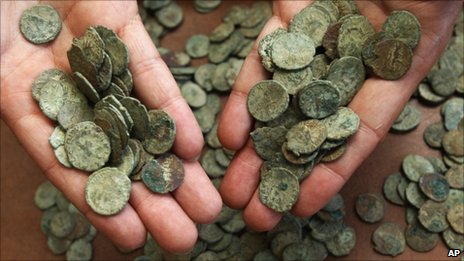
About 53,000 coins were found buried in a field in Somerset

A hoard of more than 52,500 Roman coins discovered in a Somerset field has been declared treasure.

Dave Crisp, from Wiltshire, found the coins – dating from the 3rd Century AD – in April buried near Frome.

“I’ve been metal detecting since 1988 and it’s the most exciting and important find I’ve made,” he said.

A British Museum spokesman said the 160kg find was the largest single coin haul found in one pot and was probably intended as a religious offering.

Most of the coins, which are made from debased silver or bronze, are currently at the British Museum in London and includes examples from AD286 to 293 during the reign of Carausius who was the first Roman emperor to strike coins in Britain.

A small selection has gone on display at Frome Library.

Mr Crisp had earlier found a hoard of 60 silver coins in the same field before he discovered the larger pot of coins.
The coins date from the 3rd Century AD

That find was also declared treasure earlier.

Somerset County Council Heritage Service can buy the treasure for the Museum of Somerset, which is due to reopen in 2011, under the Treasure Act.

Following the ruling by East Somerset coroner Tony Williams, Mr Crisp, who works as a chef in the NHS, said: “It was a foregone conclusion that treasure would be declared today.”

He said he did not know what reward he was going to get, but would split whatever he did get equally with the farmer who owned the land according to their agreement and the law.

It has been suggested the reward could be up to £1m.

When asked how a share of the money would change his life, Mr Crisp said he did not know but added: “I’m coming up for retirement… I’ll work until I’m 65 then I’ll see.”

He added it was not the money that mattered.

“This is what matters, I’m the finder of the largest single hoard of Roman coins ever.

“I’ll always be the finder, unless someone beats me of course. There are a lot more pots out there.”

The landowner, whose surname is not being released to deter further treasure hunters, said: “I have always loved history but I never expected anything as important, exciting or old as this to be found on my land.”

WHAT IS TREASURE TROVE?

  • Where the owner of a find cannot be traced, it normally belongs to the landowner but anything declared “treasure” belongs to the Crown
  • Anyone making find that could be treasure must report it to a coroner
  • An inquest will then determine its status
  • Treasure must be at least 300 years old
  • Once something is declared treasure, the finder may be able to keep it, or an institution, such as the British Museum, may buy it
  • Objects are not treasure if their owners can be traced or if they are found on the shore but do not come from a shipwreck

  • In pictures: Roman coin hoard
  • A British Museum spokesman said the Treasure Valuation Committee would recommend a value for the hoard in October, which would be paid out when the finder, landowner and museum agreed with the valuation.

    Anna Booth, from the Portable Antiquities Scheme (PAS), said of the reward: “It will be fairly substantial but how substantial, we don’t know.

    “If they find lots of rare coins, the price could go up. It won’t be millions, but beyond that it is hard to speculate.

    “Once it has been evaluated, the British Museum will be given a chance to acquire it. If not, the local museum will have it.

    “The British Museum has already said it hopes the find will be acquired by the Museum of Somerset.

    “We are now going to be on a fundraising drive to get the money.”

    • The story of the excavation will be told in a new BBC Two archaeology series, Digging for Britain, presented by Dr Alice Roberts and made by 360production, to be broadcast in August.

      British Tour Guide
      HisTOURies UK – The Best Tours in Histoy